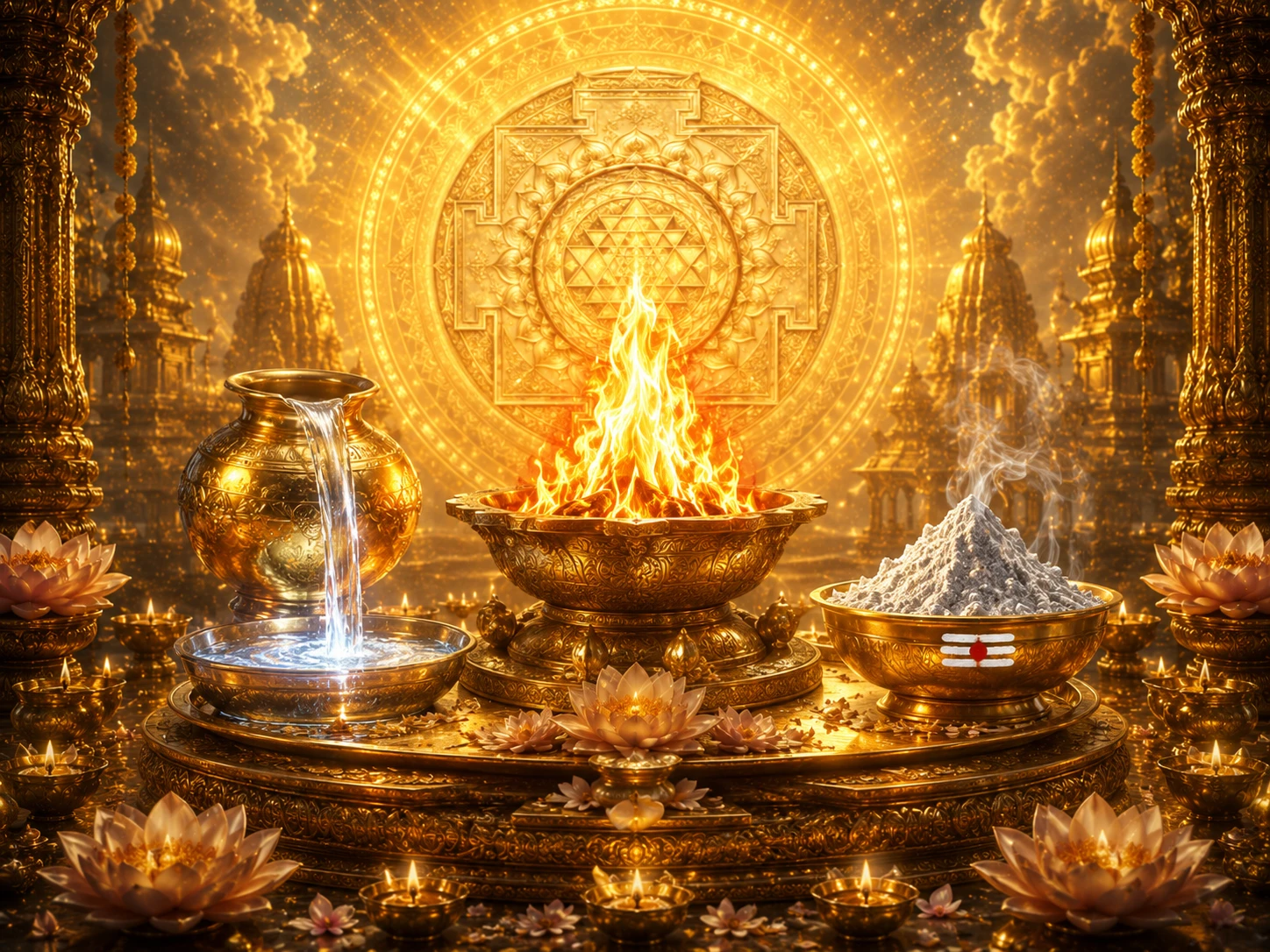
Fire, Water, and Ash -- The Three Substances of Hindu Ritual
अग्नि, जल और भस्म -- हिन्दू अनुष्ठान के तीन द्रव्य
Three Substances You Have Already Touched
Think about the last Hindu ritual you attended. A wedding mandap in Pune, a satyanarayan puja in your aunt's flat in Mumbai, an aarti at the Mahalakshmi temple before exam results, a havan organised at your office on the day you launched a new product. Look at what was actually present in the room, what your hands actually touched. There were three substances. A flame, sometimes a small one in a deepak, sometimes a large one in a yajna kunda. A vessel of water, often a copper kalash, the priest taking sips of it from his palm before chanting. And a small mound of grey-white ash, applied to your forehead in three horizontal lines or a single smear, taken home as prasadam in a folded paper twist.
Fire, water, ash. Agni, jal, bhasma. These three substances appear in every Hindu ritual, from the smallest household evening lamp to the most elaborate ten-day vedic yagya at the Sringeri Sharada Peetham. Their consistency across two thousand years of Hindu practice is not accidental, and it is not redundant. Each substance does specific work, and the three together complete a logical sequence that no single substance could complete alone. The fire transforms. The water cleanses. The ash remains. Together they perform a compressed cosmology -- creation through transformation, sustenance through purification, dissolution that returns matter to its irreducible residue. A worshipper holding all three in turn is enacting, at room scale, the same arc the universe is said to perform at cosmic scale.
This article explains why these three substances and not others. The Hindu tradition could have settled on different ritual ingredients. Many traditions worldwide use water alone, or fire alone, or wine and bread, or incense and oil. The choice of fire-plus-water-plus-ash is specific to this tradition and carries a specific philosophical claim. Once you understand the claim, you stop reaching for the deepak absent-mindedly and start participating in a practice that has been kept alive, hand to hand, for longer than most modern nations have existed.
अग्निमीळे पुरोहितं यज्ञस्य देवमृत्विजम्। होतारं रत्नधातमम्॥
agnim ile purohitam yajnasya devam rtvijam hotaram ratna-dhatamam
I praise Agni, the family priest, the divine priest of the yajna, the invoker who is the most generous bestower of treasures.
— Rig Veda 1.1.1 (the very first verse of the Rig Veda, attributed to Rishi Madhuchchhandah Vaishvamitrah)
Agni -- The Messenger Between Worlds
It is not a small thing that the Rig Veda, the oldest text of the Hindu tradition and arguably one of the oldest religious documents in continuous use anywhere in the world, opens with a verse to fire. The Rishis could have begun with Indra, the king of the gods, with Vishnu, with Shiva-Rudra, with Surya. They began with Agni. The choice tells you something about how the early seers understood ritual technology. Without fire, no other deity can be reached.
In the Vedic sacrificial framework, Agni is not merely one deity among many. Agni is the messenger, the carrier of offerings between the human world and the world of the gods. When ghee is poured into the kunda and rises as smoke, the smoke is the offering's transport. The mantra svaha, chanted at the moment of pouring, is the technical word for the act of releasing the offering into Agni's care. Without Agni, the offering stays material. With Agni, the offering becomes presence in another world. This is why every Vedic ritual, regardless of which deity is being invoked, requires fire as its operating medium. You can have a Lakshmi puja or a Kali puja or a Ganesha puja, but you cannot have any of these without lighting a flame first.
The modern parallel that captures this best is the network protocol. When you open a Zomato app at midnight in Bengaluru and order biryani, the order does not levitate to the restaurant. It is carried by an internet protocol stack -- specific software that translates your tap into packets, routes them, delivers them, and brings back a confirmation. Agni performs the same function for the older ritual technology. The flame is the protocol layer. Whatever the application -- prayer, blessing, request, gratitude -- it has to ride on the underlying transport. This is why a Hindu home, even a modern one in a Gurgaon high-rise where the puja room is a small cabinet, will keep one small lamp lit during sandhya. The protocol must remain available for any application to run.
The Three Substances and Their Distinct Roles
| Substance | Sanskrit | Function | Cosmic Mapping | Daily Use |
|---|---|---|---|---|
| Fire | अग्नि (Agni) | Transformation, transport, witness | Creation principle; messenger between worlds | Deepak, aarti, havan, marriage saptapadi |
| Water | जल (Jal) | Purification, intent-setting, dissolution of impurity | Sustenance principle; the cleansing flow that connects all forms | Achaman before puja, abhishek, ganga jal, tirtha |
| Ash | भस्म (Bhasma) | Memorial of impermanence, residue of yajna, marker of devotion | Dissolution principle; what remains when fire has done its work | Tripundra on forehead, vibhuti prasadam, post-yajna distribution |
| The Three Together | त्रिविधा (Trividha) | Complete ritual sequence | Creation, sustenance, dissolution in three substances | Every full Hindu puja uses all three in sequence |
The order is not arbitrary: water cleanses the space and the worshipper, fire transforms the offering, ash remains as the residue and reminder. Each substance is the natural completion of the one before.
Jal -- The Cleansing Principle
If Agni is the protocol, jal is the prerequisite. Before any Hindu ritual begins, water arrives. The priest performs achamana, sipping water from his right palm three times while reciting the names of Vishnu. The deity is offered arghya, a small handful of water poured at the feet. The worshipper takes a sip of teertha, sanctified water, after the puja closes. Water enters the ritual at the beginning, the middle, and the end. Without it, the ritual is technically incomplete and, in classical reckoning, not valid.
The philosophical work that water does is purification, but the Sanskrit term shuddhi means more than physical cleanness. Shuddhi is the removal of obstruction so that intention can flow cleanly. When you wash your hands before eating, you are removing physical residue. When the priest performs achamana before a puja, he is removing residue of a different kind -- the accumulated mental noise of the day, the half-finished thoughts and unresolved emotions, the leakage of attention into a thousand small concerns. The water is the same, but its job is different at different scales. The Hindu insight is that the same substance can do work at multiple levels of subtlety, and water, being the most fluid and least committed of forms, is uniquely suited to this multi-level use.
The hierarchy of waters in Hindu tradition is precise. Ordinary water is fine for ordinary acts. Filtered well-water is preferred for puja. Tirtha water from a sacred river -- Ganga, Yamuna, Godavari, Krishna, Kaveri, Sindhu, Saraswati -- is preferred over well-water. Of these, Ganga jal sits at the top of the hierarchy. A Tamil Brahmin family in Chennai will buy small bottles of Ganga jal at a Hindu store, store them in a copper vessel for years, and use a single drop to consecrate water for an important ceremony. The rationale is not that the river water is chemically different, although traditional accounts of Ganga water's antimicrobial properties have been examined by researchers at IIT BHU and CSIR-IIIT Kanpur with interesting results. The rationale is that the water carries the cumulative intention of millions of prayers and the cumulative geography of the entire civilization. It is socially-charged water, ritually thick, the way a museum object is more than its material.
The sapta-nadi tradition extends this principle. The Sankalp mantra recited before any major puja invokes seven sacred rivers together -- Ganga, Yamuna, Godavari, Sarasvati, Narmada, Sindhu, Kaveri. Even when only well-water is physically present, the chant invites the symbolic presence of all seven into the ritual vessel. A homemaker in Kanpur preparing achaman water on a winter morning, a Tamil priest at the Madurai Meenakshi temple performing the morning abhishek, and an NRI software engineer in San Jose lighting a small puja for Diwali all chant the same seven river-names before pouring the water. The water in front of them is local; the water in their imagination is the entire civilization. That gap between the two is where the ritual does its philosophical work.
Microbiologists at IIT BHU, IIT Roorkee, and CSIR-IIIT Kanpur have repeatedly studied the antimicrobial properties of Ganga water and found a measurable bacteriophage activity that is unusual for a river of this size. Bacteriophages are viruses that target specific bacteria. Ganga water contains a notably high concentration of phages active against E. coli, Vibrio cholerae, and certain Salmonella species. Whether this is due to specific minerals from glacial sources, the river's particular biology, or upstream tributary chemistry, scientists are still investigating. The traditional Hindu claim that Ganga water resists putrefaction longer than ordinary river water is partially supported by this research. The traditional metaphysical claim about its sacredness is, of course, a separate matter -- but the empirical fact that Ganga water carries unusual antimicrobial properties is well documented in peer-reviewed Indian microbiology literature.
Bhasma -- What Remains
Of the three substances, ash is the most philosophically loaded. Fire is dramatic and water is pleasant, but ash sits in a register most cultures find uncomfortable. Ash is what is left over. Ash is the residue of the dead. Ash is what your body becomes a few hours after the cremation pyre at Manikarnika Ghat in Varanasi finishes its work. The Hindu tradition does not flinch from this association. It uses the association as the substance's primary teaching.
Three forms of ash circulate in Hindu ritual life. The first is yajna-bhasma, the ash from a properly conducted fire ritual, made from cow dung cakes, ghee, and selected wood. This ash is gathered after the yajna is complete and distributed as prasadam. The second is vibhuti, particularly the ash associated with Shiva, often kept in temples in special vessels and applied as tripundra -- three horizontal lines on the forehead -- by Shaivites. The third, more austere, is shmashana-bhasma, the ash from cremation grounds, used in some Aghori and Tantric Shaiva practices but not in mainstream worship. The first two are part of every Hindu's casual experience. The third belongs to specialised ascetic traditions and is kept distinct from household practice.
The philosophical lesson encoded in vibhuti is direct. When the priest at Pashupatinath in Kathmandu, or at Tiruvannamalai in Tamil Nadu, or at Kashi Vishwanath in Varanasi, applies three lines of ash to your forehead, he is applying the residue of fire to the part of your body where you most identify with your face, your features, your continuing self. The gesture says, without saying, that this self too will become ash. The same fire that consumed the wood will consume the worshipper. This is not morbid in the Hindu reading. It is liberating. The lesson of vibhuti is that the body is borrowed from the earth and will be returned. Every time you receive vibhuti and apply it deliberately to your forehead, you are practicing a small acceptance of mortality. A Bengaluru product manager who applies vibhuti before a difficult board meeting is not seeking magical protection. She is reminding herself that whatever happens in the meeting, this body and this career are not the final reckoning. The reminder steadies the hand.
The pattern of vibhuti application carries its own grammar. Three horizontal lines across the forehead -- the tripundra -- is the Shaiva mark, where each of the three lines stands for one aspect of the threefold reality. Different Shaiva sampradayas read the lines differently. For Shaiva Siddhanta, the three lines represent ichha, jnana, and kriya -- desire, knowledge, and action. For Lingayats, they represent the past, present, and future. For Smarta tradition, they map onto the three gunas -- sattva, rajas, tamas. A central red dot of kumkum sometimes accompanies the white lines, marking the third eye position. By contrast, Vaishnava devotees wear the urdhvapundra -- two vertical lines with a centred mark, often clay-based or sandal-paste, structured in a U-shape that symbolises Vishnu's lotus feet. The substance and the geometry together tell a knowing observer at the Tirumala or Pandharpur queue which sampradaya the wearer belongs to. The bhasma is not generic. It is a localised script as precise as a regional accent.
Three Forms of Sacred Ash
| Form | Source | Composition | Where Used | Cautions |
|---|---|---|---|---|
| Yajna-Bhasma | Properly conducted fire ritual | Cow dung, ghee, selected wood, ritual herbs | Distributed as prasadam after homa or havan | Should come from a properly conducted ritual; not from any random fire |
| Vibhuti (Tripundra) | Shaiva temples, sacred ash from temple kunds | Often calcined cow dung, sometimes mixed with sandalwood paste | Applied as three horizontal lines on forehead by Shaivas; received as prasadam | Use the right hand; apply with sankalpa, not absent-mindedly |
| Shmashana-Bhasma | Cremation grounds | Residue of human cremation | Specialised Aghori and Kapalika practices only | Not for household use; reserved for trained ascetics under guru sanction |
The first two are mainstream and freely received as prasadam. The third belongs to specialised ascetic lineages and should not be sought or used outside that context.
The Cycle in Three Substances
The deepest insight of the Hindu ritual framework is that the three substances together compress the entire cosmological cycle into a hand-held experience. Hindu cosmology holds that the universe undergoes endless cycles of srishti, sthiti, and pralaya -- creation, sustenance, and dissolution. The classical correspondence is Brahma creates, Vishnu sustains, Shiva dissolves. This three-fold rhythm is not abstract. It is rendered as ritual substance in every puja you have attended.
Water is the substance of sustenance. It supports life, fills the kalash that represents abundance, washes the deity, refreshes the worshipper. Where there is water, there is the possibility of continuance. Water is Vishnu's substance. Iconographically, Vishnu reclines on the cosmic ocean, holds water in his palm, has Lakshmi -- whose name shares a root with water-words -- emerge from the ocean of milk. The kalash placed at the centre of any major puja is, in symbolic logic, Vishnu's seat.
Fire is the substance of transformation, both creation and destruction depending on direction. The fire that lights the new lamp at a new business launch in Andheri creates a beginning. The fire that consumes the body at Harishchandra Ghat ends an existence. Same fire, opposite directions of motion. Fire is therefore associated with both Brahma's creative function and Shiva's destructive function. In the threefold scheme, fire occupies the middle position, the active principle that mediates between water's stable continuance and ash's settled remainder.
Ash is the substance of dissolution and the philosophical residue of the cycle. When fire has done its work, ash is what remains. Ash is Shiva's substance. Shiva is depicted smeared with ash, dancing in cremation grounds, holding the cycle's end-point in his very body. Vibhuti applied to the forehead, then, is not just ritual ornament. It is an admission that you live within the cycle and that the cycle's end-point is built into the substance you are wearing. The deepak you light at sunset and the vibhuti you receive at the temple are two phases of the same cosmic event compressed into one ritual session. The puja takes ten minutes; the cosmology it traces takes eternity. Both are present at the same time.
The three ritual substances connect to the larger Hindu metaphysical system of pancha mahabhuta -- the five great elements: prithvi (earth), apas (water), tejas (fire), vayu (air), and akasha (space). Fire and water are two of these directly. Ash is, in this scheme, transformed prithvi -- the earth element returned to its powder form after fire has done its work. So the three ritual substances together cover three of the five mahabhuta in their most ritualized forms. The remaining two -- vayu (the air that carries the smoke) and akasha (the space in which the entire ritual occurs) -- are present too, just not in handheld form. The Hindu ritual is, on this reading, a complete elemental science compressed into a forty-minute puja. Ayurvedic doctors at institutions like the Banaras Hindu University Ayurveda department still teach this elemental framework as the basis of health diagnosis.
Living the Three Substances in Daily Practice
Once you understand the logic, the three substances become available as a daily practice that requires no priest, no temple, no formal puja. The minimum is a small lamp, a vessel of water, and a small container of vibhuti or basma that you keep in your home shrine or even on a desk corner. Ten minutes in the morning and ten minutes at sunset is enough.
The morning practice is simple. Wash your hands. Sit in front of the lamp. Light it deliberately, not as a chore but as the establishment of the ritual protocol for the day ahead. Take three sips of water from your right palm with the names of Vishnu (or any deity you prefer), saying achyutaya namah, anantaya namah, govindaya namah, or whatever feels native to your tradition. This is achamana. Now you have entered the ritual frame. Sit for five minutes in silence. Whatever practice you do next -- mantra japa, prayer, sankalpa for the day -- happens within this frame. At the end, take a pinch of vibhuti, look at it, remember its source, and apply three lines on your forehead. The day has been formally begun.
The sunset practice is the same in reverse. Light the lamp. Sip water. Sit in silence. Apply vibhuti. The act of doing this twice a day for thirty days establishes a baseline of consciousness that ordinary life rarely allows. A Hyderabad software engineer who started this practice during the lockdown of 2020 reported in a published interview that the twice-daily ritual reorganised her relationship to work, sleep, and stress in ways that two years of meditation apps had not managed. The substances do something that pure mental practice does not. They engage the body, the senses, the room. Hindu ritual has always understood that consciousness is not just in the head; it is distributed across the whole sensory system, and substances anchor what abstract practice often cannot.
There is also the larger occasion, the household puja for major festivals -- Ganesh Chaturthi, Diwali, Saraswati Puja, Krishna Janmashtami. At these times, the three substances appear in their full ritual elaboration. A priest may be invited or the family may conduct it themselves. The same logic applies but at higher resolution. Fire becomes a fuller havan kunda. Water becomes a shankha-poured abhishek. Ash becomes a shared distribution of vibhuti to all attendees. The cosmic sequence -- creation, sustenance, dissolution -- gets enacted in front of the entire family, including the child watching from the next room and absorbing, without explanation, what no textbook will ever convey. A grandparent passing vibhuti to a grandchild at a Diwali puja is transmitting a complete metaphysics through a single substance and a single gesture. The transmission is silent. It is also, on a long enough time horizon, more durable than anything written down.
Sandhya Trayam -- Twice-Daily Practice with Lamp, Water, and Vibhuti
A ten-minute practice for sunrise and sunset, using the three substances in sequence: achamana with water, lighting the lamp, a mantra, and vibhuti on the forehead. Eternal Raga's sandhyavandana guide gives the fuller form of this twice-daily practice.
Eternal Raga · शाश्वत राग
Institutional voice — scholarly articles on Sanatan Dharma
Deepen Your Understanding
अपनी समझ और गहरी करें
sacred symbols
Why the Right Hand and Clockwise -- The Logic of Dakshina
Why are gifts received with the right hand, why is pradakshina always clockwise, why is the rare right-spiral conch worth lakhs? The principle is one word: dakshina. It carries skill, south, and right -- and it shapes every Hindu ritual.
sacred symbols
Yantra Geometry -- The Sacred Mathematics of Form
Triangles, hexagrams, lotus petals, the central dot, the framing square -- every classical Hindu yantra is built from a small grammar of geometric elements. This is the visual language behind Sri Yantra, Shri Chakra, and every temple wall.
sacred symbols
Sacred Directions and Dikpalas -- The Eight Guardians of Space
Why does your grandmother insist the kitchen face southeast and the master bedroom southwest? Behind every Vastu rule stands a Dikpala -- a deity assigned to guard one of eight directions of cosmic space. Meet the eight watchmen who turn empty space into sacred geography.
vedic sciences
Kaal Ganana -- The Hindu Measure of Time
From a single blink of the eye (Nimesha) to one Day of Brahma (4.32 billion years) -- explore the complete cosmic time hierarchy of Hindu cosmology, anchored in Vishnu Purana 1.3, with its remarkable parallels to modern science.
philosophy darshana
Panchamahabhuta -- The Five Great Elements
Space, air, fire, water and earth: in Indian thought everything material, including the body, is woven from five great elements, each linked to one of the senses. Where the idea comes from, how the elements arise from one another, and how it runs through Ayurveda, yoga and temple worship.
deities avatars
Ganga as Goddess
The Ganga is not a river with divine associations. In Hindu theology she is a goddess who takes the form of a river. She flows from the feet of Vishnu through the matted hair of Shiva to the plains of North India, and every drop is considered capable of dissolving lifetimes of accumulated karma. This is the living goddess whose physical body 600 million Hindus drink, bathe in, and surrender their ashes to.
Microbiologists at IIT BHU, IIT Roorkee, and CSIR-IIIT Kanpur have repeatedly studied the antimicrobial properties of Ganga water and found a measurable bacteriophage activity that is unusual for a river of this size. Ba…
More in Sacred Symbols
Ashtamangala -- The Eight Auspicious Symbols of Hindu Tradition
13 min read
Bindu -- The Point from which Creation Emerges
12 min read
Gau -- Why the Cow Holds the Place She Does in Hindu Life
14 min readThe same translation error that turned '33 Koti' into '33 crore' in Hinduism also happened in Buddhism. The Chinese translation of Buddhist texts rendered 'Sapta Koti Buddha' (7 Supreme Buddhas) as '7 Crore Buddhas.' The…
Deities AvatarsCommunity Reflections
🕉️
Be the first to share your reflection.