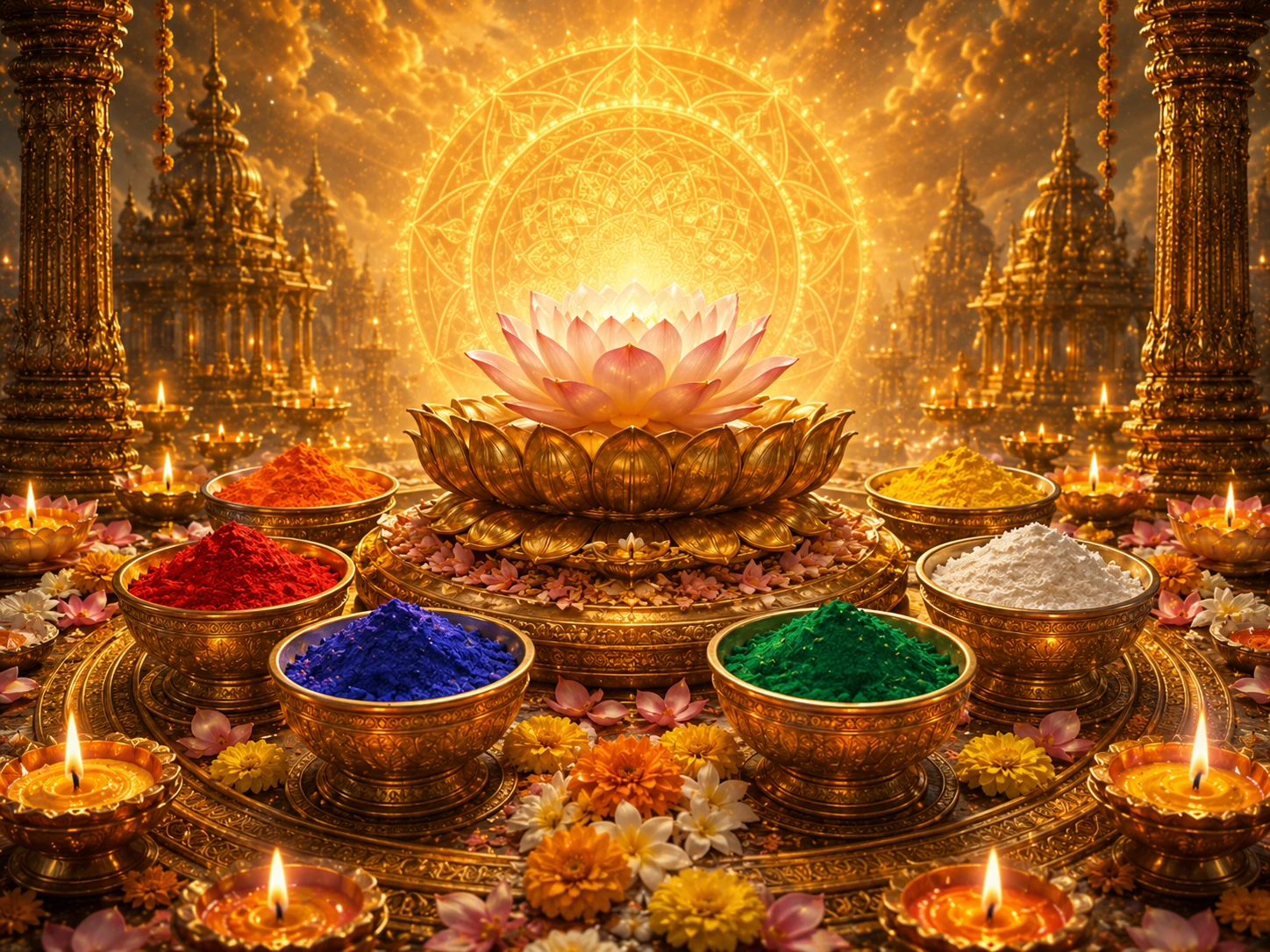
Sacred Colors -- The Hindu Spectrum and What Each Hue Carries
पवित्र रंग -- हिन्दू वर्ण-स्पेक्ट्रम और हर रंग का अर्थ
The Colors You Have Already Worn
Open the wardrobe of any Indian woman of your mother's generation, or any priest at the Tirumala temple, or any sannyasi at the Kumbh Mela, and you will find the same restricted palette. Saffron and ochre. Crimson and vermilion. Pale yellow and turmeric gold. Pure white. Deep blue. A few fixed shades of green. The colors are not the same as what you would find in a Mumbai fashion designer's mood board or a Bangalore startup logo guide. They are an older, more committed palette, with each color doing specific work.
You have already worn these colors without knowing why you were wearing them. The yellow turmeric paste smeared on your skin during the haldi ceremony before a wedding. The red kumkum dot pressed onto your forehead at any temple in Pune or Trivandrum. The white kurta-pajama your grandfather wore to a satyanarayan puja and again to a memorial service. The black-and-yellow tilak applied at Tirupati after darshan. The orange marigold garlands strung at every Diwali doorway across India. Each of these colors arrived in your life through ritual rather than fashion, and each carried a specific meaning that rarely required explanation. The grandmother applying kumkum to a granddaughter's forehead does not pause to explain what the color means. She does not need to. The transmission is silent and complete.
This article unpacks the silent transmission. Hindu ritual colors are not arbitrary aesthetics. Each hue is a coordinate in a precise philosophical grid, mapped to deities, seasons, gunas, life stages, and ritual contexts. A wedding's red is not the same red as a Devi temple's red, even though the pigment may be identical. A sannyasi's saffron is not just a colour preference; it is a public declaration of having renounced household life. A Vaishnava priest's yellow dhoti and a Shaiva priest's tiger-skin print are signalling different metaphysical commitments through their textile. Once you can read the grid, the entire visual landscape of Hindu India becomes legible. The palette is the language.
सिन्दूरारुणविग्रहां त्रिनयनां माणिक्यमौलिस्फुरत् तारानायकशेखरां स्मितमुखीमापीनवक्षोरुहाम्। पाणिभ्यामलिपूर्णरत्नचषकं रक्तोत्पलं बिभ्रतीं सौम्यां रत्नघटस्थरक्तचरणां ध्यायेत्परामम्बिकाम्॥
sindura-aruna vigraham trinayanam manikya-mauli-sphurat tara-nayaka-shekharam smita-mukhim apina-vakshoruham panibhyam alipurna ratna-chashakam raktotpalam bibhratim saumyam ratna-ghata-stha rakta-charanam dhyayet param ambikam
I meditate on the Supreme Mother -- her body shining vermilion-red, three-eyed, crowned with rubies set with the moon-crescent, smiling-faced, holding a jewel-cup full of mead and a red lotus, gentle, her red feet resting on a jewelled vase.
— Lalita Sahasranama, Dhyana Shloka (recited at the start of Sri Lalita Sahasranama recitation in Shrividya tradition)
Why Color Matters -- The Sanskrit Word Varna
The Sanskrit word varna means colour, but it also means letter, syllable, type, category, and class. The same word covers visual hue, speech sounds, and social classification. This is not loose vocabulary. It is a recognition that distinctions in the visible world, the audible world, and the social world all proceed from the same act of differentiation. To name a colour is to mark a category. The Rig Veda speaks of the universe being created through the separation of light from darkness, of one wavelength from another. Color, in this view, is not decoration laid over a colourless reality. Color is what reality looks like when it is differentiated enough to be perceived at all.
For ritual purposes, this insight matters because it explains why colors carry weight that mere visual preference does not. When a Brahmin priest at Sringeri wears a particular shade of saffron, he is not making a fashion statement. He is locating himself in a category that the colour itself encodes. The colour is the credential. A South Indian widow traditionally wearing white -- as observed at communities still maintaining classical practice in Tirunelveli or Mylapore -- is not following a passive convention; she is publicly inhabiting a category that the color makes visible. The visible identifier and the social fact are tied together by varna in both senses, the colour-meaning and the category-meaning.
The same logic operates upward through the deity-colour mapping. Vishnu is shyama, dark like a rain cloud. Krishna is more deeply blue, sometimes black-blue. Shiva is white-ash, smeared with bhasma over a body that the texts describe as being of the colour of camphor. Devi is rakta-varna, blood-red. These colours are not artistic choices left to individual painters. They are part of the deity's identity, encoded in dhyana shlokas across centuries. A painter at Madhubani in Bihar, an icon-maker at Krishnanagar in West Bengal, a temple sculptor at Mahabalipuram in Tamil Nadu, and a textile designer in Banaras printing a Krishna sari -- all of them work within the same colour grid. Variations are local; the underlying logic is pan-Indian.
The Major Sacred Colors and Their Meanings
| Color | Sanskrit | Primary Meaning | Associated Deity / Context |
|---|---|---|---|
| Saffron / Ochre (Bhagva) | भगवा / काषाय | Renunciation, agni, courage, the seeker's flame | Sannyasi vastra, saffron flag of the Marathas, Kumbh Mela ascetics |
| Red (Rakta) / Vermilion (Sindur) | रक्त / सिन्दूर | Life, fertility, devi-shakti, married woman's status | Durga, Kali, Lakshmi; bridal trousseau; kumkum tilak |
| Yellow (Pita) / Turmeric (Haldi) | पीत / हल्दी | Auspiciousness, harvest, prosperity, learning | Vishnu, Krishna's pitambara dhoti; haldi ceremony; Saraswati |
| White (Shveta) | श्वेत | Purity, peace, transcendence, also widowhood and mourning | Saraswati, Shiva-bhasma; sannyasi initiation in some lineages; antyeshti rites |
| Blue (Nila) / Dark Blue (Shyama) | नील / श्याम | Infinity, the cosmic ocean, divine consciousness | Krishna, Vishnu, Rama; the sky-deities |
| Green (Harita) | हरित | Nature, harvest, fertility, the earth in bloom | Mother goddess in agricultural contexts; Vat Savitri; Onam |
| Black (Krishna) / Dark | कृष्ण / श्याम | Mystery, time, dissolution; protection from evil eye | Kali, Shani, Bhairava; black thread protection (kala dora) |
The same physical pigment can carry different meanings depending on context. Red as kumkum is auspicious; red as a goddess's tongue can be terrifying. The grammar is contextual.
Saffron -- The Color of the Flame and the Seeker
Of all the Hindu sacred colors, saffron carries the most weight in modern Indian public life. The saffron flag flies over crores of homes during Hanuman Jayanti and Ram Navami. The saffron robe identifies a sannyasi anywhere in the country, from a Naga sadhu at the Kumbh Mela to a Ramakrishna Mission swami at a Kolkata ashram. The saffron stripe sits at the top of the Indian national flag, where it represents courage and sacrifice in the official Constituent Assembly explanation. The political weight of saffron in contemporary India is well known and fiercely contested. The ritual weight is older and more philosophically interesting.
The etymological route is direct. Bhagva is the colour of agni at its hottest, a particular shade of saffron-orange that the eye recognises as a flame at full burn. Kashaya is the related word, used for the deeper ochre-brown shade that wood-fired clay turns when fully baked. Together they form the spectrum of fire-touched matter -- the colours that emerge when something has been transformed by heat. To wear saffron is to publicly identify yourself as someone who has been burned away. A sannyasi takes saffron because he has burned the obligations of grihastha life. A monk takes saffron because he has burned the project of accumulating possessions. A warrior in classical times wore saffron because he was prepared to be burned in battle. The colour is not metaphor. It is the visible record of having been consumed by something larger than the self.
For a contemporary urban Indian, the saffron of the kumbh mela ascetic and the saffron of the political flag and the saffron of the kitchen turmeric are points on the same chromatic spectrum but doing different work. The kumbh saffron is a witness; the political saffron is a claim; the kitchen saffron is a daily small benediction. To know that all three are connected to the same fire-colour is to read the visual landscape with more depth. The next time you see a sannyasi in saffron at a Pune dargah crossroad, or a saffron flag at a Mumbai apartment building, or a saffron-stained piece of pulao at a Bengaluru lunch buffet, you are seeing one philosophical idea repeated at three scales.
The colours used at Holi were originally entirely natural. Yellow came from turmeric and chickpea flour. Red from beetroot, hibiscus, and red sandalwood. Pink from rose petals. Green from neem and henna. Blue from indigo. The festival's traditional palette was effectively a portable chemistry lesson in plant pigments. Modern Holi gulal, especially the cheap synthetic powders sold in Indian markets after the 1990s, contains industrial dyes, lead chromate, mica chips, and sometimes mercury sulphide -- ingredients with documented health risks. Researchers at IIT Delhi and AIIMS have published advisory papers on the dermatological and respiratory effects of synthetic Holi colors. Many cities have launched return-to-natural Holi campaigns; companies like Pune-based Krya Botanicals and several Vrindavan-based natural-color cooperatives now sell certified herbal gulal. The traditional ritual logic of Holi -- celebrating the chromatic flooding of the world -- works just as well, and perhaps better, with the older plant-based palette.
Red -- The Color of Life and Devi
Red is the colour of blood, and Hindu thought has never tried to hide that origin. Where some traditions distance the sacred from the embodied, Hindu ritual leans into it. The same red that announces a wound or a menstrual cycle announces the divine presence of the Mother goddess. Devi is rakta-varna, the colour of blood, and the colour is hers because she is the source of all life that runs through bodies. Lalita Tripurasundari, Durga, Kali, Bhuvaneshwari, and most goddesses in the Shakta pantheon are depicted in red or shades close to it -- vermilion, crimson, sindhura, kumkuma, japa-pushpa-varna (red hibiscus colour). The dhyana sloka quoted at the start of this article describes Lalita as sindura-aruna, vermilion-red, and this is not a poetic flourish; it is the standard iconographic colour of the goddess across temples from Kanchipuram to Kamakhya.
The same red carries forward into the human ritual life of women. The kumkum dot on the forehead, the sindhur in the parting of married hair, the red bridal sari, the red bangles given at a Karwa Chauth ceremony -- all of these are versions of the goddess's colour applied to the woman's body. The implicit theological claim is direct: the woman is, ritually, an instance of the Devi. The red colour is the visible mark of that participation. This is also why a married woman in classical observance does not wear sindhur after widowhood -- not as a punishment, but because the participation in goddess-as-life has been ritually concluded for her in this birth.
For a contemporary Indian woman, the red of the bridal sari and the red of the kumkum on a Friday morning at the Mahalakshmi temple are part of the same colour-grid. A young software engineer in Hyderabad who wears a red dot on Diwali, even when she has otherwise stopped following many traditional observances, is participating in the goddess-grid at minimum resolution. A wedding photographer at a destination wedding in Udaipur who notices that the red of the bride's lehenga is the exact red of the kumkum platter on the puja table is observing a coherence that the bride and the priest have both internalised without articulation. The colour is doing the philosophical work that nobody is explaining in words.
Major Deities and Their Iconographic Colors
| Deity | Body Color | Garment Color | Symbolism |
|---|---|---|---|
| Vishnu | Shyama (dark blue / cloud-coloured) | Pita (yellow), the famous pitambara | Cosmic ocean, infinite sky, golden light of preservation |
| Krishna | Deep blue / blue-black | Yellow pitambara with peacock feather | Same as Vishnu, with the playful descent into form |
| Shiva | Karpura-gaura (white like camphor), smeared with bhasma | Tiger skin / nothing / minimal | Pure consciousness, ash of dissolved worlds |
| Devi (Lalita, Durga) | Sindura-aruna (vermilion-red) | Red sari, gold ornaments | Life-blood, the source-flow of manifestation |
| Saraswati | White / pearl | White sari with gold border | Pure speech, knowledge unmixed with worldly concern |
| Lakshmi | Golden / fair | Red sari with gold | Wealth, abundance, ripening of effort |
| Ganesha | Red / pink-red | Red dhoti, gold ornaments | Worldly auspiciousness, removal of obstacles |
| Hanuman | Sindura-orange / red | Saffron / red dhoti | Devotion as flame, courage, energetic protection |
These are the iconographic norms taught in shilpa shastra texts. Regional variations exist (Bengali Kali is depicted blue-black, while Tamil Kali is more often red), but the core associations are pan-Indian.
Yellow, White, and the Colors of Auspiciousness
Yellow is the colour of haldi -- turmeric -- and through that simple kitchen association, it carries the colour-meaning of auspiciousness, harvest, prosperity, and beginnings into Hindu ritual life. The haldi ceremony before a wedding, in which yellow paste is applied to the bride's and groom's skin, is the most familiar example. Beyond the cosmetic effect, the ritual is making the body sacred for the upcoming union. Vishnu's pitambara, the yellow silk dhoti he wears in iconography, is the divine prototype of this auspicious yellow. When a temple priest at the Padmanabhaswamy at Thiruvananthapuram or the Tirumala Venkateswara puts on a yellow dhoti for the morning seva, he is wearing the deity's own colour as an act of sympathy. Saraswati, the goddess of learning, is also associated with yellow and white together -- the white of her sari for purity of speech, with yellow accents for the auspiciousness of knowledge.
White carries a more complex burden. In one register, white is the colour of perfect purity -- Saraswati's sari, the kurta of a Brahmin priest at sandhya, the dhoti of a renouncer in some lineages of Vaishnava sannyasi. In another register, white is the colour of widowhood and mourning. A Bengali widow in classical practice wears a white sari with no border. Pallbearers at a Hindu cremation wear white. The two readings sit together because both refer to a state in which colour has been removed -- in one case to ascend into the colourless purity beyond all hue, in the other to mark a withdrawal from the world of vivid life. White, then, is a colour by absence rather than by presence. It is what remains when other colours have been drained away.
This double meaning explains some confusing regional variation. North Indian brides wear red. South Indian brides, particularly in Kerala, often wear cream or white with gold border. Both are correct; both encode auspiciousness; but they reach the auspicious through different colour-routes. The North Indian route emphasises the activation of life-energy through red. The South Indian route emphasises the purification of intent through white-and-gold. The end is the same. The grammar is regional. A wedding photographer working across India quickly learns to read these grammars. So does a thoughtful guest. Showing up at a Tamil wedding in a black sari, even if Mumbai's fashion sense would call it elegant, signals an unawareness that the colour-grid does not pardon easily.
Beyond white and yellow, gold sits as a separate auspicious register. Gold thread woven into the border of a wedding sari, gold zari on a Banarasi silk, gold ornaments worn by a bride at her muhurtam -- these are not just displays of wealth. Gold is the colour of accumulated tapas, of the sun's stable presence, of mantra repeated long enough to ripen. The Sanskrit word hiranya means gold, but it also means light made tangible. The Vedas describe creation beginning with the hiranyagarbha, the golden womb-egg, from which the cosmos emerges. When a bride wears gold mangalsutra at a Pune wedding or a temple offers a gold-plated kalasham at the Tirumala laddoo prasad counter, the colour is invoking that ancient cosmogenic image. Even on the Indian rupee note, the saffron-and-green security thread runs through what is essentially a gold-coloured paper, holding the same auspicious chromatic logic in a thoroughly secular object.
Krishna is described in the Bhagavad Gita and Bhagavata Purana as having a complexion described as shyama, a deep dark colour usually translated as blue or blue-black. There has been considerable debate about why a human-form deity is depicted in a colour no human actually has. The most consistent textual answer is that the colour is symbolic, not literal -- shyama is the colour of the rain cloud heavy with monsoon water, the colour of the deep ocean, the colour of cosmic infinity. Some scholars have proposed that Krishna may have had unusually dark skin and that later iconographic tradition stylised this into the blue of cosmic depth. Whatever the historical truth, the modern visual norm is set: Krishna is blue. ISKCON temples worldwide, the Pichwai paintings of Nathdwara, calendar art on every Indian household wall -- all show Krishna as blue. The colour has become the deity's signature in a way that resists revision. A skin-toned Krishna would not feel like Krishna anymore.
Living the Color Grid in Modern Indian Life
The Hindu colour grid is not antiquarian. It survives in every Indian household, every shopping decision, every wedding. The young woman picking a sari for Karwa Chauth at a Surat textile shop is not idly browsing. She is choosing within a constrained palette -- red, maroon, dark pink, gold-bordered, sometimes orange -- because those are the colours the festival recognises. A Tamil techie based in Bengaluru who flies home to Chennai for Pongal will be expected to wear off-white or cream with a coloured border, because Pongal is a harvest festival and the dress code reflects rice-grain colours. A Marwari businessman dressing for a Diwali Lakshmi puja will reach for red and gold, because those are the colours of the goddess being invited. The colour grid is doing its work; the wearer rarely articulates it; the photograph after the puja shows it.
For someone who wants to engage the grid more deliberately, the entry points are simple. Notice what colour you reach for instinctively when you visit a temple. Notice what your mother put you in for festivals as a child, and what colours she avoided. Notice the difference between the saffron of a Vivekananda image and the saffron of a Hanuman flag and the saffron of a kitchen kasata roll, and ask yourself why all three colours feel related but not identical. Observe a temple priest's dhoti colour at different times of day -- it changes for different seva slots. Observe the colour of the cloth wrapped around the idol you visit most often -- it changes by season and festival in many living temples. Each of these small observations builds your fluency in the grid.
There is also the larger move: choosing colours for major life events with awareness of what they signal rather than only what they look like in photographs. Red sari for the wedding, white kurta for sandhya practice, bhagva stole for a yoga teacher's certification ceremony, blue dupatta for a Krishna Janmashtami evening, yellow on the Vasant Panchami morning -- all of these are colour decisions that participate in a tradition larger than the wearer. They are not costumes. They are quiet acts of belonging. A young Bengaluru couple at a destination wedding in Goa who decide to honour both his Punjabi family's red preference and her Keralite family's white-and-gold preference by mixing both palettes through the ceremony are not just doing a fashion compromise. They are reading two regional grammars and synthesising them into a single visual sentence that both families can read. Hindu colour grammar at its best is generous in this way. It allows synthesis. It does not demand uniformity. But it does ask that the choices be informed rather than absent-minded. That is, in the end, what the entire palette has always been asking.
Plan Your Festival Colours
Make a simple list of the colours traditionally tied to the festivals you keep -- saffron, red, yellow, white, and Navratri's nine colours where your region follows them -- noting how your family's custom differs, and plan your clothes and puja flowers around it. The Rituals and Traditions section of Eternal Gyan explains each festival.
Eternal Raga · शाश्वत राग
Institutional voice — scholarly articles on Sanatan Dharma
Deepen Your Understanding
अपनी समझ और गहरी करें
sacred symbols
Fire, Water, and Ash -- The Three Substances of Hindu Ritual
Every Hindu ritual you have ever attended uses three substances: fire to transform, water to cleanse, ash to remind you of impermanence. Together they trace a complete arc -- creation, sustenance, dissolution -- in ingredients you can hold in your hand.
sacred symbols
Why the Right Hand and Clockwise -- The Logic of Dakshina
Why are gifts received with the right hand, why is pradakshina always clockwise, why is the rare right-spiral conch worth lakhs? The principle is one word: dakshina. It carries skill, south, and right -- and it shapes every Hindu ritual.
sacred symbols
Yantra Geometry -- The Sacred Mathematics of Form
Triangles, hexagrams, lotus petals, the central dot, the framing square -- every classical Hindu yantra is built from a small grammar of geometric elements. This is the visual language behind Sri Yantra, Shri Chakra, and every temple wall.
sacred symbols
Bindu -- The Point from which Creation Emerges
Look closely at the symbol ॐ. See the small dot above the curve? That is the Bindu, and in Hindu metaphysics it is not decoration. It is the point from which the universe began, and the point into which it will return. Meet the smallest mark in Hinduism that contains all of cosmology.
sacred symbols
Kumkum and Sindoor -- The Red of Blessing
A red dot on the forehead, a line of vermilion in a bride's hair, an orange-smeared image of Hanuman: red powders mark Hindu life from worship to marriage. What kumkum and sindoor are, what they mean, how they differ -- and what to know about their safety today.
rituals traditions
Hindu Wedding Rituals -- Seven Steps Around Fire That Bind Two Lives Forever
A Hindu wedding is not a contract signed on paper. It is a Vedic yajna performed around fire, witnessed by Agni, sealed by seven vows taken step by step, and marked by sindoor and mangalsutra. By Indian law, the marriage is not legally valid until the Saptapadi is complete. Here is every ritual, from the baraat arriving at the gate to the bride crossing the threshold of her new home.
The colours used at Holi were originally entirely natural. Yellow came from turmeric and chickpea flour. Red from beetroot, hibiscus, and red sandalwood. Pink from rose petals. Green from neem and henna. Blue from indigo…
More in Sacred Symbols
Ashtamangala -- The Eight Auspicious Symbols of Hindu Tradition
13 min read
Bindu -- The Point from which Creation Emerges
12 min read
Gau -- Why the Cow Holds the Place She Does in Hindu Life
14 min readThe same translation error that turned '33 Koti' into '33 crore' in Hinduism also happened in Buddhism. The Chinese translation of Buddhist texts rendered 'Sapta Koti Buddha' (7 Supreme Buddhas) as '7 Crore Buddhas.' The…
Deities AvatarsCommunity Reflections
🕉️
Be the first to share your reflection.