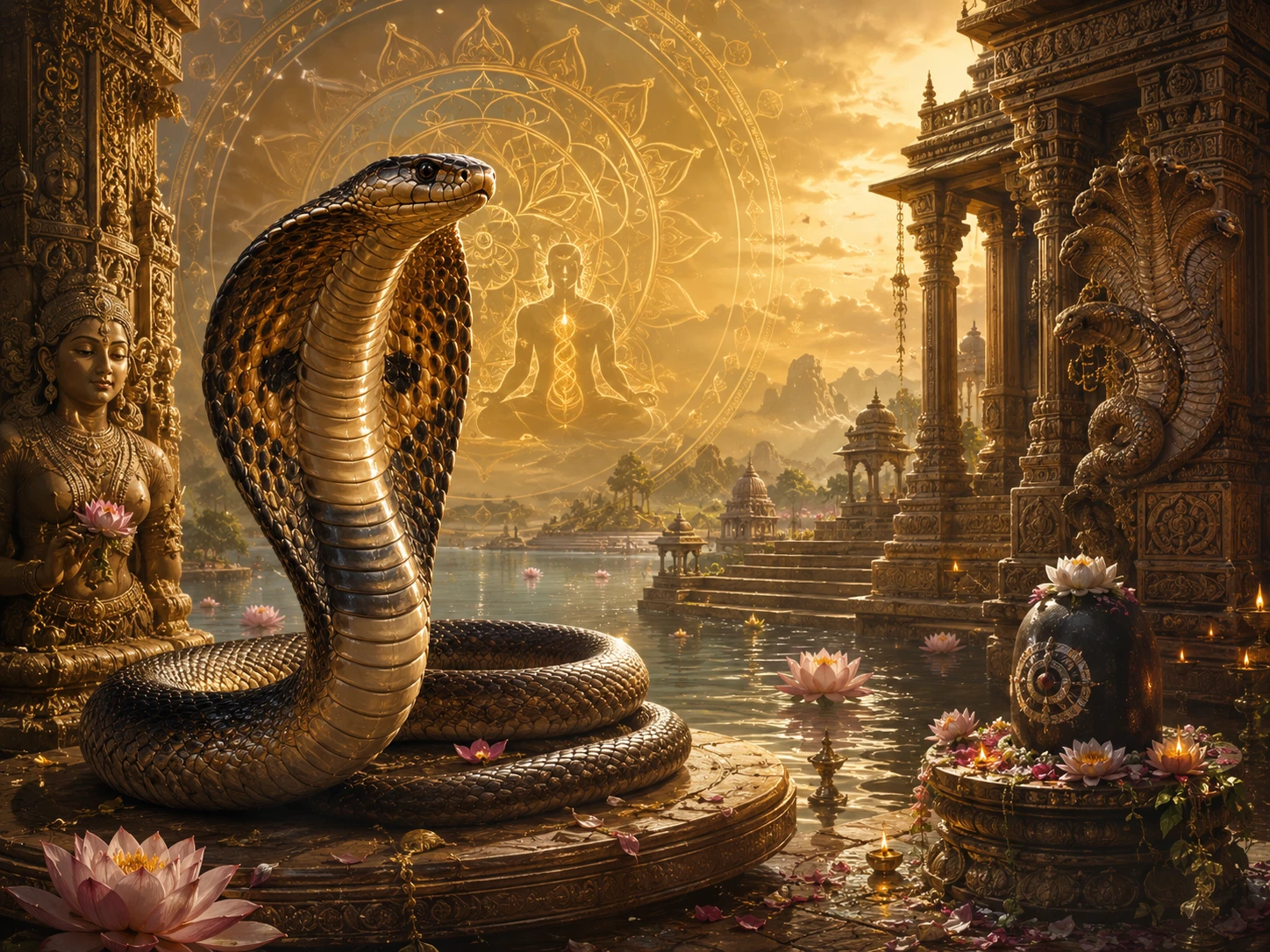
Naga -- The Serpent in Hindu Cosmology, Temple, and Body
नाग -- हिन्दू ब्रह्माण्ड, मन्दिर और शरीर में सर्प
On the morning of Nag Panchami, in the fifth lunar day of the bright half of Shravana, the courtyard of an old wooden Konkani house in Mangalore is being prepared. A small earthen pot of milk has been set on a low platform. Beside it is a brass plate of turmeric, vermilion, and rice. The eldest daughter of the family, who has driven down from Bengaluru where she works as a corporate lawyer, watches her mother draw a freehand image of a five-hooded cobra on the wall behind the platform with a paste of rice flour and water. The image is precise. Her mother has drawn it every Shravana for forty years. The lawyer realises, watching her, that this image will go on the wall of her own house when her mother is gone, and that she has not yet learnt to draw it.
In villages across Karnataka, Maharashtra, Kerala, Tamil Nadu, Bengal, and most of north India, that same morning is producing similar scenes. Milk is being offered, by hand, into the openings of nag-bhils, the small earthen recesses near homes that are believed to be where the snakes live. Earth from anthills is being collected and carried into the puja room. Black sesame seeds are being scattered around the threshold. Across the country, an ancient working agreement is being renewed. The serpents who live in the soil and the rocks and the rivers and the trees are being acknowledged. The agreement is that they will not bite the family if the family treats them with respect. This is older than the Hindu temple. This is older, in fact, than most of what we now call Hinduism.
The naga is the most layered single animal in Hindu thought. He is feared and loved. He is the guardian of the underworld and the necklace of Shiva. He is the bed of Vishnu and the rope that churned the ocean of milk. He is the kundalini coiled at the base of the spine and the serpent kings who appear, by name, in the genealogies of the Mahabharata. To understand the naga is to understand a very particular kind of Hindu thinking, in which the animal that human beings instinctively fear becomes, by the same instinct, the animal who deserves the most careful relationship.
The historical depth of serpent veneration on the Indian subcontinent is unusually well-documented for an ancient practice. Indus Valley seal evidence from sites such as Mohenjo-daro and Harappa, dated to roughly 2500 BCE, includes images of seated figures flanked by cobras with hoods raised, almost identical in iconography to the Vishnu-on-Shesha images that would be carved in temples three thousand years later. The continuity is so direct that some art historians, including the late Doris Srinivasan, have argued that the Hindu serpent iconography we recognise today is one of the longest unbroken visual traditions anywhere in the world. The pattern survived the arrival of Vedic Sanskrit-speaking groups, the rise and fall of the Mauryas, the reorganisations of medieval India, and the centuries of colonial and post-Independence change. The cobra carved on the wall of a temple in Tiruvannamalai today is, in form and gesture, the cobra carved on a seal in Mohenjo-daro four and a half thousand years ago.
The Vedic literature integrates the serpent without erasing the older substrate. The Rigveda contains hymns to serpents called sarpas. The Atharvaveda, particularly, has elaborate prayers and protections against snakebite, suggesting that the serpent's status as a being deserving of address rather than mere combat was already settled by the time the Vedic texts were composed. The Yajurveda has specific mantras for the propitiation of nagas during ritual. By the time we reach the Mahabharata, the naga has acquired a full mythological architecture: serpent kings with names and personalities, a serpent realm called Naga Loka or Patala located beneath the earth, marriages between human princes and naga princesses, and an entire epic genealogy traced from Kashyapa, the primordial sage, through his wife Kadru, the mother of all serpents.
The Mahabharata's relationship with the nagas, in particular, is so dense that it shapes the structure of the epic itself. The Mahabharata begins with the story of Janamejaya, the great-grandson of Arjuna, conducting a snake-sacrifice yajna to avenge the death of his father Parikshit, who was killed by the snake Takshaka. The yajna is interrupted by the sage Astika, the half-naga son of the sage Jaratkaru and the naga princess Manasa, who pleads for the lives of the surviving serpents. Janamejaya halts the sacrifice. The reconciliation between human royalty and the nagas is the act in which the entire Mahabharata is then narrated, by Vaishampayana to Janamejaya, as part of the closing of that wound. The epic, in its own self-understanding, is a story told to repair a broken relationship with the serpent world.
अनन्तं वासुकिं शेषं पद्मनाभं च कम्बलम्। शङ्खपालं धृतराष्ट्रं तक्षकं कालियं तथा॥
anantaṃ vāsukiṃ śeṣaṃ padmanābhaṃ ca kambalam śaṅkhapālaṃ dhṛtarāṣṭraṃ takṣakaṃ kāliyaṃ tathā
Ananta, Vasuki, Shesha, Padmanabha, and Kambala. Shankhapala, Dhritarashtra, Takshaka, and Kaliya. These are the nine great names of the great-souled nagas.
— Nava Naga Stotra, traditional
Three nagas dominate the upper register of Hindu cosmology. The first is Ananta-Shesha, the eternal serpent who serves as the bed and the canopy of Vishnu while he reclines on the cosmic ocean between universes. The image, found in temple iconography from Bhubaneswar to Srirangam to Bali, shows Vishnu lying on the multi-hooded serpent whose body is coiled to form a sleeping platform and whose hoods are spread above as a parasol. The Sanskrit word ananta means endless, and the figure is an embodied representation of the eternity that holds creation in suspension between cycles. When a new universe begins, Vishnu wakes from his yoga-nidra, and Brahma emerges from the lotus that grows from his navel. Through all of this, Shesha remains. He is the substrate of stable continuity beneath every cosmic transformation.
The second is Vasuki, the king of nagas, the serpent who served as the rope when the devas and asuras churned the ocean of milk. The Samudra Manthan, narrated in the Vishnu Purana and the Bhagavata Purana, is the foundational creation-as-cooperation story of Hindu thought. Devas and asuras, opposing forces, collaborate to extract amrita, the nectar of immortality, from the cosmic ocean. They wrap Vasuki around Mount Mandara, devas pulling from one end and asuras from the other, while Vishnu in his Kurma-tortoise form supports the mountain from below. The fourteen treasures that emerge from the churning, including the goddess Lakshmi, the divine cow Kamadhenu, the divine tree Kalpavriksha, the divine doctor Dhanvantari, and the amrita itself, are the foundational gifts of Hindu cosmology. None of them would have emerged without Vasuki. The serpent, in this account, is the working tool that makes creation possible.
The third is Manasa, the goddess-naga of Bengal, daughter of Kashyapa or by some accounts daughter of Shiva himself. Manasa is the protector against snakebite and the deity to whom Bengali farmers and fisherfolk turn during the monsoon, when snakes are most active. Her annual festival, Manasa Puja, observed primarily in Bengal, Assam, Bihar, Jharkhand, and Odisha during the month of Shravana, draws crowds rivaling Durga Puja in some districts. The Manasa Mangal Kavya, a fifteenth-century Bengali narrative tradition, tells the story of Manasa's struggle to be accepted as a deity by the wealthy merchant Chand Saudagar, a Shaiva who initially refuses to worship her. The story is one of the most beloved in Bengali literary history and has been retold in modern fiction, theatre, and cinema across the last century. Manasa's place in the Hindu pantheon is regional, but within her region she is a major figure in her own right, not merely a minor extension of any other deity.
The relationship between Shiva and the serpent is the most intimate of all in the Hindu pantheon. Shiva is the only major deity who wears a live cobra as personal ornament, coiled around his neck or his arm in nearly every standard iconographic depiction. The cobra has a name -- Vasuki, in some accounts, the same nagaraja who served as the churning rope. In other accounts, Shiva wears a different naga called Nagendra. The serpent on Shiva's body is sometimes interpreted as a sign of his command over death, since the cobra carries the most potent venom in the Indian forest, and Shiva wears it as casually as another deity might wear a flower garland. It is also interpreted as a sign of his control over the kundalini energy, the inner serpent power that yogic tradition locates at the base of the human spine.
The Mahabharata records that Shiva drank the halahala, the poison that emerged first from the Samudra Manthan and threatened to destroy the universe. He held the poison in his throat, and the throat turned blue, giving him the name Nilakantha, the blue-throated. The story binds Shiva to the toxic substrate of existence in a way no other deity is bound. The serpent, in this reading, is the form in which the poisonous truth of life is made visible -- both terrifying and ornamental, both deadly and decorative, depending on the consciousness of the one observing.
The Krishna avatara has its own naga episode, equally important. As a young boy in Vrindavan, Krishna confronts the serpent Kaliya, who has been poisoning the waters of the Yamuna and threatening the cattle and the cowherds. Krishna jumps into the river, allows Kaliya to coil around him, and then, expanding his own form, dances on each of Kaliya's hoods until the serpent surrenders. The image of Kaliya-mardana, the suppression of Kaliya, is one of the most iconographically rich Krishna images, found in temple sculpture from Tamil Nadu to Manipur, in classical paintings from the Pahari schools, and in contemporary Indian art across the country. The story is read at multiple levels. At the surface it is a victory over a dangerous animal. At a deeper level it is a story about transforming a destructive force rather than destroying it. Krishna does not kill Kaliya. He banishes Kaliya to the ocean, with the agreement that Kaliya will no longer harm the people of Vrindavan, and the relationship is preserved. The dance on the serpent's hoods is, in working iconographic terms, the most cheerful image of conquest in Hindu art. The conquered being is not annihilated; the conquered being is transformed.
The Nine Naga Kings of the Nava Naga Stotra
| Naga | Devanagari | Primary association | Where most worshipped |
|---|---|---|---|
| Ananta | अनन्त | The endless serpent who supports Vishnu and the universe between cycles | Vaishnava temples across India, especially Anantapadmanabhaswamy Thiruvananthapuram |
| Vasuki | वासुकि | King of nagas, churning-rope of Samudra Manthan, garland of Shiva | Shaiva temples, particularly Mannarasala in Kerala and Kukke Subrahmanya in Karnataka |
| Shesha | शेष | The remainder serpent, Vishnu's bed, identified with Lakshmana and Balarama avatars | Vaishnava traditions across India, with Shesha-shayana imagery widespread |
| Padmanabha | पद्मनाभ | The lotus-naveled serpent associated with Vishnu's manifestation | Kerala Vaishnava temples, especially Anantapadmanabhaswamy |
| Kambala | कम्बल | Naga of forests and groves, often invoked in Sarpa Kavu rites | Sacred groves of Kerala and coastal Karnataka |
| Shankhapala | शङ्खपाल | Naga of waters and conches, associated with rain and rivers | Maharashtra coastal communities, north Indian Naga shrines |
| Dhritarashtra | धृतराष्ट्र | Naga of foundations, supports earthly stability | Mahabharata-linked sites, north Indian temple complexes |
| Takshaka | तक्षक | Naga of forests; killed Parikshit in the Mahabharata | Takshasila tradition, north-western Indian shrines |
| Kaliya | कालिय | Once toxic, transformed by Krishna; now associated with the Yamuna | Vrindavan, Mathura, all Krishna-Vrindavan circuits |
These nine appear in the most widely recited Nava Naga Stotra. Other Naga lists in Puranic sources extend to twelve or more. Regional traditions emphasise different nagas as principal.
The translation of cosmic naga thinking into temple practice is most visible in the south Indian Sarpa Kavu tradition. A Sarpa Kavu, literally serpent-grove, is a small patch of forest -- sometimes a few trees, sometimes a hectare -- preserved within or beside a household compound and dedicated to the resident nagas. The grove is left wild. No leaf is swept. No branch is cut. No animal is hunted. A small stone naga image, sometimes a row of them, sits at the heart of the grove on a low platform. Once a year, on a date determined by the family astrologer, a priest is brought in for a brief ceremony, milk is offered, marigolds are placed, and the family withdraws. The grove returns to its undisturbed state.
Kerala has the densest network of Sarpa Kavus in India, with the Kerala State Biodiversity Board estimating, in its 2017 survey, more than 1,500 surviving groves attached to traditional Nair, Namboodiri, and other households. The Mannarasala Temple in Alappuzha district is the largest serpent-temple complex in India, with over 30,000 stone naga images placed by devotees over centuries, and is unusual in being one of the few major Hindu temples whose chief priestess is, by tradition, a woman, the eldest member of the Mannarasala Illam family. The temple's myth holds that the Naga king Anantha himself appears periodically to the chief priestess in dreams to communicate with her, and the family records of these encounters go back several generations.
The Sarpa Kavus, like the sacred groves discussed in the previous article on trees, have turned out to be remarkable repositories of biodiversity. Researchers from Kerala Forest Research Institute and Salim Ali Centre for Ornithology have documented bird species, plant species, amphibian species, and indeed snake species in the groves that are absent from the surrounding agricultural landscape. The naga belief that protected the grove also, by accident, protected an entire ecosystem. The same pattern repeats in the Naga Banas of Karnataka, the Naga Vriksha shrines of Tamil Nadu, the Naga-related shrines of Maharashtra's Konkan coast, and the smaller serpent-shrines that dot eastern Maharashtra. India's environmental movement has, in the last two decades, started to take this seriously not as folk piety but as a working biodiversity-protection mechanism that pre-dates and outperforms many formal conservation programmes.
आयुधानामहं वज्रं धेनूनामस्मि कामधुक्। प्रजनश्चास्मि कन्दर्पः सर्पाणामस्मि वासुकिः॥
āyudhānām ahaṃ vajraṃ dhenūnām asmi kāmadhuk prajanaś cāsmi kandarpaḥ sarpāṇām asmi vāsukiḥ
Of weapons I am the thunderbolt. Of cows I am Kamadhenu. Of forces of procreation I am Kandarpa. And of serpents I am Vasuki.
— Bhagavad Gita 10.28
The Indus Valley seal known as the Pashupati Seal, dated to roughly 2350 BCE, depicts a horned figure seated in a yogic posture, surrounded by animals including a tiger, an elephant, a buffalo, a rhinoceros, and at the base, two serpents with hoods raised. Some scholars, beginning with John Marshall in the 1930s, have argued this figure is a proto-Shiva. The argument remains debated, but the presence of the cobras at the seated figure's feet matches almost exactly the iconography that would appear, three thousand years later, in carved Shiva images at temples like Khajuraho and Brihadeeswarar at Thanjavur. If the identification holds, the snake at Shiva's feet may be one of the longest continuously honoured religious symbols in human history, predating Christianity by more than two thousand years and Islam by nearly three thousand.
Inside the body, in the yogic anatomy that the tradition has developed over centuries, the most important naga is invisible. The kundalini, literally 'the coiled one,' is described in tantric and yogic texts as a serpent power coiled three and a half times at the base of the spine, in the region of the muladhara chakra. Texts including the Hatha Yoga Pradipika, the Shiva Samhita, the Goraksha Samhita, and various Tantric works describe the awakening of this serpent through specific practices of breath, posture, mantra, and concentration. As she awakens, she rises through the central channel of the spine, the sushumna nadi, passing through the six chakras and finally reaching the sahasrara at the crown of the head, where, in the tradition's image, she meets Shiva in the form of pure consciousness. Liberation, in this framework, is the union of the serpent and Shiva at the crown.
The imagery is precise and physiological in a way that has interested modern researchers, including those at the AIIMS Centre for Integrative Medicine and the Vivekananda Yoga Anusandhana Samsthana in Bengaluru. Whatever the deeper metaphysical claim, the practical observation is that practices traditionally described as kundalini-related produce measurable physiological changes -- in heart-rate variability, in EEG patterns, in cortisol response, in autonomic balance. The practices are rigorous and the texts are clear that they should be undertaken under qualified instruction. The popularised yoga of metropolitan India and the Western yoga industry largely does not engage seriously with kundalini practice, and the texts themselves consistently warn that improper engagement can produce significant psychological and physiological disturbance. The serpent at the base of the spine, in the tradition's reckoning, is not a metaphor. She is a working power, and waking her is, in the texts' own framing, a serious undertaking.
The wider point is that the naga in Hindu thought operates simultaneously at the cosmic, the iconographic, the regional-religious, the agricultural, and the inner-yogic levels, and the same word, the same animal, holds them all. This kind of integration of registers across scales is one of the distinctive features of Hindu thought. The naga is the same being whether he is supporting Vishnu in the cosmic ocean, churning the Mandara mountain, sliding through the rice paddy at dusk, or coiled at the base of the practitioner's spine. The unity is not symbolic. It is, in the tradition's working understanding, structural. The serpent that lives in the field is genuinely a participant in the same cosmic-vital reality as the serpent who supports Vishnu, and the relationship one has with the field-serpent shapes, in some quiet way, the relationship one will have with the inner-serpent.
Modern India's relationship with the actual living snake is more complicated than the religious texts alone would suggest, and the difficulty deserves an honest accounting. India has the highest number of snakebite deaths of any country in the world. The Indian Million Death Study, published in eLife in 2020, estimated approximately 58,000 snakebite deaths per year between 2000 and 2019, with rural agricultural workers being the most affected. The four species responsible for most fatalities, called the Big Four, are the Indian Cobra, Common Krait, Russell's Viper, and Saw-scaled Viper. The Indian Council of Medical Research and the Madras Crocodile Bank Trust's Centre for Herpetology, based at Mahabalipuram, have been working since the 1980s on better antivenom production, regional venom-banking, and rural snakebite management training, but the gap between need and treatment remains large.
The traditional religious framework actually anticipates this difficulty. The Naga Panchami rituals, the Sarpa Kavu groves, the Manasa worship, and the household offerings of milk and turmeric were never naive about the danger. They were in fact responses to the danger, encoded as a working agreement. Treat the serpents with respect, leave them their habitat, do not provoke or harm them, offer them propitiation, and they in turn will not harm the household. In a country where rural populations live in close proximity to a high density of venomous snakes, this is not superstition. It is, in working anthropological terms, a protocol of co-existence developed over thousands of years between two species that share the same territory.
What the modern Indian state has yet to do, and what some environmental organisations such as the Wildlife Trust of India and the Indian Snakes group have started to advocate, is integrate the traditional protocol with modern medical infrastructure. Rural antivenom availability, snake-handler training, public education about which species are dangerous and which are not, and respectful preservation of the small habitats around villages where snakes naturally live, would together reduce snakebite mortality significantly. The traditional reverence for the naga, when properly understood, is not in conflict with modern conservation and medicine. It is, in fact, the cultural foundation that those modern measures could be built on, if there is the will to bridge the two registers carefully.
If the deeper teaching of the naga can be summarised in a sentence, it is this: in Hindu thought, the most powerful beings are not those who annihilate fear but those who are intimate with it. Shiva does not avoid death; he wears it as a serpent. Vishnu does not banish chaos; he reclines on its coils. Krishna does not exterminate the toxic Kaliya; he transforms him by dancing on his hoods. The kundalini at the base of the spine is not the enemy of consciousness; she is the means by which consciousness reaches its full flowering. The repeating pattern across cosmic, devotional, and yogic registers is the same. The energy that frightens you is the energy that, properly approached, becomes the foundation of your strength.
For an Indian in 2026 trying to make sense of her own internal landscape, this is a teaching the tradition has been quietly insisting on for thousands of years. Whatever you fear -- the difficult conversation, the looming illness, the shadow side of your own personality, the relationship that has been allowed to fester -- is not the enemy. It is, in this framework, the energy you have not yet learnt to coil around your neck. The young woman in Mangalore drawing the cobra on the wall on Nag Panchami morning is, in some way, learning to do exactly that.
The Mahabharata's structural irony is that the entire epic, with all its battles and betrayals and philosophical density, is told to repair the relationship between humans and the serpent world. Janamejaya, who wanted to exterminate the snakes, ends up listening to the longest story in human literature, told in part to teach him that the relationship he wanted to break by force can only be repaired by patience. The Hindu civilisational lesson, on the matter of fear, is fundamentally Janamejaya's lesson. You cannot kill what frightens you. You can only learn to live with it, with respect, with appropriate distance, with offerings of milk and turmeric, and with the deep recognition that the energy you fear is not other than the energy that sustains the cosmos. The serpent who terrifies you is the serpent who holds Vishnu in his sleep. They are, in the tradition's working understanding, the same serpent.
Read the Nava Naga Stotra in Eternal Raga
The Nava Naga Stotra names the nine great nagas and is traditionally recited on Nag Panchami, on Tuesday mornings, and before any task involving travel through forests or rivers. Three short verses, easy to learn, ancient in origin.
Eternal Raga · शाश्वत राग
Institutional voice — scholarly articles on Sanatan Dharma
Deepen Your Understanding
अपनी समझ और गहरी करें
sacred symbols
Gau -- Why the Cow Holds the Place She Does in Hindu Life
The cow is not sacred in Hindu thought because she is mystical. She is sacred because she sustains -- with milk, with labour, with the soil-fed continuity of an agricultural civilisation. From Rigvedic verses calling her sinless and inviolate, to Krishna's life as a cowherd, to the dairy farmer in Anand who still sleeps in the shed at calving time -- the same thread runs through.
sacred symbols
Vanaspati -- The Sacred Trees of the Hindu Civilisational Imagination
Pipal, Banyan, Bel, Tulsi, Neem. Five names a Hindu child learns before she can read. Each one is a deity, a doctrine, and a doctor at the same time. Behind them stands the older idea of vrkshayajna -- the worship of trees as the first acts of religion -- and the network of sacred groves that quietly preserved India's biodiversity for two thousand years.
scriptural exegesis
Samudra Manthan -- When Gods and Demons Ran a Joint Venture and the Universe Almost Died
A cosmic ocean. A mountain for a churning rod. A serpent king for a rope. Gods on one end, demons on the other. And out came 14 treasures -- including wealth, beauty, medicine, immortality, and one poison so lethal it could end creation itself. The Samudra Manthan is not mythology. It is the original playbook for collaboration, crisis management, and how to handle it when your joint venture partner tries to cheat you.
deities avatars
Who is Shiva?
He is the ash-smeared ascetic who is also the ideal husband. The destroyer of the universe who is called 'The Auspicious One.' The god of death who drank poison to save all life. He sits in meditation on a Himalayan peak, and simultaneously dances the cosmos into existence and annihilation. No deity in Hinduism contains more contradictions -- and no deity resolves them more completely. This is not a mythology explainer. This is an attempt to stand at the foot of the mountain and look up.
tantra mantra yantra
Kundalini -- The Serpent Power That Sleeps at Your Spine's Base
A coiled serpent sleeps at the base of your spine. When awakened through yoga, mantra, or guru's grace, she rises through seven energy centres, dissolving every limitation of body and mind, until she merges with pure consciousness at the crown of your head. This is not New Age fantasy. This is the central psycho-spiritual technology of Tantric Hinduism -- mapped in Sanskrit texts over 1,500 years ago and now studied by neuroscientists at institutions from Harvard to NIMHANS Bangalore.
deities avatars
Krishna Leela -- Why God Chose to Play
He stole butter, broke pots, lied to his mother's face, danced with married women under the full moon, and lifted an entire mountain on his little finger. The Bhagavata Purana's Tenth Skandha -- the most popular 4,000 verses in all of Hindu literature -- is not a biography. It is a theological argument that the Supreme Being's highest expression is not creation, destruction, or cosmic governance. It is play. Krishna Leela is the radical idea that God's truest nature is joy.
The Indus Valley seal known as the Pashupati Seal, dated to roughly 2350 BCE, depicts a horned figure seated in a yogic posture, surrounded by animals including a tiger, an elephant, a buffalo, a rhinoceros, and at the b…
More in Sacred Symbols
Ashtamangala -- The Eight Auspicious Symbols of Hindu Tradition
13 min read
Bindu -- The Point from which Creation Emerges
12 min read
Gau -- Why the Cow Holds the Place She Does in Hindu Life
14 min readThe same translation error that turned '33 Koti' into '33 crore' in Hinduism also happened in Buddhism. The Chinese translation of Buddhist texts rendered 'Sapta Koti Buddha' (7 Supreme Buddhas) as '7 Crore Buddhas.' The…
Deities AvatarsCommunity Reflections
🕉️
Be the first to share your reflection.