Chakra 6 of 7
Ajna Chakra
The Chakra of Inner Command
Ājñā literally means 'command,' 'order,' or 'authority.' This is the chakra of inner command — where intuition gives direction to action, where the deeper knowing that lives beneath thought finally speaks loudly enough to be heard. The name also carries the sense of perception, since perceiving rightly is the precondition for commanding rightly.
आज्ञा का शाब्दिक अर्थ है 'आदेश' अथवा 'अधिकार।' यह अन्तर्आदेश का चक्र है, जहाँ अन्तर्ज्ञान कर्म को दिशा देता है, जहाँ विचार से नीचे रहने वाला गहरा ज्ञान अन्ततः इतना स्पष्ट हो जाता है कि सुना जा सके।
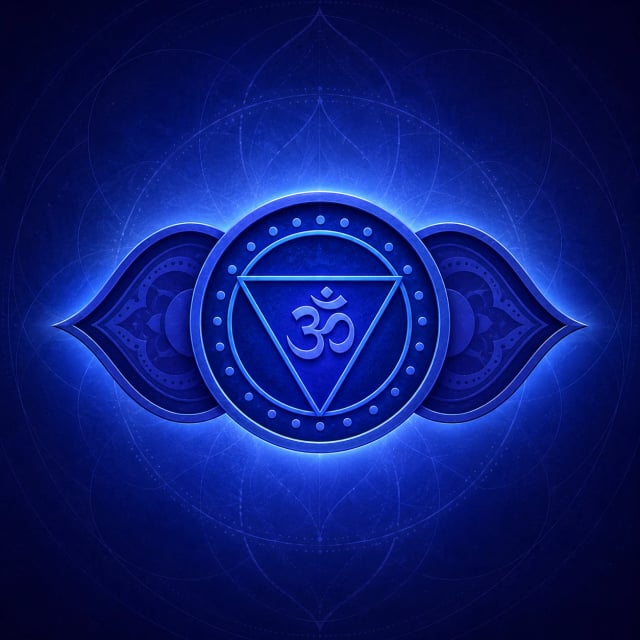
Ajna is the chakra of inner command. Ājñā literally means 'command' or 'authority' — the chakra where intuition gives direction to action, where the deeper knowing that lives beneath thought finally speaks loudly enough to be heard. The Tantric texts describe Ajna as a two-petalled lotus blooming at the space between the brows, with the seed-syllable OM glowing at its centre. The two petals carry the syllables Haṃ and Kṣaṃ, representing the Ida and Pingala channels — lunar and solar, feminine and masculine, left and right — that have flowed up from Muladhara through every chakra below and now meet here in their final convergence before rising to Sahasrara.
If Muladhara asked 'am I safe?', Svadhisthana asked 'what do I feel?', Manipura asked 'what will I do?', Anahata asked 'whom do I love?', and Vishuddha asked 'what is true?', Ajna asks the question that requires the other five to have done their work: 'what do I know?' Not what do I think, what do I believe, what do I have evidence for. What do I, beneath all of that, simply and quietly know?
This is the chakra of intuition, but the word intuition has been so thoroughly diluted by modern wellness vocabulary that it has almost lost its specificity. The Indian tradition has been clearer. Ajna intuition is not gut feeling, not vague hunches, not 'just go with what feels right.' It is buddhi — the discriminative intelligence that sees what the lower faculties cannot reach, the part of consciousness that already knows the answer before the mind has finished its analysis. Buddhi is precise. It is not louder than thought. It is quieter, and you have to learn to hear it under the noise of thinking.
The element here is no longer one of the gross or even subtle elements. Ajna's element is light, or mind, depending on which classical text you read. Mahas, manas — the witness rather than the witnessed. With Vishuddha we had moved from gross to subtle (ākāśa, space). With Ajna we move from subtle to causal. The chakra responds to anything that quiets the constant chattering layer of mind: silence, dim light, the moment just before sleep, the moment just after waking, the gaze held steady on a single point.
The bija is OM, and here a clarification is needed because the tradition has some genuine complexity. Most authoritative texts including the Shat-Chakra-Nirupana itself assign OM as the bija of Ajna. However, the two petals of Ajna carry the syllables Haṃ and Kṣaṃ, and some teachers and lineages therefore cite Kṣaṃ as a secondary bija. Both are correct, depending on which level one is working with. For the practical purpose of daily householder sadhana — which is what this app supports — OM is the standard and most accessible bija for Ajna meditation. If a teacher in your specific lineage instructs you to use Kṣaṃ instead, follow that instruction. The tradition has room for both.
In the modern Indian context, Ajna speaks particularly clearly to anyone whose intuitive faculty has been worn down by the conditions of tier-1 city working life. Ten hours of screen exposure daily, the constant ping of Slack and WhatsApp and email, the decision fatigue of being the family WhatsApp-group's de facto consultant on everything from school admissions to medical insurance to which mutual fund to invest in — all of this taxes the same subtle faculty that would otherwise be available for the deeper questions of life. The screen is not the problem in itself. The problem is what the screen replaces: the long stretches of unstimulated attention that the third eye uses to consolidate its slower deeper knowing.
The bija mantra OM is chanted with eyes gently closed, attention placed at bhrumadhya, the space between the eyebrows and slightly above. The chant has three parts: A from the belly, U rising up through the chest, M humming in the head. The closing M lingers as long as breath allows — that is the part that vibrates the Ajna region. Sustained OM japa often produces visual phenomena. Colors, points of light, fleeting images. These are real and they are normal but they are not the point. The real fruit of Ajna sadhana is a quiet knowing clarity that arrives later in the day, in moments of decision. Do not chase visions. Cultivate stability instead.
The presiding deity is Paramashiva in the form of Ardhanarishwara — the half-male, half-female form representing the perfected union of consciousness and energy. This is significant. Ardhanarishwara at Ajna is the chakra showing what it has accomplished. Every duality that the lower chakras encountered (safety versus danger, pleasure versus pain, will versus surrender, love versus detachment, truth versus silence) has been integrated by the time consciousness reaches the third eye. The wholeness is not denial of the dualities. It is the standpoint from which they are all seen at once. For Indian devotees, this is also the chakra most closely associated with Shiva in his dhyana mudra — Shiva as the eternal meditator on Mount Kailash, eyes half-closed, third eye open.
ājñāyāṃ sthitaḥ śambhuḥ buddhiṃ mama prakāśayet
May Shambhu seated at Ajna illumine my intellect.
Signs of Balance & Imbalance
When Balanced
- ✓Strong intuition that proves accurate when tested over time, not in single dramatic moments
वह अन्तर्ज्ञान जो समय के साथ सटीक सिद्ध हो, एकाध नाटकीय क्षणों में नहीं
- ✓Clear discernment between truth and noise, signal and chatter
सत्य और शोर, संकेत और बकबक के बीच स्पष्ट विवेक
- ✓Vivid, instructive dreams; good memory; mental clarity in the early morning
स्पष्ट और शिक्षाप्रद स्वप्न, अच्छी स्मरण-शक्ति, प्रातः की मानसिक स्पष्टता
- ✓Ability to hold complexity without confusion — many variables, one clear seeing
जटिलता को बिना भ्रम के धारण करने की क्षमता
- ✓Decisions that feel quiet and certain rather than agonised and second-guessed
वे निर्णय जो शान्त और निश्चित अनुभव हों, बार-बार पुनर्विचार से थके हुए नहीं
- ✓Sense of being a witness to your own thoughts rather than identified with them
अपने विचारों का साक्षी होने का अनुभव
When Imbalanced
- ✗Constant overthinking, analysis paralysis, the mind running the same question on loop without resolution
निरन्तर अति-चिन्तन, निर्णय में अड़चन, मन एक ही प्रश्न को बार-बार दुहराता हुआ
- ✗Disconnection from intuition — only trusting what can be logically justified or externally validated
अन्तर्ज्ञान से कटाव, केवल तर्क या बाह्य पुष्टि पर भरोसा
- ✗Frequent headaches at the forehead or temples, eye strain, recurring brain fog
बार-बार माथे या कनपटी पर सिरदर्द, आँखों पर दबाव, मानसिक धुंध
- ✗Difficulty visualizing things mentally, or, opposite, intrusive vivid images that will not stop
मानसिक रूप से कुछ देख पाने की कठिनाई, अथवा अनचाहे चित्रों का अविरत प्रवाह
- ✗Poor dream recall, restless sleep especially in the early morning hours
स्वप्न-स्मरण की कमी, प्रातःकाल की बेचैन निद्रा
- ✗Sense of being trapped inside one's own head, unable to see beyond current circumstances
अपने ही मन में फँसे होने का अनुभव, वर्तमान परिस्थिति से परे न देख पाना
- ✗Either complete dismissal of subtle perception ('all that intuition stuff is nonsense') or, opposite, mistaking every fleeting image for a vision
सूक्ष्म अनुभूति की पूर्ण अस्वीकृति अथवा हर क्षणिक चित्र को दर्शन समझ लेना
Practices
Japa, visualization, mudra and timing for this chakra
Bija Mantra
A-U-M — three sounds blending into one resonant hum. The 'A' rises from the belly, the 'U' moves up through the chest, and the closing 'M' vibrates in the skull, particularly at the bhrumadhya. The M is held as long as breath allows.
Japa Instructions
Sit in Sukhasana or Padmasana with the spine very straight. Close the eyes gently — not pressed shut, just settled. Bring attention to bhrumadhya, the space between the eyebrows and slightly above. Chant OM aloud one hundred and eight times. Allow A to rise from the belly, U to move up through the chest, and M to hum in the skull, particularly behind the third eye. Hold the closing M as long as breath allows. Visualize a soft indigo glow at the space between the brows, neither bright nor dim — a steady single point.
सुखासन या पद्मासन में बैठें, रीढ़ अत्यन्त सीधी। आँखें कोमलता से बन्द करें, दबाकर नहीं। ध्यान भृकुटि-मध्य पर। ॐ का १०८ बार जप, 'अ' पेट से, 'उ' छाती से ऊपर उठते हुए, और 'म' खोपड़ी में, विशेषकर तृतीय नेत्र के पीछे। अन्तिम 'म' को जितना श्वास साथ दे, उतना धारण करें।
Visualization
An indigo two-petalled lotus at the space between the brows, simple and quiet. At the centre of the lotus, a small inverted white triangle. Inside the triangle, the syllable OM in golden light, no brighter than a single small lamp in a dark room. The image should feel still rather than glowing. Ajna does not blaze. It illuminates.
Mudra
Shambhavi Mudra (the gesture of inner gazing)
Sitting tall, eyes gently open and gazing slightly upward toward the space between the brows without any strain on the eye muscles. The gaze is held but soft. If the eyes tire, close them briefly and resume. Shambhavi is the most directly Ajna-focused mudra in the Hatha Yoga tradition. Practise for one to three minutes at a time, never to the point of strain. The point is not to see something with the physical eyes but to redirect attention inward.
Timing & Duration
Minimum
Ideal
Extended
Brahma Muhurta (4–6 AM) when the mind is naturally clear, sattvic, and the world has not yet activated. This is the canonical Ajna hour. A second strong window is just before sleep (10–11 PM), to set intuition for the dream-state. Avoid practicing in the afternoon when rajasic activity is at its peak.
OM japa at Ajna can produce visual phenomena — colours, geometric patterns, points of light, fleeting images. These are real and they are normal but they are not the goal. Some practitioners see a deep blue or indigo light at the bhrumadhya within the first forty repetitions; this is welcome. Some practitioners see nothing at all and experience only a quiet attentiveness; this is equally welcome. The real fruit of Ajna sadhana shows up later in the day — in moments of decision when the answer arrives without effort, in the unexpected clarity about a situation that had been confusing for weeks, in the steady knowing that one's life is in fact moving in the right direction even when the surface evidence is mixed. Do not chase the visions. The visions are weather. The knowing is climate.
Cautions
- !Avoid forced concentration at the third eye — if a sharp headache arises, release the attention immediately and rest with eyes open looking softly at the floor
- !Do not combine intense Ajna meditation with stimulants — caffeine, intense pranayama, or aerobic exercise within the preceding hour
- !If you have a history of migraine or seizure, keep sessions short (5 to 8 minutes) and consult both a teacher and your physician before extending
- !Children under 16 should not do intense Ajna sadhana — gentle OM chanting is fine, but focused concentration at bhrumadhya should wait until the prefrontal cortex has matured
- !If unusual visual phenomena become disruptive (intrusive imagery that does not stop, sense of detachment from reality), pause practice and speak with a competent teacher; this is rare but real
Yoga Pose
Modern India Context
How this chakra shows up in everyday Indian life
Recommended Asanas
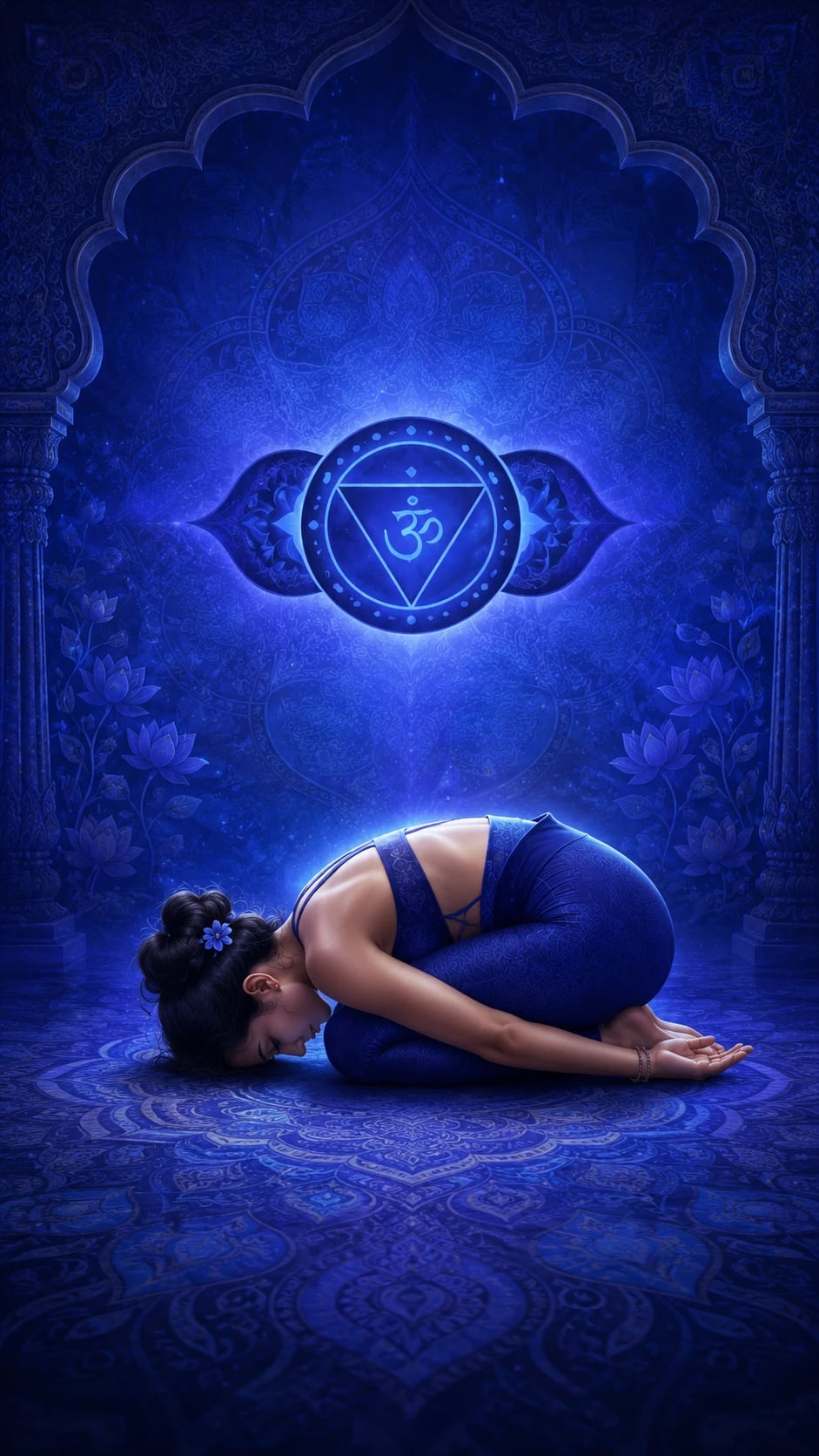
Balasana with forehead pressed to mat (Child's Pose, with direct contact at bhrumadhya)
बालासन
Kneel and fold forward, knees together, forehead resting on the mat. The direct pressure at the third eye region produces gentle stimulation. The most accessible Ajna asana for beginners. Hold for 2 to 3 minutes.
Adho Mukha Svanasana (Downward-Facing Dog)
अधो मुख श्वानासन
Hands and feet on mat, hips lifted, head below heart. Brings blood flow to the head region and creates gentle inversion. Hold for 1 minute. Pairs well as preparation for Dolphin or Shirshasana.
Dolphin Pose (Ardha Pincha Mayurasana)
अर्ध पिञ्च मयूरासन
Forearms on the mat, hips lifted, head and forehead between the forearms. A gentler inversion than full headstand, with the forehead pointing toward the floor. Excellent for Ajna stimulation without the risks of full Sirshasana.
Sirshasana (Headstand)
शीर्षासन
The classical 'king of asanas' and the most direct Ajna stimulation. Crown of head on the mat, legs vertical. Hold for 1 to 5 minutes depending on experience. Advanced practice only — never attempt without an experienced teacher's guidance. Skip in hypertension, cervical issues, glaucoma, and menstruation.
Padmasana with Shambhavi Mudra (Lotus seated with inward upward gaze)
पद्मासन + शाम्भवी मुद्रा
The classical seated posture for Ajna meditation. Cross-legged in Lotus or Half-Lotus, eyes gently directed toward the space between the brows. The most sustainable practice for daily japa. Hold for the duration of your full meditation session.
Pranayama
Anulom Vilom (Alternate Nostril Breathing)
अनुलोम-विलोम
Balancing Ida and Pingala — the two channels that converge at Ajna. Eleven cycles before OM japa creates the most receptive state for third-eye work. The single most important pranayama for this chakra.
Trataka (Steady Gazing)
त्राटक
Steady unblinking gaze at a single point — a candle flame, an OM symbol, an image of an ishta-devata — until the eyes tear and close naturally. Then hold the after-image at bhrumadhya. Directly trains the Ajna faculty. Practise for 3 to 5 minutes at a time, never to the point of strain.
Nadi Shodhana (Advanced Alternate Nostril)
नाडी शोधन
The advanced form of Anulom Vilom with breath retention (kumbhaka). Cleanses the nadis before Ajna concentration. Only attempt after several months of regular Anulom Vilom practice.
Questions & Answers
What is the Ajna or Third Eye Chakra in simple terms?▾
Ajna is the sixth of the seven chakras, located at the space between the eyebrows and slightly above (bhrumadhya). In classical yogic terms, it is the seat of intuition, insight, inner vision, and the discriminative intelligence (buddhi). Where the lower five chakras worked with progressively subtler elements (earth, water, fire, air, ether), Ajna works with the faculty of awareness itself. It is the chakra of inner command — the place from which the deeper knowing that lives beneath thought gives direction to action.
Is the Ajna bija OM or Kṣaṃ?▾
There is genuine traditional complexity here. Most authoritative texts including the Shat-Chakra-Nirupana itself assign OM as the bija of Ajna. However, the two petals of Ajna carry the syllables Haṃ and Kṣaṃ (representing the union of Ida and Pingala), and some teachers and lineages therefore cite Kṣaṃ as a secondary bija. Both are correct depending on which level one is working with. For daily householder sadhana, OM is the standard and most accessible. If a teacher in your specific lineage instructs you to use Kṣaṃ instead, follow that instruction. Eternal Raga uses OM.
How do I know if my Ajna is blocked or imbalanced?▾
Common signs include constant overthinking and analysis paralysis, disconnection from intuition (only trusting what can be logically justified), frequent headaches at the forehead or temples, eye strain, recurring brain fog, poor dream recall, restless sleep in the early morning hours, and the sense of being trapped inside one's own head. Both complete dismissal of subtle perception and its opposite (mistaking every fleeting image for a vision) are imbalance patterns.
How do I chant OM correctly for Ajna meditation?▾
Sit cross-legged with the spine straight. Close the eyes gently. Bring attention to the space between the eyebrows. Chant OM aloud — A from the belly, U rising through the chest, M humming in the skull. Hold the closing M as long as breath allows. That extended M is the part that vibrates the Ajna region. One hundred and eight repetitions is the traditional count. Visualize a soft indigo glow at bhrumadhya, neither bright nor dim, a steady single point.
Should I see things during third eye meditation? Visions, colours, lights?▾
Some practitioners do, some don't. Both are normal. OM japa at Ajna can produce visual phenomena — colours, points of light, geometric patterns, fleeting images. These are real but they are not the goal of the practice. The real fruit of Ajna sadhana shows up later in the day, in moments of decision when the answer arrives without effort, in the unexpected clarity about a situation that had been confusing. Do not chase visions. They are weather. The knowing is climate. Practitioners who see nothing and experience only quiet attentiveness are doing the practice correctly.
Can children do third eye meditation?▾
Gentle OM chanting is fine for children of any age. Focused concentration at bhrumadhya — pulling attention forcefully to the third eye for extended periods — should wait until the prefrontal cortex has matured around age 16 to 18. The chakra is not damaged by early practice, but the developing nervous system can become destabilised by sustained intense Ajna work in the way it would not by Anahata or Vishuddha practice. Let children chant Om Gan Ganpataye, Hanuman Chalisa, and Gayatri instead — these are complete spiritual practices that are entirely safe at any age.
Is opening the third eye dangerous?▾
The phrase 'opening the third eye' is loaded with cinematic associations that are not faithful to the classical tradition. Authentic Ajna sadhana, practised gradually with sensible duration limits and after some foundation work at the lower chakras, is safe for healthy adults. The genuine risks come from forcing concentration before the lower chakras are stable, attempting advanced practices without a teacher, or treating dramatic experiences as the goal. Practitioners with a history of migraine, seizure, or psychiatric conditions should consult both a teacher and their physician before extended Ajna work. Approached sensibly, this chakra meditation is one of the most beneficial practices an adult Indian householder can undertake.
What is the connection between Ajna and the pineal gland?▾
The pineal-gland-as-third-eye framing comes primarily from twentieth-century Western esoteric traditions, including Theosophy and certain New Age sources. The classical Indian Tantric tradition does not equate Ajna with any specific physical organ. The mainstream chakra interpretation associates Ajna with the pituitary gland in modern terms; the New Age interpretation associates it with the pineal. Both are modern overlays on a tradition that originally treated Ajna as a chakra of subtle awareness rather than an anatomical structure. Claims about DMT production, fluoride calcification, and similar topics are not part of the classical tradition. They may or may not have scientific merit, but they should not be confused with what the Shat-Chakra-Nirupana actually says.
Daily Affirmation
I trust my inner wisdom. I see clearly with the eye of awareness.
मैं अपने अन्तर्ज्ञान पर भरोसा करता हूँ। मैं चेतना के नेत्र से स्पष्ट देखता हूँ।
Explore Further
Classical Source
Shat-Chakra-Nirupana (षट्-चक्र-निरूपण) — Purnananda Swami (1577 CE (composed in Bengal)). Sir John Woodroffe (Arthur Avalon), 'The Serpent Power: The Secrets of Tantric and Shaktic Yoga' (1918).
Modern wellness sources often equate Ajna with the pineal gland and make extensive claims about DMT, fluoride calcification, and similar topics. These claims are largely from twentieth-century Western esoteric traditions, not from classical Indian Tantra. The classical tradition does not specify a physical organ for Ajna and treats it as a chakra of subtle awareness rather than a gland. Eternal Raga stays close to the classical sources. Where modern frameworks are mentioned, they are clearly distinguished from the traditional understanding.
← Previous
Vishuddha
Throat Chakra
Next →
Sahasrara
Crown Chakra