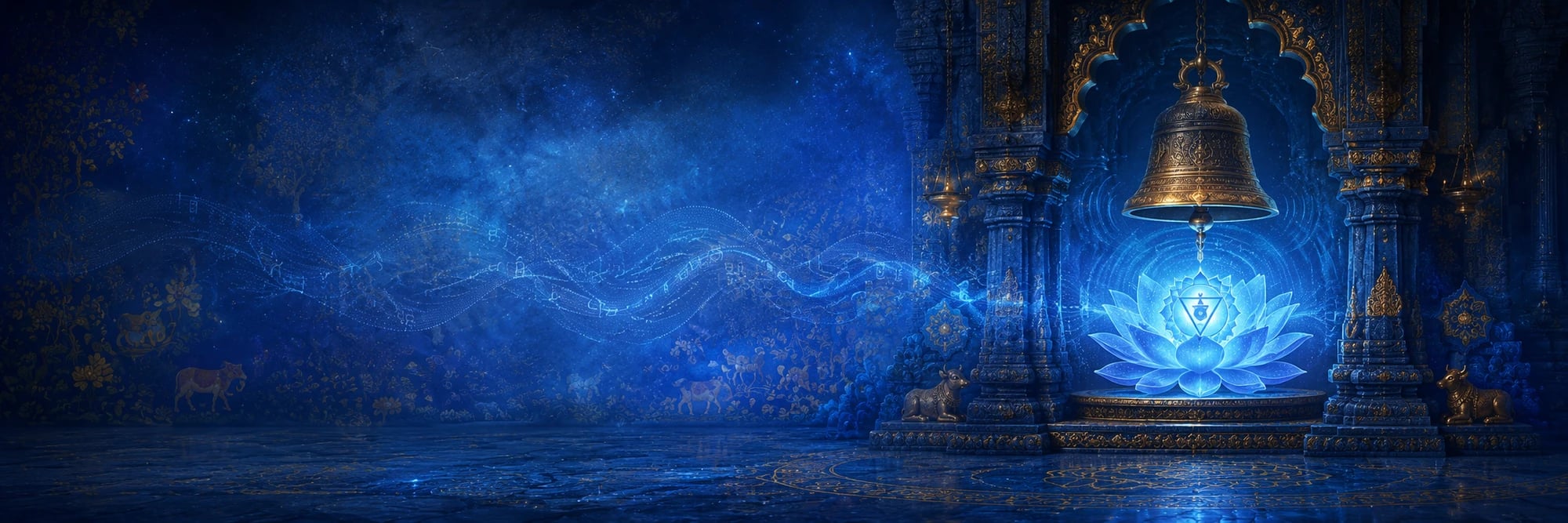
Chakra 5 of 7
Vishuddha Chakra
The Chakra of Voice and Truth
Viśuddha literally means 'especially pure' or 'thoroughly purified.' Vi (especially, intensively) plus śuddha (pure). The name points to the refinement that begins at this chakra — the place where the rough material of the lower body has been transmuted into something subtler, where speech itself becomes capable of carrying truth without distortion.
विशुद्ध का शाब्दिक अर्थ है 'विशेष रूप से पवित्र' अथवा 'भली प्रकार शुद्ध।' वि (विशेष, गहन) तथा शुद्ध (पवित्र)। यह नाम उस परिष्कार की ओर संकेत करता है जो इस चक्र पर आरम्भ होता है, जहाँ निचले शरीर की स्थूल सामग्री सूक्ष्म रूप में परिवर्तित हो चुकी होती है।
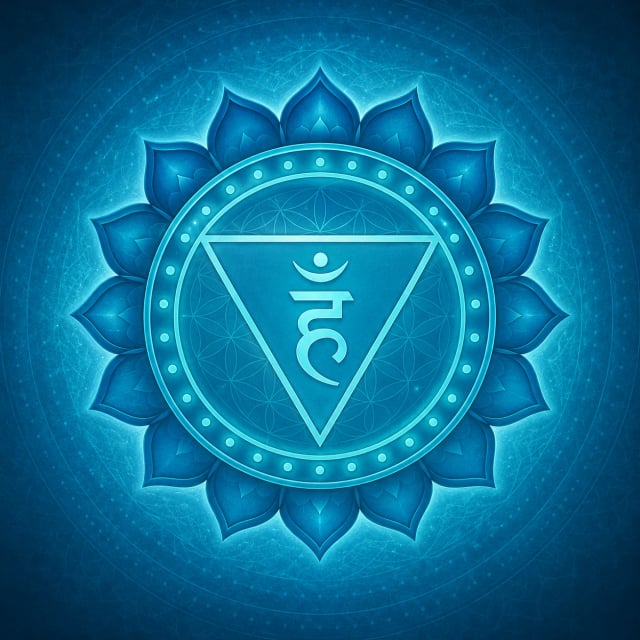
Vishuddha is the chakra of the especially pure. Viśuddha — vi (especially, intensively) plus śuddha (pure) — names a quality that the higher chakras share but that begins here: the refinement where the rough material of the lower body has been transmuted into something subtler. The Tantric texts describe Vishuddha as a smoke-blue lotus of sixteen petals blooming at the throat, with a white circle of full-moon brilliance at its centre and the seed-syllable Haṃ resonating within. The sixteen petals carry the sixteen vowels of Sanskrit — the entire matrix of sacred vowel sounds, the building blocks of every mantra ever uttered.
This is the chakra of communication, but not communication in the flattened modern sense of 'getting your message across.' Vishuddha governs the deeper question: what is the truth, and have I yet found the form for it? The chakra is the meeting-point where inner experience must take the shape of language to enter the world. Almost everyone in modern life has known the experience of holding a truth in the body that refuses to find words, or of finding words that betray the truth they were meant to carry. Both are Vishuddha doing its work imperfectly. Both heal with practice.
Where the lower chakras worked with the four gross elements — earth, water, fire, air — Vishuddha works with the fifth element, the subtle one. Ākāśa, ether or space. Space is the medium through which sound travels. Without space there is no sound, and without sound there is no communication. This is why the chakra at the throat is also the chakra of ākāśa, and why Sanskrit philosophy treats sound as something almost cosmic rather than merely human. Mantras work because of the specific configuration of mouth and breath and intention. That configuration meets space, and space carries the vibration into the practitioner's subtle body and onward.
In the modern Indian context, Vishuddha speaks especially to anyone working against the gravitational pull of generations of silence. The Indian woman who is the first in her family to negotiate her salary out loud, or to disagree with her father-in-law in front of the family, or to publish under her own name what older relatives think a woman should not say. The young person whose viva voce or job interview freeze comes from a school that punished questions, not from a lack of preparation. The senior whose voice has been growing quieter for years because someone in the household has been growing louder. None of this is character failure. It is what an inherited silence looks like when it has lodged in the throat chakra.
The bija mantra Haṃ is chanted with attention at the throat, the chin very slightly tucked, sitting tall. The 'H' is open and unforced, an aspirated breath from deep in the throat. The closing nasal 'M' vibrates exactly where the chakra is seated. Sustained Haṃ japa produces immediate physiological effects. The vagus nerve responds to throat vibration, the voice clears, the dryness common in anxious speakers softens. By the thirtieth repetition many practitioners feel old held sentences begin to surface — things one has long known how to say but has never said. Note them mentally. Speak them later if appropriate. Do not force the speech in the practice itself. The practice is the soil, not the harvest.
A cultural note worth mentioning. The Vishuddha chakra is blue. Lord Shiva, in the popular Samudra Manthan story, drank the halahala poison and held it at his throat, which turned blue — and hence Shiva's name Neelkanth, the blue-throated one. The classical Tantric texts do not explicitly equate the Vishuddha chakra colour with Neelkanth iconography, but the connection lives in the popular Indian imagination for a reason. The throat is the place where what cannot be swallowed and cannot be released must be held. Shiva at Neelkanth shows what mastery of that holding looks like. The chakra at the throat asks every practitioner to do something similar at the human scale — to hold what must be held, to release what must be released, and to know the difference.
The formal presiding deity is Sadashiva, often depicted with five faces in panchavaktra form representing speech in all its directions. But the popular devotional life of India has always associated this chakra most directly with Saraswati, the goddess of speech, learning, music, and the river of wisdom. The Saraswati Vandana that children recite at the start of every school year is in subtle terms a Vishuddha invocation. So is the Aim bija mantra. So is the discipline of classical Indian music, which trains the voice through years of vocal exercises that the Tantric tradition would recognise as throat-chakra cultivation by another name.
viśuddhe sadāśivo vāṇīṃ mama pūtāṃ karotu
May Sadashiva at Vishuddha purify my speech.
Signs of Balance & Imbalance
When Balanced
- ✓Speaking truth without aggression and without apology
बिना आक्रामकता और बिना क्षमायाचना सत्य बोलना
- ✓Listening fully before responding, not merely waiting for one's turn to speak
उत्तर देने से पूर्व पूर्ण श्रवण
- ✓Creative expression in writing, song, teaching, or any voice-based work feels alive
लेखन, संगीत, शिक्षण में रचनात्मक अभिव्यक्ति सजीव अनुभव होती है
- ✓A clear, resonant voice that lands when one speaks
स्पष्ट, गूँजती वाणी
- ✓Easy capacity to say 'no' without elaborate justification
बिना विस्तृत स्पष्टीकरण के 'नहीं' कहने की सहज क्षमता
- ✓Healthy thyroid function, supple neck, free swallow
स्वस्थ थायरॉइड, लचीला कण्ठ, सहज निगलना
When Imbalanced
- ✗Swallowing one's truth in meetings, family conversations, doctor's appointments
बैठकों, पारिवारिक वार्ताओं, चिकित्सक के पास अपना सत्य निगल जाना
- ✗Talking too much without listening, or going completely silent under pressure
अति-वाचालता अथवा दबाव में पूर्ण मौन
- ✗Frequent sore throat, hoarseness, recurrent laryngitis
बार-बार गले की खराश, स्वर-भंग, गले की सूजन
- ✗Thyroid issues — hypothyroidism, hyperthyroidism, autoimmune thyroid conditions
थायरॉइड समस्याएँ
- ✗Difficulty saying 'no' or asking directly for what is needed
अस्वीकार या प्रत्यक्ष माँग की कठिनाई
- ✗Chronic tightness in jaw, neck, shoulders — the upstream signs of held speech
जबड़े, गले, कन्धों में दीर्घकालीन जकड़न
- ✗Sense that one's voice does not match one's age or position — too soft, too small, too apologetic
वह अनुभव कि आपकी आवाज़ आपकी आयु या स्थिति से मेल नहीं खाती
Practices
Japa, visualization, mudra and timing for this chakra
Bija Mantra
Hung — open aspirated 'H' from deep in the throat (not forced), short 'a' as in 'sun', closing with a soft nasal 'M' that vibrates exactly where the throat meets the chest
Japa Instructions
Sit in Sukhasana or Padmasana with the spine very straight, the crown of the head lifting gently upward. Tuck the chin very slightly — not pressed down, just the soft Jalandhara Bandha that brings awareness to the throat. Close the eyes. Place the right hand at the throat, fingertips at the laryngeal centre, not pressing. Chant Haṃ aloud one hundred and eight times. Allow the open 'H' to come from the back of the throat, the closing nasal 'M' to vibrate beneath your fingertips. Visualize a smoke-blue lotus opening at the throat with a white moon inside.
सुखासन या पद्मासन में बैठें, रीढ़ अत्यन्त सीधी, सिर का मुकुट ऊपर की ओर। ठोढ़ी हल्की दबी हुई। आँखें बन्द करें। दायाँ हाथ कण्ठ पर रखें, अंगुलियाँ स्वर-यन्त्र पर, बिना दबाव। हं का १०८ बार जप करें, खुले 'ह' को कण्ठ की गहराई से, बन्द होते 'म' को अंगुलियों के नीचे अनुभव करते हुए।
Visualization
A sixteen-petalled smoke-blue lotus at the throat, opening with each repetition. Inside the lotus, a downward-pointing triangle. Inside the triangle, a perfectly round full moon — pure white, cool, luminous. The seed-syllable Haṃ glows softly within the moon. With each chant, the moon brightens. With each silence between chants, the moon steadies.
Mudra
Jalandhara Bandha (Throat Lock — gentle form)
Sitting tall, take a slow deep inhale through the nose. At the top of the breath, gently lower the chin toward the notch at the top of the sternum — not crushing, just settling. Hold the breath here for as long as is comfortable, then raise the chin and exhale slowly. This is the foundational throat-lock of Hatha Yoga and the most direct mudra for Vishuddha. Practise three to five rounds before japa.
Timing & Duration
Minimum
Ideal
Extended
Early morning (5–7 AM), before the day's first speech. This is the foundational principle: speak Haṃ before speaking anything else, and the rest of the day's speech is subtly aligned. Also highly effective before any significant conversation, presentation, viva voce, interview, or teaching session — eleven minutes thirty minutes before clears the voice and steadies the nervous system.
Haṃ japa awakens vagal tone through throat vibration, which produces immediate physiological calming. Within thirty chants, the voice often clears noticeably — a slight dryness or constriction that you may not have realised was there softens away. Around chant 50 to 70, suppressed truths often surface — inner sentences you have wanted to say to someone for a long time. The temptation is to use the practice to plan the speech. Resist this. Note the sentences mentally and return to the bija. The chakra is doing its work; what to say and when to say it will emerge afterward with much more clarity than what your planning mind would have produced. After 108, sit silently with eyes closed for at least two minutes.
Cautions
- !Active sore throat or laryngitis — practise silently (mental chanting) rather than aloud until inflammation settles
- !Diagnosed thyroid conditions — Haṃ japa is generally safe and supportive but should not replace your endocrinologist's prescribed treatment; let your physician know you have added this practice
- !Cervical spine issues or recent neck injury — skip Jalandhara Bandha and the chin-tuck; practise with spine upright and chin level
- !Pregnancy — gentle Haṃ japa is safe at every stage; avoid intense Jalandhara Bandha in the third trimester

Yoga Pose
Modern India Context
How this chakra shows up in everyday Indian life
Recommended Asanas
Matsyasana (Fish Pose)
मत्स्यासन
Lie on the back with a bolster under the upper back, the head dropping back gently. Opens the throat passively and stimulates the thyroid region. The most accessible Vishuddha asana for beginners. Hold for 1 to 3 minutes.
Sarvangasana (Shoulder Stand)
सर्वाङ्गासन
Often called 'queen of asanas' for its endocrine effects. Directs blood flow toward the thyroid region. Hold for 1 to 5 minutes depending on experience. Skip during menstruation, in untreated hypertension, and with cervical spine injury.
Halasana (Plow Pose)
हलासन
Natural progression from Sarvangasana — legs extend overhead to the floor behind the head. The chin is locked at the chest, creating spontaneous Jalandhara Bandha. The most direct throat-chakra asana in the Hatha tradition. Approach carefully; not for beginners.
Setu Bandhasana (Bridge Pose)
सेतुबन्धासन
Lie on the back, knees bent, lift the hips while the upper back and shoulders ground. Opens the throat from below without inversion. Excellent restorative alternative for those who cannot do shoulder stand.
Simhasana (Lion Pose)
सिंहासन
Seated, open the mouth wide, stick the tongue out as far as possible, roar a long 'haaaa' from deep in the throat. The most playful and most direct throat-releasing asana. Excellent for chronic throat tension and singers warming up.
Pranayama
Ujjayi (Victorious / Ocean Breath)
उज्जायी
Slow conscious breath with a soft constriction at the back of the throat, producing the characteristic ocean-like sound on both inhale and exhale. The most directly Vishuddha-targeted pranayama. Practise 11 cycles before HAM japa.
Bhramari (Humming Bee Breath)
भ्रामरी
Close the ears with the index fingers, hum a long bee-like sound on the exhale. The vibration travels through the throat region and calms the entire vagal axis. Perfect preparation for HAM japa or for any high-stakes speaking event.
Sheetali (Cooling Breath)
शीतली
Inhale through a curled tongue, exhale through the nose. Cools the throat directly and is especially useful in hot conditions or for those with chronic throat inflammation.
Questions & Answers
What is the Vishuddha or Throat Chakra in simple terms?▾
Vishuddha is the fifth of the seven chakras, located at the throat at the level of the laryngeal centre. In classical yogic terms, it is the seat of voice, truth, sacred speech, and authentic self-expression. Its element is ākāśa (ether or space), the subtlest of the five elements and the medium through which all sound and communication travel. The chakra governs not just talking but the deeper meeting point where inner truth must take the form of language to enter the world.
How do I know if my Vishuddha is blocked or imbalanced?▾
Common signs include swallowing your truth in meetings, family conversations, or at the doctor's office; either talking too much without listening or going completely silent under pressure; frequent sore throat, hoarseness, or recurrent laryngitis; thyroid issues including hypothyroidism, hyperthyroidism, or autoimmune thyroid conditions; difficulty saying 'no' or asking directly for what you need; and chronic tightness in the jaw, neck, and shoulders — the upstream physical signs of held speech.
How do I chant the HAM mantra correctly?▾
Sit cross-legged with the spine very straight. Tuck the chin very slightly — not pressed down, just settling. Place the right hand at the throat, fingertips at the laryngeal centre without pressing. Close the eyes. Chant Haṃ aloud one hundred and eight times — open 'H' from the back of the throat (an aspirated breath, not forced), short 'a' as in 'sun', closing with a nasal 'M' that vibrates beneath your fingertips. By the thirtieth repetition the voice typically clears noticeably.
Can throat chakra meditation help with thyroid issues?▾
It is energetically supportive of the same anatomical region, which is why daily Haṃ japa is often recommended alongside conventional thyroid treatment. The practice is generally safe for all thyroid conditions and many patients report noticeable improvement in throat-related symptoms with consistent practice over six months. However, this is supportive, not substitutive. Continue all medical care your endocrinologist has prescribed, do not self-adjust your medication, and report any noticeable changes to your physician so they can monitor your blood work appropriately.
Can it help with public speaking, viva voce, or interview anxiety?▾
Yes, and this is one of the most directly useful applications for modern Indian students and professionals. The common 'I know the answer but I cannot get the words out' freeze is a Vishuddha pattern, not a knowledge problem. Eleven minutes of HAM japa the morning of the speaking event clears throat tension and steadies the nervous system. For chronic interview anxiety, build a 40-day practice ahead of the major test. Combine with reading aloud from your subject matter for 10 minutes daily — the throat needs to be exercised, not just rested.
Why are there 16 petals, and what are the syllables on them?▾
The sixteen petals of Vishuddha carry the sixteen vowels of Sanskrit — A, Ā, I, Ī, U, Ū, Ṛ, Ṝ, Ḷ, Ḹ, E, Ai, O, Au, and the two breath-sounds anusvara (Aṃ) and visarga (Aḥ). These sixteen vowels are the complete matrix of sacred vowel sounds; every mantra ever uttered is built from them. Vishuddha is named for this completeness — it is the chakra where the building blocks of all sacred speech are held. The number sixteen is not arbitrary. It is the count of the Sanskrit vowel set, and it has been so for at least three thousand years.
Why is Saraswati so often associated with this chakra?▾
The formal Tantric attribution names Sadashiva (a form of Shiva with five faces representing speech in all directions) as the deva and Shakini as the shakti. But the living devotional life of India has always associated this chakra most directly with Saraswati, the goddess of speech, learning, music, and the river of wisdom. The Saraswati Vandana that children recite at the start of every school year is in subtle terms a Vishuddha invocation. The Aim bija mantra dedicated to Saraswati is also a Vishuddha practice. Many singers and writers in India have done complete Vishuddha sadhana through Saraswati upasana without ever using the chakra vocabulary.
Is the Vishuddha chakra related to Lord Shiva's Neelkanth (blue-throated) form?▾
Yes, in the popular Indian imagination, though the classical Tantric texts do not make the connection explicit. In the Samudra Manthan story, Shiva drank the halahala poison that emerged from the churning of the cosmic ocean and held it at his throat to protect creation, which is why his throat turned blue and he is called Neelkanth. The Vishuddha chakra is also blue and is located at the throat. The connection lives in the popular imagination for a reason: the throat is the place where what cannot be swallowed and cannot be released must be held. Neelkanth Shiva shows what mastery of that holding looks like, and Vishuddha is the chakra that asks every practitioner to do something similar at the human scale.
Daily Affirmation
I speak my truth with clarity, courage, and kindness.
मैं अपना सत्य स्पष्टता, साहस और दया से बोलता हूँ।
Explore Further
Classical Source
Shat-Chakra-Nirupana (षट्-चक्र-निरूपण) — Purnananda Swami (1577 CE (composed in Bengal)). Sir John Woodroffe (Arthur Avalon), 'The Serpent Power: The Secrets of Tantric and Shaktic Yoga' (1918).
Modern wellness sources frequently translate Vishuddha as 'self-expression' in flattened psychological language. The classical tradition is both more precise and more demanding. Vishuddha is the chakra of sacred speech — vāk — and the philosophical lineage that flows through it includes the Sanskrit grammarian tradition, the music-theory tradition (sangita-shastra), and the entire teaching of mantra-shastra. Eternal Raga stays close to these classical lineages while presenting the practice in language accessible to contemporary Indian life.
← Previous
Anahata
Heart Chakra
Next →
Ajna
Third Eye Chakra