Chakra 7 of 7
Sahasrara Chakra
The Thousand-Petalled Lotus
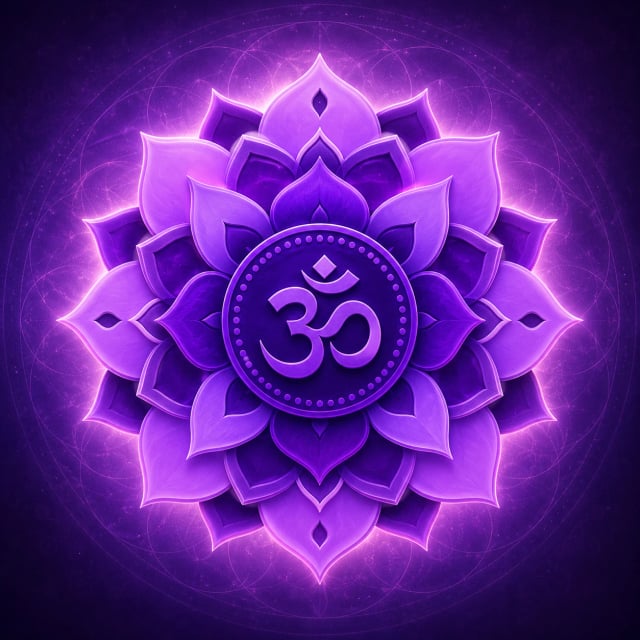
Sahasra means 'thousand.' Āra means 'spoke,' 'ray,' or 'petal' — the rays radiating from a central hub. Together: 'the thousand-petalled.' The thousand petals are not literally a thousand distinct syllables. They are the fifty Sanskrit varnas (the complete sound matrix) repeated twenty times — every possible sacred sound gathered into one supreme bloom. Sahasrara contains the matrices of all the lower chakras within itself.
सहस्र का अर्थ है 'हज़ार।' आर का अर्थ है 'किरण' अथवा 'पंखुड़ी।' मिलकर: 'सहस्र-दल।' सहस्र पंखुड़ियाँ वस्तुतः हज़ार अलग-अलग ध्वनियाँ नहीं हैं। ये पचास संस्कृत वर्ण हैं जो बीस बार दोहराए गए, समस्त पवित्र ध्वनियों का पूर्ण मातृका। सहस्रार के भीतर निचले सभी चक्रों की मातृकाएँ निहित हैं।
Sahasrara is the chakra of the thousand-petalled lotus. Sahasra (thousand) plus āra (spoke, ray, petal). The Tantric texts describe it as a lotus of a thousand petals blooming above the crown of the head, every petal a different colour, the seed-syllable in some traditions OM and in others simply silence. The thousand petals are not literally a thousand distinct syllables. They are the fifty Sanskrit varnas — the complete sound matrix — repeated twenty times, representing every possible sacred sound gathered into one supreme bloom. Sahasrara contains the matrices of all the lower chakras within itself.
This is the chakra that modern wellness vocabulary has flattened most severely. English-language popular culture talks about 'opening the crown chakra' as if it were a technique like opening a stuck window. The Indian tradition has been clearer. Sahasrara cannot be opened by technique. It is uncovered, not built. The work of the lower six chakras — every chakra below it — is preparation. When the preparation is sufficient, the crown chakra reveals what was already there. When the preparation is insufficient, technique applied directly at the crown produces something that can look like awakening from the outside but is in fact destabilising in ways that take years to recover from.
This is why every authentic teacher in every Indian lineage says the same thing. Do not start with Sahasrara. Work the lower chakras first. Even within a single day's practice, the order matters. Always activate bottom-up. Crown-first work without the ground stability of Muladhara, the emotional flow of Svadhisthana, the will of Manipura, the love of Anahata, the truth of Vishuddha, and the discernment of Ajna is the most common cause of meditation-induced anxiety, spiritual bypassing, and the bitter disappointment that follows a dramatic experience that does not durably change the person who had it.
If the lower chakras asked questions — am I safe, what do I feel, what will I do, whom do I love, what is true, what do I know — Sahasrara does not ask a question. The questioning faculty itself comes to rest here. The Sanskrit teachings sometimes call this state samādhi (literally 'placed together,' the gathered-ness of consciousness in its source). They sometimes call it mokṣa, liberation. They sometimes call it kaivalya, aloneness in the sense of complete fullness rather than isolation. The English word 'enlightenment' carries so much imported baggage that it is probably better not to translate.
The chakra is sometimes described as having no element because it is beyond the elements that the lower chakras govern. Earth, water, fire, air, ether, mind — Sahasrara is what awareness rests in when it is no longer identifying with any of these. The classical description names it as cit or brahman, pure consciousness without an object. The bija is sometimes given as OM but more accurately as Visarga, the silent exhalation that ends all sound. In practice, householder sadhana uses OM softly chanted and then allowed to dissolve into the silence that follows. The silence is the actual practice. The OM is the doorway.
For Indian householders, here is a teaching that the Bhagavad Gita makes explicit and that the chakra system encodes in the same direction. Sahasrara for a grihastha is not realised on a Himalayan cushion. It is realised in daily seva. In the cooking that nourishes the family without resentment. In the school-runs done while still being present to the child. In the elder-care offered without performing one's sacrifice. In the work-day done with attention to its dharma rather than just its outcome. Krishna's entire teaching to Arjuna in the Gita is the householder's instruction manual for Sahasrara: perform the work, surrender the result, recognise that you are not the doer. Chanting Hare Krishna Mahamantra at the kitchen sink can be deeper Sahasrara practice than an hour of crown-focused meditation in a quiet room.
The popular Indian practice that touches Sahasrara most directly is also one of the most ordinary: sashtang pranam, the full-body prostration. Eight points of the body — feet, knees, hands, chest, and forehead — touching the earth at the feet of a deity, a teacher, or a parent. The forehead and the crown both touch the ground. The body has surrendered its verticality. The ego has surrendered its claim to be the doer. The chakra at the crown receives what it could not receive while the head was held high. Indian children do this every day in temples without anyone teaching them chakra theory. The chakra theory came centuries later to explain what the practice was already accomplishing.
The presiding deity is Parashiva, the formless absolute, beyond name and form, beyond even the dualities that Ardhanarishwara at Ajna had integrated. At Sahasrara, Shiva and Shakti are not two-as-one. They are simply the one, naming itself in two ways. For Indian devotees, this is also the chakra associated with the inner Guru-tattva — the principle of teacherhood that lives in the heart of every authentic guru and ultimately in the heart of every sincere seeker. The guru outside is real and important. The guru inside is what the outside guru has been pointing toward all along.
sahasrāre paraṃ brahma sarvavyāpi namāmyaham
I bow to the Supreme Brahman that pervades all, seated at Sahasrara.
Signs of Balance & Imbalance
When Balanced
- ✓Sense of deep belonging to something larger than oneself, neither dramatic nor easily articulated
अपने से बड़े सत्य से जुड़ाव का गहरा अनुभव, न नाटकीय न आसानी से शब्दों में बयान करने योग्य
- ✓Equanimity that is not detachment — joy and sorrow are received without grasping or pushing away
वह समत्व जो वैराग्य नहीं है, सुख-दुख बिना पकड़ या प्रतिरोध स्वीकार होते हैं
- ✓Effortless awareness as background to daily activity rather than as a special state to attain
दैनिक कार्य के पीछे सहज जागरूकता, प्राप्तव्य विशेष अवस्था नहीं
- ✓Reverence as the natural response to existence itself, neither performed nor manufactured
अस्तित्व के प्रति सहज श्रद्धा, न प्रदर्शित न निर्मित
- ✓Capacity to perform daily work with full attention while remaining un-attached to its outcome (the karma yoga of the Gita)
दैनिक कर्म को पूर्ण ध्यान से करते हुए परिणाम से अनासक्त रहने की क्षमता
- ✓Sense that one's spiritual practice and one's ordinary life are not two different things
वह अनुभव कि साधना और सामान्य जीवन दो भिन्न वस्तुएँ नहीं हैं
When Imbalanced
- ✗Spiritual bypassing — using meditation, spirituality, or religious vocabulary to avoid the actual work of life
साधना को जीवन के वास्तविक कार्य से बचने के लिए उपयोग करना
- ✗Deep existential disconnection, persistent sense that nothing means anything
अस्तित्व-वियोग, अर्थहीनता का स्थायी अनुभव
- ✗Religious or spiritual rigidity, or, opposite, complete dismissal of the sacred dimension
धार्मिक अथवा आध्यात्मिक कठोरता, अथवा पवित्र आयाम का पूर्ण अस्वीकार
- ✗Chronic headaches at the crown of the head, sleep disturbances, sensitivity to light
मस्तक-शिखर पर दीर्घकालीन सिरदर्द, निद्रा-भंग, प्रकाश-संवेदनशीलता
- ✗Treating spiritual experiences as achievements to compare with others, or as proof of one's spiritual status
आध्यात्मिक अनुभवों को दूसरों से तुलना करने योग्य उपलब्धि या आध्यात्मिक स्तर का प्रमाण मानना
- ✗Cynicism about devotional practice that one used to find meaningful, without anything to replace it
उस भक्ति-साधना के प्रति सन्देह जो कभी अर्थपूर्ण लगती थी, बिना उसके स्थान पर कुछ और
- ✗Inability to find satisfaction in ordinary work because it has been judged 'not spiritual enough'
सामान्य कार्य में सन्तुष्टि न पाने की स्थिति क्योंकि वह 'पर्याप्त आध्यात्मिक' नहीं माना गया
Practices
Japa, visualization, mudra and timing for this chakra
Bija Mantra
Sahasrara is traditionally beyond sound. In practice, OM is chanted very softly and then allowed to dissolve into the silence that follows. The silence is the actual practice. The OM is the doorway.
Japa Instructions
Sahasrara cannot be 'activated' through technique — it is uncovered, not built. The classical guidance is therefore counter-intuitive. Sit in Padmasana or Sukhasana with the spine straight. Bring the hands together in Anjali Mudra above the crown of the head if able, or rest the hands gently in the lap. Close the eyes. Chant OM very softly one hundred and eight times, allowing each repetition to grow quieter than the one before it, until the last few are nearly silent. Then sit in stillness for at least three minutes. The silence is the actual practice. The OM was only the doorway.
सहस्रार तकनीक से सक्रिय नहीं किया जाता, यह अनावृत होता है। पद्मासन या सुखासन में बैठें, रीढ़ सीधी। हाथ अञ्जलि मुद्रा में मस्तक के ऊपर अथवा गोद में। आँखें बन्द करें। ॐ का १०८ बार जप अत्यन्त मन्द स्वर में करें, प्रत्येक पूर्व से शान्त, अन्तिम कुछ लगभग मौन। तत्पश्चात् कम से कम तीन मिनट मौन। मौन ही वास्तविक साधना है।
Visualization
A thousand-petalled lotus blooming above the crown of the head, every petal a different colour, light flowing both upward (the soul's offering rising) and downward (the divine's blessing descending). The image is one of complete openness in both directions. Do not try to see it sharply. Allow it to be vague, present, immense.
Mudra
Anjali Mudra above the crown (in seated practice) or Sashtang Pranam (full prostration)
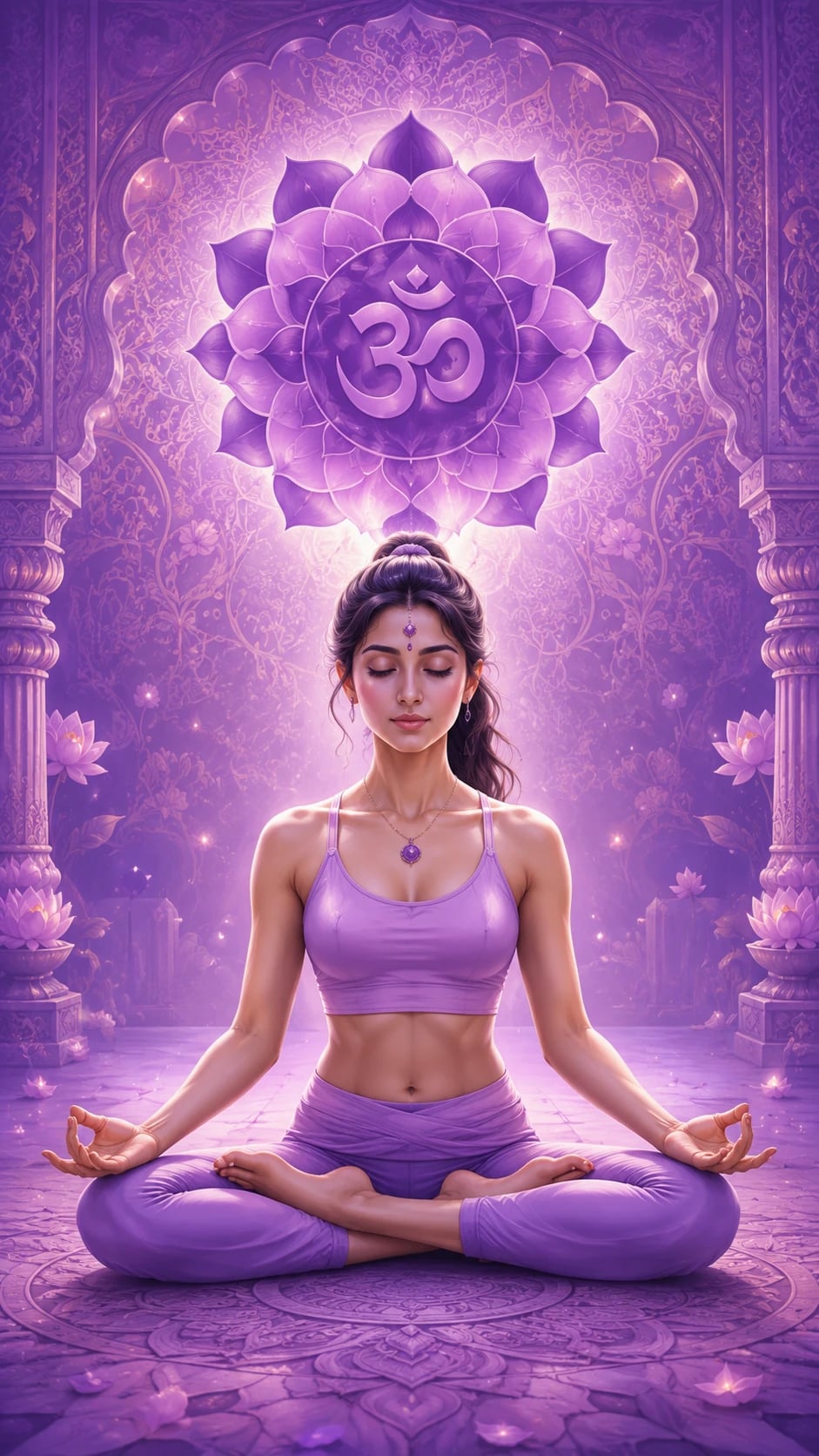
For seated practice: bring the palms together in prayer position and raise them above the crown of the head, arms straight or softly bent. Hold for three slow breaths, then release into the lap. For the more direct Sahasrara practice: sashtang pranam, the full-body prostration, eight points of the body touching the earth — feet, knees, hands, chest, and forehead. The crown and the floor become equal. This is the most accessible and most authentic Sahasrara practice in living Indian devotion.
Timing & Duration
Minimum
Ideal
Extended
Brahma Muhurta (4–6 AM), and only after Muladhara through Ajna have been touched first that session. Sahasrara work without grounding is the most common cause of meditation-induced anxiety. For practitioners new to chakra work, do not approach Sahasrara directly for at least 90 days of daily lower-chakra practice.
Sahasrara meditation properly approached produces a soft expansion at the crown, sometimes a sense of cool nectar (amrit) descending, sometimes a sensation of the head dissolving into space. Often there is no dramatic phenomenon at all — only an unmistakable quiet that lingers for hours after the practice has ended and re-emerges in unexpected moments through the day. Do not seek experience. Cultivate availability. The fruit of Sahasrara sadhana is not a state to be repeated; it is a quality that gradually saturates ordinary life. Practitioners who have been doing this work seriously for ten years describe it as a softening of the boundary between meditation and the rest of life, until the question 'when do you meditate' stops being meaningful.
Cautions
- !Do not approach Sahasrara without prior practice at the lower six chakras — this is non-negotiable, not a suggestion
- !If at any time during practice the head feels light, the body feels disembodied, or reality begins to feel unreal — open the eyes immediately, place both palms on the floor, drink cold water, and end the session
- !Avoid Sahasrara work during active grief, recent major loss, or any period of acute mental health vulnerability
- !If you are on psychiatric medication, in active therapy, or have a history of dissociation, consult both your physician and a competent teacher before any sustained Sahasrara practice
- !Pregnancy: gentle Anjali Mudra and silent OM are safe; intense crown-focused meditation should be paused until postpartum recovery is complete
- !The dramatic Kundalini awakening experiences described in some popular literature are rare, often misidentified, and should not be the goal of practice — if they do occur, immediately seek a teacher trained in your specific lineage
Yoga Pose
Modern India Context
How this chakra shows up in everyday Indian life
Recommended Asanas
Sashtang Pranam (Full-body Prostration)
साष्टाङ्ग प्रणाम
The most authentic Sahasrara asana in living Indian devotion. Eight points of the body — feet, knees, hands, chest, and forehead — touching the earth in complete surrender. Every Indian who has ever prostrated at a temple has done Sahasrara practice without needing the word.
Sirshasana (Headstand)
शीर्षासन
The crown of the head bears the body's weight on the earth. Directly stimulates the Sahasrara region. Advanced practice only — never attempt without an experienced teacher. Skip in hypertension, cervical issues, glaucoma, and menstruation. For most modern practitioners, Sashtang Pranam offers the same energetic benefit with no injury risk.
Padmasana with Anjali Mudra above the crown
पद्मासन + अञ्जलि मुद्रा
The classical seated meditation posture with the palms joined in prayer position raised above the head. Holds the body in alignment with the chakra's vertical axis. Hold for three slow breaths, repeat as needed.
Savasana (Corpse Pose)
शवासन
The pose of complete surrender. Lying flat on the back, arms slightly away from the sides, palms up, eyes closed. The ultimate Sahasrara asana — the body practices what consciousness must learn. Hold for 5 to 20 minutes.
Sukhasana with hands open in lap, palms upward
सुखासन (हथेलियाँ ऊपर)
The simplest posture for daily Sahasrara japa. Palms upward as a receiving gesture, signaling availability rather than effort. Sustainable for extended sessions.
Pranayama
Kevala Kumbhaka (Spontaneous Breath Retention)
केवल कुम्भक
The breath stilling on its own without conscious effort — the highest pranayama in the Hatha Yoga tradition. Cannot be forced. Arises naturally after years of regular practice, sometimes spontaneously during deep meditation. Advanced practice only.
Silent meditation following any pranayama
ध्यान-मौन
The simplest and most appropriate practice for Sahasrara. After any pranayama, sit in silence with attention resting at the crown. Do not chant, do not visualize, do not direct attention forcefully. Simply be available. This is the practice.
Bhramari finishing into silence
भ्रामरी (मौन में समाप्त)
Standard Bhramari humming for 7 to 11 cycles, then sit in the silence that follows for at least three minutes. The silence after Bhramari is unusually soft and is excellent preparation for Sahasrara rest.
Questions & Answers
What is the Sahasrara or Crown Chakra in simple terms?▾
Sahasrara is the seventh and final chakra in the classical system, located at the crown of the head (specifically at brahmarandhra, the subtle opening corresponding to the anterior fontanelle of infants). It is described as a thousand-petalled lotus and is associated with pure consciousness, divine connection, transcendence, and the realisation that the meditator and the meditated are one. Unlike the lower six chakras, Sahasrara does not have an element, an animal symbol, or an active question. It is the chakra of rest, of surrender, of the recognition that what was being sought was the seeker all along.
Why does the tradition say to work Sahasrara last?▾
Because Sahasrara is not opened by technique applied directly at the crown. It is uncovered, gradually, as the lower six chakras are stabilised. Crown-first work without the grounding of Muladhara, the emotional flow of Svadhisthana, the will of Manipura, the love of Anahata, the truth of Vishuddha, and the discernment of Ajna is the most common cause of meditation-induced anxiety, spiritual bypassing, and dramatic experiences that do not durably change the person who has them. Every authentic teacher in every Indian lineage says the same thing: bottom-up, not top-down. This is not a suggestion. It is a structural fact of how the chakra system works.
Is OM really the bija for Sahasrara, or is it silence?▾
Strictly speaking, Sahasrara has no bija mantra. The classical texts say its bija is Visarga (ḥ), the silent exhalation that ends all sound, or simply anāhata nāda, the unstruck inner sound. In practical householder sadhana, OM is used as the closest accessible doorway — chanted very softly and then allowed to dissolve into the silence that follows. The silence is the actual practice. The OM is just the entry point. This is the only chakra where the bija and the silence point in opposite directions and both are correct.
What does 'thousand petals' actually mean?▾
The thousand petals are not literally a thousand distinct syllables. They are the fifty Sanskrit varnas (the complete sound matrix — every consonant and vowel of Sanskrit) repeated twenty times. Fifty multiplied by twenty equals one thousand. Every possible sacred sound is gathered into one supreme lotus. The thousand-ness represents completeness, not anatomical literalism. Sahasrara contains within itself the seed-matrices of all six lower chakras.
Can householders realise Sahasrara, or is this only for renunciates?▾
Yes, householders can absolutely realise Sahasrara, and the Bhagavad Gita is the explicit teaching for exactly this case. Krishna's instruction to Arjuna throughout the Gita is the householder's manual for the crown chakra. Perform the work that your dharma requires, surrender the results, recognise that you are not the doer. For Indian householders, Sahasrara is realised in daily seva — cooking, school-runs, elder-care, work-day attention — not on a Himalayan cushion. Many of the most realised teachers in the Indian tradition were householders, including Janaka, Tukaram, and many others. Renunciation is one valid path, not the only one.
Is enlightenment the goal of Sahasrara meditation? What is samadhi?▾
The English word 'enlightenment' carries so much imported baggage that it is probably better not to translate it. The Sanskrit teachings sometimes use samādhi (literally 'placed together,' the gathered-ness of consciousness in its source), sometimes mokṣa (liberation from the cycle of becoming), sometimes kaivalya (aloneness in the sense of complete fullness rather than isolation). These are not goals to be achieved like degrees or promotions. They are descriptions of what awareness recognises about itself when the chakra has been allowed to reveal what was already there. Treating spiritual realisation as an achievement to be acquired is itself an obstacle to it. The Gita is explicit on this point.
How is Sahasrara different from Ajna? They seem similar.▾
Ajna is the chakra of inner command — buddhi, discriminative intelligence, the seer who looks. Sahasrara is what awareness rests in when it is no longer looking at anything. Ajna integrates the dualities (Shiva-Shakti as Ardhanarishwara, half-male-half-female form). Sahasrara is beyond duality entirely — Shiva and Shakti are not even two-as-one here, they are simply the one. Ajna asks 'what do I know?' Sahasrara does not ask. The questioning faculty itself comes to rest. In practice, Sahasrara cannot be approached without Ajna's discriminative clarity, but it goes one step beyond it.
What is the connection between Sahasrara and the Bhagavad Gita's teaching?▾
The Bhagavad Gita is the householder's manual for the crown chakra, even though it does not use chakra vocabulary directly. Krishna's teaching to Arjuna across all eighteen chapters is one sustained instruction in how to live in such a way that Sahasrara realises itself. Chapter 2 verses 47-50 give the karma yoga foundation: do the work, do not be attached to the fruits. Chapter 6 describes Dhyana Yoga, the meditation practice. Chapter 12 lays out Bhakti Yoga, the path of devotion. Chapter 18 verse 66 — sarva-dharmān parityajya mām ekaṃ śaraṇaṃ vraja, 'abandon all dharmas and surrender to me alone' — is in subtle terms the Sahasrara instruction at its most direct. The chakra system encodes the same teaching in the body's vertical axis.
Daily Affirmation
I am one with the supreme. I rest in pure being.
मैं परम के साथ एक हूँ। मैं शुद्ध अस्तित्व में स्थित हूँ।
Explore Further
Classical Source
Shat-Chakra-Nirupana (षट्-चक्र-निरूपण) — Purnananda Swami (1577 CE (composed in Bengal)). Sir John Woodroffe (Arthur Avalon), 'The Serpent Power: The Secrets of Tantric and Shaktic Yoga' (1918).
This is the chakra where modern wellness vocabulary has done the most damage. The English-language popular culture talks about 'opening the crown chakra' as if it were a technique, and treats spiritual awakening as a consumable experience to be repeated. Both framings depart significantly from the classical tradition. Authentic Sahasrara realisation in the Indian view is gradual, supported by the foundation work of the lower six chakras, and for householders is realised in daily seva rather than in dramatic meditative experiences. Eternal Raga presents the chakra as the living tradition has held it, not as it appears in Instagram-friendly summaries. Where modern claims are addressed in this page, they are clearly distinguished from the traditional understanding.
← Previous
Ajna
Third Eye Chakra