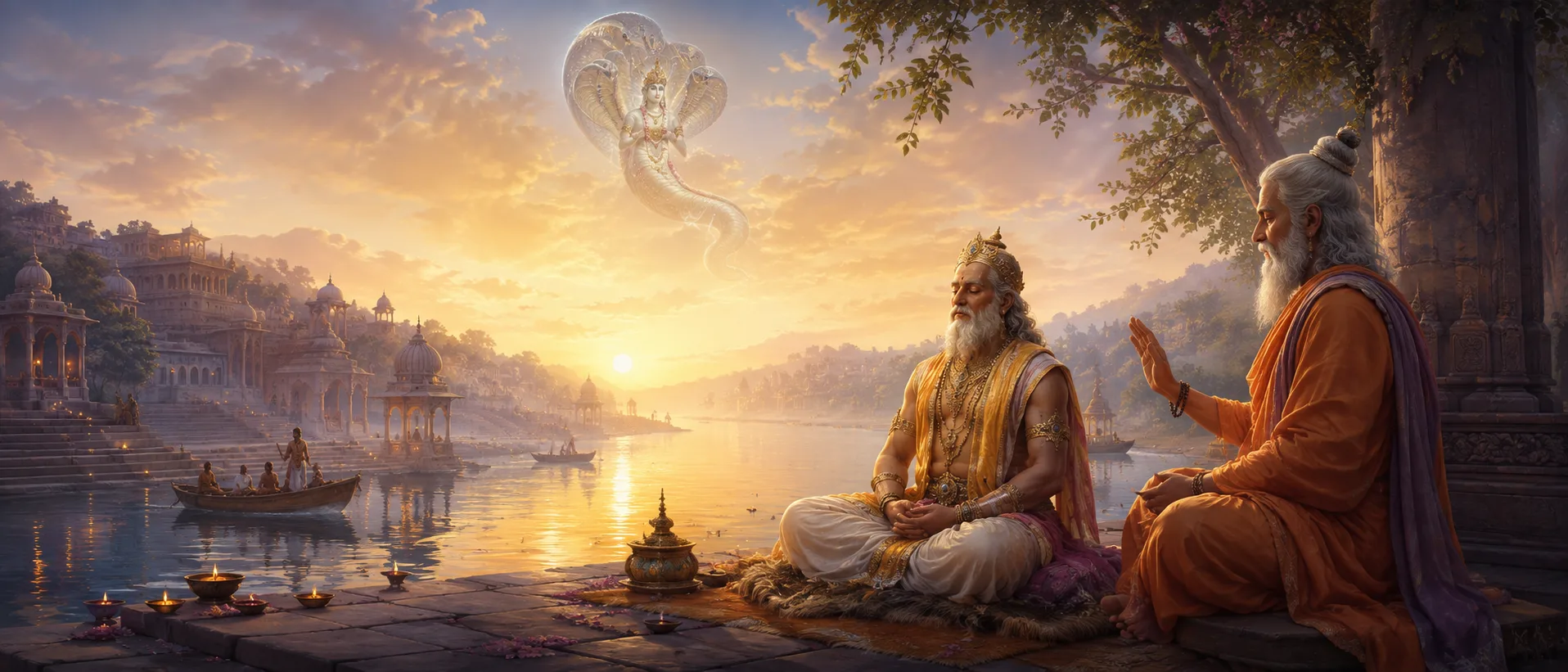
Skandha 12 closes the circle the Bhagavatam opened. King Parikshit, cursed to die within seven days for an unwitting insult, has spent that week listening to Sukadeva's teaching — the entire preceding eleven skandhas were, within the story's own frame, that teaching — and here, at last, the snake-bird Takshaka arrives and the king dies exactly as promised, at peace, his mind fixed on what he has heard. Around this quiet close the skandha assembles the Purana's remaining business: a prophecy of the kings who will rule as the world declines through Kali Yuga, the earth's own complaint at the burden of unrighteous rulers, a systematic account of how a cosmic age actually ends, and the sage Markandeya's vision of dissolution and a child floating alone on a single leaf in the cosmic ocean — an image of Vishnu at the edge of creation itself. In its final movement the text turns to speak about itself: a summary of what each of the eighteen Puranas contains, and then, closing the entire eighteen-thousand-verse work, a glorification of the Bhagavata Purana above all other scripture, ending with the traditional benediction bowing to Hari whose name alone, sung together, destroys every sin.
Chapters
Why it matters today
Skandha 12 answers its own opening question by closing it — a dying man's request for something worth hearing in his final days becomes, eighteen thousand verses later, a text confident enough to end by praising itself, not out of vanity but because by this point it has earned the claim.