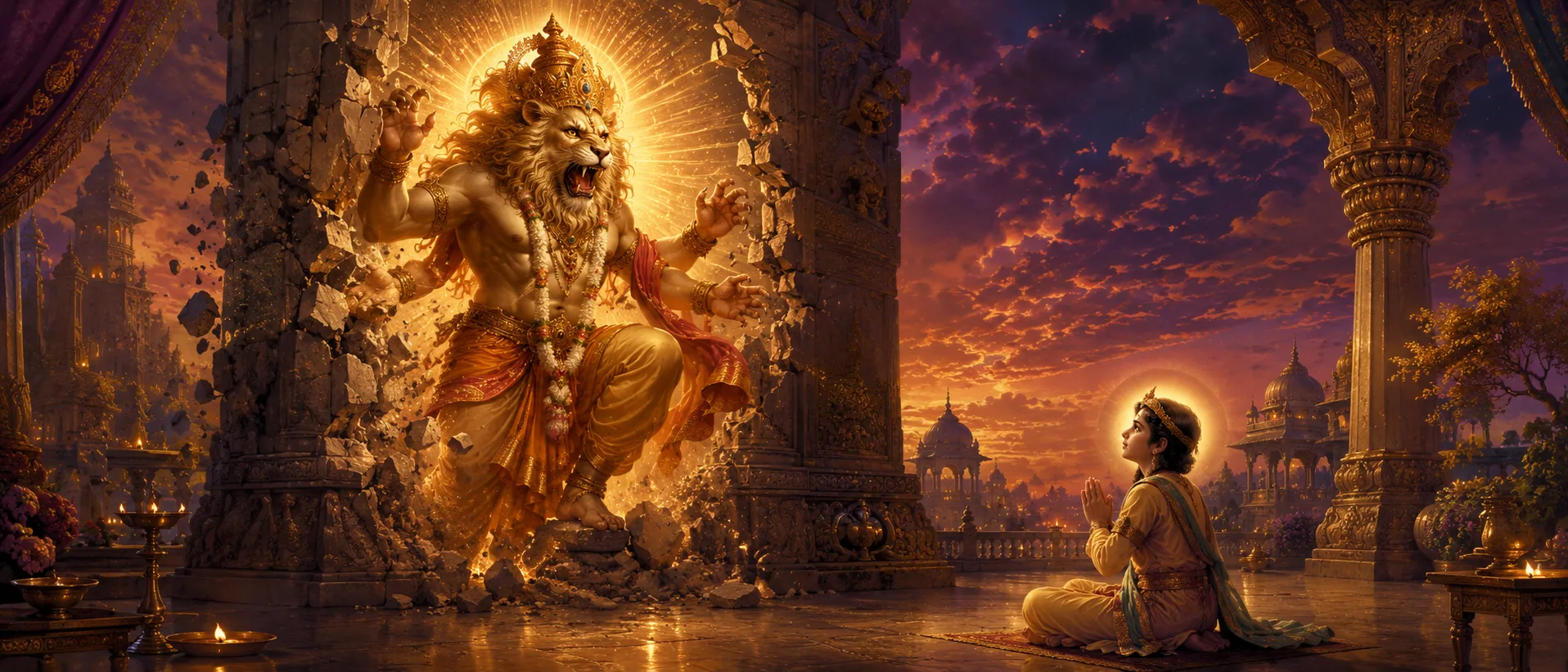
Skandha 7 tells what is perhaps the Bhagavatam's most dramatic story of devotion under siege. Hiranyakashipu, tyrant of the universe by virtue of a boon so carefully worded it seems to leave him no vulnerability, discovers that his own son Prahlada was already a devotee of Vishnu in the womb — a devotion no threat, poison, wild elephant, venomous snake, or cliff-edge can shake, because Prahlada's faith was never built on safety in the first place. Hiranyakashipu's final demand, that Prahlada show him his God in an ordinary pillar, becomes the occasion for Narasimha's appearance: not a violation of the boon's letter but its precise, merciless fulfillment, God arriving exactly where the tyrant swore he couldn't. The skandha's closing chapters step back from narrative into instruction, as Narada lays out the duties of the four social orders and the four stages of spiritual life, and the discipline by which any person, in any station, might walk the same path Prahlada walked without needing a miracle to prove it.
Chapters
Why it matters today
Skandha 7's real subject isn't the miracle at the end but the ordinariness of what precedes it — a child who simply won't be frightened out of what he already knows to be true, tested by every method power has for breaking a person's certainty. Narasimha doesn't arrive to reward cleverness or strength; he arrives because Prahlada never needed him to.