Attahas Shakti Peeth
अट्टहास शक्तिपीठ
Where Satī's lower lip fell, named for Shiva's great laughter
Labpur, West Bengal, India
AṭṭahāsaAlso known as: Attahas Shakti Peetha, Attahas (Dasgram), Phullarā at Attahas, অট্টহাস, মা ফুল্লরা মন্দির, অট্টহাস শক্তিপীঠ, অট্টহাসিনী
Era
Medieval Bengali Shākta site; present temple complex 18th, 19th c. with later additions
Architecture
Modest Bengali āṭcālā tradition in rural Bardhaman setting
Open
06:00 – 20:30
Aarti
06:30 · 12:00 · 19:30
Special
Annual Phullarā Pūjā observance; the small local mela that accompanies it is the year's signature gathering at Attahas
The Sacred Legend · पवित्र कथा
Aṭṭahāsa stands in the country between Katwa and the Bhāgīrathī river, in Purba Bardhaman district, where the philology of three names converge to define a single Peetha. The body-part that fell here is the lower lip, adhara-oṣṭha, of Satī, in the canonical Pīṭhanirṇaya attribution. The Devī enshrined here is Phullarā, 'she who blossoms' or 'she who has expanded', and the place itself is called Aṭṭahāsa, 'great laughter,' from the Sanskrit aṭṭa-hāsa, the name preserving a tradition that Shiva, when carrying Satī's body in his cosmic dance of grief, laughed a fierce laugh at this site. Lip, blossoming, laughter: three names that encode each other. The lip blossoms when it opens, and what opens from the blossoming lip is laughter; the goddess whose lip fell is named for the blossoming, and the place is named for the laughter. Few Peethas in the 51-list hold their philological coherence so tightly. The Bhairava paired with Phullarā in the Pīṭhanirṇaya is Viśveśa, 'Lord of all,' the universal-protective register of Shiva-Bhairava, whose linga is enshrined at Aṭṭahāsa adjacent to the Devī sanctum. The temple sits in modest rural country east of Katwa, near the Bhāgīrathī corridor. The site is smaller in scale than Tarapith, Bakreshwar, or Kankalitala, and lacks the elaborate Tāntric, geological, or literary-modern overlays that distinguish those larger Cluster A neighbours. What Aṭṭahāsa holds, in its compact form, is the philological tightness of the three names, a clean canonical Peetha whose theological identity is fully encoded in the body-part, the Devī-form, and the place-name that the Pīṭhanirṇaya preserves.
Sacred Designationपवित्र पदनाम
Shakti Peeth
Body part: Lower lip (adhara-oṣṭha) per the canonical 51-Peetha attribution preserved in the Pīṭhanirṇaya and the Devī Bhāgavata Purāṇa Saptama Skandha. The Pīṭhanirṇaya is consistent across major recensions on the lip attribution for Aṭṭahāsa, though some sources give the more general 'oṣṭha' (lip) and others specifically the 'adhara-oṣṭha' (lower lip). The corpus uses 'lower lip' as the more specific and commonly attested form.
Shakti: Phullarā, 'she who blossoms,' 'she who has expanded,' the Devī's form at Aṭṭahāsa per the canonical Pīṭhanirṇaya. The name philologically encodes the body-part attribution: the lip blossoms when it opens, and the goddess whose lip fell here is named for that blossoming. Phullarā is depicted in Durgā-register iconography in the temple sanctum, multi-armed, weapons drawn, in the standard Bengali Shākta murti idiom. The integration of Devī-name and body-part is among the cleaner philological alignments in the 51-Peetha geography.
Bhairava: Viśveśa, 'Lord of all,' the universal-protective register of Shiva-Bhairava paired with Phullarā in the Pīṭhanirṇaya. The Viśveśa linga is enshrined within the temple complex adjacent to the Devī sanctum. The name Viśveśa is a broad cosmic register, less localised and less philologically tied to the specific Aṭṭahāsa narrative than Bhīruka is to Bahulā or Ruru to Kankalitala, but the canonical attribution is stable across major Pīṭhanirṇaya recensions.
Sacred Origin Storyपवित्र उत्पत्ति कथा
Source: Pīṭhanirṇaya / Devī Bhāgavata Purāṇa Saptama Skandha / Bengali Shākta sthala-purāṇa
Aṭṭahāsa holds its identity in three names that name each other. The body-part: the lower lip, adhara-oṣṭha, of Satī, which fell here when Viṣṇu's Sudarśana chakra divided her body across the eastern Indian earth. The Devī's name: Phullarā, 'she who blossoms,' the name encoding the blossoming that the lip undertakes when it opens.
The place-name: Aṭṭahāsa, 'great laughter,' from the Sanskrit aṭṭa-hāsa, the name preserving a tradition that Shiva, in his cosmic dance of grief while carrying Satī's body, laughed a fierce laugh at this site, the laugh that comes from the lip that blossoms, the laugh that the goddess of the blossoming lip authorises.
The three names move in a circle. The lip is the body-part; the lip blossoms when it opens; the Devī is the goddess of the blossoming; what opens from the blossoming is laughter; the place is the place of the laughter; the laughter is Shiva's, made over the body whose lip fell there. The circle is theologically tight in a way that few Peetha-attributions sustain.
At Bakreshwar the body-part (manas) is internally philosophical but the connection to the Devī-name (Mahiṣamardinī, named for her work) and the place-name (Bakreshwar, named for the Bhairava) is loose. At Bahulā the Devī-name and body-part align (Bahulā / bāhu) but the place-name (Ketugram) is separate.
At Kankalitala the body-part and place-name align (kaṅkāla / Kaṅkālītalā) but the Devī-name (Devagarbhā) is cosmologically separate. At Aṭṭahāsa all three converge.
The Pīṭhanirṇaya preserves this attribution: body-part adhara-oṣṭha, Devī Phullarā, place Aṭṭahāsa, Bhairava Viśveśa. The canonical text is stable across Bengali Shākta and Sanskrit Tāntric recensions on this triplet. Local Bengali sthala-purāṇa preserves a narrative voicing of the story: Shiva, in the wandering grief that followed Satī's death, came to the curve of this land east of Katwa with her body; the Sudarśana chakra moved through her, the lip fell, and Shiva laughed, the aṭṭa-hāsa whose echo names the place.
The laugh in the local narrative is not joyful; it is fierce, terrible, the kind of laughter that the cremation-ground register of Bengali Shākta tradition has theological room for. It is the laugh of the god whose wife has died and whose grief has not yet found its other form; the laugh names the place because it is the moment before the grief has found its form.
The Devī here, Phullarā, holds the blossoming of that moment. To open the lip is to laugh, to weep, or to speak; Phullarā is the Devī of the blossoming itself, before the blossoming has chosen between expressions. The pilgrim who comes to Aṭṭahāsa comes to a Peetha that holds a particular moment of the Shakti-Peetha narrative, the moment when the body-part falls and the cosmic registers of grief and laughter and divine speech are still gathered together in a single lip's opening.
Sources cited:
- Pīṭhanirṇaya / Mahāpīṭhanirūpaṇa (canonical 51-Peetha enumeration; Aṭṭahāsa with body part adhara-oṣṭha, Devī Phullarā, Bhairava Viśveśa)
- Devī Bhāgavata Purāṇa, Saptama Skandha
- Attahas local sthala-purāṇa (Bengali, preserved in temple administration)
- Bengali Shākta literature on the Rāḍh Bengal Devī circuit
- Sanskrit etymological tradition on aṭṭa-hāsa and the philology of the three names
Other Traditions · अन्य परंपराएँ
Vaishnava-Shakta cross-traffic reading at the Bhāgīrathī corridor
A first alternate tradition, regionally significant given Aṭṭahāsa's location near the Bhāgīrathī corridor that historically channeled the Chaitanya-tradition Vaishnava pilgrim circuit through Bardhaman-Birbhum-Murshidabad, reads the temple within a Vaishnava-Shakta cross-traffic frame similar to but distinct from the Bahulā Ketugram pattern.
Local Vaishnava pilgrims travelling the Bhāgīrathī corridor have historically included Aṭṭahāsa as a darśana point alongside the Vaishnava sites of Katwa and the broader Chaitanya geography, and the temple's location and modest scale made it amenable to this dual-tradition pilgrim use.
The reading does not displace the Shakti-Peetha account but augments it with a recognition that Aṭṭahāsa, like Bahulā, sits within a corridor where Vaishnava and Shākta pilgrim flows have crossed for centuries.
Tāntric reading of the aṭṭa-hāsa as the goddess's own laughter rather than Shiva's
A second alternate tradition, held within certain Bengali Tāntric lineages, reverses the directionality of the laughter at Aṭṭahāsa: in this reading, the aṭṭa-hāsa is not Shiva's grief-laugh but the Devī's own fierce laughter, the laugh of the goddess whose lower lip has fallen here and who, paradoxically, laughs through that very lip's blossoming.
The reading connects to the broader Bengali Tāntric tradition of the Devī's fierce-laughter forms, particularly the Mahāvidyā Kālī's terrifying laughter at the cosmic dissolution, and locates Aṭṭahāsa within a fierce-Devī register that the primary integrated account holds in compact form.
The Devī Phullarā, in this reading, is the goddess of the laughing-blossoming, not of the blossoming-before-expression that the primary account emphasises. The reading is theologically rich but documented less in formal published Bengali Shākta sources than in living Tāntric oral interpretation.
Scholarly Context
Modern scholarship on Aṭṭahāsa is modest in volume relative to the larger Birbhum-Bardhaman Cluster A sites. June McDaniel's 'Offering Flowers, Feeding Skulls' (2004) treats Aṭṭahāsa within the broader survey of West Bengal Devī sites with attention to its compact philological integration of body-part, Devī-name, and place-name. Regional Bengali scholarship in district-pilgrimage gazetteers and Bengali Shākta historical periodicals preserves more detailed local-historical material on Aṭṭahāsa and the Bardhaman-region Shakta circuit. The Pīṭhanirṇaya body-part-Devī-Bhairava triplet (adhara-oṣṭha, Phullarā, Viśveśa) is stable across major recensions; the integration of place-name etymology (aṭṭa-hāsa = great laughter) with the body-part attribution (lip that opens for laughter) is theologically distinctive and a frequently noted feature in comparative 51-Peetha studies. Among the Bengali Shakti Peethas, Aṭṭahāsa sits structurally with Bahulā and Kankalitala as the 'clean canonical type', sites whose theology rests directly on the Pīṭhanirṇaya pair without elaborate overlays, but Aṭṭahāsa is distinguished within that type by the unusual philological tightness of its three-name circle.
Historyइतिहास
Aṭṭahāsa's documented history begins with mention in late-medieval Bengali Shākta literature, which references the site as an established Shakti Peetha with the canonical attributions (body part adhara-oṣṭha, Devī Phullarā, Bhairava Viśveśa, place name Aṭṭahāsa) by at least the fifteenth, sixteenth centuries.
The site's antiquity precedes this textual horizon, as the Pīṭhanirṇaya triplet is preserved in older Sanskrit Tāntric strata. The present temple complex dates substantially from the eighteenth and nineteenth centuries, with patronage drawn from local Bardhaman-region zamindars and from various pilgrim-patrons of the Bhāgīrathī-corridor area.
Through the medieval and early modern periods, Aṭṭahāsa was active within the broader Bardhaman-Birbhum-Murshidabad Shākta circuit, with significant Vaishnava-Shakta cross-traffic given the Chaitanya-tradition Vaishnava pilgrim routes that ran along the Bhāgīrathī.
Bengali Shākta literature of the eighteenth and nineteenth centuries references Aṭṭahāsa as one of the canonical Peethas of the West Bengal Devī geography, though without the larger pilgrim-economy attention that Tarapith and Kālīghāṭ received.
After 1947, the Partition's effect on the unified pre-Partition Bengali Shākta pilgrim circuit recontextualised Aṭṭahāsa's role within the now-bounded West Bengal Devī-circuit; the post-1947 infrastructure expansion was modest, consistent with Aṭṭahāsa's smaller pilgrim-economy footprint.
The twentieth and twenty-first centuries have brought continued local devotional activity, gradual heritage recognition by West Bengal authorities, and inclusion of Aṭṭahāsa in canonical-Peetha-circuit pilgrim itineraries.
Historical Timelineऐतिहासिक कालक्रम
Earliest documented references to Aṭṭahāsa in Bengali Shākta literature, attesting the site as an established Shakti Peetha with the canonical Pīṭhanirṇaya attributions: body part adhara-oṣṭha, Devī Phullarā, Bhairava Viśveśa, place name encoding the aṭṭa-hāsa narrative. The site's antiquity precedes this textual horizon, the Pīṭhanirṇaya triplet is preserved in older Sanskrit Tāntric strata, but Bengali documentary attestation of Aṭṭahāsa specifically as a living pilgrimage destination consolidates around the late medieval period.
The 1500 date marks the approximate horizon at which Bengali documentary attestation of Aṭṭahāsa becomes consistent, not the founding date of the Peetha. The body-part-Devī-Bhairava triplet is preserved in older Sanskrit Tāntric strata; the consolidation of Aṭṭahāsa specifically as the living-pilgrimage location for this triplet is the development that the late medieval Bengali sources document.
Active inclusion of Aṭṭahāsa within the broader Bardhaman-Birbhum-Murshidabad Shākta pilgrim circuit during the seventeenth century, paralleling the development of the Chaitanya-tradition Vaishnava pilgrim routes that ran along the Bhāgīrathī corridor. The cross-traffic between Vaishnava and Shākta pilgrim movements through the Bardhaman region created the conditions for the dual-tradition pilgrim reading of Aṭṭahāsa that the alternateAccounts section documents.
Substantial development of the present Aṭṭahāsa temple complex under local Bardhaman-region zamindar patronage during the late eighteenth century. The Phullarā sanctum, the adjacent Viśveśa linga shrine, and the principal outer enclosure take their substantial present form from this period; exact dates and patron names are variably attested in Bengali zamindari records. The late-eighteenth-century date is the most commonly cited consolidation window rather than a single attested year.
After the Partition of Bengal in August 1947, the unified pre-Partition Bengali Shākta pilgrimage circuit was disrupted at the new international border. Aṭṭahāsa's role within the now-bounded West Bengal Shākta circuit was recontextualised: while smaller in scale than Tarapith, the canonical inclusion of Aṭṭahāsa in the 51-Peetha enumeration meant the site retained meaningful pilgrim attention from West Bengali Shaktas seeking to complete a canonical Peetha-circuit within independent India. Post-1947 infrastructure expansion was modest, in keeping with Aṭṭahāsa's smaller pilgrim-economy footprint but consistent with the broader Bardhaman-region pattern.
Gradual heritage recognition by West Bengal authorities of Aṭṭahāsa as one of the canonical Shakti Peethas located within the state, contributing to modest infrastructure improvements (access roads, pilgrim amenities, basic conservation) during the mid-to-late 2010s and 2020s. The site has not received the major state-tourism promotion that Tarapith and certain other West Bengal Devī sites have received but has been documented within the state's broader Shakti-Peetha heritage frameworks.
What You'll Seeदर्शन में
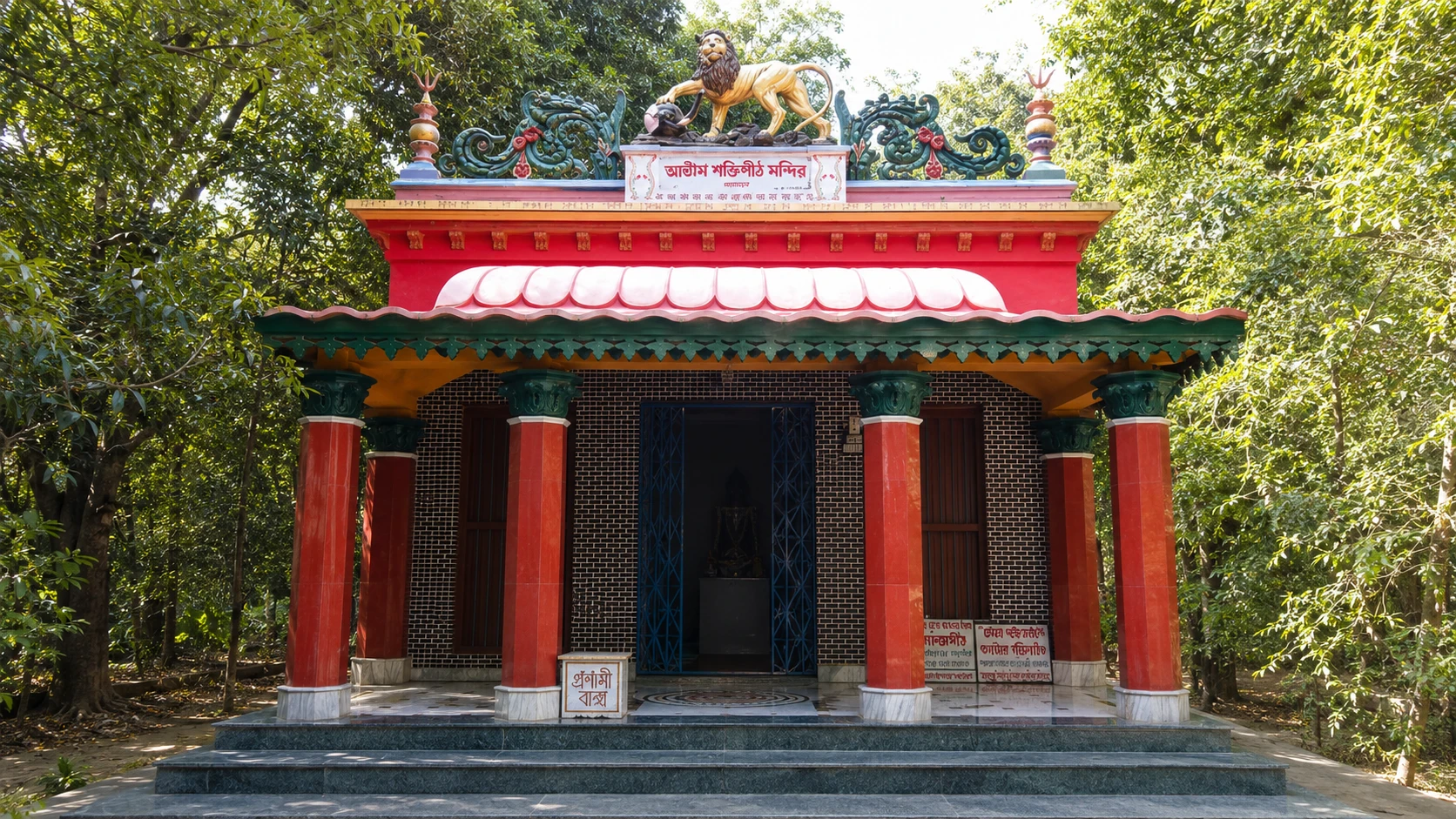
The Aṭṭahāsa sanctum holds a stone mūrti of Phullarā in Durgā-register Devī iconography, multi-armed, in standing or seated posture, in the characteristic Bengali Shākta dark-stone idiom, daubed with sindoor and ghee from continuous worship, draped in red cloth that the temple's sevāyats renew through the day.
The body-part attribution carries into the temple's worship through offering specificity rather than primarily through visible iconographic distinction: devotees commonly offer red sindoor, betel paan (which the mouth opens for), and red cloth as offerings tied thematically to the lip-fall and the blossoming-mouth that the Devī's name encodes.
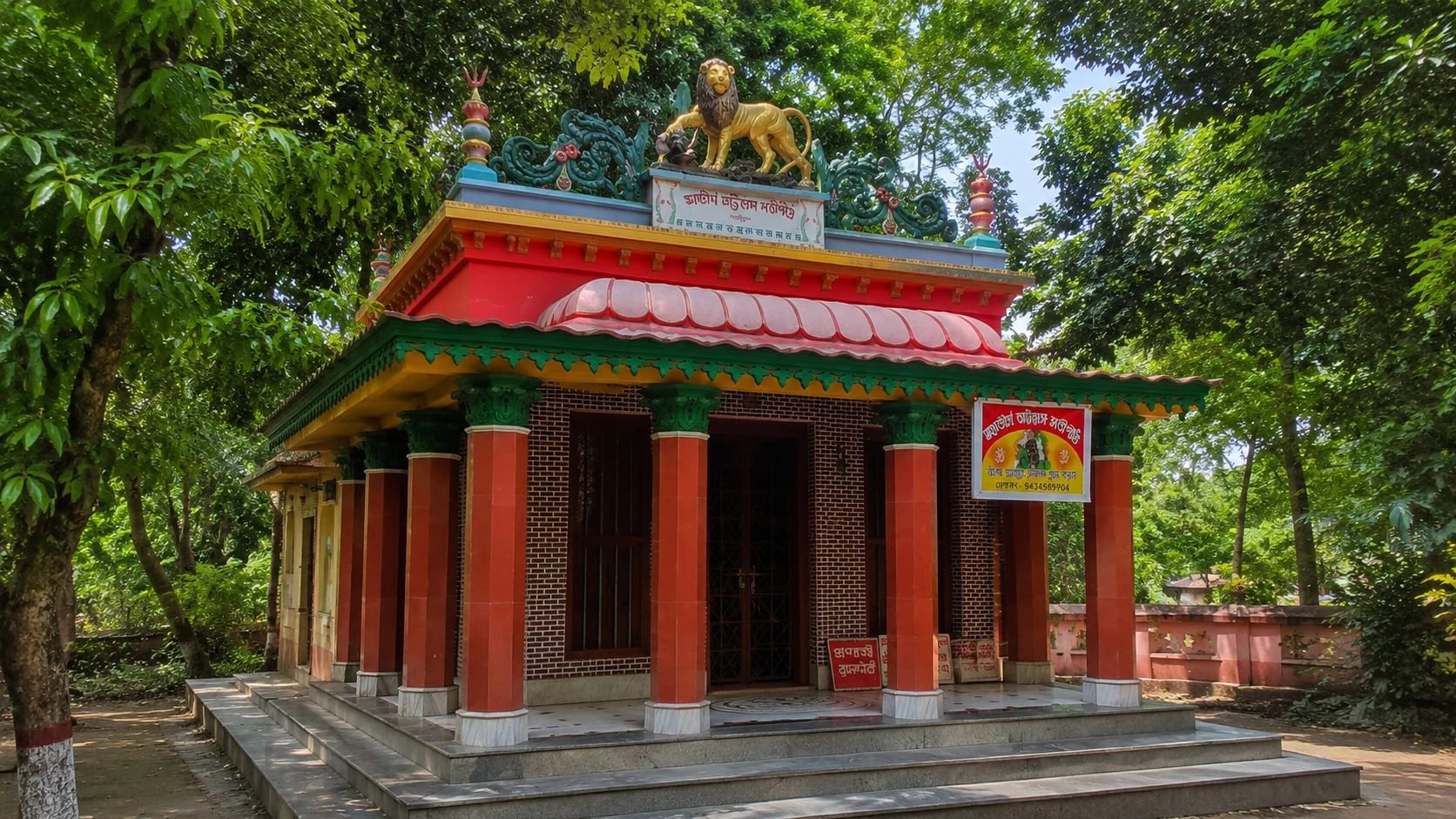
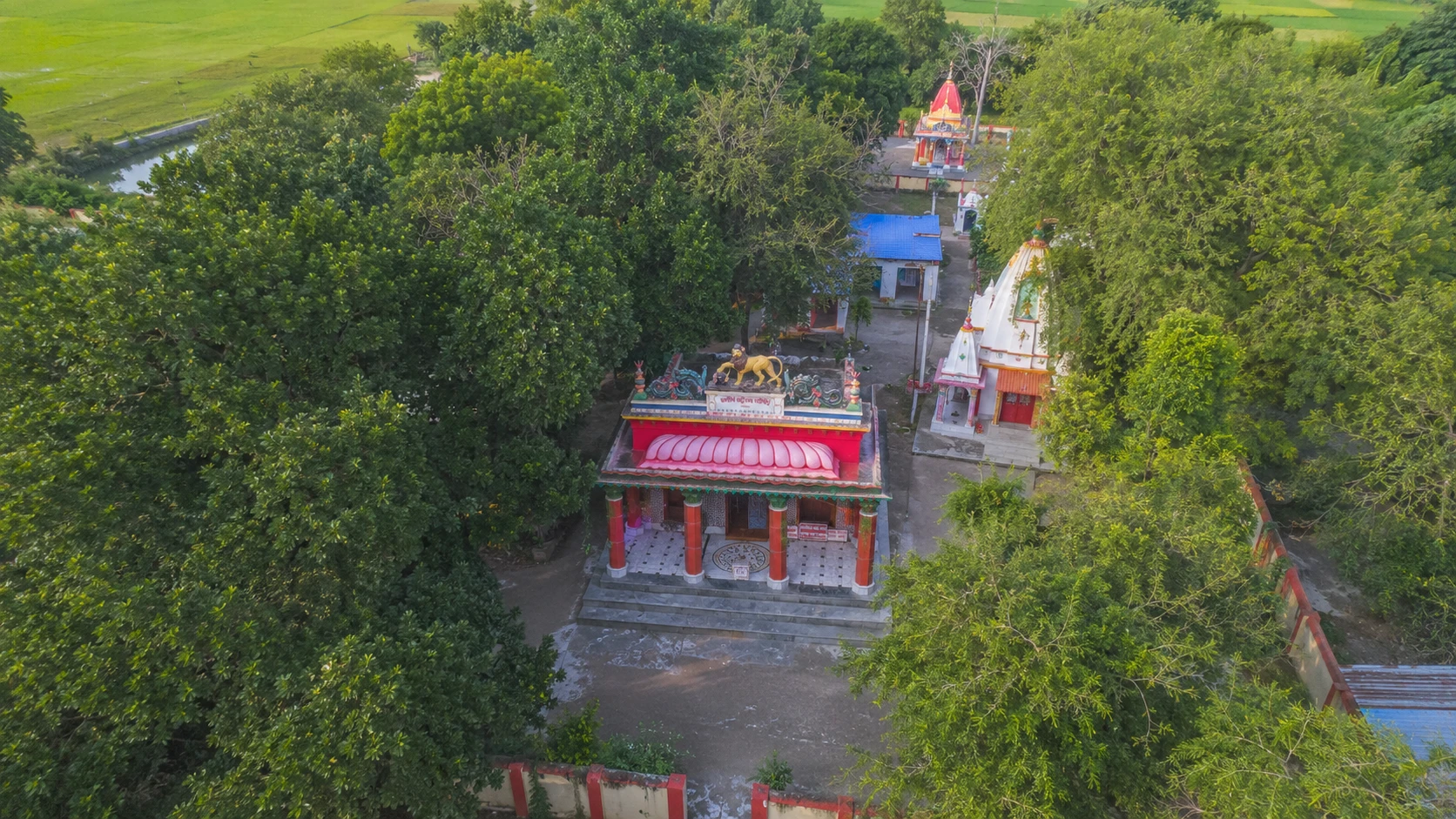
The Viśveśa linga sits in an adjacent shrine within the temple complex, a simple stone liṅga marking the canonical Bhairava-pole. The architectural scale of Aṭṭahāsa is modest: the temple is a single āṭcālā structure with central shikhara over the Devī sanctum, the smaller Viśveśa shrine, and a basic outer enclosure.
The rural Bardhaman setting east of Katwa frames the temple in open country characteristic of the Bhāgīrathī corridor, flat agricultural land, scattered village structures, the wider plain that runs east toward the Bhāgīrathī river itself.
The temple lacks the cremation-ground integration that distinguishes Kankalitala and Tarapith and lacks the geological-theological integration that distinguishes Bakreshwar; what it holds in compact form is the philological tightness of its three names.
Distinctive Practicesविशिष्ट परंपराएँ
Adhara-themed offerings, sindoor, paan, and red cloth at the sanctum
अधर-विषयक नैवेद्य, गर्भगृह पर सिंदूर, पान तथा लाल वस्त्र
Year-round, as part of standard darśana protocol; intensified during the annual Phullarā Pūjā
Devotees at Aṭṭahāsa commonly bring offerings that invoke the body-part attribution and the three-name philological circle: red sindoor (which adorns the lip in Bengali Hindu women's tradition), betel paan (the preparation that the mouth opens for, ritually associated with the lip and the speech-act it enables), and red cloth (covering the colour-register of the lip and the auspicious-marital register that the Devī Phullarā holds). The offering protocol distinguishes Aṭṭahāsa from many other Bengali Shakti Peethas through this body-part-thematic specificity. The protocol is most fully observed by pilgrim women, for whom the offerings carry double resonance, both as devotional acts to the Devī of the blossoming lip and as participation in the broader Bengali Hindu register of women's auspicious sindoor-paan-red-cloth ritual.
The adhara-themed offering enacts the three-name philological circle bodily: the lip is the body-part, the lip blossoms for paan and for sindoor and is covered by red cloth, and the goddess of the blossoming lip receives offerings that the lip itself would wear or take in. The offering is the act of bringing to the Devī the very items that the body-part would handle if it were a living lip, and through that specificity, it remembers what the Peetha is in the most direct possible terms.
Phullarā Pūjā, annual signature festival with local mela
फुल्लरा पूजा, स्थानीय मेले के साथ वार्षिक हस्ताक्षरीय उत्सव
Annual, date set by Bengali Shākta calendar, typically observed in the spring or autumn lunar windows; specific date varies year-on-year
The annual signature festival at Aṭṭahāsa is Phullarā Pūjā, observed with full local participation: a small mela (fair) takes place in the area around the temple, the Phullarā sanctum sees special abhiṣeka and extended worship, and the broader Bardhaman-corridor pilgrim community gathers. The festival is regional rather than pan-Bengali in draw, but it is the day of the year when Aṭṭahāsa is most fully Aṭṭahāsa, most fully the place where the three-name philological circle (lip / blossoming / laughter) animates the temple's annual rhythm.
The annual Phullarā Pūjā concentrates the year's devotional life of Aṭṭahāsa onto a single day on which the temple's identity is most fully expressed. The festival is the day on which the philological tightness of the three names is rehearsed in lived community practice, the day when the entire local community participates in honouring the Devī of the blossoming and the place of the laughter together.
Combined Bardhaman-corridor Vaishnava-Shakta circuit
संयुक्त बर्धमान-गलियारा वैष्णव-शाक्त परिक्रमा
Year-round; particularly active during festival weekends combining Vaishnava and Shākta observances
Aṭṭahāsa's location east of Katwa in the Bhāgīrathī corridor places it within the historic Vaishnava-Shakta cross-pilgrimage geography of Bardhaman-Birbhum-Murshidabad. Pilgrims following the Chaitanya-tradition Vaishnava routes through Katwa and along the Bhāgīrathī frequently include Aṭṭahāsa as a Shakti-Peetha darśana stop within the same trip; conversely, Shakta pilgrims completing the canonical 51-Peetha circuit may include Katwa's Vaishnava sites as adjacent darśana points. The dual-tradition practice does not have a specific liturgical form but functions as an itinerary-integration that the Bardhaman-corridor pilgrim networks have sustained for centuries. The practice parallels but is distinct from the Bahulā Caturthī double-tradition observance at Ketugram.
The Bardhaman corridor's historic openness to Vaishnava and Shākta traditions together rather than separately makes the combined itinerary at Aṭṭahāsa a continuation of regional ecumenism rather than a modern innovation. Bengali religious life in this region has long held the two traditions as parallel rather than competing expressions of Hindu devotion; Aṭṭahāsa's modest scale and the broader Bhāgīrathī-corridor pilgrim flow make this dual-tradition practice naturally sustainable.
Did You Know?क्या आप जानते हैं?
Aṭṭahāsa is among the very few Shakti Peethas in the 51-list where the three names, body-part attribution, Devī's name, and place-name, encode each other in a single philological circle. The lower lip (adhara-oṣṭha) is the body-part; the lip blossoms when it opens, and the Devī is named Phullarā ('she who blossoms'); what opens from the blossoming is laughter (hāsa), and the place is named Aṭṭahāsa ('great laughter'). Few Peetha-attributions in the canonical enumeration sustain this degree of philological tightness.
Pīṭhanirṇaya / Mahāpīṭhanirūpaṇa; Sanskrit etymological tradition; comparative 51-Peetha philological analysis
The aṭṭa-hāsa narrative, Shiva's fierce laughter at this site as he carried Satī's body in his cosmic dance of grief, is among the more theologically distinctive Peetha-foundation narratives in the 51-list. Most Peethas are named for the body-part that fell or for the Devī enshrined; Aṭṭahāsa is named for Shiva's vocal act at the moment of the body-part's falling. The narrative is preserved in local Bengali sthala-purāṇa and in the comparative 51-Peetha scholarship that has noted the unusual place-naming logic.
Aṭṭahāsa local sthala-purāṇa; Sanskrit etymological tradition; comparative Bengali Shākta literature
The Devī name 'Phullarā' is derived from the Sanskrit root √phull (to blossom, to bloom, to expand), with the feminine -ā suffix making her 'she who has blossomed.' The name belongs to a Bengali Shākta tradition of Devī names that encode the body-part attribution philologically rather than describing the goddess's form or work, alongside Bahulā ('she of the arm') at Ketugram and Kaṅkālītalā (where the place-name rather than the Devī-name encodes the body-part). Aṭṭahāsa is distinguished by extending the philological encoding to all three names rather than to one or two.
Sanskrit etymological tradition; Bengali Shākta Devī-name comparative analysis
Among Bengali Shakti Peethas, Aṭṭahāsa sits structurally with Bahulā at Ketugram and Kankalitala as the 'clean canonical type', sites whose theology rests directly on the Pīṭhanirṇaya body-part-Devī-Bhairava triplet without the layered Mahāvidyā, Tāntric-lineage, geological, or literary-modern overlays that complicate Tarapith, Bakreshwar, and other larger Cluster A neighbours. Aṭṭahāsa's distinguishing feature within the clean-canonical type is the unusual philological tightness of its three-name circle.
Bengali Shākta comparative literature; June McDaniel, 'Offering Flowers, Feeding Skulls' (2004)
The Bhairava paired with Phullarā in the Pīṭhanirṇaya is Viśveśa, 'Lord of all,' the universal-protective register of Shiva-Bhairava. Unlike the philologically specific Bhairavas at Bahulā (Bhīruka, 'the fearful one') and Kankalitala (Ruru, with its layered Sanskrit register), Viśveśa is a broad cosmic name not tightly tied to the specific Aṭṭahāsa narrative. The choice of Bhairava-name at Aṭṭahāsa is the one element of the four-name set (body-part, Devī, place, Bhairava) that does not participate in the philological circle of the other three.
Pīṭhanirṇaya; Sanskrit lexical tradition; comparative Bhairava-name analysis across the 51-Peetha enumeration
Visitor Accessप्रवेश जानकारी
Aṭṭahāsa welcomes pilgrims of all backgrounds for darśana. Photography is generally permitted in the outer temple precincts; the inner Devī sanctum follows standard Bengali Shākta photography norms, verify locally before photographing the mūrti. No caste-based or religion-based exclusions apply.
Most pilgrims complete the Aṭṭahāsa circuit in a simple sequence: Phullarā sanctum darśana with the adhara-themed offering, Viśveśa linga darśana in the adjacent shrine, and brief perambulation of the temple precincts. Allow 1.5, 2 hours for an unhurried visit; on Phullarā Pūjā plan for a full half-day. Pilgrims combining Aṭṭahāsa with Bahulā at Ketugram and other Bardhaman-corridor sites should plan a one-to-two-day Bardhaman circuit with overnight accommodation in Katwa or Bardhaman city.
Festivalsत्योहार
Phullarā Pūjā
फुल्लरा पूजा
Date set by Bengali Shākta calendar, locally observed annual signature festival
The annual signature festival at Aṭṭahāsa specifically: a small mela accompanies the day's worship, the Phullarā sanctum sees special abhiṣeka and extended worship, and the broader Bardhaman-corridor pilgrim community gathers. This is the day of the year when the three-name philological circle of Aṭṭahāsa is most fully alive in living community practice.
Durgā Pūjā
दुर्गा पूजा
Āśvina Śukla Saptamī, Daśamī (September, October)
Durga Puja at Aṭṭahāsa is observed with full Bengali Shākta protocol within the temple precincts, in keeping with Phullarā's Durgā-register form. Saptamī through Vijayā Daśamī are marked by special abhiṣeka, sandhi pūjā at the Aṣṭamī, Navamī boundary, and the Vijayā Daśamī procession. The festival draws regionally significant pilgrim numbers, though it remains a Bardhaman-corridor rather than pan-Bengali draw.
Kālī Pūjā (Bengali Shākta Diwali Amāvasyā)
काली पूजा (बंगाली शाक्त दीपावली अमावस्या)
Kārttika Amāvasyā (October, November)
Kālī Pūjā is observed at Aṭṭahāsa with standard Bengali Shākta night-worship protocol. Although Aṭṭahāsa's primary identity is Phullarā rather than Kālī, the Kārttika Amāvasyā night is the central night of the Bengali Shākta calendar and Aṭṭahāsa observes it with night ārati, special offerings and pilgrim influx, consistent with the regional festival rhythm. The Tāntric-fierce-laughter alternate reading of the aṭṭa-hāsa is theologically congruent with the Kālī register and receives some local emphasis on this night.
Vāsanti Pūjā / Caitra Navarātri
वासन्ती पूजा / चैत्र नवरात्रि
Caitra Śukla Pratipadā, Navamī (March, April)
The spring festival of the Devī, observed at Aṭṭahāsa as Vāsanti Pūjā. The nine nights are marked with daily abhiṣeka of the Phullarā mūrti and special evening ārati. Pilgrim attendance is moderate, less than Phullarā Pūjā or Durga Puja but consistent with the broader Bengali Shākta annual rhythm.
How to Reachकैसे पहुँचें
Aṭṭahāsa lies east of Katwa town in Purba Bardhaman district, West Bengal, approximately 180 km north of Kolkata and 12 km east of Katwa. The nearest rail-head is Katwa Junction (12 km), which connects via the Howrah, Bandel, Katwa line to Howrah; journey time from Howrah is approximately 3.5, 4 hours.
Local taxis, auto-rickshaws, and shared transport connect Katwa to the temple. By road, Aṭṭahāsa is accessible via state highways from Katwa and from the broader Bardhaman district network. The nearest commercial airports are Kazi Nazrul Islam Airport at Andal, Durgapur (105 km) and Netaji Subhas Chandra Bose International Airport at Kolkata (180 km).
Pilgrims combining Aṭṭahāsa with Bahulā at Ketugram and other Bardhaman-corridor sites should plan an integrated one-to-two-day Bardhaman circuit from a Katwa or Bardhaman city base.
Plan Your Visitयात्रा की योजना
🌤 Best Season
October to March is the most comfortable window for Aṭṭahāsa, with cool-to-mild daytime conditions and the rural Bardhaman landscape at its visual best. Summer (April, June) is hot (up to 42 °C in Bardhaman) and the open temple precincts are exposed. Monsoon (July, September) brings humid conditions and occasional regional flooding.
👘 Dress Code
Standard Bengali Shākta temple norms: modest clothing covering shoulders and knees; women in sari or salwar-kameez, men in dhoti-panjabi or kurta-pyjama, with standard ethnic or modest Western clothing also accepted. Footwear is removed at the temple-precinct entry.
📱 Phones & Photography
Phones and cameras are generally permitted in the outer temple precincts. The inner Devī sanctum follows standard Bengali Shākta photography norms, verify locally before photographing the mūrti.
🏨 Accommodation
Aṭṭahāsa village offers very modest local infrastructure, basic lodges and a small dharmaśālā or two. Katwa town (12 km) offers broader hotel options across price brackets and serves as the practical overnight base for pilgrims. Bardhaman city (~50 km south) offers fuller hotel and travel infrastructure for pilgrims combining Aṭṭahāsa with multiple Bardhaman-region destinations.
Sacred Soundsपवित्र ध्वनि
Durgā Saptaśatī (Devī Māhātmya), Mārkaṇḍeya Purāṇa, opening Kavaca and Argala stotras
stotram · 720
Phullarā Devī Stuti, local Bengali hymn invocation of the Aṭṭahāsa Devī
stotram · 420
Śiva Tāṇḍava Stotram, for the Viśveśa-Bhairava pole and the aṭṭa-hāsa narrative context
stotram · 360
Mahiṣāsuramardinī Stotram, 'Ayi Giri Nandini' (attributed to Ādi Śaṅkarācārya), for the Durgā-register Devī context
stotram · 540
Nārāyaṇī Stuti, Devī Māhātmya, Chapter 11, from the Caṇḍī Pāṭha
stotram · 600
108 Japa Practice
Śrī Vidyā Tri-Bīja: Oṃ Aiṃ Hrīṃ Śrīṃ
Chant 108 times in the spirit of this temple
Did You Know? · क्या आप जानते हैं?
The same translation error that turned '33 Koti' into '33 crore' in Hinduism also happened in Buddhism. The Chinese translation of Buddhist texts rendered 'Sapta Koti Buddha' (7 Supreme Buddhas) as '7 Crore Buddhas.' The Tibetan translation got it right: 7 types, not 7 crore. One Sanskrit word, misread across two major world religions, generated two identical misconceptions independently.
Related Contentसंबंधित सामग्री
Related Scriptures
Related Temples
Community Reflections
🕉️
Be the first to share your reflection.