Dakshineswar Kali
दक्षिणेश्वर काली
The Bengal Kali temple where Sri Ramakrishna's vision of the Mother shaped modern Hinduism
Kolkata, West Bengal, India
Dakṣiṇeśvar Kālī MandirAlso known as: Dakshineswar Kali Temple, Sri Sri Bhavatarini Mandir, Sree Sree Jagadiswari Kalimata Thakurani Mandir, Bhabatarini Mandir, दक्षिणेश्वर काली मन्दिर, श्री श्री भवतारिणी मन्दिर
Open
06:00 (summer 06:00; winter 06:30; opens earlier on festival days) – 20:30 (closes 12:30–15:00 for the midday break; reopens 15:00–20:30; extended hours on festival days)
The Sacred Legend · पवित्र कथा
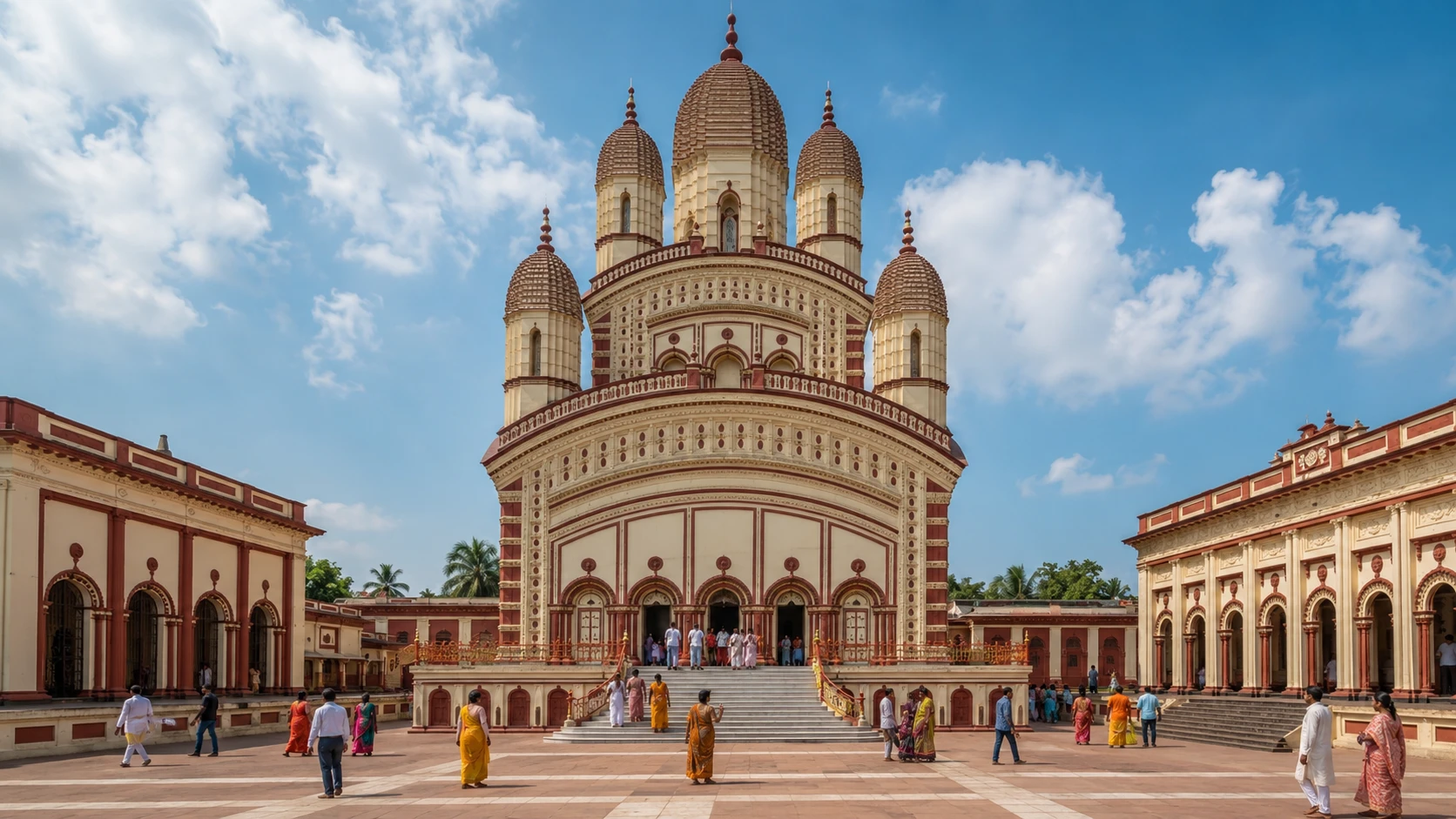
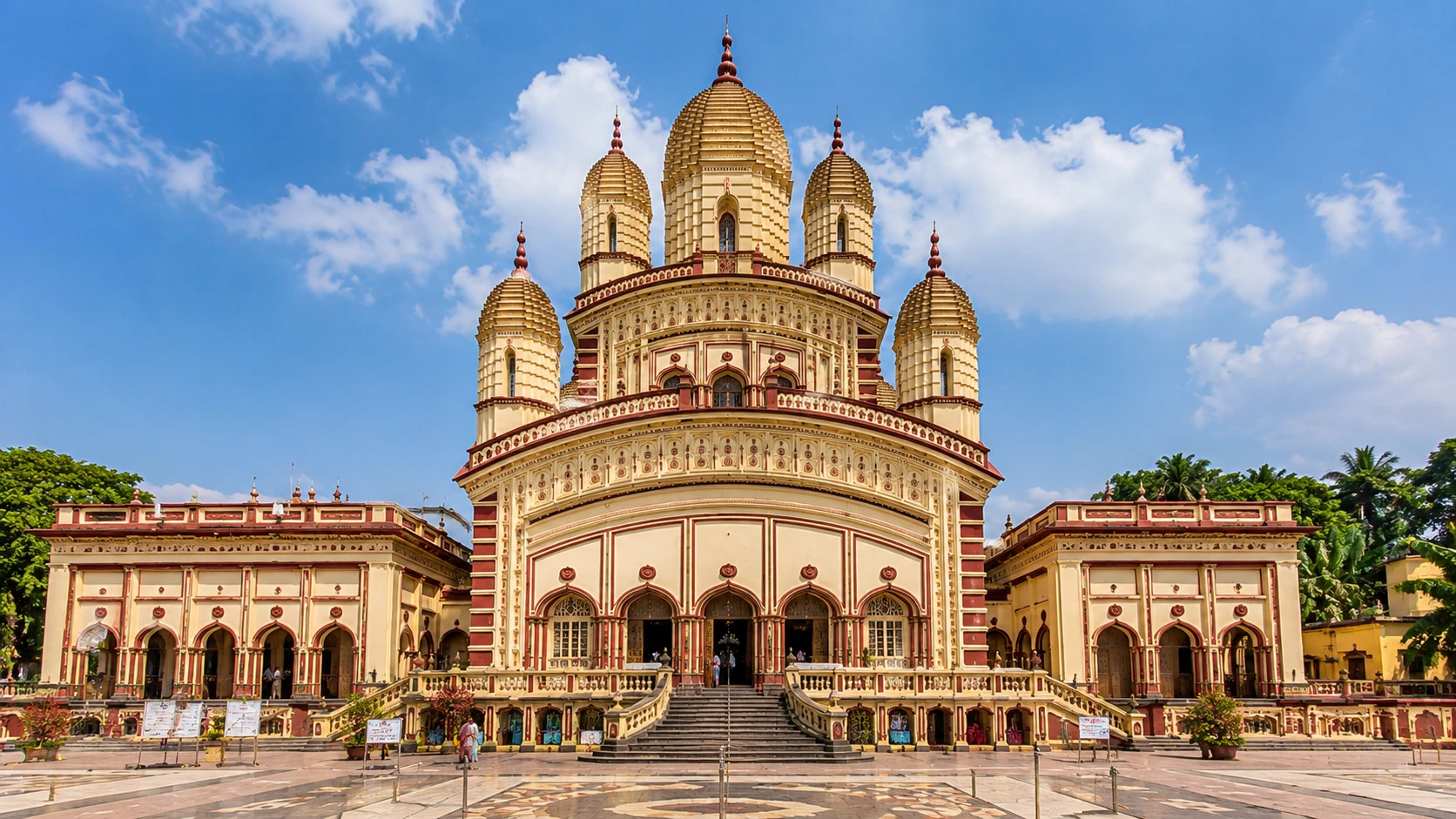
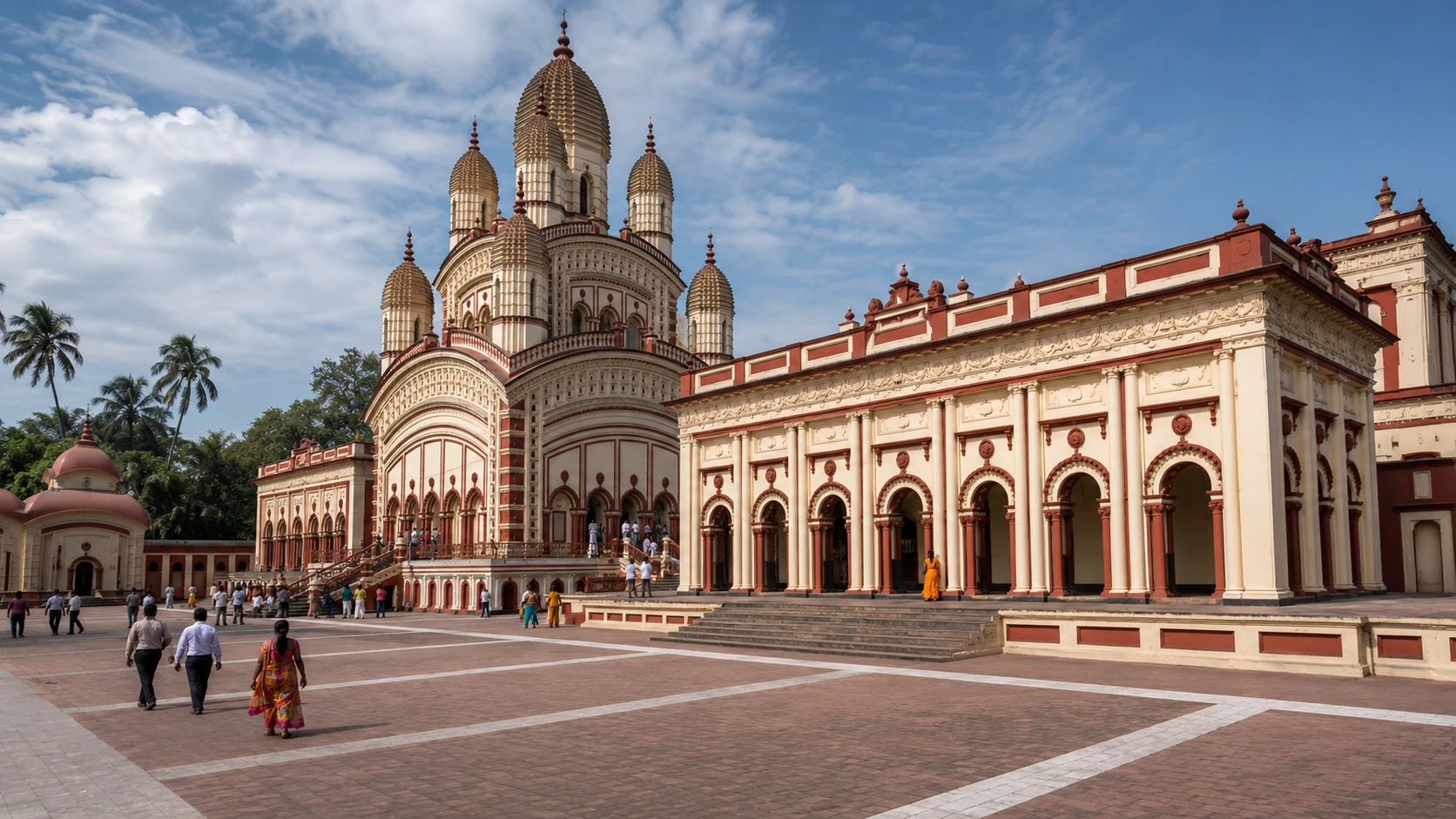
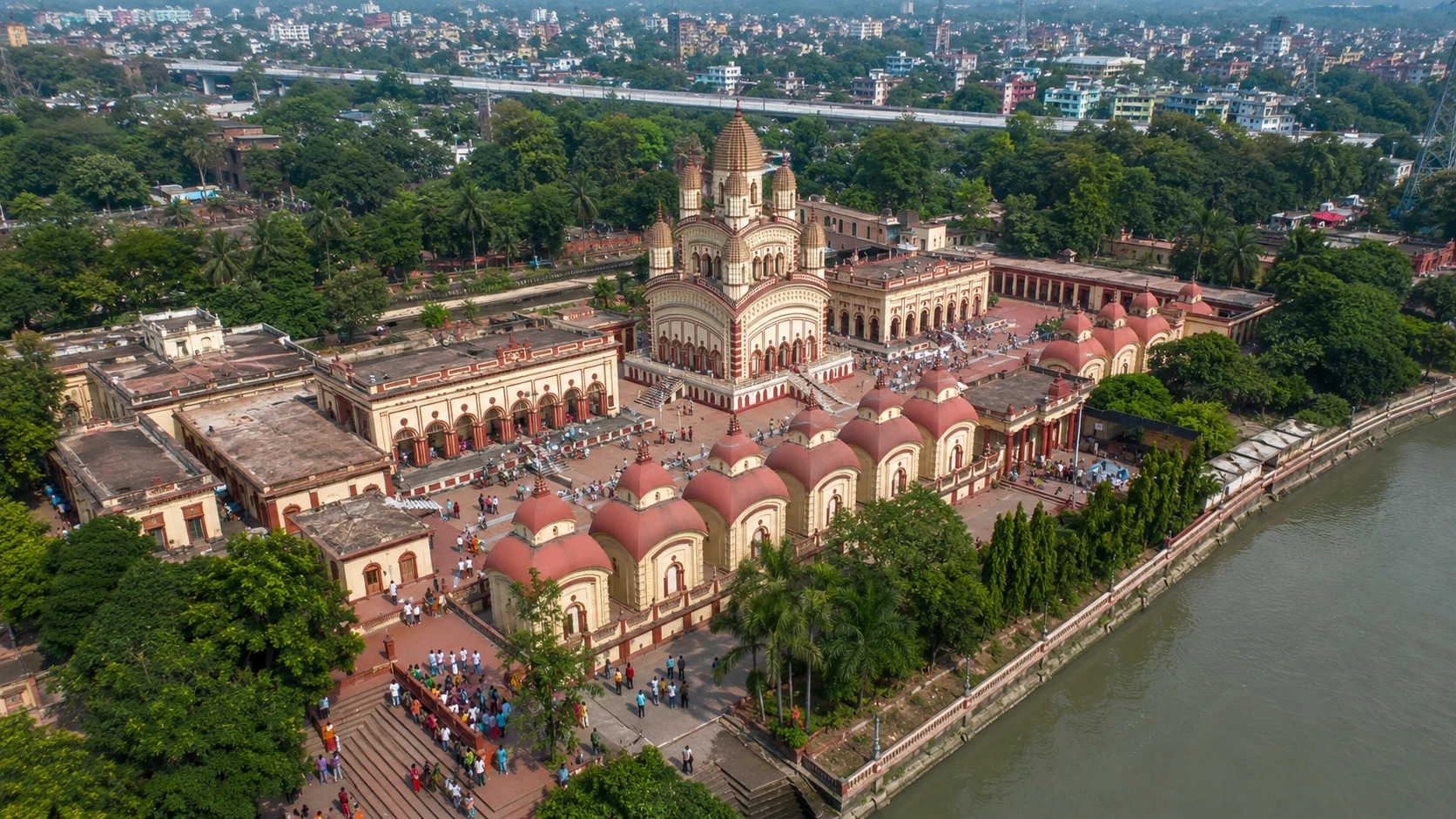
The Dakshineswar Kali temple stands on the east bank of the Hooghly (Ganga) river approximately 12 kilometres north of central Kolkata, looking across the river toward Belur Math. The principal deity is Bhavatarini Kali — 'she who liberates from the ocean of worldly existence' — and the temple's name in formal use is the Sree Sree Jagadiswari Kalimata Thakurani Mandir, though devotees and the public know it almost universally as Dakshineswar. The temple is significant on two distinct registers. On the first register, it is one of the most architecturally and iconographically realised Bengal Shakta temples of the nineteenth century — a nine-spired (nava-ratna) Kali temple consecrated in 1855 by Rani Rashmoni, the wealthy zamindar widow of Janbazar, with a courtyard arrangement that includes twelve Shiva temples in a row along the river, a Vishnu (Radhakanta) temple on the eastern side, a bathing ghat, a nahabatkhana (music tower), and the Panchavati grove. On the second register — the one for which Dakshineswar is internationally known — it is the temple where Gadadhar Chattopadhyay served as priest from 1856 onwards, where his sadhana and visions of Bhavatarini transformed him into Sri Ramakrishna Paramahamsa, and where the foundations of the modern Ramakrishna movement were laid. His direct experiential union with the Goddess at this sanctum, his teaching of disciples including the young Narendranath Datta (later Swami Vivekananda), and his thirty-year residence on the temple grounds (1856–1886) make Dakshineswar one of the founding sites of modern Hindu thought as it presents itself globally. A distinctive editorial note: the temple does not absorb the Ramakrishna layer into the Goddess-worship layer, nor does the Ramakrishna layer displace the worship of Bhavatarini herself. Devotees who come to Dakshineswar come both to take Kali's darshan and to walk where Sri Ramakrishna walked — the Panchavati where he sat, the steps where he met the young Vivekananda, the room where Sarada Devi lived. The temple's pilgrimage gravity is twofold and the two layers reinforce rather than compete with each other. Rani Rashmoni's foundation made the priestly residence possible; Ramakrishna's residence made the temple internationally significant; Bhavatarini remained the goddess at the centre throughout.
Sacred Designationपवित्र पदनाम
Sacred Origin Storyपवित्र उत्पत्ति कथा
Source: Mahanirvana Tantra and Kalika Purana for the Bhavatarini-Kali theological framework; the Bengali Devi-katha and Tantric Sahasranama literature for the regional liturgical context; the Sri Sri Ramakrishna Kathamrita (Mahendranath Gupta, 1902–1932) and the Lilaprasanga (Swami Saradananda, 1909–1919) for the Ramakrishna-period experiential account; the foundational Rani Rashmoni-period narrative is preserved in late-nineteenth- and early-twentieth-century Bengali devotional literature.
The Dakshineswar narrative unfolds across three layers — the theological, the foundational, and the experiential — that must be taken in sequence to understand the temple's full significance.
The theological layer is the prior, longer Bengal Kali tradition that the temple consciously inherited. In the Mahanirvana Tantra and Kalika Purana, Kali is the principle of time, dissolution, and ultimate reality stripped of conventional form. She is dark not because she lacks light but because she is what remains when all colour and form have been resolved into their source. Bhavatarini — 'she who liberates from the ocean of worldly existence' — is one of her devotional names, emphasising her saving aspect rather than her terrifying aspect. The Bengal Shakta tradition received this canonical theology from the broader Hindu corpus and elaborated it through its own Tantric sahasranamas, regional Devi-kathas, and the Kali-puja and Kali-aarti liturgies that evolved in Bengal from the medieval period. The Kali whom Rani Rashmoni installed at Dakshineswar in 1855 was not a new goddess but the goddess this tradition had been worshipping for centuries; what was new was the magnificent nine-spired sanctum built to house her.
The foundational layer is the story of Rani Rashmoni herself and the temple's consecration. Rashmoni Das was born in 1793 into a Kaivarta family — a community recognised in mid-nineteenth-century Bengal as outside the canonical 'twice-born' varna order. She married Raj Chandra Das, a wealthy Janbazar zamindar, and on his death in 1836 took over the management of the family estates with a degree of administrative effectiveness and public-spirited philanthropy that became legendary in colonial Bengal. According to the tradition preserved in late-nineteenth-century Bengali devotional sources, Rashmoni was about to set out on a pilgrimage to Kashi in 1847 when the Goddess appeared to her in a dream and instructed her to build a temple on the banks of the Ganga at Dakshineswar rather than complete the long journey. Rashmoni acquired the land, commissioned the temple, and oversaw its construction over eight years; consecration was set for 31 May 1855. The consecration was, however, not straightforward. The Brahmin priestly establishment of Bengal initially declined to officiate because Rashmoni was, by their reckoning, not eligible to consecrate a Brahmanical temple. Rashmoni eventually secured the services of Ramkumar Chattopadhyay — a Brahmin scholar of modest means and limited orthodoxy — who agreed to officiate, with the support of his younger brother Gadadhar (the future Sri Ramakrishna), who was then nineteen years old. The consecration took place. Rashmoni died in 1861, having seen Bhavatarini installed at Dakshineswar but having witnessed only the first five years of the temple's existence as a functioning sacred site.
The experiential layer is the Sri Ramakrishna period that began in 1856, when Ramkumar Chattopadhyay died and his younger brother Gadadhar succeeded him as the principal priest of the Bhavatarini sanctum. Gadadhar was at this point a young Brahmin from rural Hooghly with little formal scholarly training but with an unusually intense devotional temperament. His daily worship of Bhavatarini at Dakshineswar over the following decade developed into something the Bengal devotional tradition had not previously documented at this scale: a sustained, ecstatic, and ultimately experientially-non-dual relationship with the Goddess in which the boundaries between priest and deity, between worshipper and worshipped, began to dissolve. The Sri Sri Ramakrishna Kathamrita, compiled by his disciple Mahendranath Gupta from notes taken during his last years (1882–1886), preserves the conversational record of this period. The Lilaprasanga, compiled by Swami Saradananda over the decade after Ramakrishna's death, preserves the biographical and devotional reconstruction. By the 1870s Ramakrishna had performed extensive Tantric, Vaishnava, Vedantic, Islamic, and Christian sadhanas — each completed, by his own account and by the testimony of those who watched him, in compressed time and with experiential immediacy — and had begun to gather a small circle of disciples. The young Narendranath Datta, later Swami Vivekananda, first came to Dakshineswar in November 1881 at the age of eighteen. Ramakrishna's mahasamadhi at Cossipore (a Calcutta suburb where he had been taken for treatment) on 16 August 1886 ended his physical presence at Dakshineswar but began the formal-organisational phase of the Ramakrishna movement; Belur Math was founded across the river in 1898.
What the three layers together establish is that Dakshineswar is theologically inseparable from Sri Ramakrishna's experiential discovery of Bhavatarini, but not reducible to it. The temple housed the goddess before Ramakrishna arrived and continues to house her now that he has gone. His sadhana was a deepening of the existing devotional relationship, not its founding. Devotees who come to Dakshineswar to take Kali's darshan are participating in the tradition Rashmoni installed; devotees who come to walk where Ramakrishna walked are participating in the tradition Ramakrishna established; most come for both.
Sources cited:
- Mahanirvana Tantra and Kalika Purana — Bengal Shakta canonical sources for the Bhavatarini-Kali theological framework
- Sri Sri Ramakrishna Kathamrita (Mahendranath Gupta, compiled 1902–1932 from notes made 1882–1886) — the conversational record of Sri Ramakrishna's last years at Dakshineswar
- Sri Sri Ramakrishna Lilaprasanga (Swami Saradananda, 1909–1919) — the principal biographical-devotional reconstruction of Sri Ramakrishna's life
- Sri Ramakrishna: The Great Master (translation of the Lilaprasanga by Swami Jagadananda, 1952) — standard English-language reference
- Bengali devotional and historical literature on Rani Rashmoni (late nineteenth and early twentieth centuries)
- Sumit Sarkar, 'An Exploration of the Ramakrishna Vivekananda Tradition' (1993) — academic-historical treatment
Other Traditions · अन्य परंपराएँ
Scholarly Context
The Dakshineswar narrative requires editorial care on three distinct registers. First, the caste-and-consecration question: Rani Rashmoni's initial difficulty securing Brahmin priests for the 1855 consecration is a historically-attested fact of mid-nineteenth-century Bengal social structure, recorded in Bengali devotional literature and in modern academic treatments of the period. The narrative should be presented as factual social history rather than glossed over or editorialised; the temple's founding involved the negotiation of caste-and-orthodoxy norms that were live and contested at the time. Second, the Ramakrishna question: the claim that Sri Ramakrishna had direct experiential union with Bhavatarini is a theological-experiential claim, not a historical claim in the standard sense, and is preserved through Ramakrishna's own first-person testimony as recorded by Mahendranath Gupta and others. The Eternal Raga treatment is to present the testimony respectfully as the foundational source for what subsequent generations have taken as a transformative spiritual reality, without either reducing it to neurology or asserting it as historical fact in the way that, say, the 1855 consecration is historical fact. Third, the universalist-synthesis question: the Ramakrishna-Vivekananda tradition's 'all religions are one' formulation is sometimes presented as a simple syncretism or as a derivative of nineteenth-century European universalism; both readings are reductive. The synthesis Ramakrishna articulated — based on his own completed sadhanas in Tantric, Vaishnava, Vedantic, Islamic, and Christian traditions — is more theologically specific than either characterisation suggests, and is best presented through the source texts (Kathamrita, Lilaprasanga) rather than through external paraphrase. The temple itself does not require any particular theological position on these questions for darshan; devotees who come to Dakshineswar approach Bhavatarini in whatever theological frame they bring, and the temple accommodates the full range of devotional approaches.
Historyइतिहास
The history of Dakshineswar is the history of an explicitly nineteenth-century foundation that became, within thirty years of its consecration, one of the principal sites of modern Hindu thought. There is no significant pre-1847 sacred-site continuity at the present location: the land Rani Rashmoni acquired in 1847 was, prior to its acquisition, agricultural land on the east bank of the Hooghly with no major existing temple presence. The historical narrative therefore begins cleanly with the foundation rather than tracing back into pre-modern Bengal sacred geography.
Rani Rashmoni Das of Janbazar, a Kaivarta-community widow of substantial wealth, acquired the Dakshineswar land in 1847 and commissioned the temple complex over the next eight years. Construction of the nine-spired nava-ratna principal Kali sanctum, the twelve subsidiary Shiva temples along the river-front, the Radhakanta Vishnu temple on the east, the bathing ghats, and the courtyard structures proceeded steadily through this period under the supervision of contractors and craftsmen drawn from the broader Bengal temple-construction tradition. Consecration took place on 31 May 1855, after the resolution of the caste-and-priesthood question described in the mythology section.
In 1856, Ramkumar Chattopadhyay — the Brahmin scholar who had presided at the consecration — died, and his younger brother Gadadhar succeeded him as the principal priest of the Bhavatarini sanctum. Gadadhar was nineteen years old. The thirty-year period from 1856 to 1886 — during which Gadadhar became, in his own account and that of his disciples, Sri Ramakrishna Paramahamsa — represents the temple's modern formative phase. The narrative arc of that period (his marriage to Sarada Devi in 1859, his Tantric sadhanas of the 1860s, his Tota Puri-guided Vedantic initiation around 1864–1865, his Islamic and Christian sadhanas in subsequent years, his gathering of disciples from the late 1870s onwards, his first meeting with Narendranath Datta in November 1881, his throat cancer and final illness from 1885, and his mahasamadhi at Cossipore on 16 August 1886) is documented in the Ramakrishna Order's principal sources and need not be recapitulated in detail here.
The post-1886 organisational phase began with Swami Vivekananda's establishment of the Ramakrishna Order — first as a small monastic group at Baranagar in 1886–1892, then formally at the Belur Math site directly across the Hooghly in 1898. Belur Math and Dakshineswar developed into a single combined pilgrimage axis through the early twentieth century, with devotees regularly visiting both sites in sequence. The Vivekananda Setu (the Belur-Dakshineswar bridge, opened in stages from the mid-twentieth century onwards) and the more recent Nivedita Setu have operationalised the connection.
The twentieth century saw the temple continue under the private religious trust established by Rani Rashmoni's family — the Sree Sree Jagadiswari Kalimata Thakurani Estate. The trust managed administrative, ritual, and infrastructural matters through the period; the Ramakrishna Order, while institutionally separate, maintained a respectful relationship as the custodian of the broader Ramakrishna devotional and philosophical tradition that the temple had birthed. Sarada Devi's room at the Nahabatkhana was preserved as a commemorative space; the Panchavati grove was protected; the Vishnu and Shiva temples continued their regular ritual cycles; and Bhavatarini's daily, weekly, and annual worship continued without significant interruption.
The twenty-first century has brought modernisation focused on visitor logistics rather than ritual or structural change. The opening of the Dakshineswar Metro station (Kolkata Metro Line 1 North extension) in 2021 brought direct rapid-transit access from central Kolkata to the temple precinct for the first time, with daily visitor capacity now exceeding 50,000 on busy days and crossing 200,000 on Kali Puja night and other peak observances. The temple grounds have been progressively modernised with paved walkways, lighting, queue management, security infrastructure, and visitor amenities, while the historic structures (the nine-spired sanctum, the twelve Shiva temples, the Vishnu temple, the Nahabatkhana, the Panchavati grove) have been preserved without significant alteration.
Historical Timelineऐतिहासिक कालक्रम
Rashmoni Das is born in Halisahar (North 24 Parganas), into a Kaivarta-community family. She would later become Rani Rashmoni of Janbazar — the founder of the Dakshineswar temple.
Raj Chandra Das, Rashmoni's husband and the Janbazar zamindar, dies. Rashmoni takes over the administration of the family estates and begins her public-philanthropic and religious-foundational career.
Gadadhar Chattopadhyay (the future Sri Ramakrishna) is born on 18 February in Kamarpukur, a village in present-day Hooghly district, West Bengal. The synchrony between Rani Rashmoni's emergence into public-religious life and the birth of the priest who would later transform Dakshineswar is preserved in the Ramakrishna Order's biographical tradition.
Rani Rashmoni, according to the foundational tradition, receives a dream-vision of the Goddess instructing her to build a temple on the banks of the Ganga at Dakshineswar rather than complete a planned pilgrimage to Kashi. She acquires the land and commissions the temple complex; construction begins.
The Dakshineswar Kali temple is consecrated. The nine-spired Bhavatarini sanctum, the twelve subsidiary Shiva temples along the river, the Radhakanta Vishnu temple, and the courtyard structures are formally inaugurated. Ramkumar Chattopadhyay officiates as the principal priest after the resolution of the caste-and-priesthood question; his younger brother Gadadhar (the future Sri Ramakrishna), then nineteen years old, assists.
Ramkumar Chattopadhyay dies. His younger brother Gadadhar Chattopadhyay succeeds him as the principal priest of the Bhavatarini sanctum. The thirty-year Sri Ramakrishna phase of the temple's history begins.
Rani Rashmoni dies. The Sree Sree Jagadiswari Kalimata Thakurani Estate that she established passes to her descendants and continues to administer the temple. Rashmoni witnessed only the first five years of the temple's existence as a functioning sacred site.
Sri Ramakrishna's marriage to Saradamani Mukhopadhyay (later known as Sarada Devi, the Holy Mother of the Ramakrishna Order) takes place at her village of Jayrambati. The marriage is conducted while Ramakrishna is twenty-three and Sarada five years old, per the household customs of mid-nineteenth-century Bengal; she would join him at Dakshineswar in 1872 after attaining maturity.
Sri Ramakrishna undergoes formal Advaita-Vedantic initiation under the wandering monk Tota Puri at Dakshineswar, and attains, by his own subsequent account, nirvikalpa samadhi — the highest non-dual realisation of the Vedantic tradition. The episode integrates Ramakrishna's Bengali Tantric-Shakta sadhana with the broader Advaita-Vedantic stream and is foundational to the Ramakrishna-Vivekananda universalist synthesis.
Narendranath Datta (later Swami Vivekananda), then eighteen years old and a student at the General Assembly's Institution (now Scottish Church College) in Calcutta, first visits Dakshineswar at the suggestion of a college acquaintance. He meets Sri Ramakrishna; the meeting becomes the foundation of the Ramakrishna-Vivekananda relationship that would shape modern Hinduism.
At the Cossipore garden house where Sri Ramakrishna is being treated for advanced throat cancer, in an episode that has come to be called 'Kalpataru Day' in the Ramakrishna tradition, Ramakrishna formally blesses the assembled disciples and is said to have taken the form of the kalpataru (the wish-fulfilling tree). The episode is commemorated annually at Dakshineswar (despite occurring at Cossipore) as a peak devotional day; it is one of the principal events that consolidates the disciples into the future Ramakrishna Order.
Sri Ramakrishna's mahasamadhi at the Cossipore garden house ends his physical presence at Dakshineswar. The disciples gather to organise themselves into what will become the Ramakrishna Order.
Belur Math is formally established by Swami Vivekananda on the west bank of the Hooghly directly opposite Dakshineswar. The site becomes the headquarters of the Ramakrishna Order and operationally a partner-site to Dakshineswar; the two together form the Dakshineswar–Belur pilgrimage axis at the geographic centre of the modern Ramakrishna movement.
Sri Sri Sarada Devi (the Holy Mother) attains mahasamadhi at Udbodhan in Calcutta. Her room at the Nahabatkhana within the Dakshineswar precinct is preserved as a commemorative space.
The temple operates continuously under the Sree Sree Jagadiswari Kalimata Thakurani Estate through the colonial period, Indian independence (1947), Bengal partition's effects (1947), and the broader transformations of Kolkata. The Vivekananda Setu (Belur-Dakshineswar bridge) is opened in stages from the mid-twentieth century, operationalising the combined pilgrimage circuit.
The Dakshineswar Metro station (the northern terminal of Kolkata Metro Line 1) opens on 22 February 2021, bringing direct rapid-transit access from central Kolkata to the temple precinct for the first time. Daily visitor figures rise substantially with the new access, and peak-festival-day attendance routinely crosses 200,000.
What You'll Seeदर्शन में
The sanctum of the principal Kali temple holds the murti of Bhavatarini at the centre of the nine-spired structure. The murti is carved from black basalt stone, stands approximately one metre in height, and follows the canonical Bengal Kali iconographic configuration. She is four-armed, dark-complexioned (the ritual black colour of the stone being itself iconographically appropriate to her shyama-varna identity), standing in the alidha posture (one foot forward) on the supine body of Shiva. In her upper left hand she holds a severed head; in her lower left hand a blood-vessel or sometimes a small khadga (sword); in her upper right hand a larger khadga; and her lower right hand is held in varada-mudra, the gesture of granting boons. She wears a garland of severed heads (mundamala) — typically depicted as fifty-one, corresponding to the fifty-one letters of the Sanskrit alphabet — and a girdle of severed arms. Her tongue is extended (the iconographic moment commonly explained as her shocked recognition that the body beneath her foot is Shiva's). Her ornamentation includes a crown, heavy gold neck-and-ear ornaments, and a richly-coloured sari that is changed daily and ritually.
Bhavatarini's specific iconographic distinction within the broader Kali corpus is the saving-aspect emphasis — bhava-tarini means 'she who liberates from worldly existence' — which gives this Kali a redemptive rather than exclusively annihilating character. The iconographic configuration is otherwise canonical Bengal Kali, but the devotional framing through which she is approached at Dakshineswar foregrounds the mother-who-saves over the goddess-who-destroys, even as the destructive emblems (severed head, severed arms, blood-vessel, khadga) remain visually central.
The supine Shiva at her feet is depicted in his sava-rupa (corpse-form), pale-complexioned and seemingly without consciousness — the iconographic claim being that Kali's energy is what animates Shiva's stillness; without her, the principle of consciousness itself is inert. This Shaiva-Shakta theological move is fundamental to the Bengal Tantric tradition and is here given its most iconographically realised expression.
The broader sanctum precinct includes the silver-and-stone railing through which devotees take darshan; the daily-changed floral, silk, and ornament-arrangements at the goddess's feet; the perpetual ghee-lamps maintained at the platform corners; and the canopy of garlands renewed at each major aarti. The iconographic centre is uncluttered by sub-deities — the daily worship is single-focus on Bhavatarini alone, with the broader temple compound providing the Shaiva, Vaishnava, and commemorative-Ramakrishna context outside the principal sanctum.
The twelve subsidiary Shiva temples along the river-front each hold a Shiva lingam in the centre of an aat-chala-roofed sub-sanctum. Each lingam has its own name (drawn from the standard Bengal Shaiva nomenclature) and its own ritual cycle; together they constitute the Dwadasha Shiva Mandir arrangement. The Vishnu temple on the east side of the courtyard houses Sri Radhakanta (Krishna with Radha) in a smaller nava-ratna sub-temple. The Nahabatkhana — a two-storey music-tower at the south-west corner of the courtyard — preserves on its upper floor the small room in which Sri Ramakrishna lived during much of his Dakshineswar period and on its ground floor the room in which Sarada Devi lived for periods of her residence; both rooms are maintained as commemorative spaces accessible to devotees.
Photography of the Bhavatarini sanctum during darshan is restricted. Devotees may photograph the temple's nine-spired exterior, the twelve Shiva temples, the Vishnu temple, the Panchavati grove, and the river-facing platform; photography is not permitted within the inner sanctum or directly facing Bhavatarini's murti. The trust's protocols are enforced by temple-employed darshan staff.
Distinctive Practicesविशिष्ट परंपराएँ
Bhavatarini darshan with sequential Shiva-temple circumambulation
भवतारिणी दर्शन के साथ क्रमिक शिव-मन्दिर परिक्रमा
The temple's standard darshan circuit moves devotees through the principal Bhavatarini sanctum and then along the row of twelve subsidiary Shiva temples — the Dwadasha Shiva Mandir — in sequence, with a brief darshan at each. The Shiva temples are ordered from north to south along the river-facing edge of the courtyard, each housing its own lingam with its own name in the regional Bengal Shaiva tradition. The combined circuit takes 30–60 minutes depending on crowd density and is the conventional Dakshineswar darshan experience.
Panchavati and Nahabatkhana commemorative pilgrimage
पंचवटी और नहबतखाना स्मरणार्थक तीर्थ
Devotees following the Ramakrishna stream of Dakshineswar pilgrimage routinely visit the Panchavati grove (where Sri Ramakrishna sat for his Tantric and Vedantic sadhanas under the five sacred trees) and the Nahabatkhana (the music tower with the rooms where Ramakrishna and Sarada Devi lived). The practice is part of a slower, contemplative engagement with the temple grounds that supplements rather than replaces the Bhavatarini darshan. Quiet sitting, reading from the Kathamrita or Lilaprasanga, and personal reflection are common at these spots; the trust maintains them as quiet zones with minimal commercial activity.
Combined Dakshineswar–Belur Math pilgrimage
दक्षिणेश्वर–बेलूर मठ संयुक्त तीर्थ
The vast majority of devotees combine darshan at Dakshineswar with a visit to Belur Math across the Hooghly — the headquarters of the Ramakrishna Order, founded by Swami Vivekananda in 1898 and housing Sri Ramakrishna's relics and the main shrine of the Order. The two sites are connected by the Vivekananda Setu bridge for road traffic and by ferry from the Dakshineswar ghat. The combined visit takes a full day; devotees typically take morning darshan at Dakshineswar, cross to Belur Math for the midday and afternoon programme, and return for the Dakshineswar evening aarti. This combined pilgrimage operationalises what is theologically a single Ramakrishna-Sarada-Vivekananda devotional unit.
Tuesday and Saturday weekly Kali observance
मंगलवार और शनिवार साप्ताहिक काली अनुष्ठान
Tuesdays and Saturdays are the principal weekly Kali-observance days in the Bengal Shakta tradition, and at Dakshineswar these days see substantially elevated attendance compared to other weekdays. Devotees with weekly vrats to Bhavatarini complete their observances on these days; trust priests conduct expanded abhishekam and aarti. The two days together account for the majority of mid-week footfall at the temple.
Annapurna Puja seva and Bhog distribution
अन्नपूर्णा पूजा सेवा और भोग वितरण
Distinct from the Annapurna temple at Varanasi, Dakshineswar conducts its own Annapurna Puja — the recognition that Bhavatarini, in addition to her saving-aspect identity, is also the goddess as the principle of nourishment. The annual Annapurna Puja day (typically in Chaitra-Shukla, March–April) sees expanded Bhog distribution to all devotees, with the temple's khichuri (Bengali khichdi, prepared with rice, dal, ghee, and vegetables) as the principal prasad. The practice has continued from the Sri Ramakrishna period — Ramakrishna himself is recorded in the Kathamrita as having served Bhog at Annapurna Puja celebrations.
Kathamrita and Lilaprasanga group reading in the Panchavati
पंचवटी में कथामृत और लीलाप्रसंग सामूहिक पाठ
Devotees commonly gather in the Panchavati grove or its immediate surroundings for collective reading from the Sri Sri Ramakrishna Kathamrita and the Lilaprasanga, the two principal Ramakrishna source-texts. The practice is informal and devotee-organised rather than trust-administered; small groups of three to ten devotees read aloud in turn, often pausing for reflection or quiet discussion. The Panchavati's preservation as a quiet zone — without amplified music, commercial activity, or queue-management infrastructure — supports the practice. Ramakrishna Order devotees from across India and abroad have made the Panchavati a destination for this contemplative reading.
Did You Know?क्या आप जानते हैं?
Dakshineswar was founded by Rani Rashmoni — a Kaivarta-community widow whom mid-nineteenth-century Bengal Brahmin orthodoxy regarded as outside the canonical 'twice-born' varna order. Brahmin priests initially declined to consecrate the temple; the consecration of 31 May 1855 was ultimately conducted by Ramkumar Chattopadhyay, who agreed to officiate with the assistance of his younger brother Gadadhar (later Sri Ramakrishna). The episode is a documented inflection point in mid-nineteenth-century Bengal caste-and-religious history.
Sri Ramakrishna Paramahamsa lived and served as priest at the Bhavatarini sanctum at Dakshineswar for thirty years (1856–1886), making the temple the physical site at which the modern Ramakrishna devotional and philosophical tradition took shape. His Tantric, Vaishnava, Vedantic, Islamic, and Christian sadhanas were undertaken at Dakshineswar; his disciples — including Swami Vivekananda — gathered around him here; and his thirty-year residence makes Dakshineswar one of the principal sites of modern Hindu thought as it presents itself globally.
Narendranath Datta — later Swami Vivekananda — first met Sri Ramakrishna at Dakshineswar in November 1881, when he was eighteen years old and a student at the General Assembly's Institution in Calcutta. The meeting initiated the Ramakrishna-Vivekananda relationship that would, two decades later, take Hindu thought to the World's Parliament of Religions in Chicago in 1893 and from there into modern global religious discourse.
The principal deity Bhavatarini ('she who liberates from the ocean of worldly existence') is a saving-aspect Kali rather than the more terrifying-aspect Kali of some other Bengal Kali shrines. The iconography is canonical Bengal Kali — four-armed, severed head, blood-vessel, sword, varada-mudra, garland of severed heads, standing on supine Shiva — but the devotional framing through which she is approached at Dakshineswar foregrounds the mother-who-saves over the goddess-who-destroys.
The twelve Shiva temples in a row along the river-front of the Dakshineswar compound — the Dwadasha Shiva Mandir arrangement — are a distinctive Bengal Shaiva-Shakta architectural pairing in which the surrounding lord-of-consciousness Shiva temples flank and theologically frame the central goddess-as-energy sanctum. The arrangement is a rare instance in Indian temple architecture of the Shaiva-Shakta theological integration being expressed in continuous-row sub-temple form.
Belur Math — directly across the Hooghly from Dakshineswar — was founded in 1898 by Swami Vivekananda as the headquarters of the Ramakrishna Order. The Vivekananda Setu bridge connects the two sites by road; ferry service connects them across the river. Together they constitute the Dakshineswar–Belur pilgrimage axis at the geographic centre of the modern Ramakrishna movement. Most devotional pilgrims visit both sites in a single combined trip.
The Panchavati grove on the Dakshineswar grounds — a small wooded enclosure planted with the five sacred trees (banyan, peepul, ashoka, bel, and amlaki) — was the site of Sri Ramakrishna's most intense sadhana periods, particularly his Tantric practices of the 1860s and his subsequent Vedantic sadhana under Tota Puri. The grove is preserved as a quiet contemplative zone and is the destination for many devotional pilgrims wanting to sit where Ramakrishna sat.
The Nahabatkhana — the two-storey music tower at the south-west corner of the Dakshineswar compound — was Sri Ramakrishna's principal residence during his Dakshineswar period. Its upper floor preserves the small room in which he lived; its ground floor preserves the room in which Sarada Devi (his wife and later the Holy Mother of the Ramakrishna Order) lived during her periods of residence. Both rooms are maintained as commemorative spaces and are accessible to devotees.
Kalpataru Day — 1 January, commemorating Sri Ramakrishna's 'becoming the wish-fulfilling tree' on 1 January 1886 at the Cossipore garden house — is one of the temple's peak annual observances despite the original event having occurred at Cossipore rather than Dakshineswar. The day brings extreme overnight crowds; devotees often arrive on 31 December evening and queue through the night for darshan and personal-blessing at the temple grounds.
Like Mahalakshmi Mumbai, Dakshineswar is administered by a private religious trust (the Sree Sree Jagadiswari Kalimata Thakurani Estate, established by Rani Rashmoni's family) rather than by a state Endowments Department. The administrative architecture parallels Mahalakshmi Mumbai and contrasts with Annapurna Varanasi and Saraswati Basar, both of which are publicly administered. This means operational protocols, pricing, queue management, and seva booking operate under private-trust governance rather than public-law oversight.
Dakshineswar is not in the canonical 51/52 Shakti Peeth list. The Shakti Peeth associated with the Kolkata region is Kalighat (in the city's southern end, the site of Sati's right toe). Dakshineswar's significance is established not through Shakti Peeth membership but through the Bhavatarini-iconography, the Rani Rashmoni foundational tradition, and the Sri Ramakrishna experiential layer. The two principal Bengal Kali shrines — Kalighat and Dakshineswar — represent two distinct devotional registers: the canonical-Shakti-Peeth and the experientially-realised.
The 2021 opening of the Dakshineswar Metro station (the northern terminal of Kolkata Metro Line 1) brought direct rapid-transit access from central Kolkata to the temple precinct for the first time in the temple's 166-year history. Peak-festival-day attendance routinely crosses 200,000; daily attendance on busy days exceeds 50,000 — making Dakshineswar among the most-visited Hindu pilgrimage destinations in eastern India.
Festivalsत्योहार
Kali Puja (Shyama Puja)
काली पूजा (श्यामा पूजा)
The temple's principal annual flagship. While the rest of north India observes the same night as Lakshmi Pujan, the Bengal Shakta tradition centres the night on Kali, and Dakshineswar is among the principal sites of this observance. An all-night programme of abhishekam, shringar, special offerings, and continuous darshan runs from late afternoon through dawn. The trust expands staffing significantly, the West Bengal Police deploys substantial additional personnel, and cumulative attendance over the 24-hour window crosses 200,000.
Durga Puja (Sharadiya Navaratri culmination)
दुर्गा पूजा (शारदीय नवरात्रि समापन)
Durga Puja is the Bengali calendar's principal festival, and while Dakshineswar's central deity is Bhavatarini-Kali rather than Durga, the temple participates substantially in the city-wide Durga Puja observance. The Bhavatarini iconography is theologically continuous with Durga in the broader Devi-Mahatmya framework; the temple's daily worship through these days incorporates Durga-Saptashati recitation and the Durga-aspect ritual cycle.
Kalpataru Day
कल्पतरु दिवस
Though the original Kalpataru episode occurred at Cossipore rather than Dakshineswar, the commemoration on 1 January is among the temple's principal annual devotional days. Devotees believe that the wish-fulfilling grace Sri Ramakrishna offered on that day is renewed annually for those who attend the temple on the commemorative day; the consequence is one of the most-crowded single-day observances of the Dakshineswar calendar.
Sri Ramakrishna Jayanti
श्री रामकृष्ण जयन्ती
Sri Ramakrishna's appearance-anniversary is observed both on the tithi-based Bengali calendar (Phalguna Shukla Dwitiya) and on the corresponding date in the modern Gregorian calendar. At Dakshineswar the observance is centred on the Nahabatkhana — where Ramakrishna lived — with special readings, bhajans, and the trust's expanded ritual programme. Devotees from across India and the Ramakrishna Order's international branches converge on Dakshineswar for the observance.
Sri Sri Sarada Devi Jayanti
श्री श्री सारदा देवी जयन्ती
The Holy Mother's appearance-anniversary is observed at Dakshineswar particularly at her preserved room on the ground floor of the Nahabatkhana. Bhajans focused on the Mother, special offerings, and Kathamrita-readings about her interactions with Ramakrishna and the disciples mark the day. Attendance is significant but lower than Kali Puja, Kalpataru Day, and Ramakrishna Jayanti.
Swami Vivekananda Jayanti
स्वामी विवेकानन्द जयन्ती
Swami Vivekananda's appearance-anniversary is observed at Dakshineswar with a programme focused on the founding of the modern Ramakrishna movement that took place at this site. Belur Math (across the river) is the principal observance location, but Dakshineswar — where the young Narendranath first met Sri Ramakrishna in November 1881 — participates substantially in the observance. Many devotees combine a Dakshineswar visit on this day with a Belur Math visit.
Snan Yatra (bathing ceremony of the Goddess)
स्नान यात्रा (देवी का स्नान-समारोह)
The annual Snan Yatra — the ritual bathing of the goddess — is a distinctive Bengal Shakta-and-Vaishnava observance shared with the broader Jagannath-Puri tradition. At Dakshineswar the Snan Yatra is conducted for both Bhavatarini and Sri Radhakanta (the Vishnu temple's deity), with the goddess and the lord ritually bathed in elaborate water-and-substance abhishekam. The observance is moderately attended; it is more a ritual-cycle event than a peak-pilgrimage event.
Annapurna Puja
अन्नपूर्णा पूजा
Distinct from the Annapurna temple at Varanasi, Dakshineswar conducts its own Annapurna Puja recognising Bhavatarini in her nourishment-aspect. The observance has continued from the Sri Ramakrishna period — Ramakrishna himself is recorded in the Kathamrita as having served Bhog at Annapurna Puja celebrations at the temple. Khichuri (Bengali khichdi) is the principal prasad of the day, served to all devotees.
Traditional Offeringsपारंपरिक अर्पण
Primary Offerings
Red hibiscus (japa) and other red flowers
लाल गुड़हल (जपा) और अन्य लाल पुष्प
Red hibiscus is the canonical flower-offering for Kali across the Bengal Shakta tradition. The deep red colour invokes the fierce-energy aspect of the Goddess and is iconographically aligned with the blood-symbolism that runs through Kali's traditional offerings. At Dakshineswar, the daily floral arrangement before Bhavatarini features red hibiscus as the principal flower, complemented by white jasmine and marigold in seasonal availability.
Kumkum, sindoor, and turmeric
कुंकुम, सिन्दूर, और हल्दी
The triad of red kumkum, vermilion sindoor, and turmeric is offered at the goddess's feet and applied to her forehead. Sindoor in particular is significant in the Bengal Shakta tradition, where it is applied to married women devotees as a saubhagya-blessing during darshan; the Vijayadashami sindoor-khela observance — in which married women apply sindoor to each other on the river ghats — extends this temple-blessing into a community ritual.
Lemons (lebu) and animal-substitute symbolic offerings
नींबू (लेबू) और पशु-प्रतिस्थापन प्रतीकात्मक अर्पण
The Bengal Shakta tradition historically included blood-sacrifice as part of certain Kali rituals; the modern devotional practice has substantially shifted toward symbolic offerings, with lemons (split open) functioning as the principal animal-substitute. Coconuts split open also serve a similar symbolic-substitution function. Dakshineswar's daily ritual is fully vegetarian in its offerings; the symbolic-substitution practice respects the deeper Tantric framework while remaining within a sattvika offering paradigm.
Bengali sweets (sandesh, rasgulla, langcha)
बंगाली मिष्ठान्न (सन्देश, रसगुल्ला, लंगचा)
The classical Bengali sweet-tradition is integrated into the temple's daily and festival offerings to Bhavatarini. Sandesh — milk-based sweet — is the principal daily sweet-offering, with rasgulla and langcha appearing on festival days. The offered sweets are returned to devotees as prasad after the ritual presentation; many devotees bring sweets from outside (from established Kolkata mithai-shops like K.C. Das, Bhim Chandra Nag, or Balaram Mullick & Radharaman Mullick) as their personal offering.
Ghee diya (clarified-butter lamp)
घी का दीपक
Lamps of pure ghee are lit at the goddess's feet by devotees, who carry small earthen-or-metal dipikas as part of their offering. The light symbolises both the devotional warmth and the dispelling of ignorance through Mother-grace. Akhand-jyot (continuous ghee-lamp) sponsorship is available through the trust's seva-booking system, particularly for Kali Puja and other major observances.
Unique to This Temple
Khichuri Bhog (Bengali khichdi as the temple's signature daily prasad)
खिचुड़ी भोग (मन्दिर का हस्ताक्षर दैनिक प्रसाद के रूप में बंगाली खिचड़ी)
Khichuri — a Bengali single-pot dish of rice, dal, ghee, and seasonal vegetables — is the temple's signature daily prasad and the iconic offering at major festivals. The dish's roots in the Sri Ramakrishna period are well-attested; Ramakrishna himself preferred and frequently offered khichuri to disciples. The temple's khichuri is sattvika (no onion-garlic) and is distributed to all devotees regardless of socioeconomic standing — a continuation of the Mother-feeds-the-world devotional principle.
Sandesh and rasgulla sweet-offerings
सन्देश और रसगुल्ला मीठा-अर्पण
Bengali sweets — particularly the classical milk-based sandesh and the syrupy rasgulla — are integrated into the temple's offering culture in a way that is distinctive even within the broader Bengal Shakta tradition. The sweets are both daily offerings to Bhavatarini and signature take-home prasad-items; the temple's prasad-counters distribute factory-packaged versions for take-home use, and many devotees combine these with handmade purchases from established Kolkata mithai-shops.
Bhog distribution on Annapurna Puja day
अन्नपूर्णा पूजा दिवस पर भोग वितरण
The annual Annapurna Puja day (Chaitra Shukla Ashtami) recognises Bhavatarini in her nourishment-aspect, and the day's expanded Bhog distribution traces back to the Sri Ramakrishna period. Khichuri is prepared and distributed at substantially expanded scale; the practice operationalises the Mother-as-nourishment theology that is shared across the Hindu Devi tradition.
Devotees may bring offerings from outside the temple grounds or purchase them at the trust-operated counters near the entrance. Many Kolkata devotees combine handmade sweet-purchases from the city's established mithai-shops (K.C. Das, Bhim Chandra Nag, Balaram Mullick & Radharaman Mullick, Girish Chandra Dey & Nakur Chandra Nandy) with their temple offering. Flowers and lemons are typically purchased at the small stalls along the temple-approach path. Monetary offerings to the temple go through the trust counters for receipt; for larger sponsorship-amount offerings (Akhand Jyot, Annadan, Kali Puja-day special sponsorship), booking through the trust office or on the trust's verified channels is required.
How to Reachकैसे पहुँचें
Dakshineswar is well-served by Kolkata's full urban transport network. By Metro, the Dakshineswar station is the northern terminal of Kolkata Metro Line 1 (the North-South line, the city's principal rapid-transit corridor) and is approximately 500 metres from the temple entrance — the most-recommended route for most visitors. The Metro connects directly to Esplanade, Park Street, Tollygunge, and Kavi Subhash, covering the city's principal commercial and residential corridors. By suburban rail, Dakshineswar railway station (DAKE) on the Sealdah–Dankuni circular line is approximately 1 km from the temple. By road, Dakshineswar is approximately 12 km north of central Kolkata along Belghoria Expressway and connecting arterial roads; private taxis, app-based cabs (Ola, Uber), and yellow ambassador taxis serve the route. Many devotees combine the Dakshineswar visit with Belur Math across the Hooghly, accessible by the Vivekananda Setu bridge (approximately 5 km road journey via the bridge) or by ferry from the Dakshineswar ghat (approximately 15-minute river crossing). By air, Netaji Subhas Chandra Bose International Airport (CCU) is approximately 18 km — pre-paid taxi from the airport takes 45–75 minutes depending on traffic. The temple has its own private parking but the parking fills quickly on weekends and during festival periods; Metro arrival avoids parking concerns.
Plan Your Visitयात्रा की योजना
🌤 Best Season
October to February is the most comfortable period to visit — temperatures range from 14–28°C with low-to-moderate humidity. Kali Puja (October–November) and Durga Puja (September–October) are the most spiritually charged windows but also the most crowded; pre-plan accommodation in Kolkata if visiting during Puja season. Kalpataru Day (1 January) sees extreme overnight crowds. Avoid the heart of the monsoon (June–August) when Kolkata sees heavy rainfall and the Hooghly rises; while the temple itself remains accessible, urban transport and the broader experience can be disrupted. Avoid late-April through May (peak summer, 35–40°C with high humidity) when the temple's outdoor walkways and the river-facing ghats become uncomfortable. Early-morning windows (06:00–09:00) are the least crowded throughout the year.
👘 Dress Code
Modest traditional dress is the local norm. For men, dhoti-panjabi (the traditional Bengali combination) is appropriate; full-length trousers with sleeved shirts or kurtas are also accepted. For women, sarees, salwar suits, or long skirts with covered shoulders are appropriate. Shorts, sleeveless tops, and very short dresses are not appropriate for sanctum darshan; the temple's darshan staff may direct inappropriately-dressed visitors to dress-cover services available near the entrance. Head-covering is not required for the Bhavatarini darshan.
📱 Phones & Photography
Mobile phones must be on silent within the temple precinct. Photography with phones is permitted in the outer courtyard, at the twelve Shiva temples, at the Vishnu temple, in the Panchavati grove, and at the river-facing platform; phones are not permitted to be used for photography in the inner sanctum during Bhavatarini darshan, nor in the Ramakrishna and Sarada Devi rooms at the Nahabatkhana. Flash photography is discouraged everywhere. There is no phone-deposit requirement at the entrance.
🏨 Accommodation
Kolkata offers the full range of accommodation from backpacker hostels and budget guesthouses to mid-range hotels (across the city, particularly New Market, Park Street, Salt Lake, and the airport-area corridor) to luxury hotels (The Oberoi Grand, Taj Bengal, ITC Royal Bengal, and others). Dakshineswar itself has limited accommodation — a small number of dharmashalas operated by community trusts and some budget lodges near the temple precinct. The trust does not operate a dedicated dharmashala. Most devotees stay in central Kolkata or in the northern suburbs (Sodepur, Belghoria) closer to Dakshineswar. For peak festival periods (Kali Puja, Durga Puja, Kalpataru Day) book accommodation 2–4 weeks in advance.
Book a Pujaपूजा बुक करें
The Dakshineswar temple operates strict access protocols, particularly during peak-attendance days. Devotees should plan their visit around the following operational realities: (a) the temple has a midday closure period (typically 12:30–15:00) — plan to either complete darshan in the morning window or arrive after 15:00 reopening; (b) photography is not permitted in the inner sanctum during Bhavatarini darshan or in the Ramakrishna and Sarada Devi rooms at the Nahabatkhana, with trust enforcement; (c) Kali Puja night, Kalpataru Day (1 January), and the Durga Puja peak days see extreme crowds with overnight queuing being standard — pre-plan accordingly; (d) the temple does not authorise third-party agents or booking-aggregator services to provide paid darshan-skip services outside the trust's official channels — any such offer should be refused; (e) the 2021 Dakshineswar Metro station opening has made the temple substantially more accessible from central Kolkata; (f) several fraudulent websites and social-media pages impersonate the temple trust, particularly around Kali Puja. Carry photo ID for ticketed-seva attendance.
Managed by: Sree Sree Jagadiswari Kalimata Thakurani Estate (established by Rani Rashmoni's family; private religious trust)
Mangala Aarti participation (pre-dawn opening of the goddess)
मंगला आरती में भागीदारी (देवी का प्रातः-पूर्व उद्घाटन)
Bhavatarini Abhishekam
भवतारिणी अभिषेकम
Bhog Seva (prasad sponsorship including Khichuri preparation)
भोग सेवा (खिचुड़ी तैयारी सहित प्रसाद प्रायोजन)
Akhand Jyot (continuous oil/ghee lamp)
अखण्ड ज्योत (निरन्तर तेल/घी दीप)
Annadan (community meal sponsorship)
अन्नदान (सामुदायिक भोजन प्रायोजन)
Kali Puja night special sponsorship
काली पूजा रात्रि विशेष प्रायोजन
Booking information verified: 2026-05-21
Sacred Soundsपवित्र ध्वनि
Mahishasura Mardini Stotram (Aigiri Nandini) — the principal Devi-victory hymn, recited particularly at Navaratri
stotram
Karunamayi Mata (the Mother of Compassion) — devotional Bengali Mother-stotram
stotram
Shyama Sangeet — devotional songs to Kali, drawing on the Ramprasad Sen tradition of eighteenth-century Bengal Shakta poetry
stotram
Devi Mahatmya (Durga Saptashati) — recited during Durga Puja and at Mahalaya
stotram
Kalika Ashtottara Shatanamavali (108 names of Kalika)
stotram
Sri Ramakrishna Aarti — the Ramakrishna Order's daily aarti hymn, sung at Dakshineswar in the Nahabatkhana area particularly on Ramakrishna Jayanti and Kalpataru Day
aarti
Sri Sri Sarada Devi Aarti — the Holy Mother aarti hymn, sung particularly on Sarada Devi Jayanti
aarti
Did You Know? · क्या आप जानते हैं?
The same translation error that turned '33 Koti' into '33 crore' in Hinduism also happened in Buddhism. The Chinese translation of Buddhist texts rendered 'Sapta Koti Buddha' (7 Supreme Buddhas) as '7 Crore Buddhas.' The Tibetan translation got it right: 7 types, not 7 crore. One Sanskrit word, misread across two major world religions, generated two identical misconceptions independently.
Related Contentसंबंधित सामग्री
Related Scriptures
Related Temples
Kalighat
कालीघाट
Kolkata, West Bengal
Tarapith
तारापीठ
Tarapith, West Bengal
Kamakhya Temple
कामाख्या मंदिर
Guwahati, Assam
Mahalakshmi Temple (Mumbai)
महालक्ष्मी मंदिर
Mumbai, Maharashtra
Annapurna Mandir (Varanasi)
अन्नपूर्णा मंदिर
Varanasi, Uttar Pradesh
Gnana Saraswati (Basar)
ज्ञान सरस्वती मंदिर
Basar, Telangana
Ambaji
अंबाजी
Ambaji, Gujarat
Community Reflections
🕉️
Be the first to share your reflection.