Mahalakshmi Temple (Mumbai)
महालक्ष्मी मंदिर
Mumbai's principal Mahalakshmi temple, where the Tridevi were drawn from the sea
Mumbai, Maharashtra, India
Mahālakṣmī Mandir, MumbaīAlso known as: Mahalaxmi Mandir, Bhulabhai Desai Mahalakshmi, Cumballa Hill Mahalakshmi, Mumbai Mahalakshmi, महालक्ष्मी मंदिर, मुंबई, महालक्ष्मी मंदिर, कुंबाला हिल
Open
06:00 – 22:00
The Sacred Legend · पवित्र कथा
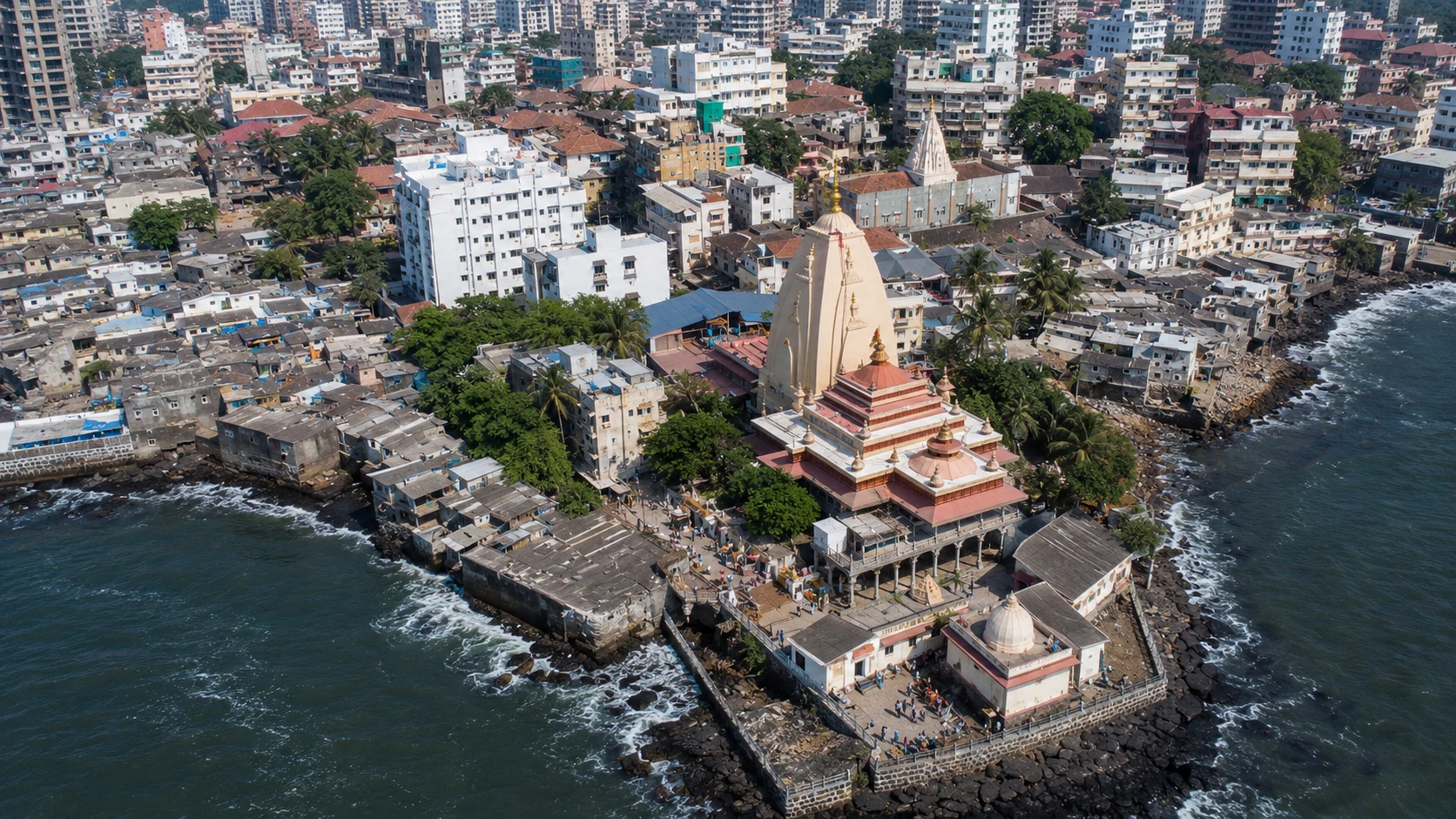
The Mahalakshmi Temple on Bhulabhai Desai Road is Mumbai's principal Devi shrine, and one of the few major Hindu temples in India where the three primary goddesses of the Devi Mahatmya — Mahakali, Mahalakshmi, and Mahasaraswati — are enshrined together on a single platform as the Tridevi. The temple's founding is bound up with one of colonial Bombay's defining infrastructure works: the Hornby Vellard, the late-eighteenth-century causeway that joined the city's seven islands by closing the Worli breach. Construction at the Worli–Mahalakshmi stretch is said to have collapsed repeatedly until the contractor Ramji Shivji Prabhu, following a dream in which Mahalakshmi appeared to him, retrieved three idols of the goddesses from the sea offshore. The Vellard was completed soon after, and Ramji built the temple in 1831 to house the goddesses on the very stretch the sea had refused to yield. The narrative is part documented colonial-engineering history (Hornby's causeway is a verifiable late-1700s public works project) and part Pathare Prabhu community memory; the idols themselves are believed by tradition to have been concealed in the sea during earlier waves of iconoclasm. Today the temple stands at the edge of the Arabian Sea on Cumballa Hill, drawing crowds throughout the year, with Navaratri, Kojagiri Pournima, and Lakshmi Pujan as its principal festivals, and the goddess Mahalakshmi at the centre — flanked by her two sisters, draped in heavy gold and red, four-armed, with elephants beside her — recognised across western India as the household deity of prosperity and grace.
Sacred Designationपवित्र पदनाम
Sacred Origin Storyपवित्र उत्पत्ति कथा
Source: Devi Mahatmya (Markandeya Purana, chapters 81–93 / Saptashati 1–13) as the theological foundation for the Tridevi configuration; the temple's founding narrative is preserved in Pathare Prabhu community memory and recorded in colonial-period Bombay Gazetteers from the late nineteenth century onward.
The theological foundation for the Mumbai Mahalakshmi temple is the Devi Mahatmya, the 700-verse hymn embedded in the Markandeya Purana that has been the principal Shakta-theological text of the Indian subcontinent for over fifteen hundred years. The Devi Mahatmya is structured in three Charitra, three movements, in each of which the Goddess takes a distinct primary form. In the Prathama Charitra she is Mahakali — the Goddess who emerges from the body of the sleeping Vishnu to slay the demons Madhu and Kaitabha at the dawn of creation. In the Madhyama Charitra she is Mahalakshmi — the eighteen-armed warrior-goddess assembled from the combined energies of all the gods, who rides the lion into battle and slays the buffalo-demon Mahishasura. In the Uttara Charitra she is Mahasaraswati — the goddess of refined wisdom and articulate power who, with her emanations including Kaushiki and Chandika, slays the brothers Shumbha and Nishumbha. The three Charitra together describe one Goddess in three primary aspects, and the medieval Shakta theological tradition gradually formalised these three aspects as the Tridevi — three sister-goddesses, three faces of one Devi.
The Mumbai temple's distinctive contribution is to enshrine all three Tridevi together on a single platform, with Mahalakshmi at the centre, Mahasaraswati on her right, and Mahakali on her left — making theologically explicit what the Devi Mahatmya makes textually progressive. Devotees who circumambulate the platform are, in effect, completing the Devi Mahatmya in stone.
The story of how the three goddesses came to be enshrined here is bound to a documented colonial-period engineering project. In 1782, the East India Company's Council in Bombay approved a public works scheme, championed by Governor William Hornby, to close the Worli breach that ran between the islands of Bombay and Worli. This causeway, completed around 1784 and later called the Hornby Vellard, would join the seven islands of Bombay into a single landmass and dry the malarial tidal flats that lay between them. The Worli–Mahalakshmi stretch proved the most stubborn segment: the breakwater repeatedly collapsed under the force of incoming tides. The contracting work in this stretch is recorded in Pathare Prabhu community tradition as having been undertaken by Ramji Shivji Prabhu, a builder of that community.
The tradition transmits that Ramji, distressed at the repeated failures of the breakwater and the financial ruin they portended, was visited in a dream by a goddess who identified herself as Mahalakshmi. She told him that her three idols, along with those of Mahasaraswati and Mahakali, had been concealed in the sea offshore during an earlier age of iconoclasm, and that the breakwater would not hold so long as the goddesses lay submerged within its line of construction. Ramji had divers descend at the location the dream had indicated; three idols were retrieved from the seabed; the Vellard's Worli–Mahalakshmi segment was completed; and Ramji, in fulfilment of the vow he had made in the dream, raised a temple on the very stretch the sea had refused to yield. The temple was consecrated in 1831, and the three idols were installed together on a single platform as the Tridevi. The temple has stood on that platform — at the edge of the Arabian Sea, on the western face of Cumballa Hill — ever since.
Sources cited:
- Markandeya Purana, Devi Mahatmya (Durga Saptashati) — chapters 81–93 / Saptashati 1–13, covering the Prathama, Madhyama, and Uttara Charitra
- Government of Bombay, 'Gazetteer of the Bombay Presidency, Volume XXVI: Materials towards a Statistical Account of the Town and Island of Bombay' (1893–1894), edited by James M. Campbell — entries on Cumballa Hill, the Worli causeway, and the Mahalakshmi temple
- Sharada Dwivedi and Rahul Mehrotra, 'Bombay: The Cities Within' (1995, revised 2001) — chapters on Bombay's Hindu shrines and the Pathare Prabhu community's role in the colonial city
- Mariam Dossal, 'Theatre of Conflict, City of Hope: Mumbai 1660 to Present Times' (2010) — colonial-period public works including Hornby Vellard documentation
- K. K. Chaudhari (ed.), 'Maharashtra State Gazetteer — Greater Bombay District' (Government of Maharashtra, 1986–1987) — historical and devotional notes on the Mahalakshmi temple
Other Traditions · अन्य परंपराएँ
Scholarly Context
The Mumbai Mahalakshmi temple's founding narrative is editorially distinctive because it sits at the intersection of three different kinds of evidence: (1) the canonical-textual basis — the Devi Mahatmya is a well-established Sanskrit Shakta text whose Tridevi theology is dated to the sixth or seventh century CE at the latest and is securely attested across the Indian subcontinent; (2) documented colonial engineering history — the Hornby Vellard is a verifiable late-eighteenth-century public works project, with construction approval, completion dates, and engineering specifications recorded in East India Company archives and Government of Bombay records; and (3) Pathare Prabhu community oral tradition — the dream, the dive, and the idol-recovery are transmitted through community memory and were recorded in nineteenth-century gazetteer-period sources without independent archaeological corroboration of the underwater find. Honest scholarship treats the three layers distinctly: the theological frame is canonical; the engineering project is documented; the recovery narrative is folk-historical and admits multiple variants (see alternateAccounts). The point is not to reduce the founding narrative to either pure history or pure myth, but to let each layer carry the kind of authority appropriate to it. The temple itself does not require the recovery story to be historically literal in order to function devotionally; the goddesses are present, the worship is continuous, and the community memory transmits the story as part of its own self-understanding. Modern devotional and tourism literature varies considerably in how it treats the colonial-period detail; some accounts emphasise the engineering history (Hornby, the Vellard, the Council records); others foreground the dream and the underwater recovery; the temple trust itself has historically held both elements together without forcing a choice.
Historyइतिहास
The history of Devi-worship on what would become Cumballa Hill is older than the temple structure itself; the broader Mumbai archipelago carried sacred sites of varying antiquity well before colonial reclamation reshaped the coastline. The specific origin of the present temple, however, is firmly tied to the late-eighteenth-century Hornby Vellard project. Governor William Hornby's Council approved the breakwater scheme in 1782; construction continued through the early 1780s and was substantially complete by 1784. The Worli–Mahalakshmi segment was the most engineering-difficult portion of the work, and it is into the documented history of this segment that the Pathare Prabhu community's narrative of the dream-and-recovery is inserted. The three idols are said to have been retrieved during the construction window, c. 1782–1785, and were initially housed in temporary accommodation while a permanent temple was planned.
The present temple was consecrated in 1831 by Ramji Shivji Prabhu, on land then known as Lala Sheth Road (later Warden Road, and from the 1980s renamed Bhulabhai Desai Road after the Gandhian leader). The trust governing the temple was formally constituted in the years following consecration, with the Prabhu family and other Pathare Prabhu community members serving as principal trustees through much of the nineteenth century. The temple grew in prominence through the colonial period as Bombay's population swelled and as the Cumballa Hill area developed from a thinly-settled outer district into one of the city's wealthier residential zones.
The nineteenth and early twentieth centuries saw incremental expansion of the temple complex: subsidiary shrines were added; the entrance pathway was formalised; gold and silver donations from devotees, including Bombay's industrialist and trading families, accumulated to substantial holdings still inventoried by the trust. Through the twentieth century the temple navigated the transitions of independence (1947), the reorganisation of Bombay State (1960), and the broader transformation of the city. The temple's coastal location and the construction of the Haji Ali causeway and surrounding sea-link infrastructure changed the visual context but left the temple's grounds and platform substantially as they had stood.
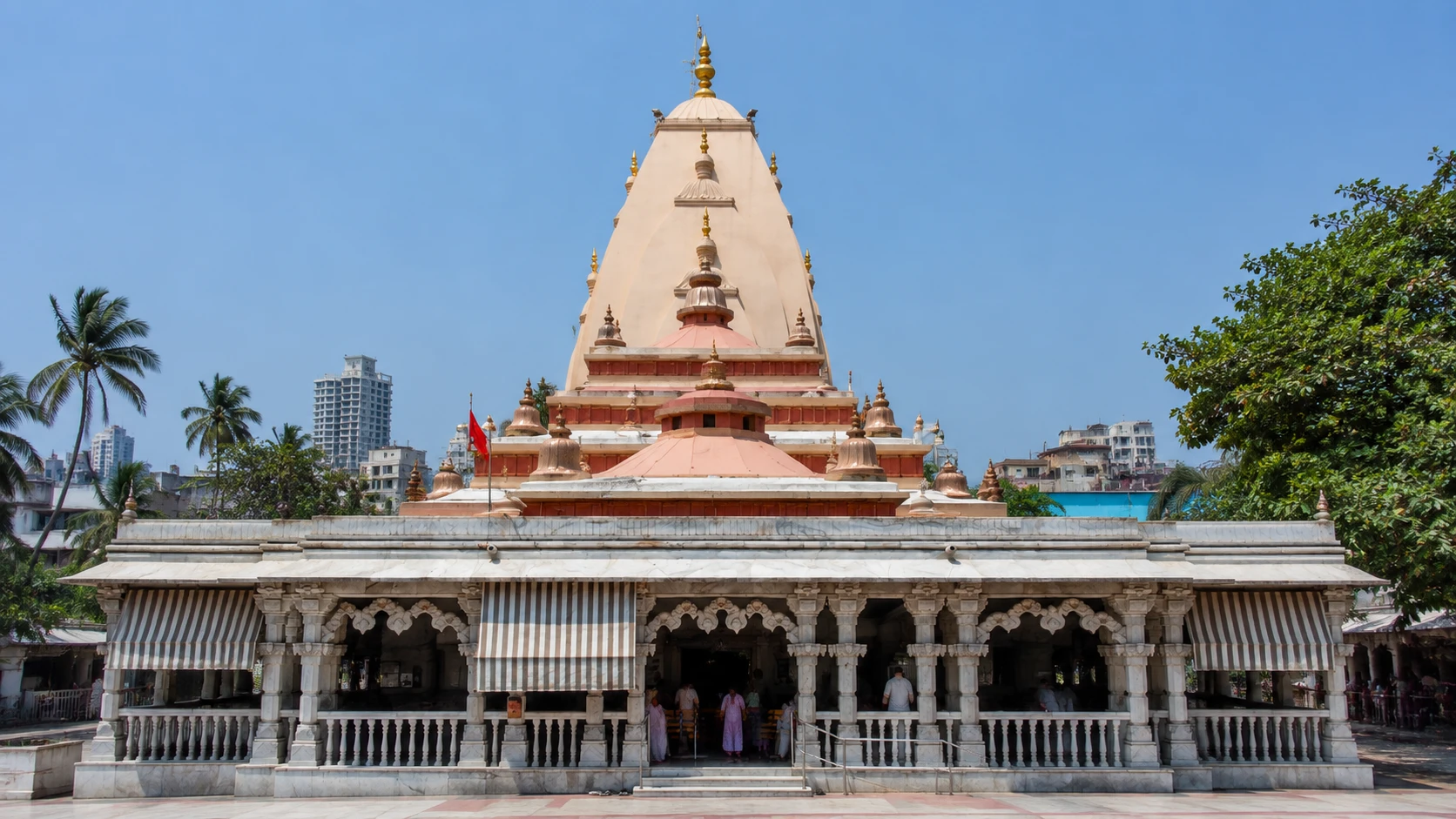
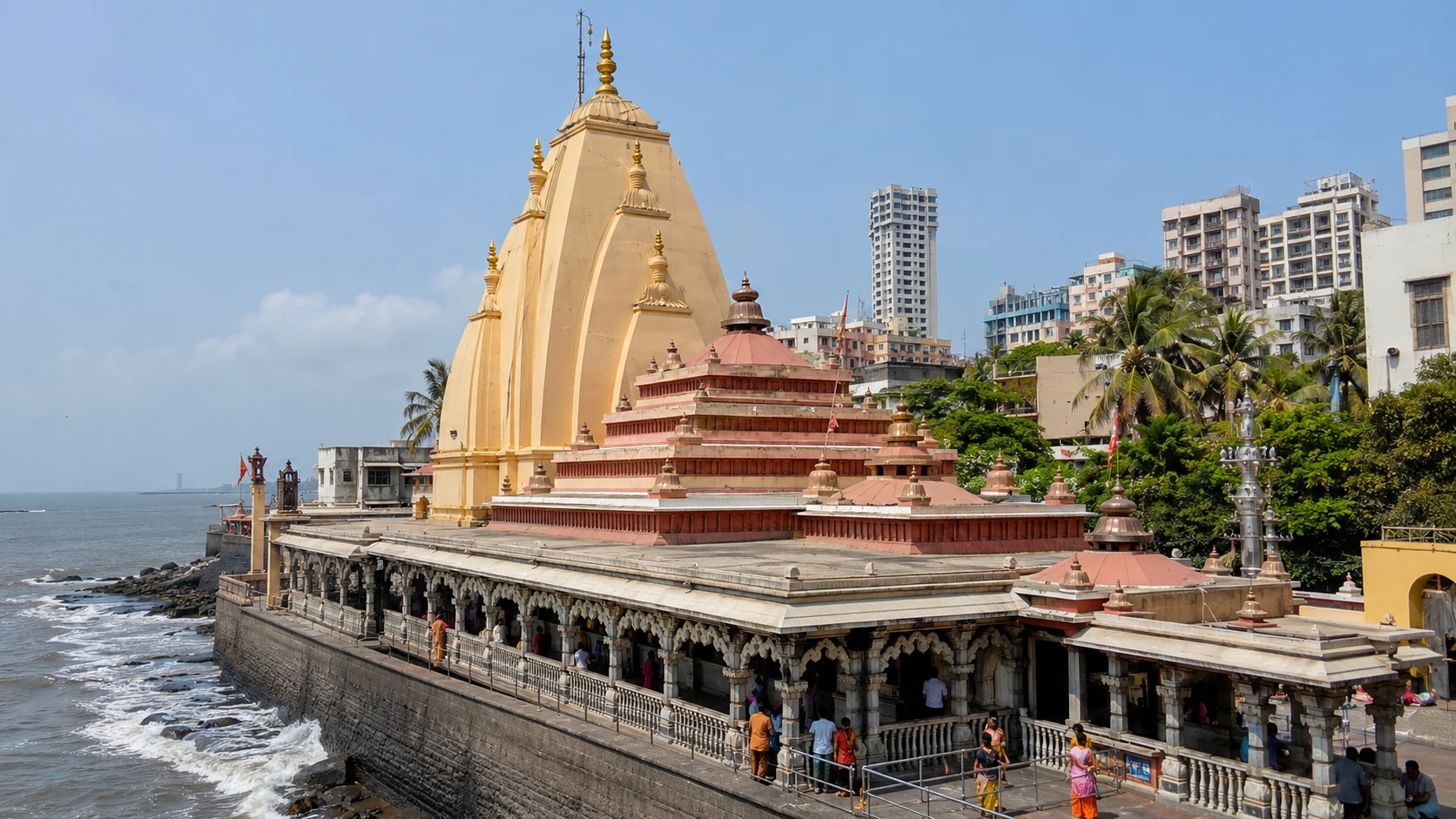
The later twentieth and twenty-first centuries saw modernisation focused on darshan logistics rather than structural change: queue management systems, online seva booking, electronic donation handling, security infrastructure, and visitor amenities. The temple closed during the strictest phases of the 2020–2021 COVID-19 lockdowns and reopened in stages thereafter, returning to full operations through 2021–2022 with some retained crowd-management protocols. The structure that visitors see today — the open mandapa fronting the sanctum, the modest modern shikhara, the sea-facing platform — has stood substantially in its present form since the nineteenth-century consolidation, with twentieth-century renovations focused on durability, capacity, and access rather than reimagining the architectural fabric.
Historical Timelineऐतिहासिक कालक्रम
Governor William Hornby's Council in Bombay approves the public works scheme to close the Worli breach — the project that becomes the Hornby Vellard. Construction begins on the breakwater across the tidal flat that separates the islands of Bombay and Worli.
Per Pathare Prabhu community tradition, the contractor responsible for the Worli–Mahalakshmi segment of the Vellard recovers three idols of Mahalakshmi, Mahasaraswati, and Mahakali from the sea following a dream visitation. The breakwater is completed shortly thereafter. The idols are temporarily housed pending construction of a permanent temple.
The Hornby Vellard is substantially completed. The Worli breach is closed, the tidal flats begin to dry, and the western Bombay coastline begins its long colonial-period transformation into a continuous urban landmass.
The present Mahalakshmi Temple is consecrated by Ramji Shivji Prabhu on the western edge of Cumballa Hill, with the three idols of Mahalakshmi, Mahasaraswati, and Mahakali installed together on a single elevated platform as the Tridevi. The temple is built on land then known as Lala Sheth Road.
The Mahalakshmi Temple Trust is formally constituted to administer the temple, with the Prabhu family and other Pathare Prabhu community elders as principal trustees. The structure of trust-based administration that governs the temple to the present day is established in these early years.
Through the latter half of the nineteenth century, gold and silver donations from Bombay's mercantile and industrial families accumulate substantially in the temple. Subsidiary shrines are added; the entrance pathway is formalised; the temple acquires its standing as one of Bombay's principal devotional landmarks alongside Mumba Devi (Bhuleshwar), Walkeshwar (Malabar Hill), and the Siddhivinayak shrine then at Prabhadevi.
The temple operates continuously through Indian independence (1947), the linguistic reorganisation that splits Bombay State into Maharashtra and Gujarat (1960), and the broader political transitions of the period. Administration remains in the hands of the trust; no significant structural changes are made.
Lala Sheth Road / Warden Road is officially renamed Bhulabhai Desai Road after the Gandhian leader and barrister Bhulabhai Desai (1877–1946). The temple's postal and administrative address is updated accordingly.
Modernisation of darshan logistics begins: formalised queue management, dedicated entry and exit routes, security infrastructure (post-1993 Bombay bomb blasts and the broader hardening of public-religious-site security in India), and growing organised seva booking systems. Donations continue to grow; the gold-and-silver corpus is publicly inventoried.
Following the November 2008 Mumbai terrorist attacks, public-religious-site security across Mumbai is reviewed and strengthened. The Mahalakshmi Temple introduces additional screening protocols and crowd-management measures. Online seva booking and electronic donation channels are progressively introduced through the 2010s.
The temple closes during the strictest phases of the COVID-19 lockdowns from late March 2020. Reopening proceeds in stages from late 2020 with attendance caps, mandatory masking, and contactless darshan protocols. Full-capacity operations resume through 2021–2022, with several digitised crowd-management protocols retained from the period.
What You'll Seeदर्शन में
The sanctum of the Mumbai Mahalakshmi Temple holds three idols set together on a single elevated stone platform, behind a low railing, beneath an ornamented metal canopy (prabhavali). The central position is held by Mahalakshmi, the largest of the three figures; Mahasaraswati stands or is seated on her devotional right (the viewer's left as one faces the goddesses); and Mahakali on her devotional left (the viewer's right). The disposition of the three reverses the textual order of the Devi Mahatmya's Charitra (Mahakali first, Mahalakshmi second, Mahasaraswati third) so as to keep Mahalakshmi at the visual and ritual centre, consistent with the temple's deity of dedication.
The central Mahalakshmi murti is shown four-armed, seated in the lalitasana posture, with the right foot lightly lowered and the left folded — the posture of ease and readiness associated with goddesses of bounty. The lower right hand holds a lotus (padma); the upper right an akshamala (rosary, less commonly a kalasha of gold); the upper left a kalasha of overflowing grain or jewels; the lower left rests in varada mudra, the gesture of granting boons. Two elephants flank her at the level of her shoulders, raising kalashas in their trunks above her head — the classical Gaja-Lakshmi configuration drawn from Rigveda and Atharvaveda sources and standardised in temple iconography from the early Gupta period onward. Her ornamentation, renewed and re-decorated daily, includes a tall crown (mukuta), heavy gold jewellery at neck and ears, a nose-ring, multiple bangle-courses, and a richly-embroidered silk antariya in red or, on festival days, in the colour of the goddess's day-form.
Mahasaraswati on the central figure's right is depicted four-armed, holding a veena (the South Asian stick-zither traditional to the goddess), a manuscript (pustaka), an akshamala, and either a water-pot (kamandalu) or a small lotus. She is dressed in white or pale gold, befitting the goddess of speech, learning, and refined arts; her crown is lighter than Mahalakshmi's, and she is shown without the elephants. Her vahana — the swan or peacock, depending on tradition — is not displayed in the sanctum itself but is invoked in the daily liturgy.
Mahakali on the central figure's left is the most iconographically restrained of the three at this temple — present in her dark-hued, fierce-but-composed form rather than the explicitly martial or tantric forms found at other Kali shrines such as Kalighat or Dakshineswar. She is depicted multi-armed, holding weapons (sword, trident) and ritual objects (a vessel for blood-offering in some renderings, a severed head in stylised form in others); her ornaments are darker and heavier; her expression is alert rather than enraged. The choice to present Mahakali in this comparatively contained form is consistent with the temple's overall character as a Mahalakshmi-centred Tridevi shrine — the fierce aspect of the Devi is acknowledged and worshipped, but the visual centre of gravity remains with the goddess of prosperity.
The platform itself is fronted by a silver torana and inset with carved decorative motifs; oil lamps burn continuously at the four corners; flower garlands, gold thread necklaces, and votive offerings accumulate through each day's worship and are reset before each major service. The sanctum opens onto the mandapa from which devotees take darshan; the back of the sanctum, accessible only to temple priests and ritual attendants, abuts the cliff-face that descends toward the Arabian Sea.
Photography of the sanctum idols themselves is restricted; devotees may take photographs in the outer mandapa, the courtyard, and the platform looking out to the sea, but the three goddesses are not photographed during darshan. Official photography by the trust is occasionally permitted for festival documentation and for the trust's own publications.
Distinctive Practicesविशिष्ट परंपराएँ
Tridevi simultaneous darshan
त्रिदेवी एक-दृष्टि दर्शन
Devotees take darshan of all three goddesses in a single line of sight from the mandapa. Unlike temples that house multiple deities in separate sanctums requiring a circumambulation route, Mumbai Mahalakshmi presents Mahakali, Mahalakshmi, and Mahasaraswati on one platform, allowing the worshipper to address the entire Tridevi at once. The practical effect is that the offering ritual at this temple is theologically unified in a way that few other Devi shrines permit.
Sea-facing pradakshina
समुद्र-मुखी प्रदक्षिणा
Following darshan, many devotees walk to the sea-facing edge of the temple platform — a stepped descent overlooking the Arabian Sea — and offer a brief private prayer to the sea before leaving the complex. The practice is not formally prescribed in any liturgical text, but it is an organic Mumbai-specific devotional gesture acknowledging the temple's founding narrative, in which the goddesses arose from the sea. The view westward toward Worli and the Haji Ali causeway, with the breaking waves at the foot of the platform, gives the practice its particular character.
Friday Lakshmi seva
शुक्रवार लक्ष्मी सेवा
Friday is the day of Lakshmi in the broader Hindu liturgical week, and at the Mumbai temple Fridays draw substantially larger crowds than other weekdays. The morning abhishekam on Friday is conducted with additional invocation to Mahalakshmi specifically; turmeric, kumkum, and red flowers are offered in greater quantity; and devotees with Lakshmi-vrats (specific vows to the goddess) typically choose Fridays for the completion of their observances. Many Mumbai families make their first major Lakshmi-puja of the calendar year — usually around Margashirsha or Diwali — at this temple on a Friday.
Gold-thread and ornament offerings
स्वर्ण-धागा और आभूषण अर्पण
Among the temple's most distinctive offering practices is the donation of gold-thread garlands (typically wound around the goddess's neck) and specific ornaments (rings, bangles, hair-pins, ear-pieces) as completion-of-vow offerings (manauti / nawas). Mumbai's mercantile, industrial, and film-industry families have for generations completed business or life-cycle vows by donating ornaments to the Mahalakshmi corpus. The trust maintains a public inventory of significant ornament-corpus holdings, and many of the goddess's daily-worn ornaments are themselves vow-completion donations rotated through use. The practice is not unique to this temple — major Devi and Vishnu temples across India have ornament corpora — but Mumbai Mahalakshmi's holdings are notable in their concentration and the social register of the donor community.
Navaratri nine-day shringar rotation
नवरात्रि नौ-दिवसीय शृंगार परिवर्तन
During the nine nights of Sharadiya Navaratri (and again during Chaitra Navaratri), the central Mahalakshmi murti is dressed and ornamented in a different shringar each night, drawn from the nine forms (Navadurga) and from regional Mahalakshmi traditions. Each day's shringar is accompanied by an abhishekam and a darshan window in which the day's specific iconographic emphasis is highlighted. The shringar rotation draws large daily attendance through the festival.
Kojagiri Pournima moon-night kheer offering
कोजागिरी पूर्णिमा चंद्र-रात्रि खीर अर्पण
On Sharad Purnima — known regionally as Kojagiri Pournima — devotees prepare kheer (rice pudding cooked in milk and sweetened with sugar) and bring it to the temple to be offered under the full moon and to consume as prasad afterwards. The tradition draws on the wider Lakshmi-Vishnu cosmology of Sharad Purnima night, when Lakshmi is said to walk the earth asking 'Ko jagarti?' ('Who is awake?') and to bestow her favour on those who keep vigil. At the Mumbai temple the kheer-offering is among the larger annual seva participations and draws particular attendance from the city's Maharashtrian households.
Margashirsha Guruvar (Thursday) Mahalakshmi vrats
मार्गशीर्ष गुरुवार महालक्ष्मी व्रत
The Maharashtrian devotional calendar gives particular weight to the Thursdays of the Margashirsha month (November–December) as days of Mahalakshmi observance. Households conduct katha-readings and ritual purnaahuti at home; many also visit the Mumbai temple to complete the vrat with a darshan and offering on one or more of the four Thursdays. The temple's Margashirsha Thursdays are accordingly among its busier weekday observances, comparable to Friday in attendance.
Did You Know?क्या आप जानते हैं?
The temple's founding narrative is among the very few major Hindu temple-origin stories in India directly tied to a documented colonial-era infrastructure project — the Hornby Vellard breakwater, approved by the East India Company's Bombay Council in 1782 and completed around 1784.
The central Mahalakshmi murti follows the Gaja-Lakshmi iconographic configuration — four-armed goddess of bounty flanked by two elephants raising kalashas above her head — which is the classical form attested in the Vedic-era Sri Suktam (Rigveda khila) and standardised across the Indian temple tradition from the early Gupta period (c. 4th–5th century CE).
Mumbai Mahalakshmi is one of the very few major Hindu temples in India where all three Mahadevis of the Devi Mahatmya — Mahakali, Mahalakshmi, and Mahasaraswati — are enshrined together on a single platform as the Tridevi, rather than in separate sub-shrines or as part of a larger Devi pantheon.
Mumbai residents traditionally count four temples as the core of the city's pre-modern Hindu sacred geography: Mumba Devi at Bhuleshwar (after whom the city is named), Walkeshwar at Malabar Hill, the Siddhivinayak shrine then at Prabhadevi, and Mahalakshmi at Cumballa Hill. Of these, the Mahalakshmi Temple has the youngest physical structure (1831) but one of the most prominent contemporary footfalls.
The temple's geographical immediate neighbour is the Haji Ali Dargah, the late-medieval Sufi shrine on a tidal island connected to the mainland by a causeway. The two sites have stood within walking distance of each other through the modern history of Mumbai and are frequently visited together as part of the city's plural sacred geography, despite belonging to entirely different religious traditions.
The temple's gold-and-silver ornament corpus, accumulated through nearly two centuries of vow-completion donations, has become one of the most substantial publicly-acknowledged temple-treasure holdings in western India. The trust periodically publishes inventory summaries; the goddess's principal ornaments are insured and rotated.
The name 'Cumballa Hill' is widely traced to the Marathi word 'kambala' (blanket) — historically the area was associated with blanket-weaving communities and textile production before its colonial-era development into a wealthy residential precinct. The Marathi name of the hill is Kambālā Ṭekaḍī.
Bhulabhai Desai Road, on which the temple stands, was renamed in the 1980s after Bhulabhai Desai (1877–1946), the Gandhian-era barrister who defended the INA prisoners (Shah Nawaz Khan, P. K. Sahgal, and G. S. Dhillon) in the Red Fort trials of 1945–1946. Before that the road was known as Warden Road, and earlier as Lala Sheth Road — the latter being the address recorded at the temple's 1831 consecration.
On a busy festival day the temple records over 100,000 darshan visits; during the nine nights of Sharadiya Navaratri the cumulative footfall typically crosses several hundred thousand. The temple uses a multi-lane queue management system with separate lines for general darshan, seva ticket-holders, and senior citizens.
The temple's architectural style is best characterised as 'late-Maratha vernacular' rather than as canonical Maratha temple architecture (which would typically include a more pronounced shikhara, more extensive carving, and a closed mandapa). The relative restraint of the 1831 structure reflects its construction context: a community-funded coastal shrine in a colonial port city, built with available craftsmen and at the scale appropriate to the period.
Mumbai's film industry families — across Hindi cinema, Marathi cinema, and the broader media-and-music industry — maintain particularly close devotional ties to the Mahalakshmi temple. The temple is one of the first stops for newly-released films seeking the goddess's blessing, and many production-house and entertainment-business vows have historically been completed here.
The temple is run as a private religious trust and is not under Maharashtra government control (as is the case for some major Maharashtra temples administered under the state's Hindu Religious Endowments framework). The Mahalakshmi Temple Trust manages all aspects of administration, finance, ritual, and infrastructure independently, in accordance with the trust deed and successive amendments since the 1834 formal constitution.
Festivalsत्योहार
Sharadiya Navaratri
शारदीय नवरात्रि
The temple's principal festival. The nine nights commemorate the Devi Mahatmya's Madhyama Charitra — the slaying of Mahishasura by Mahalakshmi — although the broader tradition layers the nine forms (Navadurga) onto the same calendar. At the Mumbai temple, the central Mahalakshmi murti is dressed in a different shringar each night, drawing on the Navadurga and regional Mahalakshmi traditions.
Chaitra Navaratri (Vasanta Navaratri)
चैत्र नवरात्रि (वसंत नवरात्रि)
The vernal counterpart to Sharadiya Navaratri. Observed across the broader Devi tradition; at the Mumbai temple, the nine nights are again marked by daily shringar rotation and elaborate evening aarti, though attendance is lower than during the autumnal observance.
Kojagiri Pournima (Sharad Purnima)
कोजागिरी पूर्णिमा (शरद पूर्णिमा)
The Lakshmi-centred lunar festival of the Maharashtrian devotional calendar. Lakshmi is said to walk the earth on this night asking 'Ko jagarti?' ('Who is awake?') and to bestow her blessings on those who keep vigil. Kheer (rice pudding cooked in milk) is the principal offering, prepared at home and brought to the temple to be offered under the full moon.
Lakshmi Pujan (Diwali)
लक्ष्मी पूजन (दीपावली)
The principal Lakshmi-worship night of the Hindu calendar, when households across India invoke Lakshmi for prosperity in the year ahead. At the Mumbai temple, Lakshmi Pujan night sees one of the largest single-night gatherings of the year, with specially commissioned mahapujas, decorative illumination of the entire complex, and individual pujas booked by business families.
Margashirsha Guruvar Vrat (Mahalakshmi Vrat)
मार्गशीर्ष गुरुवार व्रत (महालक्ष्मी व्रत)
A specifically Maharashtrian observance in which households conduct Mahalakshmi-vrat readings, kalasha-sthapana, and culminating purnaahuti on the four Thursdays of Margashirsha. The vrat is described in the regional Mahalakshmi-vratkatha literature and is observed by many Maharashtrian families as an annual obligation. The Mumbai temple sees significantly increased Thursday attendance through Margashirsha.
Akshaya Tritiya
अक्षय तृतीया
Considered one of the most auspicious days of the year for new beginnings, gold purchase, and Lakshmi-related observances. The Mumbai temple sees substantially elevated attendance, particularly from business families making annual gold-and-jewellery purchases and from devotees beginning new ventures.
Vat Pournima / Jyeshtha Purnima
वट पूर्णिमा / ज्येष्ठ पूर्णिमा
While the Vat Pournima observance is primarily associated with the Savitri-Satyavan narrative and is centred on banyan-tree veneration, married Maharashtrian women often complete the day with a visit to a Devi shrine; the Mumbai Mahalakshmi temple sees a notable observance-day footfall of married women in traditional dress completing the day's vrat with a darshan and offering.
Traditional Offeringsपारंपरिक अर्पण
Primary Offerings
Lotus (red or pink)
कमल (लाल या गुलाबी)
पद्म
The lotus is Mahalakshmi's principal flower, her seat and her hand-held emblem; the Sri Suktam invokes her as 'padmasthitām padmavarnām' — 'standing on the lotus, of the lotus's complexion'. The lotus represents purity untouched by the muddy water from which it rises, paralleling Lakshmi's grace untouched by the worldly conditions over which she presides. Red and pink lotuses, scarcer than white, are the preferred offering at the Mumbai temple.
Kumkum (vermilion) and turmeric
कुंकुम और हल्दी
कुंकुमं हरिद्रा च
Kumkum (vermilion) is offered at the goddess's feet and applied to her forehead; turmeric is offered alongside as the auspicious yellow that signifies fertility, prosperity, and the goddess's married-women's-blessing aspect. The pair are inseparable in Devi worship across the subcontinent and are particularly associated with Mahalakshmi's bestowal of saubhagya — the conjugal-and-prosperous-life-grace that Maharashtrian women invoke through her.
Coconut
नारियल
नारिकेल
The coconut (shri-phala, 'fruit of Shri/Lakshmi') is among the most ubiquitous offerings to the goddess across India. Its hard outer shell and sweet inner flesh represent the spiritual journey from the rigour of discipline to the sweetness of realisation; its three eyes are sometimes associated with the three Charitra of the Devi Mahatmya. At the Mumbai temple, coconut offerings are typically broken at the entrance and the kernel is offered to the goddess and returned as prasad.
Panchamrit (five sacred substances)
पंचामृत
पञ्चामृत
The ritual bathing of the goddess's idol with five sacred substances — milk, curd, honey, ghee, and sugar — is performed at major abhishekams. Each substance has symbolic meaning: milk for purity, curd for prosperity, honey for the sweetness of speech, ghee for victory and resilience, and sugar for happiness. The five together represent the five elements (pancha-bhuta) returned to their cosmic source; for Mahalakshmi specifically, the panchamrit invokes the abundance of the cow and the sweetness of the well-lived household.
Gold thread (suvarna sutra) garlands
स्वर्ण-धागे की मालाएँ
सुवर्ण सूत्र हार
Garlands woven of gold thread, sometimes interspersed with semi-precious stones, are placed around the goddess's neck. The offering carries both economic weight (gold is itself Lakshmi's metal) and the symbolic weight of weaving — the connecting of intent, vow, and result into a single strand. Gold-thread garlands are characteristic of the Mumbai temple's offering culture.
Red silk cloth (saubhagya vastra)
लाल रेशमी वस्त्र (सौभाग्य वस्त्र)
सौभाग्य वस्त्र
Red silk is the principal cloth of Mahalakshmi's daily and festival shringar. Devotees may offer red silk sarees, blouses, or smaller cloth-pieces to the goddess; the offered cloth is incorporated into the temple's shringar rotation or used in ritual after appropriate purification. The colour red specifically invokes saubhagya — the conjugal and prosperous-life blessing — that married women come to the temple to ask for and to give thanks for.
Sweet prasad (pedha, modak, ladoo)
मीठा प्रसाद (पेड़ा, मोदक, लड्डू)
Sweet offerings — particularly pedha (milk-and-sugar fudge), modak (steamed sweet dumplings, more associated with Ganesha but also offered to Devi during family pujas), and ladoo (round sweet balls) — are brought by devotees and offered to the goddess, with a portion returned as prasad. Each carries its own regional resonance; pedha is especially associated with Maharashtrian Lakshmi worship.
Unique to This Temple
Mahalakshmi Pedha Prasad (trust-issued)
महालक्ष्मी पेड़ा प्रसाद (ट्रस्ट-निर्गत)
The temple trust issues its own pedha prasad through counters at the exit, prepared by trust-affiliated halwais using traditional ingredients (khoya, sugar, ghee, cardamom). The trust-issued prasad is regarded by Mumbai devotees as the canonical Mahalakshmi prasad of the city and is the version most frequently brought home, distributed to families, or offered at smaller household pujas after a temple visit.
Ornament-corpus offerings
आभूषण-भंडार-अर्पण
Distinctive to this temple is the offering of specific ornaments — rings, bangles, ear-pieces, chains, hair-pins, anklets — as vow-completion donations (manauti / nawas). Such offerings are received at the trust office adjacent to the temple, formally inventoried, and either incorporated into the goddess's daily-worn ornament rotation or held in trust as part of the temple's corpus. The practice is so well-established that several Mumbai business and film-industry families maintain multi-generational records of ornaments offered.
Devotees may bring offerings from outside the temple grounds or purchase them at the trust-operated counters at the entrance. The trust does not require offerings to be purchased on the premises. Coconut-breaking is done at the entrance area; flowers and silk cloth are taken into the mandapa; ornament-and-monetary offerings go through the trust office for inventory and receipt. Bring small change for the donation kalashas placed within the sanctum view.
How to Reachकैसे पहुँचें
Mumbai is one of the most well-connected cities in India, and the Mahalakshmi Temple is centrally located on Bhulabhai Desai Road in south-central Mumbai. By air, Chhatrapati Shivaji Maharaj International Airport (BOM) at Sahar/Andheri East is the principal gateway — the domestic terminal (T1) is approximately 17 km from the temple and the international terminal (T2) is approximately 20 km, with travel times ranging from 35 minutes off-peak to over 90 minutes in peak traffic. Pre-paid taxis, app-based cabs (Ola, Uber, BluSmart), and Mumbai Metro Line 3 (Aqua Line, operational on the airport–Cuffe Parade corridor) all serve the airport. By suburban rail, Mahalaxmi station on the Western Line is the nearest at approximately 1.2 km — a 10–15 minute walk along Bhulabhai Desai Road or a short taxi-ride; Mumbai Central station (Western and Central Lines) is approximately 2.5 km. The Western Line runs from Churchgate (downtown) to Virar, and most suburban trains stop at Mahalaxmi; trains arrive every 3–5 minutes during peak hours. By long-distance rail, Mumbai Central (BCT) and Chhatrapati Shivaji Maharaj Terminus (CSMT, formerly Victoria Terminus) are the principal Mumbai terminals; both are within 4–6 km of the temple and connected by taxi, suburban train, or bus. By road, Bhulabhai Desai Road can be reached from the Bandra-Worli Sea Link via the Worli end and the Haji Ali junction, or from south Mumbai via Pedder Road, Kemps Corner, and the Breach Candy stretch. By bus, BEST routes serving the Mahalakshmi-Haji Ali corridor stop within a short walk of the temple; the temple is also a fixed stop on most Mumbai darshan tour circuits and on the Mumbai hop-on-hop-off tourist bus. Parking is constrained — the temple maintains a small designated parking area but most visitors arrive by taxi, app-cab, or suburban train; on festival days the surrounding streets are closed to private vehicles and only authorised vehicles, BEST buses, and emergency services can approach the temple precinct.
Plan Your Visitयात्रा की योजना
🌤 Best Season
November to February is the most comfortable period in Mumbai — temperatures range from 18–30°C with low humidity. Avoid the peak monsoon months (mid-June through mid-September) when heavy rain, high tides, and waterlogging on Mumbai roads can disrupt access; the sea-facing platform is also exposed to driving rain during this period. The peak summer months (April–early June, 30–38°C with high humidity) are uncomfortable for queueing. Sharadiya Navaratri (September–October) and Lakshmi Pujan (October–November) are the most spiritually charged times to visit but are also the most crowded. Weekdays other than Friday are far less crowded than Fridays or weekends; early-morning (06:00–08:00) and late-evening (20:00–21:30) windows are the most comfortable for darshan.
👘 Dress Code
Modest traditional dress is expected, though no strict dress code is formally enforced. For men, full-length trousers or dhotis with sleeved shirts or kurtas are appropriate; for women, sarees, salwar suits, or long skirts with covered shoulders are appropriate. Shorts, sleeveless tops, and very short dresses are not appropriate for darshan. Devotees in business or western attire are not turned away but are likely to feel out of place during traditional observances and festival days; for festival-day visits, traditional dress is strongly preferred. Head-covering is not required.
📱 Phones & Photography
Mobile phones must be on silent mode within the temple complex. Photography with phones is permitted in the outer mandapa, courtyard, and sea-facing platform but is not permitted within the inner sanctum or during darshan of the three goddesses. Flash photography is discouraged everywhere. There is no phone-deposit requirement at the entrance, but devotees who wish to focus on their darshan without distraction may use the cloakroom-locker facilities for valuables.
🏨 Accommodation
Mumbai offers the full range of accommodation from budget hostels (Colaba and Fort areas, generally cheaper than Cumballa Hill) to mid-range hotels (Worli, Lower Parel) to luxury properties (the Taj Mahal Palace, Trident Nariman Point, Four Seasons Worli, ITC Grand Central). Cumballa Hill itself has a small number of boutique hotels and serviced apartments. Devotees who wish to be within walking distance of the temple may consider properties on Bhulabhai Desai Road, Pedder Road, or Breach Candy. The temple does not run a dharmashala or pilgrim-accommodation facility; Mumbai's commercial accommodation landscape covers all needs.
Book a Pujaपूजा बुक करें
Mumbai is a high-online-activity environment for temple sevas, donations, and prasad orders, and the Mahalakshmi Temple is one of the most-impersonated Devi temples online. Multiple fraudulent websites and social-media pages use URLs, logos, and language that closely resemble those of the official Mahalakshmi Temple Trust. Before any payment, verify that (a) the destination URL belongs to the official trust domain — devotees should cross-check the URL with what the trust publishes on its on-premises notice board or via verified social media accounts — (b) the trust name on the payment-recipient details matches the registered trust name, and (c) the booking confirmation arrives from a trust-published email or phone number. The trust does not authorise third-party agents, and any operator claiming to expedite darshan, secure 'special access', or guarantee specific seva slots in exchange for advance payment outside the trust's published channels should be treated as a fraud. Phone numbers and email addresses published here, where given, are listed as available from public trust communications and should be re-verified with the trust before contact — they may change without notice.
Managed by: Shree Mahalakshmi Temple Charities (Mumbai)
Mahalakshmi Abhishekam (morning)
महालक्ष्मी अभिषेकम (प्रातः)
Lakshmi Mahapuja (vow-completion or new venture)
लक्ष्मी महापूजा (व्रत-पूर्णाहुति या नया उद्यम)
Akhand Jyot (continuous oil lamp)
अखंड ज्योत (निरंतर तेल-दीप)
Annadan (community meal sponsorship)
अन्नदान (सामुदायिक भोजन प्रायोजन)
Special Navaratri shringar-day sponsorship
विशेष नवरात्रि शृंगार-दिवस प्रायोजन
Booking information verified: 2026-05-21
Sacred Soundsपवित्र ध्वनि
Sri Suktam
stotram
Kanakadhara Stotram (Adi Shankaracharya)
stotram
Mahalakshmi Ashtakam
stotram
Lakshmi Ashtottara Shatanamavali
stotram
Devi Mahatmya — Madhyama Charitra (chapters 2–4)
stotram
Mahishasura Mardini Stotram (Aigiri Nandini)
stotram
Mahalakshmi Aarti (Jay Devi Jay Devi, Marathi)
aarti
Did You Know? · क्या आप जानते हैं?
The same translation error that turned '33 Koti' into '33 crore' in Hinduism also happened in Buddhism. The Chinese translation of Buddhist texts rendered 'Sapta Koti Buddha' (7 Supreme Buddhas) as '7 Crore Buddhas.' The Tibetan translation got it right: 7 types, not 7 crore. One Sanskrit word, misread across two major world religions, generated two identical misconceptions independently.
Related Contentसंबंधित सामग्री
Related Scriptures
Related Temples
Mahalakshmi Kolhapur
महालक्ष्मी कोल्हापुर
Kolhapur, Maharashtra
Ambaji
अंबाजी
Ambaji, Gujarat
Kamakhya Temple
कामाख्या मंदिर
Guwahati, Assam
Kalighat
कालीघाट
Kolkata, West Bengal
Dakshineswar Kali
दक्षिणेश्वर काली
Kolkata, West Bengal
Annapurna Mandir (Varanasi)
अन्नपूर्णा मंदिर
Varanasi, Uttar Pradesh
Gnana Saraswati (Basar)
ज्ञान सरस्वती मंदिर
Basar, Telangana
Community Reflections
🕉️
Be the first to share your reflection.