Guhyeshwari Temple
गुह्येश्वरी मंदिर
The Secret Goddess of the Bagmati, Shakti seated where Sati's knees came to rest, paired forever with Pashupati across the river
Kathmandu, Nepal, Nepal
Guhyeśvarī MandirAlso known as: Guhyeshwari Shakti Peetha, Akash Yogini Temple, Guhyakali Temple, गुह्यकाली, आकाश योगिनी, गुह्यकाली, गुप्तेश्वरी, गुह्या, गुह्यकाली, Khaganana (Newar Buddhist tradition), Nairātmyā (Vajrayana tradition)
The Sacred Legend · पवित्र कथा
Where the Bagmati river curls past the cremation ghats of Pashupatinath, a small but ancient sanctum holds Nepal's most esoteric Shakti seat. When Lord Vishnu's discus dismembered Sati's body to release Shiva from his maddened grief, fifty-one fragments fell across the Indian subcontinent, and at this spot, across the river from where Mahadeva himself stands as Pashupati, Sati's knees came to earth. The goddess seated here is Guhyeshwari, the Secret Goddess: not the slayer of demons nor the bestower of public boons, but the inward Shakti whose worship is reserved, whose mantra is whispered, whose very name (guhya, 'hidden') marks her as the goddess of what is not displayed. There is no anthropomorphic murti in the sanctum, only a sacred kalasha pot beneath a silver lid, draped in red, surrounded by an inner enclosure that few are permitted to approach. For seven hundred years and more, the Bhasha Vamshavali tells us, Nepali kings have offered worship here; the Malla emperor Pratap Malla rebuilt the present shrine in the seventeenth century. The Newar Buddhists of the valley have venerated this same spot for at least as long, calling her Khaganana or Nairātmyā, the goddess of selflessness in the Vajrayana stream. Pilgrims who come to Pashupatinath traditionally cross the Bagmati to receive her darshan; the pair is one. To stand before Guhyeshwari is to stand before Shakti at her most withdrawn, the goddess who consents to be worshipped without being seen.
Sacred Designationपवित्र पदनाम
Shakti Peeth
Body part: Both knees (jānudvayam) per Pithanirnaya; some recensions describe the site more broadly as the place where the lower-body or hip-knee region descended. The name 'Guhyeshwari' itself derives from the goddess's character as a guhya (secret, esoteric) form, not from a body-part attribution; the popular folk reading that conflates the name with guhya body parts is not supported by canonical Tantric sources.
Shakti: Guhyeshwari, the esoteric Shakti, also worshipped as Guhyakali and as Akash Yogini in tantric tradition
Bhairava: Kapali per Pithanirnaya; the adjacent Pashupatinath is regarded as the geographical Bhairava-pair across the Bagmati
Sacred Origin Storyपवित्र उत्पत्ति कथा
The origin of the Shakti Peethas is recounted across the Devi Bhagavata Purana (Skandha 7), the Kalika Purana (chapters 16, 18), and the medieval Pithanirnaya. King Daksha, Sati's father, performed a great yajna to which he invited every deity except his daughter and her husband Shiva, whose Aghori-tantric ways he could not abide.
Sati went uninvited to confront her father, and when Daksha publicly insulted Mahadeva, she immolated herself in the sacrificial fire, some texts say through yogic agni-samadhi, others through leaping into the flames. When Shiva learned of her death he descended in fury, destroyed the yajna, slew Daksha, and then took up Sati's charred body and began the Tandava, the dance of dissolution that would have ended the worlds.
To save creation, Lord Vishnu released his Sudarshana chakra, which followed Shiva and gradually dismembered Sati's body, each fragment falling to earth and consecrating that spot as a Peetha. The traditional enumeration counts fifty-one such sites; later Tantric compilations expand the list to fifty-two.
At the bank of the Bagmati, across from the Pashupatinath sanctum where Shiva himself had long manifested as the Lord of Beasts, Sati's two knees descended, janudvayam in the Pithanirnaya's catalogue. Here the goddess took her seat as Guhyeshwari, the Secret One, whose name carries her tantric character: she is the inward goddess, the goddess of what is not displayed, whose mantra is reserved and whose darshan is veiled even at the moment it is given.
Her paired Bhairava, the canonical sources name as Kapali, the Skull-Bearer, though pilgrim tradition holds that Pashupatinath himself, standing in his shrine across the river, is the geographical Bhairava with whom she keeps eternal watch.
To complete the Pashupatinath darshan without crossing to Guhyeshwari, the older Newar and Hindu liturgies hold, is to leave the offering incomplete.
Other Traditions · अन्य परंपराएँ
Newar Buddhist Vajrayana
Folk vs canonical Tantric scholarship
Historyइतिहास
Continuous worship at the Guhyeshwari site is documented at least from the Lichchhavi period (c. 4th, 9th century CE), though the present temple structure is largely a seventeenth-century Malla reconstruction. Inscriptional evidence from the Pashupatinath complex, which adjoins Guhyeshwari and shares ritual continuity with it, records royal patronage from the Lichchhavi Manadeva (c. 464 CE) onward.
The Bhasha Vamshavali, a late-medieval Nepali chronicle compiled across multiple recensions, attributes the present temple's reconstruction to King Pratap Malla, who reigned in Kantipur (the old Kathmandu) from 1641 to 1674 CE; Pratap Malla, himself a Tantric initiate and a noted patron of both Hindu and Buddhist establishments in the valley, rebuilt and re-consecrated the Guhyeshwari sanctum around the year 1654.
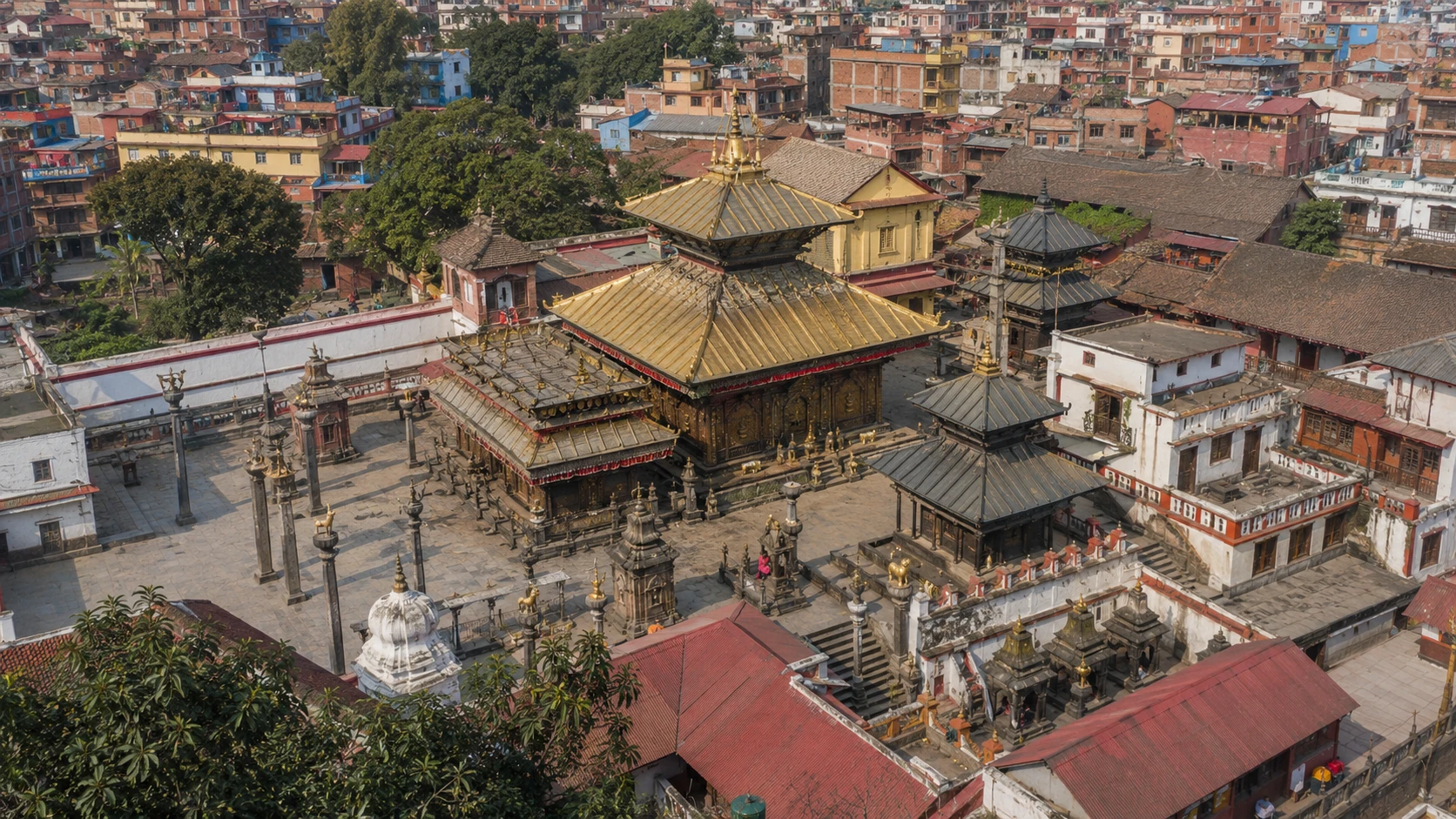
The temple's distinctive square plan with its corner pinnacles and the inner courtyard arrangement date substantially from this period. Under the Rana regime (1846, 1951), the temple's administration was tied to the royal household ritual apparatus; daily worship was funded through guthis (endowed religious trusts) attached to the Pashupatinath complex.
After the abolition of the Rana premiership in 1951 and through Nepal's subsequent transitions, the shrine came under the joint care of the Pashupati Area Development Trust (formalised in 1987 by royal decree) and the Government of Nepal's Department of Archaeology.
The 2015 Gorkha earthquake damaged a number of structures in the Pashupatinath, Guhyeshwari precinct; restoration of the Guhyeshwari sanctum itself was completed in the years immediately following, while peripheral repairs continued through the early 2020s.
The shrine remains a living temple, continuously worshipped, structurally repaired but never abandoned, and one of the rare instances in South Asia of a Hindu Shakti seat that has maintained an unbroken parallel Buddhist tantric tradition for centuries.
Historical Timelineऐतिहासिक कालक्रम
Earthquake damage figures and restoration timelines for individual shrines within the Pashupatinath precinct vary across sources; PADT, the Department of Archaeology, UNESCO, and independent heritage assessments offer somewhat different itemisations. The summary above reflects the broad consensus that the Guhyeshwari inner sanctum survived structurally while peripheral and complex-level damage required multi-year restoration.
What You'll Seeदर्शन में
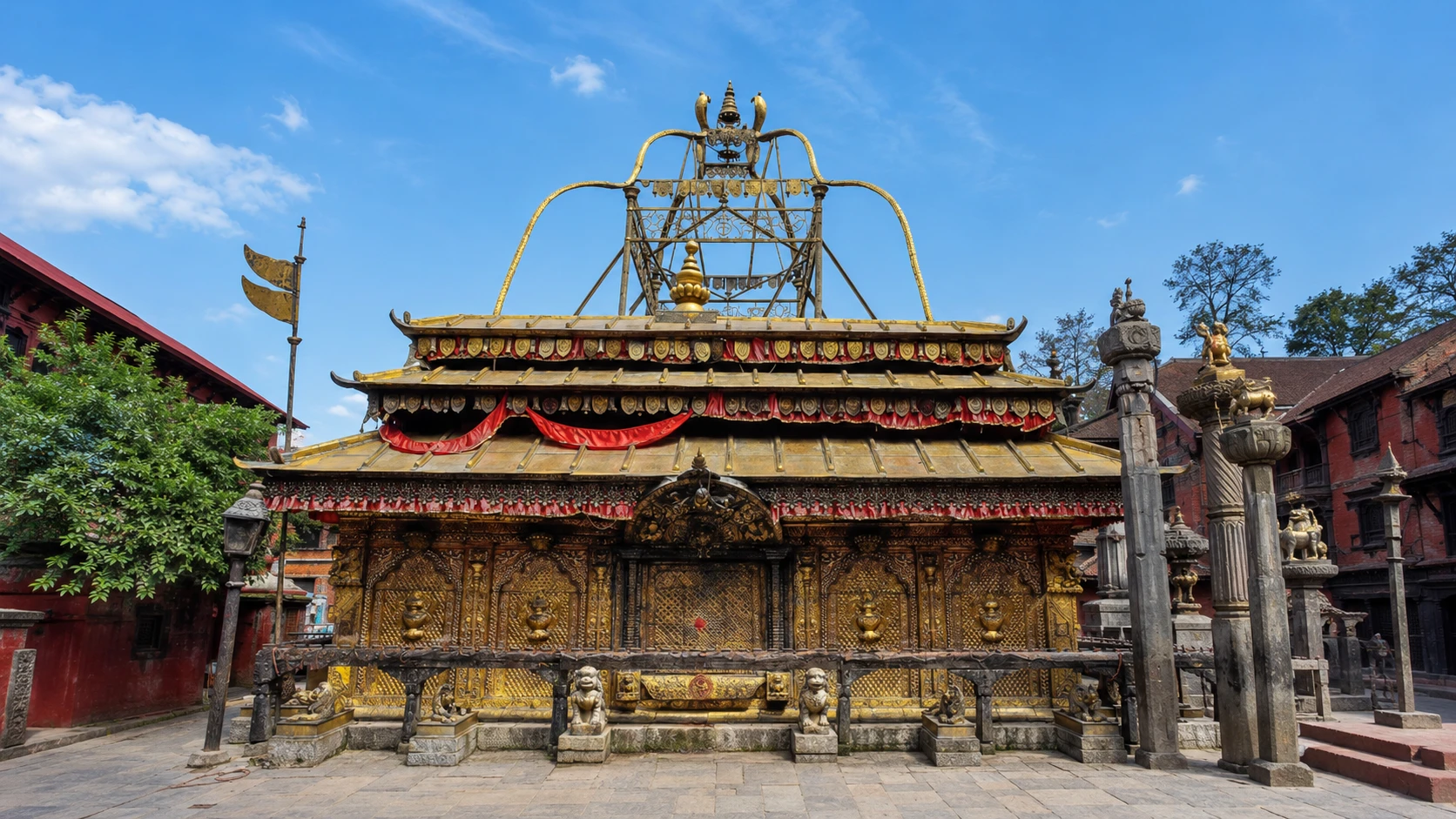
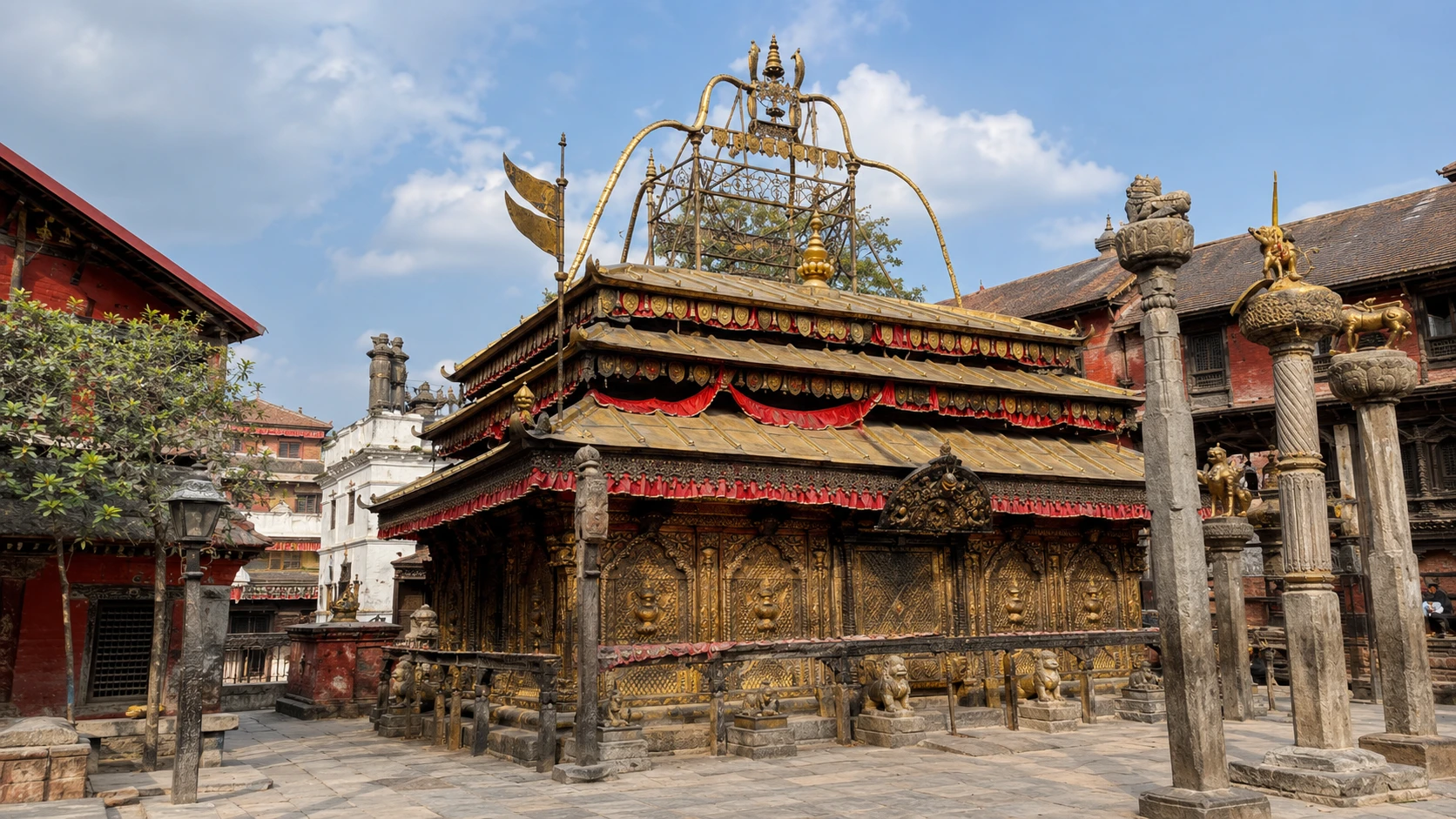
The Guhyeshwari sanctum is one of the rare major Shakti shrines in South Asia without an anthropomorphic murti. The principal object of worship is a sacred kalasha (a covered ritual pot) housed beneath a silver lid in the innermost enclosure of the temple.
The pot is draped in red cloth and surrounded by a tightly bounded inner ring that only the appointed priests may approach during daily worship; pilgrims receive darshan of the kalasha through the entrance of the inner enclosure rather than directly.
The aniconic form is theologically deliberate: the goddess here is Guhyeshwari, the Secret One, whose nature is that she is worshipped without being seen. Around the central kalasha, the inner enclosure includes a yantra inscription and ritual implements appropriate to Tantric worship.
The outer courtyard of the temple is a roughly square structure with four corner pinnacles in the gajura (Malla-period spire) style, set inside a walled compound. A small open arena around the sanctum permits circumambulation.
The Newar Buddhist Vajrayana tradition, which co-venerates the same sanctum, visualises the goddess as Khaganana ('sky-faced') or, in higher tantras, as Nairātmyā with her own iconographic conventions (a dark-blue dancing goddess with a kapala and a chopper); these conventions guide Newar Buddhist visualisation in private practice but do not introduce any visible image into the public sanctum.
Photography inside the sanctum is strictly prohibited under both temple regulation and host-country heritage law.
Distinctive Practicesविशिष्ट परंपराएँ
Veiled darshan of the kalasha
कलश का आवृत दर्शन
Daily, during all open hours; the principal moments are the morning shringar (around 5, 6 AM) and the evening aarti (around 6, 7 PM, varying by season)
Unlike most Shakti temples where the goddess presents an anthropomorphic form to her devotee's gaze, Guhyeshwari's worship is a darshan of the covered pot from outside the innermost enclosure. The silver lid of the kalasha may be lifted only by the appointed priests during specific ritual moments; for pilgrims, the offering of flowers, sindoor, and red cloth is conveyed through the priests, who carry the offering to the inner enclosure and return with the goddess's blessing in the form of prasad. The act of darshan here is, paradoxically, a darshan of restraint, of the veil itself, of the boundary that the goddess sets between her hidden form and the world.
The veiled form reflects the tantric theology that Shakti at her most powerful is also at her most withdrawn. The Sri Vidya and Kaula traditions associate the highest form of worship with what is not displayed; the visible deity is for the many, the unseen deity for the initiate. Guhyeshwari's sanctum architecturally enacts this hierarchy. The darshan trains the pilgrim to encounter divinity through restraint rather than spectacle.
The Pashupatinath, Guhyeshwari ritual pair
पशुपतिनाथ-गुह्येश्वरी अनुष्ठान युग्म
Year-round, but with heightened observance during Maha Shivaratri (Feb, Mar), Teej (Aug, Sep), Bala Chaturdashi (Nov, Dec), and the great Dashain festival (Sep, Oct)
Pilgrim tradition across the Kathmandu Valley holds that darshan at Pashupatinath is incomplete without crossing the Bagmati to receive Guhyeshwari's darshan, and vice versa. Pilgrims who come to the Pashupatinath complex from elsewhere in Nepal or from abroad commonly complete both temples in a single visit, following the older route that crosses the Bagmati south of the main Pashupati sanctum and approaches Guhyeshwari from the river's east bank. During Maha Shivaratri, parallel processions and offerings move between the two shrines; during Teej, women's processions arrive at Pashupatinath and proceed to Guhyeshwari to invoke marital and familial well-being. The pairing reflects the geographical and theological symmetry of Shiva and Shakti, the lord of beasts on one bank, the secret goddess on the other, the river between them as both boundary and bridge.
Shiva and Shakti as a paired theology is foundational to all Tantric Hinduism, but few sites enact it geographically with the clarity of the Bagmati pair. The pilgrim's bodily movement from one bank to the other dramatises the theological insistence that Shiva alone is incomplete without Shakti and that Shakti alone is incomplete without Shiva. The act of crossing the river is itself the ritual.
Parallel Newar Buddhist Vajrayana worship
समानान्तर नेवार बौद्ध वज्रयान पूजा
On Buddhist tantric calendar days, particularly the dasami and astami of the bright fortnight; specific Vajracharya-lineage rituals are scheduled by the Vajracharya families of Kathmandu and Patan under arrangement with PADT
The Vajracharya priestly lineages of the Newar Buddhist community of Kathmandu Valley have, for centuries, conducted their own tantric rituals at the Guhyeshwari sanctum, worshipping the same goddess they know as Khaganana or Nairātmyā. The Hindu daily puja conducted by the Bhatta priests of the Pashupatinath lineage and the periodic Newar Buddhist tantric rites coexist at the shrine under long-standing arrangement. The Newar Buddhist rites differ in their visualisation (Khaganana/Nairātmyā has her own iconography in tantric meditation), in the mantras employed, and in the framing of the goddess as the personification of selflessness rather than as a fallen body part of Sati. The shared sanctum makes Guhyeshwari one of the most striking examples in South Asia of a sacred site that has maintained genuine dual-tradition worship across centuries without either tradition displacing the other.
The dual-tradition worship reflects the Kathmandu Valley's distinctive religious history, in which Hindu Shakta and Newar Buddhist tantric traditions developed in close mutual contact over more than a millennium. At Guhyeshwari, theological agreement is not required for ritual coexistence; both traditions agree that the place is sacred to a great goddess, and they let their respective tantras articulate what that means without insisting on resolution. This is a rare model of inter-traditional respect that some scholars describe as 'parallel co-veneration' rather than syncretism.
Did You Know?क्या आप जानते हैं?
Guhyeshwari is one of the rare major Shakti shrines in South Asia where the principal object of worship is not an anthropomorphic murti but a covered ritual pot (kalasha) beneath a silver lid, draped in red cloth and surrounded by an inner enclosure that pilgrims do not directly enter. The aniconic form is theologically deliberate, the goddess named 'the Secret One' is worshipped without being seen.
Pithanirnaya canonical attribution; Slusser, 'Nepal Mandala' (1982); on-site PADT temple administration documentation
The shrine has been continuously co-venerated by Hindu Shakta and Newar Buddhist Vajrayana traditions for at least eight centuries, with each tradition's priests conducting their own rituals at the same sanctum. Hindu pilgrims encounter Guhyeshwari as the goddess where Sati's knees fell; Newar Buddhists encounter her as Khaganana / Nairātmyā, the goddess of selflessness, consort of Hevajra. Both rituals continue today under arrangement with the Pashupati Area Development Trust.
Slusser, 'Nepal Mandala'; Locke, 'Karunamaya'; PADT administrative records
The Malla emperor Pratap Malla (reigned 1641, 1674 CE), who rebuilt the present Guhyeshwari sanctum around 1654, was himself a Tantric initiate and a Sanskrit poet of accomplishment whose verses are inscribed across many of Kathmandu Valley's temples. His personal devotion to Guhyeshwari, recorded in the Bhasha Vamshavali, is one reason the shrine's present form is so deliberately tantric in its architectural choices, the inner enclosure, the silver lid, the red-cloth aniconic kalasha all reflect a king's understanding of how a tantric goddess should be housed.
Bhasha Vamshavali; Slusser, 'Nepal Mandala'
The Pashupatinath, Guhyeshwari precinct is part of the Kathmandu Valley UNESCO World Heritage Site (inscribed 1979), one of seven monument zones in the Valley listed under the joint inscription. Guhyeshwari thus carries dual recognition: as a living tantric shrine in continuous worship, and as a heritage monument under international conservation oversight. The 2015 Gorkha earthquake reconstruction was carried out within the UNESCO heritage-conservation framework.
UNESCO World Heritage Centre, Kathmandu Valley (ref. 121bis)
Indian citizens require no visa to enter Nepal under the long-standing 1950 Treaty of Peace and Friendship; Indian passport holders or Indian-issued voter ID/Aadhaar (subject to current Nepalese immigration rules) can cross at Sunauli, Raxaul, Birgunj, and other border points or fly directly to Tribhuvan International Airport. This makes Guhyeshwari the most operationally accessible of the four cross-border Shakti Peethas in the standard 51-Peetha enumeration, and a common addition to Pashupatinath pilgrimages from India.
Government of India and Government of Nepal, 1950 Treaty of Peace and Friendship; Embassy of India in Kathmandu, current entry guidance
Visitor Accessप्रवेश जानकारी
The Guhyeshwari Temple is open to all worshippers regardless of caste, sect, or national origin. The single significant restriction is that non-Hindus are typically not permitted to enter the inner enclosure of the sanctum; this restriction parallels the well-known policy at the adjacent Pashupatinath Temple. Foreign tourists of any religious background are generally permitted into the outer courtyard from which darshan is possible. The restriction is administered by PADT in accordance with traditional custom.
Spiritual Basis
The inner enclosure restriction at major Hindu shrines is rooted in traditional notions of ritual purity, dīkṣā (formal Hindu religious initiation), and the appropriate stewardship of a tantric sanctum. The restriction is not interpreted by the tradition as exclusionary in a social sense, Hindu pilgrims of all backgrounds are welcomed, but as a marker of the sanctum's ritual character. The same logic underlies the parallel restriction at Pashupatinath.
Contemporary Context
PADT has consistently maintained the inner-enclosure restriction since its formation in 1987, citing both traditional precedent and the parallel Pashupatinath policy. Periodic public debate in Nepal about the appropriate scope of such restrictions has not resulted in policy change at Guhyeshwari. Foreign visitors are advised to respect the boundary as marked by signage and priest direction.
Practical Guidance
Pilgrims should approach the inner enclosure boundary and offer flowers, sindoor, or red cloth through the priests. Mobile phones must be silenced or switched off; photography inside the sanctum is strictly forbidden. Dress should be modest and clean; leather items including belts and wallets are typically not permitted in the inner courtyard. Foreign tourists who do not enter the inner enclosure can still receive a meaningful darshan from the outer courtyard area; the temple staff and PADT volunteers can clarify the boundary at the site.
Festivalsत्योहार
Dashain (Bada Dashain)
दशैं (बड़ा दशैं)
Sep, Oct (Ashwin Shukla Pratipada to Purnima)
Nepal's longest and most observed festival, parallel to the Indian Durga Puja and Navaratri but with distinctively Nepali ritual structure. Guhyeshwari, as Shakti's primary seat in the valley, receives intensified worship throughout the fifteen-day festival, with special pujas on Phulpati (the seventh day), Maha Ashtami, and Maha Nawami. The Pashupatinath, Guhyeshwari pair is central to Dashain observance in Kathmandu; royal-era practices of national tika offering (which continued into the post-monarchy era as a public-presidential observance) traditionally include offerings at both shrines.
Maha Shivaratri
महाशिवरात्रि
Feb, Mar (Phalguna Krishna Chaturdashi)
The Pashupatinath complex's most-attended festival, drawing several hundred thousand pilgrims and sadhus from across Nepal and India to the precinct. Guhyeshwari receives the parallel Shakti worship that completes the Shiva, Shakti pairing through the night-long vigil; many pilgrims complete their Pashupatinath night-watch by crossing the Bagmati to receive Guhyeshwari's pre-dawn darshan, a practice especially associated with tantric initiates.
Bala Chaturdashi
बाला चतुर्दशी
Nov, Dec (Margashirsha Krishna Chaturdashi)
A distinctively Pashupatinath-area festival observed for the welfare of departed ancestors, particularly those who passed away in the year just gone. Pilgrims hold a night vigil and at dawn scatter saptadhanya (a seven-grain mixture) across the Pashupatinath, Guhyeshwari forest precinct, walking a prescribed circuit that includes Guhyeshwari. The festival, with its ancestor-welfare emphasis, draws particularly large gatherings from the Newar and Hindu communities of the valley.
Teej
तीज
Aug, Sep (Bhadrapada Shukla Tritiya)
Nepal's most important women's festival, observed primarily by Hindu women through fasting, red attire, and processions to Shiva-Shakti shrines for marital well-being and the welfare of husbands and family. The Pashupatinath, Guhyeshwari pair receives an extraordinary concentration of women pilgrims on Hari Talika Teej; queues at Guhyeshwari stretch through the day and into the night. The red cloth offerings at the Guhyeshwari kalasha multiply visibly during this festival.
Traditional Offeringsपारंपरिक अर्पण
Red cloth (lal chunari), red flowers (especially hibiscus), sindoor, kumkum, coconut, fruits, sweets, and oil lamps. Animal sacrifice, historically associated with Shakti shrines in some traditions, is not part of Guhyeshwari's contemporary ritual practice as administered by PADT; pilgrims wishing to undertake sacrificial offerings traditionally do so at the separate Dakshinkali temple south of Kathmandu.
The most-offered item at Guhyeshwari is the red cloth, which the priests place on the kalasha in the inner enclosure.
How to Reachकैसे पहुँचें
Guhyeshwari is approximately 6 km east of central Kathmandu and 6 km from Tribhuvan International Airport. The temple is directly accessible from the Pashupatinath main complex by a short pedestrian path that crosses the Bagmati on a foot-bridge; pilgrims commonly walk between the two temples (around 10, 15 minutes on foot).
By taxi, the temple is reachable from any part of Kathmandu within 30, 60 minutes depending on traffic; the temple precinct has dedicated drop-off zones. Local Kathmandu buses and microbuses also serve the area, with the closest stops at Pashupatinath / Gausala.
Indian pilgrims travelling overland from India most commonly enter via the Sunauli, Bhairahawa border (about 270 km from Kathmandu, road journey 7, 9 hours) or the Raxaul, Birgunj border (about 145 km, road journey 5, 6 hours). Domestic Indian airline service to Kathmandu is operated by multiple carriers from Delhi, Mumbai, Kolkata, Varanasi, and other hubs.
Within the Pashupatinath, Guhyeshwari precinct, all movement is on foot.
Plan Your Visitयात्रा की योजना
🌤 Best Season
October to March offers the most pleasant weather for visiting Kathmandu, clear skies, mild days, cool nights, and low rainfall. The Dashain, Tihar, Bala Chaturdashi festival window (September through December) brings the temple's most intense devotional atmosphere but also the largest crowds; pilgrims seeking quieter darshan may prefer January, February. The monsoon months (June, September) bring heavy rain that can affect both travel and the Bagmati's atmosphere around the temple, though the temple itself remains open throughout.
👘 Dress Code
Modest dress is expected: shoulders and knees covered, no shorts, no sleeveless tops. Leather items including belts, wallets, and bags are typically not permitted in the inner courtyard and should be left at the cloakroom or with a companion. Red, the goddess's colour, is auspicious for women devotees; men commonly wear traditional kurta-pajama or shirt-and-trousers. Removal of footwear is required at the entrance to the inner complex.
📱 Phones & Photography
Mobile phones must be silenced or switched off in the inner complex. Photography is strictly prohibited inside the sanctum and the inner enclosure; photography is generally permitted in the outer courtyard but pilgrims are advised to confirm with on-site staff before photographing any ritual or fellow worshippers. Video recording is restricted across the precinct; PADT may grant prior written permission for documentary or research purposes.
🏨 Accommodation
Kathmandu offers accommodation across every category, from heritage and luxury hotels in Thamel and the Boudha-Pashupati corridor to budget guesthouses and dharamshalas. Several Hindu charitable trusts and pilgrim guesthouses operate in the Pashupati area itself, offering low-cost shared accommodation; advance enquiry through Indian pilgrim-tour operators is recommended. Hotels in the Boudha-Gausala stretch place pilgrims within walking distance of the Pashupatinath, Guhyeshwari precinct.
Book a Pujaपूजा बुक करें
Photography is strictly prohibited inside the Guhyeshwari sanctum and inner enclosure under both temple regulation and Nepal's heritage-conservation law; violations are taken seriously by temple staff. Mobile phones must be silenced. Leather items (belts, wallets, bags) are not permitted in the inner courtyard. Dress should be modest and clean. Footwear must be removed at the inner complex entrance. The inner enclosure of the sanctum is reserved for the appointed priests; non-Hindus are typically not admitted to the innermost sanctum but are welcome in the outer courtyard. During festival days (Dashain, Maha Shivaratri, Bala Chaturdashi, Teej), crowds can be extraordinarily large; pilgrims with mobility constraints should plan visits on non-festival days where possible and stay close to companions.
Managed by: Pashupati Area Development Trust (PADT), Government of Nepal
Standard Darshan
साधारण दर्शन
Kalasha Puja (priest-mediated personal offering)
कलश पूजा (पुरोहित-मध्यस्थ व्यक्तिगत अर्पण)
Maha Puja / Vishesh Puja
महा पूजा / विशेष पूजा
Festival-day Special Puja
उत्सव-दिवस विशेष पूजा
Sacred Soundsपवित्र ध्वनि
Did You Know? · क्या आप जानते हैं?
The same translation error that turned '33 Koti' into '33 crore' in Hinduism also happened in Buddhism. The Chinese translation of Buddhist texts rendered 'Sapta Koti Buddha' (7 Supreme Buddhas) as '7 Crore Buddhas.' The Tibetan translation got it right: 7 types, not 7 crore. One Sanskrit word, misread across two major world religions, generated two identical misconceptions independently.
Related Contentसंबंधित सामग्री
Related Scriptures
Community Reflections
🕉️
Be the first to share your reflection.