Jakhu Hanuman Mandir (Shimla)
जाखू हनुमान मंदिर
Where Hanuman paused on his flight to save Lakshmana
Shimla, Himachal Pradesh, India
Jākhū Hanumāna MandiraAlso known as: Jakhu Temple Shimla, Jakhoo Hanuman Mandir, Jakhu Hill Temple, Yaku Hanuman
Era
Ancient shrine; documented history of several centuries; 33-metre Hanuman statue added 2010
Architecture
North Indian hill temple with modern additions; 33-metre steel and concrete Hanuman statue (2010)
Open
07:00 – 19:00
Aarti
07:30 · 12:00 · 18:30
Special
33-metre Hanuman statue visible from across Shimla valley; Tuesdays and Saturdays draw peak crowds; Hanuman Jayanti is the principal festival
The Sacred Legend · पवित्र कथा
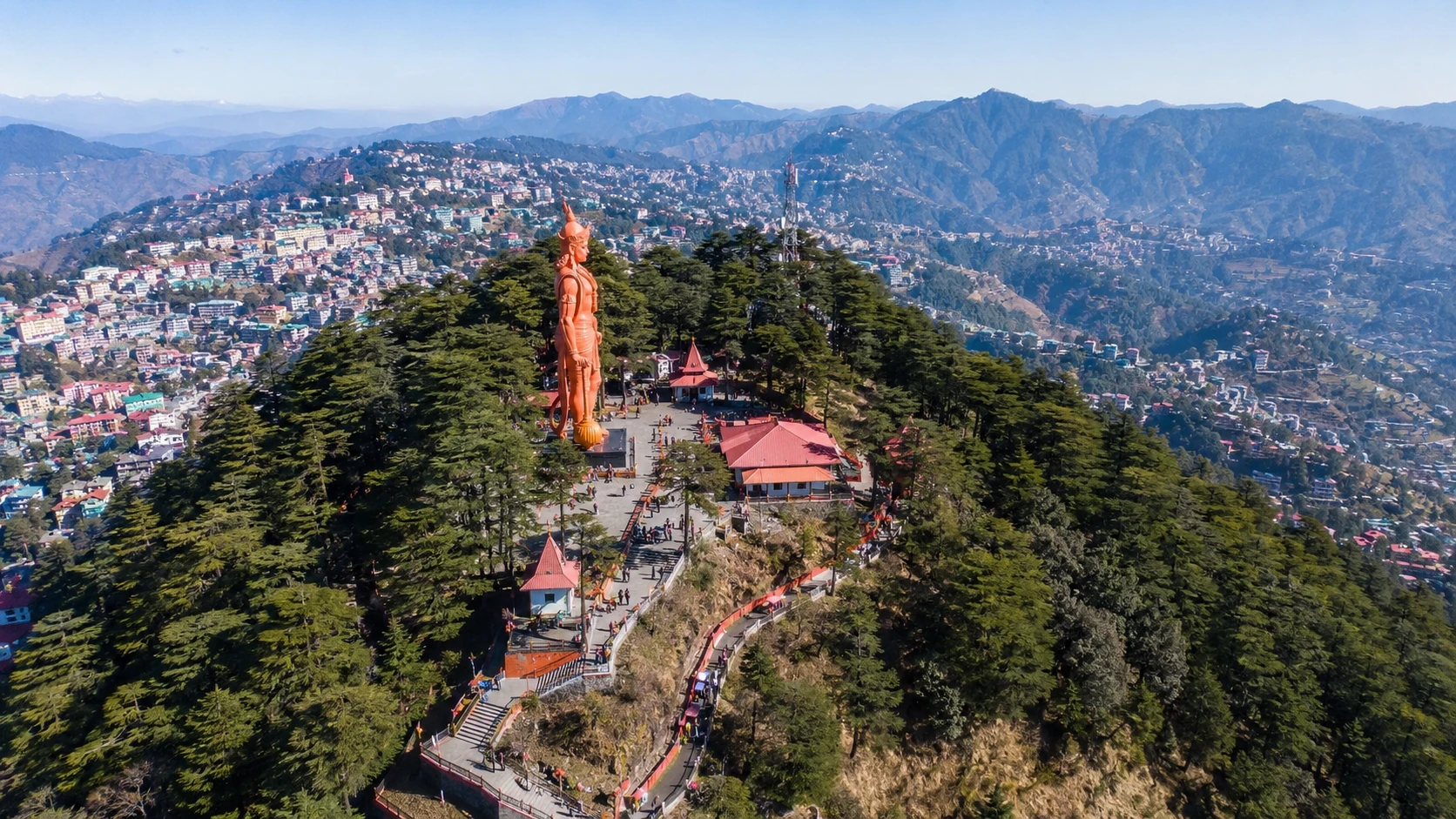
High above the colonial hill station of Shimla, on the highest peak in the surrounding range at 2,455 metres, stands a Hanuman temple that predates the British presence in these mountains by centuries. The tradition holds that when Hanuman flew northward through the Himalayas to fetch the Sanjeevani herb for the dying Lakshmana, he paused on this peak — and the footprint left by that divine rest became the sanctified ground on which the temple was built. Jakhu Hill is now crowned by a 33-metre statue of Hanuman, visible from across the Shimla valley, and guarded by troops of rhesus monkeys who descend from the forested slopes to claim offerings from pilgrims with a proprietary confidence that suggests they, too, know whose hill this is.
Sacred Origin Storyपवित्र उत्पत्ति कथा
Source: Valmiki Ramayana (Sanjeevani episode) / local Jakhu Hill tradition — widely attested
The mythology of Jakhu is embedded within one of the most dramatic moments in the Ramayana — the episode of the Sanjeevani herb.
During the great war at Lanka, the demon Meghnadha (Indrajit), son of Ravana, struck Lakshmana with a devastating weapon. Lakshmana fell unconscious and lay as if dead. Rama wept over his fallen brother, and even the great Susena Vaidya — the physician who came across the sea — could not revive him without the Sanjeevani, a life-restoring herb that grew only on the Dronagiri mountain deep in the Himalayas. There was almost no time: Lakshmana would die before dawn if the herb did not arrive.
Hanuman volunteered. He leapt from Lanka northward, his body crossing the sea, traversing the plains, climbing into the Himalayan range. The Valmiki Ramayana (Yuddha Kanda) describes his flight as a comet's streak across the sky.
The local tradition of Jakhu holds that on his northward flight toward the Himalayan highlands, Hanuman paused at this peak — this hilltop above what is now Shimla — to take his bearings and rest momentarily before continuing his flight to the higher Himalayas. The hill, by this reasoning, stands on the very trajectory of Hanuman's mercy flight.
When Hanuman arrived at Dronagiri, he could not identify the specific Sanjeevani herb among the many plants. He solved the problem with characteristic totality: he picked up the entire mountain and carried it back to Lanka. Lakshmana was revived. Hanuman returned the mountain. The world was saved.
The imprint of Hanuman's presence at Jakhu — his foot touching the hill during his pause — is what the ancient shrine commemorates. Devotees who climb to Jakhu believe they are approaching the exact point on the Himalayan landscape that Hanuman's body touched on the night he flew to save a life. The act of climbing the hill is thus not merely pilgrimage to a temple but a physical enactment of approaching the trajectory of one of the most famous acts of devotion in the entire Ramayana tradition.
Sources cited:
- Valmiki Ramayana, Yuddha Kanda — Sanjeevani episode
- Tulsidas, Ramcharitmanas, Lanka Kanda — parallel account of the Sanjeevani episode
- Local Jakhu Hill tradition (oral)
Scholarly Context
The Sanjeevani episode in the Valmiki Ramayana (Yuddha Kanda) is one of the text's most celebrated passages, establishing Hanuman's role as the active savior of the Ramayana's plot — without him, Lakshmana dies and the war is lost. Philip Lutgendorf ('Hanuman's Tale', 2007) discusses how this episode became the theological foundation for attributing healing and life-saving power to Hanuman in the popular tradition. Multiple sites across the Himalayan range — including Jakhu — claim to mark points on Hanuman's flight path, a tradition that mirrors similar geographic sanctification patterns at sites associated with other Ramayana events. The Jakhu tradition is among the best-established of these flight-path claims.
Historyइतिहास
Jakhu Temple is among the oldest documented shrines in the Shimla region, predating the British establishment of Shimla as a hill station in the early 19th century by many centuries. The temple is referenced in local Himachali oral tradition as an ancient site of Hanuman worship on the highest peak in the immediate Shimla range.
The colonial-era history of Jakhu is intertwined with Shimla's transformation into the summer capital of British India. As Shimla developed from a small hilltop settlement into the administrative heart of the British Raj (from the 1820s onward), Jakhu Hill — the forested peak rising above the town — became one of the defining features of the colonial city's landscape. British officers and residents walked the forest trail to Jakhu as exercise and sightseeing; the temple was documented by several British writers and administrators in the 19th century as a point of local religious interest.
The Kalka-Shimla narrow-gauge railway, a UNESCO World Heritage Site completed in 1903, further opened Shimla to visitors from across India and eventually made Jakhu accessible to a broader pilgrimage audience. As Shimla grew into one of India's most visited hill stations through the 20th century, Jakhu became a standard stop on any Shimla visit — temple and viewpoint combined.
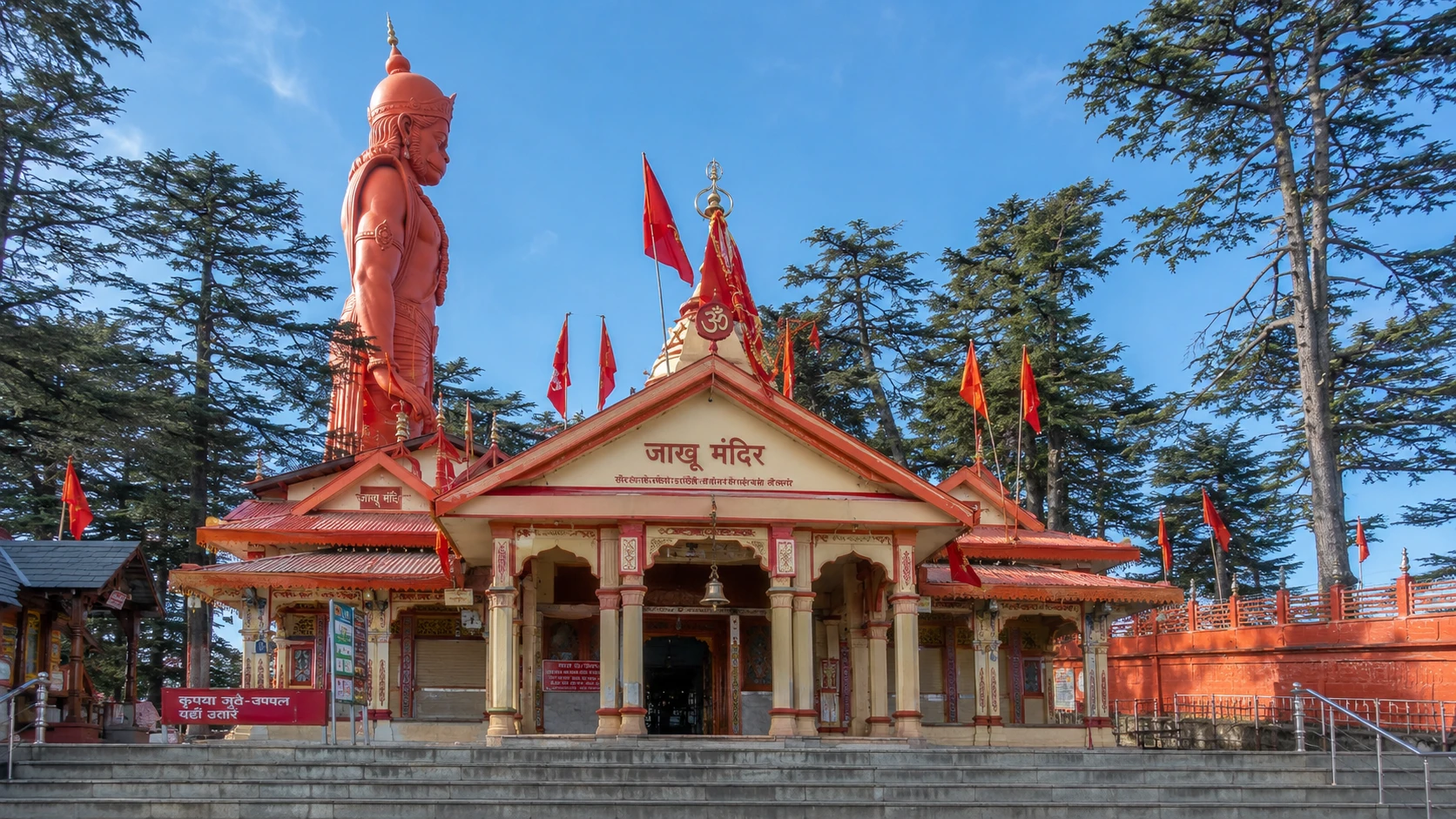
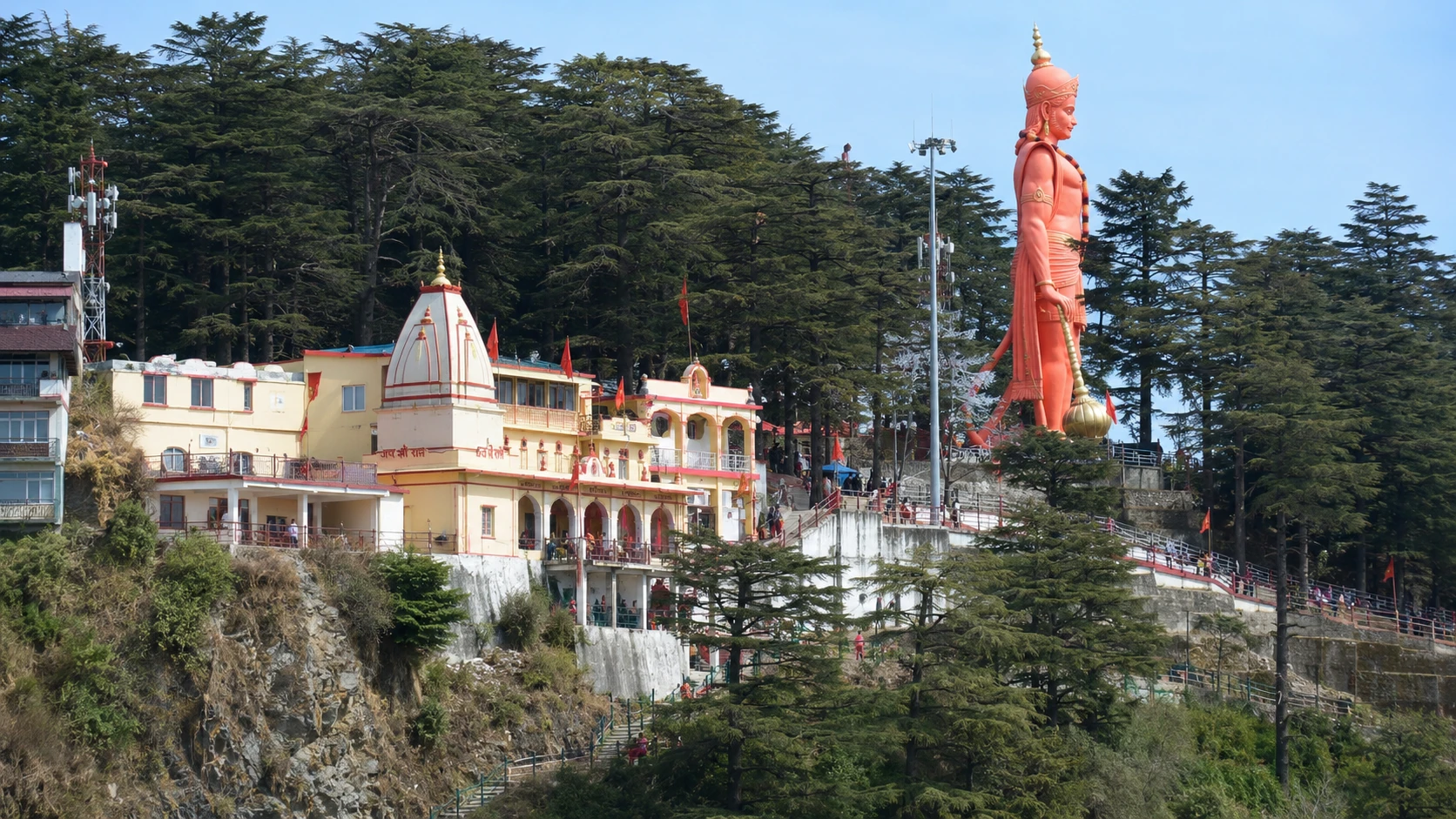
The most visible recent development is the installation of a 33-metre (108-foot) steel and concrete statue of Hanuman on Jakhu Hill, completed in 2010. The statue, designed to be visible from across the Shimla valley, transformed Jakhu's visual identity. It now dominates the Shimla skyline and has become as much a landmark of the city as the historic Viceregal Lodge or the Ridge. The number 108 feet references the sacred count used in Hindu ritual and rosary beads.
The temple today is managed under the Himachal Pradesh government's religious and cultural framework, with the hill protected as a forested heritage area. The rhesus monkey population on Jakhu Hill is protected — feeding them is encouraged by the temple tradition but visitors are cautioned about aggressive behavior.
Historical Timelineऐतिहासिक कालक्रम
Ancient shrine on Jakhu Hill established at the site believed to mark Hanuman's resting point during his flight to fetch the Sanjeevani herb. The temple predates British Shimla by many centuries; its exact founding is not documented.
British establishment of Shimla as a hill station and later as the summer capital of British India. Jakhu Hill and its temple become documented features of the colonial city's landscape, referenced by British administrators and travelers.
Completion of the Kalka-Shimla narrow-gauge railway (UNESCO World Heritage Site), opening Shimla — and Jakhu — to a much wider pilgrimage and tourist audience from across India.
Completion and installation of the 33-metre (108-foot) Hanuman statue on Jakhu Hill. The statue, visible from across the Shimla valley, became a landmark of the city and significantly increased the temple's national visibility. The 108-foot height references the sacred Hindu count.
What You'll Seeदर्शन में
The Jakhu temple has two visual registers: the ancient murti inside the sanctum, and the modern colossal statue outside. The ancient murti is a traditional standing Hanuman image in the North Indian style, thickly coated in sindoor, adorned with garlands and ornamental clothing during festivals. The murti is housed in a relatively modest sanctum that reflects the temple's centuries-old character. Outside, the 33-metre (108-foot) steel-reinforced concrete statue, completed in 2010, depicts Hanuman in a classic standing posture with his right hand raised and gada in the left — the same protector form seen at thousands of temples, here rendered at heroic scale. The statue's vermilion and orange colour-scheme mirrors the sindoor tradition and is visible from most points across the Shimla valley, from the Mall Road below to the ridges across. Between the ancient inner murti and the modern giant, the temple holds an unusual temporal span.
Distinctive Practicesविशिष्ट परंपराएँ
Monkey Feeding (Vanara Prasad)
बंदर भोजन (वानर प्रसाद)
Daily, throughout the day
Jakhu Hill is home to a large population of rhesus macaques who inhabit the forested slopes and the temple precinct. Feeding these monkeys is considered auspicious — they are regarded as vanaras, the monkey warriors of Hanuman's army in the Ramayana. Temple shops and vendors near the hill sell peanuts, chana, and fruits specifically for feeding the monkeys. The animals have no fear of humans and will approach, snatch, or inspect offerings with complete confidence.
In the Ramayana tradition, the vanaras — monkey warriors who served Hanuman and Rama — are revered not merely as animals but as divine beings who chose a simian form to serve God. Feeding the monkeys at Jakhu is thus not charity to wildlife but devotional service to Hanuman's companions, an extension of the prasad offering itself — what is given to the vanaras is received by their lord.
Did You Know?क्या आप जानते हैं?
The 33-metre Hanuman statue at Jakhu was built to exactly 108 feet — the sacred count in Hindu tradition (108 beads in a japa mala, 108 Upanishads, 108 names of major deities). The number was deliberately chosen to imbue the engineering project with sacred significance.
Temple trust documentation; Himachal Pradesh government records
Jakhu Hill, at 2,455 metres above sea level, is the highest point in the immediate Shimla area. On clear days, the view from the temple encompasses the surrounding Himalayan ranges and on exceptionally clear winter days, more distant snow peaks. The hill is a recognized forested heritage area and the rhesus monkey population is protected.
Survey of India topographic data; Himachal Pradesh Forest Department
The Kalka-Shimla narrow-gauge railway — which made Jakhu accessible to pilgrims from across India since 1903 — is a UNESCO World Heritage Site. The 96-kilometre line climbs from 656 metres at Kalka to 2,076 metres at Shimla through 102 tunnels and 864 bridges, and has been in continuous operation for over 120 years.
Indian Railways historical records; UNESCO World Heritage Site listing
The rhesus macaques at Jakhu are genuinely fearless — they will approach visitors directly and can be aggressive in acquiring food or bright objects. Visitors are advised not to carry visible food, to keep spectacles, mobile phones, and bags secure, and not to make eye contact with large males. Despite their reputation, the monkeys are considered sacred and harming them is strictly forbidden.
Temple advisory notices; Himachal Pradesh Forest Department guidelines
Visitor Accessप्रवेश जानकारी
Jakhu temple is open to all devotees. The temple is reached by a forest trail of approximately 2 km from the Mall Road / Ridge area, a walk of 45–60 minutes. A ropeway (cable car) also connects the Mall Road area to the hilltop and is a faster alternative. Photography is permitted throughout, including of the 33-metre statue. Monkey caution is essential: do not carry visible food, secure spectacles and phones, do not antagonize animals. Footwear must be removed at the temple entrance.
Take the ropeway up and walk down through the forest for the most efficient visit. Arrive early morning for the quietest experience and best views. The forest trail is shaded and pleasant in summer but can be icy in winter (December–February) — wear appropriate footwear year-round. Do not carry visible food — monkeys will take it. Keep phones in pockets and bags zipped. The ropeway timings vary seasonally; verify current schedule before planning.
Festivalsत्योहार
Hanuman Jayanti
हनुमान जयंती
Mar-Apr (Chaitra Purnima)
The principal festival at Jakhu, drawing pilgrims from across Shimla and the surrounding Himachal region. The 33-metre statue is specially illuminated, special abhishekam and prayers are performed at the ancient inner murti, and extended darshan hours allow for larger crowds. The Sanjeevani connection gives Hanuman Jayanti at Jakhu a particular character — the day commemorates not just Hanuman's birth but his healing mission through these very mountains.
Navratri
नवरात्रि
Mar-Apr and Sep-Oct
Both Navratri periods draw crowds to Jakhu along with the broader Shimla temple circuit. The Shimla area has a strong goddess-worship tradition, and the nine-day period is one of the most festival-dense in the local calendar. Jakhu sees supplementary pilgrimage traffic from devotees combining the hill temple with visits to Shimla's other temples.
Traditional Offeringsपारंपरिक अर्पण
Primary Offerings
Sindoor (Vermilion)
सिंदूर
सिन्दूर
Sindoor is the primary offering to Hanuman, recalling his legendary act of covering his body in vermilion for Lord Rama's wellbeing. At Jakhu, sindoor offered to the murti at the site of Hanuman's Sanjeevani flight carries particular resonance — the vermilion honors the deity who passed through these very mountains on his mission of mercy.
Laddoo (Sweet offering)
लड्डू
Boondi laddoos are the standard sweet offering to Hanuman, available from shops near the ropeway base and on the forest trail. A portion of purchased laddoos is offered at the sanctum and received back as prasad. The remainder — a popular tradition at Jakhu — is given to the monkeys on the descent, completing the devotional circuit: offering to deity, prasad for the human, gift for the vanaras.
Chameli Tel (Jasmine Oil)
चमेली तेल
Jasmine oil is offered to anoint the murti, standard practice at North Indian Hanuman temples. The fragrance is believed to please Hanuman and invoke his protective presence. At a mountain temple like Jakhu, the oil offering in the cool, cedar-scented air carries a distinct sensory character.
Peanuts and Chana (for the vanaras)
मूँगफली और चना (वानरों के लिए)
While technically monkey feed rather than a classical temple offering, purchasing peanuts and chana to feed the Jakhu monkeys is considered a devotional act embedded in the pilgrimage experience. Vendors on the trail and near the temple sell these specifically for the purpose. The act is understood as offering prasad to Hanuman's vanaras — and by extension, to Hanuman himself.
Offerings (sindoor, laddoos, chameli oil) are available from shops near the ropeway base station and from vendors on the forest trail. Peanuts and chana for the monkeys are widely sold throughout the approach. Do NOT carry loose, visible food items in your hands — the monkeys will take them unpredictably. Purchase offerings in closed bags and keep them until you are at the sanctum.
How to Reachकैसे पहुँचें
Jakhu Hill is directly above central Shimla, approximately 2 km from the Mall Road and the Ridge by the forest trail.
On foot: The most traditional approach is the forest trail from near the Scandal Point area of the Ridge. The trail is approximately 2 km and takes 45–60 minutes. The path is well-marked and passes through deodar cedar and oak forest. The climb is moderately steep. This is the standard pilgrimage approach.
By ropeway: A cable car operates between a base station near the Mall Road area and the hilltop. The ropeway is faster (approximately 5–7 minutes) and an excellent option for elderly visitors or those with mobility constraints. Ropeway timings vary seasonally — check current schedules before visiting.
By road: There is limited vehicle access to a point near the hilltop via a restricted road, but this is not the standard approach for pilgrims.
To reach Shimla: By the Kalka-Shimla narrow-gauge heritage railway (UNESCO World Heritage Site) from Kalka (takes approximately 5 hours, scenic); by road from Chandigarh (120 km, ~3 hours via NH-5); or by air to Shimla Airport, Jubbarhatti (22 km, limited flights from Delhi and Chandigarh).
Plan Your Visitयात्रा की योजना
🌤 Best Season
April to June and September to November are the best periods — pleasant temperatures (15–25°C) and clear Himalayan views. December to February brings snow, which makes the trail beautiful but slippery — wear proper non-slip footwear and expect reduced ropeway availability. July–August is the monsoon season with heavy mist and rain, making views poor and trails muddy but the forest extraordinarily lush. Summer (May–June) is peak Shimla tourist season with the heaviest crowds.
👘 Dress Code
No formal dress code, but modest attire is appropriate. Comfortable walking shoes are essential for the forest trail. In winter months, warm layered clothing is necessary. Remove footwear at the temple entrance.
📱 Phones & Photography
Photography permitted throughout, including of the 33-metre statue. Keep phones in pockets or zipped bags — monkeys are known to snatch phones from hands.
🏨 Accommodation
Jakhu is visited as a day excursion from Shimla — no accommodation at the hilltop itself. Shimla offers extensive accommodation at all price points, from HPTDC (Himachal Pradesh Tourism) guest houses and heritage hotels to budget lodges and guesthouses in the bazaar area. Booking well in advance is essential in summer (May–June) and during Christmas-New Year, when Shimla is at peak occupancy.
Sacred Soundsपवित्र ध्वनि
Did You Know? · क्या आप जानते हैं?
The same translation error that turned '33 Koti' into '33 crore' in Hinduism also happened in Buddhism. The Chinese translation of Buddhist texts rendered 'Sapta Koti Buddha' (7 Supreme Buddhas) as '7 Crore Buddhas.' The Tibetan translation got it right: 7 types, not 7 crore. One Sanskrit word, misread across two major world religions, generated two identical misconceptions independently.
Related Contentसंबंधित सामग्री
Related Scriptures
Community Reflections
🕉️
Be the first to share your reflection.