Sankat Mochan
संकट मोचन
Founded by Tulsidas, guarded by langurs, alive with ragas
Varanasi, Uttar Pradesh, India
Saṅkaṭamocana Hanumān MandiraAlso known as: Sankat Mochan Mandir, Sankat Mochan Hanuman Temple Varanasi, Tulsidas Hanuman Temple
Era
16th century (founded by Tulsidas, c. 1575–1600)
Architecture
North Indian temple architecture with later modifications
Open
05:00 – 22:00
Aarti
05:30 · 12:00 · 19:30
Special
Tuesday is the primary congregation day with extended hours and massive footfall; Saturday also draws large crowds
The Sacred Legend · पवित्र कथा
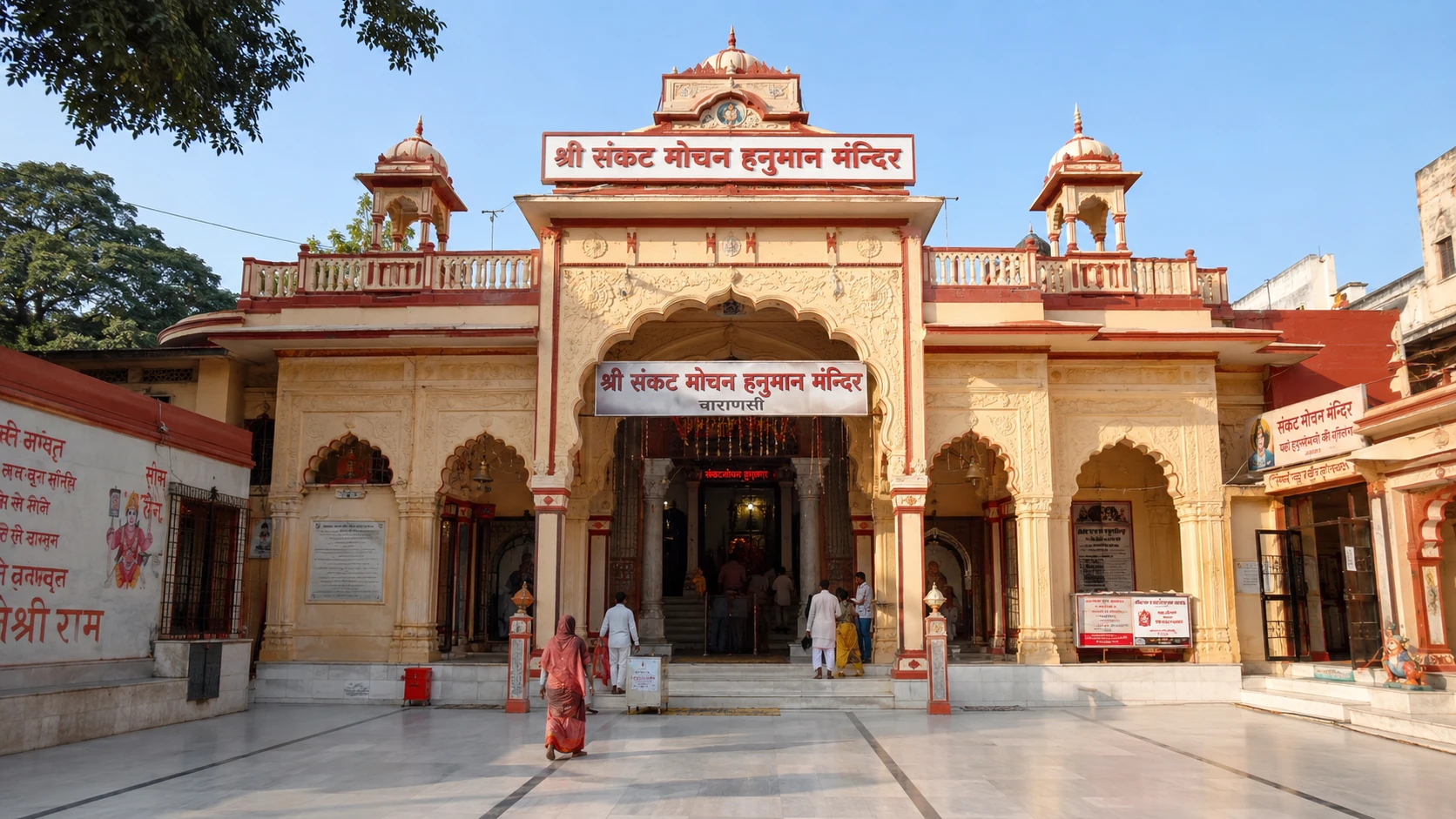
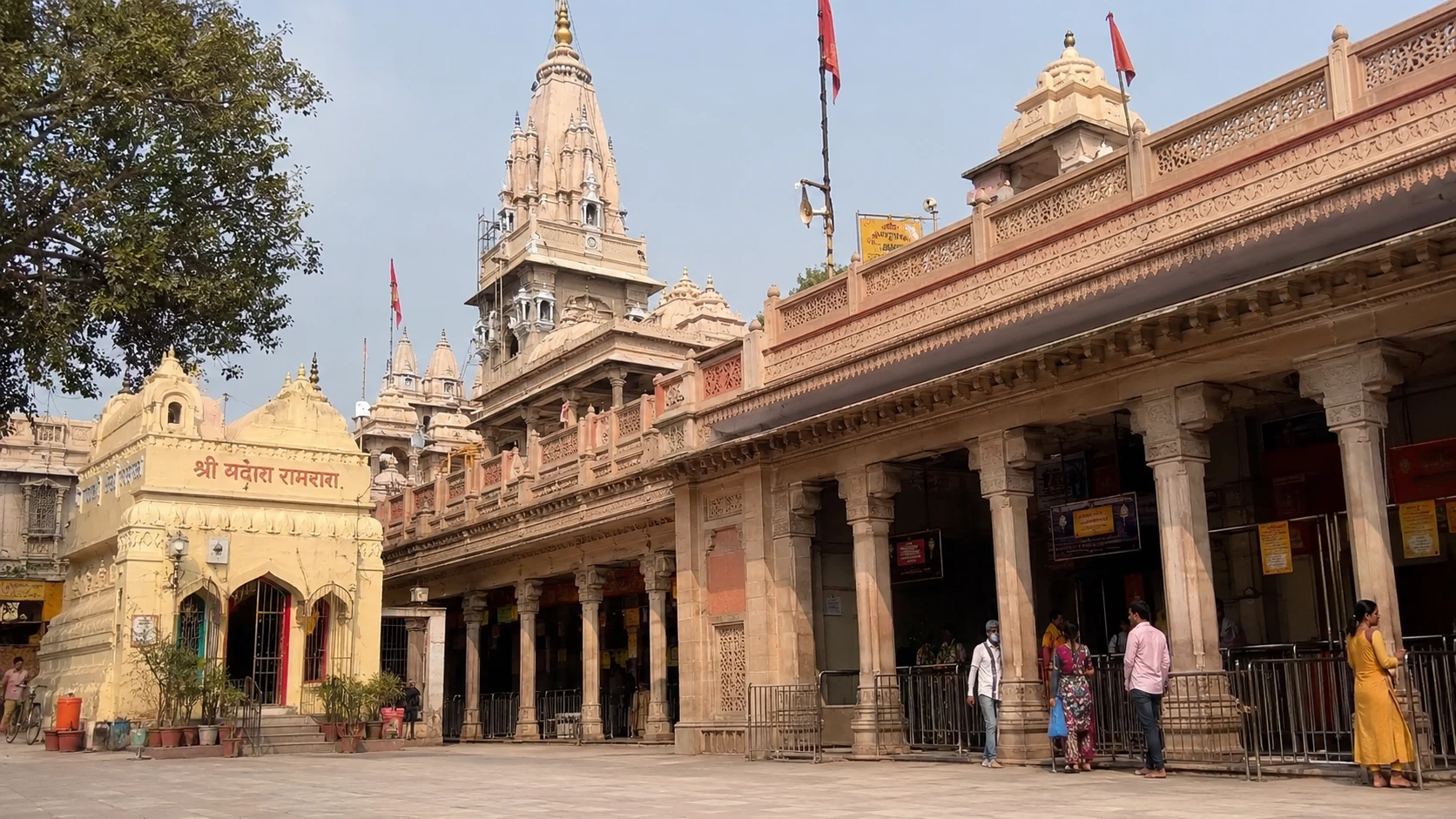
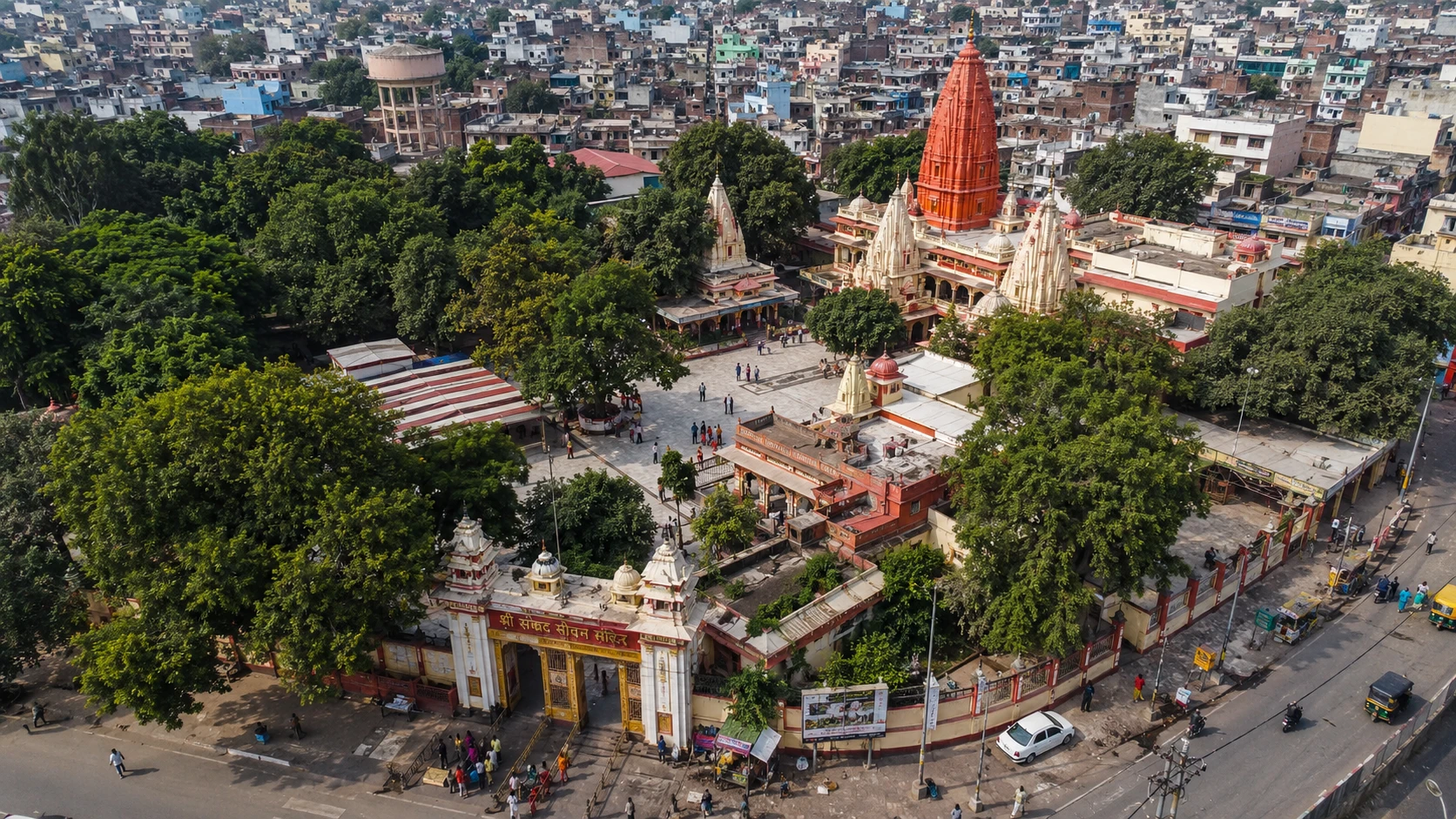
In the holy city of Varanasi, where every stone seems to carry a thousand years of prayer, one temple stands apart not for its antiquity or its wealth but for the story of how it came to be. Sankat Mochan — the Reliever of Distress — was founded by Tulsidas himself, the poet-saint who gave Hindi its Ramcharitmanas. Tradition holds that it was here, in the wooded area south of Assi Ghat, that Tulsidas first beheld Hanuman in a vision and received the divine grace that would fuel his life's work. Today the temple is inseparable from Varanasi's cultural identity: langur monkeys swing through its precincts as if they own the place, classical musicians gather each spring for one of India's most revered music festivals in its courtyard, and every Tuesday a sea of vermilion-smeared devotees fills the lanes leading to its sanctum.
Sacred Origin Storyपवित्र उत्पत्ति कथा
Source: Tulsidas hagiographic tradition / Varanasi oral history — widely attested
The founding of Sankat Mochan is woven into the life story of Goswami Tulsidas, the poet-saint who composed the Ramcharitmanas in the late 16th century.
Tulsidas arrived in Varanasi as a wandering ascetic, already consumed by his devotion to Lord Rama. The hagiographic tradition — principally the Mula Gosain Charit and the Gosain Charit attributed to Veni Madhav Das — holds that Tulsidas lived in the southern part of the city, near the area where the Assi river meets the Ganges. It was here, in a wooded grove, that the defining event of his spiritual life occurred.
One account, deeply embedded in Varanasi's oral tradition, describes how Tulsidas would pour the water left from his morning worship at the base of a tree. A spirit (pret) dwelling in the tree, sustained by this daily offering of sanctified water, appeared before Tulsidas in gratitude and offered him a boon. Tulsidas asked for the one thing he desired above all else: darshan of Lord Hanuman. The spirit directed him to a particular spot where an old man came every day to listen to the Ramayana recitation — that man, the spirit revealed, was Hanuman himself, disguised as an elderly listener.
Tulsidas went to the spot and recognized Hanuman among the gathering. He fell at the deity's feet. Hanuman, moved by the poet's devotion, blessed him and granted him the further boon of Rama's darshan. It was at this site — the wooded grove near Assi — that Tulsidas established the Sankat Mochan temple, consecrating it to the Hanuman who had appeared to him here.
The name Sankat Mochan — Reliever of Distress — reflects the theological function Tulsidas attributed to Hanuman: not merely a devotee of Rama but the active agent who removes obstacles and suffering from those who call upon him. Tulsidas's own Hanuman Chalisa, composed in Varanasi and recited daily at this temple, is the distillation of this theology — forty verses that have become the most widely recited Hindu devotional text in North India.
The temple thus carries a double sanctity: it is both the site of Tulsidas's vision and the home of the Hanuman Chalisa tradition. For devotees, praying here is praying at the very spot where Tulsidas received the grace that produced the greatest Hanuman devotional text ever written.
Sources cited:
- Mula Gosain Charit (hagiographic tradition of Tulsidas)
- Gosain Charit attributed to Veni Madhav Das
- Varanasi oral tradition — documented in multiple Hindi literary sources
- Philip Lutgendorf, 'Hanuman's Tale: The Messages of a Divine Monkey' (2007)
Scholarly Context
Philip Lutgendorf's 'Hanuman's Tale: The Messages of a Divine Monkey' (2007) provides the most comprehensive scholarly treatment of the Tulsidas-Hanuman connection and the role of Sankat Mochan in the development of Hanuman devotion in North India. Lutgendorf notes that the temple's significance lies not only in its hagiographic association with Tulsidas but in its function as the epicenter of the Hanuman Chalisa recitation tradition — the forty verses composed by Tulsidas that became the most widely recited devotional text in Hindi-speaking India, arguably surpassing even the Ramayana in daily household use.
Historyइतिहास
Sankat Mochan's history is inseparable from the life of Goswami Tulsidas, who is believed to have founded the temple in the late 16th century during his decades-long residence in Varanasi. The hagiographic tradition places Tulsidas in Varanasi from approximately the 1570s until his death in 1623, and the temple's founding is attributed to this period — likely between 1575 and 1600, though no dated foundation inscription survives.
The temple grew through the centuries as a center of Hanuman devotion in the city, but its significance was always literary as much as devotional. Varanasi's scholarly and priestly community maintained the temple as the living link to Tulsidas's legacy — the place where the Hanuman Chalisa tradition was born. The priestly lineage at Sankat Mochan traces its custodianship through generations.
In the 20th century, the temple gained additional renown through the Sankat Mochan Foundation, established by Professor Veer Bhadra Mishra, who served simultaneously as the temple's mahant (chief priest) and as a professor of hydraulic engineering at Banaras Hindu University. Prof. Mishra became internationally known for his campaign to clean the Ganges, combining his priestly devotion to the river with scientific expertise on water pollution. Under his leadership, Sankat Mochan became not just a devotional center but a symbol of the marriage between traditional faith and modern environmental activism.
The temple was the target of a terrorist bombing on March 7, 2006, when a series of coordinated blasts struck Sankat Mochan and the Dashashwamedh Ghat area of Varanasi. The blast at Sankat Mochan occurred during the crowded Tuesday evening aarti, killing at least 20 people and injuring many more. The attack was a defining trauma for Varanasi's religious community. The temple was repaired and reopened, and the annual Sankat Mochan Sangeet Samaroh — the classical music festival held in the temple courtyard each spring — continued without interruption, a deliberate statement of cultural resilience.
Prof. Veer Bhadra Mishra passed away in 2013, and the temple's custodianship has continued through the priestly lineage. The temple today remains one of the most visited Hanuman temples in Uttar Pradesh and a key stop on the Varanasi pilgrimage circuit.
Historical Timelineऐतिहासिक कालक्रम
Founding of Sankat Mochan temple by Goswami Tulsidas at the site where he is believed to have had his vision of Hanuman, in the wooded grove near Assi Ghat in southern Varanasi.
No dated foundation inscription survives. The founding date is estimated from the hagiographic chronology of Tulsidas's life in Varanasi (c. 1570s–1623). Lutgendorf (2007) treats the founding tradition as historically plausible given Tulsidas's documented long residence in Varanasi and his centrality to the Hanuman devotional tradition.
Establishment of the Sankat Mochan Foundation by Professor Veer Bhadra Mishra, who served as both the temple's mahant and a professor of hydraulic engineering at BHU. The foundation became internationally known for its campaign to clean the Ganges, combining priestly devotion with environmental science.
Terrorist bombing at Sankat Mochan temple during the crowded Tuesday evening aarti. A series of coordinated blasts struck the temple and the Dashashwamedh Ghat area of Varanasi. At least 20 people were killed and many more injured at the temple site. The attack was a defining trauma for Varanasi's religious community.
The 2006 Varanasi bombings targeted two of the city's most sacred sites — Sankat Mochan temple and the Dashashwamedh Ghat area. The investigation and prosecution of suspects involved multiple agencies and courts. The temple was repaired and reopened, and the annual Sankat Mochan Sangeet Samaroh continued without interruption as a deliberate statement of cultural resilience.
Death of Professor Veer Bhadra Mishra, the temple's mahant and founder of the Sankat Mochan Foundation. Prof. Mishra had served as the bridge between the temple's priestly tradition and modern environmental activism for decades.
What You'll Seeदर्शन में
The presiding murti at Sankat Mochan depicts Hanuman in his classic North Indian iconographic form — standing, with right hand raised in abhaya mudra (protection and fearlessness), the left hand holding a gada (mace). The murti is thickly coated in sindoor, renewed daily by devotees. The image is adorned with fresh flower garlands — jasmine, marigold, and seasonal flowers — and during festivals, elaborate silver and gold ornamentation, new garments, and a decorative crown. The overall impression is of Hanuman in his benevolent, protective aspect — the Sankatahara (Reliever of Distress) rather than the fierce warrior form. The sanctum also houses smaller images and the temple carries a distinct atmosphere of literary-devotional Varanasi Hinduism — scholarly, musical, and textured with centuries of recitation tradition.
Distinctive Practicesविशिष्ट परंपराएँ
Sankat Mochan Sangeet Samaroh (Classical Music Festival)
संकट मोचन संगीत समारोह
Annual, typically April (spring, 5 days)
Each spring, the temple courtyard becomes the venue for one of India's most prestigious classical music festivals. The Sankat Mochan Sangeet Samaroh runs for five nights, featuring the finest Hindustani classical musicians, vocalists, and instrumentalists performing under the open sky in the temple precinct. The festival is free to attend and open to all. Begun under the patronage of the temple's priestly lineage and sustained through the Sankat Mochan Foundation, the festival embodies the Varanasi tradition of offering art as worship — the musicians perform not for an audience but for Hanuman.
In Varanasi's devotional culture, music is not entertainment but offering. The Narada tradition holds that raga is a path to the divine — and Hanuman himself is considered the patron of musicians in many North Indian traditions, his devotion to Rama expressed through song. The Sangeet Samaroh is thus not a secular concert series held at a temple; it is a structured act of worship through sound, continuing the tradition that Tulsidas himself embodied — the poet whose devotion took the form of verses.
Did You Know?क्या आप जानते हैं?
The temple hosts the annual Sankat Mochan Sangeet Samaroh, a five-night classical music festival that is considered one of the most prestigious in India. The festival is held in the temple courtyard, is free to attend, and features the finest Hindustani classical musicians performing as an offering to Hanuman. Artists including Pandit Ravi Shankar, Bismillah Khan, and Girija Devi have performed here.
Sankat Mochan Foundation; festival documentation
The temple's langur monkeys are one of its most distinctive features. Large troops of Hanuman langurs (Semnopithecus entellus) inhabit the temple grounds and are regarded by devotees as Hanuman's living emissaries. The monkeys are fed by devotees and temple staff, and their presence is considered auspicious. The species is named after Hanuman himself.
On-site observation; zoological naming convention for Semnopithecus entellus
Professor Veer Bhadra Mishra, the temple's mahant from the late 20th century until 2013, held the unusual dual role of chief priest and professor of hydraulic engineering at Banaras Hindu University. His internationally recognized campaign to clean the Ganges through the Sankat Mochan Foundation made the temple a symbol of the marriage between faith and environmental science.
Sankat Mochan Foundation; BHU records; international media coverage
Sankat Mochan is traditionally held to be the very site where Tulsidas first received darshan of Hanuman — the vision that is said to have catalyzed the composition of the Hanuman Chalisa, now the most widely recited devotional text in Hindi-speaking India. Reciting the Chalisa here thus carries the significance of reciting it at its place of origin.
Mula Gosain Charit; Philip Lutgendorf, 'Hanuman's Tale' (2007)
Visitor Accessप्रवेश जानकारी
Sankat Mochan welcomes all devotees without restriction. Photography is permitted in the outer courtyard and grounds but not inside the inner sanctum during darshan and aarti. Mobile phones should be on silent mode inside the temple. Footwear must be removed before entering. Security screening is in place at the temple entrance since the 2006 bombing — cooperate with security personnel and carry photo ID.
Tuesdays draw the heaviest crowds — arrive early morning for shorter waits. The temple is located in the narrow lanes of southern Varanasi; vehicles cannot reach the entrance directly. Park at the nearest accessible point (near Assi Ghat or Tulsi Ghat) and walk. Be mindful of the langur monkeys — they are accustomed to humans but can snatch food, spectacles, and small items. Do not carry visible food into the temple. Security screening is mandatory at the entrance.
Festivalsत्योहार
Hanuman Jayanti
हनुमान जयंती
Mar-Apr (Chaitra Purnima)
The principal festival, celebrating the birth of Hanuman. The temple sees its peak annual footfall. Special abhishekam, continuous Hanuman Chalisa recitation, extended darshan hours, and large-scale prasad distribution characterize the day. The murti receives elaborate decoration with new garments, gold and silver ornaments, and towering flower arrangements.
Sankat Mochan Sangeet Samaroh
संकट मोचन संगीत समारोह
Apr (typically 5 nights in spring)
The annual five-night Hindustani classical music festival held in the temple courtyard. Free and open to all, featuring India's finest classical musicians performing as an offering to Hanuman. The festival continued without interruption even after the 2006 bombing, affirming Varanasi's cultural resilience.
Tuesday Congregations
मंगलवार समागम
Every Tuesday, year-round
Tuesday is the primary weekly congregation day at Sankat Mochan. The temple draws its largest regular crowds on this day, with extended aarti schedules and continuous Hanuman Chalisa recitation. Devotees from across Varanasi and visiting pilgrims converge on the temple, and the narrow lanes around Sankat Mochan fill with flower and offering vendors.
Traditional Offeringsपारंपरिक अर्पण
Primary Offerings
Sindoor (Vermilion)
सिंदूर
सिन्दूर
Sindoor is the primary offering to Hanuman, recalling his legendary act of covering his entire body in vermilion for Lord Rama's wellbeing. At Sankat Mochan, the murti receives continuous sindoor offerings from the stream of devotees, maintaining the deep orange-red coating that characterizes all Hanuman murtis in the North Indian tradition.
Laddoo (Boondi Laddoo prasad)
लड्डू (बूंदी लड्डू प्रसाद)
Boondi laddoos are the signature offering and prasad at Sankat Mochan. The temple is famous across Varanasi for its laddoo prasad — devotees purchase laddoos at shops outside the temple, offer them at the sanctum, and receive them back as blessed prasad. Tuesdays see the highest volume of laddoo offerings. The practice recalls Hanuman's fondness for sweet foods in folk Ramayana traditions.
Chameli Tel (Jasmine Oil)
चमेली तेल
Jasmine oil offered to anoint the murti, mixed with sindoor to maintain the deity's characteristic coating. The oil offering is a standard practice at North Indian Hanuman temples, associated with Hanuman's brahmachari (celibate ascetic) status — fragrant oils are offered to celibate deities as a mark of worship distinct from the flower-and-sweet offerings typical of married deity forms.
Coconut
नारियल
नारिकेल
Coconut offered and broken before Hanuman symbolizes the shattering of ego and obstacles. The hard shell represents difficulties in the devotee's life; breaking it before the Sankatahara (Reliever of Distress) enacts the removal of those difficulties through Hanuman's grace.
Flower garlands (Jasmine, Marigold)
फूल मालाएँ (चमेली, गेंदा)
Fresh flower garlands, particularly jasmine and marigold, are draped over the murti during each aarti. Jasmine (chameli) is considered particularly sacred to Hanuman in the North Indian tradition. The fragrance of jasmine is believed to please the deity and invoke his protective presence. Marigold symbolizes auspiciousness and is used universally across Hindu temples.
Unique to This Temple
Sankat Mochan Laddoo Prasad
संकट मोचन लड्डू प्रसाद
The temple's boondi laddoo prasad is famous across Varanasi and is the most iconic offering associated with Sankat Mochan. Shops lining the lane to the temple specialize in producing these laddoos specifically for temple offerings. The prasad laddoo received back from the sanctum is considered particularly blessed and is typically shared with family and friends — carrying a piece of Sankat Mochan's grace into the devotee's daily life.
Laddoo shops line the approach lane to the temple — these are the traditional source for offering laddoos. The temple does not operate its own prasad kitchen for laddoos; the neighborhood shops have served this function for generations. Sindoor, chameli oil, garlands, and coconut are also available from vendors near the entrance. During Tuesday crowds, purchase offerings before joining the darshan queue.
How to Reachकैसे पहुँचें
Sankat Mochan is in the southern part of Varanasi's old city, near Assi Ghat and Tulsi Ghat on the western bank of the Ganges.
Within Varanasi, the temple is accessible by auto-rickshaw or taxi to the nearest drop point (Assi Ghat intersection or Lanka area), followed by a 5–10 minute walk through narrow lanes. Vehicles cannot reach the temple entrance directly. From Varanasi Junction (Varanasi Cantt station), the temple is about 7 km, reachable by auto in 20–30 minutes depending on traffic. From Varanasi City Station, it is approximately 4 km.
By rail, Varanasi Junction (Varanasi Cantt) is the main station with trains from Delhi, Mumbai, Kolkata, Chennai, and all major cities. The city is one of the best-connected rail junctions in North India.
By air, Lal Bahadur Shastri International Airport at Babatpur is 25 km from the temple (45–60 minutes by taxi). The airport has domestic flights from Delhi, Mumbai, Bengaluru, Hyderabad, and Kolkata, with limited international connections.
Sankat Mochan is typically visited as part of the broader Varanasi temple circuit, which includes Kashi Vishwanath, Durga Temple (Durga Kund), Tulsi Manas Temple, and the ghats. The temple is a short walk from Assi Ghat, making it easy to combine with a morning ghat walk and boat ride.
Plan Your Visitयात्रा की योजना
🌤 Best Season
October to March is the most comfortable period for visiting Varanasi (15–28°C). The Sankat Mochan Sangeet Samaroh in April is worth timing a visit for despite the warmth. Avoid May–June (extreme heat, 42–47°C). The monsoon (July–September) makes Varanasi's narrow lanes slippery and the Ganges floods the lower ghats, but the temple remains accessible. Dev Deepawali (November) is Varanasi's most spectacular festival if timing allows.
👘 Dress Code
Modest dress expected. Traditional Indian attire is appropriate. Remove footwear before entering the temple complex.
📱 Phones & Photography
Mobile phones on silent mode inside the temple. Photography permitted in outer courtyard but not in the inner sanctum during darshan.
🏨 Accommodation
Varanasi offers extensive accommodation at all price points. The Assi Ghat area (closest to Sankat Mochan) has numerous guesthouses, hostels, and boutique hotels popular with both pilgrims and tourists. The Lanka area near BHU also has good mid-range options. For heritage stays, the ghats of central Varanasi (Dashashwamedh to Manikarnika) offer restored havelis. Temple trust accommodation is not available at Sankat Mochan itself.
Sacred Soundsपवित्र ध्वनि
Did You Know? · क्या आप जानते हैं?
The same translation error that turned '33 Koti' into '33 crore' in Hinduism also happened in Buddhism. The Chinese translation of Buddhist texts rendered 'Sapta Koti Buddha' (7 Supreme Buddhas) as '7 Crore Buddhas.' The Tibetan translation got it right: 7 types, not 7 crore. One Sanskrit word, misread across two major world religions, generated two identical misconceptions independently.
Related Contentसंबंधित सामग्री
Related Scriptures
Community Reflections
🕉️
Be the first to share your reflection.