Mehandipur Balaji
मेहंदीपुर बालाजी
Where Hanuman wages war against the unseen
Mehandipur, Rajasthan, India
Mehandīpur BālājīAlso known as: Mehandipur Dham, Mehandipur Hanuman, Balaji Mehandipur, Balaji Dham Mehandipur
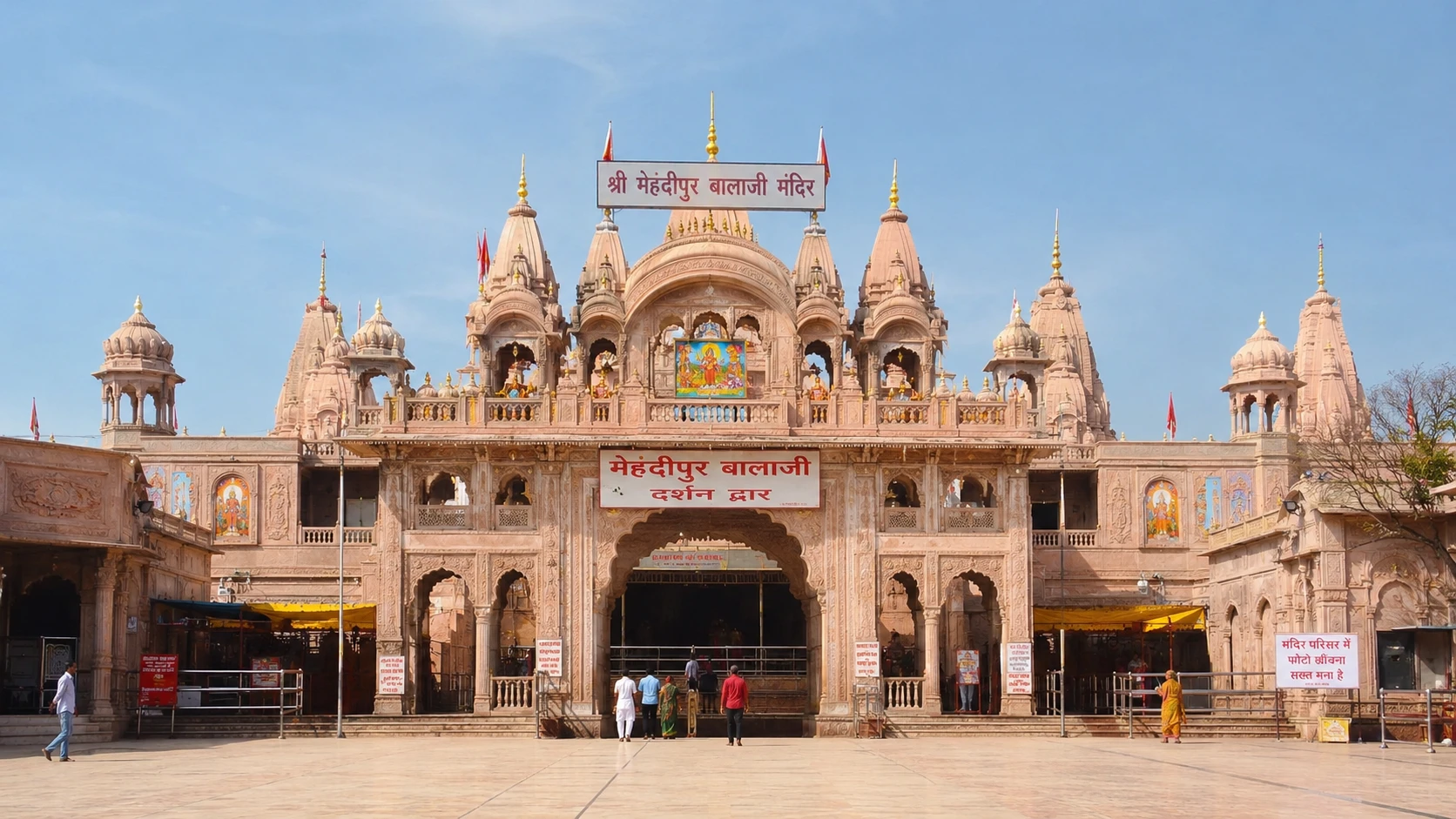
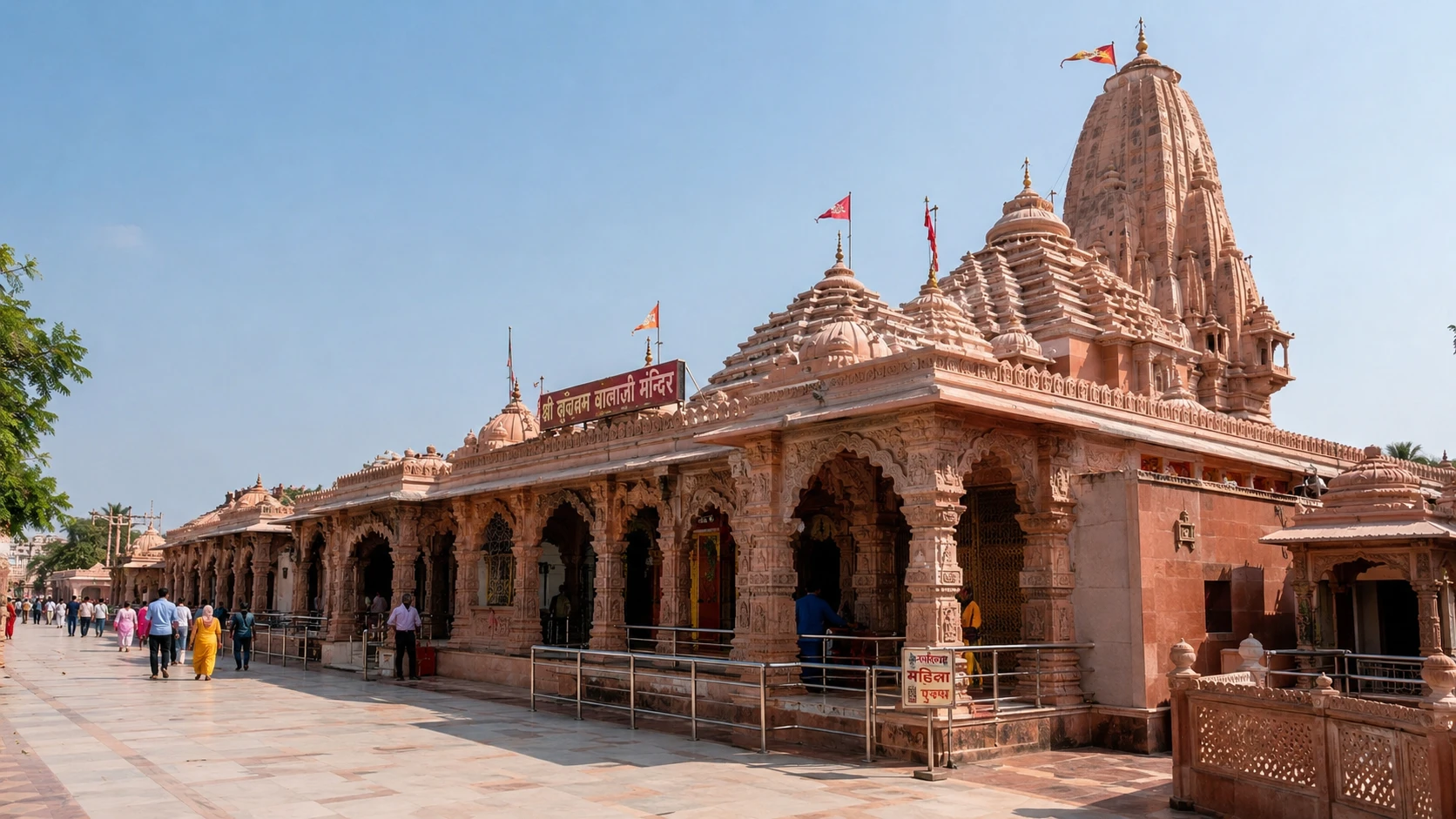
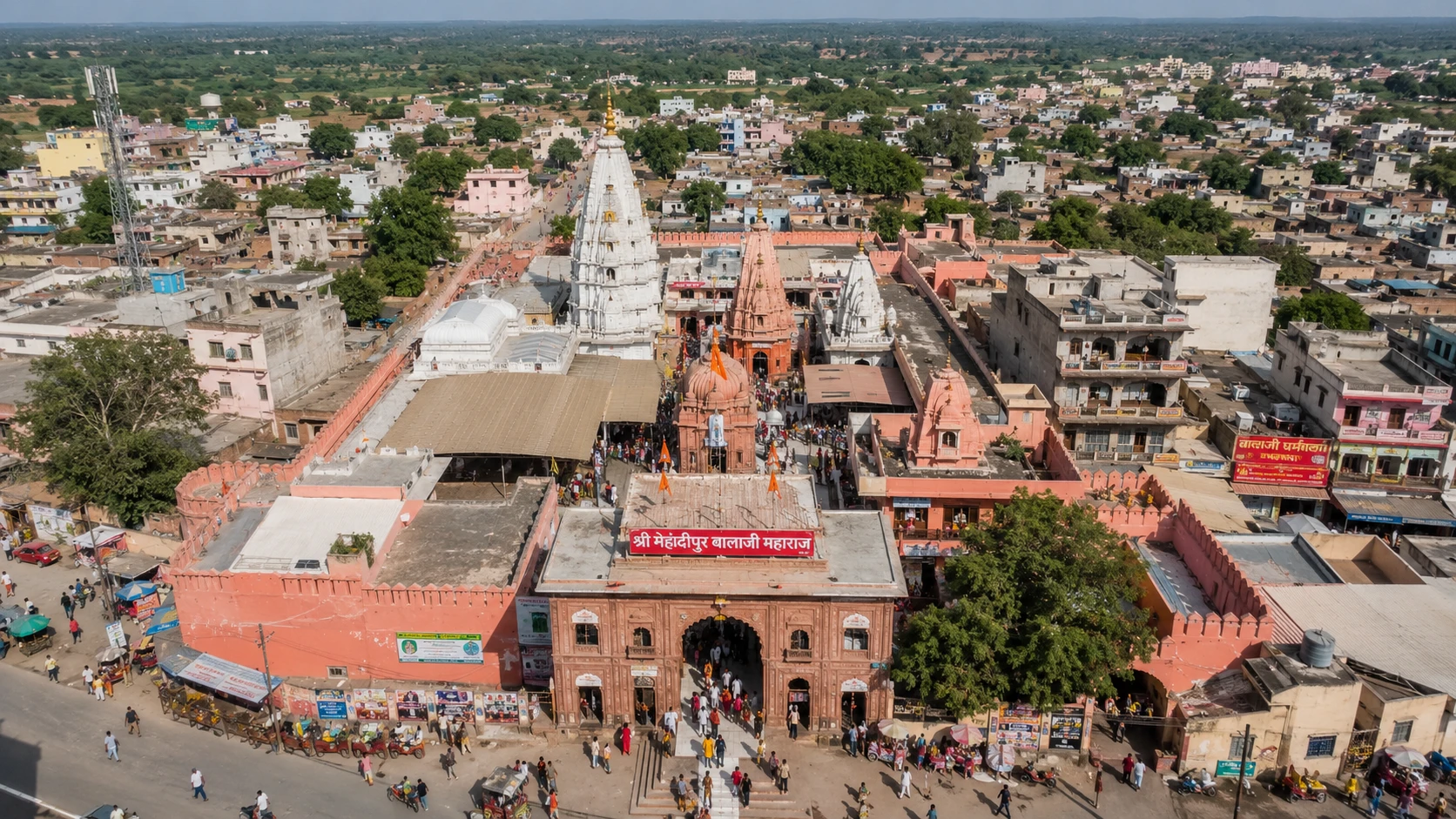
Era
Antiquity uncertain; documented worship from ~17th–18th century onward
Architecture
Hill-ravine shrine; natural rock formations integrated with built temple structures
Open
05:00 – 21:00
Aarti
06:00 · 12:00 · 18:30
Special
Tuesdays and Saturdays draw the largest crowds; Hanuman Jayanti and Navratri see peak visitor volumes
The Sacred Legend · पवित्र कथा
There are temples where you go for peace, and there are temples where you go for war. Mehandipur Balaji is the second kind. Nestled in a narrow ravine between two hills in Rajasthan's Dausa district, this is India's most famous healing shrine — a place where devotees come not for routine blessings but to be freed from what they believe are possessions by malevolent spirits. Three self-manifested deities preside here: Balaji (Hanuman), Pret Raja (the King of Spirits), and Bhairavnath — together forming a divine tribunal that hears the afflicted, commands the spirits, and delivers release. The atmosphere inside is unlike any other Hindu temple in the country: intense, raw, visceral. For believers, Mehandipur is the last court of appeal when all else has failed.
Sacred Origin Storyपवित्र उत्पत्ति कथा
Source: Local Sthala Purana / Rajasthani folk tradition — orally transmitted
The origin of Mehandipur Balaji does not trace to a single Puranic narrative but to a convergence of local miracle traditions centered on the ravine between two hills in what is now Dausa district.
The foundational belief is that the three presiding deities — Balaji (Hanuman), Pret Raja, and Bhairavnath — are swayambhu: they manifested naturally in the rock formations of the ravine, not carved by human hands. Devotees regard the hillside itself as a living spiritual presence, the stone faces emerging from the rock as proof that this particular gorge was chosen by Hanuman as a seat of power over the spirit world.
The mythology explaining why Hanuman presides over spirits here draws on multiple Puranic and folk sources. In the broader Hindu tradition, Hanuman is Rudra-avatara — a partial incarnation of Shiva himself — and therefore possesses sovereignty over all beings, including spirits and ghosts who inhabit the lower planes. The Hanuman Chalisa, Tulsidas's 16th-century devotional hymn, declares 'Bhoot pisach nikat nahin aavai, Mahavir jab naam sunavai' — ghosts and spirits cannot approach when Hanuman's name is spoken. This theological principle is the foundation of Mehandipur's spiritual function.
The local tradition adds a specific narrative layer: Hanuman, after his service to Lord Rama was complete, chose this ravine as a place where he would continue his mission of protecting devotees — not only from worldly troubles but from afflictions of the spirit. Pret Raja, installed as a subordinate deity, functions as the administrator of the spirit realm under Hanuman's authority — he is the one who identifies, summons, and adjudicates the spirits said to afflict devotees. Bhairavnath, the fierce form of Shiva, serves as the enforcer — the power that compels obedience from spirits who resist.
Together, the three deities form a hierarchy: Balaji (supreme authority), Pret Raja (judge of the spirit world), and Bhairavnath (enforcer of divine commands). Devotees who come seeking relief from perceived spiritual afflictions petition this trinity in a specific order — first presenting their case before Pret Raja, then seeking Bhairavnath's intervention, and finally receiving Balaji's blessing of protection and release.
The tradition holds that no spirit, however powerful, can resist the combined authority of these three. This belief is the engine that has driven pilgrimage to Mehandipur for centuries, drawing those who believe themselves afflicted by forces beyond the reach of medicine or ordinary prayer.
Sources cited:
- Local Sthala Purana of Mehandipur Balaji (oral tradition)
- Hanuman Chalisa by Tulsidas (16th century) — verse on bhoot-pisach protection
- Rajasthani folk tradition compilations on healing shrines
Scholarly Context
Mehandipur Balaji occupies a significant place in the anthropological study of spirit possession and healing in South Asia. Scholars including Sudhir Kakar ('Shamans, Mystics and Doctors', 1982) and Graham Dwyer ('The Divine and the Demonic: Supernatural Affliction and its Treatment in North India', 2003) have documented the healing practices here as a functioning system of what anthropologists term 'ritual healing' — a culturally embedded response to psychological distress that operates within a coherent belief framework. Dwyer's ethnographic work at Mehandipur specifically notes that the shrine serves a population with limited access to formal psychiatric care, and that the ritual framework provides structure, community support, and a culturally meaningful narrative for experiences of mental distress. This scholarly perspective does not validate or invalidate the theological claims; it contextualizes the shrine's social function.
Historyइतिहास
The documented history of Mehandipur Balaji is difficult to establish with precision because the shrine's tradition is primarily oral and the site lacks dated inscriptions or architectural evidence of the kind found at more institutionally established temples. The swayambhu murtis in the ravine are undated, and the temple's own tradition does not claim a specific founding year.
What is clear is that the site has functioned as a healing shrine for at least several centuries. The ravine between the two hills in Dausa district was likely a place of folk worship long before the current temple infrastructure was built. The Aravalli range in eastern Rajasthan has numerous small shrines dedicated to Bhairav, local deities, and spirit-related worship — Mehandipur emerged as the most prominent of these, likely because the convergence of three deities (Balaji, Pret Raja, Bhairavnath) at a single site gave it a theological completeness that smaller shrines lacked.
Through the 19th and early 20th centuries, the temple was a regional healing center, drawing primarily from Rajasthan, eastern Rajputana, and the Braj region of western Uttar Pradesh. The turning point came in the mid-to-late 20th century, when improved road connectivity, growing bus networks, and word-of-mouth testimony through the Marwari and Jat diaspora transformed Mehandipur from a local shrine into a nationally known pilgrimage destination.
The temple is managed by a hereditary pujari lineage. In recent decades, the shrine has grown significantly — new mandapas, pilgrim shelters, shops, and a bustling temple town have developed around the ravine. The Rajasthan government has invested in road infrastructure and crowd management facilities, particularly for Hanuman Jayanti and Navratri. The temple now draws visitors from across North India, with significant footfall from Rajasthan, Uttar Pradesh, Haryana, Madhya Pradesh, Delhi, and Gujarat.
Historical Timelineऐतिहासिक कालक्रम
Earliest documented worship at the Mehandipur ravine site. The three swayambhu rock formations — identified as Balaji, Pret Raja, and Bhairavnath — become established as a triad of healing deities in the regional folk tradition.
No dated epigraphic or architectural evidence exists for the founding of the shrine. The oral tradition does not claim a specific founding date. The 17th–18th century estimate is based on the age of surrounding settlements and the pattern of similar folk healing shrines in the Aravalli region.
Mehandipur begins its transformation from a regional healing shrine to a nationally significant pilgrimage destination, driven by road connectivity improvements, growing bus networks from Jaipur and Delhi, and diaspora patronage from the Marwari and Jat communities.
Major expansion of the temple complex and surrounding infrastructure. New mandapas, pilgrim shelters, and crowd management facilities constructed. The Rajasthan government invested in road widening and traffic management for the temple approach road, particularly for peak pilgrimage periods.
What You'll Seeदर्शन में
The presiding deity at Mehandipur is not a conventionally sculpted murti but a swayambhu rock formation in the ravine wall, identified as Hanuman (Balaji). The natural rock face bears features interpreted by devotees as Hanuman's visage — prominent eyes, a broad forehead, and a powerful frame. The image is thickly coated in sindoor and chameli oil, renewed constantly by devotees. Garlands of marigold and jasmine are draped over the formation daily. A silver crown and ornamental clothing are placed on the deity during festivals and special occasions. Two additional swayambhu formations in the same ravine are venerated as Pret Raja and Bhairavnath, each with their own dedicated worship space within the temple complex. The overall sacred geography of the site is unusual — the three deities are arranged along the ravine rather than in a conventional temple plan, and the natural rock is the sanctum itself rather than an enclosed garbhagriha.
Distinctive Practicesविशिष्ट परंपराएँ
Arji (Petition to the Spirit Court)
अर्ज़ी (आत्मा न्यायालय में याचिका)
Daily, throughout the day; peak on Tuesdays and Saturdays
Devotees who believe themselves or their family members to be afflicted by spirits present a formal arji (petition) before the three deities in sequence — first before Pret Raja, then Bhairavnath, then Balaji. The afflicted person sits in the temple courtyard, and the petition is offered through prayer, chanting, and offerings. The atmosphere is intense — other devotees in various states of distress surround the petitioner, and the collective energy in the ravine is raw and unmediated.
The arji system reflects a theological structure where the spirit realm is understood as operating under divine law, not chaos. Just as a human petitions a court for justice, the afflicted petition the divine tribunal. Pret Raja investigates, Bhairavnath enforces, and Balaji delivers the final judgment. The practice gives the devotee's suffering a narrative structure — their pain has a cause, an arbiter, and a resolution.
Prasad Rules (Strict Disposal Protocol)
प्रसाद नियम (सख्त निपटान प्रोटोकॉल)
Always — applies to every visit
Mehandipur has a unique and strictly enforced rule: prasad received at the temple must be consumed entirely within the temple premises or disposed of before leaving. It cannot be carried home. Devotees are warned — repeatedly, by signs and by word of mouth — that taking prasad outside the temple boundary invites the very afflictions the temple is meant to cure. Similarly, visitors are cautioned not to look back after leaving the temple premises until they are well clear of the site.
The prohibition reflects the temple's theological function as a containment zone for malevolent spiritual forces. The belief is that spirits expelled from devotees remain trapped within the temple's sacred boundary under the authority of the three deities. Taking prasad out carries the risk of transporting the spiritual residue of affliction back into the devotee's home. The rule transforms the temple boundary from a physical line into a spiritual barrier — the inside is the zone of Hanuman's jurisdiction, and what is cleansed within must stay within.
Did You Know?क्या आप जानते हैं?
Mehandipur Balaji is one of the very few Hindu temples in India where the presiding deities include 'Pret Raja' — literally the 'King of Spirits' — a deity whose explicit theological function is to govern ghosts and malevolent spirits. This makes the temple's divine hierarchy unique: Balaji (supreme protector), Pret Raja (spirit-world administrator), and Bhairavnath (enforcer).
Temple tradition; Graham Dwyer, 'The Divine and the Demonic' (2003)
Unlike virtually every other Hindu temple in India, Mehandipur Balaji strictly prohibits devotees from taking prasad outside the temple premises. This rule is enforced through signage, verbal warnings, and social enforcement by other devotees. The belief is that carrying prasad out would transport spiritual affliction back into the devotee's home.
Temple rules; ethnographic documentation by Graham Dwyer (2003)
The temple is built into a natural ravine between two hills in the Aravalli range, making its sacred geography unusual among major Hindu temples. The three deities are arranged along the ravine wall rather than in a conventional temple plan — the hillside itself is the garbhagriha, and the open sky above the gorge is the shikhara.
On-site observation; temple architectural documentation
Mehandipur Balaji has been the subject of serious academic study by multiple scholars of religion and anthropology. Graham Dwyer's 'The Divine and the Demonic' (2003) is a full-length ethnographic study of the temple, and Sudhir Kakar's 'Shamans, Mystics and Doctors' (1982) references Mehandipur as a significant site in the landscape of Indian healing traditions.
Graham Dwyer (2003); Sudhir Kakar (1982)
Visitor Accessप्रवेश जानकारी
Mehandipur Balaji is open to all devotees without restriction by gender, caste, or origin. Photography is strictly prohibited within the sanctum and the deity worship areas. Mobile phones should be switched off, not merely silenced, inside the core worship zone. Visitors should be prepared for an intensely charged atmosphere — the temple's healing function means devotees in various states of emotional and physical distress are present at all times. First-time visitors unfamiliar with the practices should exercise respectful awareness.
On Tuesdays and Saturdays, expect very heavy crowds and long waits. Carry water and stay hydrated, especially in summer. Remember the strict prasad rule — consume all prasad within the temple premises, do not carry any outside. The temple tradition also advises against looking back after exiting the premises. Keep valuables secure in vehicle or at hotel — the temple area is crowded and busy. Visitors with young children or those uncomfortable with intense emotional environments should exercise personal judgment.
Festivalsत्योहार
Hanuman Jayanti
हनुमान जयंती
Mar-Apr (Chaitra Purnima)
The most significant day at Mehandipur Balaji, drawing the year's largest crowds. Special abhishekam of all three deities, extended darshan hours, and massive community bhandaras characterize the celebration. Many devotees who have been cured of afflictions during the year return on this day to offer gratitude.
Chaitra and Ashwin Navratri
चैत्र और आश्विन नवरात्रि
Mar-Apr and Sep-Oct
Both nine-day Navratri periods draw massive crowds to Mehandipur. The temple tradition holds that the power of the healing deities is particularly strong during Navratri, when the divine feminine energy is at its peak. Many devotees bring afflicted family members specifically during these nine days, believing the likelihood of cure is highest.
Tuesday and Saturday Congregations
मंगलवार और शनिवार समागम
Every Tuesday and Saturday, year-round
Both days are dedicated to Hanuman worship in North Indian tradition. At Mehandipur, these are the peak weekly days, functioning as recurring mini-festivals. The temple extends hours, additional food distribution is organized, and the crowd can swell to several times the normal weekday footfall.
Traditional Offeringsपारंपरिक अर्पण
Primary Offerings
Sindoor (Vermilion)
सिंदूर
सिन्दूर
Sindoor is the primary offering to Hanuman at Mehandipur, as at all Hanuman temples, recalling his legendary act of covering his entire body in vermilion for Lord Rama's wellbeing. At Mehandipur specifically, sindoor carries additional significance as a protective seal — devotees believe the vermilion coating on the murti concentrates Hanuman's power against malevolent spirits.
Chameli Tel (Jasmine Oil)
चमेली तेल
Jasmine oil is offered to anoint the rock formation. The oil mixed with sindoor creates the distinctive deep-orange coating on the deity. In the Mehandipur tradition, the oil offering is considered particularly powerful for those seeking relief from spiritual afflictions — the fragrance is believed to please Hanuman and strengthen his protective presence around the devotee.
Laddoo (Sweet offering)
लड्डू
Laddoos, particularly boondi laddoos, are offered to Balaji. At Mehandipur, the strict prasad rule applies — any laddoo offered and returned as prasad must be consumed entirely within the temple premises. This transforms the offering from a routine devotional act into a disciplined spiritual practice requiring conscious compliance with the temple's unique rules.
Coconut
नारियल
नारिकेल
Coconut breaking before Hanuman symbolizes the shattering of obstacles and the breaking of the hold of malevolent forces. At Mehandipur, where the primary function is spiritual healing, the coconut offering carries particular weight — devotees break the coconut as a physical enactment of the spiritual breaking of the spirit's hold on the afflicted person.
CRITICAL: All prasad received at Mehandipur Balaji must be consumed entirely within the temple premises. It is strictly prohibited to carry prasad outside the temple boundary. This rule is unique to Mehandipur and is enforced through signage, verbal warnings, and social enforcement. Offerings can be purchased from authorized shops near the temple entrance. The temple tradition also advises devotees not to look back after leaving the premises.
How to Reachकैसे पहुँचें
Mehandipur is in Dausa district, eastern Rajasthan, roughly midway between Jaipur and Agra on the NH-21 corridor.
By road is the most common approach. From Jaipur, the drive takes approximately 1.5–2 hours (75 km) via NH-21 toward Agra, turning off near Balaji More. From Delhi, the drive is about 5–6 hours (250 km) via NH-48 to Jaipur and then NH-21 eastward; alternatively, 4–5 hours via Bharatpur and Dausa. From Agra, the drive is approximately 3 hours (150 km). RSRTC and private bus operators run direct services from Jaipur, and several Delhi-based pilgrim bus operators offer overnight Mehandipur packages.
By rail, Bandikui Junction (26 km from the temple) is the closest station with regular trains from Jaipur and Delhi on the Delhi-Jaipur-Ahmedabad route. Dausa (35 km) is also an option. From Bandikui, shared autos, taxis, and temple-bound minibuses are readily available.
By air, Jaipur Airport (75 km, ~1.5 hours drive) is the nearest. Jaipur has domestic and limited international connectivity.
Pilgrims often combine Mehandipur with Khatu Shyamji (130 km northwest) or with the Jaipur temple circuit (Birla Mandir, Govind Dev Ji).
Plan Your Visitयात्रा की योजना
🌤 Best Season
October to March offers the most comfortable weather (15–28°C). Avoid the peak summer months (April–June) when temperatures in the Dausa region exceed 45°C and the open-air ravine temple offers no shade cover during long darshan queues. The monsoon (July–September) makes road approaches slippery and the ravine floor can get waterlogged. Hanuman Jayanti (March-April) and Navratri are the most charged periods but also the most crowded.
👘 Dress Code
Modest traditional dress is expected. There is no formal enforcement, but the temple's intense spiritual atmosphere naturally encourages conservative attire. Remove footwear well before the temple entrance.
📱 Phones & Photography
Mobile phones should be switched off (not merely silenced) inside the core worship area. Photography and videography are strictly prohibited within the sanctum and the deity worship zones.
🏨 Accommodation
Mehandipur town has basic pilgrim dharamshalas and budget lodges. For more comfortable options, Bandikui (26 km) and Dausa (35 km) offer better hotels. Many pilgrims from Jaipur (75 km) visit as a day trip. Devotees undertaking extended healing stays (which can last days or weeks) typically rent basic rooms in the temple town. Advance booking is recommended during festival seasons.
Sacred Soundsपवित्र ध्वनि
Did You Know? · क्या आप जानते हैं?
The same translation error that turned '33 Koti' into '33 crore' in Hinduism also happened in Buddhism. The Chinese translation of Buddhist texts rendered 'Sapta Koti Buddha' (7 Supreme Buddhas) as '7 Crore Buddhas.' The Tibetan translation got it right: 7 types, not 7 crore. One Sanskrit word, misread across two major world religions, generated two identical misconceptions independently.
Related Contentसंबंधित सामग्री
Related Scriptures
Community Reflections
🕉️
Be the first to share your reflection.