Jogulamba Temple
जोगुलाम्बा मंदिर
The Yoga-Mother whose Pīṭha sits within the Navabrahma temple-cluster at the Krishna-Tungabhadra confluence
Alampur, Telangana, India
Jogulāmbā / YogulāmbāAlso known as: Jogulamba Devi, Yogulamba, Yogamba, Sri Jogulamba, Yoga-Amba, Jogulamba Amma
Era
Pre-canonical Krishna-Tungabhadra confluence sacred-geography (continuous worship from at least the Sātavāhana period, c. 2nd c. BCE, 2nd c. CE); canonical Pīṭha attestation by 8th, 12th c.; current temple structure substantially Bādāmi Chālukya 7th, 8th c. construction with continuing Kakatiya, Vijayanagara and modern renovation phases. The Navabrahma temple-cluster (nine Śiva-Liṅga shrines) including the Bāla Brahmeśvara that functions as the Pīṭha's Bhairava-pair surrounds the Jogulāmbā sanctum. The complex was substantially protected from Srisailam Dam reservoir backwater in the 1980s through Archaeological Survey of India infrastructure works
Architecture
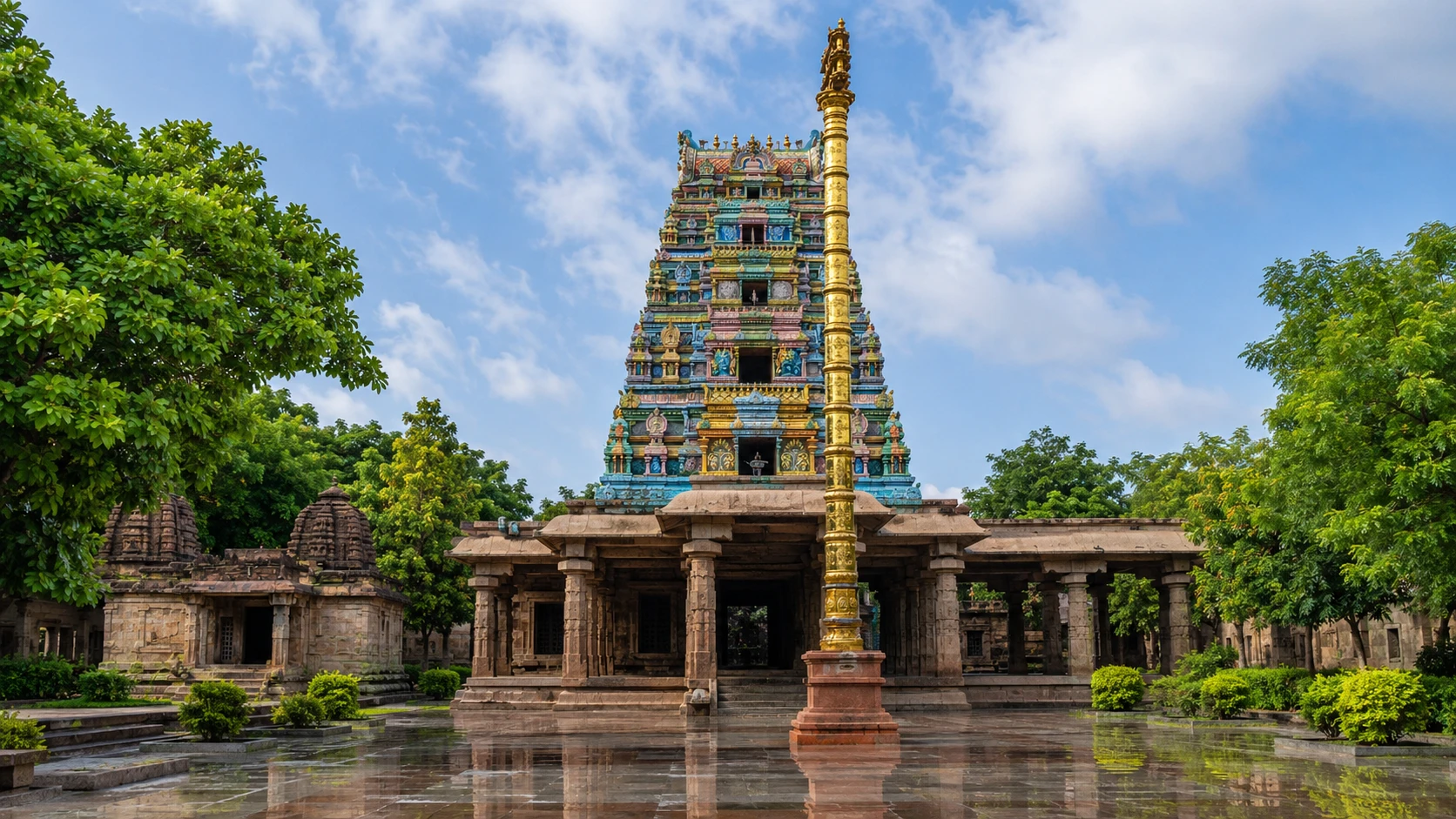
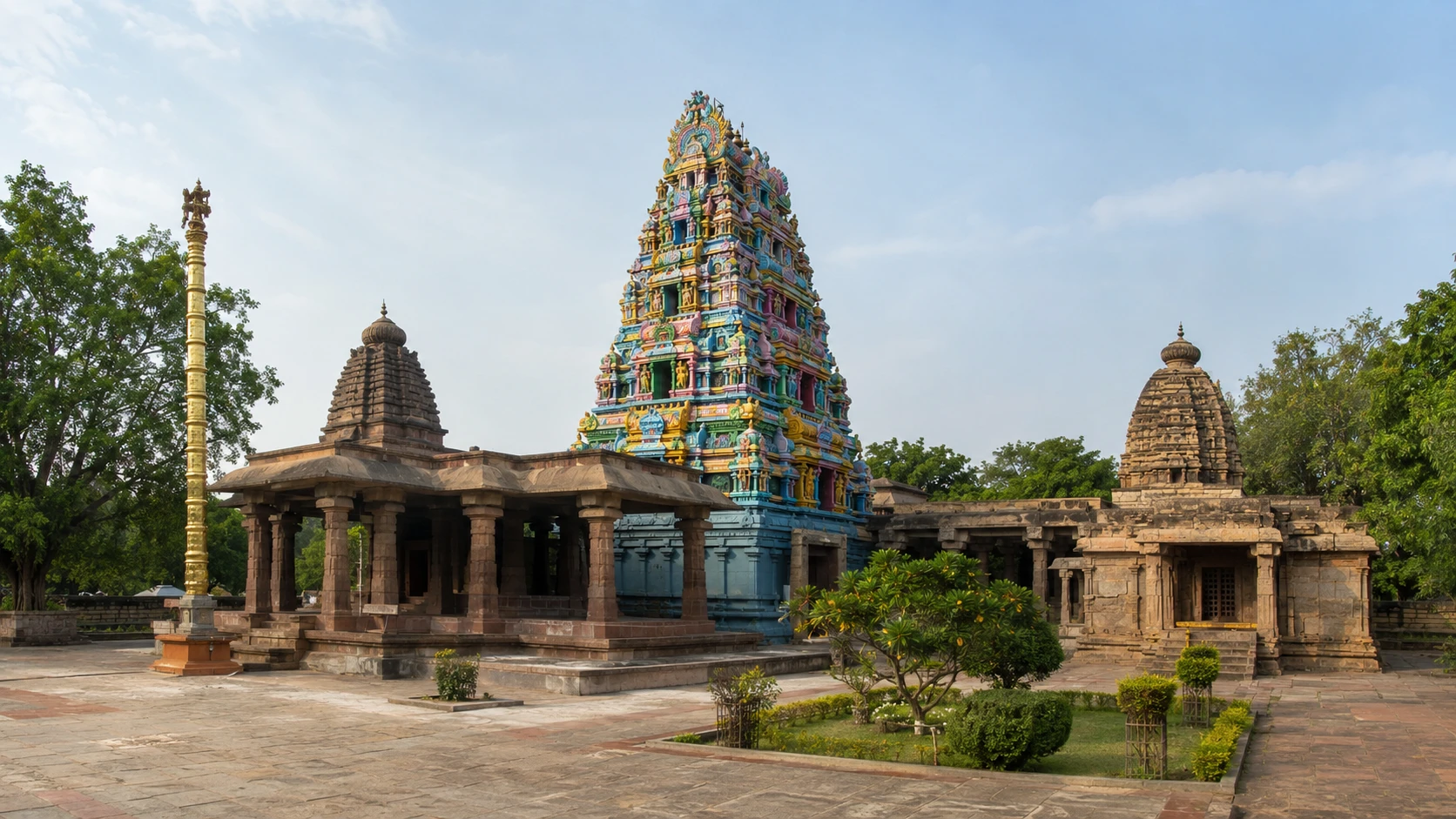
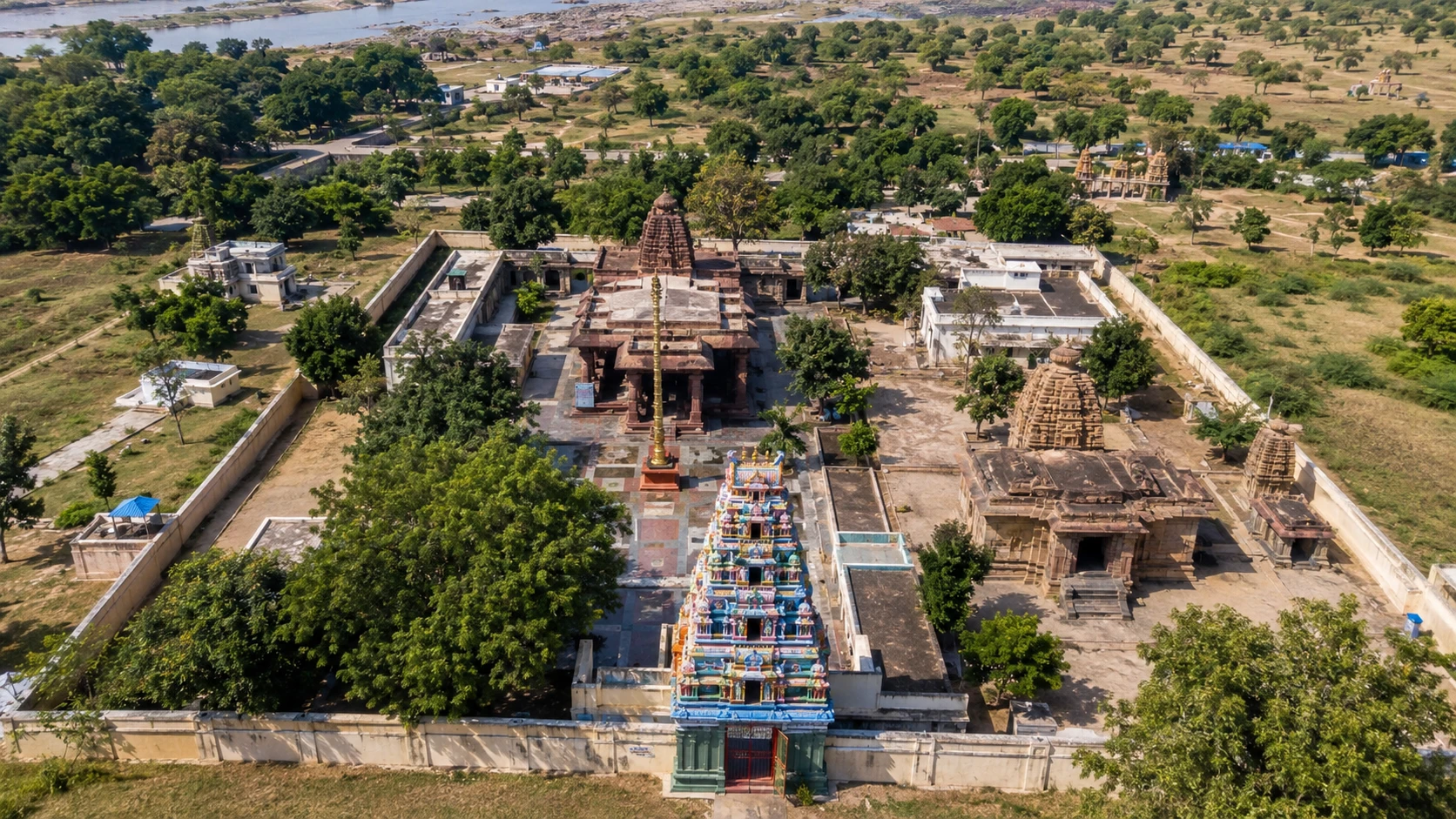
Bādāmi Chālukya (7th, 8th c.) early-Dravidian / proto-Dravidian, among the oldest surviving stone temple architecture in Telangana, with the Jogulāmbā sanctum integrated into the broader Navabrahma complex's nine Śiva-Liṅga shrines arranged in a clustered prākāra layout. The architectural register precedes the later layered Vijayanagara elaborations seen at most Pīṭha-Jyotirliṅga sites and preserves a distinctively early-medieval Deccan temple-aesthetic
Open
05:30 – 20:30
Aarti
06:00 · 11:30 · 18:00 · 20:00
Special
The Bhramarāmbā-Jogulāmbā Telugu Shakta paired-pilgrimage circuit is the principal regional devotional flow (pilgrims combine Alampur with Srisailam, 145 km upstream, as the two adjacent Telugu-state Ashtādaśa shrines); the Navabrahma + Jogulāmbā integrated darshan circuit is the standard on-site pilgrim sequence. Mahā Śivarātri brings significant pilgrim flow because of the joint Devī-Śaiva-cluster framing; the Jogulāmbā Brahmotsavam (Caitra, Mar, Apr) is the principal Devī-focused festival; Sharad Navrātri brings substantial Telugu regional pilgrim flow
The Sacred Legend · पवित्र कथा
Alampur sits at the geographic seam where the Tungabhadra river joins the Krishna, the southern Deccan's most consequential river-confluence, and the Jogulāmbā Devī Pīṭha sits at the religious seam where two embeddings meet: the canonical 18-Aṣṭādaśa Pīṭha network and the Alampur Navabrahma temple-cluster of nine Chālukya-period Śiva-Liṅga shrines. The Devī's name carries the integration in its grammar: Jogulāmbā (Yogulāmbā in the Sanskrit register) is Yoga-Ambā, the Yoga-Mother, the Devī whose body-part attribution (the upper teeth, ūrdhva-danta) corresponds to the seat where speech, breath and the disciplined yogic exhalation converge. The teeth are the locus of mantra-formation, of the consonants without which speech does not articulate, of the disciplined respiration that yogic practice trains; and Jogulāmbā is the Devī whose Pīṭha presides over the body's threshold where breath becomes voice. The Navabrahma temple-cluster, nine Śiva-Liṅga shrines constructed in the 7th, 8th-century Bādāmi Chālukya architectural register, among the oldest surviving stone temple complexes in Telangana, surrounds the Jogulāmbā shrine, with the Bāla Brahma temple's Liṅga functioning as the canonical Bhairava-pair Bāla Brahmeśvara. Pilgrims canonically darshan the Devī alongside the surrounding Śaiva cluster, treating the integrated Navabrahma + Jogulāmbā precinct as a single devotional unit anchored at the Krishna-Tungabhadra confluence. The site's modern history carries a corpus-distinctive layer: the Srisailam Dam project's reservoir backwater (1980s) threatened the Alampur temple-cluster's continued existence, and the Archaeological Survey of India undertook substantial protective infrastructure to preserve the temples, a 20th-century preservation episode that, like the contemporaneous Srisailam Dam impact on Bhramarāmbā's pilgrim ecology 145 kilometres upstream, makes the Krishna-Tungabhadra hydroelectric transformation a recurring structural fact in the modern history of southern Telugu Shakta sacred geography.
Sacred Designationपवित्र पदनाम
Shakti Peeth
Body part: Upper Teeth (Ūrdhva-danta)
Shakti: Jogulāmbā (Yogulāmbā in Sanskrit register; Yoga-Ambā, the Yoga-Mother)
Bhairava: Bāla Brahmeśvara (the Bāla Brahma temple's Liṅga within the Navabrahma cluster)
Sacred Origin Storyपवित्र उत्पत्ति कथा
Source: Devī Bhāgavata Purāṇa, Skandha VII (canonical 51-Pīṭha enumeration); Kālikā Purāṇa, Chapters 18 and 60, 62 (52-list, ūrdhva-danta body-part attribution); Pīṭhanirṇaya; Ashtadasha Shakti Pīṭha Stotram attributed to Ādi Śaṅkarācārya (Ālampure Jogulāmbā, position 5); regional Telugu Sthala Purāṇa tradition on Alampur; Bādāmi Chālukya-period inscriptional and architectural-historical evidence
When Viṣṇu cut Satī's body with the Sudarśana Cakra, the upper teeth (ūrdhva-danta), the dentition that frames the mouth and forms the seat of articulate speech, fell at Ālampure, and the Pīṭha that arose at the site was identified with Jogulāmbā, the Yoga-Mother.
The theological reading of the body-part is rich: the teeth are where the consonants of speech form, where the breath-modulated articulations of mantra emerge, where the disciplined yogic respiration meets the discriminating organ of speech-formation.
The Devī as Yoga-Ambā presides at the body-threshold where prāṇa (breath) becomes vāc (speech), the threshold without which mantra-practice and yogic discipline would have no embodied locus. The name Jogulāmbā (Yoga-Ambā in Sanskrit) reflects this theological grounding directly; the Devī is not a generalized Devī presence localized at a teeth-Pīṭha, but specifically the Yoga-Mother whose presence is named for the embodied threshold she presides over.
The Pīṭha is anchored at Ālampure at the Krishna-Tungabhadra confluence, the southern Deccan's principal river-junction, geographically positioning the Devī at the meeting point of the two major southern Indian river systems.
The surrounding Navabrahma temple-cluster of nine Chālukya-period Śiva-Liṅga shrines provides the broader Śaiva architectural context, the Bāla Brahmeśvara Liṅga functioning as the canonical Bhairava-pair of the Pīṭha, the integrated Devī-Śaiva precinct standing as one of the oldest continuously-worshipped temple complexes of Telangana.
Sources cited:
- Devī Bhāgavata Purāṇa, Skandha VII (canonical 51-Pīṭha enumeration)
- Kālikā Purāṇa, Chapters 18 and 60, 62 (52-list tradition; ūrdhva-danta body-part attribution)
- Pīṭhanirṇaya
- Ashtadasha Shakti Pīṭha Stotram attributed to Ādi Śaṅkarācārya (Ālampure Jogulāmbā, position 5)
- Regional Telugu Sthala Purāṇa tradition on Alampur
- Bādāmi Chālukya-period inscriptional evidence at the Navabrahma temple-cluster
- Sircar, D. C., 'The Śākta Pīṭhas' (Motilal Banarsidass, 1948; revised 1973)
- Bhattacharya, N. N., 'History of the Sakta Religion' (Manohar, 1974)
- Talbot, Cynthia, 'Precolonial India in Practice: Society, Region, and Identity in Medieval Andhra' (Oxford University Press, 2001)
Other Traditions · अन्य परंपराएँ
Pre-canonical Krishna-Tungabhadra confluence sacred-geography reading
Modern scholarship treats the Jogulāmbā Pīṭha and the surrounding Navabrahma temple-cluster as the Chālukya-period architectural-religious formalization of a much older sacred-river-confluence tradition. The Krishna-Tungabhadra confluence at Alampur is one of the southern Deccan's principal sangam-tīrthas, river-confluences hold particular sacred standing in Hindu sacred geography across all regional traditions, and the Alampur confluence has been documented as a religious site to at least the Sātavāhana period (c. 2nd c.
BCE, 2nd c. CE). On this scholarly reading, the Chālukya 7th-century Navabrahma construction and the subsequent canonical Pīṭha identification arrived at a pre-existing river-confluence shrine that already carried regional religious significance in the Deccan sacred geography.
The Pīṭha-cluster integration that Alampur expresses is, on this view, the architectural and theological formalization of a sacred-geographical fact (the river-confluence) that predates both the Chālukya construction and the canonical Pīṭha attestation.
Yoga-Ambā etymological tradition vs. local Telugu name-form variability
The Devī's name appears across sources in two principal forms: the Telugu local form Jogulāmbā (often rendered Yogulāmbā in Sanskrit-derived spelling) and the cleaner Sanskrit form Yoga-Ambā. The two names are theologically identical, both encode the Yoga-Mother attribution, but the Telugu form is the dominant living-tradition name and is used in the temple's daily liturgy, in the district-name (Jogulamba Gadwal), and in the regional pilgrim guidance.
Some scholarly sources prefer the Sanskrit Yoga-Ambā form as the canonical reading; the corpus uses Jogulāmbā (with Yogulāmbā / Yoga-Ambā as alternate-name registrations) reflecting the dominant living-tradition usage.
Scholarly Context
Jogulāmbā at Alampur occupies a structurally distinctive position in the Pīṭha network through its integration with the Alampur Navabrahma temple-cluster, nine Chālukya-period Śiva-Liṅga shrines (Tāraka Brahma, Svarga Brahma, Padma Brahma, Bāla Brahma, Garuḍa Brahma, Kumāra Brahma, Arka Brahma, Vīra Brahma, Viśva Brahma) constructed in the 7th, 8th centuries under Bādāmi Chālukya patronage and among the oldest surviving stone temple complexes in Telangana. The Bāla Brahmeśvara Liṅga (within the Bāla Brahma shrine) functions as the canonical Bhairava-pair of the Jogulāmbā Pīṭha, making the Pīṭha-Bhairava pairing implemented within an integrated temple-precinct rather than as separated shrines, a structural feature shared with the Pīṭha-Jyotirliṅga unity at Bhramarāmbā (Srisailam) and Vishālākṣī (Kashi) but instantiated here with a non-Jyotirliṅga Śiva-Liṅga shrine. The corpus-distinctive teeth body-part attribution and the Yoga-Ambā theological grounding give the Devī her singular identity: the upper teeth as the threshold where breath becomes speech, and the Devī as Yoga-Mother presiding over this embodied threshold of mantra-formation. The Krishna-Tungabhadra confluence location adds river-tīrtha resonance, sangam-tīrthas hold particular sacred standing in Hindu sacred geography, and the Alampur confluence integrates the two major southern Indian river systems at a single religious-geographical point. The site's 20th-century history carries a corpus-distinctive preservation episode: the Srisailam Dam project's reservoir backwater (1980s) threatened the Alampur temple-cluster's continued existence, and the Archaeological Survey of India undertook substantial protective infrastructure works to preserve the Chālukya temples, a 20th-century preservation event that parallels the contemporaneous Srisailam Dam's transformation of the Bhramarāmbā pilgrim ecology 145 kilometres upstream, making the Krishna-Tungabhadra hydroelectric era a recurring structural fact in the modern history of southern Telugu Shakta sacred geography. Cynthia Talbot's 'Precolonial India in Practice' (2001) and the broader scholarly literature on Bādāmi Chālukya regional temple-construction provide the principal modern academic treatments of the site's combined Pīṭha-cluster theological-architectural framework.
Historyइतिहास
Alampur's historical depth as a sacred site is anchored in the Krishna-Tungabhadra confluence's standing as a southern Deccan sangam-tīrtha, the confluence has been documented as a religious site to at least the Sātavāhana period (c. 2nd c. BCE, 2nd c. CE), with the broader Krishna valley sacred geography supporting Buddhist, Jain and Hindu religious activity simultaneously.
The Bādāmi Chālukya period (6th, 8th c. CE) brought the foundational construction event for the present-day Alampur temple-precinct: the Navabrahma temple-cluster of nine Śiva-Liṅga shrines was constructed under Bādāmi Chālukya patronage in the 7th, 8th centuries, making the complex among the oldest surviving stone temple architecture in Telangana.
The Jogulāmbā Pīṭha shrine's standing within this Chālukya construction phase is somewhat differently positioned, the canonical Pīṭha narrative arrived at Alampur in the 8th, 12th c. textualization period (the Devī Bhāgavata, Kālikā Purāṇa, Pīṭhanirṇaya, and Adi Shankara's Ashtadasha Stotram), and the Devī's iconographic-architectural integration into the Navabrahma complex consolidated during this canonical-attestation phase.
The Kakatiya dynasty (12th, 14th c.) provided continuing regional patronage to the Alampur complex through inscriptions documenting grants and ritual sponsorships. The Vijayanagara period (14th, 16th c.) brought additional renovation phases and pilgrim-infrastructure development; Krishnadevaraya's documented pilgrimage to the broader Krishna-valley Shakta circuit (Srisailam, Mahanandi, Alampur) reflects the regional integration of Alampur into the major pan-southern Indian devotional flow.
The Qutb Shahi (16th, 17th c.) and Asaf Jahi (18th, 20th c.) periods saw Alampur's continued Hindu institutional life through the regional administrative transitions, the site's geographic position on the southern frontier of the Hyderabad state, in the Krishna-valley sacred geography that the regional administrative apparatus generally preserved, supported continuity through the period.
The 20th century brought the corpus-distinctive Srisailam Dam-era preservation episode: the Srisailam Hydroelectric Project's reservoir (completed 1981) created a substantial backwater that threatened the Alampur temple-cluster, and the Archaeological Survey of India undertook protective infrastructure works including embankment construction and structural reinforcement to preserve the Chālukya-period temples, a preservation effort that complemented the broader Srisailam Dam pilgrim-ecology transformations and that, alongside the formal recognition of the Navabrahma complex as ASI-protected monuments, established the modern administrative framework for the site.
The Government of Telangana (post-2014 state bifurcation; the district was renamed Jogulamba Gadwal in honour of the Devī) administers the temple complex through the state's endowments framework in coordination with the ASI for the protected Chālukya monuments.
Historical Timelineऐतिहासिक कालक्रम
Pre-canonical establishment of the Krishna-Tungabhadra confluence at Alampur as a southern Deccan sangam-tīrtha. The Sātavāhana period brought substantial regional religious patronage to the broader Krishna valley, with Buddhist establishments at nearby Amaravati and Nagarjunakonda flourishing alongside the Hindu sangam-tīrtha tradition at confluence sites like Alampur. The integrated religious landscape provided the substrate within which the subsequent Chālukya-period temple-construction event would unfold.
Bādāmi Chālukya construction of the Navabrahma temple-cluster at Alampur, nine Śiva-Liṅga shrines (Tāraka Brahma, Svarga Brahma, Padma Brahma, Bāla Brahma, Garuḍa Brahma, Kumāra Brahma, Arka Brahma, Vīra Brahma, Viśva Brahma) built in the early-Dravidian / proto-Dravidian architectural register characteristic of Bādāmi Chālukya religious patronage. The complex is among the oldest surviving stone temple architecture in Telangana and is recognized by the Archaeological Survey of India as protected heritage. The Bāla Brahma Liṅga within the cluster would subsequently function as the Bhairava-pair Bāla Brahmeśvara of the Jogulāmbā Pīṭha when the canonical Pīṭha attestation arrived at Alampur in the 8th, 12th c. textualization phase.
Canonical formalization of the Jogulāmbā Pīṭha through textualization in the Devī Bhāgavata Purāṇa (Skandha VII, 51-Pīṭha enumeration), the Kālikā Purāṇa (Chapters 18, 60, 62, 52-list, ūrdhva-danta body-part attribution), the Pīṭhanirṇaya, and the Ashtadasha Shakti Pīṭha Stotram attributed to Ādi Śaṅkarācārya (Ālampure Jogulāmbā, position 5). The canonical attestation arrived at a site already established by the Chālukya 7th, 8th c. Navabrahma construction, and the Jogulāmbā shrine's iconographic-architectural integration into the broader Navabrahma cluster consolidated during this canonical-attestation phase. The body-part attribution (ūrdhva-danta / upper teeth) and the Bhairava attribution (Bāla Brahmeśvara, the Bāla Brahma Liṅga of the cluster) are canonical and structurally stable across primary sources.
Kakatiya dynasty patronage of the Alampur Navabrahma complex including the Jogulāmbā shrine. Kakatiya-era inscriptions document grants, ritual sponsorships and pilgrim-infrastructure development at Alampur; the dynasty's broader engagement with the Krishna-valley sacred geography (including Srisailam upstream) provided sustained royal patronage to the regional Shakta-Shaiva temple ecology. Alampur's standing within the Kakatiya religious-administrative framework reflects the dynasty's recognition of the integrated Pīṭha-cluster as a regionally significant religious site.
Vijayanagara patronage continuity at Alampur, with documented inclusion of the Pīṭha-cluster in the broader Vijayanagara Krishna-valley Shakta pilgrimage circuit. Krishnadevaraya's (r. 1509, 1529) documented engagement with the Krishna-valley sacred geography included pilgrimage to the Alampur-Srisailam-Mahanandi circuit; his Āmuktamālyada and other Vijayanagara-period sources reflect the regional integration of Alampur into the major pan-southern Indian devotional flow. The subsequent Qutb Shahi period (16th, 17th c.) brought regional administrative transitions but Alampur's Hindu institutional life was preserved through the period, the site's geographic position in the Krishna-valley sacred geography that the regional administrative apparatus generally preserved supported continuity.
Srisailam Dam-era protective infrastructure for the Alampur Navabrahma complex. The Srisailam Hydroelectric Project (construction 1960, 1981) created a substantial reservoir backwater that extended upstream and threatened the Alampur temple-cluster's continued existence. The Archaeological Survey of India undertook substantial protective infrastructure works through the 1970s, 1990s including embankment construction, structural reinforcement of the Chālukya-period temples, and integrated water-management to preserve the temple-cluster from reservoir-backwater inundation. The preservation effort is corpus-distinctive, Alampur is one of the very few major Hindu temple sites whose 20th-century history is centrally shaped by hydroelectric-infrastructure-driven preservation interventions. The same Srisailam Dam project transformed the pilgrim ecology at Bhramarāmbā 145 kilometres upstream (see Bhramarāmbā entry); the Krishna-Tungabhadra hydroelectric era is thus a recurring structural fact in the modern history of southern Telugu Shakta sacred geography.
The destruction_disruption_avoided token applies here with a third corpus-distinctive mechanism: at Ambaji, geographic isolation + iconographic invisibility; at Gaya, family-religious framing of Pitr-tarpana ritual; at Alampur, active ASI protective infrastructure against state-led hydroelectric development. The three mechanisms each represent a different mode of preservation under modern-era pressures. Alampur's case is corpus-distinctive in that the preservation was achieved through institutional state-archaeological intervention rather than through pre-modern factors.
What You'll Seeदर्शन में
The Jogulāmbā Devī sanctum sits within the integrated Alampur Navabrahma temple-cluster, with the central garbhagriha housing the Devī murti in a distinctly early-medieval iconographic register that predates the elaborated Devī forms of later Vijayanagara and post-Vijayanagara construction.
The principal murti depicts the Devī seated, four-armed in the canonical Pīṭha-Devī register, holding the standard Devī attributes (a small bow, a triśūla, a damaru, and the abhaya-varada mudra arrangement in some iconographic variants).
The seated posture reflects the Yoga-Ambā theological identity, the Devī as Yoga-Mother, seated in the meditative posture appropriate to her body-part attribution at the threshold of breath-speech formation. The murti has a complex modern history: the currently-worshipped image is held by the temple administration to be the consecrated continuation of the original Chālukya-period Devī presence, with periodic ritual restoration across the centuries; some scholarly accounts note historical disruption episodes during the regional Sultanate period (15th, 17th c.) and subsequent restoration of the murti through the temple's hereditary priestly families and successive royal patronage.
The Devī is draped through the day in traditional silk vestments and ornamented with regional Telugu jewellery preserved across the temple's patronage history. The Navabrahma temple-cluster surrounding the Jogulāmbā sanctum is iconographically distinctive in the corpus: the nine Śiva-Liṅga shrines (Tāraka Brahma, Svarga Brahma, Padma Brahma, Bāla Brahma, Garuḍa Brahma, Kumāra Brahma, Arka Brahma, Vīra Brahma, Viśva Brahma) are arranged in a clustered prākāra layout, each with its own compact Bādāmi Chālukya-period stone vimāna in the early-Dravidian / proto-Dravidian architectural register characteristic of 7th, 8th-century southern Deccan temple construction.
The Bāla Brahma Liṅga, functioning as the Pīṭha's Bhairava-pair Bāla Brahmeśvara, is integrated into the daily darshan-flow alongside the Jogulāmbā shrine. The temple-cluster's overall architectural profile preserves the early-medieval Deccan temple aesthetic in a way that is corpus-distinctive, most Pīṭha shrines have been layered over by successive medieval and early-modern reconstruction phases, but Alampur preserves substantial Chālukya-period structural integrity through the ASI's 20th-century protective infrastructure works.
Distinctive Practicesविशिष्ट परंपराएँ
Navabrahma + Jogulāmbā Ten-Shrine Integrated Darshan Circuit
नवब्रह्म + जोगुलांबा दस-मंदिर एकीकृत दर्शन परिक्रमा
Daily; particularly weighted during Mahā Śivarātri (joint Devī-Śaiva-cluster framing), Jogulāmbā Brahmotsavam (Caitra), and the Sharad Navrātri cycle
The corpus-distinctive practice at Alampur is the integrated darshan circuit that pairs the Jogulāmbā Devī Pīṭha with the nine surrounding Śiva-Liṅga shrines of the Navabrahma cluster as a single coordinated devotional unit. The standard pilgrim sequence circulates through the nine Brahma Liṅga shrines (Tāraka Brahma, Svarga Brahma, Padma Brahma, Bāla Brahma, Garuḍa Brahma, Kumāra Brahma, Arka Brahma, Vīra Brahma, Viśva Brahma) and culminates at the Jogulāmbā Devī sanctum, though the sequence can vary by individual pilgrim tradition. The Bāla Brahma shrine, housing the Liṅga Bāla Brahmeśvara that functions as the Pīṭha's canonical Bhairava-pair, receives particular weight in the sequence as the structural Bhairava-of-Pīṭha shrine. The 10-shrine circuit is corpus-unique in its structural form: at Bhramarāmbā (Srisailam) the dual-shrine darshan pairs one Devī Pīṭha with one Jyotirliṅga; at Alampur the dual-shrine pattern is extended to 1 Pīṭha + 9 Śiva-Liṅgas, making the integrated devotional experience structurally more elaborated than any other Pīṭha-cluster in the corpus. The integration reflects the Bādāmi Chālukya architectural-religious unification of the precinct in the 7th, 8th c. and the subsequent Pīṭha-attestation overlay onto the established temple-cluster.
The integrated Pīṭha-cluster darshan represents an architectural-religious truth about Alampur that is not abstractable from the site's geography: the Devī presence at Jogulāmbā is not a standalone Pīṭha but the Devī-pole of an integrated Śaiva-Shakta precinct, and the canonical Bhairava-pair (Bāla Brahmeśvara) is one of nine Śiva-Liṅga shrines that together constitute the broader Śaiva matrix within which the Pīṭha is embedded. Pilgrims completing only the Jogulāmbā darshan without the surrounding Navabrahma circuit have approached the Devī in isolation from her architectural-religious context; the full 10-shrine circuit is the canonical pilgrim grammar of Alampur and reflects the site's Chālukya-period theological architecture.
Krishna-Tungabhadra Saṅgam-Tīrtha Ablution
कृष्णा-तुंगभद्रा संगम-तीर्थ स्नान
Year-round, with particular intensity before major festival darshans and during pilgrim arrival sequences
The Krishna-Tungabhadra confluence at Alampur is one of the southern Deccan's principal sangam-tīrthas, river-confluence sacred-bathing sites that hold particular weight in Hindu sacred geography. Pilgrims canonically perform ritual ablution at the confluence before approaching the Jogulāmbā temple, with the integrated waters of the two major river systems sanctifying the pilgrim for the subsequent integrated Pīṭha-cluster darshan. The sangam ablution is structurally analogous to the Pātāla Gaṅgā ablution at Srisailam (which engages the same Krishna river through its subterranean course); pilgrims who complete the Bhramarāmbā-Jogulāmbā paired-pilgrimage circuit perform both ablutions, Pātāla Gaṅgā at Srisailam and Krishna-Tungabhadra sangam at Alampur, as the dual-tirtha preparation for the dual-Pīṭha darshan. The sangam location was affected by the Srisailam Reservoir's backwater modifications post-1981, with the modern confluence point's flow regime substantially altered from its pre-dam configuration; pilgrim infrastructure at the sangam has been adapted to the post-dam hydrology.
Sangam-tīrthas in Hindu sacred geography hold particular weight because the confluence of waters mirrors theological-cosmographic unities, two distinct sacred currents meeting at a single point of integration. At Alampur the Krishna-Tungabhadra confluence integrates the two principal southern Indian river systems at a single religious-geographical point, making the ablution a cosmographic act of preparation: the pilgrim is sanctified through the integrated waters before approaching the integrated Pīṭha-cluster shrine. The body-part theological resonance, water passing through the throat region (the body-region of the Pīṭha's upper-teeth attribution) as the pilgrim drinks consecrated sangam-water, adds an embodied layer to the cosmographic preparation.
Yoga-Ambā Body-Part-Thematic Pranayama-Vow Observance
योग-अंबा शरीर-अंग-विषयक प्राणायाम-व्रत आचरण
Particularly observed during the Jogulāmbā Brahmotsavam, Mahā Śivarātri night, and during personal pilgrim observance cycles when pilgrims undertake structured pranayama or speech-vow practice at the shrine
The body-part-thematic distinctivePractice at Jogulāmbā is the observance that engages the Devī's Yoga-Ambā theological identity through pranayama (yogic breath-discipline) and structured speech-vow practice at the shrine. The Devī's body-part attribution (ūrdhva-danta, upper teeth) and her name-meaning (Yoga-Ambā, Yoga-Mother) together create a corpus-distinctive theological cluster: the Devī presides over the embodied threshold where prāṇa (breath) becomes vāc (speech), where the disciplined yogic exhalation meets the dentition-formed consonants of mantra. Pilgrims who undertake structured pranayama or speech-vow practice at the shrine, sometimes as part of personal yogic discipline cycles, sometimes as devotional vow-observance, engage the body-part-thematic linkage directly. The practice runs the spectrum from simple silent recitation at the Devī's sanctum (engaging the breath-vāc threshold mindfully) to formal pranayama sessions undertaken by yogic practitioners visiting the shrine. Some Telugu regional traditions undertake speech-restraint vows (mauna-vrata) at Jogulāmbā for periods ranging from a single day to extended retreat-cycles, with the Devī invoked as the protectress of the dentition-speech threshold through which the disciplined silence must pass.
The Yoga-Ambā theological identity makes pranayama and speech-vow observance at this Pīṭha structurally appropriate in a way that is corpus-distinctive, most Devī Pīṭhas accommodate yogic practice as one devotional option among many, but at Jogulāmbā the Devī's name and body-part attribution together encode the breath-speech threshold as the very thing the Devī presides over, making pranayama and speech-discipline the practices most aligned with her specific identity. The body-part-thematic embodied logic is multi-stranded: the upper teeth as the locus of consonant-formation, the dentition-tongue interface as where the breath becomes articulate, the Yoga-Ambā as the maternal-presiding presence over this threshold, and the practitioner who engages pranayama or speech-vow at her sanctum participates in the embodied theology directly.
Did You Know?क्या आप जानते हैं?
Jogulāmbā at Alampur is the only Shakti Pīṭha in the corpus with the upper-teeth (ūrdhva-danta) body-part attribution, and the theological grounding through the Devī's name Yoga-Ambā (Yoga-Mother) creates a corpus-distinctive embodied theology: the Devī presides over the threshold where prāṇa (breath) becomes vāc (speech), where the dentition meets the tongue to form the consonants of mantra. Pilgrims who undertake pranayama or speech-vow practice at the shrine engage this body-part-thematic theological linkage directly, the practice connecting the body-part attribution to the embodied yogic discipline that the Devī's name encodes. The corpus-distinctive integration of body-part + name-meaning + practice forms one of the most theologically coherent body-part-thematic devotional structures in the entire Pīṭha network.
Devī Bhāgavata Purāṇa, Skandha VII; Kālikā Purāṇa; Pīṭhanirṇaya; Sircar, 'The Śākta Pīṭhas' (1948)
The Alampur Navabrahma temple-cluster of nine Bādāmi Chālukya-period Śiva-Liṅga shrines (7th, 8th c.) surrounds the Jogulāmbā Pīṭha and creates a corpus-distinctive 10-shrine devotional precinct (9 Śiva-Liṅgas + 1 Devī Pīṭha). The Bāla Brahma shrine houses the Liṅga Bāla Brahmeśvara, which functions as the canonical Bhairava-pair of the Pīṭha. The cluster's structural form is unique in the corpus, most Pīṭha-Bhairava pairings involve either a single co-located Bhairava (Bhramarāmbā with one Jyotirliṅga at Srisailam) or geographically separate shrines; Alampur's 1+9 integrated cluster is the most architecturally-elaborated Pīṭha-Śaiva-temple convergence in the entire 51-Pīṭha network.
Talbot, 'Precolonial India in Practice' (2001); Hardy, 'Indian Temple Architecture' (1995); ASI Alampur documentation
Following the Telangana state bifurcation in 2014, the district within which Alampur sits was reorganized and named Jogulamba Gadwal in honour of the Devī, making Jogulāmbā one of very few Pīṭha-Devīs whose name has been officially adopted as a district-name in modern Indian state administration. The reorganization reflects the Devī's pan-Telugu devotional standing and the recognition of Alampur as a principal regional Shakta site within the new Telangana state's religious-administrative framework.
Government of Telangana, district reorganization documentation (2014 state bifurcation reforms)
Jogulāmbā at Alampur (Ashtādaśa #5) and Bhramarāmbā at Srisailam (Ashtādaśa #6) constitute the canonical Telugu-state Ashtādaśa twin-shrines, adjacent positions in the Adi Shankara Stotram enumeration, located 145 kilometres apart along the Krishna river, and jointly observed in the regional Telugu Shakta paired-pilgrimage tradition. The paired-pilgrimage circuit is corpus-distinctive in that no other consecutive-numbered Ashtādaśa positions are also adjacent state-paired shrines on the same river system. The Srisailam Dam (1960, 1981) infrastructure project affected both shrines, transforming the pilgrim ecology at Bhramarāmbā and threatening the temple-cluster preservation at Alampur, making the hydroelectric era a shared structural fact in the modern history of the Telugu Shakta paired-shrine pilgrim circuit.
Ashtadasha Shakti Pīṭha Stotram positions 5 and 6; Government of Andhra Pradesh + Telangana, Srisailam Hydroelectric Project documentation; regional Telugu pilgrim circuit literature
The Alampur Navabrahma temple-cluster's 20th-century preservation history is corpus-distinctive: the Srisailam Dam project's reservoir backwater threatened the cluster in the 1970s, 80s, and the Archaeological Survey of India undertook substantial protective infrastructure works including embankment construction and structural reinforcement to preserve the Chālukya-period temples in their original location. The preservation effort makes Alampur one of the very few major Hindu temple sites whose 20th-century history is centrally shaped by hydroelectric-infrastructure-driven preservation interventions, and one of the few sites where the canonical destruction_disruption_avoided pattern operates through institutional state-archaeological intervention rather than through pre-modern factors (as at Ambaji, where geographic-iconographic factors preserved the site, or Gaya, where family-religious framing of Pitr-tarpana ritual preserved the institutional ecology).
Archaeological Survey of India, Alampur protected-monument documentation; Government of Andhra Pradesh Irrigation Department, Srisailam Hydroelectric Project documentation
Visitor Accessप्रवेश जानकारी
The shrine is open to all pilgrims regardless of background. Photography and videography are strictly prohibited inside the Jogulāmbā garbhagriha and within the inner sanctum areas of the Navabrahma Liṅga shrines; phones should be carried switched off or deposited at the designated counter. Footwear is removed at the entrance to the temple-cluster precinct. The integrated 10-shrine darshan-flow takes pilgrims through the Navabrahma circuit and the Jogulāmbā sanctum in a coordinated sequence. The Navabrahma temple-cluster is an Archaeological Survey of India protected monument and additional restrictions on touching architectural elements, climbing on shrine surfaces, or interfering with the protective infrastructure apply alongside the standard temple-worship restrictions. The shrine operates from approximately 05:30 to 20:30 with four canonical aarti times.
Spiritual Basis
The photography prohibition reflects the standard sanctum-photography policy of major Pīṭha and Shaiva-cluster shrines. The ASI-protected-monument status adds an institutional layer to the restrictions, visitors should refrain from touching architectural elements, climbing on shrine surfaces, or interfering with protective infrastructure both because of the devotional context and because of the heritage-conservation requirements that govern ASI-protected sites.
Contemporary Context
The Government of Telangana Endowments Department administers the Jogulāmbā temple through the Sri Jogulāmbā Bāla Brahmeśvara Swamy Devasthanam in coordination with the Archaeological Survey of India for the protected Chālukya-period Navabrahma monuments. The 21st century has brought improvements in pilgrim infrastructure (improved approach roads, parking facilities, basic accommodation upgrades) while preserving the ASI-mandated heritage-conservation requirements. There are no caste, gender or sectarian access restrictions in modern practice.
Practical Guidance
For pilgrims completing the full Navabrahma + Jogulāmbā 10-shrine darshan circuit, allow at least 3, 4 hours at the site during off-peak periods (longer during festival peaks). Most pilgrims combine Alampur with Srisailam (145 km, 3, 4 hours by road) as the Telugu Shakta paired-pilgrimage, with overnight stay at Srisailam typically preferred over Alampur due to the more elaborated accommodation infrastructure upstream. The Krishna-Tungabhadra sangam-tīrtha ablution before approaching the temple is the canonical preparation. Modest, traditional dress is expected; head covering is customary at the sanctums. The Nallamala forest range surroundings can be warm during summer; carry water for the on-foot circumambulation between the 9 Navabrahma shrines. For festival-period visits, Mahā Śivarātri, Jogulāmbā Brahmotsavam (Caitra), Ugādi, Sharad Navrātri, advance accommodation booking is essential, with most pilgrims basing at Srisailam or in Kurnool (28 km from Alampur).
Festivalsत्योहार
Mahā Śivarātri (Joint Navabrahma + Jogulāmbā Observance)
महा शिवरात्रि (संयुक्त नवब्रह्म + जोगुलांबा आचरण)
Feb-Mar (Phālguna Kṛṣṇa Caturdaśī)
Mahā Śivarātri at Alampur is observed as a joint Devī-Śaiva-cluster festival, with the night-vigil extending across the Jogulāmbā sanctum and the nine Navabrahma Liṅga shrines. The integrated festival framing reflects the temple-precinct's combined Pīṭha-cluster architecture; pilgrim flow during the night-vigil weaves through all ten shrines in coordinated sequence, with continuous abhiṣekas at the Bāla Brahmeśvara Liṅga (the Bhairava-pair) and at the Jogulāmbā sanctum integrated as the structural anchors of the night. Substantial regional Telugu pilgrim flow comes to Alampur for the joint Devī-Shaiva observance; many pilgrims combine the Alampur night-vigil with the Srisailam Mahā Śivarātri observance as part of the Telugu Shakta paired-pilgrimage circuit.
Jogulāmbā Brahmotsavam (Caitra)
जोगुलांबा ब्रह्मोत्सवम (चैत्र)
Mar-Apr (Caitra month)
The principal Jogulāmbā Devī-focused annual festival, a multi-day cycle in the Caitra month featuring elaborate processional rituals at the Devī's sanctum, the Devī's vāhana cycle through different mounts on different days, special abhiṣekas, and the culminating Theertha-vāri observance at the Krishna-Tungabhadra sangam. The festival is a regional Telugu Devī festival of substantial significance, drawing pilgrim flow from across Telangana, Andhra Pradesh and Karnataka. The Jogulāmbā-specific elaborations include extended Yoga-Ambā theological observances and body-part-thematic pranayama / speech-vow programmes for committed practitioners.
Sharad Navrātri
शरद नवरात्र
Sep-Oct
The autumn Navrātri at Jogulāmbā is observed with full nine-night aarti liturgy, kanyā-pūjā observances on Aṣṭamī and Navamī, and substantial regional Telugu pilgrim flow that characterizes the autumn Devī cycle in Telangana and Andhra Pradesh. The Navabrahma-side observances continue in parallel reflecting the dual-precinct architecture; Vijayadaśamī brings coordinated procession-rituals across the integrated precinct.
Ugādi (Telugu New Year)
उगादि (तेलुगु नववर्ष)
Mar-Apr (Caitra Śukla Pratipadā)
Ugādi marks the Telugu (and Kannada) New Year on Caitra Śukla Pratipadā. At Jogulāmbā the day is observed with special abhiṣekas, the traditional reading of the Telugu Pañcānga (annual almanac) by the temple priests, distribution of Ugādi pachadi (the six-taste festival preparation symbolizing life's full range), and substantial regional pilgrim flow from across Telangana and Andhra Pradesh. The observance immediately precedes the Jogulāmbā Brahmotsavam in the Caitra month, making the Ugādi-Brahmotsavam cycle one of the most theologically charged spring periods at the shrine. The shared Ugādi observance with the Bhramarāmbā shrine at Srisailam reflects the Telugu Shakta paired-pilgrimage tradition that integrates the two Ashtādaśa shrines.
Traditional Offeringsपारंपरिक अर्पण
Primary Offerings
Red flowers, hibiscus, marigold, jasmine
लाल पुष्प, गुड़हल, गेंदा, चमेली
पुष्प-माल्य; जपा-कुसुम
Red flowers are the canonical floral offering across the Shākta tradition. At Jogulāmbā the hibiscus (japā-kusum) and marigold carry the standard Devī weight; jasmine flowers carry additional resonance because the Bāla Brahmeśvara Liṅga (the Bhairava-pair) and other Navabrahma Liṅgas receive jasmine offerings as part of the integrated cluster worship. The flowers are offered at the parapet area, placed before the murti by the priests, and incorporated into the daily alaṅkāra.
Silk vestment (Pattu Sari) and Chunari
रेशम वस्त्र (पट्टु साड़ी) और चुनरी
क्षौम; उत्तरीय
Silk offerings at Jogulāmbā are the canonical Devī-vestment offering. The regional Andhra-Telangana silk-weaving traditions (Pochampally, Gadwal, Venkatagiri) provide regional pilgrims with locally-significant silk-offering options; the Gadwal silk weave is particularly associated with the Jogulamba Gadwal district and pilgrims often offer Gadwal-woven sarees as a regional thematic offering. The offered silk is incorporated into the Devī's daily alaṅkāra rotation.
Coconut
नारियल
नारिकेल
Coconut, offered whole or broken before the sanctum, represents the egoic self surrendered to the Devī. At Jogulāmbā the coconut offering follows the standard Andhra-Telangana temple convention with the coconut-breaking ritual integrated into the standard Devī offering grammar. The integrated 10-shrine precinct's coconut-receiving infrastructure coordinates offerings across the Jogulāmbā Devī sanctum and the surrounding Navabrahma Liṅga shrines.
Sindoor and Kumkum (vermilion offerings)
सिंदूर और कुंकुम
सिन्दूर; कुङ्कुम-तिलक
Sindoor and kumkum are applied at the parapet, on the chunari, and as tilak on the pilgrim's forehead. At Jogulāmbā the sindoor offering carries standard Devī suhāg-blessing weight; the consecrated kumkum returned as prasad is held to confer the Devī's protective gaze. Married women carry consecrated Jogulāmbā-kumkum home for the household altar and for personal application.
Akhand-Jyot ghee and wicks
अखंड-ज्योत हेतु घी और बत्तियाँ
अखण्ड-ज्योतिः घृत-वर्तिका
The shrine maintains continuously-burning lamps in both the Jogulāmbā garbhagriha and the principal Navabrahma Liṅga sanctums (particularly Bāla Brahmeśvara), refilled in cycle by the priests. Pilgrims offer ghee and wicks to be added to these lamps. The dual-precinct lamp-maintenance reflects the integrated Pīṭha-cluster devotional architecture, with the Devī's lamp and the Bhairava-pair's lamp constituting the dual visible markers of the precinct's combined sanctity.
Unique to This Temple
Tāmbūla Offering (Betel-leaf preparation; corpus-distinctive body-part-thematic dentition offering)
ताम्बूल अर्पण (पान-पत्र तैयारी; संग्रह-विशिष्ट शरीर-अंग-विषयक दन्त अर्पण)
The tāmbūla offering, the traditional betel-leaf preparation with areca-nut, lime paste, cardamom, cloves and other condiments wrapped in fresh betel leaves, is the corpus-distinctive body-part-thematic offering at Jogulāmbā. The tāmbūla engages the dentition body-part attribution (ūrdhva-danta / upper teeth) directly: tāmbūla is consumed by chewing, the betel-leaf-and-areca-nut preparation works through the teeth and tongue, the lime-paste activates the mouth's red-stained mastication that traditional Hindu South Indian liturgy associates with auspicious offerings to female deities. Pilgrims offer tāmbūla at the Jogulāmbā sanctum as a standard South Indian Devī offering and additionally as a body-part-thematic engagement with the Devī's specific identity. The Yoga-Ambā theological reading adds depth: the dentition-tongue-mouth complex that the tāmbūla preparation engages is the same embodied threshold where breath becomes speech, where the Devī's Yoga-Ambā presiding presence is theologically active. The tāmbūla offering is most weighted during Jogulāmbā Brahmotsavam (Caitra) and during personal pilgrim observance cycles when devotees undertake structured body-part-thematic engagement with the Devī.
Bilvapatra (Bel-leaves; joint Navabrahma-cluster cluster-wide offering)
बिल्वपत्र (बेल-पत्र; संयुक्त नवब्रह्म-समूह व्यापक अर्पण)
Bilvapatra is the canonical Śaiva offering and at Jogulāmbā the offering takes corpus-distinctive form because of the integrated Pīṭha-cluster architecture: bilvapatra is offered across the nine Navabrahma Liṅga shrines as the canonical Śaiva-cluster acceptance, with each of the nine shrines receiving bilvapatra offerings during the 10-shrine integrated darshan circuit. The Bāla Brahmeśvara Liṅga (the Pīṭha's Bhairava-pair) is the principal bilvapatra-recipient because of its structural role; pilgrims canonically offer bilvapatra at Bāla Brahmeśvara as the central Śaiva acceptance, with the surrounding eight Brahma shrines receiving accompanying offerings as part of the cluster-wide devotional flow. The three-lobed bilva leaf is symbolically appropriate to the 9-Liṅga cluster because the three-fold symbolism (sattva-rajas-tamas; jāgrat-svapna-suṣupti) maps onto the 9-shrine cluster's structural elaboration of Śiva-presence across the integrated Pīṭha-precinct.
Offerings may be brought from outside or purchased at vendor counters near the temple-cluster precinct. The integrated 10-shrine offering coordination is structurally important, pilgrims completing the full Navabrahma + Jogulāmbā circuit should understand the canonical offering sequence (bilvapatra distributed across the Navabrahma shrines with concentration at Bāla Brahmeśvara, red flowers and silk at Jogulāmbā, coconut across both, tāmbūla at Jogulāmbā as the body-part-thematic offering). The Telangana State Endowments Department through the Sri Jogulāmbā Bāla Brahmeśvara Swamy Devasthanam coordinates the temple's offering ecology in coordination with the ASI for the heritage-conservation requirements at the Chālukya-period architectural elements.
How to Reachकैसे पहुँचें
Alampur is moderately accessible from major Telangana-Andhra Pradesh transport hubs. By air, Rajiv Gandhi International Airport at Hyderabad (HYD, 220 km) offers full domestic and international connectivity and is the standard arrival point; pre-arranged taxis from Hyderabad airport take approximately 4, 5 hours via the Hyderabad-Kurnool road.
By rail, Kurnool City Junction (KRNT, 28 km) is the nearest major railhead with connectivity to Hyderabad, Bengaluru, Chennai and broader southern Indian rail network; Mahabubnagar (MBNR, 65 km) is the nearest Telangana-side rail junction. From either railhead, pilgrims complete the journey to Alampur by road via local taxis or APSRTC bus services.
By road, Alampur is on the NH 44 corridor (Hyderabad-Bengaluru axis) approximately 20 km off the highway via local roads; the road approach is well-maintained but the final stretch becomes more local-rural as it approaches the temple complex.
Andhra Pradesh State Road Transport Corporation (APSRTC) and Telangana State Road Transport Corporation (TSRTC) operate bus services from Hyderabad, Kurnool and Bengaluru. Most pilgrims combine Alampur with Srisailam (145 km, 3, 4 hours by road via the Srisailam-Mahabubnagar-Alampur route), with the combined two-temple itinerary representing the standard Telugu Shakta paired-pilgrimage.
Within Alampur, the temple-cluster precinct is approachable by walking from the bus stand and local accommodation areas; the 10-shrine darshan circuit is on-foot within the integrated precinct.
Plan Your Visitयात्रा की योजना
🌤 Best Season
October through February offers the most agreeable weather, cool, dry, and clear, ideal for the on-foot 10-shrine circumambulation circuit through the Navabrahma cluster. March through June bring intense pre-monsoon heat (the Krishna-Tungabhadra confluence area becomes substantially warmer than the surrounding plateau); the monsoon months (July-September) bring rainfall that can complicate the on-foot inter-shrine circumambulation. The major festival seasons, Mahā Śivarātri (Feb-Mar), Jogulāmbā Brahmotsavam (Mar-Apr), Ugādi (Mar-Apr), Sharad Navrātri (Sept-Oct), bring substantial pilgrim flow.
👘 Dress Code
Modest, traditional attire is expected, Andhra-Telangana temple convention permits both traditional and modern modest dress: for women, sarees, salwar-kameez or full-length skirts with covered shoulders; for men, dhoti or full-length trousers with a shirt or kurta. Some pilgrims wear dhoti for entering the Bāla Brahmeśvara Liṅga sanctum. Comfortable walking footwear is essential for the on-foot 10-shrine circumambulation (footwear is then removed at the precinct entrance). Head covering is customary at the sanctums.
📱 Phones & Photography
Mobile phones must be deposited at the cloak counter before entering the Jogulāmbā garbhagriha or the inner sanctum areas of the Navabrahma Liṅga shrines, or carried in switched-off state. Photography and videography are strictly prohibited within these areas; signage is posted at sanctum entrances and ASI heritage-conservation enforcement is active. Photography is permitted in the outer prākāra, on the temple-cluster's exterior, and at the Krishna-Tungabhadra sangam area; ASI-protected architectural elements should not be touched or climbed on.
🏨 Accommodation
Alampur has a limited accommodation inventory, basic Devasthanam-administered guesthouse facilities, a few small private hotels in the town centre, and the APTDC Haritha Hotel facility. Most pilgrims combine Alampur with Srisailam as a paired pilgrimage and stay at Srisailam (which has substantially more elaborated accommodation infrastructure including the Devasthanam Choultry network). Pilgrims based in Kurnool (28 km) or Hyderabad (220 km) often undertake Alampur as a day-trip rather than overnight stay. During Jogulāmbā Brahmotsavam (Caitra) and Mahā Śivarātri the accommodation demand at Alampur exceeds local supply; advance arrangements at Srisailam or Kurnool are recommended.
Book a Pujaपूजा बुक करें
Alampur is a moderate-volume Telangana pilgrim site with substantial pilgrim flow during major festival periods and through the Bhramarāmbā-Jogulāmbā Telugu Shakta paired-pilgrimage tradition. Third-party activity to navigate with care includes: travel-agency operators offering 'Srisailam-Alampur-Mantralaya combined Andhra-Telangana pilgrimage packages' that may charge significantly above market for routine arrangements; online booking aggregators selling 'guaranteed Jogulāmbā Brahmotsavam VIP darshan' or 'integrated 10-shrine ritual coordination' outside official Devasthanam channels; and informal-vendor intermediaries at the temple-cluster precinct selling prasad-items or ritual materials of varying authenticity. Any third-party website or service claiming to offer 'guaranteed Jogulāmbā VIP darshan,' 'authenticated Sri Jogulāmbā Bāla Brahmeśvara Swamy Devasthanam ritual coordination,' or 'Krishna-Tungabhadra sangam-tīrtha priority booking' should be verified through the Devasthanam's posted signage or Telangana Endowments Department channels before any payment. The ASI heritage-conservation requirements at the Navabrahma temple-cluster mean that pilgrims should refrain from touching or interacting with the protected Chālukya-period architectural elements regardless of any unofficial intermediary suggestions to the contrary, such interactions would both violate heritage law and disrupt the temple's preservation infrastructure.
Managed by: Sri Jogulāmbā Bāla Brahmeśvara Swamy Devasthanam, the temple's official trust under the Government of Telangana Endowments Department. The Devasthanam coordinates major sevas, sponsored rituals, festival programming, basic pilgrim infrastructure, and operates in coordination with the Archaeological Survey of India for the protected Chālukya-period Navabrahma monuments
Booking information verified: 2026-05-17
Sacred Soundsपवित्र ध्वनि
Ashtadasha Shakti Pīṭha Stotram (attributed to Ādi Śaṅkarācārya; names Ālampure Jogulāmbā at position 5 in the eighteen-shrine canonical sequence)
stotram
Durgā Saptaśatī / Devī Māhātmya Pāṭha (the 700-verse Shākta liturgy from the Mārkaṇḍeya Purāṇa), regularly recited at Jogulāmbā during the Brahmotsavam cycle and Sharad Navrātri
path
Lalitā Sahasranāma from the Brahmāṇḍa Purāṇa, thousand-name hymn to Lalitā-Tripurasundarī; regularly recited at Jogulāmbā as part of the Devī's daily and festival liturgical programme
stotram
Pañcākṣarī Mantra (Om Namaḥ Śivāya), the five-syllable Śiva mantra recited at the Navabrahma Liṅga shrines surrounding the Jogulāmbā sanctum; the Bāla Brahmeśvara Liṅga (the Pīṭha's Bhairava-pair) is a particular focal point for Pañcākṣarī recitation as part of the integrated Pīṭha-cluster devotional cycle
mantra
Śrī Vidyā Tri-Bīja (Om Aim Hrīṁ Śrīm), the three-seed Devī mantra suitable for non-initiated recitation; the Pañcadaśākṣarī and longer Śrī Vidyā mantras require initiation and are not published
mantra
Did You Know? · क्या आप जानते हैं?
The same translation error that turned '33 Koti' into '33 crore' in Hinduism also happened in Buddhism. The Chinese translation of Buddhist texts rendered 'Sapta Koti Buddha' (7 Supreme Buddhas) as '7 Crore Buddhas.' The Tibetan translation got it right: 7 types, not 7 crore. One Sanskrit word, misread across two major world religions, generated two identical misconceptions independently.
Related Contentसंबंधित सामग्री
Related Scriptures
Related Temples
Bhramaramba Devi (Srisailam)
भ्रमरांबिका देवी (श्रीशैलम)
Srisailam, Andhra Pradesh
Mallikarjuna
मल्लिकार्जुन
Srisailam, Andhra Pradesh
Lanka Shankari Temple
लंका शंकरी मन्दिर
Trincomalee, Eastern Province
Kamakshi Amman Temple
कामाक्षी अम्मन मंदिर
Kanchipuram, Tamil Nadu
Mookambika (Kollur)
मूकाम्बिका मंदिर
Kollur, Karnataka
Chamundeshwari
चामुण्डेश्वरी
Mysore, Karnataka
Mahalakshmi Kolhapur
महालक्ष्मी कोल्हापुर
Kolhapur, Maharashtra
Avanti (Harasiddhi Mata)
अवंती शक्तिपीठ
Ujjain, Madhya Pradesh
Kamakhya Temple
कामाख्या मंदिर
Guwahati, Assam
Jwala Devi
ज्वाला देवी
Jwalamukhi, Himachal Pradesh
Mangala Gauri Temple
मंगला गौरी मंदिर
Gaya, Bihar
Vishalakshi Temple
विशालाक्षी मंदिर
Varanasi, Uttar Pradesh
Ambaji
अंबाजी
Ambaji, Gujarat
Community Reflections
🕉️
Be the first to share your reflection.