Kala Ram Mandir (Nashik)
काला राम मंदिर नाशिक
Black Ram of Panchavati — where Rama's forest exile unfolded on the banks of the Godavari
Nashik, Maharashtra, India
Kālarāma MandiraAlso known as: Kala Ram Temple, Kalaram Temple Nashik, Panchavati Ram Mandir, Black Ram Temple Nashik
Era
1792 CE (Peshwa period); mythological association: Treta Yuga
Architecture
Hemadpanthi (Maharashtra)
Open
06:00 – 21:00
Aarti
06:00 · 12:00 · 19:00
Special
Simhastha Kumbh Mela (every 12 years, next 2027) — one of the four Kumbh sites; millions gather at Panchavati's Godavari ghats
The Sacred Legend · पवित्र कथा
Nashik's Kala Ram Mandir carries two histories, both extraordinary. The first is Puranic: Panchavati — the five-banyan grove on the Godavari's banks — is where Ram, Sita, and Lakshmana built their forest hermitage during the 14-year exile. Where Shurpanakha came. Where the golden deer led Ram away and Ravana seized his moment. The place where the Ramayana turned. The second history is modern: on 2 March 1930, Dr. B.R. Ambedkar led thousands of untouchables to the gates of this same temple and demanded the right to enter and take darshan — one of independent India's earliest civil rights stands, conducted ten days before Gandhi's Dandi March began. The black stone deity who watched the Ramayana's darkest hour watched that struggle too.
Sacred Designationपवित्र पदनाम
Sacred Origin Storyपवित्र उत्पत्ति कथा
Source: Vaishnava — Ramayani (Panchavati / Godavari tradition)
The Valmiki Ramayana's Aranya Kanda (Forest Book) identifies Panchavati — named for five ancient banyan trees (pancha = five, vata = banyan) — as the site of Ram's hermitage during his fourteen-year forest exile. Guided by the sage Agastya to choose Panchavati as his dwelling place on the banks of the Godavari, Ram, Sita, and Lakshmana settled here after their time in Chitrakoot. Lakshmana built a thatched leaf-hut (parna-kuti) for the family. It was at Panchavati that the demoness Shurpanakha approached Ram and was sent away by Lakshmana; it was from Panchavati's edge that the illusory golden deer (Maricha in disguise) lured Ram deep into the forest; and it was here, left alone with the protection of a drawn Lakshmana Rekha, that Sita was taken by Ravana in the guise of a mendicant. The Kala Ram Mandir marks this forest hermitage — the dwelling of Ram during the Ramayana's most pivotal interval — with a black stone image that expresses, in its very material, the 'shyama' (dark-hued) complexion that the Valmiki Ramayana gives to Rama throughout.
Sources cited:
- Valmiki Ramayana, Aranya Kanda (Book III), sargas 13–16 (Agastya's instruction to go to Panchavati), sargas 40–47 (Shurpanakha, Maricha, Sita's abduction)
- Valmiki Ramayana, Aranya Kanda, sarga 15: 'panchavati' name and location on Godavari described
- Goswami Tulsidas, Ramcharitmanas, Aranya Kanda — parallel narrative of Panchavati
Scholarly Context
The identification of modern Nashik's Panchavati neighbourhood with the Valmiki Ramayana's Panchavati is a tradition of long standing, accepted by the temple tradition and upheld in regional pilgrimage geography. Academic scholars of sacred geography (notably Diana Eck, 'India: A Sacred Geography', 2012) note that Panchavati's association with the Ramayana is among the oldest and most continuous of Hindu sacred site identifications in the Deccan. The specific spot of Sita's abduction, the five banyan trees, and the Sita Gupha (Sita's cave) are all part of the living devotional landscape at Panchavati. These identifications are devotional geography — they carry immense spiritual meaning — and should be understood as such rather than as claims of archaeological exactitude.
Historyइतिहास
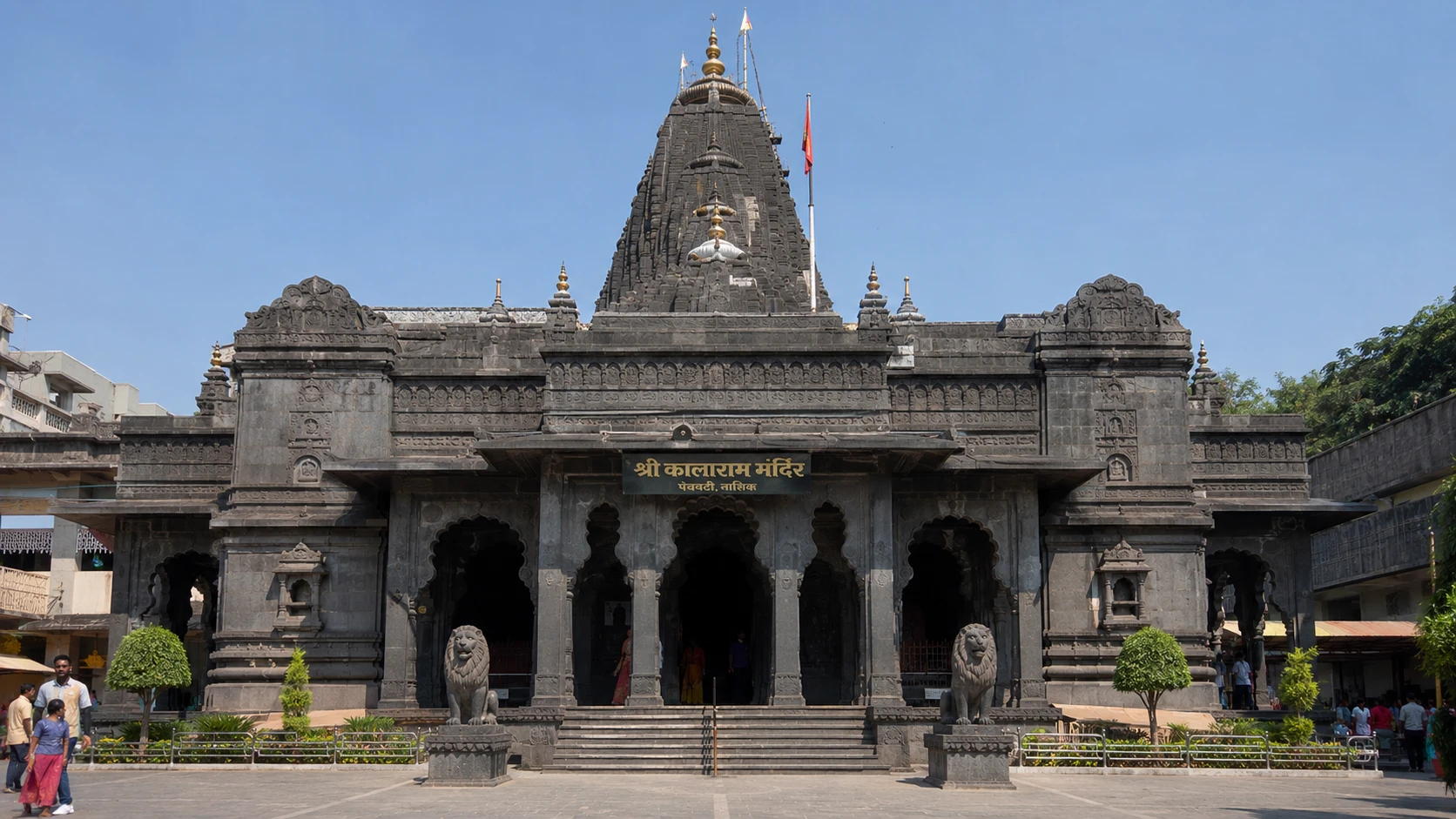
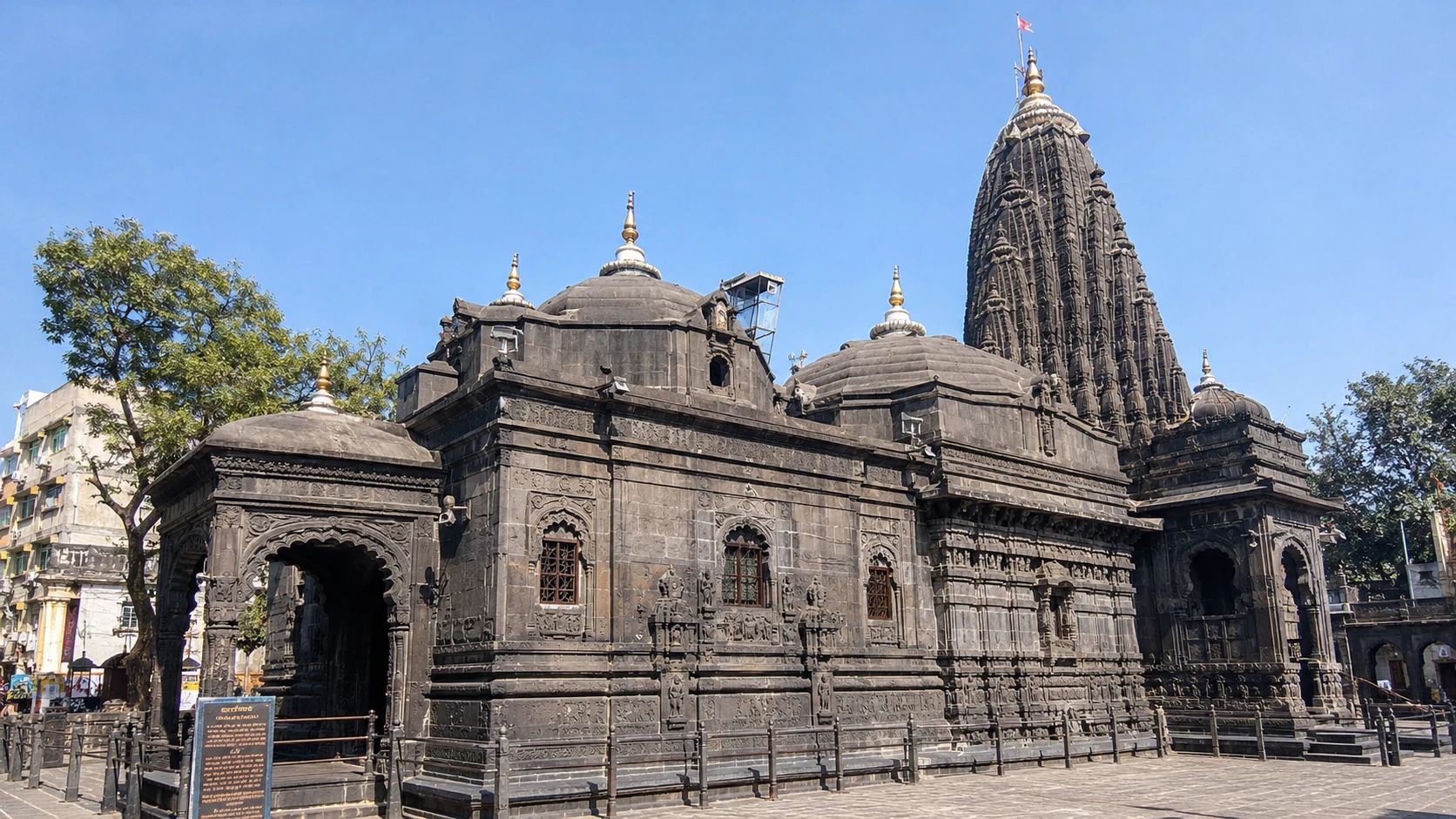
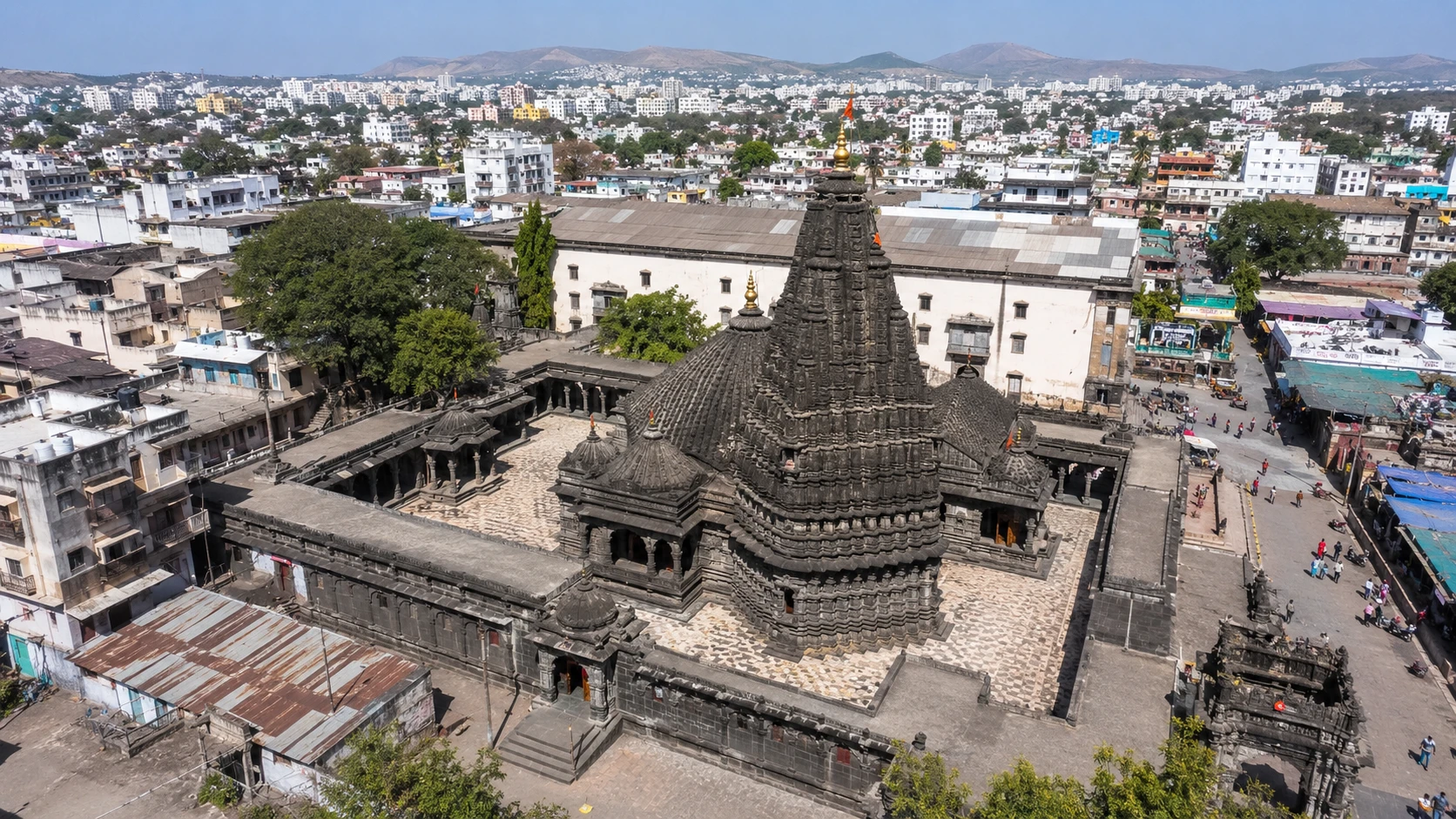
Panchavati has been a Ramayana pilgrimage site for many centuries, drawing devotees to the Godavari's banks as the place where Ram lived, Sita was taken, and the war with Lanka began. The present Kala Ram Mandir was built in 1792 by Sardar Rangrao Odhekar, a military commander in the service of the Maratha Peshwas, with Peshwa patronage. The construction follows the Hemadpanthi style — named after Hemadri (Hemadpant), the 13th-century minister of the Yadava dynasty, who advocated building temples from locally quarried black basalt without lime mortar. The black stone of the temple's construction mirrors the black stone of its presiding deity, giving the complex a distinctive visual unity. The temple houses a 2-foot-high image of Ram carved from black stone — hence the name Kala Ram (Kala = black) — flanked by Sita and Lakshmana inside the sanctum and with a large Hanuman figure at the entrance. The temple assumed a second historical significance on 2 March 1930, when Dr. B.R. Ambedkar led the Kalaram Mandir Satyagraha — a non-violent campaign demanding that untouchable castes be permitted to enter the temple for darshan, from which they had been excluded. The satyagraha was one of the defining acts of India's social reform movement. The temple was opened to all communities following independence and subsequent legal reform.
Historical Timelineऐतिहासिक कालक्रम
Ram, Sita, and Lakshmana establish their forest hermitage at Panchavati on the banks of the Godavari, following the sage Agastya's direction. The key narrative episodes of the Aranya Kanda — Shurpanakha, the golden deer, Sita's abduction by Ravana — unfold at this site. The location is held sacred in the Ramayana pilgrimage tradition.
The identification of Nashik's Panchavati with the Valmiki Ramayana site is a devotional tradition, not an archaeological determination. The Valmiki text places Panchavati on the Godavari's banks, which is geographically consistent with Nashik. The identification is ancient, continuous, and accepted in temple tradition, but should be understood as sacred geography rather than historical-archaeological certification.
Sardar Rangrao Odhekar, a commander in the Maratha Peshwa service, constructs the Kala Ram Mandir at Panchavati with Peshwa financial patronage. The temple is built in the Hemadpanthi style using black basalt. The presiding deity — a 2-foot black stone image of Ram flanked by Sita and Lakshmana — is installed.
On 2 March 1930, Dr. B.R. Ambedkar leads the Kalaram Mandir Satyagraha at Nashik — a non-violent campaign demanding that untouchable (Dalit) castes be permitted to enter the temple for darshan, from which temple management had excluded them. Thousands of participants arrive at the temple gates. The satyagraha is one of the first major civil rights actions in modern Indian history — organised ten days before Gandhi's Dandi March — and draws national attention to the question of equal access to public religious spaces.
The Kalaram Mandir Satyagraha ran from 2 March 1930 and continued in periodic campaigns through approximately 1935. Ambedkar's position was that equal access to public religious spaces — temples funded implicitly by the taxes and labour of all castes — was a fundamental right, not a favour to be granted by caste Hindus. The satyagraha did not achieve immediate entry but marked a watershed in public articulation of Dalit civil rights. In 1935, Ambedkar publicly declared he would not die a Hindu — a statement in which Nashik and its temple stood as a formative context. The temple was opened to all communities following independence and the legal abolition of untouchability under Article 17 of the Constitution of India (1950).
Following years of the Kalaram Mandir campaign and continued social discrimination, Dr. Ambedkar publicly declares at Yeola (near Nashik) that he will not die a Hindu. The declaration is a direct consequence of his experiences at Nashik and becomes one of the most significant statements of the Indian religious reform era.
The Constitution of India comes into force, with Article 17 abolishing untouchability and its practice in any form. Subsequently, the Kala Ram Mandir is opened to devotees of all castes and communities. The temple now receives pilgrims from across India without restriction.
What You'll Seeदर्शन में
The presiding deity is Ram in standing form, carved from black basalt — the defining feature that gives the temple its name. The Valmiki Ramayana describes Ram's complexion as 'shyama' (dark-hued, like a monsoon cloud) throughout the text, and the black stone murti makes that scriptural description visually present. The image is approximately 2 feet high. Sita stands to Ram's left and Lakshmana to his right inside the garbhagriha. The sacred trio — Ram, Sita, Lakshmana — represents the complete forest-hermitage household of the Aranya Kanda. At the main entrance stands a large image of Hanuman, the devoted protector, facing the deity. The black stone exterior walls of the Hemadpanthi construction create a visual continuum: stone to deity, structure to sanctum, the same material throughout.
Distinctive Practicesविशिष्ट परंपराएँ
Panchavati Parikrama (Sacred Circuit of Five Sites)
पंचवटी परिक्रमा
Year-round; especially during Ram Navami and Kumbh Mela
Pilgrims to Panchavati complete a walking circuit of the five sacred sites associated with Ram's vanvas: the Kala Ram Mandir, the Sita Gupha (the cave where Sita is said to have sheltered), the Tapovan (the forest of austerities), the Kapileshwar Mahadev Temple (Shiva as witness to the vanvas), and the five ancient banyan trees (pancha-vata) on the Godavari's bank. The circuit is undertaken on foot and often done before sunrise.
The circuit retraces the sacred geography of Ram's forest life — not as a historical route but as a living devotional presence. Each site activates a different episode of the Aranya Kanda, allowing the pilgrim to inhabit the Ramayana narrative rather than observe it from outside. The pre-dawn timing mirrors the early-morning rhythms of the forest hermitage itself.
Did You Know?क्या आप जानते हैं?
The idol of Ram at Kala Ram Mandir is carved from black basalt — 'Kala' simply means black in Marathi and Hindi. But the name carries scriptural resonance: the Valmiki Ramayana consistently describes Ram as 'shyama' — dark-complexioned, like a monsoon cloud heavy with rain. The black stone murti makes visible what the oldest Sanskrit Ramayana has always said.
Valmiki Ramayana — 'shyama' descriptions throughout; temple iconographic tradition
Panchavati is the site where the Ramayana's most pivotal crisis occurred: the abduction of Sita by Ravana. The Valmiki Ramayana's Aranya Kanda (Book III) narrates the sequence — the golden deer, Ram's pursuit, Lakshmana's departure, the mendicant Ravana — across sargas 40 to 47, set specifically at the Godavari-bank hermitage. Every part of that sequence has a corresponding sacred site in Nashik's Panchavati landscape today.
Valmiki Ramayana, Aranya Kanda, sargas 40–47
On 2 March 1930, Dr. B.R. Ambedkar led the Kalaram Mandir Satyagraha — demanding the right of Dalit communities to enter this temple for darshan. The campaign began ten days before Gandhi's Dandi March and is one of the founding acts of the modern Indian civil rights movement. The temple is today open to all.
Dhananjay Keer, 'Dr. Ambedkar: Life and Mission' (1954); Government of Maharashtra historical documentation
Nashik is one of the four cities of the Kumbh Mela rotation — the others being Prayagraj, Haridwar, and Ujjain. The Nashik Kumbh (called Simhastha) occurs every twelve years when Jupiter (Guru) is in Leo (Simha) and the Sun is in Aries. During Simhastha, the Godavari ghats at Panchavati receive tens of millions of pilgrims for the sacred Godavari snan (bath). The next Simhastha is expected in 2027.
Regional Kumbh Mela calendrical tradition; Government of Maharashtra, Simhastha documentation
Visitor Accessप्रवेश जानकारी
Kala Ram Mandir is open to all devotees regardless of caste, community, or background. The temple was the site of Dr. B.R. Ambedkar's 1930 satyagraha precisely because it had previously excluded lower-caste devotees; those exclusions have no legal or moral standing under the Constitution of India (Article 17, 1950) and are not in effect. All visitors are welcome.
Festivalsत्योहार
Ram Navami
राम नवमी
March–April (Chaitra Shukla Navami)
Ram's birthday is the principal annual festival at Kala Ram Mandir. The Panchavati sacred circuit is completed by thousands of pilgrims, special pujas are performed from pre-dawn, and the Godavari ghats fill with devotees. The Panchavati connection adds a specific Aranya Kanda resonance to the celebration — Ram's birth is honoured at the very site where the hardest chapter of his human life was set.
Simhastha Kumbh Mela
सिंहस्थ कुंभ मेला
April–May (every 12 years; next 2027)
Once every twelve years, Nashik becomes one of the four Kumbh sites. Tens of millions of pilgrims descend on Panchavati's Godavari ghats for the sacred Simhastha snan. Kala Ram Mandir sits at the spiritual centre of the Kumbh geography — the deity of the Aranya Kanda on the river's banks. The Kumbh transforms the temple's scale of pilgrimage entirely for its duration.
Dussehra (Vijayadashami)
दशहरा (विजयादशमी)
September–October (Ashwin Shukla Dashami)
The celebration of Ram's victory over Ravana carries particular weight at Panchavati — the place where Ravana committed his treachery and from where the war of Lanka began. The Dussehra at Nashik is celebrated with processions and the burning of Ravana effigies; the pilgrimage geography gives the victory its story's proper beginning.
Traditional Offeringsपारंपरिक अर्पण
Primary Offerings
Tulsi (Holy Basil)
तुलसी
तुलसी
Tulsi is the most sacred offering to Vishnu and his avatars, including Ram. The Padma Purana (Uttara Khanda) states that Vishnu holds Tulsi dearer than any other offering — its fragrance purifies the offering, the air around the shrine, and the mind of the devotee. At Panchavati, where the forest itself was Ram's dwelling, the forest-born Tulsi plant carries an additional resonance.
Godavari Jal (Godavari river water)
गोदावरी जल
The Godavari is the sacred river on whose banks Ram built his Panchavati hermitage. Offering water drawn from the Godavari at Panchavati's ghats for abhishekam is a practice specific to this temple's geography — it connects the ritual of abhishekam to the very river that Ram, Sita, and Lakshmana bathed in during the vanvas. The Skanda Purana's Brahma Khanda refers to the Godavari as 'Dakshina Ganga' — the Ganga of the south.
Yellow flowers (Marigold / Champa)
पीले फूल (गेंदा / चंपा)
Yellow and saffron flowers are associated with Rama's solar lineage — he is born of the Ikshvaku (Suryavansha) dynasty. Marigolds and champa are traditional in Ram temple garlands, their brightness echoing the solar radiance (tejas) that the Valmiki Ramayana attributes to the Raghu lineage throughout.
Panchamrit (abhishekam blend)
पंचामृत
पञ्चामृत
Panchamrit — milk, curd, ghee, honey, and sugar — is offered in the ritual bathing of the deity. The five components correspond to the five elements; the ritual purifies the sanctum atmosphere and invites full divine presence into the physical form. Offered during special sevas at Kala Ram Mandir.
Godavari water drawn from the Panchavati ghats is the most place-specific offering available to pilgrims. Tulsi and flower garlands are sold by vendors at the ghat steps and near the temple entrance. Panchamrit sevas are arranged by the temple.
How to Reachकैसे पहुँचें
Nashik is well connected by rail, road, and air. Nashik Road Railway Station (8 km from Panchavati) is on the Mumbai–Manmad–Delhi Central Railway line with frequent express services from Mumbai (approximately 3.5–4 hours), Pune, and other major cities. From Nashik Road station, auto-rickshaws and taxis go directly to Panchavati and Kala Ram Mandir (approximately 20–30 minutes). By road, Nashik is 170 km from Mumbai on NH-160 (approximately 3–4 hours), 210 km from Pune, and well served by state transport and private buses. Nashik Airport at Ozar (approximately 25 km from Panchavati) operates limited scheduled flights; Chhatrapati Shivaji Maharaj International Airport, Mumbai, is the nearest major hub. Within Nashik, Panchavati is a distinct neighbourhood on the Godavari's east bank — all major pilgrimage sites including Kala Ram Mandir, Sita Gupha, and the ghats are walkable from each other.
Plan Your Visitयात्रा की योजना
🌤 Best Season
October to March. Nashik's summers (April–June) are hot. The monsoon (July–September) brings heavy rain but also the Godavari's full, beautiful flow. Winter months offer the most comfortable pilgrimage conditions. Note: if visiting during Simhastha Kumbh (every 12 years, next 2027), plan accommodation months in advance — the city's capacity is overwhelmed.
👘 Dress Code
Modest, traditional attire. Footwear to be removed before entering. Head covering preferred. The river ghats can be slippery in monsoon — appropriate footwear for the parikrama circuit is advisable.
📱 Phones & Photography
Photography inside the sanctum is not permitted. Photography of the temple exterior, the ghats, and the Panchavati circuit sites is generally permitted.
🏨 Accommodation
Nashik has a range of hotels and dharamshalas in and around Panchavati. During Simhastha Kumbh years, the entire city is overwhelmed with pilgrims — book accommodation at least six months in advance. MTDC (Maharashtra Tourism Development Corporation) guest houses are available.
Sacred Soundsपवित्र ध्वनि
Did You Know? · क्या आप जानते हैं?
The same translation error that turned '33 Koti' into '33 crore' in Hinduism also happened in Buddhism. The Chinese translation of Buddhist texts rendered 'Sapta Koti Buddha' (7 Supreme Buddhas) as '7 Crore Buddhas.' The Tibetan translation got it right: 7 types, not 7 crore. One Sanskrit word, misread across two major world religions, generated two identical misconceptions independently.
Related Contentसंबंधित सामग्री
Related Scriptures
Related Temples
Ram Raja Mandir (Orchha)
राम राजा मंदिर ओरछा
Orchha, Madhya Pradesh
Ram Janmabhoomi
राम जन्मभूमि
Ayodhya, Uttar Pradesh
Ramaswamy Temple (Kumbakonam)
रामस्वामी मंदिर कुम्भकोणम्
Kumbakonam, Tamil Nadu
Triprayar Sri Rama Temple
त्रिप्रयार श्री राम मंदिर
Triprayar, Kerala
Trimbakeshwar
त्र्यंबकेश्वर
Trimbak, Maharashtra
Community Reflections
🕉️
Be the first to share your reflection.