Ram Raja Mandir (Orchha)
राम राजा मंदिर ओरछा
The only temple in India where God receives a state police salute
Orchha, Madhya Pradesh, India
Rāmarājā MandiraAlso known as: Ram Raja Temple, Ram Raja Sarkar Mandir, Rāmarājā Sarkar, Orchha Ram Mandir
Era
17th century (c. 1627 CE)
Architecture
Bundeli palace-temple (Orchha School)
Open
08:00 – 20:00
Aarti
08:00 · 12:00 · 19:00
Special
Police guard of honour and flag salute at morning and evening aarti — the only temple in India with official state military honours
The Sacred Legend · पवित्र कथा
At Ram Raja Mandir in Orchha, God is not a deity — he is a king. Ram rules Orchha as its reigning sovereign, and has done so since the 17th century, when a queen's devotion brought him here on one unbreakable condition: that he would sit where he was first placed and never be moved. He was set down in the royal palace. The grand Chaturbhuj Mandir, built specially for him across the courtyard, waited in vain. Ram stayed in the palace, and the palace became the temple. Every morning and evening since, the Madhya Pradesh Police presents arms and the flag flies — because in Orchha, Ram is not worshipped as God alone, but obeyed as king.
Sacred Designationपवित्र पदनाम
Sacred Origin Storyपवित्र उत्पत्ति कथा
Source: Vaishnava — Ramayani / Bundeli
Queen Ganeshkunwari, consort of Raja Madhukar Shah Bundela of Orchha (r. 1554–1592), was an ardent devotee of Rama. She undertook a pilgrimage to Ayodhya and performed intense tapas on the banks of the Sarayu, seeking Rama's darshan and his presence in Orchha. Rama appeared and consented to accompany her — but on one inviolable condition: he would be seated wherever he was first placed and would not be moved from that spot for any reason. The queen accepted and carried the idol by boat down the Yamuna and Betwa rivers to Orchha. On arriving at the palace, the idol was temporarily placed in the queen's private chamber in the Rani Mahal while the grand Chaturbhuj Mandir — a dedicated temple of monumental scale — was being completed. When the Chaturbhuj Mandir was ready and the priests attempted to transfer the idol, it could not be moved. Rama's condition had been kept: the palace chamber was now the temple. From that day, the deity has been worshipped with royal protocol — the flags of Orchha fly over the palace-temple, the police present arms, and Ram is addressed not as Bhagwan alone but as Sarkar — the sovereign.
Sources cited:
- Bundelkhand regional tradition; referenced in Vishwambhar Nath Upadhyay, 'Orchha ka Itihas'
- Archaeological Survey of India, Orchha World Heritage Site documentation
- M.P. Tourism Authority, Orchha heritage documentation
Scholarly Context
The precise reign during which Queen Ganeshkunwari's pilgrimage occurred is debated. Many traditional accounts associate her with Raja Madhukar Shah (r. 1554–1592); others link the physical completion of the Chaturbhuj Mandir — and therefore the establishment of the palace-as-temple — to Bir Singh Deo Bundela (r. 1605–1627), who was the great builder of Orchha. The Chaturbhuj Mandir's construction is generally dated to c. 1627 CE. The two traditions are not necessarily contradictory: the idol's installation may predate the Chaturbhuj's completion by decades. No primary Bundela court chronicle with an unambiguous date for the installation has been published in accessible scholarly literature.
Historyइतिहास
Orchha was founded in 1501 by Rudra Pratap Singh Bundela, who established it as the capital of the Bundela Rajput kingdom on the banks of the Betwa River. The Bundela rulers built the town's famous suite of palaces and temples — Jahangir Mahal, Raj Mahal, Chaturbhuj Mandir, Laxminarayan Temple — across the 16th and 17th centuries, making Orchha one of the most concentrated ensembles of medieval Rajput architecture in central India. The Ram Raja Mandir emerged from this patronage as an accidental consequence of devotion rather than deliberate design: a palace chamber became a temple because the deity chose it over a purpose-built structure. This inversion — the domestic over the monumental — defines Orchha's spiritual character. The tradition of state honours for Ram, including the police guard of honour, developed under Bundela sovereignty and survived every subsequent political change: Maratha overlordship in the 18th century, British political suzerainty in the 19th, and incorporation into Madhya Pradesh after 1947. Today, Ram Raja Mandir is the only temple in India where the national police force presents arms in honour of a deity, treating the divine as a sovereign.
Historical Timelineऐतिहासिक कालक्रम
Queen Ganeshkunwari brings the Ram idol from Ayodhya to Orchha; the idol is temporarily placed in the Rani Mahal (royal palace). The Chaturbhuj Mandir is subsequently completed, but the idol cannot be transferred, establishing the palace chamber permanently as the temple.
The precise date of the idol's installation is not established in published primary sources. Estimates range from the reign of Madhukar Shah (r. 1554–1592) to that of Bir Singh Deo (r. 1605–1627). The completion of the Chaturbhuj Mandir is commonly attributed to Bir Singh Deo's patronage c. 1627. The two phases — installation in the palace and completion of the Chaturbhuj — may be separated by decades.
Chaturbhuj Mandir completed by Bir Singh Deo Bundela. The four-armed form the temple was designed to enshrine never takes residence; the temple stands largely without its intended deity — a monumental testament to the palace-temple's primacy.
Bundela kings formalize the tradition of royal state honours for Ram Raja — daily flag protocol, police salute, and a royal seal designating Orchha's temporal sovereignty as held by Ram himself.
Under British political suzerainty over Orchha State, the tradition of state honours for Ram Raja is formally acknowledged and continued. The Orchha State Gazetteer and Central India Agency colonial records document the temple's unique royal protocol.
Post-independence, Orchha is merged into Vindhya Pradesh and subsequently into Madhya Pradesh. The Madhya Pradesh Police formally continues the tradition of presenting arms at Ram Raja Mandir — the only instance in independent India of a state police force rendering military honours to a deity.
What You'll Seeदर्शन में
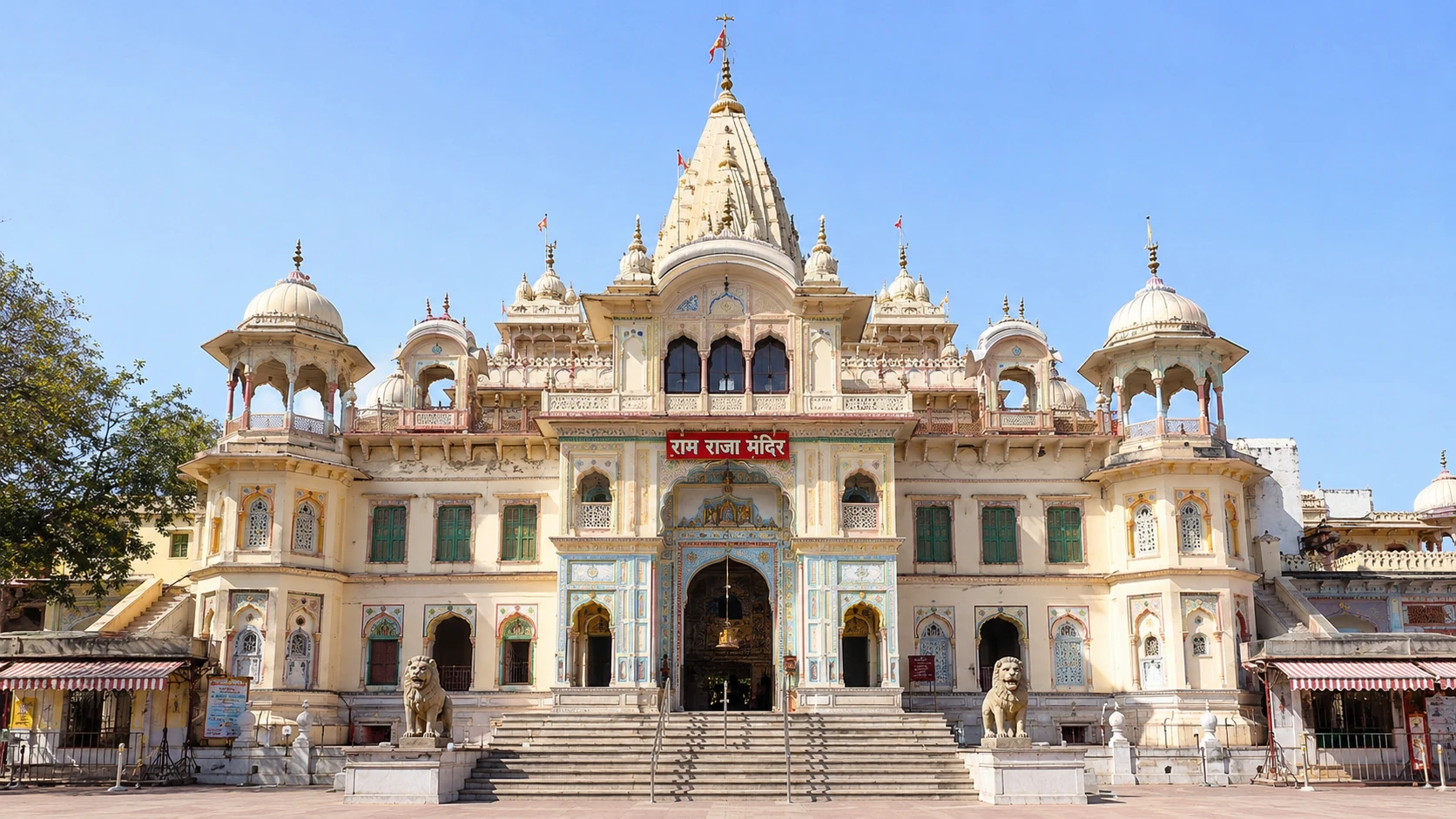
The presiding deity is Ram in his Rājarājā (kingly) form — a standing figure of dark stone, holding the bow (dhanu) in his left hand. Sita stands to his left and Lakshmana to his right, completing the sacred trio that defines the Vaishnava Rama tradition. A small image of Hanuman is present at the feet or to the side. What distinguishes the darshan here from any other Ram shrine is the setting: the deity stands not in a shikhara-topped garbhagriha but in a palace chamber — the former private quarters of the Orchha queens. The murti is adorned in royal attire (vastra), and the ceremonial royal paraphernalia — canopy, silver throne, fly-whisks (chamara) — reinforce the sovereign identity. During the morning and evening aarti, the Madhya Pradesh Police presents arms outside the entrance, and the saffron and white flag of Ram Raja Sarkar is raised and lowered according to formal protocol.
Distinctive Practicesविशिष्ट परंपराएँ
Police Guard of Honour (Shastra Salami)
पुलिस गार्ड ऑफ़ ऑनर (शस्त्र सलामी)
Daily — morning and evening aarti
At the morning and evening aarti, a detachment of the Madhya Pradesh Police presents arms (shastra salami) at the entrance of Ram Raja Mandir. The saffron and white flag of Ram Raja Sarkar is hoisted at dawn and lowered at dusk following full flag protocol — the same protocol observed for a head of state. This is not a ceremonial gesture performed for tourists; it is a formal practice of the Madhya Pradesh state police, maintained under the official recognition of Ram as the reigning sovereign of Orchha.
The practice embodies the theological principle that in Orchha, temporal sovereignty itself belongs to Ram. The Bundela kings originally conceived of themselves not as independent rulers but as administrators (diwan) serving Ram as the ultimate sovereign. The police salute is the modern state's continuation of that principle — an acknowledgment that governmental authority here flows from, and is answerable to, the divine. No human ruler is ultimate; Ram Sarkar is.
Did You Know?क्या आप जानते हैं?
Ram Raja Mandir is the only temple in India where the state police force presents arms in military honour to a deity. The Madhya Pradesh Police performs this salute twice daily — morning and evening — treating Ram as the reigning sovereign of Orchha. The tradition has continued without interruption through Bundela, Maratha, British colonial, and post-independence Indian administrations.
Madhya Pradesh Tourism Authority; Archaeological Survey of India, Orchha heritage documentation
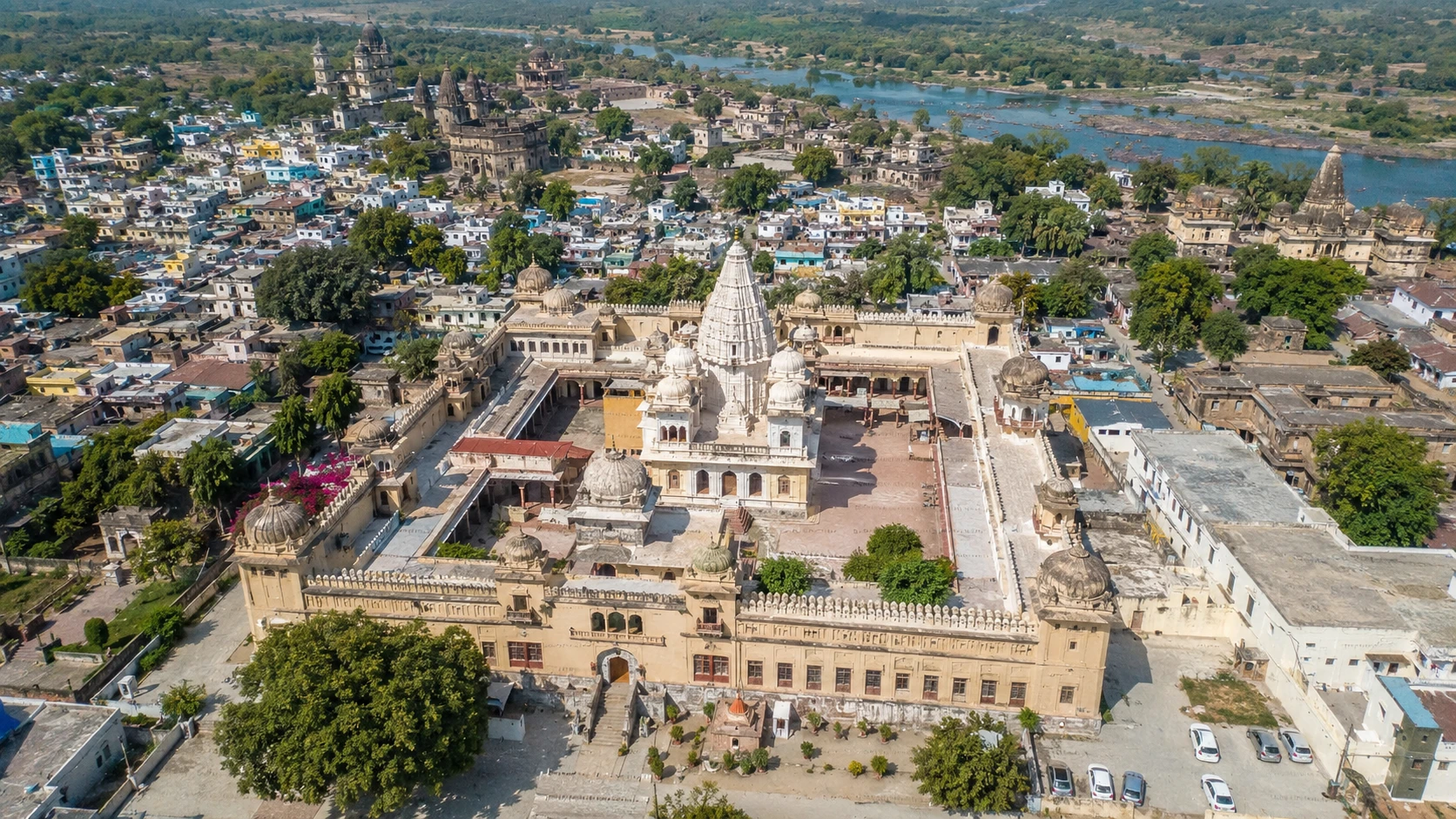
The Chaturbhuj Mandir — a towering temple completed around 1627 CE and specifically designed to house the Ram idol — stands across the courtyard from Ram Raja Mandir virtually without its intended deity. The four-armed (chaturbhuja) form for which it was named and built never took permanent residence there. It is one of the most extraordinary architectural ironies in Indian temple history: a great temple waiting forever for the god who chose a palace instead.
Archaeological Survey of India, Orchha documentation; ASI architectural survey
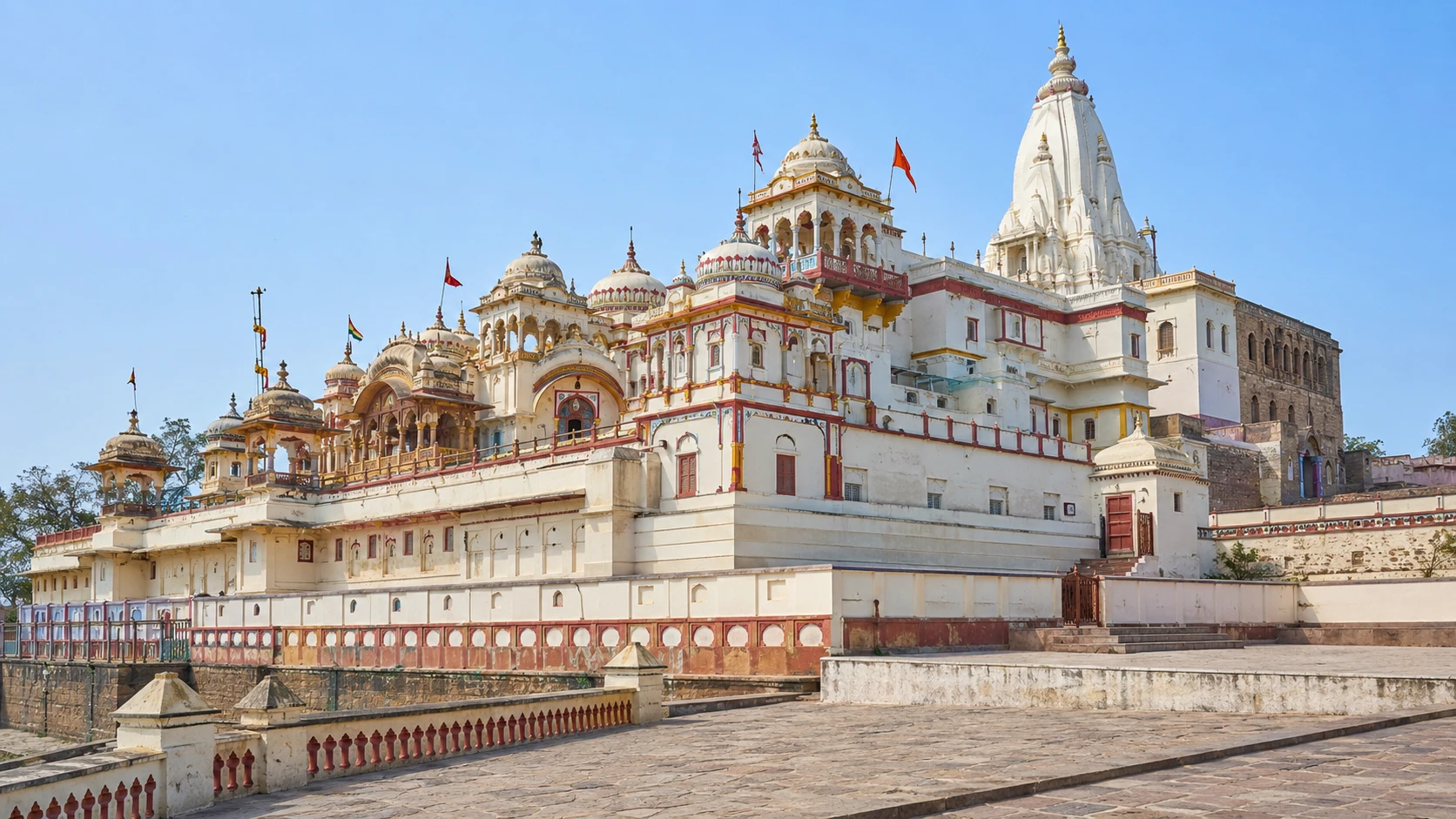
Ram Raja Mandir is housed not in a purpose-built shikhara temple but in a medieval royal palace — the former private chambers of Orchha's queens. Devotees approach the deity through palace corridors. The garbhagriha is the queen's former residential suite. No other major temple in India is situated in a royal bedchamber.
Archaeological Survey of India, Orchha World Heritage Site documentation
Ram is addressed in Orchha not as 'Bhagwan' or 'Prabhu' but as 'Sarkar' — meaning 'the government' or 'the sovereign authority'. Historical correspondence of the Orchha state used the seal of Ram Raja Sarkar, and local tradition holds that no human authority in Orchha is ultimate — all governance is conducted in the name of Ram Sarkar.
Bundelkhand regional tradition; referenced in M.P. Tourism heritage documentation
Visitor Accessप्रवेश जानकारी
Ram Raja Mandir is open to all devotees regardless of faith, caste, or background. Photography is not permitted inside the sanctum. Visitors are requested to remove footwear before entering and maintain silence during aarti. The morning and evening police guard of honour is a solemn state protocol — visitors are welcome to witness it respectfully.
Festivalsत्योहार
Ram Navami
राम नवमी
March–April (Chaitra Shukla Navami)
The birthday of Rama is Orchha's most important annual celebration. The entire town celebrates Ram as its living king — the police salute is performed with added ceremony, a grand shobha yatra (procession) moves through the streets, and pilgrims from across Bundelkhand converge for darshan. The day carries a civic dimension absent from other Ram temples, since the town's sovereign is literally celebrating his birthday.
Vivaha Panchami
विवाह पंचमी
November–December (Margashirsha Shukla Panchami)
The anniversary of Ram and Sita's divine marriage, celebrated at Orchha with the deities adorned in bridal attire and special puja. Bundelkhand's devotional music tradition — including folk Ramayana ballads (Ramayan patha) — is performed through the night.
Kartik Purnima
कार्तिक पूर्णिमा
October–November
A large annual mela held at Orchha centred on the Betwa River. Thousands of pilgrims take a holy dip in the Betwa and visit Ram Raja Mandir. One of the largest religious gatherings in the Bundelkhand calendar.
Traditional Offeringsपारंपरिक अर्पण
Primary Offerings
Tulsi (Holy Basil)
तुलसी
तुलसी
Tulsi is the most sacred offering to Vishnu and his avatars. The Padma Purana (Uttara Khanda) states that Vishnu holds Tulsi dearer than any other offering — its fragrance purifies the offering, the atmosphere of the shrine, and the mind of the devotee. At Ram temples, the offering of Tulsi is inseparable from Rama bhakti, as Ram is Vishnu incarnate in the Treta Yuga.
Yellow flowers (Marigold / Champa)
पीले फूल (गेंदा / चंपा)
Yellow and saffron flowers are associated with Rama's solar lineage — he is born of the Ikshvaku (Suryavansha) dynasty. Marigolds and champa are traditional in Ram temple garlands; their brightness echoes the solar radiance (tejas) attributed to the Raghu lineage across the Valmiki Ramayana.
Panchamrit (abhishekam blend)
पंचामृत
पञ्चामृत
Panchamrit — the blend of milk, curd, ghee, honey, and sugar — is offered in abhishekam of the deity. The five components correspond to the five elements and the five pranas; the ritual purifies the space and invites the divine presence fully into the physical murti. At Ram Raja Mandir, panchamrit abhishekam is performed during special sevas.
Sandalwood paste (Chandan)
चंदन
चन्दन
Chandan paste is the cooling, fragrant offering associated with Vishnu and his avatars — applied to the deity's forehead as tilak during puja. Its coolness symbolises the gentle, benevolent aspect of Rama as king and protector. The Vishnu Purana lists chandan among the sixteen upacharas (ritual services) to be offered to Vishnu.
Unique to This Temple
Royal Bhog Prasad
राजकीय भोग प्रसाद
At Ram Raja Mandir, the bhog (food offering) follows a royal protocol befitting a sovereign — the prasad is prepared in the temple's bhog shala and offered in multiple sessions through the day as formal meals would be presented to a reigning king. Devotees receive this prasad as the grace of the sovereign. The bhog follows Vaishnava norms: sattvic food, no onion, no garlic.
Tulsi is the most accessible and appropriate offering to bring. Flower garlands are available from vendors near the temple entrance. Large sevas including panchamrit abhishekam are arranged by the temple trust.
How to Reachकैसे पहुँचें
Orchha is 16 km from Jhansi Junction, which lies on the main Delhi–Mumbai and Delhi–Chennai trunk railway lines with frequent express and superfast services from all major cities. From Jhansi, autos, taxis, and shared jeeps run regularly to Orchha (approximately 30–40 minutes). By road, Orchha is 178 km from Gwalior on NH-75 and roughly 250 km from Bhopal; state buses and private vehicles are available. The nearest airports are Gwalior (approximately 120 km) and Khajuraho (approximately 165 km), the latter serving limited scheduled and charter flights. Once in Orchha town, the Ram Raja Mandir, Chaturbhuj Temple, and the palace complex are all within easy walking distance of each other.
Plan Your Visitयात्रा की योजना
🌤 Best Season
October to March. Bundelkhand summers (April–June) are severe — temperatures frequently exceed 44°C — making extended time at the outdoor palace-temple complex uncomfortable. The monsoon (July–September) brings welcome relief but heavy rain. Cool winter months offer ideal conditions for both the temple visit and Orchha's broader heritage walk.
👘 Dress Code
Modest, traditional attire preferred. Remove footwear before entering. Head covering is customary. Sleeveless clothing and shorts are discouraged inside the temple premises.
📱 Phones & Photography
Mobile phones and cameras are not permitted inside the sanctum. Photography of the palace-temple exterior and the police guard of honour is permitted from a respectful distance; do not obstruct the ceremony.
🏨 Accommodation
Orchha has MPTDC (Madhya Pradesh Tourism Development Corporation) hotels and guest houses in the heritage zone, several restored heritage havelis operating as boutique hotels, and a range of budget guesthouses near the temple. Advance booking is strongly recommended during Ram Navami and Kartik Purnima when the town fills with pilgrims.
Sacred Soundsपवित्र ध्वनि
Did You Know? · क्या आप जानते हैं?
The same translation error that turned '33 Koti' into '33 crore' in Hinduism also happened in Buddhism. The Chinese translation of Buddhist texts rendered 'Sapta Koti Buddha' (7 Supreme Buddhas) as '7 Crore Buddhas.' The Tibetan translation got it right: 7 types, not 7 crore. One Sanskrit word, misread across two major world religions, generated two identical misconceptions independently.
Related Contentसंबंधित सामग्री
Related Scriptures
Related Temples
Ram Janmabhoomi
राम जन्मभूमि
Ayodhya, Uttar Pradesh
Kala Ram Mandir (Nashik)
काला राम मंदिर नाशिक
Nashik, Maharashtra
Ramaswamy Temple (Kumbakonam)
रामस्वामी मंदिर कुम्भकोणम्
Kumbakonam, Tamil Nadu
Triprayar Sri Rama Temple
त्रिप्रयार श्री राम मंदिर
Triprayar, Kerala
Hanuman Garhi
हनुमान गढ़ी
Ayodhya, Uttar Pradesh
Community Reflections
🕉️
Be the first to share your reflection.