Kireet Shakti Peeth
किरीट शक्तिपीठ
Where Satī's crown fell on the Bhāgīrathī's east bank
Lalbagh (Murshidabad), West Bengal, India
KirīṭeśvarīAlso known as: Kiriteshwari, Kiriteswari, Kiritkona Devi, Vimalā Devī Pīṭha (canonical), Kirīṭa Pīṭha, Kiritkona Mandir
Era
Pre-Pīṭhanirṇaya canonical inclusion (medieval); continuously active documented presence from approximately c. 1500; current āṭcālā structure nineteenth century with later restorations
Architecture
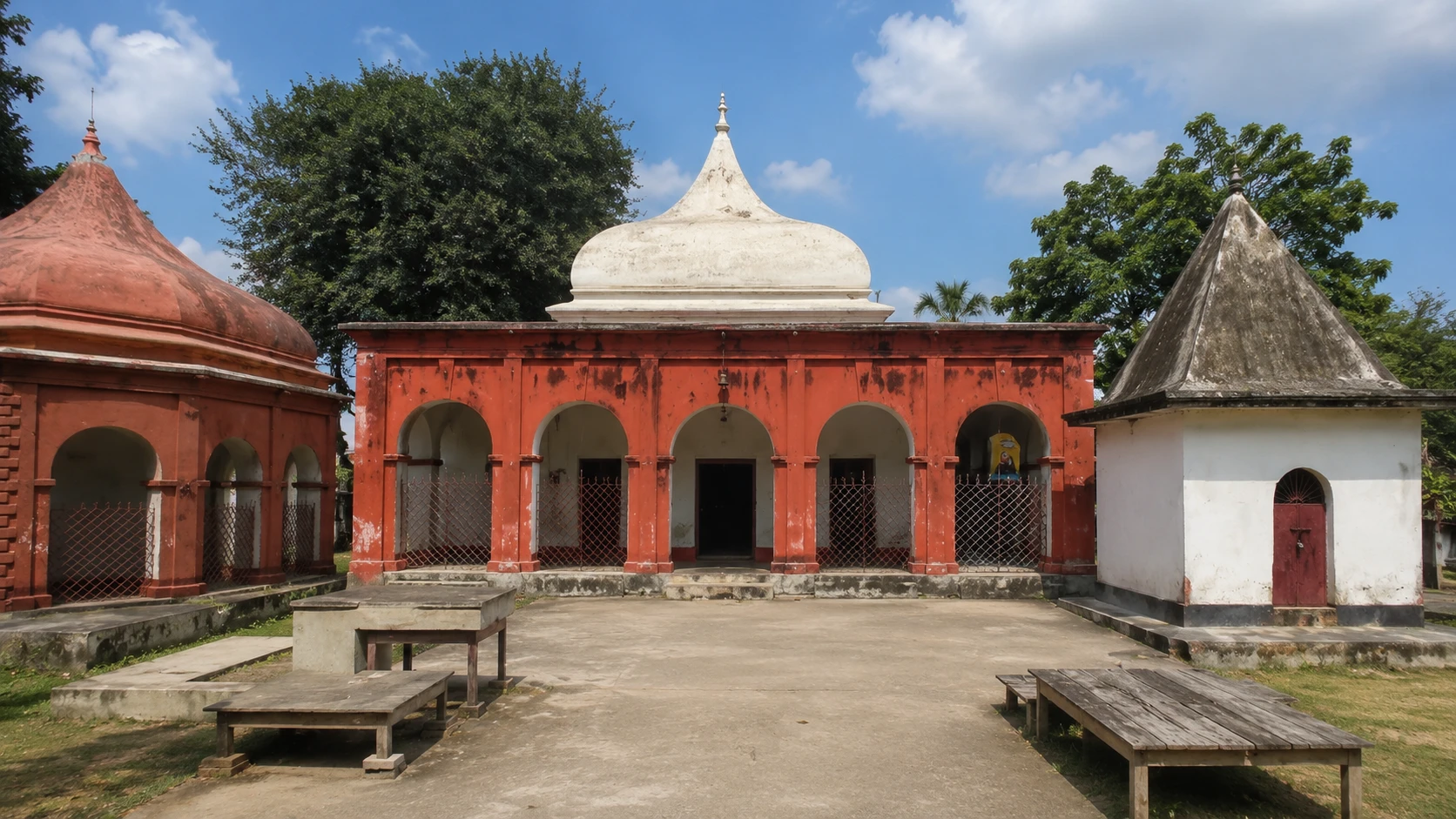
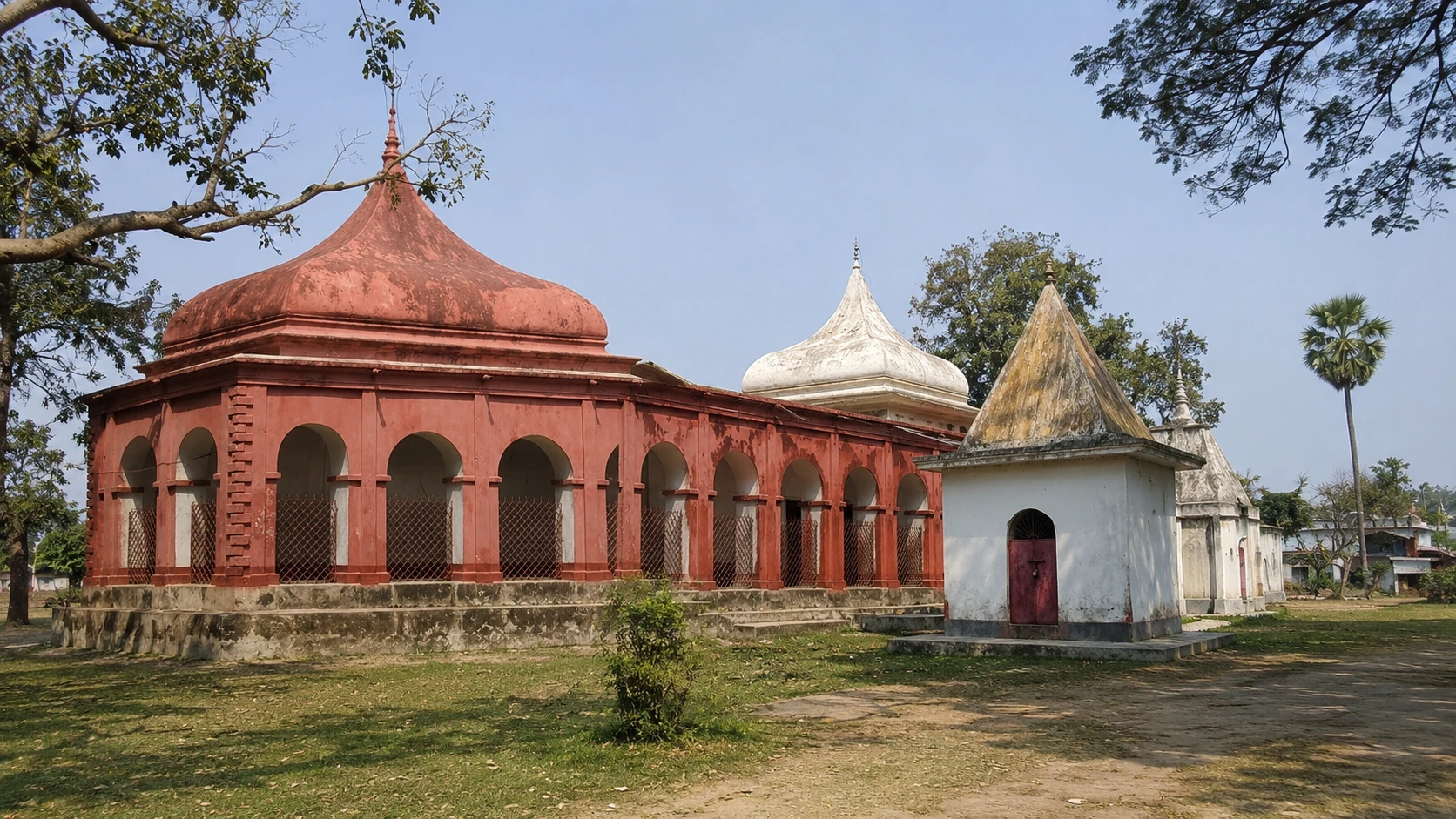
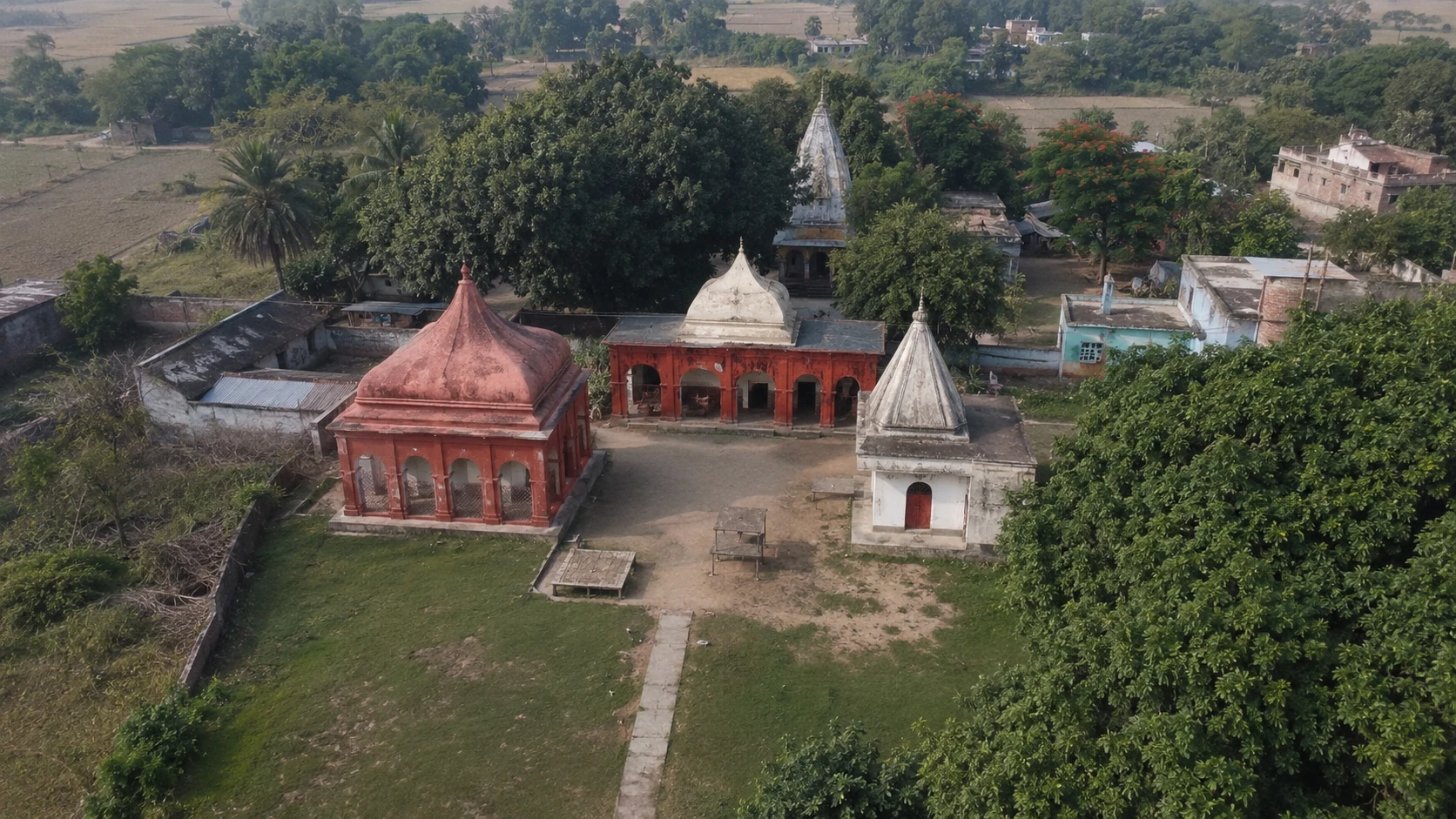
Bengali āṭcālā (eight-roofed) regional sacred architecture characteristic of Murshidabad and Rāḍh Bengal; brick-and-lime construction with terracotta detailing; modest scale befitting a village Pīṭha rather than a major court temple
Open
05:00 – 21:00
Aarti
06:00 · 12:00 · 19:00
Special
Annual Kirīṭeśvarī Pūjā during Aswin śuklapakṣa alongside Durgā Pūjā; Kālīkṣetra night observance on Kālī Pūjā (Kārtika amāvasyā); Vāsanti Pūjā in Caitra
The Sacred Legend · पवित्र कथा
Kiriteshwari is the Bengal Shākta tradition's crown, the Pīṭha where Satī's kirīṭa, her royal diadem, is said to have fallen as Viṣṇu's Sudarśana cakra cut her body apart upon the back of the grieving Śiva. The canonical Pīṭhanirṇaya names this place's presiding form Vimalā, paired with the dissolution-fire Bhairava Saṁvarta; the living tradition of the village, transmitted across generations of Bengal Shākta households, calls her Kirīṭeśvarī, 'Mistress of the Crown.' The place itself, Kiriteshwari, Kiritkona, also carries the same word. The body part, the Devī's local name, and the village name all speak the kirīṭa. Set on the high ground east of the Bhāgīrathī, twelve kilometres north of Lalbagh-Murshidabad, the eighteenth-century Nawabi capital that once governed all of Bengal, Bihar and Orissa, and twenty kilometres south of the present international border with Bangladesh, Kiriteshwari has lived continuously through Mughal-Nawabi rule, the 1757 transition at Plassey, the nineteenth-century zamindari restorations, and the 1947 Partition, remaining active through every reordering of the political geography around it.
Sacred Designationपवित्र पदनाम
Shakti Peeth
Body part: Crown / Diadem (kirīṭa)
Shakti: Vimalā (canonical Pīṭhanirṇaya) / Kirīṭeśvarī (living local tradition)
Bhairava: Saṁvarta
Sacred Origin Storyपवित्र उत्पत्ति कथा
Source: Pīṭhanirṇaya (canonical Tantric pīṭha-enumeration text) and Bṛhannīla Tantra, paired with Bengali Shākta living-tradition oral transmission and the regional Kālīkā Purāṇa register
When Dakṣa Prajāpati performed his great sacrifice and refused to invite his daughter Satī's husband, the ascetic Śiva, whom Dakṣa had never accepted as a son-in-law, Satī went to her father's court uninvited, intending to confront him. Dakṣa met her not with welcome but with public condemnation.
He spoke of Śiva as one fit only for cremation grounds, as the consort of ghosts and bhūtas, as no proper husband for the daughter of a Prajāpati. Satī, hearing her husband mocked in the assembly of the gods, would not return to him bearing such humiliation. She invoked her own yogic fire at her father's hearth and consumed her body in it.
When Śiva learned of his wife's self-immolation, his grief broke the cosmos. He destroyed Dakṣa's yajña, sending Vīrabhadra to scatter the gods and behead Dakṣa himself, and then, taking up Satī's burned body across his shoulders, he began the wandering called the Tāṇḍava of grief.
He walked across the earth without rest, the dead weight of his wife borne on his back, and as he walked, all creation began to shudder. The mountains trembled with his footsteps; the seas churned at his approach; the gods feared the world itself would dissolve from his sorrow alone.
Viṣṇu, who alone of the gods could intervene, took up his Sudarśana cakra, the discus that cuts through illusion, and, walking behind Śiva on his unending journey, he reached his discus forward and began to cut. Piece by piece, almost surgically, the cakra severed Satī's body from Śiva's shoulders.
Each part fell to earth at the place where the cakra's stroke had cut, and each place where a piece of the goddess fell became sanctified, a Pīṭha, a seat of the goddess's power, where she could thereafter be worshipped in fragmentary but inexhaustible presence. Where Śiva felt the weight lifted, his grief slowly lessened, and the cosmos was preserved.
At one such cut, Satī's kirīṭa, her crown, the diadem that marked her sovereignty as the daughter of Dakṣa and the consort of Śiva, fell to the high ground on the eastern bank of the river the world would come to call Bhāgīrathī. The place where the crown came to rest took the crown's name.
Centuries later, when the Pīṭhanirṇaya was compiled to enumerate the body-parts and the corresponding Devī forms across the subcontinent, this place was registered under the name Vimalā, 'the spotless one', paired with the Bhairava Saṁvarta, the dissolution-fire that ends each cosmic cycle.
But the village had its own name for her, and the village remembered. Across centuries of pilgrimage, household worship, and oral transmission, the local form remained Kirīṭeśvarī, 'the Mistress of the Crown', naming her by the very organ that had fallen there. The place itself, Kiriteshwari, Kiritkona, also took that word into its name.
When the canonical and the local diverge in Bengali Shākta tradition, both are kept: the Pīṭhanirṇaya's Vimalā is read out in liturgy, and the village calls upon Kirīṭeśvarī in everyday worship, and no one is asked to choose between them.
The dissolution-fire Bhairava Saṁvarta paired with this Pīṭha carries its own theological weight. Saṁvarta is the form of fire that consumes the cosmos at the end of each kalpa, the pralaya-agni, the conflagration that returns all manifestation to its source.
That this dissolution-fire stands as the male counterpart to the crown, the symbol of royal sovereignty, of completed worldly form, gives Kirīṭeśvarī a particular tāntric register: the highest manifestation, the crown, paired with the highest dissolution, the conflagration. The apex of worldly form is held in companionship with the unmaking of all form.
The Devī here, in this reading, is neither only manifestation nor only dissolution, but the holding-together of both.
Sources cited:
- Pīṭhanirṇaya (canonical Tantric pīṭha-enumeration), entry for the kirīṭa-fall locus
- Bṛhannīla Tantra, sections on the Bengal Pīṭhas
- Kālīkā Purāṇa, Chapters 18 and 60, 62 (Daksha-Sati-Shiva-Vishnu cakra-cutting cycle)
- Devī Bhāgavata Purāṇa, Skandha VII (51-Pīṭha enumeration tradition)
- Sircar, D. C., 'The Śākta Pīṭhas' (Journal of the Royal Asiatic Society of Bengal, 1948; revised monograph 1973), canonical modern critical compilation of the Pīṭha lists
- Banerjea, J. N., 'Paurāṇic and Tāntric Religion' (University of Calcutta, 1966)
Other Traditions · अन्य परंपराएँ
Hindu-Muslim coexistence reading, Nawabi-era accommodation in the Murshidabad heartland (eighteenth-century historical-cultural framing)
A distinctive reading of Kiriteshwari's continuous activity emphasises not its mythological foundation but its persistence through the eighteenth century, the period when Murshidabad, twelve kilometres south, was the capital of all of Bengal, Bihar and Orissa under the Shī'a Nawabs Murshid Quli Khan, Shujā-ud-Dīn, Sarfarāz Khan, and Alivardi Khan.
In this reading, the temple's survival and continued patronage through the Nawabi period is read as a marker of a wider regional pattern: the Bengal Nawabs did not pursue the policies of temple destruction sometimes associated with earlier Mughal sovereigns, and Hindu Shākta worship at sites like Kiriteshwari continued openly under their watch.
Pilgrims travelling to Kiriteshwari in the 1740s would have passed through a Murshidabad whose Friday prayers at the Katra Mosque and Shī'a Muharram processions at the Imambara coexisted, in the same regional sacred geography, with the Devī's annual Pūjā at Kiriteshwari.
Local oral tradition preserves accounts of Hindu zamindars under Nawabi authority making endowments to the temple, a register of accommodation that this reading takes as historically and ethically significant in its own right. Modern scholarship (Richard M.
Eaton, Kumkum Chatterjee, Tilottama Mukherjee) has rehabilitated the Nawabi period from earlier nationalist historiography as a period of plural sovereignty in which Hindu sacred sites persisted and prospered. In this account, Kiriteshwari is not merely a Pīṭha, it is a living witness to that plurality.
Tāntric reading, Saṁvarta as principal pole, with Kirīṭa as the form held in the dissolution-fire (Śākta-Śaiva dialectical register)
A second reading, transmitted within Bengali Tāntric sādhanā lineages rather than in widespread devotional liturgy, reverses the apparent figure-ground of the canonical pair. In conventional Pīṭha-iconography the Devī is the primary worshipped form and the Bhairava is her local guardian-consort.
At Kiriteshwari, this reading proposes, the iconographic emphasis on the kirīṭa-locus, the diadem, the symbol of completed sovereign form, is itself most fully understood through Saṁvarta, the dissolution-fire that consumes all forms at kalpa's end. The crown is the apex of what manifestation can become; the dissolution-fire is what reduces that apex back to its source.
The pairing, in this reading, is not Devī-as-primary and Bhairava-as-secondary, but rather a single tāntric meditation on the simultaneity of highest form and total unmaking, the kirīṭa held in the conflagration, manifestation and dissolution as a single act.
For sādhakas of this lineage, the principal meditation at Kiriteshwari is on Saṁvarta-agni as the field within which the kirīṭa appears, rather than on the kirīṭa as the form to which Saṁvarta is appended. This is not a doctrinal challenge to the canonical Devī-primary reading; it is a contemplative alternative held by a specific Tāntric register, surfaced here for those for whom the pair Vimalā-Saṁvarta carries dialectical rather than hierarchical weight.
Scholarly Context
Modern scholarship treats Kiriteshwari as a 'clean canonical type' Pīṭha, one whose theological identity rests on the Pīṭhanirṇaya body-part-Devī-Bhairava triplet without the elaborate Purāṇic overlays that characterise the major Devī sites (Kāmākhyā, Hingulā, Jvālāmukhī). The site is distinguished philologically by the unusual dual encoding of the body part: the canonical Devī-name (Vimalā) does not encode the kirīṭa, but both the local Devī-name (Kirīṭeśvarī) and the place-name (Kiriteshwari/Kiritkona) do, making this one of the few Pīṭhas where the everyday speech of the village preserves the body-part-correspondence more faithfully than the canonical text. Its historical distinctiveness within the Bengal Shākta tradition lies in its continuous documented activity through the most turbulent transitions of Bengal's political history, the eighteenth-century Nawabi capital twelve kilometres south, the 1757 Plassey transition that ended that capital, the nineteenth-century zamindari restorations that re-funded its festivals, and the 1947 Partition that placed it twenty kilometres from a new international border. D. C. Sircar's foundational compilation of the Pīṭha lists ('The Śākta Pīṭhas', 1948/1973) places this site within the 51-Pīṭha tradition; its inclusion in both the Devī Bhāgavata and Kālīkā Purāṇa enumerations gives it stable canonical standing across multiple list-traditions.
Historyइतिहास
Kiriteshwari's documented history is one of remarkable continuity through the most volatile centuries of Bengal's political life. The site is recorded under the kirīṭa-Pīṭha designation in the medieval Pīṭhanirṇaya tradition and was already an established place of Shākta pilgrimage by the time the first reliable village-level Bengali documentary horizon opens around the turn of the sixteenth century, local records, zamindari memory, and the Krittivāsī Maṅgalkāvya literary tradition together attest to active Devī worship at the kirīṭa-locus by this period, with patronage from minor Rāḍh Bengal landed families predating the Mughal consolidation of the region.
In 1717, the political geography around Kiriteshwari was transformed. Murshid Quli Khan, formerly Diwan of Bengal under Aurangzeb, established his independent Nawabi capital at Muqsudabad, which he renamed Murshidabad after himself, twelve kilometres south of Kiriteshwari on the western bank of the Bhāgīrathī.
For the next forty years, Kiriteshwari sat in the immediate hinterland of what was effectively the wealthiest political-economic capital of eighteenth-century South Asia: the Nawabi state at its peak collected revenue exceeding the entire annual income of the Mughal centre in Delhi, ran a sophisticated bureaucracy combining Persian administrative culture with Bengali zamindari networks, and presided over a regional economy that drew Dutch, French, and English East India Company factors to Murshidabad's markets.
Through this period, Kiriteshwari remained continuously active, drawing pilgrims from the regional Hindu zamindari families, notably the Nashipur Raj and the Lalgola Raj, and from Shākta households across Rāḍh Bengal.
The Nawabi era ended at the Battle of Plassey in June 1757, twenty kilometres south-east of Kiriteshwari, where Robert Clive's East India Company forces defeated Sirāj-ud-Daulah through a combination of military action and the prior defection of Mīr Ja'far, an event modern historiography treats as the inflection point at which effective sovereignty over Bengal began transferring from the Nawabi state to the Company.
The decades following Plassey saw Murshidabad gradually decline as a capital, replaced by Calcutta, while the surrounding hinterland, Kiriteshwari included, passed into the Company's revenue jurisdiction.
The nineteenth century brought a different kind of patronage to the temple. Under the Permanent Settlement and its aftermath, the Hindu zamindari families of the Murshidabad-Lalgola corridor, Nashipur, Lalgola, Kasimbazar, consolidated their landholdings and revived their patronage of regional Shākta sites.
Kiriteshwari's annual Pūjā cycles, infrastructure restorations, and the maintenance of the āṭcālā structure across the nineteenth century are documented in zamindari records of this period.
The twentieth century brought the most profound geographic recontextualisation in Kiriteshwari's history. With the 1947 Partition and the drawing of the Radcliffe Line, the territory immediately to the north and east of Kiriteshwari became East Pakistan, leaving the temple, for the first time in any documented period, within twenty kilometres of an international border.
The Bhāgīrathī, which had defined the region's sacred geography since the medieval period, now ran south through a Murshidabad that was a frontier district rather than a regional heartland. The 1971 emergence of Bangladesh redrew the political character of that border but did not change its location.
Through these transformations, Kiriteshwari has remained continuously active, hosting an annual pilgrimage cycle that draws devotees from across Rāḍh Bengal, the Murshidabad heritage circuit, and increasingly from West Bengal's wider Shākta diaspora.
Historical Timelineऐतिहासिक कालक्रम
Documentary horizon for active Devī worship at the kirīṭa-locus. Local Bengali zamindari records and the Krittivāsī Maṅgalkāvya literary tradition together establish Kiriteshwari as an active Shākta pilgrimage site by approximately the turn of the sixteenth century. The Pīṭhanirṇaya canonical inclusion predates this horizon, but verifiable on-the-ground activity becomes documentable from this period onward, predating Mughal consolidation of the region.
Documentary horizon does not imply origin. The Pīṭhanirṇaya canonical inclusion is medieval and predates the c. 1500 horizon; site-level activity is plausibly older still. The c. 1500 dating refers specifically to the earliest period for which independent documentary verification of on-the-ground activity becomes available, rather than to the temple's foundation.
Establishment of Murshidabad as Nawabi capital of Bengal, Bihar and Orissa by Murshid Quli Khan, twelve kilometres south of Kiriteshwari on the Bhāgīrathī. The Nawabi state at its peak collected revenue exceeding the Mughal centre's annual income, ran a sophisticated bureaucracy combining Persian administrative culture with Bengali zamindari networks, and presided over a regional economy that drew European East India Company factors to its markets. Kiriteshwari sat in the immediate hinterland of this capital throughout the Nawabi period (1717, 1757), drawing pilgrims from regional Hindu zamindari families and Rāḍh Bengal Shākta households under Nawabi authority.
Battle of Plassey, twenty kilometres south-east of Kiriteshwari, where Robert Clive's East India Company forces defeated Sirāj-ud-Daulah through military action combined with the prior defection of Mīr Ja'far. The battle is treated by modern historiography as the inflection point at which effective sovereignty over Bengal began transferring from the Nawabi state to the Company. In the decades that followed, Murshidabad declined as a capital, replaced by Calcutta, and the surrounding hinterland, Kiriteshwari included, passed into the Company's revenue jurisdiction.
Modern scholarship has nuanced the older 'Plassey 1757 = beginning of British India' historiography. The transfer of effective sovereignty was gradual and contested through the 1757, 1765 period, culminating in the grant of Diwani rights in 1765 rather than at Plassey itself. The battle remains, however, the conventional inflection point for the political recontextualisation of the Murshidabad-Kiriteshwari region.
Nineteenth-century zamindari consolidation and renewed patronage of Kiriteshwari. Under the Permanent Settlement of 1793 and its mid-nineteenth-century maturation, the Hindu zamindari families of the Murshidabad-Lalgola corridor, Nashipur Raj, Lalgola Raj, Kasimbazar Raj, consolidated their landholdings and revived their patronage of regional Shākta sites. Kiriteshwari's annual Pūjā cycles, infrastructure restorations, and the maintenance of the āṭcālā structure across the nineteenth century are documented in zamindari records of this period. The mid-nineteenth-century dating refers to the broad consolidation rather than a single discrete event.
Partition of British India and the Radcliffe Line. With the drawing of the new international border, the territory immediately to the north and east of Kiriteshwari became East Pakistan (after 1971, Bangladesh), placing the temple, for the first time in any documented period, within twenty kilometres of an international border. The Murshidabad district, which had been the heartland of an eighteenth-century capital, was now a frontier district in independent India. The Bhāgīrathī, which had defined the region's sacred geography since the medieval period, now ran south through a Murshidabad whose political character had been redefined. Kiriteshwari's pilgrimage activity continued through the immediate post-Partition turbulence and subsequent decades, but the temple's geographic context was permanently transformed.
The 1971 emergence of Bangladesh redrew the political character of the border to Kiriteshwari's north but did not change its location. The temple's twenty-kilometre proximity to the international border is the most enduring geographic legacy of the 1947 Partition for this site.
What You'll Seeदर्शन में
The Kirīṭeśvarī mūrti is enshrined in a modest brick-and-lime āṭcālā (eight-roofed) structure characteristic of Rāḍh Bengal regional sacred architecture. The presiding image is a stone-and-wood Devī form, robed in red-and-gold textile during ceremonial seasons, with a prominent gold-leaf-and-vermilion treatment of the kirīṭa, the diadem from which the temple takes its name.
The iconographic emphasis on the crown is unusual within the broader Shākta Pīṭha tradition: most Pīṭha sites foreground a body-organ, face, tongue, breast, yoni, feet, but Kiriteshwari is one of the rare Pīṭhas where the fallen item is an ornament rather than an organ, which gives the visual programme a distinctive royal-adornment register.
The mūrti's eyes are large and outlined in the Bengali Shākta convention; the facial register is benign-protective rather than fierce, in keeping with the Vimalā ('spotless') canonical naming, even as the village's local form name (Kirīṭeśvarī) inscribes the body-part directly into the Devī's everyday speech.
The sanctum is small and densely attended during peak festival darshan; on ordinary mornings it is quiet, with the resident pūjārī and a small handful of household devotees in attendance. Bhairava Saṁvarta is represented by a small linga-form companion shrine adjacent to the sanctum, with offering practices generally restricted to the resident pūjārī rather than open to the lay pilgrim.
The temple sits on high ground east of the Bhāgīrathī, with sightlines toward Lalbagh-Murshidabad's eighteenth-century Nawabi skyline twelve kilometres south; the approach road from Azimganj Junction passes through groves and the low-lying agricultural land typical of the lower Bhāgīrathī-Murshidabad corridor, with the temple itself standing on a slightly elevated rise that has kept it above seasonal flooding through the centuries.
Distinctive Practicesविशिष्ट परंपराएँ
Kirīṭa-themed offerings
किरीट-केन्द्रित अर्पण
Year-round; intensifies during the annual Kirīṭeśvarī Pūjā in Aswin
Devotees bring offerings that take the kirīṭa-fall theme as their visual organising principle: small gold-coloured cloth diadems, red-and-gold silk or cotton lengths for draping the mūrti, gold-leaf packets for application to the diadem on the image, and crown-imagery items (small metal or paper kirīṭa votives) placed before the Devī. Vermilion-and-gold combinations dominate the offering palette. The practice extends a wider Cluster A pattern in which Bengal Pīṭhas develop offering registers thematically aligned to the fallen body part, Bahulā receiving red bangles and arm-cloth at the vāma-bāhu locus, Aṭṭahāsa receiving sindoor and paan-leaf at the adhara (lip) locus, but at Kiriteshwari the thematic alignment is sharpened by the fact that the fallen item is itself an ornament, so the offering register and the iconography move in continuous registers of regalia.
The kirīṭa-themed offering is a meditation on the body-part-correspondence of the Pīṭha tradition. By bringing what fell, the crown, the devotee participates in the sanctifying logic by which each Pīṭha is constituted: the falling body part becomes the seat of the Devī's presence, and the offering of an item visually resonant with that part renews the recognition that the Devī is here, in this specific place, in this specific aspect. The crown's symbolism of completed sovereign form makes the offering an implicit prayer for the devotee's own completion under the Devī's protection.
Murshidabad heritage circuit integration
मुर्शिदाबाद हेरिटेज सर्किट में समाकलन
Year-round; visitor flows align with West Bengal Tourism circuit windows
A practice that has emerged with the maturation of West Bengal's heritage tourism in the late twentieth and early twenty-first centuries: pilgrims to Kiriteshwari increasingly combine the temple visit with the wider Murshidabad heritage circuit. A typical two-day itinerary includes the Hazārduārī Palace (the early nineteenth-century Nawabi residence, now a museum), the Katra Mosque (Murshid Quli Khan's funerary mosque, 1723), the Imambara (Sirāj-ud-Daulah's nephew Nazim Humayun Jah, 1847, one of the largest Shī'a Imambaras in South Asia), the Khushbāgh complex (the burial garden of the Nawabs of Bengal), and the riverbank ghāts of Lalbagh-Murshidabad, alongside Kiriteshwari at the northern end. This circuit-integration is distinctive among Cluster A West Bengal Pīṭhas: Kankalitala anchors a Tagore-Santiniketan literary-modern circuit, Bahulā an agrarian-Vaishnava-Shakta caturthī observance circuit, Attahas a Bardhaman-corridor cross-traffic circuit; only Kiriteshwari is anchored within a heritage circuit foregrounding eighteenth-century Indo-Persian Nawabi-era architecture alongside the Pīṭha itself.
The heritage-circuit integration is not, in itself, a devotional practice, but it has become a devotionally significant one because of what it makes available to the pilgrim. To approach Kiriteshwari through Murshidabad is to walk through three centuries of layered sovereignty, Hindu, Mughal, Nawabi, British, independent, and to arrive at a Pīṭha that has remained continuously active across all of them. The wider circuit thus dramatises the temple's own historical persistence; the visitor experiences the temple not in isolation but as a thread that has held through every reordering of the territory around it. For many contemporary pilgrims, this layered approach is itself part of the darshan.
Annual Kirīṭeśvarī Pūjā regional pilgrim gathering
वार्षिक किरीटेश्वरी पूजा क्षेत्रीय तीर्थयात्री-समागम
Aswin śuklapakṣa (September, October), running concurrent with the wider Durgā Pūjā cycle of Bengal
The annual Kirīṭeśvarī Pūjā is the principal pilgrimage event of the temple's calendar and the moment when the village's typical quiet gives way to the largest single gathering of the year. The pūjā runs concurrent with the wider Durgā Pūjā cycle of Bengal, most pilgrims arrive on Saptamī, Aṣṭamī, or Navamī, but the Kirīṭeśvarī-specific liturgy preserves elements distinct from the standard Durgā-Pūjā paṇḍāl observance: a kirīṭa-themed offering procession, a chanting cycle drawing on Bṛhannīla Tantra and local Bengali Shākta hymns, and a closing aarti in which the diadem on the mūrti is washed and re-gilded for the coming year. The gathering draws pilgrims primarily from Murshidabad district, Nadia, Birbhum, Bardhaman, and Hooghly, the Rāḍh Bengal Shākta corridor, with smaller cohorts arriving from Kolkata and from the wider West Bengal Shākta diaspora. Local zamindari families historically associated with the temple's patronage, where their descendants remain in the region, often participate in specific liturgical roles.
Annual gathering at the Pīṭha is the structural form of Shākta devotion for many Bengali households: the goddess returns to her father's house each Aswin, and the household returns to her Pīṭha. At Kiriteshwari, this returning has a particular density because the temple has been continuously available for that return across every political reordering of the surrounding territory. To gather here in Aswin is to enact the tradition's affirmation that the Devī remains where her crown fell, and that the village has remembered her continuously through every century.
Did You Know?क्या आप जानते हैं?
Kiriteshwari is the only major West Bengal Shakti Pīṭha to have remained continuously active across the full sequence of regional political transitions, pre-Mughal zamindari Bengal, Mughal-Nawabi sovereignty (1717, 1757) with the Nawabi capital at Murshidabad twelve kilometres south, the Plassey transition of 1757, the British colonial period, the 1947 Partition with the new international border drawn twenty kilometres north, and the 1971 emergence of Bangladesh. No other Cluster A Bengal Pīṭha sits within this dense a sequence of recontextualisations while remaining continuously open and operational throughout.
Synthesised from Sircar (1948/1973), Eaton (1993), Chatterjee K. (2009), Chatterji J. (1995, 2007); regional comparison across Cluster A entries (Tarapith, Bakreshwar, Bahula, Kankalitala, Attahas)
Three things speak the same word at Kiriteshwari: the body part that fell (kirīṭa), the Devī's local name (Kirīṭeśvarī), and the village name (Kiriteshwari, also Kiritkona). Among the West Bengal Pīṭhas, this is the most complete philological encoding of the body-part-fall narrative into the everyday speech of the place. By comparison, Bahulā at Ketugram encodes the body-part only in the Devī's name (Bahulā = vāma-bāhu), Kankalitala only in the place-name, and Aṭṭahāsa in all three but with a different organising principle (the laughter, not the lip-organ). Kiriteshwari's dual canonical/local Devī naming (Vimalā / Kirīṭeśvarī) is itself unusual; few Pīṭhas preserve both registers actively in worship.
Synthesised from Sircar (1948/1973); comparative observation across Cluster A entries
Kiriteshwari is one of the few major Shakti Pīṭhas where the fallen item is an ornament rather than a body organ. Most of the 51 Pīṭhas locate themselves on body parts proper, face, tongue, eye, breast, heart, navel, yoni, hand, foot, but a small subset (including Kiriteshwari with the crown, and a handful of others associated with garment-elements) inscribe themselves on royal-adornment. The theological implication is significant: where most Pīṭhas mark the Devī's physical extension into the territory, Kiriteshwari marks the falling-away of her sovereign authority, which the Pīṭha then re-anchors in the village's continuous worship.
Sircar, D. C., 'The Śākta Pīṭhas' (1948/1973); comparative iconographic analysis of the 51-Pīṭha tradition
Kiriteshwari is the closest among the major West Bengal Shakti Pīṭhas to the India-Bangladesh international border, approximately twenty kilometres south of the Radcliffe Line as drawn in 1947. The proximity is geographic rather than political: the border in this stretch has been peaceful through the post-1971 decades, and pilgrimage to the temple has continued without disruption. But the placement gives Kiriteshwari a distinct context within the Bengali Shākta tradition: it is the Pīṭha where the questions of border, partition, and the redrawn geography of Bengal are most physically present in the surrounding landscape.
Radcliffe Boundary Commission Award (1947); Chatterji, Joya, 'Bengal Divided' (1995); Survey of India and Government of West Bengal cartographic records
Pilgrims to Kiriteshwari historically arrived at Murshidabad's river ghāṭs from across the Bhāgīrathī-system, then proceeded north-east along the east bank to the temple, a route that brought them through the heart of the Nawabi capital during its eighteenth-century peak. Eighteenth-century Persian chronicles describe such pilgrim movement through Murshidabad as ordinary urban traffic of the Nawabi era; the city's economic flourishing was, in part, sustained by the religious and commercial traffic of the wider hinterland it governed. Kiriteshwari's pilgrim flow was thus woven into the everyday economic life of the eighteenth-century Nawabi capital, rather than standing outside it.
Riyāzu-s-Salāṭīn of Ghulām Husain Salim (1786); Mukherjee, Tilottama, 'Political Culture and Economy in Eighteenth-Century Bengal' (2013)
Visitor Accessप्रवेश जानकारी
Kiriteshwari welcomes devotees of all backgrounds for darshan throughout its open hours. There are no caste-based, sectarian, or gender-based entry restrictions. The temple's setting in a small Murshidabad-district village means that the pilgrim experience is informal and locally-paced; dress, conduct, and offering practices follow standard Bengali Shākta convention. Photography of the inner sanctum is not permitted; outer-grounds photography is generally accepted by local custom. The temple's twenty-kilometre proximity to the India-Bangladesh international border has not, in the post-1971 decades, produced any operational restrictions on pilgrim access; the border region in this stretch is peaceful and routine pilgrim travel along the Lalbagh-Azimganj corridor is unaffected.
Festivalsत्योहार
Annual Kirīṭeśvarī Pūjā
वार्षिक किरीटेश्वरी पूजा
Sep, Oct (Aswin śuklapakṣa)
The temple's principal annual observance, running concurrent with the wider Durgā Pūjā cycle of Bengal but preserving Kirīṭeśvarī-specific liturgical elements. The pūjā centres on the kirīṭa-fall locus and reaches its devotional peak across Saptamī, Aṣṭamī, and Navamī; the closing aarti includes the washing and re-gilding of the diadem on the mūrti for the coming year. Draws the largest single annual gathering at the temple, primarily from the Rāḍh Bengal Shākta corridor (Murshidabad, Nadia, Birbhum, Bardhaman, Hooghly).
Durgā Pūjā
दुर्गा पूजा
Sep, Oct (Aswin śuklapakṣa)
Bengal's most widely observed annual festival, coinciding with the Kirīṭeśvarī Pūjā. At Kiriteshwari, Durgā Pūjā is observed in continuity with the wider regional cycle but with the local-Devī register foregrounded, the goddess celebrated here is recognised both as the canonical Mahiṣāsuramardinī Durgā and as the local Kirīṭeśvarī, with the Vimalā canonical naming surfacing in the formal Sanskrit liturgy. Many pilgrims combine Kiriteshwari with one or more of the regional Durgā paṇḍāls in the Murshidabad-Berhampore corridor.
Kālī Pūjā (Kālīkṣetra night observance)
काली पूजा (कालीक्षेत्र रात्रि-अनुष्ठान)
Oct, Nov (Kārtika amāvasyā)
The new-moon Kālī Pūjā is observed at Kiriteshwari with a particular night-time register that draws on the Pīṭha's inclusion in the Kālīkā Purāṇa 52-Pīṭha list. The pūjā is held overnight; the liturgy invokes the Devī in her dissolution-aspect, paired with Bhairava Saṁvarta's pralaya-agni register. The attendance is smaller than the Aswin pūjā but the devotional intensity, particularly for those drawn to the Kālī-Mahāvidyā Shākta lineage, is among the most concentrated of the temple's calendar.
Vāsanti Pūjā
वासन्ती पूजा
Mar, Apr (Caitra śuklapakṣa)
The 'spring Durgā' observance, theologically reckoned in some Bengal Shākta traditions as the more ancient of the two Durgā-Pūjā cycles (Caitra preceding Aswin). At Kiriteshwari, Vāsanti Pūjā is a smaller, quieter observance than the Aswin gathering but is preserved as a continuous part of the temple's annual cycle. The Caitra-Pūjā attracts primarily local Murshidabad-district devotees and Shākta households for whom the spring observance carries devotional priority.
Traditional Offeringsपारंपरिक अर्पण
Primary Offerings
Red Japā (Hibiscus) flowers
लाल जपा (गुड़हल) के पुष्प
जपा-पुष्प
The red hibiscus is the canonical floral offering to the Devī across Bengali Shākta tradition. The deep red signifies the goddess's life-force and her victory over the asuric power; the flower's open, unguarded form mirrors the devotee's open offering of self. The Devī Māhātmya and the Caṇḍī Pāṭh both single out the red japā as the most fitting offering for the goddess's fierce-protective forms.
Kumkum and Sindūr (Vermilion)
कुमकुम और सिन्दूर
कुङ्कुम / सिन्दूर
Vermilion is offered at the Devī's feet and to the diadem of the mūrti. The red of sindūr carries the same significance as the red of the japā: the Devī's manifest power, the life-force she protects, and the sovereignty she bestows. At Kiriteshwari, the kirīṭa-iconography gives sindūr a particular role, the diadem itself is regularly re-vermilioned during the annual pūjā cycle.
Red bangles and red-bordered cloth
लाल चूड़ियाँ और लाल-किनारी वस्त्र
Bengali Shākta devotees offer red bangles and lengths of red-and-white cloth (śādā-lāl) to the Devī. The bangles carry the everyday Bengali Shākta association of the Devī with the married woman, the householder's protectress, and the goddess as bestower of saubhāgya (auspicious wholeness). The red-and-white cloth is folded onto the mūrti during festival days and distributed as prasād at the conclusion.
Coconut
नारियल
नारिकेल
The coconut is broken before the Devī as a symbolic offering of the ego: the hard outer shell, the white interior, and the sweet water within correspond to the body, mind, and consciousness offered to the goddess. The breaking of the coconut at the threshold of darshan is a near-universal Hindu temple practice and is observed at Kiriteshwari in continuity with Bengali Shākta convention.
Pān-supāri (Betel leaf and areca)
पान-सुपारी
ताम्बूल-पूगफल
Betel leaf with areca and lime is a traditional auspicious offering across eastern India, signifying hospitality, honour, and welcome to the deity. At Kiriteshwari, pān-supāri is placed before the Devī in a small ritual platter and is also distributed at the close of the major festival aartis as a token of the Devī's reciprocal welcome to the devotee.
Unique to This Temple
Kirīṭa-themed offerings (crown imagery)
किरीट-केन्द्रित अर्पण (मुकुट प्रतिमा)
Small metal or paper crown votives, gold-leaf packets for application to the diadem on the mūrti, and red-and-gold textile lengths are brought specifically because of the temple's identity as the kirīṭa-Pīṭha. These offerings have no parallel at non-kirīṭa Pīṭhas; they exist because the body-part-correspondence at Kiriteshwari is itself an ornament, and the offerings literally hand back what fell. The gold-leaf is applied to the diadem by the resident pūjārī during the closing aarti of the annual Kirīṭeśvarī Pūjā, refreshing the mūrti's crown for the coming year.
Most devotees bring offerings from outside the temple grounds. Local vendors near the temple gate sell pre-packaged offering bundles (japā flowers, sindūr packets, red bangles, kirīṭa votives) during festival weeks. The temple itself does not maintain a formal offerings counter; offering arrangements are informal and locally-paced, in keeping with the village-Pīṭha character of the site.
How to Reachकैसे पहुँचें
Kiriteshwari is most commonly reached from Azimganj Junction (12 km), which is the closest railway station and lies on the Sealdah, Lalgola line operated by Eastern Railway. Lalgola station (18 km north) and Berhampore Court (40 km south) are alternative rail entry points.
From Kolkata, the journey is typically eight to ten hours by train via Sealdah; the Hazarduari Express and the Bhagirathi Express are the principal services. Pilgrims often base themselves in Lalbagh-Murshidabad (12 km south) where accommodation and the wider Murshidabad heritage circuit are concentrated, and approach the temple as a day trip combining heritage visits and darshan.
The nearest functional airports are Kazi Nazrul Islam Airport at Durgapur (180 km, limited connectivity) and Netaji Subhash Chandra Bose International Airport at Kolkata (230 km, full connectivity). The road approach from Berhampore to Lalbagh-Murshidabad is well-surfaced; the final twelve-kilometre stretch from Lalbagh-Murshidabad to Kiriteshwari is a regional road through agricultural land and small villages, fully driveable by car but slower than the Berhampore approach.
Local transport from Lalbagh-Murshidabad includes shared autos, hired cars, and cycle-rickshaws for the final approach.
Plan Your Visitयात्रा की योजना
🌤 Best Season
October to March is the most comfortable visiting window, with cooler temperatures, dry weather, and the convergence of the temple's major festival cycle (Aswin Durgā-Kirīṭeśvarī Pūjā in Sep, Oct, Kālī Pūjā in Oct, Nov, the Caitra Vāsanti Pūjā in Mar, Apr). The April, June pre-monsoon period is hot and humid; the June, September monsoon brings heavy rain to the Bhāgīrathī corridor and occasional disruption to the secondary road from Lalbagh-Murshidabad. The Durgā-Kirīṭeśvarī Pūjā week itself is the most atmospherically charged visit but also the most crowded; pilgrims seeking quieter darshan may prefer the November, February stretch.
👘 Dress Code
Standard Bengali Shākta dress-code convention applies. For women: saree, salwar-kameez, or other modest full-coverage attire is appropriate; many local devotees wear the traditional red-bordered white cotton saree associated with Bengali Devī observance, particularly during festival days. For men: dhoti-kurta or modest trousers-and-shirt is appropriate. There is no enforced dress restriction; the recommendation is one of cultural fit with a small village temple rather than a regulatory requirement. Footwear is removed before entering the sanctum proper.
📱 Phones & Photography
Mobile phones are permitted on the temple grounds. Photography is not permitted in the inner sanctum (garbhagriha); outer-grounds photography is generally accepted by local custom but courtesy toward fellow devotees during darshan is expected. Flash photography near the mūrti is not appropriate even where photography is otherwise tolerated. Silenced or low-volume phone use during darshan is recommended.
🏨 Accommodation
Most pilgrims base themselves in Lalbagh-Murshidabad, which has a range of modest hotels and heritage guesthouses near Hazarduari and the Imambara, and is the natural hub for the wider Murshidabad heritage circuit. Berhampore (40 km south, the district headquarters) offers a wider range of mid-range hotels and is the principal commercial centre of the district. The village of Kiriteshwari itself has very limited accommodation, a small dharamshala and a few simple guesthouses oriented to overnight pilgrim stays during festival weeks; these fill quickly during Durgā-Kirīṭeśvarī Pūjā. Off-festival visits are best planned as day trips from Lalbagh-Murshidabad or Berhampore.
Sacred Soundsपवित्र ध्वनि
Did You Know? · क्या आप जानते हैं?
The same translation error that turned '33 Koti' into '33 crore' in Hinduism also happened in Buddhism. The Chinese translation of Buddhist texts rendered 'Sapta Koti Buddha' (7 Supreme Buddhas) as '7 Crore Buddhas.' The Tibetan translation got it right: 7 types, not 7 crore. One Sanskrit word, misread across two major world religions, generated two identical misconceptions independently.
Related Contentसंबंधित सामग्री
Related Scriptures
Related Temples
Tarapith
तारापीठ
Tarapith, West Bengal
Bakreshwar Mahishmardini
बक्रेश्वर शक्तिपीठ
Bakreshwar, West Bengal
Bahula Shakti Peeth
बहुला शक्तिपीठ
Ketugram, West Bengal
Kankalitala Shakti Peeth
कंकालीतला शक्तिपीठ
Bolpur, West Bengal
Attahas Shakti Peeth
अट्टहास शक्तिपीठ
Labpur, West Bengal
Kalighat
कालीघाट
Kolkata, West Bengal
Community Reflections
🕉️
Be the first to share your reflection.