Kumararama (Samarlakota)
कुमारारामा
Where the one who broke the linga installed its third fragment
Samarlakota, Andhra Pradesh, India
KumārārāmaAlso known as: Kumararamam, Sri Kumara Bhimeshwara Swamy Temple, Samarlakota Bhimeshwara Temple, Kumara Bhimeshwara Devalayam, Chalukya Bhimeshwara (regional usage)
Era
Eastern Chalukya period predominant (9th–11th c.); continuous worship documented from at least the early medieval period; major Chola and Kakatiya additions
Architecture
Eastern Chalukya / Dravidian Andhra (with Chola and Kakatiya sculptural and inscriptional layers)
Open
06:00 – 20:30
Aarti
06:30 · 12:00 · 18:30
Special
Two-storey abhishekam tickets at counter inside complex; Skanda Sashti seva sponsorship; Bala Tripura Sundari Navaratri sevas; surge during Pradosha vrats and during the Godavari Pushkaralu (every 12 years)
The Sacred Legend · पवित्र कथा
Kumararama is the third of the Pancharama Kshetra and the only one in the sequence where the installer of the linga fragment is also the very being whose weapon had broken the original linga in battle. Here at Samarlakota in the Godavari delta, Kumara — the war-god, Kartikeya, son of Shiva and slayer of Tarakasura — raised the third fragment of the atma-linga he himself had shattered, and consecrated it in his own name. The presiding linga rises through a two-storey sanctum in pale shaft, reaching what local tradition holds to be the greatest height among the Pancharama lingas; beside it, Sri Bala Tripura Sundari is enshrined as the youthful form of the principal Sri Vidya goddess. The temple's particular theological poetry — that the destroyer of the linga returned as its installer — has no parallel in the Pancharama network, and gives Kumararama a status within the five-temple circuit as the site of cosmic reconciliation: the boy-god who had to break the linga to save the worlds returns to put it back together in worship.
Sacred Designationपवित्र पदनाम
Sacred Origin Storyपवित्र उत्पत्ति कथा
Source: Skanda Purana (regional Andhra Pancharama narratives) and the Sthala Purana corpus of coastal Andhra; the broader Tarakasura cycle drawn from the Skanda Purana, the Shiva Purana (Rudra Samhita, Kumara Khanda), and the Mahabharata's Vana Parva; the Kumara-as-installer narrative also draws on the regional Skanda mythology cycle preserved in the Telugu Kumara Sambhavam and in Andhra Sri Vaidya traditions
When Tarakasura received from Brahma the boon that he could be killed only by a son of Shiva, the asura also undertook a parallel austerity by which he won from Shiva himself an atma-linga — a personal Shiva-linga, the embodiment of the Lord — which became the source of his battlefield invincibility. Carrying both the boon and the linga, Tarakasura conquered the three worlds and displaced Indra from the celestial Amaravati. The devas, paralysed by their own helplessness, brought Shiva and Parvati together at last; their union produced the warrior-child Kumara, raised by the six Krittikas and named Karttikeya in their honour. Within seven days the boy grew into a six-faced commander; he mounted his peacock, took up the Shakti weapon that Shiva himself had forged for him, and led the deva army against Tarakasura in the great battle.
The battle was inconclusive while Tarakasura held the atma-linga. As long as the linga remained intact in the asura's possession, no deva weapon could touch him. Kumara understood, and aimed the Shakti not at the asura but at the linga itself — and the weapon, charged with Shiva's own forging, struck the linga and broke it. The fragments scattered across what would later become coastal and central Andhra. Tarakasura, his protection gone, fell to Kumara's next blow. The cosmic crisis was ended.
But the fragments could not lie where they had landed. They were Shiva himself, in pieces. The Pancharama Sthala Purana describes how, in the aftermath of the battle, the devas gathered to determine the proper installation of each fragment — and at the third site, in the Godavari delta, Kumara was chosen to install the fragment himself. The selection was not random. Of all the devas, Kumara alone could close the circle: it was his weapon that had broken the linga, and now his hands would lift one of its fragments back into worship. The act of destruction and the act of installation belonged to the same being, separated only by their place in the sequence.
Kumara descended at Samarlakota. The Sthala Purana describes him approaching the fallen fragment with a particular humility — for the boy-god, in this moment, was not the warrior who had ended Tarakasura but the son returning to his father in a different form. He lifted the linga, consecrated it with mantras taught to him by his own father Shiva (the mantras now preserved in the temple's Mahanyasam tradition), and named the place Kumararama — Kumara's place — in token of the personal completion that the installation represented. After consecrating the linga, Kumara installed beside it the youthful form of the goddess he most deeply venerated — Bala Tripura Sundari, in the Sri Vidya tradition the principal grace-form of the universal Devi — so that the temple's central courtyard would hold not only Shiva-as-fragment but also the goddess in her youngest form, both deities adolescent and both received at Kumararama in their most personally restored aspect.
A strand of the Sthala Purana extends this account into one further detail. It says that the linga at Kumararama, of all the five Pancharama fragments, grew most after installation — perhaps because it had been raised by the very hand that broke it, and Shiva's compensatory grace flowed most fully into this fragment of the original. Whether the height-tradition is read literally or as devotional emphasis, it is the basis of the local claim that Kumararama's linga is the tallest of the Pancharama lingas, and the architectural basis of the temple's particularly tall two-storey sanctum.
Sources cited:
- Skanda Purana — regional Pancharama narratives within the Andhra-specific khanda tradition
- Pancharama Sthala Purana corpus (Telugu and Sanskrit; printed editions)
- Shiva Purana, Rudra Samhita, Kumara Khanda (Tarakasura cycle and Kumara's role)
- Mahabharata, Vana Parva (Markandeya's narration of Kumara and Tarakasura)
- Linga Purana (linga theology underlying the Pancharama installation narrative)
- Telugu Kumara Sambhavam and regional Skanda mythology tradition
Other Traditions · अन्य परंपराएँ
Linga-height variant readings
Sources differ substantially on the height of the Kumararama linga. Temple literature most consistently cites approximately fourteen feet, comparable to the lingas at Amararama and Draksharama. A folk and popular devotional tradition claims the Kumararama linga to be the tallest Shiva linga in India, with reported heights ranging up to sixty feet. The Sthala Purana strand reconciles these by holding that the linga continued to grow after installation, more than at any other Pancharama site — making both the modest empirical figure and the larger devotional figures partly true at different moments in the linga's history. Eternal Raga records the temple-literature value as the most consistently stated, treats the 'tallest in India' claim as devotional tradition, and notes that no modern survey measurement against scientific protocols is publicly documented.
Kumara-installer variant — joint installation with Vishnu reading
A small minority of regional Pancharama sources, particularly in some Vaishnava-influenced retellings, describe the Kumararama installation as a joint act of Kumara and Vishnu, with Vishnu present as witness and Kumara as principal installer. This reading aligns the Pancharama narrative more closely with the broader Daksha-yajna and Sati-fragmentation cycles, in which Vishnu plays the catalytic role of releasing Shiva from his grief. The majority canonical position keeps Kumara as sole installer at Kumararama and reserves Vishnu's installer role for the fourth Pancharama site (Ksheerarama); Eternal Raga follows the majority position while documenting the variant.
Scholarly Context
Modern scholarship places Kumararama's principal construction phase under the Eastern Chalukyas of Vengi in the ninth through eleventh centuries CE, with the same dynastic context that produced the Draksharama temple's principal structure. Royal patronage is attested under Chalukya Bhima I (reign c. 892–921 CE) — the king after whom the temple's epithet 'Chalukya Bhimeshwara' is named — and continues through Vimaladitya and Rajaraja Narendra in the early eleventh century. The integration of the temple into the broader Pancharama Kshetra theological network is documented in Eastern Chalukya inscriptions of the period, indicating that the five-site Pancharama identity was an established medieval framework rather than a later retrojection. The temple's specifically Kumara-as-installer attribution is consistent across the Sthala Purana corpus and the canonical Pancharama Stotram tradition. The April 2022 administrative reorganisation placing the temple in the newly-created Kakinada district (formerly East Godavari district) does not affect scholarly questions about the temple's history but is noted for current pilgrim-logistics relevance. The linga-height claim — that Kumararama holds the tallest of the Pancharama lingas — is a stable folk-devotional tradition that should be documented in those terms; precise survey measurement is not available, and the height-tradition's empirical content is best treated with scholarly distance.
Historyइतिहास
Kumararama's documented history begins firmly under the Eastern Chalukyas of Vengi, the dynasty that ruled most of coastal Andhra from approximately 624 CE through 1075 CE and whose patronage produced the principal architectural phase of all three of the most thoroughly documented Pancharama temples (Draksharama, Kumararama, Bhimarama). The temple's local epithet 'Chalukya Bhimeshwara' commemorates Chalukya Bhima I (reign c. 892–921 CE), the Eastern Chalukya king who is most prominently associated with the temple's principal Eastern Chalukya construction phase. Inscriptions of his reign and of subsequent Chalukya rulers — including Vimaladitya (reign c. 1011–1018 CE) and Rajaraja Narendra (reign c. 1018–1061 CE) — record gifts, endowments, and renovations at the site, integrating Kumararama into the broader Pancharama theological network at the same period in which Nannaya Bhattaraka was composing the foundational Telugu Mahabharata at the same Eastern Chalukya court.
The Kakatiyas (twelfth through fourteenth centuries) inherited much of the Eastern Chalukya religious patronage network and maintained Kumararama's standing. Reddy and Vijayanagara patronage in subsequent centuries continued the line, and Sri Krishnadevaraya's celebrated early-sixteenth-century tour of the Pancharama Kshetra included Kumararama. Vijayanagara-period sculptural and inscriptional additions remain visible in the temple's outer prakara. The Qutb Shahi and Mughal periods (sixteenth through seventeenth centuries) brought the broader Godavari delta under different political arrangements, but the temple itself remained in continuous worship under local administration. The eighteenth and nineteenth centuries saw local zamindari patronage, with the temple's inscriptions beginning to be systematically documented under late-British-era archaeological administration.
In the twentieth century the temple passed to the Andhra Pradesh Charitable and Hindu Religious Institutions and Endowments Department, the administrative authority under which it currently functions. The most recent administrative event of relevance is the April 2022 state reorganisation of Andhra Pradesh districts, which carved the new Kakinada district out of the former East Godavari district. The temple's address now falls within Kakinada district. The Godavari Pushkaralu of 2015 (12 July–23 July) was the most recent major pan-river festival at Kumararama; the next is expected in 2027. Pilgrim flow has otherwise remained steady through the post-Independence period under Endowments Department administration, with Kumararama functioning as the third stop on the standard Pancharama Kshetra pilgrim circuit and as a principal Skanda-tradition site in coastal Andhra.
Historical Timelineऐतिहासिक कालक्रम
Principal Eastern Chalukya construction phase under Chalukya Bhima I (reign c. 892–921 CE), the king after whom the temple's local epithet 'Chalukya Bhimeshwara' is named. The Eastern Chalukya structure of the present temple, including the two-storey garbhagriha that accommodates the tall linga, dates to this period. Royal endowments are attested in inscriptions of the reign.
Continued Eastern Chalukya patronage under Vimaladitya (reign c. 1011–1018 CE) and Rajaraja Narendra (reign c. 1018–1061 CE) — the same court at which Nannaya Bhattaraka composed the foundational Telugu Mahabharata. Additional inscriptions of this period record renovations, endowments, and the formal integration of Kumararama into the broader Pancharama Kshetra theological network, indicating that the five-site identity was an established medieval framework by this point.
Kakatiya patronage maintains the temple's standing as a regional pilgrimage centre. The Kakatiyas, who had absorbed Eastern Chalukya territories, added substantial sculptural and inscriptional layers to the existing Eastern Chalukya structure. Reddy patronage in the fourteenth century continues the line, with the temple's place in the Pancharama Kshetra circuit firmly established by this period.
Sri Krishnadevaraya of Vijayanagara visits Kumararama as part of his celebrated tour of the Pancharama Kshetra and makes endowments at the temple. Vijayanagara-period sculptural and inscriptional additions to the temple complex are visible in the outer prakara.
The Andhra Pradesh district reorganisation of April 2022 carves the new Kakinada district out of the former East Godavari district. The temple's address now falls within Kakinada district, though no change in administration, ritual life, or status of the temple itself accompanies the reorganisation — the change is purely in district nomenclature and revenue boundaries. The temple remains under the AP Charitable and Hindu Religious Institutions and Endowments Department.
What You'll Seeदर्शन में
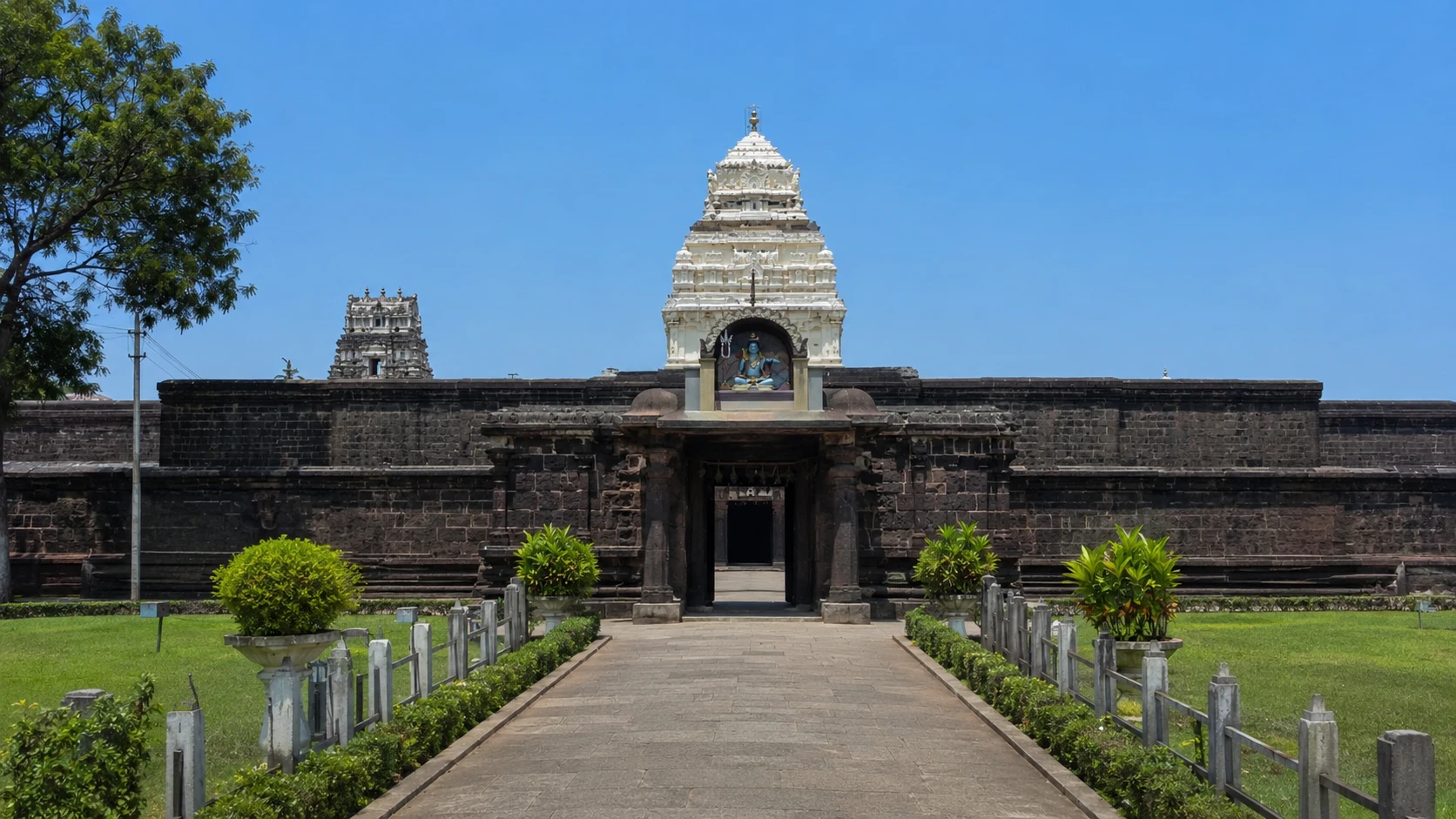
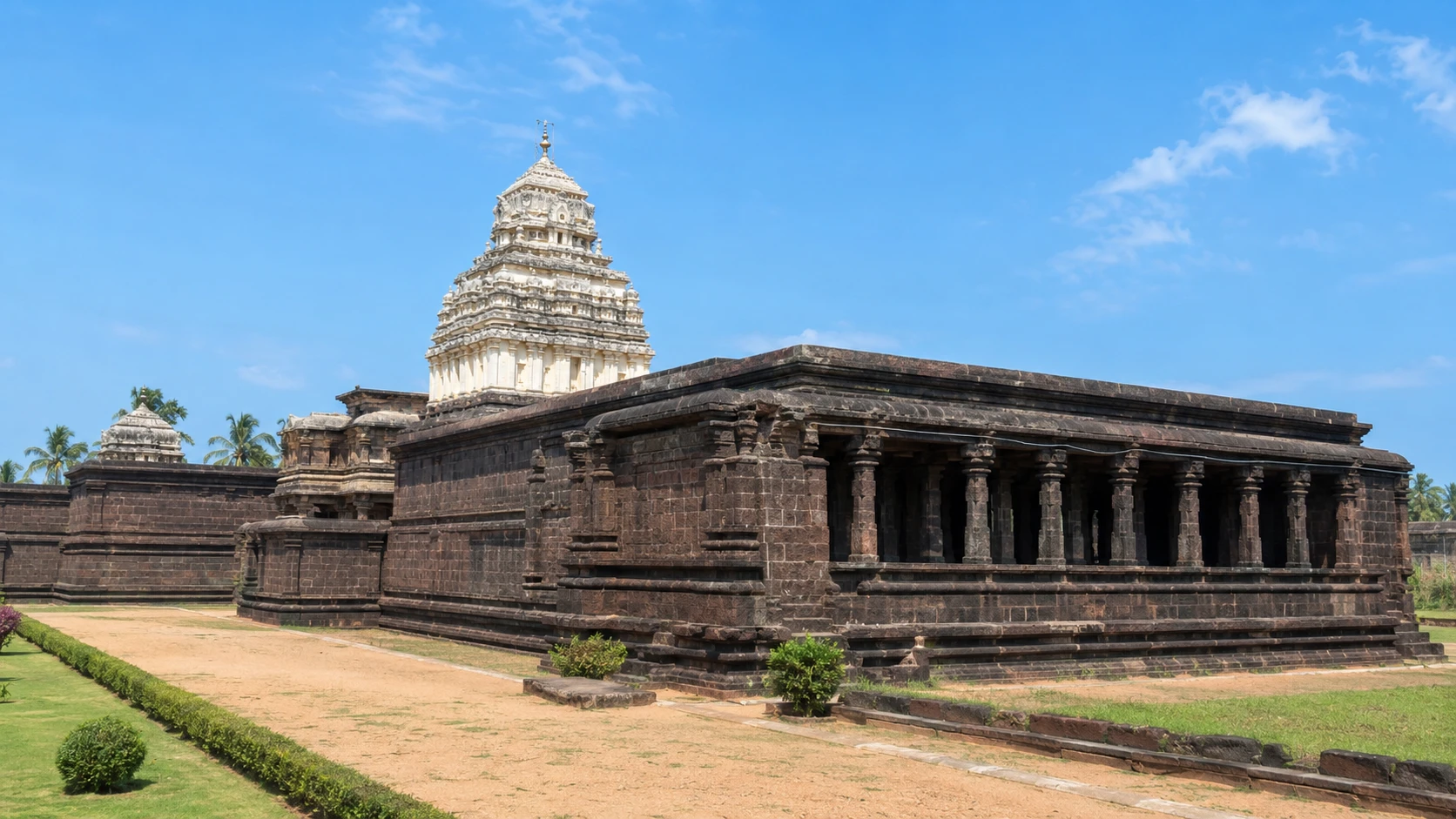
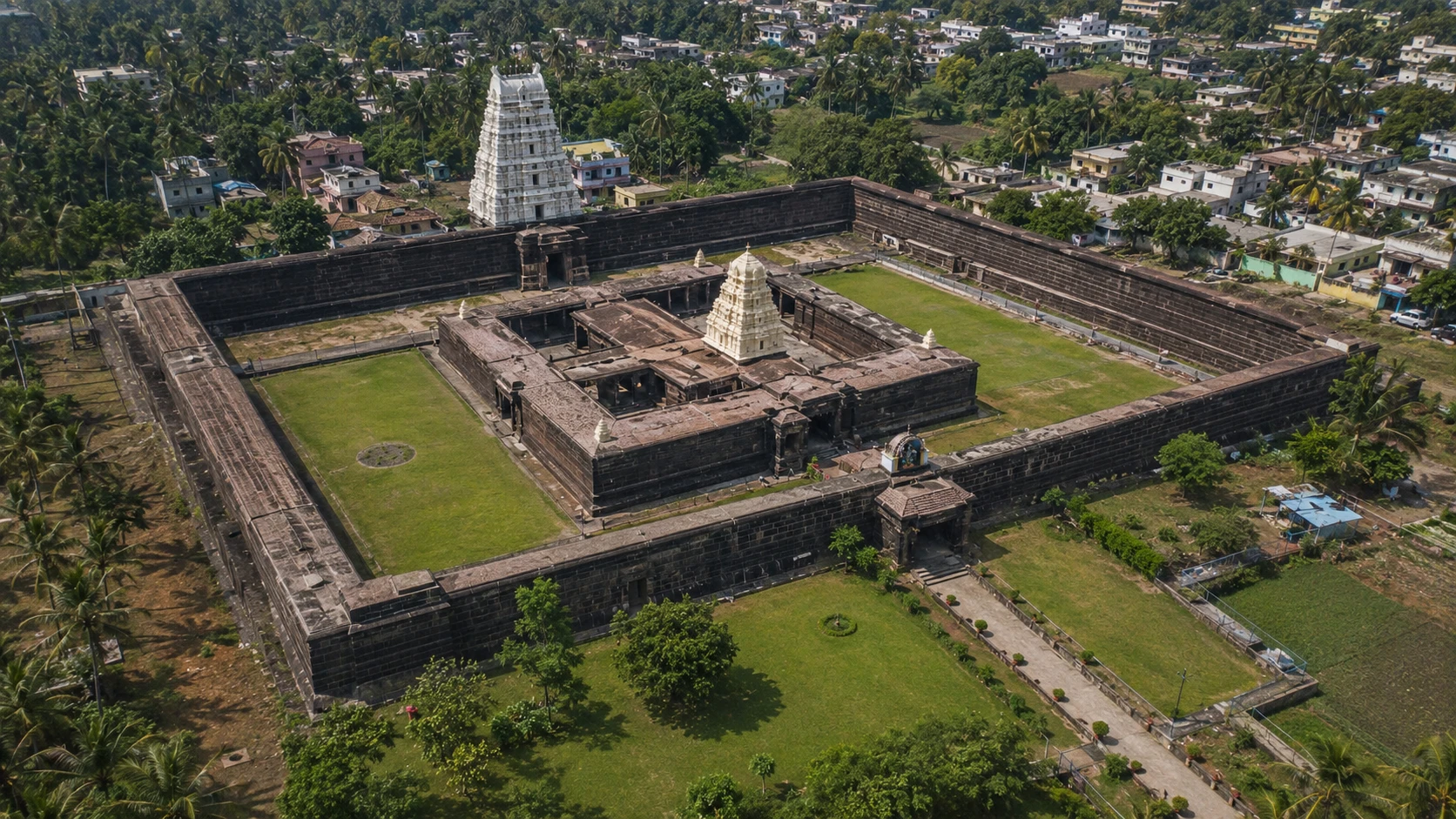
The presiding image at Kumararama is Sri Kumara Bhimeshwara, manifest as a tall pale-stone linga rising through a two-storey garbhagriha. Local tradition holds the linga to be the tallest of the five Pancharama lingas, though precise measurement against modern survey protocols is not publicly documented; temple literature most consistently cites approximately fourteen feet, with folk-devotional traditions describing larger figures. Devotees view the linga's base and middle from the ground floor and ascend an internal staircase to a first-floor circumambulatory passage from which the upper portion is seen and offered worship. The linga rests on a panavattam of dark stone. Above the sanctum rises the Eastern Chalukya gopuram, with later Kakatiya and Vijayanagara sculptural elaboration on the surrounding prakara.
The Sri Bala Tripura Sundari shrine sits within the same temple complex in its own walled enclosure, with a distinct sanctum. The Devi is enshrined in her young (bala) form — youthful, gentle, grace-bestowing rather than fierce — and is canonically four-armed, holding pasha (noose), ankusha (goad), and showing varada (boon-giving) and abhaya (protection) mudras. The Sri Vidya tradition's principal yantra, the Sri Chakra, is enshrined at the Devi's feet, and daily worship follows the Sri Vidya protocol with morning and evening alankarams that vary through the lunar cycle. The Bala form's youthfulness theologically pairs with the temple's installer Kumara, also youthful — two adolescent deities holding the central Pancharama position.
The surrounding precinct includes subsidiary shrines to Subrahmanya (Kumara himself, here worshipped as the installer of his own linga — a theological self-reference unique to this site), Vinayaka, the Navagrahas, Saptamatrika (the seven mother-goddesses), and a Veerabhadra shrine. The temple's pushkarini is the Chakra Pushkarini, a sacred tank held in local tradition to derive from Kumara's own striking of the earth with his Shakti weapon during the installation. Eastern Chalukya sculptural panels on the prakara depict the Tarakasura battle, Kumara's birth from the six Krittikas, and the Pancharama installation sequence in carved narrative form. Devotees on the Pancharama Kshetra Yatra typically combine darshan at the Bhimeshwara, Bala Tripura Sundari, and Subrahmanya shrines into a single integrated circuit.
Distinctive Practicesविशिष्ट परंपराएँ
Skanda Sashti — the installer's own festival at the installer's site
स्कन्द षष्ठी — स्थापक का अपना उत्सव स्थापक के स्थल पर
Annual; six-day observance culminating on Sashti tithi (the sixth day) of Karthika Shukla paksha (October–November)
Skanda Sashti is the principal annual festival celebrating Kumara (Skanda, Kartikeya, Subrahmanya), observed across South India as the commemoration of his victory over Tarakasura. At Kumararama the festival carries unique theological density: the installer of the temple's linga is also the protagonist of the festival being celebrated, and the same hands that broke the asura's linga and installed its fragment here are the same hands honoured by the six days of Sashti vrat. The festival unfolds over six days of progressive observance — fasting, lamp-lighting, recitation of the Subrahmanya Bhujangam and the Skanda Shashti Kavacham, and culminating processions on Sashti day. The full Mahanyasam tradition — the elaborate mantric installation preserved from Kumara's own consecration of the linga — is performed at Kumararama on Sashti day in a form not observed at the other four Pancharama sites.
Skanda Sashti at the installer's own site is the closest a devotee can come to the founding moment of the temple's identity. The temple's local tradition holds that on Sashti day, Kumara's presence is more directly accessible at Kumararama than anywhere else — for the boy-god returns to the site of his own installation to receive the festival's offerings, and the personal circle that was closed at the founding installation is closed again, annually, in the ritual present.
Pradosha vrat with two-storey abhishekam
द्वि-मंज़िला अभिषेक के साथ प्रदोष व्रत
Twice monthly — Trayodashi tithis (the thirteenth day) of both shukla and krishna paksha; particularly significant on Soma Pradosha (Monday Pradosha) and Mahapradosha during Pradosha month
Pradosha — the auspicious twilight hour preceding Shivaratri on each Trayodashi tithi — is observed with particular intensity at Kumararama. The temple's two-storey abhishekam protocol is performed in its complete form during Pradosha: priests coordinate water, milk, panchamrit, and sandal-paste offerings between the ground floor (linga base) and the first-floor passage (linga upper portion), with the offerings timed to peak at the precise Pradosha hour computed by the temple panchang. Devotees gather in the eastern courtyard for the Pradosha aarti, and the temple's particular height — believed in local tradition to make the Kumararama linga closer to the celestial sphere than the other Pancharama lingas — gives Pradosha here an additional symbolic charge.
Pradosha is theologically the moment when Shiva is said to dance the Anandatandava — the dance of cosmic joy — between the worlds. Observing Pradosha at the temple where Kumara installed Shiva's linga reads, in the local tradition, as participating in a particular father-son moment within the dance: Kumara's installation set the linga in place, and every Pradosha at Kumararama re-activates that placing in ritual time.
Pancharama Yatra middle-station darshan
पंचाराम यात्रा मध्य-स्टेशन दर्शन
Year-round; particularly observed by pilgrims completing the formal five-temple yatra
Kumararama occupies the structural midpoint of the Pancharama Kshetra circuit — the third of five — and a long tradition of formal Pancharama Yatra (the pilgrim circuit of all five sites in canonical sequence) treats Kumararama as the central station of the journey. Pilgrims who complete the yatra over three to five days typically arrange their route so that the Kumararama darshan falls at midpoint — geographically as well as theologically. The temple's information desk arranges yatra-context darshan, including special seva at the linga that explicitly invokes the pilgrim's status as a Pancharama yatri. The middle-station identity also affects the seva-economy: many pilgrim families take the Skanda Sashti window or Pradosha vrat windows as occasions to undertake the full circuit, with Kumararama as the natural anchor day.
The middle-station identity is not just logistical but theological. In the Pancharama narrative the third installation is Kumara's — the central installer whose act resolves the asuric crisis — and the geographic centrality of the temple in the five-site circuit mirrors the theological centrality of the third installation in the five-installation sequence. To stand at Kumararama at the midpoint of the yatra is, in the tradition's framing, to stand at the centre of the entire Pancharama mythology.
Did You Know?क्या आप जानते हैं?
Kumararama is the only one of the five Pancharama Kshetra where the installer of the linga fragment is also the very being whose weapon shattered the original linga in battle. Kumara, who broke Tarakasura's atma-linga in war, returned afterwards to lift one of its fragments back into worship — making the third Pancharama installation the unique site where the destroyer and the installer are the same person. No other major Hindu temple network carries a destroyer-installer identity of this kind in its founding mythology.
Pancharama Sthala Purana corpus (Telugu and Sanskrit); Skanda Purana regional Andhra narratives
The temple's local epithet 'Chalukya Bhimeshwara' commemorates Chalukya Bhima I (reign c. 892–921 CE), the Eastern Chalukya king under whose patronage the principal construction phase of the present temple was completed. The 'Bhimeshwara' name overlaps with the Draksharama presiding deity, but at Kumararama it specifically denotes the Kumara-installed Bhimeshwara, and the 'Chalukya' qualifier distinguishes this temple's Bhimeshwara from his counterpart at the second Pancharama site.
Eastern Chalukya inscriptions at Kumararama (South Indian Inscriptions corpus); K. A. Nilakanta Sastri, 'A History of South India' (1955)
Local tradition holds the Kumararama linga to be the tallest of the five Pancharama lingas and, in some accounts, the tallest Shiva linga in India. Reported heights range across sources: temple literature most consistently cites approximately fourteen feet, while folk-devotional sources state heights up to sixty feet. The Sthala Purana reconciles the variation through the 'continuing growth' tradition — that the linga grew most at Kumararama because the hand that broke the original also installed this fragment, drawing Shiva's compensatory grace most fully. Precise survey measurement against modern scientific protocols is not publicly documented; the height tradition is best understood as a living devotional emphasis on the singular theological status of the installer-destroyer site.
Sri Kumara Bhimeshwara Swamy Devasthanam temple literature; regional Telugu Pancharama Sthala Mahatmya texts
The temple complex includes a subsidiary shrine to Subrahmanya — that is, to Kumara himself, the temple's installer, worshipped here separately from the main Bhimeshwara linga that he installed. This is a theological self-reference unique to Kumararama: the installer is also a separately enshrined object of worship within his own installation. No other Pancharama site enshrines its installer-deity in a dedicated shrine.
Sri Kumara Bhimeshwara Swamy Devasthanam temple literature; Pancharama Sthala Purana corpus
The consort goddess Sri Bala Tripura Sundari is the youthful form of one of the principal Mahavidya goddesses, central to the Sri Vidya tantric tradition. Her pairing with Kumara — also a youthful god — gives Kumararama the distinction of being the only Pancharama site where both the principal deity-pair (Bhimeshwara-Bala Tripura Sundari) and the installer-pair (Kumara himself) hold youthful aspects. The temple is, structurally, a temple of adolescent divinity at the centre of the five-site network.
Sri Vidya tradition canonical sources; Sri Kumara Bhimeshwara Swamy Devasthanam temple literature
Kumararama occupies the geographic and structural midpoint of the Pancharama Kshetra Yatra circuit — the third of five — and a long tradition of formal yatra treats it as the central anchor of the journey. Pilgrims completing the five-temple circuit over three to five days typically arrange their route so that the Kumararama darshan falls at the midpoint, with the previous two temples (Amararama, Draksharama) completed before and the subsequent two (Ksheerarama, Bhimarama) after. The geographic mid-station mirrors the theological mid-installation by Kumara.
Pancharama Kshetra Yatra pilgrim tradition; AP Endowments Department temple network documentation
Visitor Accessप्रवेश जानकारी
Sri Kumara Bhimeshwara Swamy Temple at Kumararama is open to devotees of all backgrounds, without restriction by gender, caste, or community. Standard South Indian temple decorum applies — devotees remove footwear before entering the temple complex, maintain silence near the sanctum, and dress in modest, preferably traditional, attire. The Bhimeshwara, Bala Tripura Sundari, and Subrahmanya shrines all follow the same access norms. Photography is permitted in the outer courtyards and around the temple grounds; photography inside the inner sanctums is at the discretion of temple authorities and should be confirmed on the day. Non-Hindus are welcome.
Consult the Sri Kumara Bhimeshwara Swamy Devasthanam information desk on arrival for the day's seva schedule, two-storey abhishekam availability, Skanda Sashti and Pradosha seva sponsorship, and Bala Tripura Sundari alankaram. The Andhra Pradesh Endowments Department's official site lists the temple under its registered devasthanam list. Verify any third-party booking offers against the official devasthanam — no third-party agent is required for ordinary darshan or routine seva.
Festivalsत्योहार
Skanda Sashti — the installer's own festival
स्कन्द षष्ठी — स्थापक का अपना उत्सव
Oct-Nov (Karthika Shukla Sashti, six-day observance culminating on Sashti)
The principal festival of the temple year at Kumararama and the most distinctive in the Pancharama circuit. Skanda Sashti commemorates Kumara's victory over Tarakasura; at Kumararama, this victory is structurally inseparable from the temple's identity, since the very act being celebrated — Kumara's breaking of the asura's atma-linga — produced the fragment installed here. The festival unfolds over six days with progressive observance, culminating in the Sashti-day procession of the Kumara utsava-murti, recitation of the Subrahmanya Bhujangam and the Skanda Shashti Kavacham, and the full Mahanyasam abhishekam at the linga. The festival draws Skanda-tradition devotees from across South India, particularly Tamil Nadu and Andhra-Telugu speaking regions, in addition to the standard Pancharama yatra pilgrim flow.
Maha Shivaratri with two-storey abhishekam
द्वि-मंज़िला अभिषेक के साथ महाशिवरात्रि
Feb-Mar (Phalguna Krishna Chaturdashi)
The principal Shaivite festival of the temple year, observed with night-long jagaran and four praharas of two-storey abhishekam at the Bhimeshwara linga. The four-prahara protocol is particularly demanding at Kumararama because the linga's height requires full coordination between ground-floor and first-floor priests across each prahara cycle. Devotees participate in continuous chanting of the Lingashtakam, Bilvashtakam, and Om Namah Shivaya through the night, with the Mahapradosha hour marked by a particularly elaborate abhishekam sequence. The Sashti-pairing of Skanda and Shivaratri across the temple year frames Kumararama as the principal Shaivite-Skanda site of the Pancharama network.
Devi Navaratri (Bala Tripura Sundari Sri Vidya alankaram)
देवी नवरात्रि (बाला त्रिपुर सुन्दरी श्री विद्या अलंकारम)
Sep-Oct (Ashwin Shukla Pratipada to Vijayadashami)
The nine nights of Sharadiya Navaratri are observed at the Sri Bala Tripura Sundari shrine with the Sri Vidya alankaram cycle — daily transformations of the Devi's adornment and seva that mark each of the nine canonical Shakti forms. The Bala form's youthful character gives Navaratri at Kumararama a particular tonal register: the sevas emphasise grace, learning, and protection rather than fierce battle, and the festival reads as a counterpoint to the warrior-energy of Skanda Sashti six lunar months later. Vijayadashami concludes with the Aayudha Puja and a procession that links the Bala Tripura Sundari shrine with the main Bhimeshwara garbhagriha.
Karthika Masam and Karthika Pournami
कार्तिक मास और कार्तिक पूर्णिमा
Nov-Dec (Karthika)
The lunar month of Karthika is observed at Kumararama with the broader Karthika vratam — pre-dawn river-bath in the Godavari channel near Samarlakota, daylight fasting, evening lamp-lighting, recitation of the Karthika Mahatmya — and weekly Kalyanotsavam on each Monday of the month. Karthika Pournami, the full-moon night of the month, sees the temple lit by thousands of oil lamps. The month also contains the Skanda Sashti six-day observance in its first week, making Karthika at Kumararama the most concentrated devotional month of the year, combining Shiva-month observance with the temple's installer-deity festival.
Traditional Offeringsपारंपरिक अर्पण
Primary Offerings
Bilva Patra
बिल्व पत्र
बिल्व पत्र
The three leaflets of the bilva represent the three eyes of Shiva, the trident he wields, and the trinity of creation, preservation, and dissolution. At Kumararama the bilva is offered onto the Bhimeshwara linga's base by ground-floor devotees and carried up to the first-floor passage for upper-portion offering during full-height abhishekam. The tall linga at this site requires more bilva for full coverage than at any other Pancharama temple.
Panchamrit (milk, curd, ghee, honey, sugar)
पञ्चामृत
पञ्चामृत
The five sacred substances of abhishekam are offered at the Bhimeshwara linga in the two-storey protocol, with priests at both levels coordinating the flow so the substances cover the linga along its full vertical reach. The full-height panchamrit abhishekam is one of the principal special-seva offerings at Kumararama and can be sponsored at the temple counter.
Chakra Pushkarini water and Godavari channel water
चक्र पुष्करिणी जल और गोदावरी चैनल जल
चक्र पुष्करिणी जल, गोदावरी जल
Water from the temple's Chakra Pushkarini — held in local tradition to derive from Kumara's striking of the earth with his Shakti weapon during the installation — and water from the nearby Godavari channel are both used in daily abhishekam. The Chakra Pushkarini water carries the founding-moment association: its use returns the abhishekam to the act of installation itself.
Vibhuti (sacred ash) and Kumkum for Bala Tripura Sundari
विभूति और बाला त्रिपुर सुन्दरी के लिए कुङ्कुम
विभूति, कुङ्कुम
Vibhuti is applied to the Bhimeshwara linga and to the devotee's forehead. At the Bala Tripura Sundari shrine, kumkum is offered alongside flowers, and the standard Sri Vidya alankaram includes saffron and turmeric paste. Devotees on the dual-shrine darshan circuit receive vibhuti at the linga and kumkum at the Devi shrine before exiting.
Vel offering at the Subrahmanya shrine
सुब्रह्मण्य मंदिर पर वेल अर्पण
वेल, शक्ति
The vel — the Shakti weapon Kumara wielded — is symbolically offered at the Subrahmanya shrine within the temple complex, in remembrance of the weapon that broke the original linga and also founded the temple. Devotees place a small ritual vel or a flower-garland in the vel-form on the shrine before the Subrahmanya icon, particularly during Skanda Sashti. This offering is unique to Kumara temples and carries particular weight at Kumararama because the vel-weapon is structurally tied to the temple's founding.
Unique to This Temple
Two-storey full-height abhishekam sponsorship
द्वि-मंज़िला पूर्ण-ऊँचाई अभिषेक प्रायोजन
Distinctive to Kumararama (and to its Pancharama siblings Amararama and Draksharama): devotees may sponsor a full-height abhishekam in which the consecratory substances are carried up to the first-floor passage and offered onto the upper portion of the linga simultaneously with ground-floor offering. At Kumararama the full-height abhishekam carries additional significance because the linga is held to be the tallest of the Pancharama lingas — the full-height abhishekam here reaches further than at any of the sibling sites. Sponsorship is arranged at the temple counter; the seva is performed in the early-morning or noon abhishekam slot, with extended versions for Maha Shivaratri and Skanda Sashti.
Mahanyasam abhishekam sponsorship
महान्यासम अभिषेक प्रायोजन
Distinctive to Kumararama: the full Mahanyasam — the elaborate mantric installation tradition held by Sthala Purana to preserve Kumara's own consecration of the linga — is performed at the temple for Maha Shivaratri, Skanda Sashti, and on devotee sponsorship. The Mahanyasam takes approximately three hours and includes the recitation of the complete Rudra Suktas, Chamakam, the installer's-own mantras attributed to Kumara, and the full sequence of abhishekam substances poured at both levels of the sanctum. This is the most elaborate seva at Kumararama and is undertaken by relatively few devotees in any given year; advance arrangement through the temple counter is required.
Pilgrims may bring offerings from outside the temple grounds; the temple counter also offers pre-arranged offering bundles, prasad packets, and seva sponsorship for all three principal shrines (Bhimeshwara, Bala Tripura Sundari, Subrahmanya). The Sri Kumara Bhimeshwara Swamy Devasthanam operates under the Andhra Pradesh Charitable and Hindu Religious Institutions and Endowments Department, and seva fees go through the official devasthanam counter — third-party intermediaries are not required for any standard offering or darshan. Devotees with questions about Skanda Sashti seva sponsorship, the Mahanyasam abhishekam, or two-storey full-height abhishekam should call the temple in advance.
How to Reachकैसे पहुँचें
Samarlakota sits in the Godavari delta of coastal Andhra Pradesh, with the temple in the historic core of the town. Samarlakota Junction is one of the most convenient railheads of any Pancharama site — the station is within the town itself, approximately one kilometre from the temple, with regular express train services on the Howrah–Chennai main line and excellent connectivity to Hyderabad, Bengaluru, Chennai, Visakhapatnam, and most major northern cities. Kakinada Town (approximately 12 km away) is the closest larger railhead and bus terminus. From either station, autorickshaws and short taxi rides reach the temple directly. By air, Rajahmundry Airport at Madhurapudi (approximately 50 km from the temple) provides daily connections to Hyderabad, Bengaluru, and Chennai through major domestic carriers; Visakhapatnam International Airport (approximately 155 km) provides broader long-distance connectivity for pilgrims travelling from northern and western India. The drive from Rajahmundry Airport is approximately 75 minutes; from Visakhapatnam, approximately 3 hours. Pilgrims combining Kumararama with the wider Pancharama Kshetra circuit typically use Rajahmundry, Kakinada, or Visakhapatnam as their hub city and arrive at Kumararama as the third stop, after Amararama and Draksharama.
Plan Your Visitयात्रा की योजना
🌤 Best Season
October through March, when the Godavari delta is at its most temperate. Days are warm and dry, evenings comfortably cool, and the Skanda Sashti (Oct-Nov), Karthika (Nov-Dec), Devi Navaratri (Sep-Oct), and Maha Shivaratri (Feb-Mar) festival windows fall within this period. April through June is hot and humid, with temperatures regularly above 38°C. July through September brings the southwest monsoon — pilgrim activity continues but heavy rain can disrupt road access and ghat operations.
👘 Dress Code
Traditional Indian attire is preferred and is the norm among most devotees: dhoti and angavastram or kurta-pyjama for men, saree or salwar-kameez for women. Shorts, sleeveless tops, and short skirts may attract polite request to cover up, particularly for sanctum-level darshan. Footwear is removed at the entrance to the inner temple complex; covered shoe-rack facilities are available. All three principal shrines (Bhimeshwara, Bala Tripura Sundari, Subrahmanya) follow the same dress conventions.
📱 Phones & Photography
Mobile phones are generally permitted in the outer courtyards and around the temple grounds. Inside the inner sanctums and during abhishekam, alankaram, or Mahanyasam-period rituals, devotees are asked to switch phones to silent and refrain from photography. The temple's specific photography policy for the inner sanctums should be confirmed on the day with the information desk. Photography during Skanda Sashti processions and Mahapradosha abhishekam is particularly discouraged.
🏨 Accommodation
Samarlakota itself has limited dedicated dharamshala accommodation. Most pilgrims stay in Kakinada (12 km), Rajamahendravaram (60 km), or Visakhapatnam (155 km), where mid-range hotels, business hotels, and well-rated guesthouses are widely available. The Andhra Pradesh Tourism Development Corporation (APTDC) operates Haritha hotels in these cities. Some basic dharamshala accommodation is available within Samarlakota through the AP Endowments Department; quality is functional rather than premium. For Skanda Sashti, Maha Shivaratri, Navaratri, Karthika Pournami, and the twelve-yearly Godavari Pushkaralu, advance booking through APTDC or major hotel chains is strongly recommended.
Sacred Soundsपवित्र ध्वनि
Did You Know? · क्या आप जानते हैं?
The same translation error that turned '33 Koti' into '33 crore' in Hinduism also happened in Buddhism. The Chinese translation of Buddhist texts rendered 'Sapta Koti Buddha' (7 Supreme Buddhas) as '7 Crore Buddhas.' The Tibetan translation got it right: 7 types, not 7 crore. One Sanskrit word, misread across two major world religions, generated two identical misconceptions independently.
Related Contentसंबंधित सामग्री
Related Scriptures
Community Reflections
🕉️
Be the first to share your reflection.