Martand Sun Temple
मार्तंड सूर्य मंदिर
The greatest Sun Temple of ancient India — magnificent ruins on the roof of Kashmir
Anantnag, Jammu and Kashmir, India
Mārtaṇḍa Sūrya MandiraAlso known as: Martand Sun Temple, Mattan Temple, Martanda Bhairava Mandir, Martand temple ruins

Era
8th century (c. 724–760 CE); Karkota dynasty
Architecture
Kashmiri Nagara — hybrid of Gandharan, Gupta-period Indian, and Central Asian elements; characteristic trefoil arch; peristyle courtyard with colonnade
Open
06:00 – 18:00
The Sacred Legend · पवित्र कथा
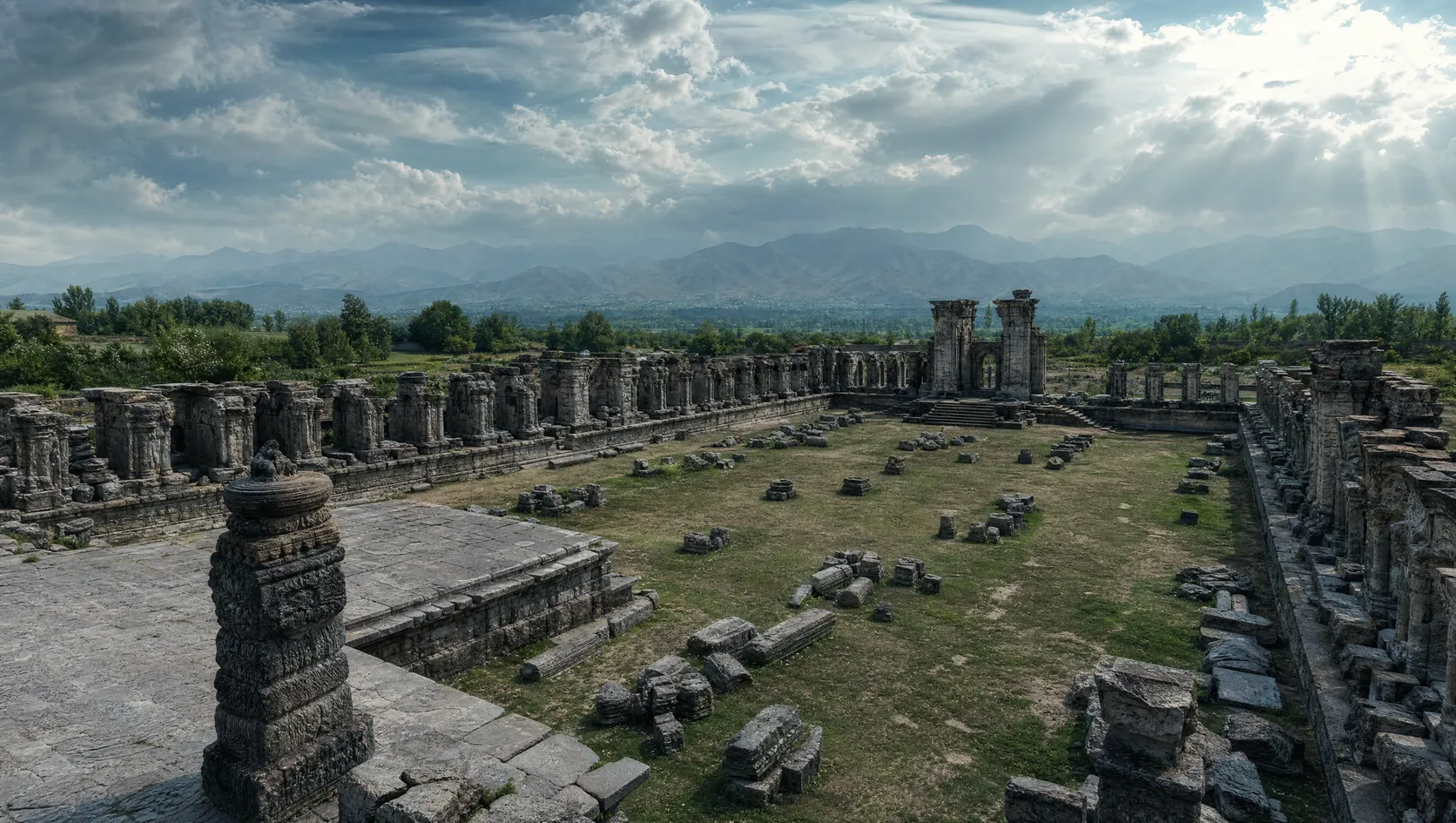
In the middle of the eighth century, one of the most powerful kings of the ancient world built a temple to the sun on a high plateau in the Kashmir Valley. Lalitaditya Muktapida — whose campaigns had reached Bengal to the east and the frontiers of Central Asia to the northwest — chose the flat Karewa tableland above the village of Mattan, nine kilometres from what is now Anantnag, for his greatest monument: a Sun Temple whose colonnade of eighty-four shrines enclosed a rectangular precinct so large the whole complex measured nearly two hundred metres across. Kalhana's twelfth-century Rajatarangini, the most remarkable chronicle written by any ancient Indian historian, records Lalitaditya's works with barely concealed awe. For six centuries, Martand presided over the valley from its plateau. Sikandar Shah Miri, Sultan of Kashmir between approximately 1389 and 1413 and remembered in the Kashmiri chronicles by the epithet But-shikan — the idol-breaker — ordered the temple systematically demolished. The stone was so precisely cut, so perfectly fitted without mortar, that the destruction was slow and laborious. Contemporary accounts record that the work took months. The stone was ultimately repurposed for other constructions in the valley. What remained was the complex's skeleton: stretches of the colonnade still half-standing, the plinth of the main shrine, the walls of the outer enclosure, and everywhere the distinctive trefoil arches that define the Kashmiri architectural tradition. Martand is ruins now — complete, comprehensive ruins. It will not be restored; the stones are scattered and gone. What remains is what was too heavy or too far embedded to remove: one of the great archaeological sites of the ancient world, on a plateau from which the entire Kashmir Valley spreads in every direction.
Sacred Designationपवित्र पदनाम
Sacred Origin Storyपवित्र उत्पत्ति कथा
Source: Vedic Aditya tradition (Rig Veda, Shatapatha Brahmana); Nilmat Purana (Kashmir's principal Purana, c. 6th–8th century CE)
The name Martanda reaches back to the Rig Veda's account of the solar creation. Aditi — the great mother of the gods, boundless and primordial — bore eight sons. Seven she placed among the Adityas, the immortal solar deities who govern the cosmic order. The eighth she cast away: Martanda, the 'dead egg' (from Sanskrit marta, mortal, and anda, egg or embryo). This eighth son was born misshapen, without the full vitality of his brothers, and his mother set him aside.
The gods, however, did not leave him discarded. They took Martanda and shaped him — cutting away the excess, refining the form — until what remained was the sun as mortals know it: the one that rises and falls, that brightens and darkens, that brings warmth and then withdraws it, that moves through the sky on a visible arc across each day. Unlike his Aditya brothers who dwell in permanent celestial light, Martanda descends into darkness each evening and is reborn each dawn. He is the sun of mortal experience — the solar principle made earthly, made temporal, made subject to the cycle that all living things share with it.
The Nilmat Purana, the foundational text of Kashmir's sacred geography composed between the sixth and eighth centuries CE, establishes that the Kashmir Valley has been a place of Surya's special presence since the lake that once filled the valley (Satisara, in the Purana's cosmogony) was drained and made habitable. The Kashmiri Brahmin tradition of Surya worship is documented as ancient; the Karkota king Lalitaditya, himself likely a devotee of Surya, chose the Martanda name and the elevated plateau setting specifically to honour the solar deity in a landscape where the sun's power — intense high-altitude light, extreme seasonal variation from the longest summer days to the briefest winter sun — is experienced with unusual directness.
Martanda, the cast-off son redeemed and shaped by the gods, was the appropriate deity for a king who had taken the unlikely project of a Kashmir-based empire and shaped it, through campaign and monument, into something that commanded the known world's attention.
Sources cited:
- Rig Veda 10.72.8–9 (Aditi and the eight Adityas; Martanda narrative)
- Shatapatha Brahmana 3.1.3.3 (Martanda's formation by the gods)
- Nilmat Purana (Kashmir Purana, c. 6th–8th century CE) — sacred geography of the Kashmir Valley
- Kalhana, Rajatarangini (Chronicle of the Kings of Kashmir, 12th century CE), Tarangas III–IV on Lalitaditya
Scholarly Context
The Martand temple's attribution to Lalitaditya Muktapida rests on Kalhana's Rajatarangini (completed 1149–1150 CE), which is the most systematically historical chronicle produced in pre-modern India. Kalhana was writing approximately four centuries after Lalitaditya's reign and drew on earlier sources now lost; his account of Lalitaditya is detailed but should be read as partly legendary. No foundation inscription from Martand survives; the dating is therefore a combination of Kalhana's testimony and architectural analysis. Scholars including Percy Brown, R.C. Kak, and more recently scholars of Kashmiri art history, have consistently placed the temple in the early-to-middle Karkota period (8th century CE) on stylistic grounds. The destruction of the temple by Sikandar Shah Miri (But-shikan) is attested in the Baharistan-i-Shahi and other sources; the precise dates of his reign (which various chronicles give as 1389–1413 or 1393–1416) have a minor margin of scholarly debate, but the fact and scale of the destruction are not in dispute.
Historyइतिहास
The Martand Sun Temple was built by Lalitaditya Muktapida, the greatest king of the Karkota dynasty of Kashmir, probably between approximately 725 and 760 CE. Lalitaditya was among the most militarily ambitious rulers of the ancient world: his campaigns extended into Tibet, against the Arab expansion in Sindh and Punjab, into the Gangetic plain, and as far as the frontiers of Central Asia. Kalhana's Rajatarangini — composed four centuries later and drawing on sources now lost — credits him with an empire of extraordinary reach and describes his building programme in terms of magnificence. Martand was his capstone monument.
The choice of site was deliberate. The Karewa plateau above Mattan sits at approximately 1600 metres, significantly above the valley floor, and commands panoramic views of the Kashmir Valley in all directions. The light at this altitude, especially at the equinoxes and solstices, is of exceptional intensity. The complex was laid out on a monumental scale: an outer enclosure wall enclosing a rectangular precinct of approximately 220 by 142 metres; within it, a colonnade of eighty-four smaller shrines arranged around the perimeter; at the centre, the main Surya temple with its mandapa (porch) and sanctum, constructed in the distinctive Kashmiri style that blends Gandharan, Gupta-period Indian, and Central Asian architectural vocabularies into a unique regional synthesis. The defining visual element is the trefoil arch — a triple-lobed form used for windows, niches, and doorways throughout the complex — which became the signature of Kashmiri sacred architecture.
The temple stood for six centuries. In the final decade of the fourteenth century, Sikandar Shah Miri became Sultan of Kashmir and initiated what the Kashmiri chronicles document as a systematic campaign against the valley's Hindu and Buddhist sacred sites. At Martand, the demolition was ordered and executed — the chronicles note with some grudging acknowledgment that the stone was so expertly cut and fitted that it resisted demolition, and the work of destruction took months. The stone was redistributed for use in mosque construction and other projects in the valley.
What remained was documented by European surveyors in the colonial period, most comprehensively by R.C. Kak in 'Ancient Monuments of Kashmir' (1933). The Archaeological Survey of India assumed conservation responsibility and the site is now a protected monument, though the ruins are presented as ruins — there has been no reconstruction, and the site management focuses on stabilisation and documentation rather than restoration.
Historical Timelineऐतिहासिक कालक्रम
Martand Sun Temple constructed by Lalitaditya Muktapida of the Karkota dynasty, during the period of his greatest imperial power. The complex — a main Surya shrine enclosed by a peristyle colonnade of 84 subsidiary shrines within a monumental rectangular enclosure approximately 220 by 142 metres — represents the peak of Kashmiri sacred architecture.
No foundation inscription from the Martand temple survives. The attribution to Lalitaditya rests entirely on Kalhana's testimony in the Rajatarangini — written approximately four centuries after the events described — and on stylistic architectural analysis. The date range c. 724–760 CE corresponds to Lalitaditya's generally accepted reign period, though the precise years of his rule are themselves reconstructed from the Rajatarangini's regnal calculations, which scholars have subjected to varying adjustments.
Martand Sun Temple systematically destroyed on the orders of Sikandar Shah Miri (Sikandar But-shikan), Sultan of Kashmir. The temple's demolition — recorded in the Baharistan-i-Shahi and continuation accounts of the Kashmiri chronicles — was part of a broader campaign against the valley's Hindu and Buddhist sacred sites. The precision-cut stone of the complex, fitted without mortar, resisted demolition; the destruction reportedly took months. The stone was subsequently repurposed for mosque and other construction in the valley.
The dates of Sikandar Shah Miri's reign are variously given in different sources as 1389–1413 CE or 1393–1416 CE. The destruction of Kashmir's temples under his rule is attested across multiple independent sources and is not in scholarly dispute; the precise sequence of which sites were targeted in which years is less clearly documented. The epithet But-shikan (idol-breaker) is applied to him consistently in later Kashmiri historical literature.
R.C. Kak publishes 'Ancient Monuments of Kashmir', providing the most comprehensive pre-independence documentation of the Martand complex, including measured architectural drawings, photographic surveys, and an analysis of the temple's relationship to other Kashmiri sacred monuments. This work remains a foundational reference for the site.
Martand Sun Temple ruins designated an ASI-protected monument. Conservation work focuses on stabilisation of the surviving structural elements — sections of the colonnade, the enclosure walls, the main shrine plinth — without reconstruction. The ruins are presented in their current state as an archaeological heritage site.
What You'll Seeदर्शन में
Martand Sun Temple is complete ruins. No image of Surya survives in situ; the sanctum is an empty shell without its shikhara; the majority of the subsidiary shrines in the colonnade have collapsed. What remains is structural rather than iconographic — but the structural remains are themselves extraordinary.
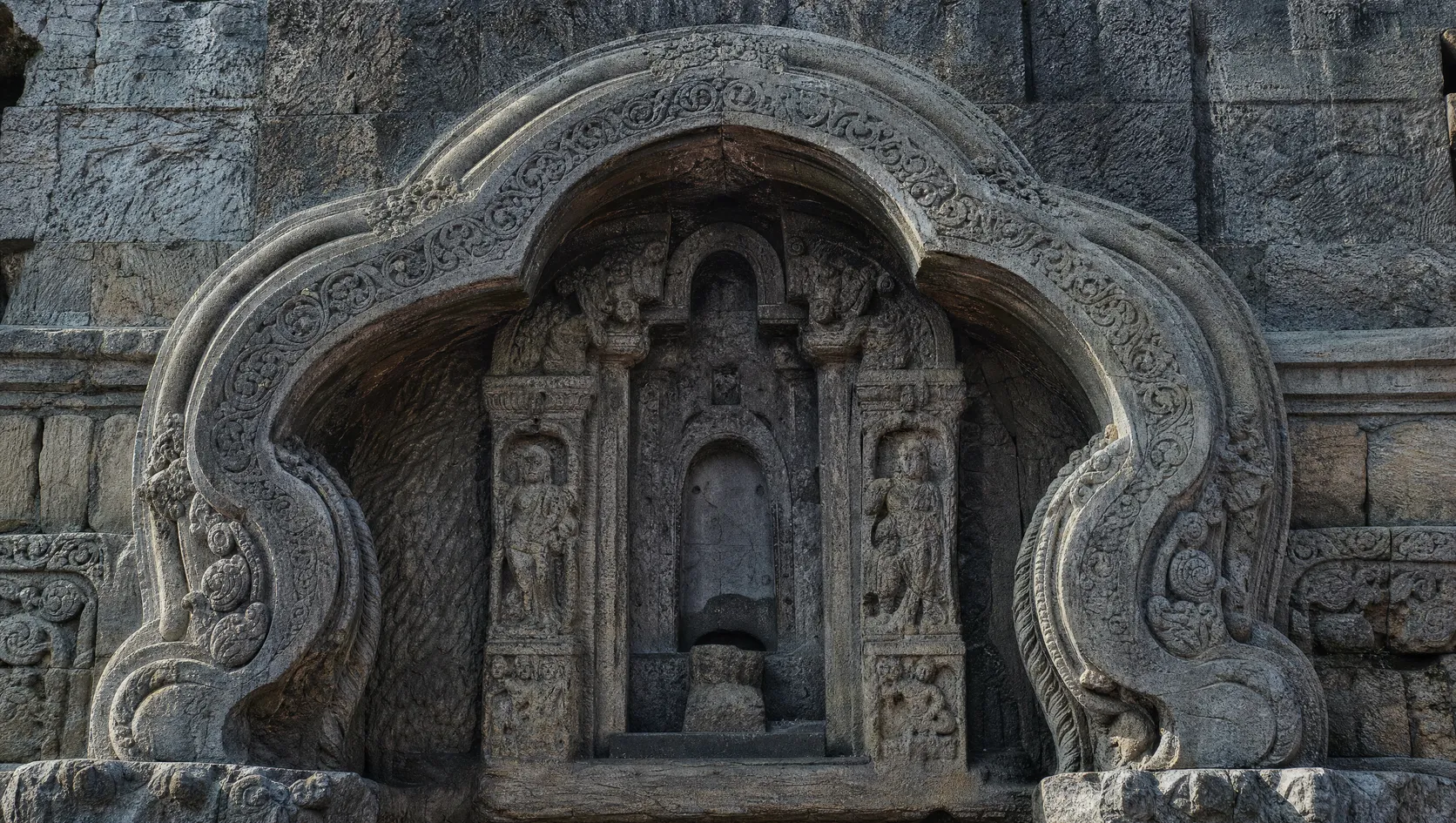
The most distinctive architectural element surviving at Martand is the trefoil arch: a triple-lobed arch form used for doorways, window niches, and decorative recesses throughout the complex. This form is unlike anything in the temple architecture of the Indian plains and represents a genuine synthesis of architectural vocabularies — the Indo-Aryan Nagara tradition, the Buddhist Gandharan tradition of northwest India (itself incorporating Hellenistic elements), and the indigenous Kashmiri vernacular. The trefoil arch at Martand became the template for Kashmir's subsequent temple-building tradition, making Lalitaditya's monument the origin point of an entire regional architectural language.
The main shrine's entrance porch (mandapa) retains portions of its original carved decoration, including remnants of figure sculpture — yaksha guardians, decorative bands of foliage and geometric work. The scale of the surviving masonry is itself informative: the precisely cut stone blocks, fitted without mortar in the dry-stone technique that made the complex both superbly durable under normal conditions and exceptionally resistant to the forces that eventually destroyed it, give a clear sense of the quality of workmanship invested.
The enclosure walls — partially preserved, particularly on the north and east sides — trace the rectangular perimeter of the complex and give the visitor a sense of the original scale. From inside the enclosure, with the ruins of the colonnade around the perimeter and the main shrine at the centre, the spatial logic of the complex is still legible: a sun temple designed to be a world in itself, with the solar deity at the centre of an ordered universe of subsidiary shrines.
The view from the Karewa plateau must be understood as part of the architectural experience: Lalitaditya chose this site not despite but because of its exposure to the open sky. The sun at this altitude — intense, direct, dramatically angled at the solstices — was the living temple around which the stone one was built.
Distinctive Practicesविशिष्ट परंपराएँ
Kashmiri Pandit pilgrimage and memory
कश्मीरी पंडित तीर्थयात्रा और स्मृति
Particularly at Shishur Sankrant (winter solstice), Navreh (Kashmiri New Year), and individually year-round
For Kashmiri Pandits — the Hindu community indigenous to the Kashmir Valley, a significant proportion of whom were displaced from the valley beginning in 1990 — Martand carries a weight of cultural memory that goes beyond the archaeological. The site is associated with the deepest strata of Kashmir's Brahmin identity, with Surya worship as a practice integral to the Kashmiri Pandit liturgical tradition, and with the solar festivals (particularly Shishur Sankrant, the Kashmiri observance of winter solstice) that marked the ritual year. Displaced Kashmiri Pandits who return to the valley or visit the site often come to Martand as an act of reconnection as much as religious pilgrimage.
The solar liturgical tradition of Kashmiri Pandits — including the dawn arghya and the observation of solar transitions — is one of the oldest continuously documented forms of Surya worship in India. Martand was that tradition's greatest monument, and its ruins carry the tradition's historical depth even as the monument itself is silent.
Archaeological and scholarly visitation
पुरातात्विक और विद्वान भ्रमण
Year-round (weather permitting)
Martand is a significant site for historians of Indian architecture, art, and the Karkota period. Scholars from India and internationally visit specifically to study the trefoil arch, the peristyle colonnade design, and the hybrid architectural vocabulary. The site's combination of documented historical circumstances (the Rajatarangini's testimony), physical evidence, and the complete absence of later religious reuse makes it particularly valuable for archaeological analysis.
Did You Know?क्या आप जानते हैं?
Lalitaditya Muktapida, builder of Martand, is the only ancient Indian king whose territorial ambitions appear in contemporary Chinese court records. The Tang Dynasty annals of the 8th century mention a Kashmiri king who sent embassies and whose influence reached across Central Asia. This makes him one of the most internationally documented figures of the early medieval period — and Martand one of the few temples whose builder has a global historical footprint.
Tang Dynasty annals (Xin Tang Shu); Kalhana, Rajatarangini, Tarangas III–IV; modern scholarship on Lalitaditya's empire
The trefoil arch at Martand — a triple-lobed arch form found nowhere in the Indian plains — became the defining signature of Kashmiri temple architecture for centuries after Lalitaditya's time. Scholars have traced elements of this form to Gandharan Buddhist architecture, which itself absorbed Hellenistic influences from the post-Alexander period. The arch at Martand is thus a living trace of the fusion of civilizations along the ancient Silk Road.
Percy Brown, 'Indian Architecture: Buddhist and Hindu Period' (1942); R.C. Kak, 'Ancient Monuments of Kashmir' (1933); M.A. Dhaky and colleagues, studies on regional temple traditions
Kalhana's Rajatarangini — the primary historical source for Martand and for Lalitaditya — is considered the only true historical chronicle (in the modern sense) produced in pre-modern India. Unlike the Puranas, which operate in mythological time, the Rajatarangini attempts to date events to specific years. Kalhana's methodology, his use of inscriptions and earlier texts, and his willingness to include unflattering accounts of kings make the text a unique achievement in the Sanskrit literary tradition.
Kalhana, Rajatarangini (ed. and trans. M.A. Stein, 1900); scholarly assessments of the Rajatarangini's historicity
The Martand ruins are on the Karewa plateau at approximately 1,600 metres above sea level, offering unobstructed views of the Kashmir Valley in all directions. The high-altitude light at this location — intense, blue-white, and dramatically angled at the solstices — was almost certainly a deliberate consideration in the site's selection. Lalitaditya was building a temple to the sun in a location where the sun's power is felt with unusual immediacy.
Site geography; R.C. Kak, 'Ancient Monuments of Kashmir' (1933); ASI site documentation
Visitor Accessप्रवेश जानकारी
Martand Sun Temple ruins are an ASI-protected archaeological site in Anantnag district, Jammu and Kashmir. The ruins are open to all visitors without restriction by faith, gender, or caste. Entry fees may apply (verify with ASI or at the site). There is no active puja, no inner sanctum access (the sanctum is a roofless empty structure), and no temple services. Good walking footwear is essential — the terrain is uneven. A travel advisory applies for J&K; see advisory section below.
Contemporary Context
The site is administered by ASI under the AMASR Act. Given its location in Jammu and Kashmir, visitors are strongly advised to check current travel and security advisories from the Ministry of Home Affairs and the J&K Tourism Department before planning their visit.
Practical Guidance
The ruins site requires 1–1.5 hours for a thorough walk. There is no formal guide service on-site; hiring a local guide from Anantnag or Mattan village is recommended. Carry water, as there are no facilities at the site itself. The approach from the Mattan road involves a climb onto the Karewa plateau. Morning visits are strongly preferred for the light quality on the pale sandstone ruins.
Festivalsत्योहार
Shishur Sankrant (Kashmiri winter solstice observance)
शिशुर संक्रांत (कश्मीरी शीतकालीन अयनांत परंपरा)
December–January (winter solstice, locally observed around Makar Sankranti)
Shishur Sankrant is the Kashmiri Pandit observance of the winter solstice — the sun's return from its southernmost point, marking the beginning of Uttarayan. Traditional Kashmiri Pandit practice on this day includes dawn arghya to Surya and prayer at solar sacred sites. Martand, as the greatest historical Surya shrine in Kashmir, carries deep symbolic significance for this festival even though no formal puja is conducted at the ruins.
Navreh (Kashmiri New Year)
नवरेह (कश्मीरी नव वर्ष)
March–April (Chaitra Shukla Pratipada)
Navreh — the Kashmiri Pandit new year, falling on the first day of the bright half of Chaitra — includes solar observances and is one of the most significant festivals in the Kashmiri liturgical calendar. The day is marked by dawn rituals including salutation to the sun. For Kashmiri Pandits who visit Martand, Navreh carries the dual significance of new year celebration and pilgrimage to their most sacred solar site.
Traditional Offeringsपारंपरिक अर्पण
Primary Offerings
Arghya (dawn water offering)
अर्घ्य
अर्घ्य
The dawn arghya — water offered from a copper vessel to the rising sun — is the foundational Surya practice of the Kashmiri Pandit liturgical tradition. Kashmiri Pandits have historically performed arghya at solar tirthas at dawn; Martand's Karewa plateau, where the high-altitude sunrise is particularly intense, would have been the setting for this practice. Though no puja infrastructure exists at the ruins, a devotee may perform arghya facing the rising sun from the plateau as an act of personal devotion.
Arka flowers (Calotropis gigantea)
अर्क पुष्प
अर्क
The arka plant, whose Sanskrit name shares the root for sun, is the traditional floral offering at any Surya tirtha. In the Kashmiri tradition, wildflowers of the high meadows have also been used as solar offerings, as the valley's ecology differs from the plains. Arka flowers, if available, are the canonical offering; local meadow flowers at Martand carry the same devotional intention.
Red lotus (Rakta Kamala)
रक्त कमल
रक्त कमल
The red lotus is the primary iconic offering for Surya across all regional traditions, and the Kashmiri tradition is no exception. The lotus is Surya's held attribute in his sculptural representations — Martand's own Surya images, where they survive in fragments or in documentation, show the god holding lotuses. Offering a lotus to Surya completes the symbolic exchange between the deity's iconographic form and the devotee's act of remembrance.
Martand is a ruins site with no active puja, no temple trust, and no offering infrastructure. The traditional Surya offerings described here are from the scriptural and Kashmiri liturgical tradition and are provided for devotional context. There is no facility for commissioning puja or leaving ritual offerings at the site. Devotees who wish to mark the site devotionally may do so through personal arghya at the plateau at dawn and recitation of the Gayatri Mantra or Aditya Hridayam.
How to Reachकैसे पहुँचें
Martand Sun Temple ruins are located near Mattan village in Anantnag district, approximately 9 km northeast of Anantnag city and approximately 65–70 km south of Srinagar.
From Srinagar: The most common route. Take NH 44 (the Srinagar–Jammu National Highway) south toward Anantnag, approximately 55–60 km. From Anantnag city, the temple site at Mattan is approximately 9 km by road (northeast). Taxis and shared sumos (local vehicles) are available from Anantnag. Srinagar-based taxi services can be arranged for the full day — allow at least 3 hours of travel time each way plus time at the site.
From Anantnag: Auto-rickshaws and local taxis connect the city to the Mattan/Martand site (9 km). The road ascends to the Karewa plateau; a short walk is required from the road to the ruins.
By air: Sheikh ul-Alam International Airport, Srinagar (SXR) is the gateway, with regular flights from Delhi, Mumbai, and other major Indian cities. From the airport, taxi to Martand takes approximately 1.5–2 hours.
Rail: Rail connectivity to the Kashmir Valley is expanding under the Udhampur–Srinagar–Baramulla Rail Link (USBRL) project — verify current operational status before travel, as sections were progressively opening as of 2025.
Important: Always verify current road and security conditions for the Anantnag district before travelling. The Mattan area is generally accessible to tourists under normal conditions, but conditions in J&K can change. Check advisories before departure.
Plan Your Visitयात्रा की योजना
🌤 Best Season
April to October is the accessible season for Kashmir Valley — pleasant temperatures (15–30°C in summer), clear skies. Spring (April–May) and autumn (September–October) offer the most dramatic light on the sandstone ruins. Winter (November–March) can bring heavy snow to the Karewa plateau, making access difficult or impossible. Summer (June–August) is warm and generally the peak Kashmir tourism season.
👘 Dress Code
No religious dress code (archaeological ruins). Comfortable, warm layers are essential as the Karewa plateau can be significantly cooler than the valley floor even in summer. Sturdy footwear for uneven terrain. Sun protection (hat, sunscreen) is important at this altitude.
📱 Phones & Photography
Photography freely permitted throughout the ruins site. No restrictions apply.
🏨 Accommodation
Accommodation in Anantnag city (9 km) is limited to basic hotels and guesthouses. Most visitors travelling specifically to Martand base themselves in Srinagar (65–70 km) and make the journey as a day trip, often combining Martand with Pahalgam (a major hill station approximately 40 km from Anantnag). Srinagar has a wide range of accommodation, from houseboats on Dal Lake to mid-range and luxury hotels.
Sacred Soundsपवित्र ध्वनि
Did You Know? · क्या आप जानते हैं?
The same translation error that turned '33 Koti' into '33 crore' in Hinduism also happened in Buddhism. The Chinese translation of Buddhist texts rendered 'Sapta Koti Buddha' (7 Supreme Buddhas) as '7 Crore Buddhas.' The Tibetan translation got it right: 7 types, not 7 crore. One Sanskrit word, misread across two major world religions, generated two identical misconceptions independently.
Related Contentसंबंधित सामग्री
Related Scriptures
Community Reflections
🕉️
Be the first to share your reflection.