Modhera Sun Temple
मोढेरा सूर्य मंदिर
Where the winter sun still finds its way to the sanctum
Modhera, Gujarat, India
Modhera Sūrya MandiraAlso known as: Modhera Surya Mandir, Modhera Temple, Modherapuri Surya Mandir

Era
11th century (c. 1026–27 CE); Chaulukya (Solanki) dynasty
Architecture
Maru-Gurjara (Solanki/Chaulukya) — Nagara form; three-part complex: Surya Kund, Sabha Mandap, Garbhagriha
Open
06:00 – 18:00
Special
Winter solstice (Makar Sankranti / Uttarayan, c. January 14): the rising sun enters the sanctum and illuminates the inner shrine directly, activating the temple's original solar alignment. Modhera Dance Festival (Uttarardh Mahotsav): January, classical dance at the Surya Kund.
The Sacred Legend · पवित्र कथा
At Modhera, the architecture is the argument. Built in the eleventh century by the Solanki king Bhimadeva I on the banks of the Pushpavati river in northern Gujarat, the Sun Temple was designed to demonstrate that the sun could be drawn down into stone without losing any of its power. The result is three structures arranged in deliberate east-to-west sequence: first, a vast stepped tank (Surya Kund) whose every tier holds a miniature shrine — 108 in all, one for each of the sun's traditional epithets — then an assembly hall of fifty-two intricately carved pillars, then a sanctum whose entrance faces precisely east so that at winter solstice the rising sun enters and illuminates where the image once stood. Of all this the tank, the assembly hall, and the sanctum walls survive — the shikhara is gone, the original image long removed — and the Archaeological Survey of India has protected the complex for over a century. But the alignment survives. Every January at Uttarayan, the sun still finds its way to the place the architects of Bhimadeva I's court intended it to reach.
Sacred Designationपवित्र पदनाम
Sacred Origin Storyपवित्र उत्पत्ति कथा
Source: Local Gujarati and regional Vaishnava tradition; Modha Brahmin community oral history
Modhera occupies a place in the Ramayana's aftermath. After the great war at Lanka, Rama — having defeated Ravana and restored Sita — faced an internal reckoning. Ravana was no ordinary adversary: he was the son of the sage Vishrava, a brahmin by lineage, and his killing — however justified — constituted brahminicide (brahmahatya) in the accounting of dharma. No victory, however righteous, comes without its karmic weight.
Rama sought prayaschitta: a formal expiation for the deed. Tradition holds that he came to Dharmapur — the ancient name for this site on the banks of the Pushpavati — and performed his atonement through worship of Surya, the witness of all righteous and unrighteous acts. Surya, who observes everything beneath the sky without judgment, was the fitting deity before whom to lay down the burden of a necessary violence. Rama worshipped here, performed the prescribed rituals, and the site was sanctified by that act of royal humility.
The name Modhera itself carries traces of this history: the Modha Brahmin community (Modhavipra), one of Gujarat's distinguished Brahmin lineages, identifies this site as their ancestral sacred ground. Their tradition maintains that the Rama penance established Modhera as a Surya tirtha long before the Solanki king's great temple gave the site its stone form. When Bhimadeva I chose this particular place on the Pushpavati in the eleventh century, he was consecrating a site already resonant with centuries of solar veneration.
Sources cited:
- Modha Brahmin community oral and written tradition
- Local Gujarat Vaishnava-Shaiva tradition associating the site with Dharmapur
- James Burgess and Henry Cousens, 'The Architectural Antiquities of Northern Gujarat' (1903) — contextual site history
Scholarly Context
The documentary foundation for the Modhera temple's construction rests primarily on stylistic and historical dating rather than a surviving foundation inscription. The temple's Maru-Gurjara architectural style is consistent with Chaulukya (Solanki) work of the early 11th century, and scholars including M.A. Dhaky and Madhusudan Dhaky have placed its construction in the reign of Bhimadeva I (c. 1022–1064 CE), likely in the years immediately following Mahmud of Ghazni's 1025 raid on Somnath. The political context — a Solanki king reasserting Hindu royal patronage through monument-building shortly after the Somnath disaster — is widely accepted as context for the commission, though no inscription makes this explicit.
Historyइतिहास
The Sun Temple at Modhera was built by Bhimadeva I of the Chaulukya (Solanki) dynasty, probably around 1026–27 CE — a year or two after Mahmud of Ghazni's 1025 devastation of the Somnath temple on Gujarat's southwestern coast. The political resonance of the commission is difficult to ignore: a Solanki king, on whose watch the greatest Shaiva shrine of the region had been sacked, building a magnificently appointed new Surya temple in the heart of his own territory. Whether or not this was explicit commemoration, the Modhera complex is a statement of Solanki artistic and religious confidence.
The temple's design exhibits the full flowering of the Maru-Gurjara style, the architectural tradition that flourished in Gujarat and Rajasthan from roughly the 8th to the 13th centuries. Three distinct components are arranged along an east-west axis. The Surya Kund — a massive stepped rectangular tank approximately 53 by 36 metres — anchors the complex's eastern end; its sides descend in tiers, each tier holding a row of miniature shrines, totalling 108 in all (one for each of the sun's epithets) and 176 pillared pavilions. The tank's water reflects the temple during the day and the stars at night; it served both ritual purification and, scholars believe, architectural amplification of the sacred axis.
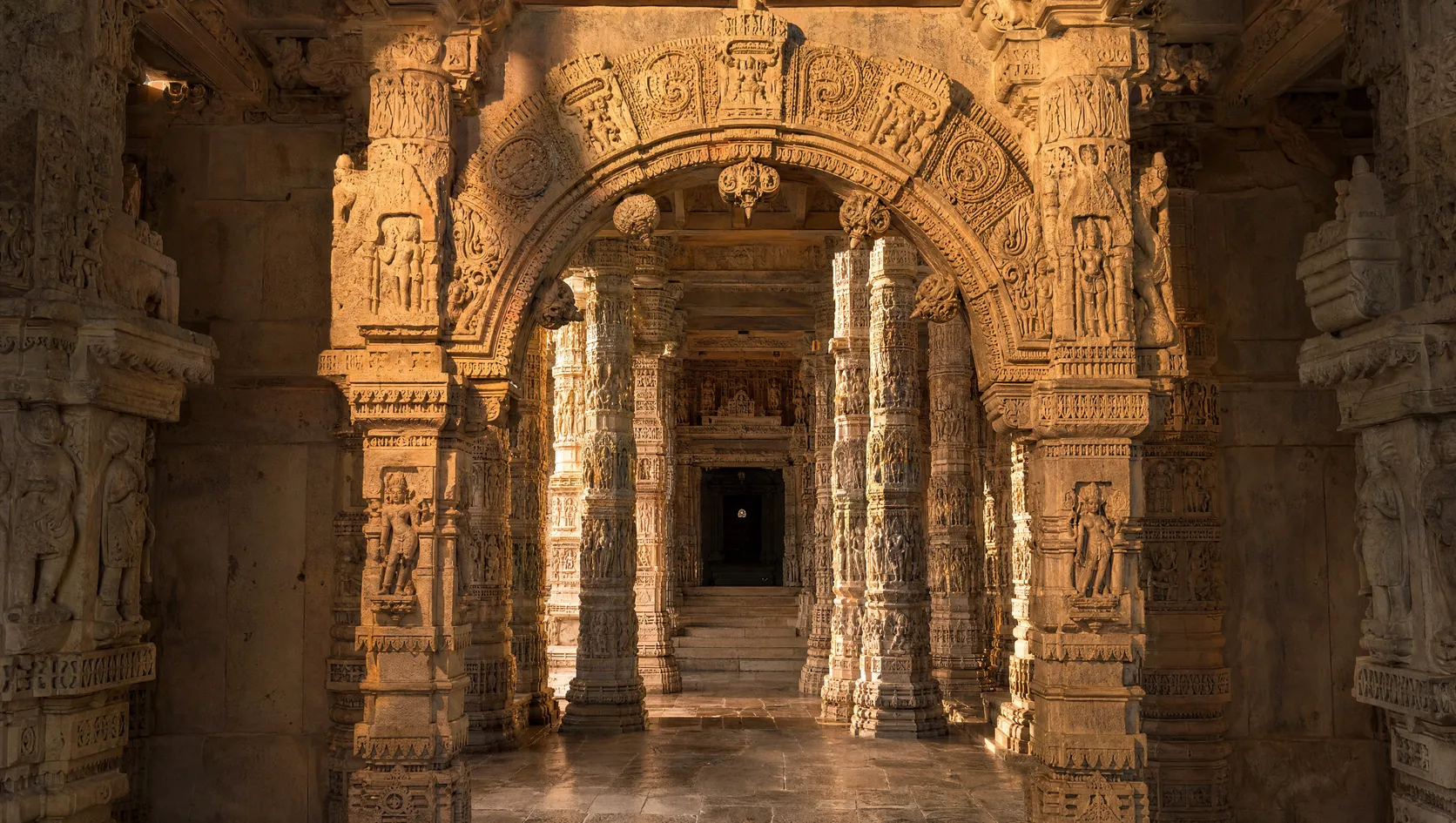
West of the tank stands the Sabha Mandap (assembly hall), its roof supported on fifty-two ornately carved pillars — the fifty-two weeks of the year. The pillars are among the finest examples of Solanki stone-carving: each is individualised with figures of apsaras, erotic couples, celestial attendants, and deities. The mandapa ceiling carries an intricate lotus rosette of exceptional quality. Beyond the assembly hall stands the sanctum, whose entrance faces precisely east for the sunrise alignments; its shikhara has not survived.
The temple suffered damage during Alauddin Khilji's 1299 Gujarat campaign and was subsequently left without royal patronage as the Solanki dynasty declined. By the time systematic European documentation began in the 19th century, the shikhara was already gone and the main image removed. The Archaeological Survey of India assumed conservation responsibility in the colonial period and continues to administer the site. The annual Modhera Dance Festival (Uttarardh Mahotsav), held since the 1990s, has given the monument a new form of cultural life.
Historical Timelineऐतिहासिक कालक्रम
Sun Temple complex at Modhera constructed by Bhimadeva I of the Chaulukya (Solanki) dynasty. The commission is placed in the years immediately following Mahmud of Ghazni's 1025 raid on Somnath. Stylistic analysis by scholars including M.A. Dhaky confirms the early 11th-century Solanki attribution. No foundation inscription survives.
No foundation inscription has been found for the Modhera temple. The dating rests entirely on stylistic grounds — the temple's sculptural programme and architectural members are closely paralleled by datable Solanki commissions from the reigns of Bhimadeva I and his immediate successors. The proposed connection to the post-Somnath political context is plausible but not epigraphically documented.
Alauddin Khilji's military campaign into Gujarat reaches Modhera district. The temple suffered damage in this period, and royal Solanki patronage — already diminishing — effectively ceased after the Solanki dynasty's collapse in the 13th century.
The specific damage inflicted on Modhera in 1299 is not individually documented in the Persian chronicles, which record the Gujarat campaign in broader terms. The attribution of the shikhara's loss and image removal to this period is the scholarly consensus but lacks direct textual confirmation; deterioration and abandonment over subsequent centuries may have compounded the damage.
Systematic archaeological documentation of the Modhera complex by British surveyors including James Burgess and Henry Cousens, culminating in 'The Architectural Antiquities of Northern Gujarat' (1903). This publication brings the temple to the sustained attention of the global scholarly community and initiates conservation discussions.
The Gujarat government and ASI institute the annual Modhera Dance Festival (Uttarardh Mahotsav), held each January around Makar Sankranti. Classical dance performances in the open air at the Surya Kund give the site a continuing cultural life and have made Modhera a significant destination in Gujarat's cultural tourism calendar.
What You'll Seeदर्शन में
The original Surya image that once occupied the Modhera sanctum has not survived — it was removed or lost during the medieval period, most likely in the aftermath of the 13th-century invasions. The shikhara (tower) above the sanctum is also gone; only the sanctum's outer walls and their sculptural programme remain.
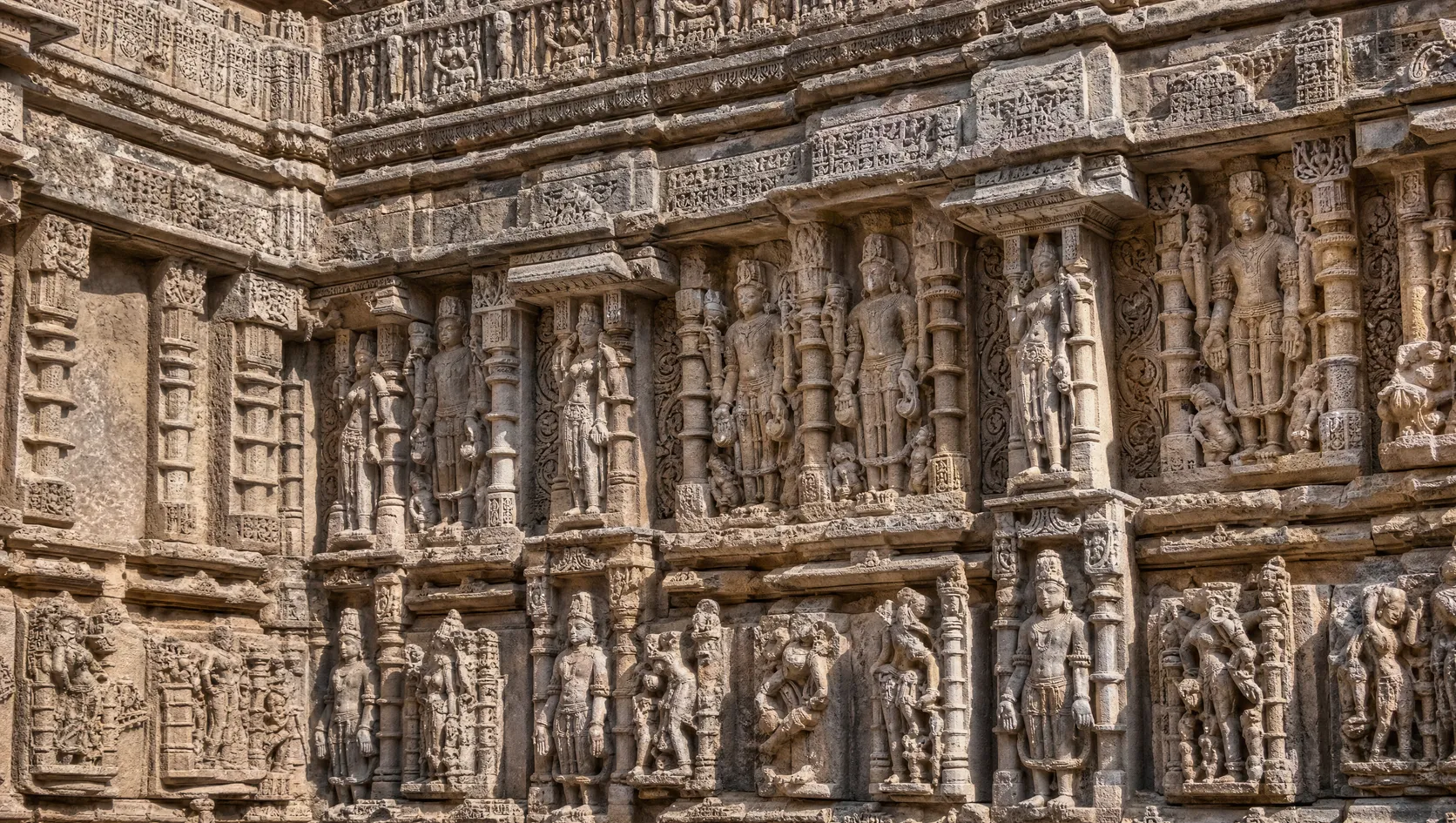
What Modhera offers the visitor in place of a presiding image is an extraordinary density of secondary sculpture. The outer walls of both the Sabha Mandap and the sanctum are carved in horizontal registers with exceptional Solanki work: apsaras in various postures, erotic mithuna couples, Surya in the standard northern form (wearing boots, holding lotuses), the nine grahas (planetary deities), Vishnu in multiple avataras, Shiva, and the directional guardians (ashtadikpalas). The quality of the carving — particularly the figures of celestial women (sura-sundaris) on the Sabha Mandap's exterior — represents some of the finest stone sculpture produced by the Maru-Gurjara tradition.
The Sabha Mandap's interior is celebrated for its ceiling: an elaborate corbelled composition culminating in a hanging pendant (sukanasa), carved with a lotus rosette of exceptional intricacy. The fifty-two pillars of the hall are individually carved, each presenting a different arrangement of figures, foliage, and geometric motifs. The torana — the ornate gateway arch connecting the Sabha Mandap to the sanctum — is one of the finest surviving examples of Solanki decorative architecture, its archivolt carved with miniature figures of gods, celestial attendants, and floral scrollwork at a scale that rewards close examination.
The Surya Kund is architecturally the most distinctive element of the complex. Its trapezoidal stepped plan descends to the water level through a series of landings, each lined with 108 miniature shrines dedicated to various deities — a compendium of the medieval Hindu pantheon arranged around a solar focal point. The tank's eastern face receives the morning light first, the shrines along the steps casting long shadows down the tiers at dawn.
Distinctive Practicesविशिष्ट परंपराएँ
Winter Solstice Solar Alignment (Uttarayan)
शीतकालीन अयनांत सौर संरेखण (उत्तरायण)
Annual, Makar Sankranti / Uttarayan (c. January 14)
At winter solstice (Makar Sankranti, falling around January 14), the rising sun's rays enter the east-facing sanctum doorway and illuminate the inner shrine directly — the precise alignment the Solanki architects designed into the east-west axis of the complex. The equinoxes also produce significant solar events at the temple. Gujarat celebrates Uttarayan as a major cultural and spiritual festival; the Modhera Sun Temple on this day draws visitors who come to witness the solar alignment that gave the temple its reason for being.
Uttarayan — the sun's northward journey beginning at winter solstice — is the most auspicious period of the solar year in the Hindu tradition. The Bhagavad Gita (8.24) associates Uttarayan with the path of light along which the liberated soul travels. The Solanki architects anchored this cosmic turning point in stone: the temple's east-facing sanctum ensures that the solstice sun, at its most potent moment of directional shift, enters the house built for it.
Modhera Dance Festival (Uttarardh Mahotsav)
मोधेरा नृत्य महोत्सव (उत्तरार्ध महोत्सव)
Annual, January (around Uttarayan)
The annual Modhera Dance Festival — organised by the Gujarat Tourism Development Corporation and ASI — is held over two to three evenings each January, with classical dance performances set against the illuminated Surya Kund and temple complex. Artists performing Bharatanatyam, Odissi, Kathak, and other classical forms present their work in one of the most spectacular natural-stage settings available to a dance festival in India. The event has been held since the mid-1990s.
The classical dance tradition's foundation in temple service makes the Modhera festival not merely aesthetic but devotional. The Surya Kund — a space designed for ritual, purification, and the daily correspondence between human practice and solar rhythm — becomes a stage where that correspondence is enacted through the kinetic art form that ancient India considered closest to divine expression.
Did You Know?क्या आप जानते हैं?
The Surya Kund at Modhera holds 108 miniature shrines arranged along its stepped sides — one for each of Surya's traditional epithets. The number 108 is among the most sacred in Hindu cosmology (108 Upanishads, 108 names of each major deity, 108 beads on a mala). Constructing an entire stepped tank whose every level functions as a prayer is one of the most ambitious symbolic architectural programmes in the subcontinent.
ASI site documentation; James Burgess and Henry Cousens, 'The Architectural Antiquities of Northern Gujarat' (1903)
The fifty-two pillars of the Sabha Mandap represent the fifty-two weeks of the year — the same symbolic encoding of solar time that Konark's twenty-four wheels represent in hours. The entire architectural programme of Modhera is a temporal instrument: the tank (for daily dawn ablution), the pillars (the yearly cycle), the sanctum alignment (the solstice).
ASI interpretive documentation; architectural historians of the Maru-Gurjara tradition
At both equinoxes (Vasanta and Sharad) as well as the winter solstice, the rising sun's light falls through the sanctum doorway at specific angles that correspond to the three key solar turning points of the year. The Solanki architects built a precision solar calendar into the orientation and opening dimensions of the shrine.
ASI technical studies; architectural astronomy analyses of the Modhera complex
The torana (decorative gateway arch) connecting the Sabha Mandap to the sanctum at Modhera is considered by scholars of Maru-Gurjara architecture to be one of the finest surviving examples of its type. Its archivolt is carved with miniature figures at a density and quality that rivals the best Solanki work anywhere in Gujarat or Rajasthan.
M.A. Dhaky, studies on Maru-Gurjara temple architecture; ASI site assessments
Visitor Accessप्रवेश जानकारी
Modhera Sun Temple is an ASI-protected monument — not an active place of worship. The complex is open to all visitors without restriction by faith, gender, or caste. Entry fees apply (verify current ASI rates at asi.nic.in or at the ticket counter). The Surya Kund (stepped tank) is accessible and is the primary attraction; the Sabha Mandap interior can be viewed; the sanctum is accessible from outside but is not an active shrine. Footwear must be removed before the main monument area.
Contemporary Context
Administered under the AMASR Act by ASI. Entry ticket required. A Sound and Light Show is held in the evenings — verify current timings with Gujarat Tourism or ASI.
Practical Guidance
Allow 1.5–2 hours for the complex. Morning visits are strongly preferred: the light on the Surya Kund at dawn is exceptional, and sunrise (particularly at Uttarayan) activates the sanctum alignment. Guides are available at the gate. Modhera is typically combined with visits to Patan (UNESCO-listed Rani ki Vav stepwell, 30 km north) as a day circuit from Ahmedabad.
Festivalsत्योहार
Makar Sankranti / Uttarayan (Solar Alignment Day)
मकर संक्रांति / उत्तरायण
January (c. January 14)
The most significant solar event at Modhera: the rising sun enters the sanctum at precisely the angle the Solanki architects calibrated over a thousand years ago. Gujarat's major kite-flying festival coincides with Uttarayan, and the Modhera temple draws visitors who come specifically to witness the solar alignment on this day. The Modhera Dance Festival (Uttarardh Mahotsav) is held around this date.
Modhera Dance Festival (Uttarardh Mahotsav)
मोधेरा नृत्य महोत्सव (उत्तरार्ध महोत्सव)
January
Classical dance performances — Bharatanatyam, Odissi, Kathak, and others — held over two to three evenings against the illuminated Surya Kund and temple complex. Organised by Gujarat Tourism and ASI. One of Gujarat's premier cultural events and the event that has most significantly raised Modhera's profile as a cultural destination.
Vasanta Panchami (Spring Surya worship)
वसंत पंचमी
Jan–Feb (Magha Shukla Panchami)
Vasanta Panchami, the beginning of the spring season, is associated with Surya in the Vedic tradition as the time when the sun's warmth begins its return. At Modhera, the vernal equinox solar alignment gives this seasonal transition an architectural dimension: the equinox sun enters the sanctum from a different angle than the solstice sun, marking a second key point in the solar calendar.
Traditional Offeringsपारंपरिक अर्पण
Primary Offerings
Arghya (water offering in copper vessel)
अर्घ्य
अर्घ्य
The foundational Surya offering: water poured from a copper vessel toward the rising sun so the stream catches and refracts the light, returning the sun's own element to its source. The Surya Kund at Modhera was designed specifically for this practice — its stepped descent to the water creates the ideal dawn setting for performing arghya before entering the temple.
Arka flowers (Calotropis gigantea)
अर्क पुष्प (आक / मदार)
अर्क
The arka plant, whose name shares the Sanskrit root for sun (arka), is the primary floral offering for Surya across all solar traditions. Its pale white flowers are offered directly to solar images. The Solanki-era sculptures at Modhera depict Surya holding lotuses, but arka flowers are the traditional accompaniment to Surya worship at any solar tirtha.
Red lotus (Rakta Kamala)
रक्त कमल
रक्त कमल
Surya's primary iconographic attribute across all his temple representations, including at Modhera. The lotus opens at sunrise and closes at sunset, enacting the sun's daily rhythm; offering it back to Surya completes the symbolic cycle. Red, the colour of the risen sun, distinguishes the Surya lotus offering from those made to Vishnu or Lakshmi.
Wheat and jaggery (Godhuma and Guda)
गेहूँ और गुड़
गोधूम और गुड
Wheat is the Vedic grain of Surya, ripened by his direct power; jaggery is the sweetness extracted from sugarcane by heat and solar energy. Together they constitute the standard naivedya (food offering) at Surya tirthas, prescribed in the Bhavishya Purana.
Modhera is an ASI-protected monument with no active puja infrastructure. Traditional offerings described here are drawn from the scriptural tradition of Surya worship and are provided for devotional context. Pilgrims who wish to perform arghya may do so at the Surya Kund at dawn — this remains the most appropriate devotional act at this site.
How to Reachकैसे पहुँचें
Modhera is located in Mehsana district of northern Gujarat, approximately 102 km north of Ahmedabad and 25 km southwest of Mehsana city.
From Ahmedabad: The most common route. GSRTC (Gujarat State Road Transport Corporation) buses run regularly from Ahmedabad's Geeta Mandir bus stand to Mehsana, from where local buses and autos connect to Modhera (25 km). By private taxi or car, the direct Ahmedabad–Modhera drive takes approximately 1.5–2 hours via the Ahmedabad–Mehsana highway (NH 48 / SH). Many visitors book a Modhera-Patan day circuit from Ahmedabad by private taxi.
From Mehsana: The most convenient local base. Frequent local buses and auto-rickshaws connect Mehsana to Modhera (25 km, approximately 45 minutes). Mehsana has the nearest rail connection, served by trains on the Ahmedabad–Palanpur section.
By air: Sardar Vallabhbhai Patel International Airport in Ahmedabad (AMD) is the gateway, with connections from all major Indian cities. Taxi to Modhera from Ahmedabad airport: approximately 1.5–2 hours.
Note: Modhera is most efficiently visited in combination with Patan (UNESCO-listed Rani ki Vav stepwell, 30 km north) as a single day's circuit from Ahmedabad.
Plan Your Visitयात्रा की योजना
🌤 Best Season
October to March is ideal — pleasant temperatures (15–30°C) and clear skies that enhance the Surya Kund's reflections. January is particularly recommended for the Makar Sankranti solar alignment and the Modhera Dance Festival. Summer (April–June) is very hot in northern Gujarat (above 40°C). Monsoon (July–September) brings humidity but the Surya Kund fills with water, creating a striking visual.
👘 Dress Code
No religious dress code (ASI monument). Modest clothing appropriate for a historic site. Footwear removed before the monument area. Sun protection essential in all seasons.
📱 Phones & Photography
Photography freely permitted throughout the complex. Professional/commercial photography equipment requires prior ASI permission.
🏨 Accommodation
Accommodation at Modhera itself is minimal — a few guesthouses near the temple. Most visitors stay in Mehsana (25 km) or Ahmedabad (102 km). Mehsana has budget and mid-range hotels. Ahmedabad has the full range including international brands. During the Dance Festival in January, accommodation in the wider region should be booked well in advance.
Sacred Soundsपवित्र ध्वनि
Did You Know? · क्या आप जानते हैं?
The same translation error that turned '33 Koti' into '33 crore' in Hinduism also happened in Buddhism. The Chinese translation of Buddhist texts rendered 'Sapta Koti Buddha' (7 Supreme Buddhas) as '7 Crore Buddhas.' The Tibetan translation got it right: 7 types, not 7 crore. One Sanskrit word, misread across two major world religions, generated two identical misconceptions independently.
Related Contentसंबंधित सामग्री
Related Scriptures
Community Reflections
🕉️
Be the first to share your reflection.