Namakkal Anjaneyar
नमक्कल आंजनेयर
The giant guardian who gazes eternally at his lord Narasimha
Namakkal, Tamil Nadu, India
Nāmakkal ĀñjaneyarAlso known as: Namakkal Anjaneyar Temple, Namakkal Hanuman, Anjaneyar Kovil Namakkal, Namagiri Anjaneyar
Era
Rock-cut murti of uncertain ancient date; Pallava or early medieval period attribution in local tradition
Architecture
Rock-cut Tamil temple tradition; granite inselberg with natural rock serving as temple base and shikhara
Open
06:00 – 20:30
Aarti
06:30 · 12:00 · 18:00 · 20:00
Special
Fridays and Saturdays are primary congregation days; Hanuman Jayanti and Karthigai Deepam are principal festival periods
The Sacred Legend · पवित्र कथा
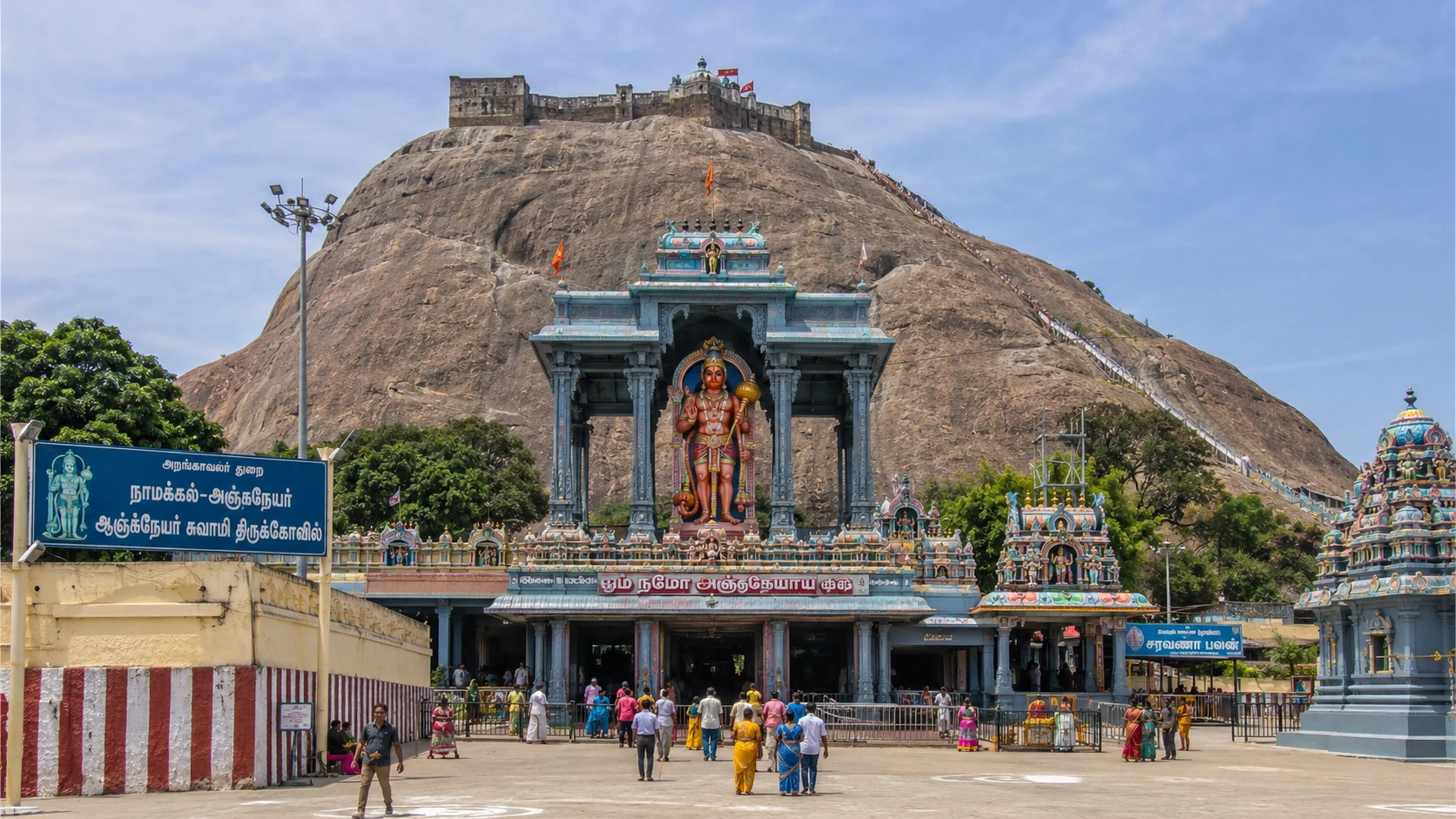
At the foot of a great granite rock rising from the Tamil plains, an eighteen-foot Hanuman stands carved into the living stone — face upturned, gaze fixed on the Narasimha temple that crowns the same rock above him. The devotional logic is direct and luminous: Hanuman, who served Rama, keeps eternal vigil over Narasimha, the form of Vishnu from whom Rama himself descended. To visit Namakkal is to enter a site where the vertical geography of the rock is itself a theological statement — below, the devoted servant; above, the lord — and where the granite that holds both is older than any temple built by human hands.
Sacred Origin Storyपवित्र उत्पत्ति कथा
Source: Tamil Vaishnava tradition / Namakkal Sthala Purana — widely attested
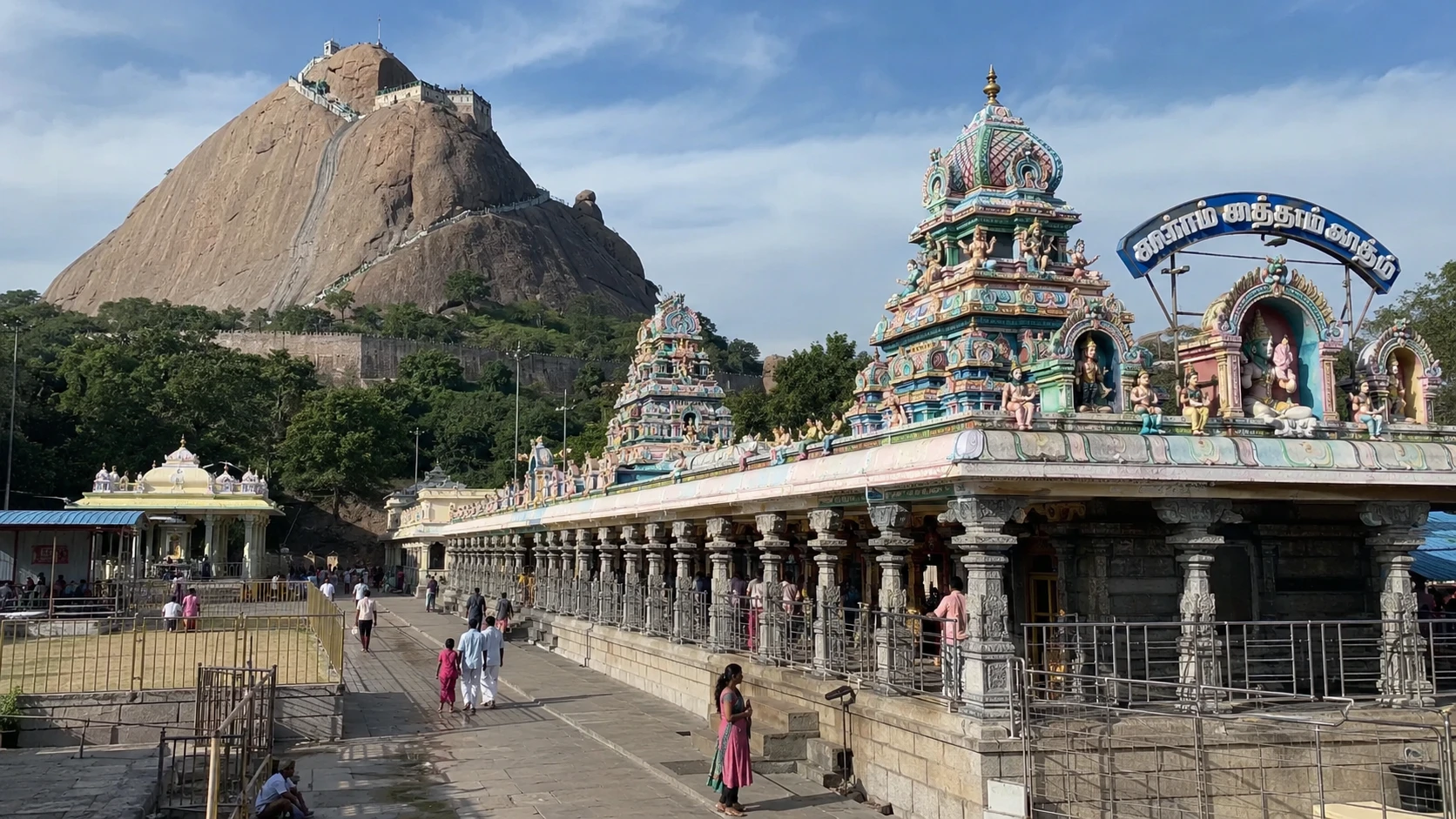
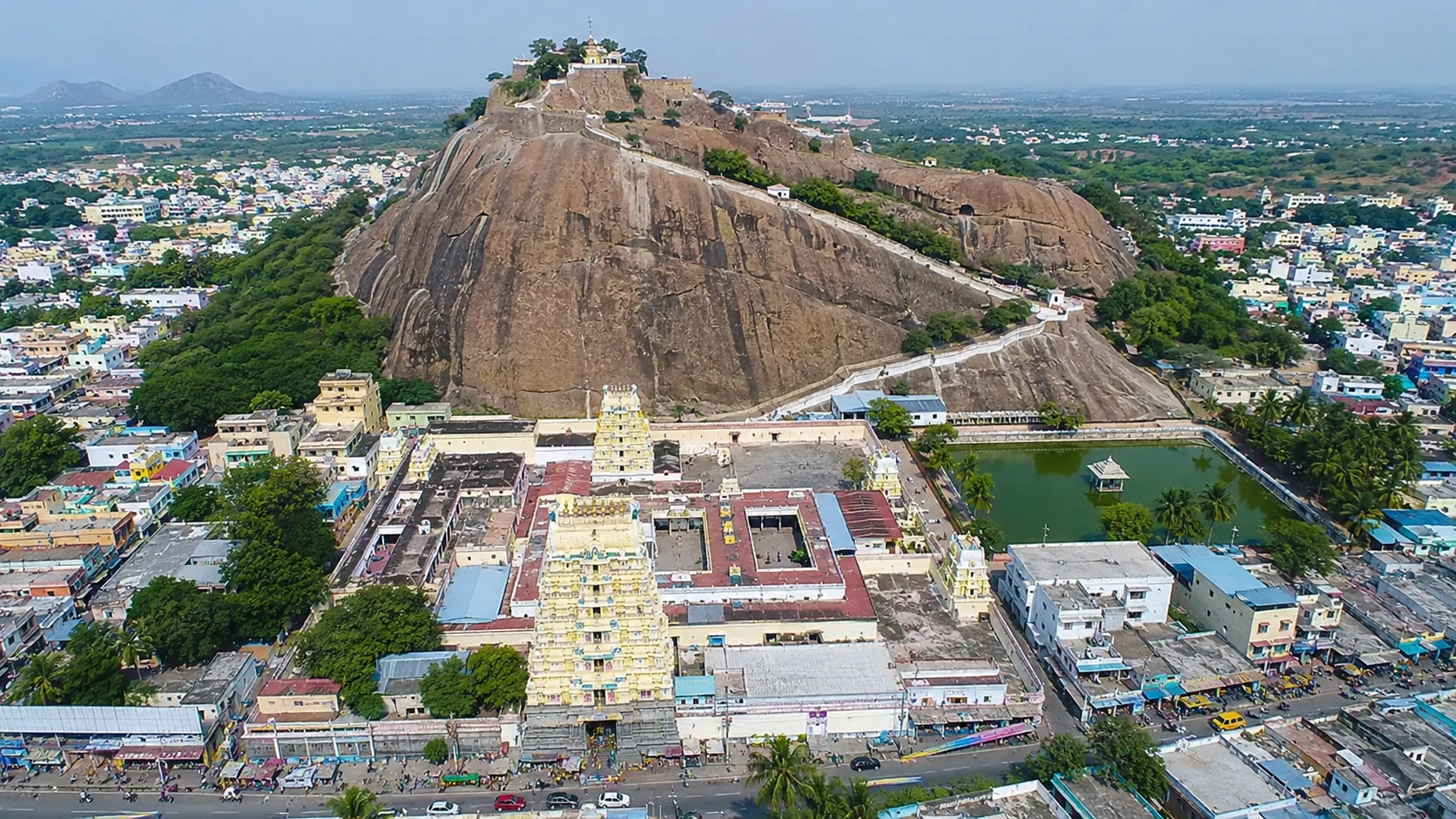
The mythology of Namakkal is inseparable from the sacred geography of the rock itself — the Namakkal malai (hill), a natural granite inselberg rising abruptly from the flat plains, which has been held as a place of divine presence since antiquity.
The primary account draws from the broader Tamil Vaishnavite tradition. Narasimha — the half-lion, half-human avatar of Vishnu who emerged from a pillar to save the devotee Prahlada from his demon father Hiranyakashipu — is the presiding deity atop the Namakkal rock. The Narasimhar temple on the summit is among the few shrines in Tamil Nadu where Narasimha is worshipped in his most ferocious form: Ugra Narasimha, the wrathful protector whose rage against injustice is the theological subject of the site.
At the base of the same rock, Anjaneyar (Hanuman) stands as the eternal guardian. The placement is theologically deliberate: Hanuman's gaze is directed upward toward Narasimha, an act of perpetual darshan of his lord. The logic is layered — Hanuman is a devotee of Rama, who is an avatar of Vishnu. Narasimha is also an avatar of Vishnu. Hanuman's upward gaze at Narasimha thus represents the devotee seeing the source through the form — Rama's divine lineage made visible in Narasimha's ferocious grace.
The local Sthala Purana holds that this location was chosen for Anjaneyar's installation because of the natural elevation of the rock: Hanuman, whose devotion to Vishnu is total, was placed where he could never turn away from his lord — the landscape itself prevents any other orientation. The rock is his temple; the space between the base murti and the summit shrine is the height of his worship.
Sources cited:
- Namakkal Sthala Purana (oral tradition)
- Tamil Vaishnava tradition — Narasimha avatara narrative from Bhagavata Purana, Seventh Skandha
- Local epigraphic and temple records
Scholarly Context
The Namakkal rock complex — Narasimha on the summit, Anjaneyar at the base — represents a spatial theology of devotion characteristic of Tamil Vaishnava sacred geography. The arrangement where a devotee-deity is positioned below and oriented toward the principal deity above is a pattern found at several Tamil Nadu sites, encoding the theological hierarchy in the landscape itself rather than merely in scripture. Diana Eck ('India: A Sacred Geography', 2012) discusses similar vertical sacred architectures in the broader Indian tradition. The rock-cut Anjaneyar at Namakkal is among the oldest and largest such carvings in Tamil Nadu, though the exact date of the carving is not established through epigraphy.
Historyइतिहास
The Namakkal rock and its associated shrines have been sacred since at least the early medieval period. The Namakkal Narasimhar temple on the summit of the granite rock is believed to be of great antiquity, with some inscriptional evidence suggesting significant activity in the Pallava and medieval Chola periods. The Anjaneyar (Hanuman) murti carved at the base of the rock is attributed in tradition to the same early period, though the precise date of the rock-cut carving has not been established through dated epigraphy.
Namakkal came under the control of various medieval Tamil kingdoms — the Pallavas, Gangas, and later the Vijayanagara Empire — each of which is associated with temple construction and patronage across Tamil Nadu. The broader Namakkal area was part of the Kongu Nadu, a culturally distinct region of Tamil Nadu with its own devotional traditions.
In the modern period, Namakkal has grown into a significant commercial town — one of the largest centers of truck body fabrication in Asia — while retaining its identity as a pilgrimage destination. The town is also known for its poultry and egg production industry, giving it an unusual combination of agricultural-industrial identity and ancient pilgrimage significance.
The temple is administered by the Hindu Religious and Charitable Endowments (HR&CE) Department of Tamil Nadu, the government body that manages thousands of temples across the state. Under HR&CE administration, the temple has seen infrastructure improvements including new facilities for pilgrims, improved access, and conservation work on the rock-cut elements.
The Anjaneyar temple at Namakkal has also developed a reputation as a temple where students and academic aspirants come to seek blessings for examinations and intellectual success — a tradition possibly connected to the temple's association with the Mercury (Budha) graha through the broader devotional culture of the region, where Hanuman is propitiated for sharpness of mind.
Historical Timelineऐतिहासिक कालक्रम
Earliest attributed period for the Namakkal Narasimhar temple on the rock summit and the rock-cut Anjaneyar murti at its base. Inscriptional evidence from the site suggests significant patronage and worship activity during this period, though the rock-cut carving's precise date remains unestablished.
The exact date of the rock-cut Anjaneyar carving at Namakkal has not been established through dated epigraphy. Attribution to the Pallava or early Chola period is based on stylistic analysis and the general pattern of rock-cut temple activity in Tamil Nadu during those periods.
Namakkal area under Vijayanagara Empire suzerainty. The Vijayanagara period saw significant temple construction and expansion across Tamil Nadu. Temple records suggest renovations and additions to the Namakkal complex during this period.
Tamil Nadu HR&CE Department administration of the Namakkal temple. Infrastructure improvements, pilgrim facilities, and rock-cut monument conservation work. Growth of the temple's reputation as a site for student blessings, drawing academic aspirants particularly during examination seasons.
What You'll Seeदर्शन में
The presiding Anjaneyar (Hanuman) murti at Namakkal is a large rock-cut standing figure approximately eighteen feet in height, carved directly into the granite face of the Namakkal rock. The murti depicts Hanuman in a standing posture (sthanaka), with the face oriented upward in a posture of devotional attention toward the Narasimha temple on the rock's summit above. The right hand is raised and the figure is adorned with the characteristic attributes of Anjaneyar in the Tamil sculptural tradition. The surface is coated in sindoor and the murti is richly decorated with fresh garlands, ornamental clothing, and gold and silver ornamentation during festivals. Being rock-cut, the murti cannot be separated from the hillside — the granite cliff is both its base and its backdrop, making the experience of darshan qualitatively different from a freestanding temple: the devotee stands before a figure that has emerged from the stone itself, always gazing upward, inseparable from the hill it inhabits.
Distinctive Practicesविशिष्ट परंपराएँ
Student Blessings Pilgrimage
छात्र आशीर्वाद तीर्थयात्रा
Year-round; peaks during Tamil Nadu examination seasons (March–April and November)
Namakkal Anjaneyar has developed a strong tradition of students and academic aspirants seeking blessings for examinations and scholarly success. Before major school examinations, college entrance tests, and competitive examinations (IIT JEE, NEET, UPSC), students from across Tamil Nadu and neighboring states visit the temple, offer sindoor and laddoos, and circumambulate the rock before returning home. The tradition is particularly strong in Tamil Nadu, where examinations carry enormous social weight and divine intercession for academic success is sought across many temples.
Hanuman is revered across the Hindu tradition as a master of both physical strength and intellectual acuity — his command of Sanskrit, his knowledge of the Vedas, his ability to compose the Sundara Kanda's verses, all mark him as a deity of learning as much as a deity of power. In Tamil tradition, Anjaneyar is specifically propitiated for clarity of thought, memory (dharana), and the ability to perform under pressure — qualities essential for examination success.
Did You Know?क्या आप जानते हैं?
The Anjaneyar murti at Namakkal is oriented upward with its gaze fixed on the Narasimha temple at the summit of the same rock — a theological arrangement unique to this site, encoding the devotee-deity relationship (Hanuman-Rama-Vishnu) in the vertical architecture of the natural landscape.
Temple tradition; on-site architectural observation
The rock-cut Anjaneyar murti is approximately eighteen feet tall and is carved directly into the granite hillside — making it one of the largest and oldest rock-cut Hanuman sculptures in Tamil Nadu. Being rock-cut, the murti is inseparable from the hillside; it cannot be 'housed' in a conventional sense — the rock is the temple.
Archaeological Survey of India site survey; temple records
Namakkal has become strongly associated with student blessings in Tamil Nadu. Students traveling to take competitive examinations — IIT JEE, NEET, board exams — frequently detour to Namakkal for darshan. The town's combination of industrial prosperity (truck body manufacturing) and ancient pilgrimage heritage is unusual in Tamil Nadu's religious geography.
Tamil Nadu pilgrimage documentation; local tradition
The Namakkal Narasimhar temple atop the rock is among the few Tamil Nadu temples where Ugra (wrathful) Narasimha is the primary deity. In most Narasimha temples, the deity is depicted in the pacified form (Yoga Narasimha or Lakshmi Narasimha). Ugra Narasimha's presence above a gentle, upward-gazing Anjaneyar creates one of the most theologically rich vertical compositions in Tamil temple geography.
Temple tradition; Tamil Narasimha iconography surveys
Visitor Accessप्रवेश जानकारी
Namakkal Anjaneyar temple is open to all devotees without restriction. Photography of the exterior rock-cut murti is generally permitted. Photography inside the inner worship area is restricted — confirm at the site. Footwear must be removed before the temple premises. The Narasimhar temple at the summit of the same rock requires a separate climb and has its own darshan protocol.
Combine the visit with the Narasimhar temple at the rock summit — both together constitute the complete Namakkal pilgrimage. The summit climb is a short but moderately steep walk. Fridays draw the largest weekly crowds. The town of Namakkal is a major lorry hub — approach roads may have heavy commercial vehicle traffic. Best reached by private vehicle or bus from Salem (48 km) or Tiruchengode (30 km).
Festivalsत्योहार
Hanuman Jayanti
हनुमान जयंती
Mar-Apr (Chaitra Purnima)
The principal festival at Namakkal Anjaneyar, drawing pilgrims from across central Tamil Nadu. Special abhishekam, extended darshan, and elaborate floral decoration of both the Anjaneyar murti and the Narasimhar temple mark the celebration. Students particularly flock to Namakkal during this period, timing their visit to Hanuman Jayanti for examination blessings before the April board examination season.
Karthigai Deepam
कार्तिगई दीपम
Nov-Dec (Karthigai month, Tamil calendar)
Karthigai Deepam is one of the most important festivals in Tamil Nadu's devotional calendar — the Festival of Lights specific to the Tamil tradition, distinct from Diwali. At Namakkal, both the Anjaneyar and Narasimhar temples are specially illuminated and lamps are lit across the rock face. The festival draws large crowds and is one of the most visually spectacular at this site.
Traditional Offeringsपारंपरिक अर्पण
Primary Offerings
Sindoor (Vermilion)
सिंदूर
सिन्दूर
Sindoor is the primary offering to Anjaneyar, recalling his legendary act of covering his body in vermilion for Lord Rama's wellbeing. In Tamil temple tradition, sindoor (sinturam) offered to Anjaneyar is considered particularly potent for removing obstacles — the vermilion color itself is associated with martial power and victory.
Vada mala (Fried lentil garland)
वड़ा माला
The vada mala — a garland made of fried vadas (lentil doughnuts) strung together — is a distinctively Tamil offering to Anjaneyar with no direct parallel in North Indian Hanuman temples. The practice is well-established across Tamil Nadu's Hanuman temples. The vada, a savory fried food, is offered as a food-garland rather than a flower-garland: the temple honors Hanuman's warrior-nature with sustaining, substantial food rather than the delicacy of flowers alone.
Pancha Amrit Abhishekam (Five sacred substances)
पंचामृत अभिषेकम
पञ्चामृत अभिषेक
Panchamrit abhishekam — ritual bathing with milk, curd, honey, ghee, and sugar — is performed for Anjaneyar on auspicious occasions. In Tamil temple tradition, the abhishekam sequence is more elaborate than in North Indian temples and forms the core of the priests' ritual service. Each substance symbolically represents a quality that the devotee prays to receive: milk for purity, curd for prosperity, honey for eloquence, ghee for strength, sugar for happiness.
Tulasi (Holy basil)
तुलसी
तुलसी
Tulasi leaves are offered to Anjaneyar as part of the Tamil Vaishnava tradition, which emphasizes the tulasi plant's significance in Vishnu worship. Since Anjaneyar is a Vishnu devotee through his devotion to Rama, tulasi bridges the Shaivite-Vaishnava boundary that Hanuman historically straddles. In Tamil practice, tulasi and bilva leaves may both be offered at Anjaneyar temples.
Unique to This Temple
Ellu (Sesame) Abhishekam
एल्लु (तिल) अभिषेकम
Sesame (ellu in Tamil) abhishekam is a distinctive Tamil offering to Anjaneyar, particularly for those seeking relief from the malefic influence of Shani (Saturn) — the same Shani-Hanuman relationship honored through Saturday worship in North India. In Tamil tradition, sesame seeds are strongly associated with Shani's propitiation, and offering ellu to Anjaneyar combines the Shani-relief function with direct Hanuman devotion.
The vada mala is available from vendors near the temple entrance and is the most distinctively Tamil offering here — try to purchase it from the temple-approved vendors. Sindoor, tulasi, and flower garlands are also widely available. For panchamrit and ellu abhishekam, these are typically scheduled pujas — confirm timing and booking with the temple priests.
How to Reachकैसे पहुँचें
Namakkal is in central Tamil Nadu, approximately 48 km from Salem and well-connected by road and rail.
By road, Namakkal is on the NH-544 (Salem–Coimbatore highway), making it easily accessible from Salem (48 km, ~1 hour), Erode (55 km, ~1 hour), Tiruchengode (30 km, ~45 minutes), and Coimbatore (120 km, ~2.5 hours). Tamil Nadu State Transport buses run frequently from Salem, Erode, Tirupur, Coimbatore, and Tiruchirappalli.
By rail, Namakkal does not have a railway station on the main trunk line. The nearest railway junctions are Salem Junction (48 km, on the main Chennai–Coimbatore line), from where frequent buses and taxis connect to Namakkal. Erode Junction (55 km) is another option.
By air, the closest airports are Salem Airport (50 km, limited connectivity), Tiruchirappalli International Airport (115 km), and Coimbatore International Airport (120 km). Tiruchirappalli and Coimbatore both have regular flights from Chennai, Mumbai, Bengaluru, Delhi, and Hyderabad.
Pilgrims from outside Tamil Nadu often route through Chennai (310 km) or Coimbatore and combine Namakkal with nearby Tiruchengode (Arthanareeswarar temple, 30 km) and Salem temple circuit.
Plan Your Visitयात्रा की योजना
🌤 Best Season
October to February is the most comfortable period for visiting central Tamil Nadu (22–30°C). March–June is hot (32–40°C) but this coincides with examination season when students particularly visit. The monsoon (July–September northeast, October–December southwest for this region) does not significantly disrupt temple access but roads can be wet.
👘 Dress Code
Modest traditional dress expected. Remove footwear before the temple premises. Dhotis or full trousers for men; salwar suits or sarees for women. No shorts or sleeveless tops.
📱 Phones & Photography
Mobile phones on silent mode. Photography of the exterior rock-cut murti is permitted. Confirm photography rules inside the inner worship area at the site.
🏨 Accommodation
Namakkal town has a range of budget and mid-range hotels catering to both commercial travelers (truck industry clientele) and pilgrims. Salem (48 km) offers a wider range of accommodation options including comfortable hotels and lodges. Tiruchengode (30 km) also has basic options.
Book a Pujaपूजा बुक करें
Booking links and phone numbers for Tamil Nadu HR&CE temples are verified periodically but may change. Always confirm seva booking details directly through the official HR&CE portal (tnhrce.gov.in) before payment. The HR&CE administers thousands of Tamil Nadu temples and its portal is the authoritative source for current fee structures and booking availability.
Managed by: Tamil Nadu HR&CE Department (Hindu Religious and Charitable Endowments)
Abhishekam
अभिषेकम
Archana (Nama-parayana)
अर्चना
Booking information verified: 2026-05-22
Sacred Soundsपवित्र ध्वनि
Did You Know? · क्या आप जानते हैं?
The same translation error that turned '33 Koti' into '33 crore' in Hinduism also happened in Buddhism. The Chinese translation of Buddhist texts rendered 'Sapta Koti Buddha' (7 Supreme Buddhas) as '7 Crore Buddhas.' The Tibetan translation got it right: 7 types, not 7 crore. One Sanskrit word, misread across two major world religions, generated two identical misconceptions independently.
Related Contentसंबंधित सामग्री
Related Scriptures
Community Reflections
🕉️
Be the first to share your reflection.