Adinathar (Alwarthirunagari)
आदिनाथर अळवारतिरुनगरी
The first and chief of the Nava Tirupati, and the birthplace of Nammalvar, greatest of the Alvars, sung on the Thamirabarani as Adinatha
Alwarthirunagari, Tamil Nadu, India
Ādinātha (Āḻvārtirunagari)Also known as: Adinathar Temple Alwarthirunagari, Azhwar Thirunagari, Sri Adinatha Perumal Temple, Kurugur
Era
An ancient Divya Desam sung in the Nalayira Divya Prabandham and revered as the birthplace of Nammalvar; the temple was endowed and expanded under the Pandyas, Cholas and the Vijayanagara and Nayaka rulers
Architecture
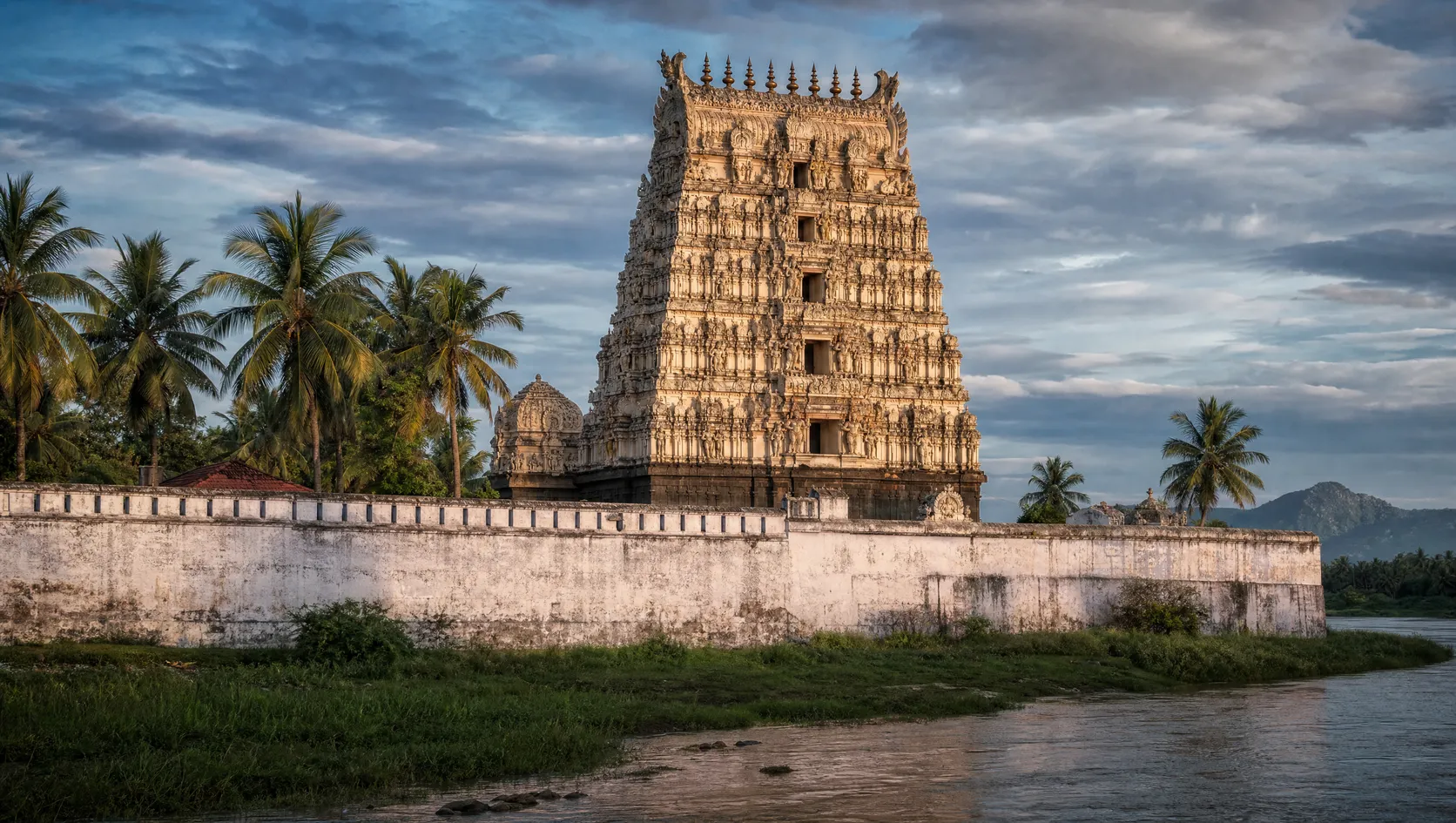
Dravidian, with a gopuram over the entrance, the sanctum of the standing Adinatha crowned by its vimana, the shrine of Adinayaki, the shrine of Nammalvar, and within the precinct the revered ancient tamarind tree
Open
07:00 – 20:00
Special
The temple follows the Srivaishnava round of worship to Adinatha and Adinayaki, with the recitation of the Nalayira Divya Prabandham, and observes the great Vaikasi Visakam festival of Nammalvar and the Nava Tirupati Garuda Sevai. Timings run in morning and evening sessions with a midday break and vary with the festival calendar; they should be confirmed locally.
The Sacred Legend · पवित्र कथा
Among the hundred and eight Divya Desams, the abodes of Vishnu sung by the Alvar poet-saints, a small town on the south bank of the Thamirabarani in the far Tamil south carries a weight out of all proportion to its size. This is Alwarthirunagari, the ancient Thirukkurugur, and its full name declares its meaning: the sacred town of the Alvar. For here, the tradition holds, was born Nammalvar, our own Alvar, Sri Shathakopa, Maran of Kurugur, the greatest of the twelve Alvars, from whose mouth came the Tiruvaymozhi and the larger part of the Nalayira Divya Prabandham. The Vishnu of the temple is Adinatha, Adinatha Perumal, the First Lord, standing in the sanctum with his consort Adinayaki, the Kurugur Valli. But the town belongs as much to the saint as to the god, and its dearest object is neither image nor tower but a tree: the ancient tamarind, the puliyamaram, under and within which the infant Nammalvar is said to have sat in silence for years, taking neither food nor speech, lost in the contemplation of Vishnu, until the day a searching pilgrim drew from him the first word of the Tiruvaymozhi. That tamarind, worshipped as embodying the saint himself, still stands in the temple, and pilgrims come to it as to a living relic of the Alvar's silence. Alwarthirunagari is the first and chief of the Nava Tirupati, the nine Vishnu temples strung along the Thamirabarani and worshipped together as the nine planets, and no journey through them is complete that does not begin here, at the birthplace of the poet who gave the whole Srivaishnava tradition its Tamil Veda.
Sacred Designationपवित्र पदनाम
Sacred Origin Storyपवित्र उत्पत्ति कथा
Source: The Srivaishnava tradition, the Guru Parampara accounts of Nammalvar, and the Sthala Purana of Thirukkurugur
The heart of the tradition of Alwarthirunagari is not an origin myth of the image but the birth of a saint. In the town of Thirukkurugur on the Thamirabarani, the tradition tells, a child was born to the pious Kariyar and his wife Udayanangai, a child who from the moment of birth would not cry, would not open his eyes, would not take the breast, and would not speak. The parents, uncomprehending, carried the silent infant to the temple of Adinatha and set him down at the foot of the ancient tamarind tree that stood within the precinct. There the child sat, in the hollow of the tree, in the posture of yoga, his eyes closed, taking neither food nor water, unmoving, for year upon year.
This was no affliction but the deepest absorption. The child, the tradition holds, was a great soul born already turned wholly toward Vishnu, so full of the Lord that the world and its speech had no hold on him; he sat in the tamarind lost in the contemplation of Narayana, and the silence was itself his worship. Years passed, and the strange silent saint of the tamarind became known across the land.
Far in the north, another devotee, Madhurakavi, saw a light in the southern sky and followed it until it led him to Thirukkurugur and to the tree. Seeking to draw the silent one into speech, he put to him a riddle: if the small is born in the belly of the dead, what does it eat and where does it lie? And the saint, who had not spoken in all his years, opened his mouth and answered, and from that first speaking flowed the Tiruvaymozhi, the sacred word of the mouth, and the rest of his hymns. Madhurakavi became his disciple, and the child of the tamarind became Nammalvar, our Alvar, the saint through whom the tradition believes Vishnu himself sang in Tamil.
Sources cited:
- Srivaishnava Guru Parampara accounts of Nammalvar
- Sthala Purana of Thirukkurugur (Alwarthirunagari)
- The Nalayira Divya Prabandham and the tradition of Madhurakavi Alvar
Other Traditions · अन्य परंपराएँ
The Srivaishnava acharya tradition on the standing of Nammalvar and the Prabandham
Scholarly Context
Alwarthirunagari is studied above all for its association with Nammalvar, the most important of the Alvars, and for its place at the head of the Nava Tirupati group on the Thamirabarani. The Alvars, the Tamil poet-saints of Vishnu, are generally placed by scholars across the middle and later centuries of the first millennium; Nammalvar himself is commonly dated by historians to around the ninth century, though the tradition places him far earlier, in a sacred antiquity beyond ordinary reckoning. What is not in doubt is the scale of his contribution: of the four thousand verses of the Nalayira Divya Prabandham, the largest single share, including the whole of the Tiruvaymozhi, is his. The temple of Adinatha is sung in the Prabandham as Thirukkurugur, and the town takes its later name, Alwarthirunagari, the sacred town of the Alvar, directly from its most famous son. Historically the temple was endowed and expanded under the Pandyas, whose heartland this was, and under the Cholas, the Vijayanagara empire and the Nayakas, in the long pattern of southern temple growth. The Nava Tirupati, the nine Vishnu temples of the Thamirabarani, are studied as a distinctive regional cluster, worshipped together and associated with the nine planets of the Navagraha, and Alwarthirunagari is understood as their chief, both by its own importance and as the birthplace of the poet whose hymns are sung across all of them. The Garuda Sevai, in which the processional deities of all nine are brought together on their Garuda mounts, is examined as a rare surviving example of a coordinated multi-temple festival.
Historyइतिहास
Alwarthirunagari is one of the 108 Divya Desams, sacred to Vishnu as Adinatha, and above all the birthplace of Nammalvar, the greatest of the twelve Alvar poet-saints of the Tamil land. It stands on the south bank of the Thamirabarani in the far south, and its name, the sacred town of the Alvar, records the saint to whom it owes its fame.
The importance of the place is attested from deep antiquity by the Nalayira Divya Prabandham, the collected Tamil hymns of the Alvars, in which the temple appears as Thirukkurugur, the poet's own town. Nammalvar, born here as the tradition holds and known as Sri Shathakopa and Maran of Kurugur, is the author of the Tiruvaymozhi and the larger part of the whole Prabandham, and his standing gives the small town an importance far beyond its size.
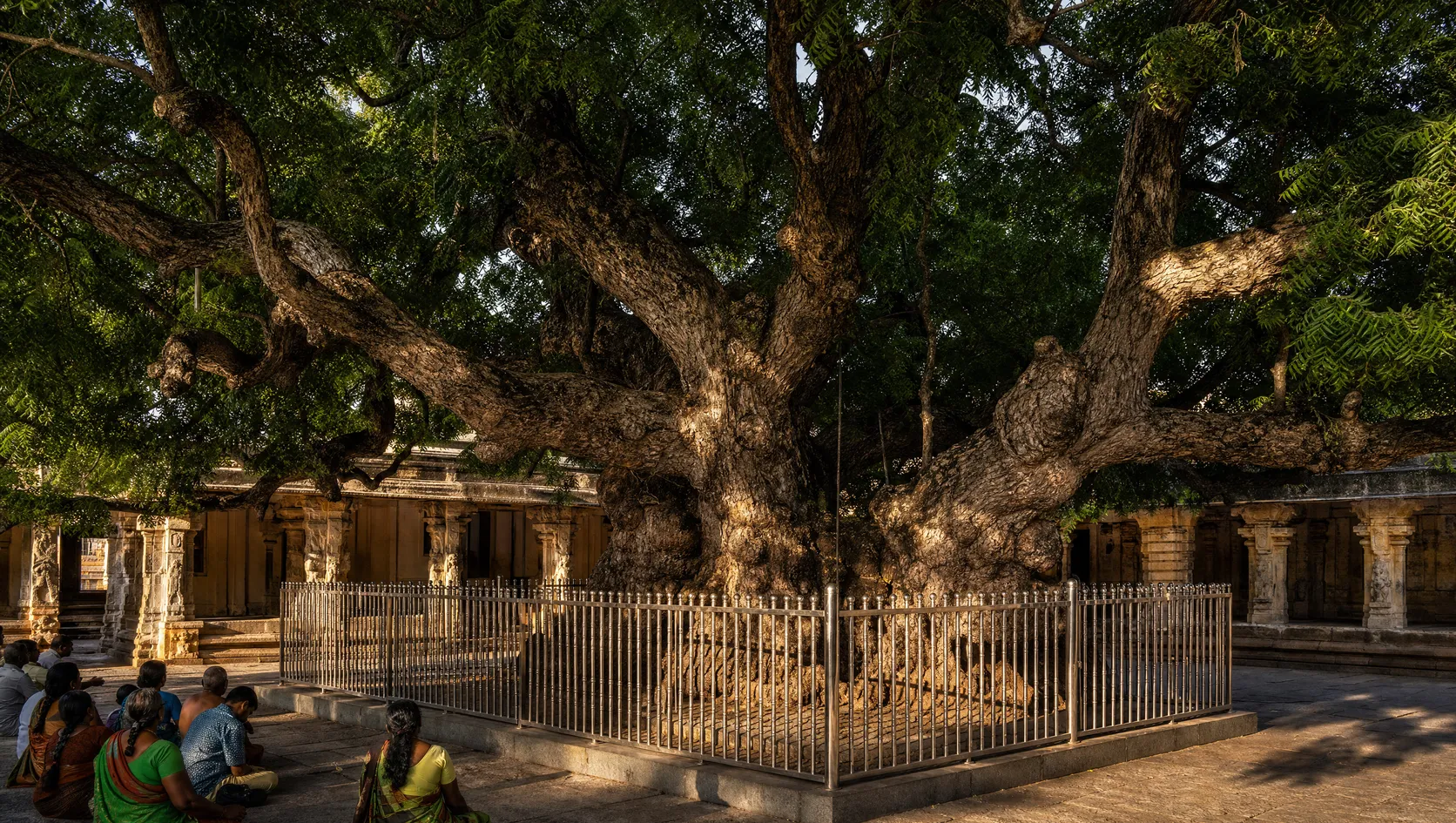
The temple grew over many centuries. Lying in the Pandya heartland, it was endowed and expanded under the Pandyas, and later under the Cholas, the Vijayanagara emperors and the Madurai Nayakas, who added to its halls, its gopuram and its shrines in the long pattern of southern temple building. Within the precinct stand the sanctum of the standing Adinatha, the shrine of his consort Adinayaki, the shrine of Nammalvar, and, most cherished of all, the ancient tamarind tree, the puliyamaram, under which the saint is said to have sat in silence; the tree is worshipped as embodying Nammalvar himself and is a focus of pilgrimage.
Alwarthirunagari is the first and chief of the Nava Tirupati, the nine Vishnu temples strung along the Thamirabarani in the Tirunelveli and Thoothukudi country. These nine are worshipped together and associated with the nine planets of the Navagraha, and pilgrims traditionally seek to visit all nine, ideally in a single day, as one great act of devotion. On the birth-star day of Nammalvar, the Vaikasi Visakam, the processional deities of all nine temples are brought together for the celebrated Garuda Sevai, when they stand in a row upon their Garuda mounts and the Tiruvaymozhi is sung before them, one of the great sights of the Srivaishnava year in the south.
At the heart of the temple's life is the recitation of the Prabandham and the observance of the Adhyayana Utsavam, when Nammalvar's hymns are chanted in full. The town remains a living centre of Srivaishnava devotion, drawing pilgrims to the god, to the saint and to the tree, and standing as the fountainhead of the Tamil hymnody that the whole tradition holds as scripture.
Historical Timelineऐतिहासिक कालक्रम
Nammalvar, the greatest of the Alvars, is born at Thirukkurugur as the tradition holds, and from him come the Tiruvaymozhi and the larger part of the Nalayira Divya Prabandham, establishing the town as the fountainhead of the Tamil hymnody of Vishnu.
Scholars commonly date Nammalvar to around the ninth century, while the tradition places him in a far greater antiquity; his verses are the largest single share of the Prabandham.
Madhurakavi, following a light in the southern sky, comes to Thirukkurugur, draws the silent saint into speech with a riddle, and becomes his disciple, later singing the Kanninun Siruthambu in praise of his master, the one Prabandham hymn addressed to a guru rather than to God.
Madhurakavi's devotion to Nammalvar as his acharya becomes a model in Srivaishnavism for the reverence owed to the teacher.
The temple of Adinatha is sung in the Nalayira Divya Prabandham as Thirukkurugur, the poet's own town, giving it an attested sanctity of great antiquity among the Divya Desams.
The town's later name, Alwarthirunagari, the sacred town of the Alvar, derives directly from Nammalvar.
Lying in the Pandya heartland, the temple is endowed and expanded under the Pandya kings, who patronise the shrine and its worship in the long tradition of Pandya support for the temples of the far south.
Under the Cholas the temple receives further endowment and building, in the pattern by which the great southern dynasties added enclosures, halls and towers to the older shrines of the Tamil country.
In the age of Ramanuja and the acharyas, Nammalvar's Tiruvaymozhi is confirmed at the centre of Srivaishnava worship as the Tamil Veda, and the systematic recitation of the Prabandham, the Adhyayana Utsavam, is given the shape it keeps to this day.
The elevation of Nammalvar's hymns to the standing of Veda is the defining doctrine that binds the acharyas to the saint of Thirukkurugur.
The community of acharyas after Ramanuja keeps Alwarthirunagari and the Nava Tirupati within the living tradition, and the pilgrimage to the nine temples of the Thamirabarani takes its enduring form.
The Vijayanagara emperors and the Madurai Nayakas endow and further build at the temple, adding to its halls, gopuram and festivals in the age of renewed temple building across the Tamil south.
The nine Vishnu temples of the Thamirabarani come to be worshipped together as the Nava Tirupati, associated with the nine planets of the Navagraha, and the Garuda Sevai, in which the processional deities of all nine gather on their Garuda mounts on Nammalvar's birth star, is established as the great shared festival of the group.
The Garuda Sevai is a rare surviving example of a coordinated festival binding several temples of a region into one observance.
The temple and the Nava Tirupati group are recorded in colonial-era surveys and gazetteers of the Tirunelveli country, which note Alwarthirunagari as the birthplace of Nammalvar and the chief of the nine Thamirabarani shrines.
Alwarthirunagari remains a living centre of Srivaishnava worship and the first of the Nava Tirupati, drawing pilgrims to Adinatha, to the shrine of Nammalvar and to the sacred tamarind, above all at the Vaikasi Visakam festival and the Nava Tirupati Garuda Sevai.
What You'll Seeदर्शन में
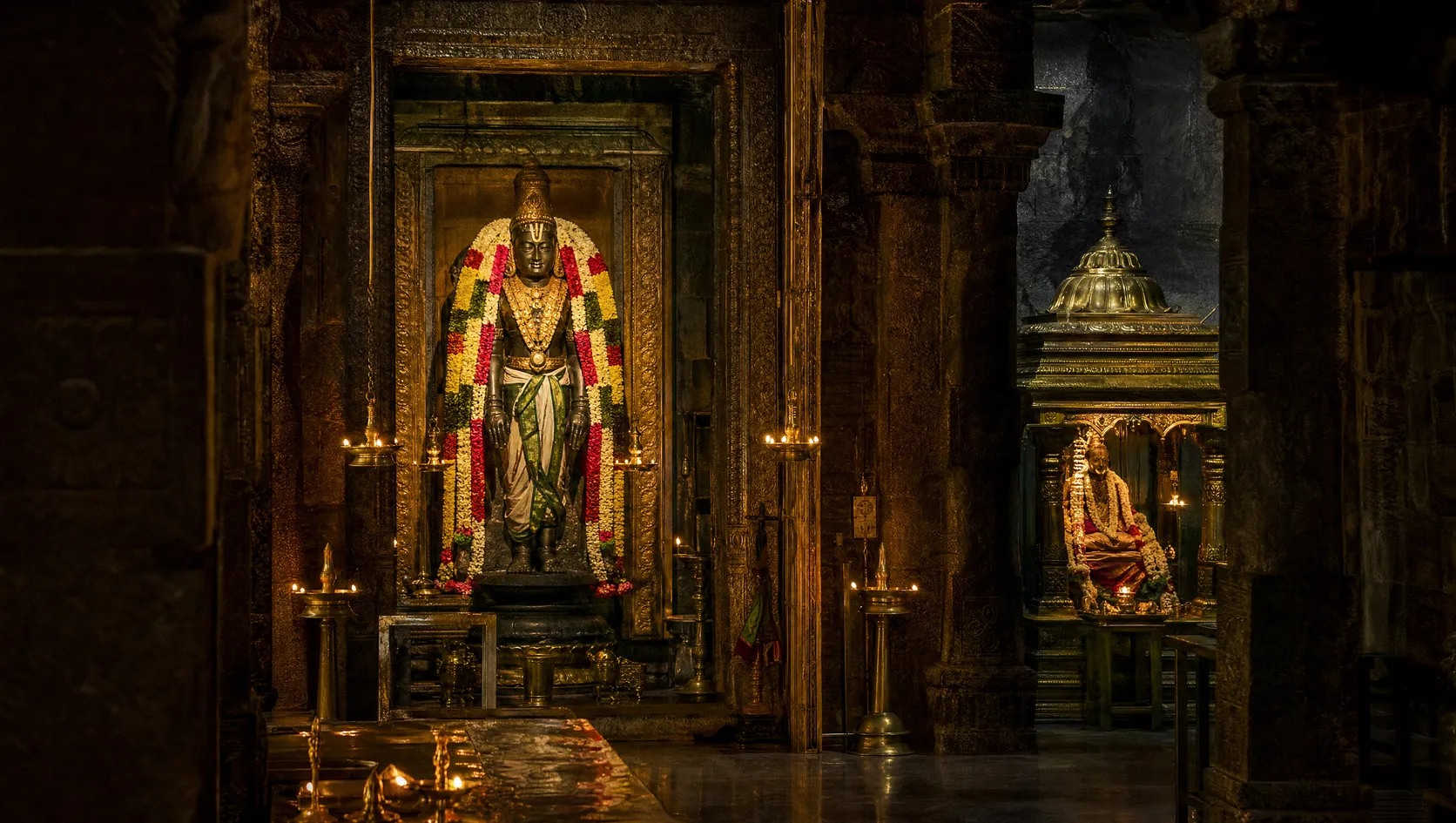
The presiding image of Alwarthirunagari is Adinatha, Adinatha Perumal, the First Lord, Vishnu standing upright in the sanctum in the still, frontal posture of the standing form, facing east, and worshipped as the Moolavar, the fixed stone image over which rises the sanctum's vimana. Beside him, in her own shrine within the precinct, stands his consort Adinayaki, the Kurugur Valli, the goddess of the town. Beside the stone Moolavar is kept the processional image, the utsava murti, carried in the festivals and brought out for the Nava Tirupati Garuda Sevai.
But the iconography of this temple cannot be told through the god's image alone, for its most revered object is the ancient tamarind tree, the puliyamaram, that stands within the precinct. The tradition holds this to be the very tree under and within which the infant Nammalvar sat in silent meditation, and it is worshipped as embodying the saint himself. It is said of the tamarind that its leaves fold at night as if in worship and do not fall, that it never fully sheds, a living sign of the saint's undying devotion; pilgrims come to the tree as to a shrine, and it is as central to the temple as the sanctum.
Within the complex too is the shrine of Nammalvar, where the saint is worshipped in his own image as the head of the Alvars and the source of the Tiruvaymozhi. The pattern of Alwarthirunagari is thus a double one: the standing Adinatha at the heart of the sanctum, and, held equally dear, the saint and the tree through whom the god was sung, so that the town keeps together the Lord and the poet who gave him his Tamil voice.
Distinctive Practicesविशिष्ट परंपराएँ
Recitation of the Tiruvaymozhi and the Nalayira Divya Prabandham
तिरुवाय्मोऴि और नालायिर दिव्य प्रबंधम् का पाठ
Daily in worship, and centrally in the Adhyayana Utsavam
In the very birthplace of Nammalvar, the recitation of his Tiruvaymozhi and of the whole Nalayira Divya Prabandham is the heart of the temple's worship, sung before Adinatha beside the Sanskrit Veda; and in the Adhyayana Utsavam the hymns are chanted in full over its days, above all the Tiruvaymozhi, sung here where its author was born.
That the Tamil hymns of Nammalvar are given the standing of the Veda is the defining claim of Srivaishnavism: the Tiruvaymozhi is the Dravida Veda, the Veda in Tamil, and Nammalvar a seer on a level with the ancient rishis. To sing the Tiruvaymozhi at Alwarthirunagari is to sing it in the place from which it first came, at the tamarind where the silent saint spoke his first word, so that the recitation returns the hymn to its source and worships the god in the very language and the very town he gave the tradition.
Veneration of the Sacred Tamarind (the Puliyamaram)
पवित्र इमली की श्रद्धा (पुलियामरम्)
Year-round, at the tree within the precinct
Within the temple stands the ancient tamarind tree under and within which the infant Nammalvar is said to have sat in years of silent meditation. It is worshipped as embodying the saint himself; the tradition holds that its leaves fold at night as in worship and that it does not shed, and pilgrims come to the tree as to a living relic of the Alvar's silence, circling and honouring it as a shrine.
To worship the tamarind is to honour the saint in the very form his silence took. The tree is where a great soul, born wholly turned toward Vishnu, sat unmoving in the contemplation of the Lord until devotion overflowed as the Tiruvaymozhi; to revere it is to revere that absorption, the picture of a mind so full of God that the world had no hold on it. In the folded leaves that do not fall the tradition reads the sign of a devotion that never sleeps, and the tree keeps present at the temple the beginning of the greatest of the Alvars.
The Nava Tirupati Pilgrimage of the Nine Temples
नौ मंदिरों की नव तिरुपति तीर्थयात्रा
Year-round, ideally completed in a single day
Alwarthirunagari is the first and chief of the Nava Tirupati, the nine Vishnu temples strung along the Thamirabarani in the Tirunelveli and Thoothukudi country. Pilgrims seek to worship all nine, which are associated with the nine planets of the Navagraha, ideally within a single day, beginning at the birthplace of Nammalvar, as one continuous act of devotion through the river country he sang.
The Nava Tirupati bind nine temples into a single pilgrimage, and their association with the nine planets folds the whole heaven of the Navagraha into the worship of Vishnu, so that to complete the circuit is held to place the pilgrim and the influences that govern his life alike under the grace of the Lord. That the circuit begins at Alwarthirunagari, the birthplace of Nammalvar, gives it its meaning: the pilgrim moves through the very river country the saint sang, worshipping the god at each of the nine shrines whose praise flows through the one body of the Prabandham.
The Garuda Sevai on Nammalvar's Birth Star
नम्माळवार के जन्म-नक्षत्र पर गरुड़ सेवै
Vaikasi Visakam (May-June)
On the Vaikasi Visakam, the birth star of Nammalvar, the processional deities of all nine Nava Tirupati temples are brought together and set upon their Garuda mounts in a row for the celebrated Garuda Sevai, and the Tiruvaymozhi is sung before them, in one of the great shared observances of the Srivaishnava year in the Tamil south.
The Garuda Sevai gathers the nine gods of the river country into a single sight, each borne on the eagle Garuda, the mount and servant of Vishnu, and honours them together on the day the poet who sang them all was born. To see the nine upon their Garudas in a row while the Tiruvaymozhi is chanted is to see the whole devotion of the Nava Tirupati made one, the saint and the nine forms of the Lord he praised brought together in the presence of the assembled devotees.
Did You Know?क्या आप जानते हैं?
Alwarthirunagari, the ancient Thirukkurugur, is the birthplace of Nammalvar, the greatest of the twelve Alvars, whose name the town itself carries: the sacred town of the Alvar.
Srivaishnava tradition
Nammalvar composed the Tiruvaymozhi and other works together making up the largest single share of the four thousand verses of the Nalayira Divya Prabandham, held as the Tamil Veda.
Nalayira Divya Prabandham
The tradition holds that the infant Nammalvar sat in silent meditation for years within an ancient tamarind tree, the puliyamaram, taking neither food nor speech, until a searching pilgrim drew out his first word.
Guru Parampara accounts of Nammalvar
That very tamarind still stands within the temple and is worshipped as embodying Nammalvar himself; it is said its leaves fold at night as in worship and that it does not shed.
Temple tradition
Alwarthirunagari is the first and chief of the Nava Tirupati, the nine Vishnu temples of the Thamirabarani, worshipped together and associated with the nine planets of the Navagraha.
Nava Tirupati tradition
On Nammalvar's birth star, the Vaikasi Visakam, the processional deities of all nine Nava Tirupati temples are set on their Garuda mounts in a row for the great Garuda Sevai.
Nava Tirupati temple tradition
Madhurakavi Alvar, who drew the silent saint into speech and became his disciple, sang the Kanninun Siruthambu in his master's praise, the one Prabandham hymn addressed to a guru rather than to God.
Kanninun Siruthambu; Srivaishnava tradition
The presiding Vishnu here is Adinatha, the First Lord, standing in the sanctum with his consort Adinayaki, the Kurugur Valli, the goddess of the town.
Temple tradition
The tradition venerates Nammalvar as the head of the Alvars and the fountainhead of the lineage of Srivaishnava teachers, so that every acharya after him, down to Ramanuja, is held to stand in a line beginning at the tamarind of Thirukkurugur.
Srivaishnava acharya tradition
Visitor Accessप्रवेश जानकारी
The temple is open to all Hindus, and the sanctum of Adinatha is reached through the entrance gopuram and the halls of the precinct. As at many major Vaishnava temples of the south, entry to the innermost sanctum is restricted to Hindus, and this is observed at the temple. The temple is of moderate size and an unhurried visit takes in the sanctum of the standing Adinatha, the shrine of Adinayaki, the shrine of Nammalvar and the revered tamarind tree within the precinct. A dress code of traditional attire applies, and footwear is left outside the temple. Timings run in morning and evening sessions with a midday closure, and vary with the festival calendar, above all around the Vaikasi Visakam and the Nava Tirupati Garuda Sevai, when the town fills with pilgrims. Confirm current timings and any restrictions locally before visiting.
Spiritual Basis
The restriction of the innermost sanctum to Hindus follows the practice of the major Vaishnava temples of the south, which preserve the ritual purity of the sanctum according to their tradition. At Alwarthirunagari the sacred ground is not the sanctum alone: the tamarind of Nammalvar within the precinct is itself a place of worship, so that the pilgrim who comes to Adinatha comes also to the tree where the saint sat, and the town gathers the god and the poet into one act of reverence. The god's accessibility is held to be real for all his devotees within these forms. Adinatha is the First Lord who receives those who come to him, and the temple's restriction orders the approach to the sanctum according to its tradition rather than denying the Lord to the devotee, who worships in the halls, at the shrine of Nammalvar and at the sacred tree.
Contemporary Context
Alwarthirunagari is a small temple town in Thoothukudi district, quiet on ordinary days and drawing steady pilgrimage as the birthplace of Nammalvar and the first of the Nava Tirupati. It is well connected to Tirunelveli and Thoothukudi and easily reached, and many pilgrims come to it as the starting point of the Nava Tirupati circuit. Crowds rise sharply around the Vaikasi Visakam and the Nava Tirupati Garuda Sevai, when the birth of Nammalvar is celebrated and the deities of all nine temples are gathered, and around the Adhyayana Utsavam of Prabandham recitation. On an ordinary day a visit is unhurried, allowing time at the sanctum, the shrine of Nammalvar and the sacred tamarind; on the great festival days the town fills and the pace quickens.
Practical Guidance
Allow a couple of hours for an unhurried visit: the sanctum of the standing Adinatha, the shrine of Adinayaki, the shrine of Nammalvar and, not to be missed, the ancient tamarind tree within the precinct. Non-Hindu visitors can see much of the temple but should note the restriction at the innermost sanctum. Dress traditionally and leave footwear outside. Alwarthirunagari is best combined with the other Nava Tirupati temples along the Thamirabarani, which pilgrims traditionally seek to complete in a single day, beginning here at the birthplace of Nammalvar; it is easily reached from Tirunelveli and Thoothukudi. If the aim is the great festival itself, plan for the Vaikasi Visakam and the Garuda Sevai, when crowds are large and the town is at its most vivid.
Festivalsत्योहार
Vaikasi Visakam and the Nava Tirupati Garuda Sevai
वैकासि विशाखम् और नव तिरुपति गरुड़ सेवै
May-June (Vaikasi)
The birth star of Nammalvar, the greatest festival of Alwarthirunagari, celebrating the appearance of the saint in the town of his birth. On this day the processional deities of all nine Nava Tirupati temples are gathered and set upon their Garuda mounts in a row for the celebrated Garuda Sevai, with the Tiruvaymozhi sung before them, one of the great sights of the Srivaishnava year in the south.
Adhyayana Utsavam
अध्ययन उत्सवम्
Dec-Jan (Margazhi)
The festival of the recitation of the Nalayira Divya Prabandham, when the Tamil hymns of the Alvars, above all the Tiruvaymozhi of Nammalvar, are chanted in full over its days, observed with special meaning here in the very birthplace of the poet whose hymns are its heart.
Vaikuntha Ekadasi
वैकुण्ठ एकादशी
Dec-Jan (Margazhi)
The great Vaishnava festival of the gate of heaven, observed at the temple with the special worship of Adinatha, when devotees seek the vision of the Lord that the day promises, in keeping with its observance across the Srivaishnava temples of the south.
Brahmotsavam of Adinatha
आदिनाथ का ब्रह्मोत्सवम्
Annual (temple calendar)
The great annual festival of the temple, over which the processional Adinatha is taken in procession on the many vahanas around the streets of the town, the fullest celebration of the Lord's public presence at Alwarthirunagari.
Traditional Offeringsपारंपरिक अर्पण
Primary Offerings
Tulasi (holy basil)
तुलसी
तुलसी
Tulasi, the holy basil beloved of Vishnu, is the offering most proper to Adinatha as to any form of Vishnu, laid at his feet and woven into his garlands. No worship of Vishnu is complete without it, and at Alwarthirunagari it is offered to the standing Lord in the daily round of worship.
Garlands of flowers
पुष्प-मालाएँ
पुष्पमाला
Garlands of flowers, with tulasi, are offered to Adinatha and to the goddess Adinayaki, and garlands that have adorned the deity are returned to devotees as a blessing carrying the touch of the Lord.
Sacred food (prasadam)
प्रसाद
प्रसाद
Cooked food is offered to Adinatha and shared with devotees as prasadam, the Lord's grace made tangible. To receive the prasadam of the temple is to carry away a portion of the worship offered to the standing First Lord.
Lamp offering (deepa)
दीप-भेंट
दीप
The offering of light before the standing Adinatha, the lamp waved in worship and lit by devotees, is a constant of the temple's service, the flame carrying the devotee's reverence to the Lord who receives it in the sanctum.
Recitation of the Tiruvaymozhi and the Vishnu Sahasranama
तिरुवाय्मोऴि और विष्णु सहस्रनाम का पाठ
स्तोत्रपाठ
Beyond material offerings, the recitation of Nammalvar's Tiruvaymozhi and of the Vishnu Sahasranama, the thousand names of Vishnu, is held a high offering to Adinatha, the god worshipped as much in sung word as in flower and food. At the birthplace of the poet, the offering of hymn is central to the temple's worship.
Unique to This Temple
The Offering at the Sacred Tamarind of Nammalvar
नम्माळवार की पवित्र इमली पर भेंट
What is particular to Alwarthirunagari is the worship offered at the ancient tamarind tree within the precinct, the puliyamaram under which the infant Nammalvar sat in silent meditation, revered as embodying the saint himself. Pilgrims come to the tree as to a shrine, circling and honouring it, offering their reverence at the very place where the greatest of the Alvars was drawn into the world's speech and gave forth the Tiruvaymozhi. Here the offering is not only flower and lamp but the turning of the heart to the saint who sat in silence turned wholly toward Vishnu; to worship at the tamarind is to seek a portion of that absorption, and the tradition holds that the tree keeps present the beginning of the whole Tamil hymnody that the Srivaishnava path holds as scripture. The offering and the blessing meet at the tree: the devotee honours the saint of silence, and receives the grace of the poet through whom the Lord was sung.
Offerings at Alwarthirunagari follow the Srivaishnava tradition, with tulasi, flowers, garlands, lamp and prasadam central, and the recitation of the Tiruvaymozhi and the Vishnu Sahasranama held as offerings of word, together with the reverence offered at the sacred tamarind of Nammalvar. Eternal Raga presents these practices as a devotional tradition; specific seva and offering arrangements should be confirmed with the temple.
How to Reachकैसे पहुँचें
Alwarthirunagari lies on the south bank of the Thamirabarani in Thoothukudi (Tuticorin) district of the far Tamil south, between Tirunelveli and the coast, and is easily reached.
By air: Thoothukudi (Tuticorin) Airport is about 30 km away, with connections to Chennai; Tirunelveli and Madurai are the wider air links, Madurai being the larger airport of the region.
By rail: Alwarthirunagari has its own railway station on the Tirunelveli-Tiruchendur line, and Tirunelveli Junction, a major railhead of the far south connected to Chennai, Madurai and the wider network, is a short distance away.
By road: Alwarthirunagari is served by buses and taxis from Tirunelveli and Thoothukudi, and lies on the route toward Tiruchendur on the coast. The town is small and the temple is at its heart.
Many pilgrims come to Alwarthirunagari as the first of the Nava Tirupati and continue from here to the other eight Vishnu temples strung along the Thamirabarani, seeking to complete the nine ideally within a single day.
Plan Your Visitयात्रा की योजना
🌤 Best Season
October to March is the most comfortable time to visit the far Tamil south, with milder temperatures on the Thamirabarani plain. The Margazhi month (December-January) brings the Adhyayana Utsavam of Prabandham recitation and Vaikuntha Ekadasi, a spiritually rich season. The Vaikasi month (May-June) brings the temple's greatest festival, the Vaikasi Visakam birth star of Nammalvar and the Nava Tirupati Garuda Sevai, though this falls in the hot season of the southern plain. The northeast monsoon brings rain later in the year, but the temple remains accessible. Early morning and evening sessions are the most atmospheric, when the temple is active with worship and the Prabandham is recited, and the heat of the plain is least. On ordinary days the visit is unhurried; on the great festival days it becomes a large gathering.
👘 Dress Code
Traditional and modest dress is required. Men commonly wear a dhoti or trousers with a shirt; women a saree or salwar kameez. Footwear is left outside the temple. As a Vaishnava Divya Desam, Alwarthirunagari expects respectful traditional attire within the precinct.
📱 Phones & Photography
Photography is generally restricted within the inner enclosure and the sanctum; cameras and phones may need to be kept away in the innermost areas. Follow the posted rules and the directions of temple staff, and keep phones silenced within the shrines and at the sacred tamarind.
🏨 Accommodation
Alwarthirunagari is a small town with limited accommodation, and most visitors stay in nearby Tirunelveli or Thoothukudi, both larger towns with a full range of hotels and lodges a short distance away. Basic lodging and pilgrim facilities may be found closer to the temple. Demand rises around the Vaikasi Visakam and the Nava Tirupati Garuda Sevai, when the town fills with pilgrims and booking ahead in Tirunelveli or Thoothukudi is advisable. Outside the great festivals the area is quiet and easily managed.
Sacred Soundsपवित्र ध्वनि
Did You Know? · क्या आप जानते हैं?
The same translation error that turned '33 Koti' into '33 crore' in Hinduism also happened in Buddhism. The Chinese translation of Buddhist texts rendered 'Sapta Koti Buddha' (7 Supreme Buddhas) as '7 Crore Buddhas.' The Tibetan translation got it right: 7 types, not 7 crore. One Sanskrit word, misread across two major world religions, generated two identical misconceptions independently.
Related Contentसंबंधित सामग्री
Related Scriptures
Community Reflections
🕉️
Be the first to share your reflection.