Thirukoodalur Vaiyam Kondan
तिरुक्कूडलूर
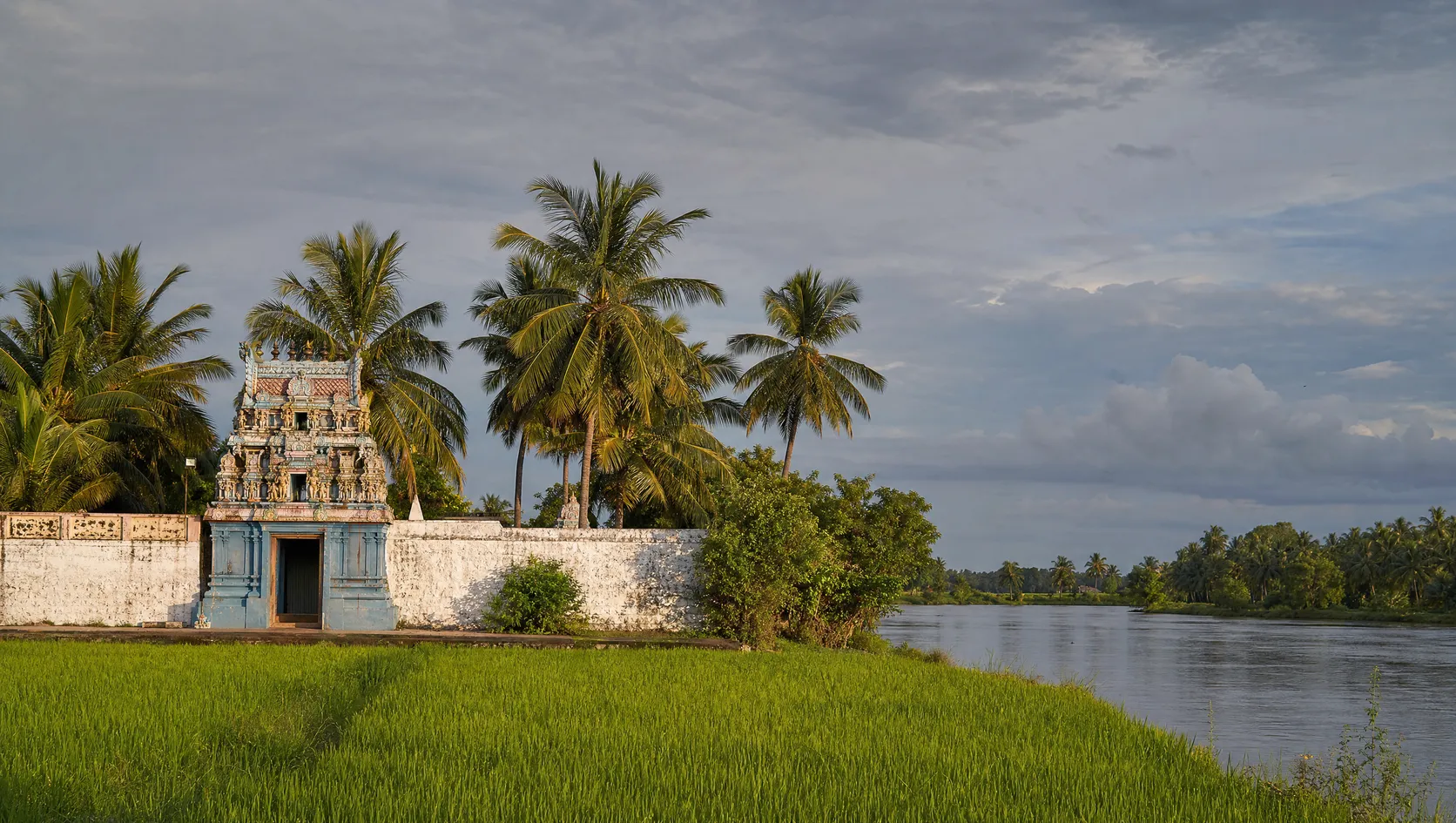
A serene Kaveri-delta Divya Desam where Vishnu stands as Vaiyam Kondan, the Lord who measured and holds the world
Thirukoodalur, Tamil Nadu, India
Tirukkūḍalūr (Vaiyam Koṇḍāṉ)Also known as: Vaiyam Kondan Perumal Temple, Aduthurai Perumal, Thirukoodaloor
Era
An ancient Divya Desam sung by Thirumangai Alvar in the first millennium, built and endowed in stone under the Cholas and later dynasties of the Kaveri delta
Architecture
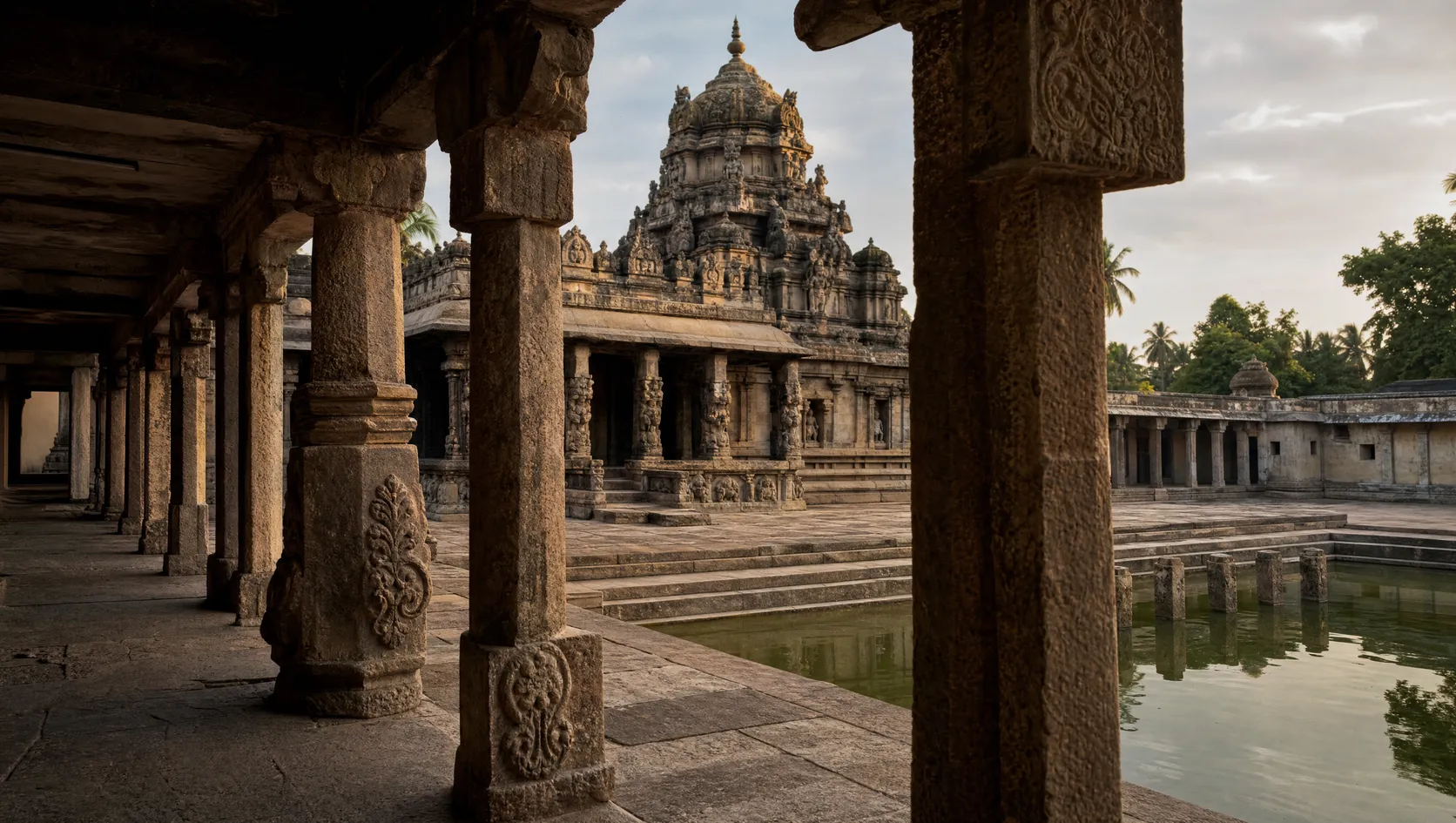
Dravidian temple architecture of the Kaveri delta, with a gopuram gateway, pillared halls and the sanctum of the standing Lord beneath its vimana, on the modest but complete scale of the delta Divya Desams
Open
07:00 – 20:00
Special
The temple observes the Srivaishnava round of daily worship to Vaiyam Kondan and Padmasani Thayar, with the recitation of the Nalayira Divya Prabandham on set occasions. As a smaller delta shrine its timings run in a morning and an evening session with a long midday closure, and should be confirmed locally before visiting.
The Sacred Legend · पवित्र कथा
Among the hundred and eight Divya Desams, the abodes of Vishnu sung by the Alvar poet-saints, many are the great pilgrim cities, thronged and towering; and many more are the quiet riverine shrines of the Kaveri delta, where the god stands in a small town among green fields and the slow water, waiting for the devotee who comes. Thirukoodalur, at Aduthurai on the Kaveri in the old Chola country, is one of these quieter abodes, and no less a Divya Desam for its stillness. Here Vishnu stands, not reclining as at Srirangam nor seated, but upright and gracious, and his name at this place is Vaiyam Kondan, the Lord who took the world, who measured and holds the earth. The name recalls the great deed of Vamana grown to Trivikrama, who with three strides spanned the worlds, and it names the god of this delta shrine as the one whose foot covers the whole earth even as he stands quietly in a small Tamil town. The very name Koodalur speaks of meeting and confluence, koodal, the joining of waters in the delta and, to the devotees, the joining of the soul with God. Sung by Thirumangai Alvar, the last and most prolific of the Alvars, Thirukoodalur is a place where the vast reach of the Lord who measured the worlds and the intimacy of a quiet riverside darshan are held together, and the pilgrim who comes to this unhurried shrine meets the same Vishnu who spans the three worlds, standing near at hand by the Kaveri.
Sacred Designationपवित्र पदनाम
Sacred Origin Storyपवित्र उत्पत्ति कथा
Source: The Srivaishnava tradition, the Sthala Purana of Thirukoodalur, and the name Vaiyam Kondan drawn from the Vamana-Trivikrama account
The name of the Lord at Thirukoodalur, Vaiyam Kondan, the one who took the world, carries within it the great story of Vishnu's descent as Vamana. In that account the demon king Mahabali, righteous and generous but grown too great, had won lordship over the three worlds, and the gods came to Vishnu for rescue. Vishnu was born as Vamana, a small brahmin boy, and came to Mahabali's sacrifice to beg a gift of three paces of ground. The king, scorning so slight a request, granted it; and the small boy grew to Trivikrama, the strider of three steps, until with one foot he covered the earth and with a second the heavens, and there was no place left for the third but the head of Mahabali himself, whom he pressed down to the netherworld, taking back the worlds for the gods.
At Thirukoodalur the Lord is worshipped as the one who did this deed, Vaiyam Kondan, the taker and holder of the world, and yet he stands here not in the vast striding form but quietly upright, gracious to the devotee, as if the same foot that measured the three worlds rests now upon the soil of this delta shrine. The tradition holds that the very greatness of the god who spanned the worlds is present in this standing image, so that the small delta town holds the Lord of all the earth.
The place-name Koodalur, from koodal, meeting or confluence, is read by the tradition as the meeting of the Lord and the devotee, the union that the whole path of Srivaishnavism seeks; and the delta setting, where the waters of the Kaveri divide and rejoin among the fields, is taken as the outward form of that inward confluence of the soul with God.
Sources cited:
- Sthala Purana of Thirukoodalur
- Nalayira Divya Prabandham and the hymns of Thirumangai Alvar
- Vamana-Trivikrama tradition of the Puranas
Other Traditions · अन्य परंपराएँ
The Srivaishnava Prabandham tradition of the Alvars and the Chola-country Divya Desams
Scholarly Context
Thirukoodalur is counted among the Divya Desams of the Chola Nadu, the group of Vishnu shrines of the old Chola heartland in the Kaveri delta, and its attestation as a sacred place rests on its inclusion in the Nalayira Divya Prabandham, sung by Thirumangai Alvar, whose activity is placed in the middle centuries of the first millennium. Like many delta Divya Desams it is a shrine of modest physical scale but full canonical standing, its sanctity carried more by the Prabandham than by monumental architecture. The standing form of the Lord and the name Vaiyam Kondan connect the shrine to the wider Vamana-Trivikrama theme found across Vishnu worship, in which the small brahmin who measured the worlds is one of the ten avataras; scholars note how a local shrine draws a pan-Indian myth into a particular place and image, so that a village by the Kaveri becomes the seat of the Lord who spanned the three worlds. The temple has been built and rebuilt in stone under the Cholas and the later dynasties of the delta, whose endowment of the many Divya Desams of the region is well attested in inscription. One recurring point of care in the tradition and in modern listings is the distinction of this Thirukoodalur, at Aduthurai near Kumbakonam, from the similarly named Koodalur near Tiruchirappalli; the two are separate shrines, and this one, the Divya Desam sung by Thirumangai Alvar as the abode of Vaiyam Kondan, is the temple of the Kaveri delta.
Historyइतिहास
Thirukoodalur is one of the 108 Divya Desams, the abodes of Vishnu sung by the Alvar poet-saints, and lies in the Kaveri delta of the old Chola country near Aduthurai, between the temple towns of Kumbakonam and Mayiladuthurai. Here Vishnu is worshipped as Vaiyam Kondan, the Lord who measured and holds the world, standing upright and gracious, with his consort Padmasani Thayar; the shrine belongs to the group of Chola Nadu Divya Desams that gather along the sacred river.
The temple's attested sanctity is ancient, resting on its inclusion in the Nalayira Divya Prabandham, the four thousand Tamil verses of the Alvars, in which it is sung by Thirumangai Alvar, the last and most prolific of these poet-saints. The mangalasasanam, the auspicious hymn of an Alvar, is what raises a shrine to the rank of a Divya Desam, and Thirukoodalur has held that rank in the memory and daily recitation of the Srivaishnava tradition ever since.
In stone the temple was built and enlarged under the Cholas, whose delta heartland is dense with Vishnu and Shiva shrines endowed across the centuries, and under the later dynasties who continued their patronage of the Divya Desams of the Kaveri. Like most of the delta shrines it is of modest size beside the great pilgrim temples, a gopuram, pillared halls and the sanctum of the standing Lord, complete in its worship but quiet in its scale.
Throughout its history the temple has kept the full Srivaishnava round of worship, with the recitation of the Prabandham beside the Sanskrit offerings, and the festivals of the Vaishnava year observed in their season. It has remained a living shrine of the delta, drawing the devotees of the Divya Desam pilgrimage who move from abode to abode of Vishnu along the Kaveri, and those of the surrounding country who come to the standing Lord.
A point of care in its history and its records is that this Thirukoodalur, at Aduthurai, is distinct from the Koodalur near Tiruchirappalli; it is this delta shrine, the abode of Vaiyam Kondan sung by Thirumangai Alvar, that is counted among the hundred and eight. Today it remains a serene and living Divya Desam, its worship unbroken, one of the many quiet seats of Vishnu that make the Kaveri delta a landscape of the god.
Historical Timelineऐतिहासिक कालक्रम
Thirumangai Alvar, the last and most prolific of the Alvars, sings Thirukoodalur in his Tamil hymns, gathered into the Nalayira Divya Prabandham, consecrating the shrine as a Divya Desam and giving it an attested sanctity of great antiquity.
The mangalasasanam of an Alvar is what raises a shrine to the rank of a Divya Desam; the Prabandham is the earliest firm evidence of Thirukoodalur's importance.
Under the Cholas, whose heartland lay in the Kaveri delta, the temple is built and endowed in stone along with the many Vishnu shrines of the region, establishing its lasting physical form.
The delta is dense with shrines endowed under the Cholas; the region's Divya Desams share this common history of Chola patronage.
Thirukoodalur is kept in the memory and daily recitation of the Srivaishnava tradition as one of the Chola Nadu Divya Desams, its worship following the pattern of the delta shrines of Vishnu along the Kaveri.
With the flowering of Srivaishnavism under Ramanuja and the acharyas, the Prabandham recitation and the organised worship of the Divya Desams are strengthened, and the delta shrines including Thirukoodalur are held within this living tradition.
The organisation of Prabandham worship under Ramanuja gave the many Divya Desams, great and small, a shared and continuing ritual life.
Under the Vijayanagara emperors and the Thanjavur and Madurai Nayakas, the temples of the Kaveri delta receive renewed endowment and repair, and the worship of its Divya Desams including Thirukoodalur is sustained through the later medieval centuries.
The temple maintains the full Srivaishnava round of worship to Vaiyam Kondan and Padmasani Thayar, with the Prabandham recited beside the Sanskrit offerings and the festivals of the Vaishnava year kept in their season.
The Divya Desams of the Kaveri delta, Thirukoodalur among them, are recorded in colonial-era surveys and gazetteers of the Tanjore country, which note the dense network of Vishnu and Shiva shrines of the delta.
The temple is maintained under the Tamil Nadu Hindu Religious and Charitable Endowments administration, which oversees the great majority of the Divya Desams of the state, and continues as a functioning shrine of the delta.
In modern Divya Desam listings and pilgrim guides, care is taken to distinguish this Thirukoodalur at Aduthurai, the abode of Vaiyam Kondan sung by Thirumangai Alvar, from the similarly named Koodalur near Tiruchirappalli.
The similarity of the names has led to confusion in some accounts; the Divya Desam of Vaiyam Kondan is the Aduthurai shrine of the delta.
Thirukoodalur remains a serene and living Divya Desam, its worship unbroken, drawing the devotees of the Divya Desam pilgrimage who move from abode to abode of Vishnu along the Kaveri, and the people of the surrounding delta country.
The temple observes the great Vaishnava festivals, above all Vaikuntha Ekadasi in Margazhi and the annual Brahmotsavam, when the standing Lord is honoured with the fuller ceremony that gathers the delta's devotees.
What You'll Seeदर्शन में
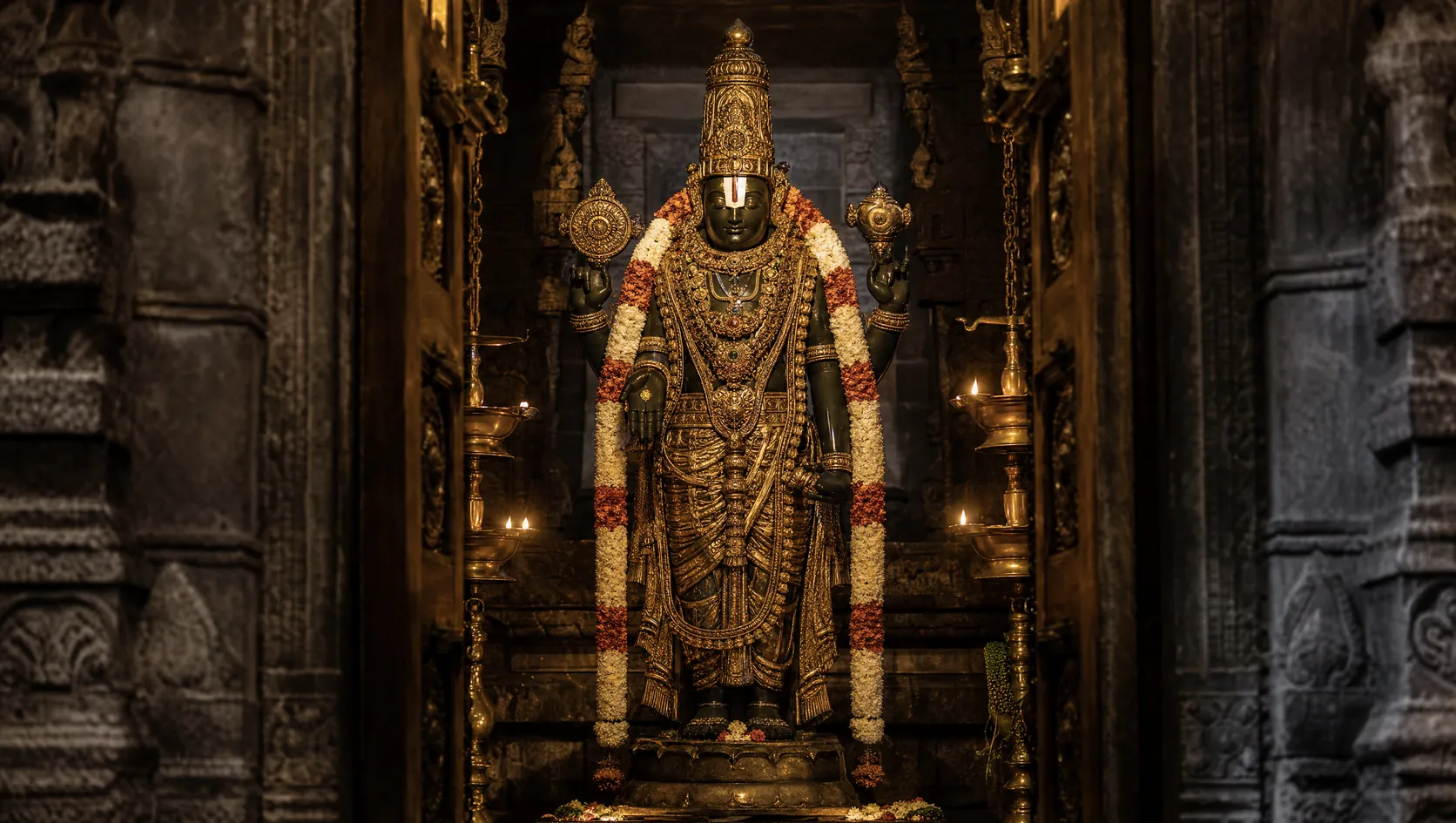
The presiding image of Thirukoodalur is Vaiyam Kondan, Vishnu standing upright in the sanctum, the Lord who measured and holds the world. Unlike the reclining Ranganatha of Srirangam or the seated forms of other shrines, here the god is worshipped in the standing posture, the nindra thirukolam, gracious and near, holding the discus and conch that mark him as Vishnu, and known also as Aduthurai Perumal for the place he stands in.
The name Vaiyam Kondan gives the standing image its meaning. It recalls the Vamana who grew to Trivikrama and with three strides took back the three worlds, so that the quiet standing Lord of this delta shrine is understood as the same god whose foot spans the earth and the heavens. The tradition holds the greatness of that cosmic deed present in the still, upright form, a whole world held by the one who stands here in a small town by the Kaveri.
His consort is Padmasani Thayar, the goddess of the shrine, worshipped in her own precinct as the Sri who is inseparable from Vishnu and the mediatrix of his grace. The Moolavar, the immovable stone image in the sanctum, is joined in worship by the processional image, the utsava murti, carried in the festivals through the streets around the temple.
As at every Divya Desam, the iconography is completed by the presence of the Alvar in the tradition of the place: Thirukoodalur is what it is because Thirumangai Alvar sang the standing Lord here, and the shrine holds within its worship the memory of that consecrating hymn. The standing Vaiyam Kondan, gracious to the devotee who comes, with Padmasani beside him and the Alvar's verses upon him, is the iconographic pattern of this quiet abode of the Lord who holds the world.
Distinctive Practicesविशिष्ट परंपराएँ
Recitation of the Nalayira Divya Prabandham
नालायिर दिव्य प्रबंधम् का पाठ
Daily in worship and centrally in the Adhyayana Utsavam
As at every Divya Desam, the Tamil hymns of the Alvars, the Nalayira Divya Prabandham, are recited in the temple's worship beside the Sanskrit offerings, and above all the verses of Thirumangai Alvar that consecrated this shrine are sung before Vaiyam Kondan, keeping alive the hymn by which the place became one of the hundred and eight.
In Srivaishnavism the Prabandham is the Dravida Veda, the Veda in Tamil, and the Alvars are seers on a level with the ancient rishis. To sing Thirumangai Alvar's hymn before the standing Lord is not a memorial but a worship: the very verses that made the shrine a Divya Desam are offered back to the god they consecrated, so that the recitation renews at each turn the bond between the Alvar's vision and the Lord who stands to be seen. The hymn is what keeps a small delta shrine alive in the memory of the whole tradition.
Darshan of the Standing Vaiyam Kondan
खड़े वैयम् कोंडान का दर्शन
Year-round, in the daily worship
Devotees come for the darshan of Vishnu in the standing posture as Vaiyam Kondan, the Lord who measured and holds the world, and meditate before the still upright image on the greatness of the god who spanned the three worlds now standing near at hand, gracious to the one who comes to a quiet shrine by the Kaveri.
The standing form holds together two truths the tradition loves to join: the Lord's boundless greatness and his nearness to the devotee. To stand before Vaiyam Kondan is to remember that the god who took the whole world in three strides is the same who waits, quietly upright, to receive the one soul that comes to him. The darshan of the standing Lord is thus a meeting of the immeasurable and the intimate, the confluence that the very name of Koodalur, the place of meeting, holds out to the worshipper.
The Kaveri-Delta Divya Desam Pilgrimage
कावेरी-डेल्टा दिव्य देशम् तीर्थ
Year-round, especially in the pilgrim seasons
Thirukoodalur is one abode among the many Divya Desams of the Chola Nadu strung along the Kaveri, and devotees come to it as part of the larger pilgrimage that moves from shrine to shrine of Vishnu across the delta, gathering the darshan of the Lord in his many forms, standing, seated and reclining, through the sacred river country.
To make the pilgrimage of the Divya Desams is to follow the Alvars' own footsteps, who wandered from abode to abode singing the Lord, and to gather the whole vision of Vishnu that no single shrine can hold. Each delta abode adds its form and its name to the pilgrim's darshan, and Thirukoodalur gives the standing Vaiyam Kondan, the holder of the world, to that gathering vision. The many quiet shrines together make the Kaveri delta a single landscape of the god, and the pilgrimage binds them into one act of devotion.
Did You Know?क्या आप जानते हैं?
Thirukoodalur is one of the 108 Divya Desams, the abodes of Vishnu sung by the Alvars, a Kaveri-delta shrine of the old Chola country near Aduthurai.
Srivaishnava Divya Desam tradition
Here Vishnu is worshipped as Vaiyam Kondan, the Lord who measured and holds the world, standing upright rather than reclining or seated.
Sthala Purana of Thirukoodalur
The name Vaiyam Kondan recalls the Vamana who grew to Trivikrama and with three strides took back the three worlds, one of the ten avataras of Vishnu.
Vamana-Trivikrama tradition
The shrine is sung by Thirumangai Alvar, the last and most prolific of the twelve Alvars, whose hymn is what raises it to the rank of a Divya Desam.
Nalayira Divya Prabandham
The presiding goddess is Padmasani Thayar, worshipped in her own precinct as the Sri inseparable from Vishnu and the mediatrix of his grace.
Temple tradition
The place-name Koodalur, from koodal meaning meeting or confluence, is read by the tradition as the union of the soul with God, mirrored in the joining of the delta's waters.
Srivaishnava tradition
The Lord is also known as Aduthurai Perumal, after the town of Aduthurai on the Kaveri where the shrine stands.
Temple tradition
This Thirukoodalur at Aduthurai is distinct from the similarly named Koodalur near Tiruchirappalli; it is the delta shrine of Vaiyam Kondan that is counted among the Divya Desams.
Divya Desam listings
Thirukoodalur belongs to the Chola Nadu group of Divya Desams, the Vishnu shrines gathered along the sacred Kaveri in the old Chola heartland.
Divya Desam tradition
Visitor Accessप्रवेश जानकारी
The temple is open to devotees for the darshan of Vaiyam Kondan and Padmasani Thayar. As at the Vaishnava temples of the south, entry to the innermost sanctum may be restricted according to the temple's tradition, and this is observed at the shrine. As a smaller delta Divya Desam the temple keeps a morning and an evening session with a long midday closure, and the priest may need to be found to open the sanctum outside busier hours; it is wise to confirm timings before travelling, especially for those making the Divya Desam pilgrimage from shrine to shrine. A dress code of traditional attire applies, and footwear is left outside the temple. On ordinary days the shrine is quiet and the darshan unhurried; on festival days, above all Vaikuntha Ekadasi and the Brahmotsavam, it draws the larger gatherings of the delta. Confirm current timings and any restrictions locally before visiting.
Spiritual Basis
The quiet of the delta shrine is itself part of its spiritual character. Where the great temples overwhelm with scale, a small Divya Desam offers the darshan of the Lord in stillness, one devotee before the standing god with little between them; the tradition values this intimacy as a form of the nearness that Srivaishnavism seeks. The restriction of the innermost sanctum, where it is observed, follows the practice of the Vaishnava temples of the south, which preserve the ritual purity of the sanctum according to their tradition. The god's accessibility is held to be real within these forms: Vaiyam Kondan is the Lord who holds the whole world and yet stands to receive the single soul that comes to him, and the very smallness of the shrine makes that meeting the more direct. The devotee who finds the sanctum open meets the Lord of the three worlds face to face by the Kaveri.
Contemporary Context
Thirukoodalur is a serene rural Divya Desam, far quieter than the great pilgrim temples, and most of its visitors are devotees making the Divya Desam pilgrimage of the Kaveri delta or people of the surrounding country. On ordinary days a visitor may have the darshan of the standing Lord in near solitude, an experience the busier shrines cannot give. Because the temple keeps limited hours and a long midday closure, and because the priest may serve more than one shrine, it is best to plan the visit around the morning or evening session and to confirm timings ahead, especially when combining several delta abodes in a single journey. The festivals, above all Vaikuntha Ekadasi and the Brahmotsavam, bring the fuller gatherings of the delta and a livelier celebration around the standing Vaiyam Kondan.
Practical Guidance
Plan the visit around the morning or evening session, since the temple closes for a long midday break, and confirm the timings ahead, especially if travelling from a distance or combining several Divya Desams of the delta in one day. Allow a little time to find the priest if arriving in quieter hours. Dress traditionally and leave footwear outside. Thirukoodalur is easily combined with the nearby Divya Desams and the great temples of the Kaveri delta, with Kumbakonam and Mayiladuthurai as convenient bases; many pilgrims see it as one abode within a longer pilgrimage of the delta shrines. Take care to reach this Thirukoodalur at Aduthurai, the abode of Vaiyam Kondan, rather than the similarly named Koodalur near Tiruchirappalli.
Festivalsत्योहार
Vaikuntha Ekadasi
वैकुण्ठ एकादशी
Dec-Jan (Margazhi)
The great Vaishnava festival of the opening of the gate of heaven, kept at Thirukoodalur as at every Divya Desam, when Vaiyam Kondan is honoured with special worship and the devotees of the delta gather for the most sacred day of the Vaishnava year.
Brahmotsavam
ब्रह्मोत्सवम्
annual, in its appointed month
The great annual festival of the temple, over which the processional Vaiyam Kondan is taken in procession on the vahanas around the shrine and streets, the fullest celebration of the standing Lord's public presence in the delta town.
Panguni Uthiram
पंगुनि उत्तिरम्
Mar-Apr (Panguni)
The spring festival of Panguni, kept at the Vishnu shrines of the south, observed at Thirukoodalur with special worship of Vaiyam Kondan and Padmasani Thayar, a season of celebration in the temple's calendar.
Adhyayana Utsavam
अध्ययन उत्सवम्
Dec-Jan (Margazhi), around Vaikuntha Ekadasi
The festival of the recitation of the Nalayira Divya Prabandham, when the Tamil hymns of the Alvars, and above all the verses of Thirumangai Alvar that consecrated the shrine, are chanted in full before Vaiyam Kondan, a central observance of the Srivaishnava year.
Traditional Offeringsपारंपरिक अर्पण
Primary Offerings
Tulasi (holy basil)
तुलसी
तुलसी
Tulasi, the holy basil beloved of Vishnu, is the offering most proper to Vaiyam Kondan as to any form of Vishnu, laid at his feet and woven into his garlands. No worship of Vishnu is complete without it, and at Thirukoodalur it is offered to the standing Lord in the daily worship.
Garlands of flowers
पुष्प-मालाएँ
पुष्पमाला
Garlands of flowers, with tulasi, are offered to Vaiyam Kondan and to the goddess Padmasani Thayar, and garlands that have adorned the deity are returned to devotees as a blessing carrying the touch of the Lord.
Sacred food (prasadam)
प्रसाद
प्रसाद
The food offered to Vaiyam Kondan and shared with devotees as prasadam, the sweet and savoury offerings of the Vaishnava temples of the delta, is received as the Lord's grace made tangible, a portion of what has been given to the god returned to those who come.
Lamp offering (deepa)
दीप भेंट
दीप
The offering of lamps before the standing Lord, the waving of light in the arati and the lighting of lamps by devotees, is a central act of the temple's worship, the light offered to the god who holds the world and returned as his blessing upon those who see it.
Recitation of the Prabandham and the Sahasranama
प्रबंधम् और सहस्रनाम का पाठ
स्तोत्रपाठ
Beyond material offerings, the recitation of the Alvars' Tamil hymns, above all the verses of Thirumangai Alvar that consecrated the shrine, and of the Vishnu Sahasranama, the thousand names of Vishnu, is held a high offering to Vaiyam Kondan, the god worshipped as much in sung word as in flower and food.
Unique to This Temple
The Offering at the Confluence: Surrender to Vaiyam Kondan
संगम पर भेंट: वैयम् कोंडान को शरणागति
What is particular to Thirukoodalur, the place whose very name, Koodalur, means the meeting or confluence, is that its highest offering is the meeting of the soul with the Lord, the surrender that the whole path of Srivaishnavism seeks. The tradition reads the joining of the delta's waters as the outward sign of that inner confluence, and holds that the devotee who comes to the standing Vaiyam Kondan is invited to give himself to the god who holds the world. A pilgrim brings tulasi, flowers, food and lamp as at any shrine of Vishnu, but the offering the tradition holds highest here is the turning of the heart to the Lord who measured the three worlds and yet stands near at hand, the surrender of the self in the trust that he receives all who come. The offering and the blessing meet in that confluence: the devotee gives himself, and the Lord who holds the world gives his grace.
Offerings at Thirukoodalur follow the Srivaishnava tradition, with tulasi, flowers, garlands, prasadam and the lamp central, and the recitation of the Prabandham and the Vishnu Sahasranama held as offerings of word. As a smaller delta shrine its arrangements are simpler than at the great temples. Eternal Raga presents these practices as a devotional tradition; specific seva and offering arrangements should be confirmed with the temple.
How to Reachकैसे पहुँचें
Thirukoodalur lies in the Kaveri delta near Aduthurai, between the temple towns of Kumbakonam and Mayiladuthurai in central Tamil Nadu, in the country of the old Cholas.
By air: Tiruchirappalli International Airport is the nearest airport, roughly 90 km away, connected to Chennai and several domestic and international destinations; Chennai's larger airport is the alternative for wider connections.
By rail: Kumbakonam and Mayiladuthurai junctions are the major railheads serving the area, on the delta lines connected to Chennai, Thanjavur, Tiruchirappalli and the wider network; Aduthurai is reached from these by road.
By road: Aduthurai and Thirukoodalur are reached by road from Kumbakonam and Mayiladuthurai, which are the natural bases, by bus, auto or taxi through the delta country of fields and river branches. The many Divya Desams and great temples of the delta are close together, and local transport connects them.
Most pilgrims come to Thirukoodalur as one abode within the Divya Desam pilgrimage of the Kaveri delta, combining it with the nearby Vishnu shrines and the great temples of Kumbakonam and the surrounding country. Take care to reach this Thirukoodalur at Aduthurai, distinct from the Koodalur near Tiruchirappalli.
Plan Your Visitयात्रा की योजना
🌤 Best Season
October to March is the most comfortable time to visit the Kaveri delta, with milder weather over the river plain. The Margazhi month (December-January) brings the temple's greatest observances, Vaikuntha Ekadasi and the Adhyayana Utsavam, a spiritually rich season across all the Divya Desams of the delta. April to June is hot in the plain, though Panguni Uthiram falls in the spring and is a season of celebration. The southwest and northeast monsoons bring rain to the delta but the temple remains accessible; the northeast monsoon in particular greens the country and fills the river branches. The morning and evening sessions are the times of worship; because of the long midday closure, plan the darshan for these hours. On ordinary days the shrine is serene and unhurried, and the standing Lord may be seen in near solitude.
👘 Dress Code
Traditional and modest dress is expected. Men commonly wear a dhoti or trousers with a shirt; women a saree or salwar kameez. Footwear is left outside the temple. As a Vaishnava shrine of the delta, Thirukoodalur expects respectful traditional attire within its precincts.
📱 Phones & Photography
Photography is generally restricted within the sanctum, and phones should be silenced within the shrine. Follow the posted rules and the directions of the temple priest and staff, and refrain from photographing the deity where it is not permitted.
🏨 Accommodation
There is little accommodation at the shrine itself, and most visitors stay at Kumbakonam or Mayiladuthurai, the nearby temple towns, which together offer a full range of lodges, guest houses and hotels convenient for the Divya Desam pilgrimage of the delta. From these bases the many shrines of the region, Thirukoodalur among them, are easily reached in a day's touring. Demand rises around the great festivals, above all Vaikuntha Ekadasi, when booking ahead is advisable; outside the festivals the delta towns absorb their pilgrims easily. Kumbakonam in particular, being a large temple town, has ample options for those making the round of the Divya Desams and the great shrines of the Kaveri.
Sacred Soundsपवित्र ध्वनि
Did You Know? · क्या आप जानते हैं?
The same translation error that turned '33 Koti' into '33 crore' in Hinduism also happened in Buddhism. The Chinese translation of Buddhist texts rendered 'Sapta Koti Buddha' (7 Supreme Buddhas) as '7 Crore Buddhas.' The Tibetan translation got it right: 7 types, not 7 crore. One Sanskrit word, misread across two major world religions, generated two identical misconceptions independently.
Related Contentसंबंधित सामग्री
Related Scriptures
Community Reflections
🕉️
Be the first to share your reflection.