Thiruvananthapuram Anantha Padmanabha
तिरु अनंत पद्मनाभ
The celestial Ocean of Milk among the 108 Divya Desams, where Vishnu reclines on Adisesha, with its earthly temple of Prasanna Venkatesa
Thiruvananthapuram, Kerala, India
Tiruppārkaḍal (Prasanna Veṅkaṭeśa)Also known as: Thiruparkadal, Prasanna Venkatesa Perumal Temple, Ksheerabdhi Nathan, Paarkadal
Era
An abode of great antiquity as a celestial Divya Desam sung by the Alvars in the first millennium; the earthly Prasanna Venkatesa temple that represents it stands in the old temple country near Thakkolam and Kanchipuram and has been maintained and renewed over the centuries
Architecture
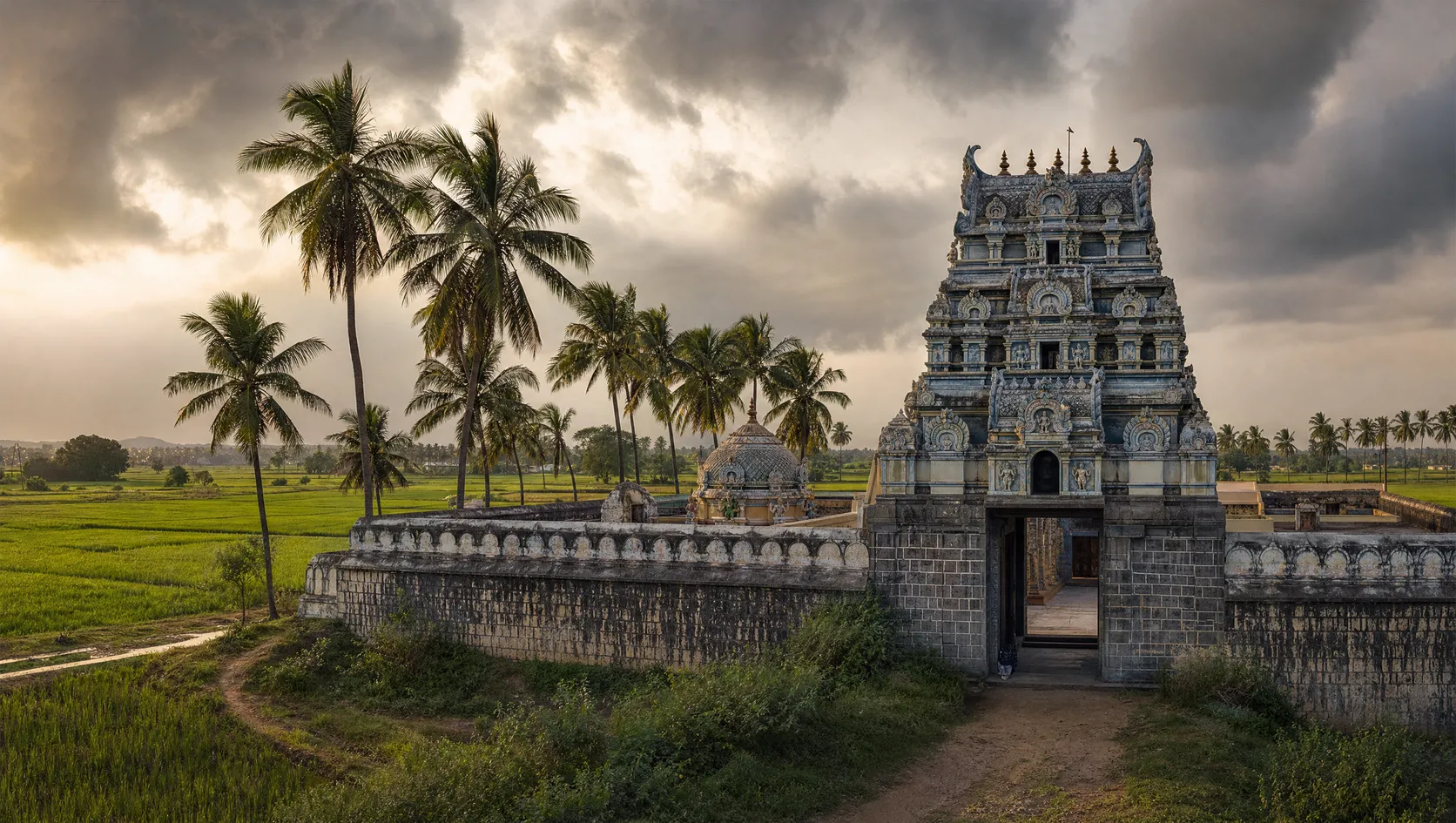
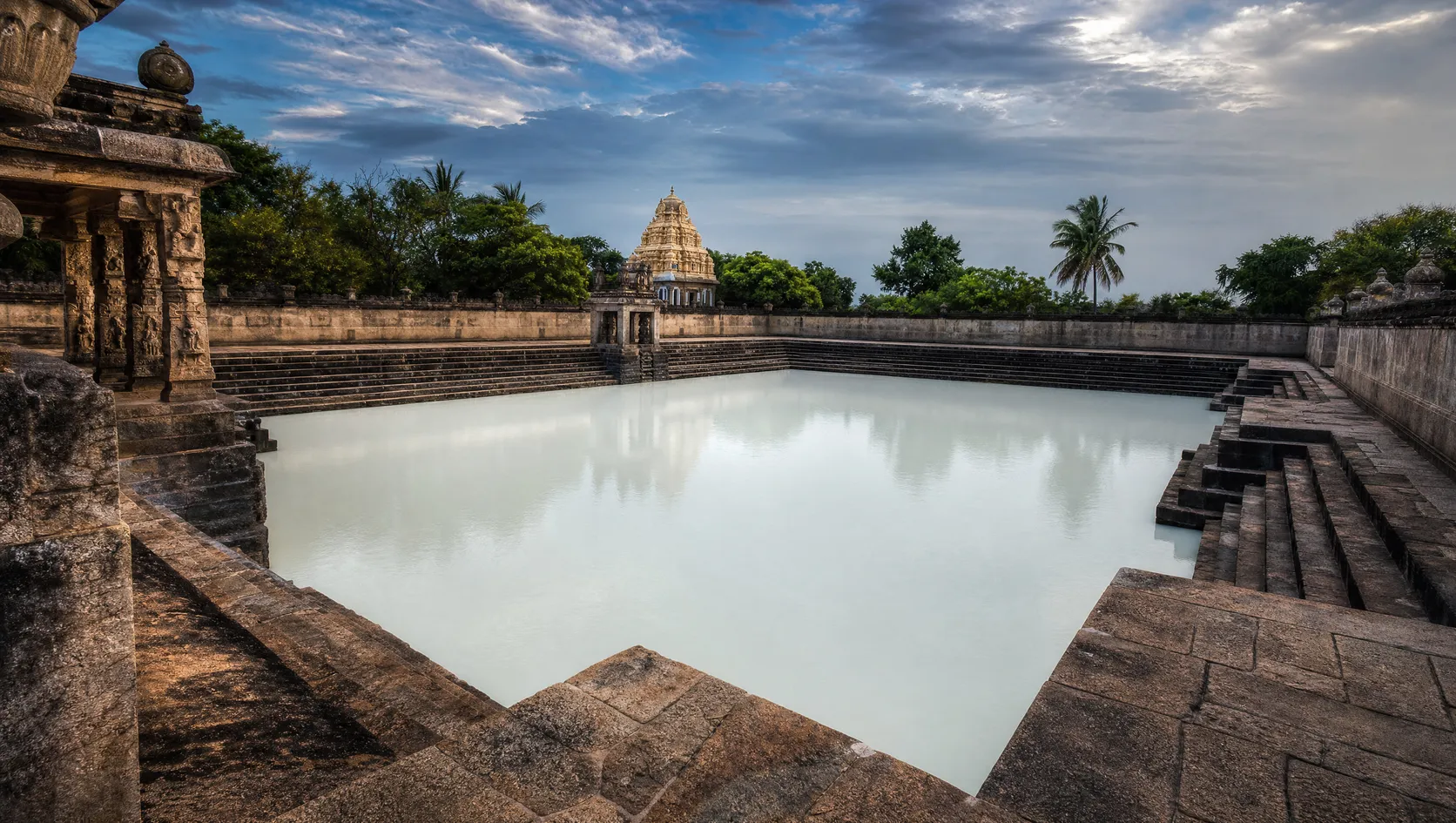
A Dravidian temple of modest village scale, with a gopuram gateway, the sanctum of Prasanna Venkatesa and its vimana, and the sacred tank, standing for the vast celestial Ocean of Milk it represents
Open
07:00 – 19:00
Special
The temple observes the daily worship of Prasanna Venkatesa in the Srivaishnava manner, with the recitation of the Nalayira Divya Prabandham at set occasions. Timings run in a morning and an evening session with a long midday closure, as at village temples, and vary with the festival calendar; they should be confirmed locally before travelling.
The Sacred Legend · पवित्र कथा
Among the hundred and eight Divya Desams, the abodes of Vishnu sung by the Alvar poet-saints, all but two are places a pilgrim can walk to. Two are not: Paramapadam, the highest heaven, Vaikuntha itself; and Thiruparkadal, the Ocean of Milk. Thiruparkadal is the paal-kadal, the great sea of milk of the cosmos, upon which Vishnu reclines on the coils of the serpent Adishesha in yoga-nidra, the sleep from which the worlds are dreamed. It is the abode the Alvars sang not by travelling to it but by seeing it in vision, the celestial ocean where the Lord lies between the ages of the world. This is the sea that the gods and the demons churned together in the Samudra Manthana, the churning of the ocean, using the mountain Mandara for a churning-staff and the serpent Vasuki for a rope, and from which arose, after much else, the amrita, the nectar of deathlessness, and the goddess Lakshmi herself, rising from the milk-waters as the Lord's eternal consort. The Ocean of Milk is thus the source of the nectar and the birthplace of the Goddess, and its Lord is Vishnu asleep upon the serpent at the still centre of creation. Because the Divya Desam of Thiruparkadal lies beyond the earth, the tradition gives it an earthly seat where devotees may worship the Lord of the Milk Ocean: the temple of Prasanna Venkatesa Perumal at the village of Thiruparkadal, near Thakkolam in northern Tamil Nadu, which bears the sacred name and stands as the ground-representative of the celestial sea. To come here is to stand, in the tradition's understanding, at the shore of the Ocean of Milk itself, before the Lord who sleeps upon it and grants the nectar of his grace.
Sacred Designationपवित्र पदनाम
Sacred Origin Storyपवित्र उत्पत्ति कथा
Source: The Srivaishnava tradition, the Puranic account of the churning of the Ocean of Milk, and the Divya Desam tradition of the Alvars
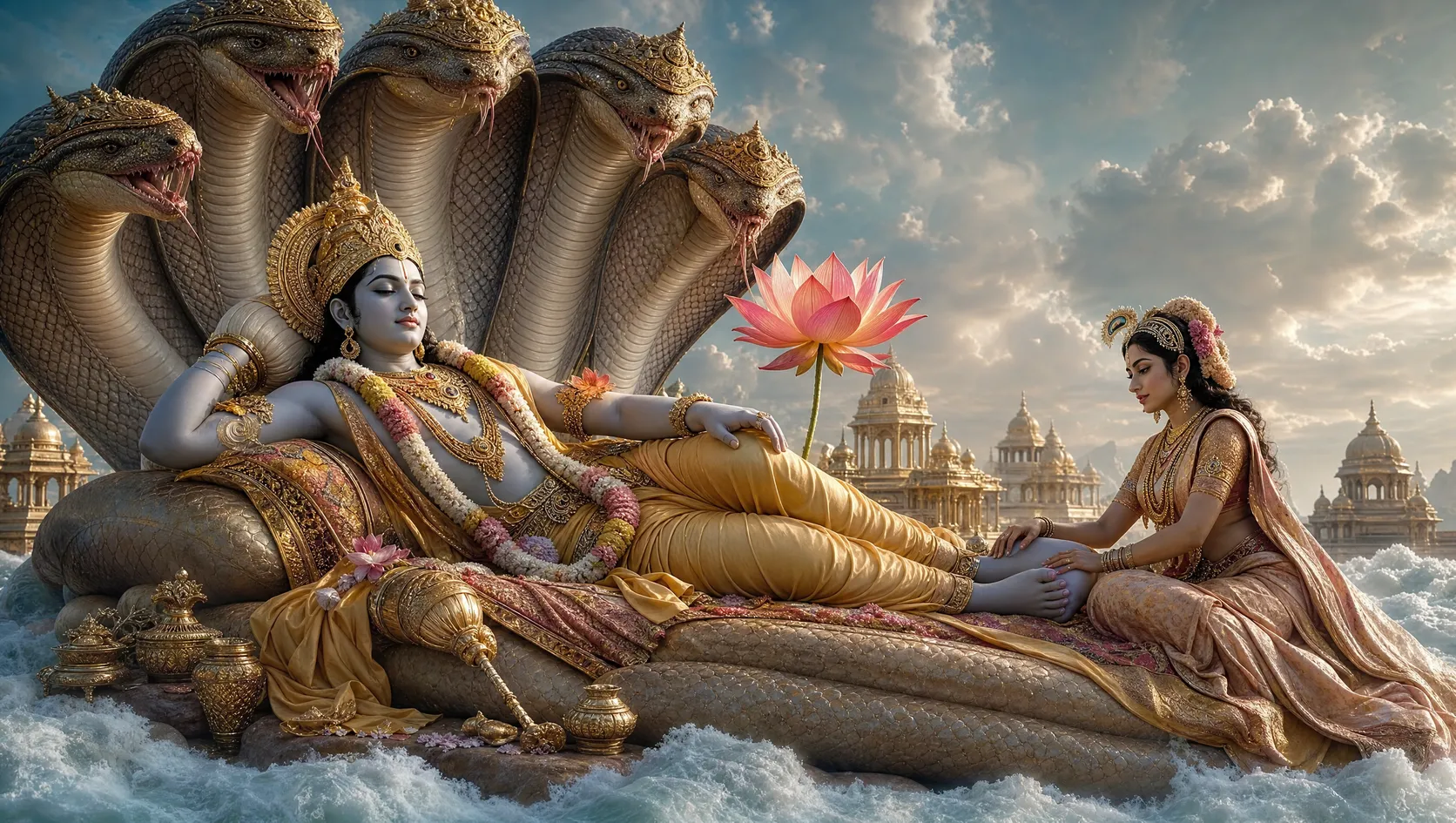
The Ocean of Milk, the Ksheera Sagara, is in the Puranas the greatest of the cosmic seas, white as milk, upon whose waters Vishnu reclines on the thousand-hooded serpent Adishesha, floating between the dissolution and the making of the worlds. This is Vishnu in yoga-nidra, the cosmic sleep, and from the lotus that rises from his navel is born Brahma, who fashions the worlds anew; so the Ocean of Milk is the very seedbed of creation, and its sleeping Lord the ground of all that is.
The most celebrated event of this ocean is the Samudra Manthana, the churning of the sea. The gods, weakened and robbed of their fortune, are counselled by Vishnu to churn the Ocean of Milk for the amrita, the nectar of deathlessness, and to do it in alliance with their enemies the demons. They take the mountain Mandara for a churning-staff and the great serpent Vasuki for the churning-rope, and Vishnu, as the tortoise Kurma, bears the mountain upon his back so that it does not sink. Gods and demons pull the serpent to and fro, and the ocean yields up its treasures one by one: the poison Halahala, which Shiva drinks to save the worlds; the wish-cow, the moon, the celestial tree and the divine physician Dhanvantari bearing at last the pot of amrita; and, rising radiant from the milk-waters, the goddess Lakshmi herself, who chooses Vishnu for her Lord.
So the Ocean of Milk is the source of the nectar and the birthplace of the Goddess, and its Lord is Vishnu at the still centre of the churning world. The Alvars, singing the abodes of Vishnu, sang this celestial ocean among them, seeing in vision the Lord asleep upon the serpent; and because the abode lies beyond the earth, its worship was given a seat on the ground, at the temple of Prasanna Venkatesa that bears the name Thiruparkadal, so that the pilgrim may stand at the shore of the Ocean of Milk and worship the Lord who sleeps upon it.
Sources cited:
- Puranic account of the Samudra Manthana (churning of the Ocean of Milk)
- Nalayira Divya Prabandham and the Srivaishnava Divya Desam tradition
- Sthala tradition of the Prasanna Venkatesa temple at Thiruparkadal
Other Traditions · अन्य परंपराएँ
The Srivaishnava tradition on the earthly seat of a celestial abode
Scholarly Context
The Divya Desams, the hundred and eight abodes of Vishnu sung by the twelve Alvar poet-saints of the Tamil country, are among the most studied features of Srivaishnavism. The great majority are identifiable temples across southern India and beyond, but the tradition itself counts two of the hundred and eight as lying outside the earthly world: Thirupparamapadam, the highest heaven of Vaikuntha, and Thiruparkadal, the Ocean of Milk on which Vishnu reclines. Thiruparkadal is thus a celestial Divya Desam, an abode the Alvars celebrated in vision rather than as a place of pilgrimage. The Ocean of Milk, the Ksheera Sagara, is one of the oldest and most widely attested images of Vishnu in the Sanskrit tradition, the setting of his cosmic sleep and of the Samudra Manthana, the churning of the sea for the nectar, a narrative found across the Puranas and depicted in temple art throughout the Indian world. The Alvars, drawing on this pan-Indian imagery in their Tamil hymns, folded the milk-ocean into their map of Vishnu's abodes. The earthly temple of Prasanna Venkatesa at the village of Thiruparkadal, near Thakkolam in the old temple country of the northern Tamil plains between Kanchipuram and Arakkonam, is understood in the tradition as the ground-representative of this celestial abode, bearing the sacred name. Scholars treat Thiruparkadal as a valuable case of how the Alvar tradition maps a cosmic, non-terrestrial abode onto the pilgrimage landscape, giving a heavenly ocean a shrine that devotees can reach.
Historyइतिहास
Thiruparkadal is one of the 108 Divya Desams, the abodes of Vishnu sung by the Alvar poet-saints in the Nalayira Divya Prabandham, and it holds a rare place among them: it is one of only two of the hundred and eight that the tradition counts as lying beyond the earth, the other being Paramapadam, the highest heaven of Vaikuntha. Thiruparkadal is the Ksheera Sagara, the celestial Ocean of Milk, upon which Vishnu reclines on the serpent Adishesha, the setting of his cosmic sleep and of the great churning of the sea from which the nectar and the goddess Lakshmi arose.
Because the abode is celestial and not a place a pilgrim can travel to, the tradition provides an earthly seat where the Lord of the milk-ocean may be worshipped on the ground: the temple of Prasanna Venkatesa Perumal at the village of Thiruparkadal, near Thakkolam in the northern Tamil plains. The village and its temple bear the sacred name of the celestial ocean and stand, in the tradition's understanding, as its representative on earth, so that devotees who cannot ascend to the milk-sea may worship its Lord here.
The country around Thakkolam, between Kanchipuram and Arakkonam, is old temple land, worked over by the Pallavas, the Cholas and the dynasties after them, and dotted with shrines of great antiquity; Thakkolam itself is remembered in regional history as the site of a great medieval battle. The Prasanna Venkatesa temple stands in this landscape, a modest village temple carrying a cosmic name, maintained and renewed by its community over the generations in the ordinary way of the smaller Divya Desams, which lack the vast endowments of the great temples but keep their sanctity undimmed.
Worship at Thiruparkadal follows the Srivaishnava tradition, with the recitation of the Nalayira Divya Prabandham beside the Sanskrit texts and the offering of tulasi to the Lord. The temple observes the festivals of the Vaishnava year, above all Vaikuntha Ekadasi, when the gate of heaven is opened, and the Ksheerabdhi Dwadasi, the day sacred to the Ocean of Milk itself, which the temple's very name and character make peculiarly its own. Thiruparkadal remains a living Divya Desam, drawing pilgrims who make the round of the abodes and seek, at this quiet village shrine, the presence of the Lord who sleeps upon the sea of milk at the centre of the world.
Historical Timelineऐतिहासिक कालक्रम
The Alvars, the Tamil poet-saints of Vishnu, sing the Ocean of Milk among the abodes of the Lord in the hymns gathered as the Nalayira Divya Prabandham, giving Thiruparkadal its place among the 108 Divya Desams as a celestial abode beheld in vision.
The Alvars' activity is generally placed across the middle centuries of the first millennium; their hymns are the foundation of the Divya Desam tradition.
The Ocean of Milk is celebrated across the Puranas as the setting of Vishnu's cosmic sleep on Adishesha and of the Samudra Manthana, the churning of the sea from which the amrita and the goddess Lakshmi arose, the pan-Indian imagery that the Alvars drew upon in naming Thiruparkadal.
The churning of the Ocean of Milk is among the most widely depicted narratives of the Indian tradition, found across many Puranas and in temple art throughout the region.
The Srivaishnava tradition, systematising the abodes sung by the Alvars into the canonical list of 108 Divya Desams, counts Thiruparkadal among the two that lie beyond the earth, alongside Paramapadam, the highest heaven, marking it as a celestial rather than a terrestrial abode.
The counting of Thiruparkadal and Paramapadam as celestial abodes is a settled feature of the classical Divya Desam enumeration.
The country around Thakkolam, between Kanchipuram and Arakkonam, is developed as temple land under the Pallavas and Cholas, whose shrines dot the northern Tamil plains; the Prasanna Venkatesa temple stands within this old landscape of Vaishnava worship.
Thakkolam and its surrounding country hold shrines of considerable antiquity from the Pallava and Chola centuries.
Thakkolam, near the village of Thiruparkadal, is remembered in regional history as the site of a great medieval battle between the Cholas and the Rashtrakutas, a marker of the antiquity and importance of the country in which the temple stands.
The Battle of Takkolam is a noted event of tenth-century South Indian history; it is cited here to place the temple's locale, not the temple itself, in historical time.
The earthly seat of the celestial Ocean of Milk takes shape as the Prasanna Venkatesa temple at Thiruparkadal, maintained through the medieval centuries as one of the smaller Divya Desams, carrying the sacred name of the milk-ocean it represents.
The smaller Divya Desams are often maintained by local communities over long spans without the extensive inscriptional record of the great temples; precise construction dates are seldom fixed.
In the wider pattern of the northern Tamil country under the Vijayanagara empire and the Nayakas, the Vaishnava temples of the region receive patronage and renewal, and the worship of the Divya Desams, including the smaller abodes, is sustained through these centuries.
Thiruparkadal is kept in the living memory of the Srivaishnava community as one of the 108 Divya Desams to be honoured in the pilgrimage round of the abodes, its celestial character making it a place of particular contemplation among the sung shrines of Vishnu.
The Divya Desam tradition, including the celestial abodes of Thiruparkadal and Paramapadam, is documented in colonial-era studies and compilations of Srivaishnava sacred geography, which record the canonical list of the 108 and the peculiar standing of the two abodes beyond the earth.
The Prasanna Venkatesa temple is renewed by its community in the modern age, with consecration rites in the customary manner of Tamil temples, keeping the worship of the Lord of the Ocean of Milk alive at his earthly seat.
Periodic consecration (kumbhabhishekam) is the ordinary means by which Tamil temples are renewed; details for this shrine should be confirmed locally.
Thiruparkadal remains a living Divya Desam, drawing pilgrims who make the round of the 108 abodes and come to this quiet village shrine to worship the Lord who sleeps upon the celestial Ocean of Milk, above all on Vaikuntha Ekadasi and the Ksheerabdhi Dwadasi.
What You'll Seeदर्शन में
The abode of Thiruparkadal, in its celestial nature, is Vishnu reclining at full length upon the coils of the thousand-hooded serpent Adishesha, floating upon the Ocean of Milk, the great white sea of the cosmos. This is the Lord in yoga-nidra, the cosmic sleep between the ages of the world, from whose navel-lotus Brahma is born to fashion the worlds anew; the serpent's many hoods spread above him as a canopy, and the goddess Lakshmi, who arose from these very milk-waters, attends at his feet. It is the image of the still centre of creation, the sleeping Lord upon the sea from which the nectar and the Goddess came.
At the earthly temple that represents this celestial abode, Vishnu is worshipped as Prasanna Venkatesa, the gracious Lord, the presiding form in the sanctum around which the village shrine is built. The tradition holds the earthly image and the celestial ocean together: the pilgrim before Prasanna Venkatesa stands, in the understanding of the tradition, at the shore of the milk-sea, worshipping the same Lord who reclines upon it in the heaven beyond the earth.
The consort is Mahalakshmi, Sri, who rose radiant from the Ocean of Milk at the churning of the sea and chose Vishnu for her Lord, and who is honoured at the temple as the goddess of the milk-waters and the giver of fortune. The imagery of Thiruparkadal is thus wholly the imagery of the milk-ocean: the serpent-couch, the cosmic sleep, the nectar-bearing sea and the Goddess born of its waves, gathered at a village shrine that carries the name of the celestial abode and sets it before the devotee on the ground.
Distinctive Practicesविशिष्ट परंपराएँ
Worship of the Celestial Ocean at its Earthly Shrine
पार्थिव मंदिर पर दिव्य सागर की उपासना
Year-round, in the daily worship of Prasanna Venkatesa
The distinctive character of Thiruparkadal is that it is the earthly seat of a celestial abode. Devotees who come to the Prasanna Venkatesa temple worship, in the tradition's understanding, the Lord of the Ocean of Milk himself, standing at the ground-representative of a heaven they cannot reach, so that the ordinary darshan at a village shrine becomes an approach to a cosmic sea.
The practice rests on the tradition's teaching that the Lord provides for his unreachable abodes to be worshipped on the ground. Thiruparkadal and Paramapadam lie beyond the earth, yet the devotee is not to be shut out from them; so the milk-ocean is given a shrine at the shore the tradition sets before him. To worship here is to trust that the near stands for the far, that the small sanctum opens onto the cosmic sea, and that the Lord who receives worship at the village shrine is the same who sleeps upon the ocean at the centre of the world.
Ksheerabdhi Dwadasi, the Day of the Ocean of Milk
क्षीराब्धि द्वादशी, क्षीर सागर का दिन
Ksheerabdhi Dwadasi, in Kartik (Oct-Nov)
The temple keeps with particular meaning the Ksheerabdhi Dwadasi, the twelfth day sacred to the Ocean of Milk, when Vishnu is held to wake from his cosmic sleep upon the milk-sea. Where at other shrines the day is one observance among many, at Thiruparkadal, which bears the very name of the milk-ocean, it is peculiarly the temple's own, a day when the abode and its meaning meet.
Ksheerabdhi Dwadasi celebrates the Ocean of Milk directly, the sea of Vishnu's sleep and of the tulasi and the goddess Lakshmi born of its waters. At a temple named Thiruparkadal, the Ocean of Milk, the day is not an abstraction but the festival of the abode itself: to keep it here is to honour the very sea the shrine represents, the source of the nectar and the couch of the sleeping Lord, on the day the tradition sets aside for it.
Recitation of the Nalayira Divya Prabandham
नालायिर दिव्य प्रबंधम् का पाठ
In the daily worship and centrally in the Adhyayana Utsavam
As at every Divya Desam, the Tamil hymns of the Alvars, the Nalayira Divya Prabandham, are recited in the temple's worship beside the Sanskrit texts, and the verses that sing the Ocean of Milk are given their place, so that the abode is worshipped in the very hymns that named it among the 108.
That the Tamil hymns of the Alvars are given standing beside the Sanskrit Veda is the defining mark of Srivaishnavism: the Prabandham is the Dravida Veda, the Veda in Tamil, and the Alvars are seers on a level with the ancient rishis. Because it was the Alvars who set Thiruparkadal among the abodes of Vishnu, to recite their hymns here is to worship the milk-ocean in the words that made it a Divya Desam, keeping the abode alive in the singing that first beheld it.
The Offering of Tulasi to the Lord of the Milk Ocean
दुग्ध-सागर के प्रभु को तुलसी की भेंट
Year-round, in the daily worship
The tulasi, the holy basil beloved of Vishnu, is offered to the Lord at Thiruparkadal as at every abode of Vishnu, and here it carries an added meaning, for the tulasi too is held in the tradition to have arisen from the Ocean of Milk at the churning of the sea, so that the offering returns to the Lord a plant born of his own milk-waters.
No worship of Vishnu is complete without the tulasi, and at the shrine of the milk-ocean the offering closes a circle: the plant that rose from the churning of the sea is laid before the Lord who sleeps upon that sea. To offer tulasi here is to acknowledge the whole story of the Ocean of Milk in a single leaf, the nectar, the Goddess and the sacred basil all born of the waters over which the Lord reclines, and all returned to him in worship.
Did You Know?क्या आप जानते हैं?
Thiruparkadal is one of only two of the 108 Divya Desams that the tradition counts as lying beyond the earth, the other being Paramapadam, the highest heaven of Vaikuntha.
Srivaishnava Divya Desam tradition
The abode is the Ksheera Sagara, the celestial Ocean of Milk, on which Vishnu reclines on the serpent Adishesha in his cosmic sleep between the ages of the world.
Puranic tradition of the Ksheera Sagara
The Ocean of Milk is the sea churned in the Samudra Manthana, from which arose the amrita, the nectar of deathlessness, and the goddess Lakshmi herself.
Puranic account of the Samudra Manthana
Because the celestial abode cannot be reached, its worship is given an earthly seat: the Prasanna Venkatesa Perumal temple at the village of Thiruparkadal, near Thakkolam in Tamil Nadu.
Sthala tradition of the Prasanna Venkatesa temple
The village and its temple bear the sacred name of the celestial ocean, so that a modest village shrine carries the name of a cosmic sea.
Divya Desam tradition
The consort at the abode is Mahalakshmi, who arose radiant from the Ocean of Milk at the churning of the sea and chose Vishnu for her Lord.
Puranic tradition of Lakshmi's origin
The temple keeps the Ksheerabdhi Dwadasi, the day of the Ocean of Milk, with peculiar meaning, since it bears the very name of the milk-sea the day honours.
Temple tradition
The country around Thakkolam is old temple land near Kanchipuram, and Thakkolam itself is remembered as the site of a great tenth-century battle between the Cholas and the Rashtrakutas.
Medieval South Indian history
The Alvars sang the Ocean of Milk not by travelling to it but by beholding it in vision, making Thiruparkadal an abode reached in contemplation rather than by pilgrimage.
Nalayira Divya Prabandham
Visitor Accessप्रवेश जानकारी
The Prasanna Venkatesa temple at Thiruparkadal is a village Divya Desam, open to devotees in the ordinary way of Tamil temples, without the restriction of the innermost precinct to Hindus that applies at some of the great Vaishnava shrines. It is a small and relatively quiet temple, off the main pilgrim routes, and reached along country roads near Thakkolam in Ranipet district. As at village temples, the timings run in a morning and an evening session with a long midday closure, and it is wise to plan a visit around these rather than arrive in the middle of the day. A dress code of modest, traditional attire applies, and footwear is left outside. There are few crowds except on the great festival days. Because it is a smaller temple away from the cities, facilities are simple and timings can vary; confirm the day's hours and any festival arrangements locally, ideally in advance, before travelling.
Plan a visit around the morning or evening session, confirming the day's timings locally before setting out, since a village temple may close for a long midday break. The temple is reached by road near Thakkolam in Ranipet district; a car or taxi from Kanchipuram, Arakkonam or Chennai is the most practical way, as public transport to the village is limited. Dress modestly and traditionally, and leave footwear outside. There is little in the way of facilities at the shrine itself, so carry water and plan meals in the larger towns. The visit is best combined with the many temples of the surrounding country, above all the great shrines of Kanchipuram a short distance to the south, making Thiruparkadal one stop in a richer temple circuit of the northern Tamil plains.
Festivalsत्योहार
Vaikuntha Ekadasi
वैकुण्ठ एकादशी
Dec-Jan (Margazhi)
The great Vaishnava festival, when the gate of the highest heaven is held to open and the devotees of Vishnu seek a vision of Vaikuntha. At Thiruparkadal, the earthly seat of a celestial abode, the day carries the added resonance of a shrine that already stands for a world beyond the earth.
Brahmotsavam
ब्रह्मोत्सवम्
Varies by the temple calendar
The annual Brahmotsavam of the temple, its fullest yearly celebration, when the Lord is honoured over a set of days with processions, decorations and special worship, the public festival of Prasanna Venkatesa at his village shrine.
Ksheerabdhi Dwadasi
क्षीराब्धि द्वादशी
Oct-Nov (Kartik)
The day sacred to the Ocean of Milk itself, when Vishnu is held to wake from his cosmic sleep upon the milk-sea. At a temple named for the Ocean of Milk it is peculiarly its own festival, the day on which the abode and its meaning are directly celebrated.
Adhyayana Utsavam
अध्ययन उत्सवम्
Dec-Jan (Margazhi)
The festival of the recitation of the Nalayira Divya Prabandham, when the Tamil hymns of the Alvars are chanted in full over its days, including the verses that sing the Ocean of Milk, a central observance of the Srivaishnava year at every Divya Desam.
Traditional Offeringsपारंपरिक अर्पण
Primary Offerings
Tulasi (holy basil)
तुलसी
तुलसी
Tulasi, the holy basil beloved of Vishnu, is the offering most proper to the Lord at Thiruparkadal as at any form of Vishnu, laid at his feet and woven into his garlands. Here it carries an added meaning, for the tulasi too is held to have arisen from the Ocean of Milk at the churning of the sea, so that the leaf returns to the Lord a plant born of his own milk-waters.
Sacred food (prasadam)
प्रसाद
प्रसादम्
The food offered to Prasanna Venkatesa and shared with the devotees is prasadam, the Lord's grace made tangible. Received from the shrine of the milk-ocean, it carries the blessing of the Lord who sleeps upon the sea from which all nourishment is held to flow.
Garlands of flowers
पुष्प-मालाएँ
पुष्पमाला
Garlands of flowers, with tulasi, are offered to Prasanna Venkatesa and to the goddess Mahalakshmi, and the garlands that have adorned the deity are returned to devotees as a blessing carrying the touch of the Lord and the Goddess born of the milk-sea.
Lamp offering (deepa)
दीप
दीप
The offering of the lamp before the Lord, the waving of light in the darkened sanctum, is central to the worship at Thiruparkadal as at every temple, the flame lifted before Prasanna Venkatesa carrying the devotee's reverence to the Lord of the Ocean of Milk.
Recitation of the Prabandham and the Sahasranama
प्रबंधम् और सहस्रनाम का पाठ
स्तोत्रपाठ
Beyond material offerings, the recitation of the Alvars' Tamil hymns and of the Vishnu Sahasranama, the thousand names of Vishnu, is held a high offering to the Lord, worshipped as much in sung word as in flower and food. Because the Alvars sang the Ocean of Milk among the abodes, the offering of hymn here worships the very abode in the words that named it.
Unique to This Temple
The Offering at the Shore of the Ocean of Milk
क्षीर सागर के तट पर भेंट
What is particular to Thiruparkadal is that its offering is made, in the tradition's understanding, at the shore of the celestial Ocean of Milk. The pilgrim who lays tulasi and flowers before Prasanna Venkatesa is held to be offering them at the milk-sea itself, the source of the amrita and the birthplace of Lakshmi, so that the ordinary gifts of a village shrine are received at the couch of the sleeping Lord of the cosmos. The highest offering, as at every Srivaishnava abode, is the turning of the heart to the Lord in loving surrender, prapatti; and here that surrender is made to the Vishnu who reclines upon the Ocean of Milk at the still centre of creation. The devotee gives himself at the shore of the milk-sea, and the Lord who sleeps upon it, from whose waters the nectar of deathlessness arose, gives in return the amrita of his grace.
Offerings at Thiruparkadal follow the Srivaishnava tradition, with tulasi, flowers, garlands, the lamp and prasadam central, and the recitation of the Prabandham and the Vishnu Sahasranama held as offerings of word. Eternal Raga presents these practices as a devotional tradition; specific seva and offering arrangements should be confirmed with the temple.
How to Reachकैसे पहुँचें
Thiruparkadal lies near Thakkolam in Ranipet district of northern Tamil Nadu, in the temple country between Kanchipuram and Arakkonam, and is reached along the roads of the plains.
By air: Chennai International Airport is the nearest major airport, roughly 90 km to the east, connected to cities across India and abroad; from there the temple is reached by road.
By rail: Thakkolam and Arakkonam are the nearest railheads, with Arakkonam Junction, on the Chennai line, the larger junction and the more convenient railway approach; from there the village is reached by road.
By road: the temple is reached by country roads near Thakkolam. A car or taxi from Kanchipuram, Arakkonam or Chennai is the most practical means, since public transport to the village itself is limited; local buses and autos serve the Thakkolam area.
The visit is easily combined with the great temples of Kanchipuram a short distance to the south, and with the other shrines of the northern Tamil plains, making Thiruparkadal one stop in a rich temple circuit rather than a journey on its own.
Plan Your Visitयात्रा की योजना
🌤 Best Season
October to March is the most comfortable time to visit, with milder weather across the northern Tamil plains. The season also holds the temple's most meaningful days: the Ksheerabdhi Dwadasi in Kartik (October-November), sacred to the Ocean of Milk itself, and Vaikuntha Ekadasi and the Adhyayana Utsavam in Margazhi (December-January). April to June is hot in this inland country, and the middle of the day is best avoided; the southwest and northeast monsoons bring rain but the temple remains accessible. As at any village temple, the morning and evening sessions are the times to come, when worship is offered and the heat of the plain is least. On ordinary days the visit is quiet and unhurried; on the festival days the shrine draws larger gatherings.
👘 Dress Code
Traditional and modest dress is expected, as at any Tamil temple. Men commonly wear a dhoti or trousers with a shirt; women a saree or salwar kameez. Footwear is left outside the temple. Respectful attire is appreciated at this village shrine as at the greater temples.
📱 Phones & Photography
As at most temples, photography within the sanctum is generally not permitted, and phones should be silenced in the shrine. Follow the directions of the temple staff and any posted rules, and be respectful of worship in progress at what is a small and quiet shrine.
🏨 Accommodation
There is little accommodation at the village itself, and most visitors stay in the larger towns of the region. Kanchipuram, a short distance to the south, offers a range of lodges and hotels serving its many pilgrims, and Arakkonam and Chennai provide fuller options; a day visit to Thiruparkadal from any of these is easily managed. Because it is a small village Divya Desam, the temple is best approached as part of a wider circuit of the northern Tamil plains, basing oneself in Kanchipuram or Chennai and reaching the shrine by road. Demand for rooms rises in the region around the great festival days.
Sacred Soundsपवित्र ध्वनि
Did You Know? · क्या आप जानते हैं?
The same translation error that turned '33 Koti' into '33 crore' in Hinduism also happened in Buddhism. The Chinese translation of Buddhist texts rendered 'Sapta Koti Buddha' (7 Supreme Buddhas) as '7 Crore Buddhas.' The Tibetan translation got it right: 7 types, not 7 crore. One Sanskrit word, misread across two major world religions, generated two identical misconceptions independently.
Related Contentसंबंधित सामग्री
Related Scriptures
Community Reflections
🕉️
Be the first to share your reflection.