Yogadya (Kshirgram)
योगाद्या शक्तिपीठ
Where Satī's right great toe fell, and the milk-village remembers
Kshirgram, West Bengal, India
YogādyāAlso known as: Jogadya, Yogadya, Jogadya Mata, Kshirgram Devi, Yogeśvarī (regional), Kṣīra-grāmīṇī Devī
Era
Pre-Pīṭhanirṇaya canonical inclusion (medieval); late-medieval Bengali Maṅgalkāvya literary horizon (17th, early 18th century); current temple structure in its substantive form 18th, 19th century with later restorations
Architecture
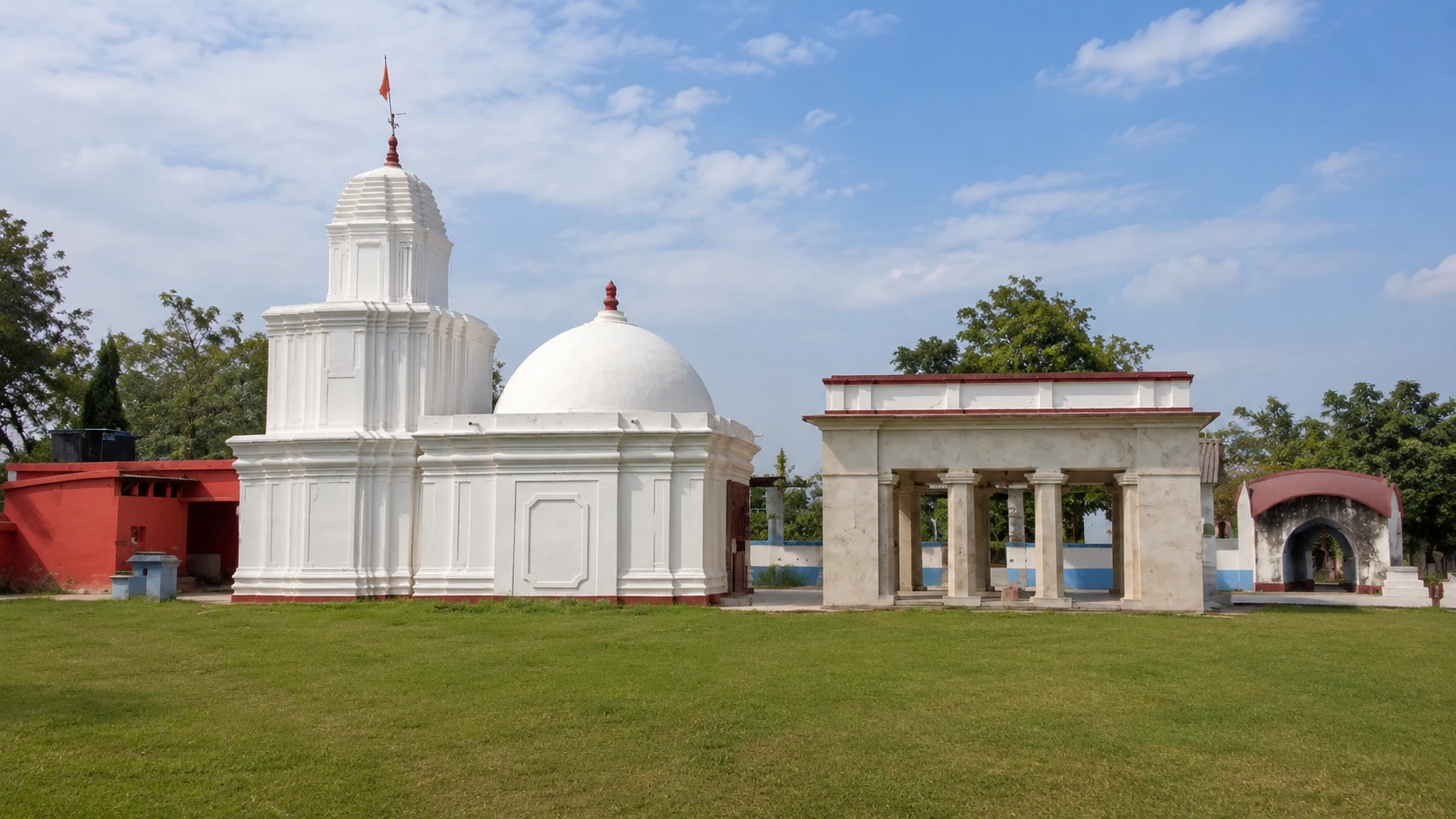
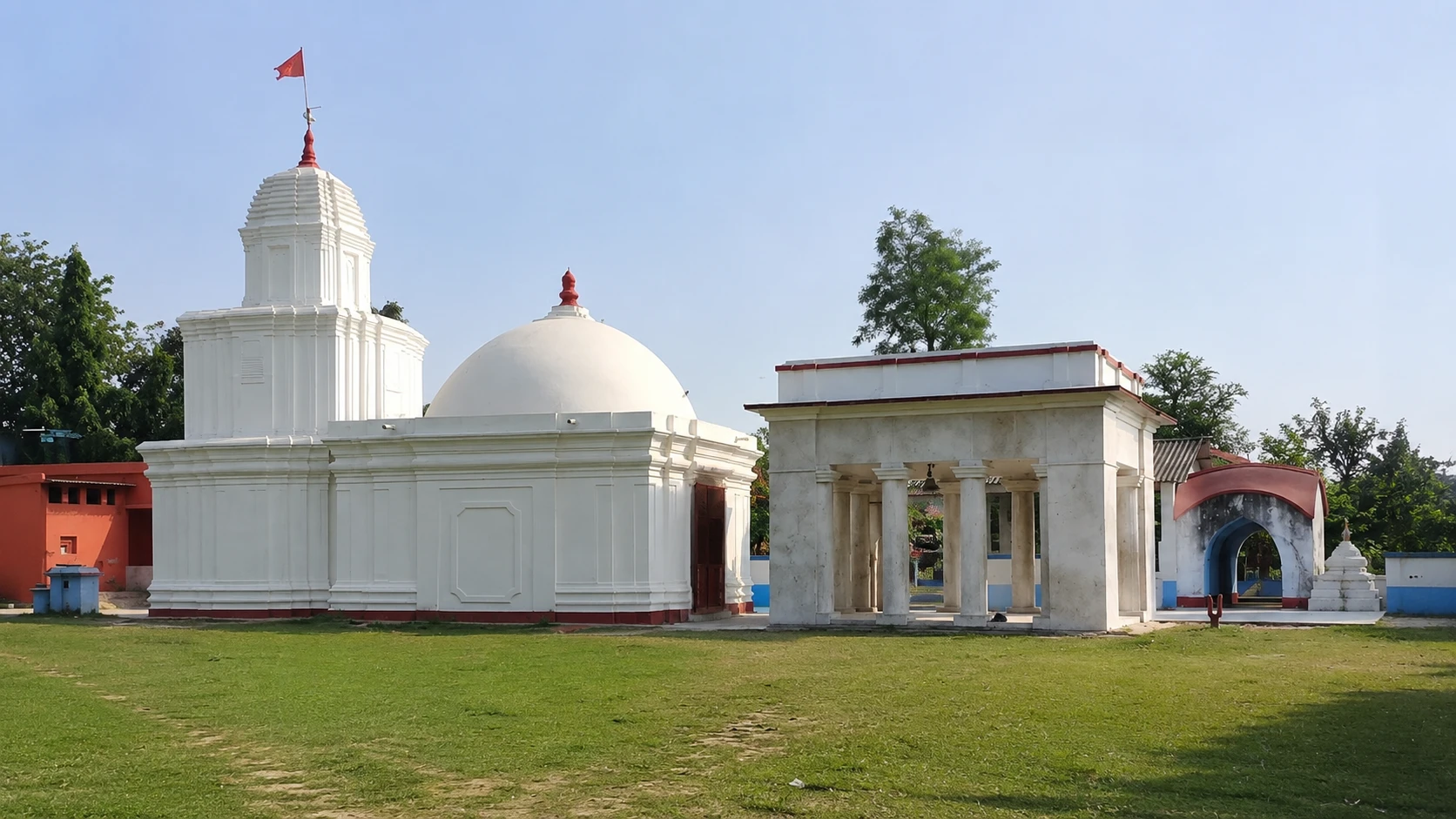
Bengali āṭcālā (eight-roofed) regional sacred architecture characteristic of Rāḍh Bengal; brick-and-lime construction with terracotta detailing; the temple sits within a larger walled compound that incorporates a sacred tank associated with the Sannyāsīr Mela ritual cycle
Open
05:00 – 21:00
Aarti
06:00 · 12:00 · 19:00
Special
Annual Sannyāsīr Mela and Yogādyā Pūjā during Vaiśākh-Jyaiṣṭha (the principal pilgrimage event, distinct in its non-Aswin timing among major Bengal Pīṭhas); Durgā Pūjā in Aswin; Kālī Pūjā on Kārtika amāvasyā; Vāsanti Pūjā in Caitra
The Sacred Legend · पवित्र कथा
Yogādyā at Kshirgram is the Pīṭha where Satī's right great toe is said to have fallen as Viṣṇu's Sudarśana cakra cut her body apart upon the back of the grieving Śiva. The canonical Pīṭhanirṇaya names this place's presiding form Yogādyā, 'the primordial yoginī', paired with the Bhairava Kṣīra-Kaṇṭaka. But unlike most Bengal Pīṭhas, Yogādyā's continuing identity does not rest only on canonical Tantric attestation: it rests, equally, on a late-medieval Bengali Maṅgalkāvya, the Yogādyā Maṅgal, that gave the Devī a vernacular literary tradition entire to herself, one of the few Bengal Shakti Pīṭhas to be foregrounded in its own named kāvya. Set in the village of Kshirgram (literally 'milk-village') in Mangalkot block of Purba Bardhaman district on the Khari river, a Bhāgīrathī tributary running through the agrarian heartland of Rāḍh Bengal, the Pīṭha has been the centre of an annual Sannyāsīr Mela held in Vaiśākh-Jyaiṣṭha that draws pilgrims, wandering sannyāsīs, and Maṅgalkāvya devotees across centuries. Under the formal patronage of the Bardhaman Raj from the eighteenth century forward, and as the rare Bengal Pīṭha foregrounded equally in canonical Tantra and vernacular Bengali devotional literature, Yogādyā at Kshirgram occupies a distinctive seat at the crossing of two ordinarily distinct registers of Shākta tradition.
Sacred Designationपवित्र पदनाम
Shakti Peeth
Body part: Right great toe (dakṣiṇa-pādāṅguṣṭha)
Shakti: Yogādyā ('the primordial yoginī'); regional variant Yogeśvarī
Bhairava: Kṣīra-Kaṇṭaka
Sacred Origin Storyपवित्र उत्पत्ति कथा
Source: Pīṭhanirṇaya (canonical Tantric pīṭha-enumeration text) and Bṛhannīla Tantra, paired with Bengali Shākta living-tradition oral transmission and the Kālīkā Purāṇa register
When Dakṣa Prajāpati performed his great sacrifice and refused to invite his daughter Satī's husband, the ascetic Śiva, whom Dakṣa had never accepted as a son-in-law, Satī went to her father's court uninvited, intending to confront him.
Dakṣa met her not with welcome but with public condemnation: he spoke of Śiva as one fit only for cremation grounds, as the consort of ghosts, as no proper husband for the daughter of a Prajāpati. Satī, hearing her husband mocked in the assembly of the gods, would not return to him bearing such humiliation.
She invoked her own yogic fire at her father's hearth and consumed her body in it.
When Śiva learned of his wife's self-immolation, his grief broke the cosmos. He destroyed Dakṣa's yajña, sending Vīrabhadra to scatter the gods and behead Dakṣa himself, and then, taking up Satī's burned body across his shoulders, he began the wandering called the Tāṇḍava of grief.
He walked across the earth without rest, the dead weight of his wife borne on his back, and as he walked, all creation began to shudder.
Viṣṇu, who alone of the gods could intervene, took up his Sudarśana cakra and, walking behind Śiva on his unending journey, he reached his discus forward and began to cut. Piece by piece, almost surgically, the cakra severed Satī's body from Śiva's shoulders.
Each part fell to earth at the place where the cakra's stroke had cut, and each place where a piece of the goddess fell became sanctified, a Pīṭha, a seat of the goddess's power, where she could thereafter be worshipped in fragmentary but inexhaustible presence.
At one such cut, Satī's right great toe, the dakṣiṇa-pādāṅguṣṭha, fell to the agrarian plain east of the Damodar and west of the Bhāgīrathī, on the bank of the smaller Khari river that runs through what would later be called Kshirgram, the milk-village.
The Pīṭhanirṇaya canonical enumeration registers this place's presiding Devī as Yogādyā, 'the primordial yoginī,' the foundational mistress of yogic discipline, and her companion Bhairava as Kṣīra-Kaṇṭaka, a name that carries the milk (kṣīra) into the divine pair just as the place-name carries it into the village.
The Devī's name, Yogādyā, places her at the head of all yoginī-traditions. Where other Shakti Pīṭhas bring forward the goddess's specific aspects, the fierce protectress, the bestower of sovereignty, the dissolution-bringer, Yogādyā is named for the very first principle of yoga itself, the unstruck origin of the discipline that the Devī's later forms practise.
The placement of the right great toe at her Pīṭha is theologically apt: the toe is what the body presses against the earth, the foundation point of the standing posture, the anchor without which no yogic āsana can be held. The first principle of yoga, then, rests at the place where the goddess's first foundation-point fell.
The canonical mythology is intact and complete; but at Kshirgram, the Devī's story has not stayed only with the Pīṭhanirṇaya. In the late seventeenth and early eighteenth centuries, the Bengali Maṅgalkāvya tradition, that vernacular genre of devotional narrative poetry which gave Bengali peasant culture its own access to Shākta and Vaiṣṇava theology, composed an entire kāvya around Yogādyā.
The Yogādyā Maṅgal narrates the Devī's interactions with kings, householders, and ascetics in the Bengali idiom of village experience; it does not contradict the canonical account, but it gives Yogādyā a second and equally living narrative existence that few Bengal Pīṭhas can claim.
Sources cited:
- Pīṭhanirṇaya (canonical Tantric pīṭha-enumeration), entry for the dakṣiṇa-pādāṅguṣṭha-fall locus
- Bṛhannīla Tantra, sections on the Bengal Pīṭhas
- Kālīkā Purāṇa, Chapters 18 and 60, 62
- Devī Bhāgavata Purāṇa, Skandha VII
- Yogādyā Maṅgal (late 17th, early 18th century Bengali Maṅgalkāvya tradition)
- Sircar, D. C., 'The Śākta Pīṭhas' (Journal of the Royal Asiatic Society of Bengal, 1948; revised monograph 1973)
- Sen, Sukumar, 'History of Bengali Literature' (Sahitya Akademi, 1960), for the Maṅgalkāvya horizon dating
Other Traditions · अन्य परंपराएँ
Vikramāditya local origin tradition, royal-installation reading transmitted in Kshirgram oral memory and Bardhaman-region zamindari tradition
A second account, widely transmitted in the village of Kshirgram itself and in the wider Bardhaman zamindari oral tradition, holds that Yogādyā's installation at Kshirgram was not first established by the cosmic body-fall narrative but by a specific royal action: King Vikramāditya, the legendary first-century BCE sovereign whose memory is dispersed across many sacred-site origin myths, is said to have come to Kshirgram after dreaming of the Devī, and to have personally installed her mūrti at the site.
In this reading, the Pīṭha's local devotional identity rests not on the Pīṭhanirṇaya alone but on a royal-foundational act: the goddess was already present at this place, awaiting recognition, and Vikramāditya's installation made the site formally a Pīṭha.
The account is consistent with a wider pattern in Indian sacred geography where the Devī's manifest presence at a place is understood as preceding the body-fall narrative, with the body-fall narrative recognising and registering an already-active divine ground rather than establishing it.
The Vikramāditya tradition does not contest the canonical mythology, it gives the site a second, complementary founding layer in which royal devotion and divine recognition meet.
Yogādyā Maṅgal vernacular literary tradition, Bengali Maṅgalkāvya devotional narrative reading (late 17th, early 18th century)
A third reading of Yogādyā emerges not from canonical Tantric texts or from royal-foundational legend but from the medieval Bengali Maṅgalkāvya tradition, that vernacular genre of devotional narrative verse which composed entire poetic cycles around regional deities, narrating their interactions with kings, householders, merchants, and ascetics in the Bengali idiom of village experience.
The Yogādyā Maṅgal, composed in the late seventeenth or early eighteenth century, gives the Devī her own kāvya: a sustained narrative in which Yogādyā moves through Rāḍh Bengal as a presence that intervenes in daily life, protecting the just, testing the proud, granting boons to the devoted, withdrawing favour from those who slight her.
The Maṅgalkāvya reading approaches Yogādyā not through the static categorisation of the Pīṭhanirṇaya body-part-Devī-Bhairava triplet, but through the dynamic narrative practice of vernacular Bengali devotion, in which the goddess is a character with a story rather than a node in a canonical enumeration.
For many Bengali Shākta devotees, particularly those for whom the Maṅgalkāvya tradition remains a living register, Yogādyā is the Devī of the kāvya before she is the Devī of the Pīṭhanirṇaya: the village remembers her through the verses sung at Sannyāsīr Mela and recited at household pūjās, not primarily through Sanskrit Tantric attestation.
This reading does not contest the canonical mythology but supplies an entire parallel devotional grammar.
Scholarly Context
Modern scholarship treats Yogādyā at Kshirgram as a Pīṭha of distinctive 'dual-register' identity within the Bengal Shākta tradition: canonically attested through the Pīṭhanirṇaya (with the dakṣiṇa-pādāṅguṣṭha attribution and the Yogādyā / Kṣīra-Kaṇṭaka pairing) and vernacularly elaborated through the Yogādyā Maṅgal of the late seventeenth and early eighteenth centuries. The body-part attribution (right great toe) is the most commonly cited in the 51-list traditions for Kshirgram, but some enumerations vary; D. C. Sircar's foundational compilation ('The Śākta Pīṭhas', 1948/1973) treats the dakṣiṇa-pādāṅguṣṭha attribution as the standard reading. The site's historical visibility increases substantially from the late seventeenth century onward, when the Yogādyā Maṅgal gave it a vernacular literary horizon, and from the eighteenth century onward, when the Bardhaman Raj (the dominant Hindu zamindari power of the lower Damodar-Bhāgīrathī region) extended formal patronage. The Sannyāsīr Mela's Vaiśākh-Jyaiṣṭha timing, distinct from the Aswin Durgā-Pūjā cycle that anchors most Bengal Pīṭha calendars, is itself a feature noted in scholarly accounts of Bengal Shakta festival geography (R. M. Sarkar, A. K. Banerjee). Kunal Chakrabarti's work on the regional construction of the Bengal Purāṇic tradition ('Religious Process', 2001) places Yogādyā within a wider pattern of Bengal Shākta sites where royal-installation legend, Tantric canonical inclusion, and vernacular Maṅgalkāvya elaboration converge.
Historyइतिहास
Yogādyā at Kshirgram's documented history unfolds in three principal layers. The earliest, canonical-Tantric layer is medieval: the dakṣiṇa-pādāṅguṣṭha-fall and the Yogādyā-Kṣīra-Kaṇṭaka pairing emerge in the Pīṭhanirṇaya enumeration tradition and in related Bengal Tāntric texts of the medieval period.
As with most Bengal Pīṭhas, site-level activity at Kshirgram is plausibly older than the canonical attestation, but verifiable on-the-ground documentation begins only with the early-modern documentary horizon.
The second, vernacular-literary layer opens in the late seventeenth century with the composition of the Yogādyā Maṅgal, the Bengali Maṅgalkāvya cycle dedicated to the Devī. The Maṅgalkāvya tradition was at this period the principal vehicle through which Bengal's peasant and zamindari publics encountered theological narrative; the inclusion of Yogādyā within its own kāvya marked a substantial elevation of the Kshirgram Pīṭha's regional standing.
The Yogādyā Maṅgal narrates the Devī's interactions with kings, householders, and ascetics across Rāḍh Bengal in the Bengali idiom of village life, and survived in multiple recensions transmitted through manuscript copies, household recitations, and the annual Sannyāsīr Mela.
The exact authorship and earliest manuscript dating remain matters of scholarly variation, but the late-seventeenth-century horizon is consistent across the major modern critical accounts.
The third, royal-zamindari patronage layer unfolds across the eighteenth and nineteenth centuries under the Bardhaman Raj, the dominant Hindu zamindari power of the lower Damodar-Bhāgīrathī region. Beginning with the patronage extended under Raja Tilakchand Bahadur in the mid-eighteenth century and continuing through Raja Tej Chandra Bahadur in the later eighteenth and early nineteenth centuries, the Bardhaman Raj formalised endowments to Yogādyā and supported the temple's expansion and the annual Sannyāsīr Mela.
The Permanent Settlement of 1793 stabilised the Bardhaman Raj's revenue base and enabled continuous patronage through the nineteenth century, during which the major fabric of the present temple structure was renovated and the Sannyāsīr Mela's regional reach expanded.
Through the twentieth century, Yogādyā at Kshirgram remained continuously active. The 1947 Partition placed the temple firmly within the interior of West Bengal rather than near the new international border (unlike Kiriteshwari in Murshidabad, ninety-plus kilometres to the north-east), so the geographic dislocation that reshaped some Bengal Pīṭhas affected Yogādyā only at the level of regional connectivity rather than direct border proximity.
The Sannyāsīr Mela was formalised and grew through the twentieth century as one of the major annual fairs of Purba Bardhaman district, attracting pilgrims, sannyāsīs, Maṅgalkāvya enthusiasts, and the wider regional Shākta diaspora.
West Bengal heritage and tourism authorities have noted Kshirgram in subsequent decades as a site of distinct religious-literary significance, though the temple itself continues to be administered primarily through local village-level arrangements rather than through a formal trust.
Historical Timelineऐतिहासिक कालक्रम
Pīṭhanirṇaya canonical inclusion of Kshirgram as the dakṣiṇa-pādāṅguṣṭha-fall locus, with Yogādyā as the presiding Devī and Kṣīra-Kaṇṭaka as the companion Bhairava. This canonical-Tantric layer precedes the early-modern documentary horizon and establishes Kshirgram's standing within the broader Bengal Shākta Pīṭha tradition. Related medieval Bengal Tāntric texts (Bṛhannīla Tantra) corroborate the attribution.
The exact medieval dating of the Pīṭhanirṇaya inclusion is not pinned to a single year; the canonical layer pre-dates the early-modern documentary horizon but is itself part of a longer medieval Tantric enumeration tradition. Body-part attributions vary slightly across the 51-list traditions; the dakṣiṇa-pādāṅguṣṭha attribution for Kshirgram is the most commonly cited but is not universally unanimous across all enumerations.
Composition of the Yogādyā Maṅgal, Bengali Maṅgalkāvya dedicated to the Devī. The kāvya gave Yogādyā a vernacular literary tradition entire to herself and marked a substantial elevation of Kshirgram's regional Shākta standing. Multiple recensions survive; the precise authorship and earliest manuscript dating remain matters of scholarly variation, but the late-seventeenth to early-eighteenth century horizon is consistent across modern critical accounts. Among Bengal Pīṭhas, this is one of the few to be foregrounded in its own named Maṅgalkāvya.
Authorship of the Yogādyā Maṅgal is variously attributed across the surviving manuscript tradition; some recensions name specific poet-authors while others are transmitted anonymously. The genre's broader pattern of authorial fluidity (compare Manasā Maṅgal, Caṇḍī Maṅgal, Dharmaṅ Maṅgal) makes single-author attribution provisional. The c. 1690, 1720 range is intended to capture the genre's principal compositional horizon rather than a single date.
Formalisation of Bardhaman Raj patronage under Raja Tilakchand Bahadur and successors. The Bardhaman Raj, the dominant Hindu zamindari power of the lower Damodar-Bhāgīrathī region, extended formal endowments to Yogādyā at Kshirgram and supported the temple's expansion and the annual Sannyāsīr Mela. The patronage continued under Raja Tej Chandra Bahadur in the later eighteenth and early nineteenth centuries. The Bardhaman Raj's investment formalised Kshirgram's status from a regionally-important Pīṭha into a temple anchored within the formal patronage geography of the Bengal zamindari system.
Nineteenth-century renovation of the temple structure and expansion of the annual Sannyāsīr Mela. Under the matured Permanent Settlement (1793) and the continued patronage of the Bardhaman Raj, the major fabric of the present temple was renovated across the mid-nineteenth century, and the Sannyāsīr Mela grew into one of the principal annual fairs of the lower Damodar-Bhāgīrathī region. The mela's expansion drew not only Shākta pilgrims but also Vaiṣṇava sannyāsīs, ascetic communities, and the wider regional rural economy into Kshirgram's annual cycle.
Continuation of the Sannyāsīr Mela and formalisation of Yogādyā at Kshirgram as a major regional Shākta pilgrimage destination through twentieth-century changes. Through the 1947 Partition, the temple's location in interior Purba Bardhaman insulated it from direct border-proximity effects; pilgrimage continued through the post-Independence decades. The Sannyāsīr Mela expanded into one of the principal annual religious fairs of the lower Damodar-Bhāgīrathī region, with growing participation from West Bengal's wider Shākta diaspora. The temple continues to be administered through local village-level arrangements rather than through a formal trust.
What You'll Seeदर्शन में
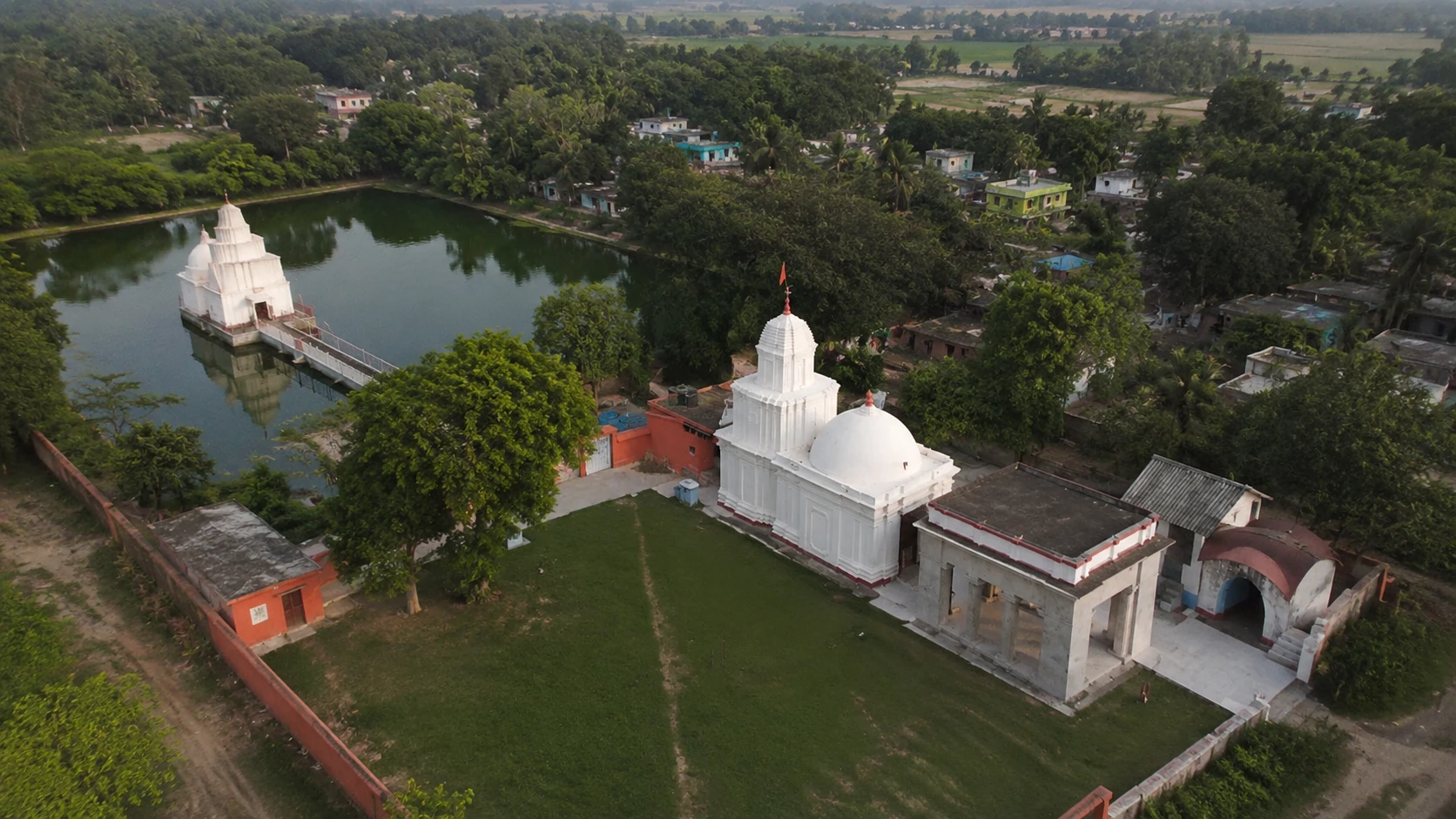
The Yogādyā mūrti is enshrined in a brick-and-lime āṭcālā (eight-roofed) structure characteristic of Rāḍh Bengal regional sacred architecture, set within a walled compound that includes a sacred tank associated with the Sannyāsīr Mela ritual cycle.
The presiding image is a stone Devī form, robed in red textile during the major festival weeks, with the iconographic emphasis falling on the goddess's seated yogic posture, the pose that names her Yogādyā, 'the primordial yoginī.' Unlike the kirīṭa-imagery that organises Kirīṭeśvarī's mūrti or the body-part-thematic visuals at Bahulā and Aṭṭahāsa, Yogādyā's image foregrounds the discipline-form rather than the body-organ-form: she sits in dhyānāsana, the hands disposed in gestures associated with the meditative subduing of the senses, the visual register more contemplative-yogic than fierce-protective.
The eyes are large in the Bengali Shākta convention, but the facial register is the gathered stillness of one absorbed in tapas rather than the outward gaze of the warrior goddess. Bhairava Kṣīra-Kaṇṭaka is represented by a small linga-form companion shrine adjacent to the sanctum; the Bhairava's name, with its milk (kṣīra) reference, ties the male principle directly to the place-name of the village in which the temple sits.
The compound contains the temple's sacred tank, a pavilion used during the Sannyāsīr Mela for sannyāsī gatherings, and small ancillary shrines reflecting the temple's integration into a wider ritual ground rather than a stand-alone sanctum.
The approach from Katwa or from the Bardhaman side passes through the agrarian heartland of Rāḍh Bengal, paddy fields, mango groves, low-lying alluvial plain between the Damodar and the Bhāgīrathī, and emerges at the village through narrow roads typical of Mangalkot block.
Distinctive Practicesविशिष्ट परंपराएँ
Yogādyā Maṅgal recitation and Maṅgalkāvya literary integration
योगाद्या मंगल पाठ और मंगलकाव्य साहित्यिक समाकलन
Year-round in household practice; intensifies during the Sannyāsīr Mela in Vaiśākh-Jyaiṣṭha
A practice distinctive to Yogādyā at Kshirgram, sustained from the late seventeenth century onward: the recitation of verses from the Yogādyā Maṅgal, the Bengali Maṅgalkāvya dedicated to the Devī, in both temple liturgy and household pūjās. Selected episodes are sung at the Sannyāsīr Mela; longer recitations are observed during full-cycle household pūjās in Vaiśākh-Jyaiṣṭha. The Maṅgalkāvya tradition is not, for Bengali Shākta devotees, a strictly literary artefact: it is a living devotional form, recited and heard in households across Rāḍh Bengal, in which the Devī is a character with a story rather than a node in canonical enumeration. Among the West Bengal Pīṭhas, only Yogādyā is foregrounded in its own named Maṅgalkāvya in this way; Kankalitala has the Tagore-Santiniketan literary-modern register, but the Maṅgalkāvya tradition is pre-modern, vernacular, and household-recited, a different and distinctive literary anchoring of the Pīṭha.
Maṅgalkāvya recitation makes the Devī's narrative itself the field of devotional encounter. Where the Pīṭhanirṇaya tradition meets the Devī through structural categorisation, body-part, devi_form, bhairava, Maṅgalkāvya meets her through story. The devotee hears the Devī moving through situations recognisable from village life: protecting the poor, testing the proud, granting boons to the just. This narrative encounter complements rather than competes with canonical encounter; the devotee at Kshirgram approaches Yogādyā along two parallel paths, and the temple stands at the crossing of both.
Sannyāsīr Mela ascetic-pilgrim gathering (Vaiśākh-Jyaiṣṭha)
संन्यासी मेला तपस्वी-तीर्थयात्री समागम (वैशाख-ज्येष्ठ)
Annual; principal observance in Vaiśākh-Jyaiṣṭha (April, June)
The Sannyāsīr Mela is the principal pilgrimage event of Yogādyā at Kshirgram and is, alongside the Maṅgalkāvya tradition, the most distinctive feature of the temple's calendar. Held in Vaiśākh-Jyaiṣṭha, the late-spring through early-monsoon window, the mela's timing places it outside the Aswin Durgā-Pūjā cycle that anchors most major Bengal Pīṭha festivals (Kirīṭeśvarī, Tarapith, Kankalitala, Bakreshwar). The Vaiśākh-Jyaiṣṭha placement gives the gathering a distinctive composition: alongside Shākta pilgrims, the mela draws significant numbers of wandering sannyāsīs and ascetic communities (Daśanāmī, Vaiṣṇava bairāgī, Aghorī lineages), Maṅgalkāvya enthusiasts attending recitations, and the rural economy of the lower Damodar-Bhāgīrathī region. The sannyāsī presence, from which the mela takes its name, distinguishes it from the household-pilgrim profile of an Aswin festival; this is one of the few major Bengal Pīṭha festivals where the ascetic community is itself a defining demographic.
The Vaiśākh-Jyaiṣṭha timing aligns the festival with the Yogādyā Maṅgal's narrative arc and with the late-spring agrarian cycle, but its spiritual register goes further. The presence of sannyāsīs and ascetics gives the gathering a contemplative-renunciate weight: this is a festival where pilgrims encounter the Devī alongside, and in the company of, those who have renounced household life. For Yogādyā, the primordial yoginī, the foundational mistress of yogic discipline, this composition is theologically apt. The Devī of yoga draws the practitioners of yoga, and the place where her first foundation-point fell becomes annually the ground where the practice's living lineages return.
Milk-themed (kṣīra) offerings
क्षीर-केन्द्रित अर्पण
Year-round; intensifies during the Sannyāsīr Mela and the Bhairava-pūjā cycle
A practice that draws together two distinctive features of the temple's onomastics: the village name Kshirgram (literally 'milk-village'), and the Bhairava's name Kṣīra-Kaṇṭaka. Devotees bring offerings of fresh cow's milk, kṣīra-anna (rice cooked in milk), milk-based sweets (sandesh, rasagullā, mishti dahi), and ghee for use in dīpa-arghya. These offerings have a particular thematic weight at Kshirgram because both the place-name and the male principle of the Pīṭha pair are organised around kṣīra. The pattern parallels the body-part-thematic offering register elsewhere in Cluster A (Bahulā receiving red bangles at the vāma-bāhu locus, Aṭṭahāsa receiving sindoor at the adhara, Kirīṭeśvarī receiving kirīṭa-imagery), but at Yogādyā the philological encoding is of the Bhairava-name rather than the body-part, a new variant in the Cluster A taxonomy.
Milk is the substance of nourishment that the cow gives without exchange, the most generous of substances in the householder's economy, the substance offered to deities and to ancestors alike. Bringing milk to a place whose very name carries 'milk' is offering the place its own name back: the gift returns the substance that the village and the Bhairava both already encode. The act is thus a small philological liturgy as much as a material offering, a recognition that the name itself is sacred, and that what the name speaks, the offering returns.
Did You Know?क्या आप जानते हैं?
Yogādyā at Kshirgram is one of the few West Bengal Shakti Pīṭhas to be foregrounded in its own named Bengali Maṅgalkāvya, the Yogādyā Maṅgal, composed in the late seventeenth or early eighteenth century. Most Bengal Pīṭhas appear, where they appear in vernacular literature at all, as passing references in broader Devī-stuti or in regional purāṇic compilations; only a handful have an entire Maṅgalkāvya cycle dedicated to them as named protagonist. This places Yogādyā at the crossing of two ordinarily distinct registers of Bengali Shākta tradition: canonical Tantric Pīṭha-enumeration on one side, vernacular Maṅgalkāvya literary devotion on the other, a dual-register identity rare among the West Bengal Pīṭhas.
Sen, Sukumar, 'History of Bengali Literature' (1960); Bhattacharya, Asutosh, 'Bāṅglā Maṅgalkāvyer Itihāsa'; Sarkar, R. M. (1986); comparative observation across the West Bengal Pīṭha corpus
The philological encoding at Yogādyā runs through the Bhairava's name rather than through the Devī's name or the body-part name, a new variant in the Cluster A taxonomy. The place-name Kshirgram (kṣīra-grāma, 'milk-village') encodes the kṣīra that also appears in the Bhairava's name Kṣīra-Kaṇṭaka. By contrast, Bahulā encodes the body-part in the Devī's name (Bahulā = vāma-bāhu), Kankalitala in the place-name, Aṭṭahāsa in all three (laughter, lip, place), and Kirīṭeśvarī in the place-name and the local Devī-name. Yogādyā is the only Cluster A entry where the principal philological resonance runs through the Bhairava's name.
Comparative observation across Cluster A entries (Tarapith, Bakreshwar, Bahula, Kankalitala, Attahas, Kireet, Yogadya); Sircar, D. C., 'The Śākta Pīṭhas' (1948/1973)
The Sannyāsīr Mela at Kshirgram is one of the few major Bengal Shakti Pīṭha festivals timed outside the Aswin Durgā-Pūjā cycle. The mela is held in Vaiśākh-Jyaiṣṭha (April, June), the late-spring through early-monsoon window, distinct from the Aswin (September, October) timing that anchors festival cycles at Tarapith, Bakreshwar, Kankalitala, Bahulā, Aṭṭahāsa, and Kirīṭeśvarī. The Vaiśākh-Jyaiṣṭha timing aligns with the Yogādyā Maṅgal's narrative arc and with the agrarian cycle of the lower Damodar-Bhāgīrathī, and gives the mela its distinctive ascetic-pilgrim demographic.
West Bengal District Gazetteer entries for Bardhaman district; Sarkar, R. M. (1986); anthropological field studies on Bengal religious fairs
The Devī's name, Yogādyā, places her at the head of all yoginī-traditions: literally 'the primordial yoginī,' or 'the first principle (ādi) of yoga.' Where other Shakti Pīṭhas bring forward the goddess's specific aspects, fierce protectress, sovereignty-bestower, dissolution-bringer, Yogādyā is named for yoga itself, the discipline whose later forms her other manifestations practise. The placement of the right great toe (dakṣiṇa-pādāṅguṣṭha) at her Pīṭha is theologically apt: the toe is the foundation-point of standing posture, the anchor without which no yogic āsana can be held. The first principle of yoga rests at the place where the goddess's first foundation-point fell.
Pīṭhanirṇaya entry for Yogādyā; comparative onomastic analysis of the 51-Pīṭha Devī-form names
Unlike most major Bengal Pīṭhas, Yogādyā at Kshirgram does not sit on the Bhāgīrathī itself but on the smaller Khari river, a Bhāgīrathī tributary running through the agrarian interior between the Damodar and the Bhāgīrathī. This riverine placement gives the Pīṭha a distinctively interior-agrarian character compared to the Bhāgīrathī-bank Pīṭhas of Kirīṭeśvarī (Murshidabad), Bahulā (Ketugram-Katwa), and Kankalitala (Birbhum-Bīrbhūm). The lower Damodar-Bhāgīrathī agrarian plain in which Kshirgram sits has been one of the most productive rice-growing regions of Bengal for centuries, and the temple's annual cycle is woven into the cropping and harvest rhythms of this hinterland.
Government of West Bengal District Gazetteer for Purba Bardhaman district; Survey of India hydrological records
Visitor Accessप्रवेश जानकारी
Yogādyā at Kshirgram welcomes devotees of all backgrounds for darshan throughout the temple's open hours. There are no caste-based, sectarian, or gender-based entry restrictions. The temple's setting in an interior Purba Bardhaman village means that the pilgrim experience is informal and locally-paced; dress, conduct, and offering practices follow standard Bengali Shākta convention. Photography of the inner sanctum is not permitted; outer-compound photography is generally accepted by local custom. Unlike Kirīṭeśvarī, Yogādyā does not sit close to an international border, so no cross-border travel considerations apply; the Pīṭha is approachable as part of the wider Purba Bardhaman rural-religious heritage geography, often combined with visits to Mayapur (Nadia), Navadwip, and other Bengal Vaiṣṇava-Shākta sites in the lower Bhāgīrathī corridor.
Festivalsत्योहार
Sannyāsīr Mela / Annual Yogādyā Pūjā
संन्यासी मेला / वार्षिक योगाद्या पूजा
Apr, Jun (Vaiśākh-Jyaiṣṭha)
The temple's principal annual observance and the only major Bengal Pīṭha festival timed outside the Aswin Durgā-Pūjā cycle. Held over multiple days in Vaiśākh-Jyaiṣṭha, the mela combines the formal Yogādyā Pūjā with the ascetic-pilgrim gathering that gives the festival its name. Selected episodes from the Yogādyā Maṅgal are recited; sannyāsīs and ascetic communities from across Rāḍh Bengal converge; the temple's sacred tank and pavilion are central to the ritual cycle. The largest single annual gathering at Kshirgram, drawing pilgrims primarily from Purba and Paschim Bardhaman, Hooghly, Birbhum, and Nadia, with smaller cohorts from across West Bengal's Shākta diaspora.
Durgā Pūjā
दुर्गा पूजा
Sep, Oct (Aswin śuklapakṣa)
Although the Sannyāsīr Mela is the temple's principal annual observance, Durgā Pūjā is also observed at Kshirgram in continuity with the wider Bengal Aswin cycle. The local liturgy foregrounds Yogādyā as the form of the goddess celebrated, with the Vimalā-Mahiṣāsuramardinī canonical framework alongside; the household-pilgrim composition of Aswin attendance is distinct from the Sannyāsīr Mela's ascetic emphasis. For many local Murshidabad-Bardhaman Shākta households, Yogādyā at Kshirgram is woven into the Aswin family pilgrimage cycle alongside other Bengal Pīṭhas.
Kālī Pūjā
काली पूजा
Oct, Nov (Kārtika amāvasyā)
The new-moon Kālī Pūjā is observed at Kshirgram with a night-time register that draws on the Pīṭha's inclusion in the Kālīkā Purāṇa 52-Pīṭha list. The pūjā is held overnight; the liturgy invokes the Devī alongside Bhairava Kṣīra-Kaṇṭaka. Attendance is smaller than the Sannyāsīr Mela but the devotional concentration is high, particularly among Tāntric sādhakas and Kālī-Mahāvidyā lineage practitioners for whom Yogādyā's yoginī-register aligns with broader Mahāvidyā contemplation.
Vāsanti Pūjā
वासन्ती पूजा
Mar, Apr (Caitra śuklapakṣa)
The 'spring Durgā' observance, theologically reckoned in some Bengal Shākta traditions as the more ancient of the two Durgā-Pūjā cycles. At Kshirgram, Vāsanti Pūjā is a smaller observance than the Sannyāsīr Mela that follows it in Vaiśākh, but is preserved as a continuous part of the temple's annual cycle. The Caitra-Vaiśākh sequence, Vāsanti Pūjā followed by the Sannyāsīr Mela, gives Yogādyā at Kshirgram a continuous late-spring through early-monsoon devotional anchoring that distinguishes the temple's calendar from the Aswin-concentrated rhythms of most other major Bengal Pīṭhas.
Traditional Offeringsपारंपरिक अर्पण
Primary Offerings
Red Japā (Hibiscus) flowers
लाल जपा (गुड़हल) के पुष्प
जपा-पुष्प
The red hibiscus is the canonical floral offering to the Devī across Bengali Shākta tradition. The deep red signifies the goddess's life-force and her victory over the asuric power; the flower's open, unguarded form mirrors the devotee's open offering of self. The Devī Māhātmya and the Caṇḍī Pāṭh both single out the red japā as the most fitting offering for the goddess's fierce-protective forms.
Kumkum and Sindūr (Vermilion)
कुमकुम और सिन्दूर
कुङ्कुम / सिन्दूर
Vermilion is offered at the Devī's feet. The red of sindūr carries the same significance as the red of the japā: the Devī's manifest power, the life-force she protects, and the sovereignty she bestows. At Yogādyā, the placement of the offering at the feet is theologically apt, since the dakṣiṇa-pādāṅguṣṭha (right great toe) attribution makes the foot the body-part-locus of the Pīṭha itself; vermilion at the goddess's feet honours both the canonical body-part-fall and the seat of the goddess's manifest presence at Kshirgram.
Red bangles and red-bordered cloth
लाल चूड़ियाँ और लाल-किनारी वस्त्र
Bengali Shākta devotees offer red bangles and lengths of red-and-white cloth (śādā-lāl) to the Devī. The bangles carry the everyday Bengali Shākta association of the Devī with the married woman, the householder's protectress, and the goddess as bestower of saubhāgya (auspicious wholeness). The red-and-white cloth is folded onto the mūrti during festival days and distributed as prasād at the conclusion.
Coconut
नारियल
नारिकेल
The coconut is broken before the Devī as a symbolic offering of the ego: the hard outer shell, the white interior, and the sweet water within correspond to the body, mind, and consciousness offered to the goddess. The breaking of the coconut at the threshold of darshan is a near-universal Hindu temple practice and is observed at Kshirgram in continuity with Bengali Shākta convention.
Pān-supāri (Betel leaf and areca)
पान-सुपारी
ताम्बूल-पूगफल
Betel leaf with areca and lime is a traditional auspicious offering across eastern India, signifying hospitality, honour, and welcome to the deity. At Yogādyā, pān-supāri is placed before the Devī in a small ritual platter and is also distributed at the close of the major festival aartis as a token of the Devī's reciprocal welcome to the devotee.
Unique to This Temple
Milk-themed (kṣīra) offerings
क्षीर-केन्द्रित अर्पण
Fresh cow's milk, kṣīra-anna (rice cooked in milk), milk-based sweets (sandesh, rasagullā, mishti dahi), and ghee for dīpa-arghya are offered specifically because of the temple's identity as the kṣīra-grāmīṇī Pīṭha, the place whose village name and Bhairava-name both encode kṣīra. The offering returns to the place the substance its name speaks: a small philological liturgy in which what the name carries, the offering hands back. The milk-based prasād from these offerings is widely valued among Rāḍh Bengal Shākta households for its association with the place-name's kṣīra resonance.
Yogādyā Maṅgal recitation as devotional offering
भक्ति-अर्पण के रूप में योगाद्या मंगल पाठ
Among the offerings made at Yogādyā at Kshirgram, the recitation of selected episodes from the Yogādyā Maṅgal, the Devī's own Bengali Maṅgalkāvya, holds a distinctive place. This is a non-material offering: what the devotee brings is the kāvya's verses, sung or recited in the Devī's presence. The practice is concentrated during the Sannyāsīr Mela but extends to household pūjās year-round. The kāvya is itself read as a long-form prayer to Yogādyā; reciting it at her Pīṭha is the return of the words to the place that holds her seat. Few Bengal Pīṭhas have this kind of dedicated Maṅgalkāvya-recitation offering; it is one of Yogādyā's most distinctive traditions.
Most devotees bring offerings from outside the temple grounds. Local vendors near the temple gate sell milk-based prasād bundles, japā flowers, sindūr packets, and red bangles during the Sannyāsīr Mela. The temple does not maintain a formal offerings counter; offering arrangements are informal and locally-paced, in keeping with the village-Pīṭha character of the site.
How to Reachकैसे पहुँचें
Yogādyā at Kshirgram is most commonly reached from Katwa Junction (30 km), the closest functional railway station on the Howrah-Katwa line. Saktigarh (50 km) on the Howrah-Bardhaman main line and Bardhaman Junction (60 km) are alternative entry points with stronger long-distance rail connectivity.
From Kolkata, the journey is typically three to four hours by road via the NH19/NH16 to Bardhaman and then north-east to Mangalkot, or four to five hours by train via Bardhaman with road onward. The final approach from Katwa or from the Bardhaman side passes through agrarian Mangalkot block on regional roads; the road is fully driveable but is paced like rural Rāḍh Bengal travel rather than urban-grid traffic.
The nearest functional airports are Kazi Nazrul Islam Airport at Durgapur (90 km, limited connectivity) and Netaji Subhash Chandra Bose International Airport at Kolkata (190 km, full connectivity). Pilgrims often combine Yogādyā with visits to Mayapur (Nadia), Navadwip, and the wider Bengal Vaiṣṇava-Shākta heritage of the lower Bhāgīrathī corridor.
During the Sannyāsīr Mela in Vaiśākh-Jyaiṣṭha, regional bus services to Kshirgram from Bardhaman and Katwa are augmented to meet pilgrim demand.
Plan Your Visitयात्रा की योजना
🌤 Best Season
October to early March is the most comfortable visiting window for an off-festival darshan, with cooler temperatures, dry weather, and good road conditions. The Sannyāsīr Mela period in Vaiśākh-Jyaiṣṭha (April, June) is the most atmospherically intense visit but coincides with Rāḍh Bengal's hot and humid pre-monsoon season; pilgrims should be prepared for daytime temperatures often exceeding 38°C, with humidity adding significant discomfort. The June-September monsoon brings heavy rain to the lower Damodar-Bhāgīrathī plain and may produce disruption to secondary roads in Mangalkot block; off-festival monsoon visits are not generally recommended.
👘 Dress Code
Standard Bengali Shākta dress-code convention applies. For women: saree, salwar-kameez, or other modest full-coverage attire is appropriate; many local devotees wear the traditional red-bordered white cotton saree during festival days. For men: dhoti-kurta or modest trousers-and-shirt is appropriate. The Sannyāsīr Mela's distinctive ascetic-pilgrim composition means that monastic robes (saffron, white) are visibly present and welcome; lay devotees should expect to be in mixed company. Footwear is removed before entering the sanctum.
📱 Phones & Photography
Mobile phones are permitted on the temple grounds. Photography is not permitted in the inner sanctum (garbhagriha); outer-compound photography is generally accepted by local custom but courtesy toward fellow devotees, particularly during the Sannyāsīr Mela when ascetic communities are present, is expected. Flash photography near the mūrti or directed at meditating sannyāsīs is not appropriate. Silenced or low-volume phone use during darshan is recommended.
🏨 Accommodation
Most pilgrims visiting for darshan base themselves in Bardhaman (60 km) or Katwa (30 km), both of which have mid-range hotels and guesthouses with the standard amenities of Bengal district towns. Kshirgram itself has very limited accommodation, a small village dharamshala and a few simple guesthouses oriented to overnight pilgrim stays during the Sannyāsīr Mela; these fill quickly during the mela period and are not generally available for casual off-festival booking. Off-festival visits are best planned as day trips from Bardhaman or Katwa. The Sannyāsīr Mela period sees temporary tented accommodation around the temple compound managed by local arrangements; pilgrims planning to attend the mela should confirm logistics in advance with local Mangalkot block contacts or West Bengal Tourism.
Sacred Soundsपवित्र ध्वनि
Yogādyā Maṅgal, Selected Episodes (Bengali Maṅgalkāvya)
mangalkavya · 1083
Yogādyā Praṇām Mantra (Kshirgram living tradition)
pranam_mantra · 173
Śakti Pīṭha Stotram (51-Pīṭha enumeration)
stotram · 894
Caṇḍī Pāṭh, Devī Māhātmya Chapter 1
path · 1247
Ramprasad Sen Śyāma-saṅgīt (Bengali Shākta tradition)
bhajan · 423
Did You Know? · क्या आप जानते हैं?
The same translation error that turned '33 Koti' into '33 crore' in Hinduism also happened in Buddhism. The Chinese translation of Buddhist texts rendered 'Sapta Koti Buddha' (7 Supreme Buddhas) as '7 Crore Buddhas.' The Tibetan translation got it right: 7 types, not 7 crore. One Sanskrit word, misread across two major world religions, generated two identical misconceptions independently.
Related Contentसंबंधित सामग्री
Related Scriptures
Related Temples
Kireet Shakti Peeth
किरीट शक्तिपीठ
Lalbagh (Murshidabad), West Bengal
Tarapith
तारापीठ
Tarapith, West Bengal
Bakreshwar Mahishmardini
बक्रेश्वर शक्तिपीठ
Bakreshwar, West Bengal
Bahula Shakti Peeth
बहुला शक्तिपीठ
Ketugram, West Bengal
Kankalitala Shakti Peeth
कंकालीतला शक्तिपीठ
Bolpur, West Bengal
Attahas Shakti Peeth
अट्टहास शक्तिपीठ
Labpur, West Bengal
Kalighat
कालीघाट
Kolkata, West Bengal
Community Reflections
🕉️
Be the first to share your reflection.