Lalita Devi (Naimisharanya)
ललिता देवी मंदिर
Where the goddess of Sri Vidya keeps watch over the forest in which the Puranas were first told
Naimisharanya, Uttar Pradesh, India
Lalitā DevīAlso known as: Lalita Mata, Lalita Tripura Sundari Naimisharanya, Linga Dharini Devi, Lingadharini, Naimisha Lalita
युग
Puranic origin (forest tirtha); current sanctum structure 19th–20th century with subsequent renovations
वास्तुकला
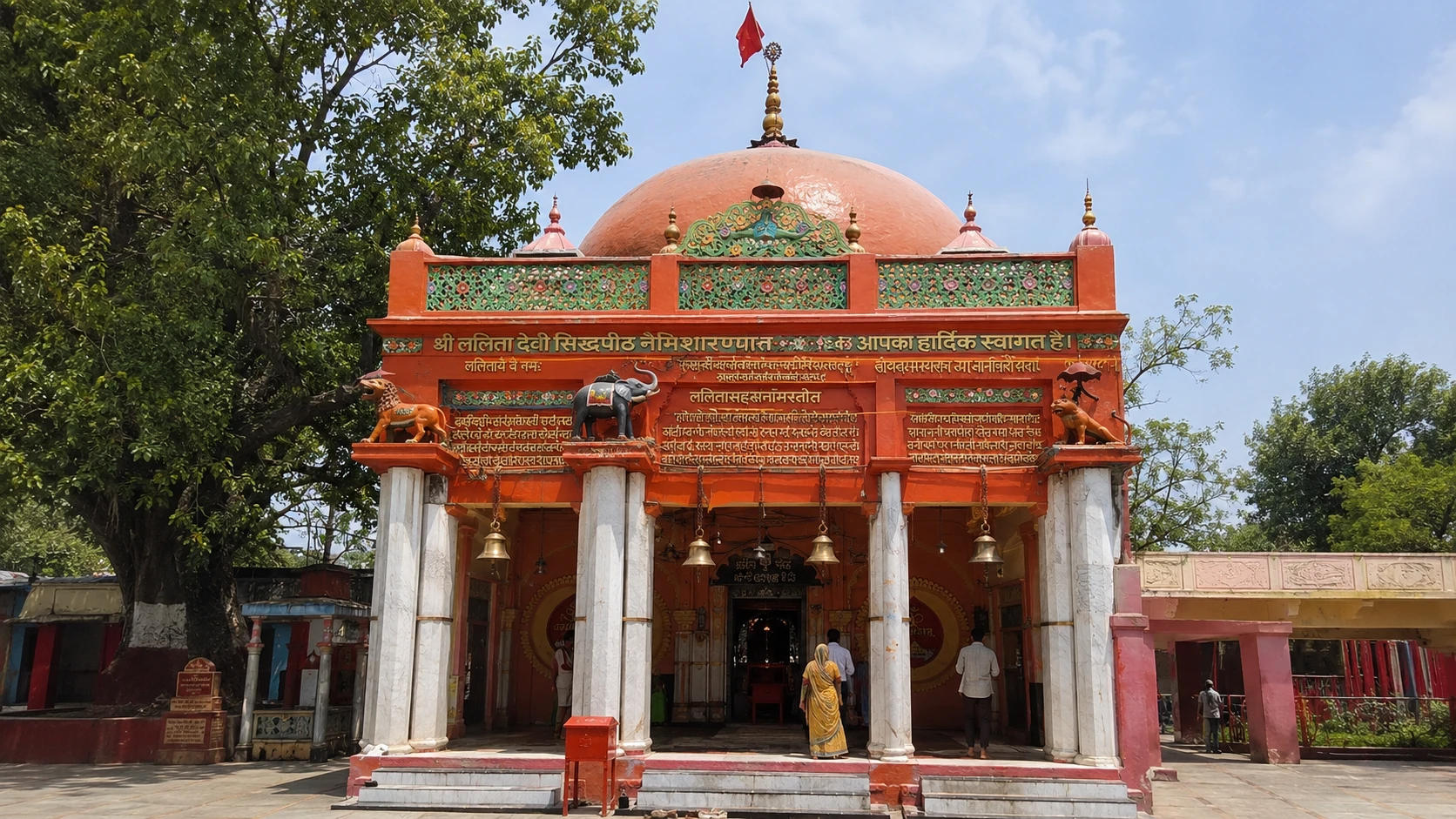
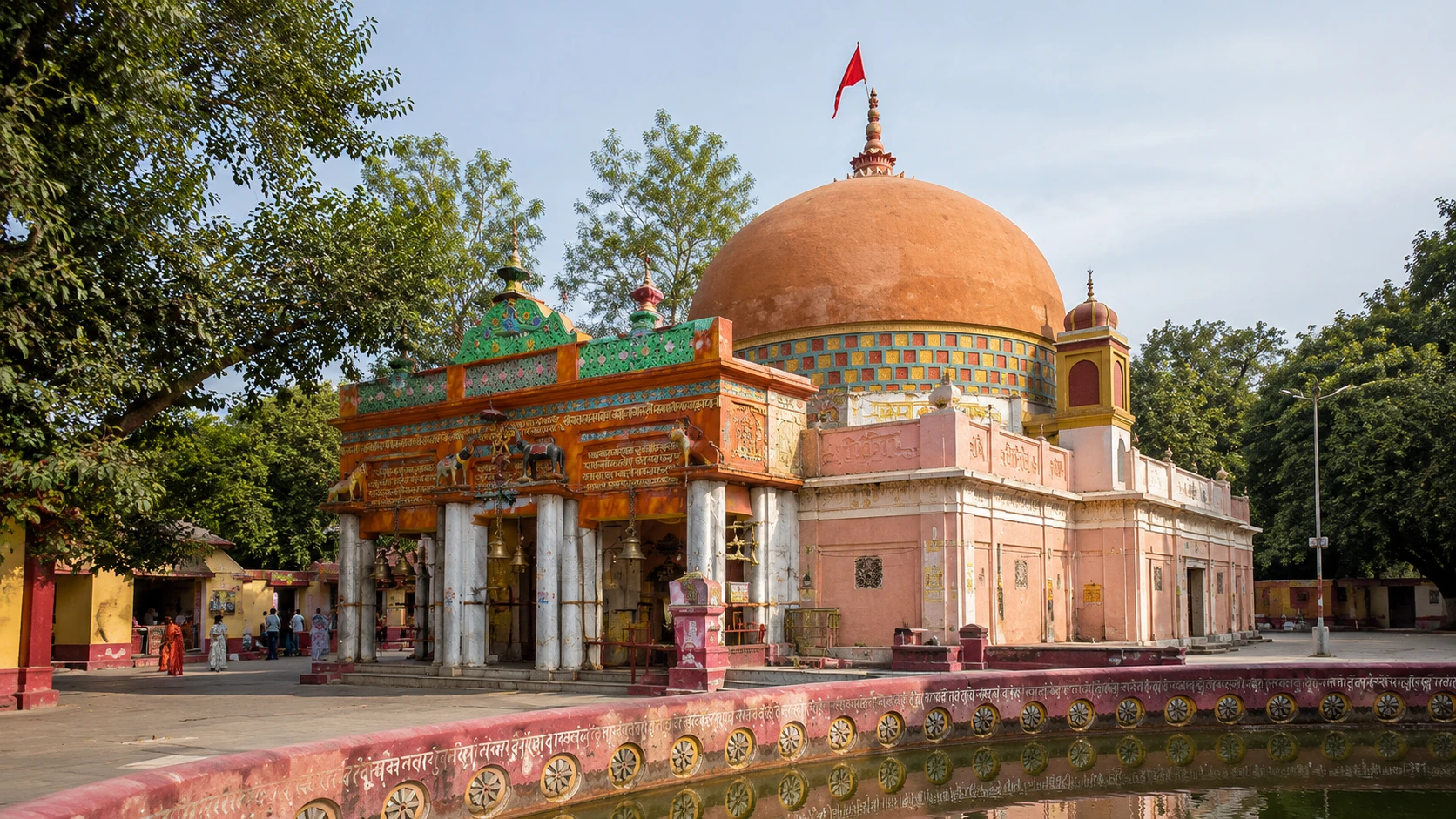
North Indian Nagara — modest village-temple scale
खुला
05:00 – 21:00
आरती
05:30 · 12:00 · 19:00
विशेष
Lalita Sahasranama paath in the sanctum on Fridays and during Navaratri; Chakra Tirtha kund pilgrimage adjoins the temple itinerary for most visitors
पवित्र कथा · पवित्र कथा
Naimisharanya is the forest where Hindu memory begins. Here, on the banks of the Gomati, the sage Suta sat with the rishis led by Shaunaka and recited the Puranas — the frame narrative that contains almost every story Hindus tell themselves about the gods. Watching over that forest, in a small temple shaded by the same shala-vana that received Brahma's discus when it fell from heaven, sits Lalita Devi — the supreme goddess of Sri Vidya, the deity of the Lalita Sahasranama, the form of the Mother who is said to have been worshipped here before there were Puranas to record her worship. She is not the goddess of a famous Shakti Peetha. She is not approached by national pilgrim flows. But she is the deity of the place where the storytelling started — and that, in the geography of Hindu sacrality, is its own kind of supremacy.
Sacred Designationपवित्र पदनाम
Shakti Peeth
शरीर का अंग: Heart (hṛdaya) — per the Devi Bhagavata Purana 108-Peetha tradition. The site is generally not enumerated in the more widely-circulated 51 or 52-Peetha lists (Tantra Chudamani, Pithanirnaya), where the body-part attributions differ across schools.
शक्ति: Lingadharini (also venerated locally as Lalita)
भैरव: Sarvananda
Sacred Origin Storyपवित्र उत्पत्ति कथा
Source: Devi Bhagavata Purana (Lalita-mahatmya / 108-Peetha enumeration); Brahmanda Purana Uttara-khanda (Lalitopakhyana — Hayagriva-Agastya samvada); Vayu Purana (Naimisha mahatmya, Chapters 1–2)
The story of this place begins not with the goddess directly, but with the gods searching for somewhere holy enough to perform a yajna. According to the Vayu Purana, the sages of the Satya Yuga approached Brahma and asked him to show them a place pure enough to hold a thousand-year sacrifice. Brahma released his manomaya chakra — the wheel of the mind — and told them to follow it. Wherever the rim of that wheel touched the earth and stopped, there, he said, the sacrifice should be performed. The chakra rolled across Bharata until it came to rest in a shala-vana on the banks of the Gomati, and the place where its nemi — its rim — fell came to be called Naimisha, the forest of the rim. The thousand-year sacrifice was performed there. The Puranas, which had been gathered into eighteen by Vyasa, were recited there for the first time by Suta to the assembled rishis under Shaunaka's headship.
Into that already-sacred geography the goddess descended. The Devi Bhagavata Purana, in its enumeration of one hundred and eight sacred seats of the goddess, names Naimisha as the place where the heart of Sati came to rest when Vishnu's discus dismembered her corpse across the subcontinent. The shakti who manifested there is named Lingadharini — the bearer of the linga — and the bhairava, Sarvananda. The local tradition of the small temple identifies this Lingadharini with Lalita, the supreme goddess of Sri Vidya, whose thousand names are the Lalita Sahasranama and whose worship in this region is referred back to the Brahmanda Purana's Lalitopakhyana — the great dialogue in which the sage Hayagriva taught the worship of Lalita Tripura Sundari to Agastya muni.
The theological assertion of the place is therefore layered. The forest itself is sanctified by Brahma's chakra. The yajnashala within it is sanctified by Suta's recitation. And the goddess who watches over both is sanctified by being identified — by long local tradition and by the Devi Bhagavata's enumeration — as the heart of Sati and as Lalita herself. Devotees who come here often speak of Lalita Devi Naimisharanya not as a famous shrine but as a quietly central one: the deity of the place where the stories of every other deity began to be told.
उद्धृत स्रोत:
- Vayu Purana, Chapters 1–2 (Naimisha mahatmya — Brahma's chakra and the yajnashala)
- Devi Bhagavata Purana, Skandha 7, Chapter 38 (108-Peetha enumeration — Naimisha as heart of Sati, shakti Lingadharini, bhairava Sarvananda)
- Brahmanda Purana, Uttara-khanda (Lalitopakhyana — Hayagriva-Agastya samvada and the Sri Vidya doctrine of Lalita Tripura Sundari)
- Mahabharata, Adi Parva, Chapters 1–4 (Suta-Shaunaka frame narrative set in Naimisharanya)
अन्य परंपराएँ · अन्य परंपराएँ
Sri Vidya — Dakshinachara lineage transmission (Brahmanda Purana, Lalitopakhyana)
Within the Sri Vidya tradition, the worship of Lalita Tripura Sundari at any site is referred back to the Lalitopakhyana of the Brahmanda Purana, in which the sage Hayagriva — an incarnation of Vishnu in horse-headed form — teaches the worship of Lalita to Agastya muni and his consort Lopamudra. The Lalitopakhyana describes Lalita not as a regional goddess but as the supreme cosmic feminine, the source of all other goddesses, the deity whose Sri Chakra is the very geometry of creation. At Naimisharanya, the local tradition that identifies the resident Devi as Lalita is therefore a tradition of supreme-deity worship in a small village shrine — a theological assertion of the highest order at a place of modest physical scale. Sri Vidya practitioners often visit Lalita Devi Naimisharanya as part of a broader pilgrimage to sites where the Lalita Sahasranama is recited in continuous transmission; the temple is considered a satellite of the much larger Sri Vidya sites (Kanchipuram Kamakshi, Tripurantakam Tripura Sundari, Madurai Meenakshi), bound to them by shared mantra and shared doctrine rather than by physical pilgrim flow.
Naimisharanya etymology — Puranic variants
The name 'Naimisha' itself carries more than one Puranic etymology. The primary account (Vayu Purana) derives it from nemi, the rim of a wheel, recording that Brahma's manomaya chakra came to rest here and so the place became Nemisha or Naimisha. A second tradition, recorded in some Puranic and folk sources, derives the name from King Nimi of the Ikshvaku dynasty, who is said to have performed a yajna in this forest and given it his name. A third tradition associates the name with the killing of a host of asuras here in 'one nimisha' — one blink of an eye — by the gods, the speed of the destruction giving the forest its name. These etymologies are not mutually exclusive within Puranic literary culture, where multiple derivations of a single sacred name are often layered into a place's identity rather than treated as competing claims.
विद्वत संदर्भ
Naimisharanya occupies an unusual position in Hindu sacred geography. It is not a famous Shakti Peetha in the canonical 51 or 52-list sense — the older Pithanirnaya and Tantra Chudamani lists generally do not include it, and the body-part attributions in those lists are distributed differently. The Devi Bhagavata Purana's later 108-Peetha enumeration does include Naimisha, attributing the heart of Sati to it and naming the shakti as Lingadharini and the bhairava as Sarvananda. The historical layering is therefore that the site's identification as a Shakti Peetha is recent within Puranic literary history (the Devi Bhagavata is conventionally dated to the medieval period, later than the foundational 51-Peetha lists) and is best understood as an expansion of the Shakti Peetha tradition rather than as a primary attestation. The local identification of the resident Devi with Lalita — the supreme goddess of Sri Vidya — appears to be a parallel devotional development, anchored in the regional spread of Sri Vidya worship across north India in the late medieval and early modern periods. Modern scholarship on Naimisharanya as a Puranic forest tirtha (Diana Eck, 'India: A Sacred Geography', 2012) treats the place primarily as the Puranic narration site — the literary frame of the Suta-Shaunaka samvada — rather than as a Shakti Peetha; the Shakti Peetha layer should therefore be understood as one of several traditions that have accreted onto an already-sacred forest, not as the site's foundational identity. The theologically substantive point is that for Sri Vidya practitioners, the identification of the resident Devi with Lalita Tripura Sundari is doctrinally weight-bearing in a way that does not depend on canonical Shakti Peetha enumeration; she is the supreme deity here in the same sense that she is the supreme deity everywhere. The site at Tripurantakam in Andhra Pradesh — the canonical 18-Ashtadasa Shakti Peetha seat of Tripura Sundari — is theologically paired with Naimisharanya rather than competing with it: both are seats of the same goddess in the same Sri Vidya doctrinal lineage, geographically distinct but doctrinally continuous.
Historyइतिहास
The documented history of the Lalita Devi temple at Naimisharanya is, like the history of most small village shrines in the eastern Gangetic plain, sparse compared to its mythological depth. The Naimisharanya forest as a whole is a documented Puranic-era pilgrimage destination — references to it occur across the Mahabharata's frame narrative, the Vayu Purana's opening chapters, and the Naimisha mahatmyas of multiple Mahapuranas, attesting that the site was an active pilgrimage destination by at least the early centuries of the Common Era. The Lalita Devi temple within Naimisharanya, however, is not separately attested in the major medieval pilgrimage literature in the way that, for example, the temples of Mathura, Varanasi, or Prayaga are. The standing structure of the present sanctum is a modest 19th–20th century reconstruction on what local tradition holds to be the original Devi-shrine spot within the forest, with substantial renovation through the second half of the 20th century undertaken by the local Sanatan Dharma trust that manages the temple. Naimisharanya as a tirtha received material attention from the Government of India through the Ministry of Tourism's PRASHAD scheme (Pilgrimage Rejuvenation and Spiritual, Heritage Augmentation Drive), initiated in 2014–2015, which funded basic-infrastructure development across the broader Naimisha forest pilgrimage circuit including approach roads, lighting, and visitor facilities. The Lalita Devi sanctum has remained a small, locally-managed shrine throughout this institutional history — distinct in scale and management style from the larger marquee Devi sites of Uttar Pradesh (Vindhyavasini, Banaras Annapurna, Allahabad Alopi Devi) and noticeably distinct from the corporately-managed major Shakti Peethas. Pilgrim flow is regional rather than national, drawn primarily from Awadh, the Doab, and from Sri Vidya practitioners within the broader north Indian Shakta tradition.
Historical Timelineऐतिहासिक कालक्रम
Naimisharanya is established in Sanskrit literary culture as the frame setting for Puranic recitation through the Mahabharata's Adi Parva, the Vayu Purana's opening, and the Naimisha mahatmyas of multiple Mahapuranas. The Suta-Shaunaka samvada — Suta the bard narrating the epics and Puranas to the rishis under Shaunaka — is conventionally located here, making Naimisharanya the literary cradle of the Puranic genre as a whole.
The Mahabharata's compositional dates are disputed (the conventional range is c. 400 BCE to 400 CE for the layered text), so the dating of the Naimisharanya frame is necessarily a range rather than a point. The frame is a literary convention used across multiple Puranas, not a record of a single historical narration; what is dateable is the establishment of the place in Sanskrit literary memory as the canonical site of Puranic recitation, which is firmly attested by the early centuries of the Common Era.
Devi Bhagavata Purana enumerates Naimisharanya among one hundred and eight sacred seats of the goddess in its Saptama Skandha, identifying the body part of Sati as the heart, the shakti as Lingadharini, and the bhairava as Sarvananda. This is the earliest Sanskrit textual attestation of Naimisharanya as a Shakti Peetha in any tradition; earlier Pithanirnaya and Tantra Chudamani lists, which form the basis of the canonical 51-Peetha enumeration, generally do not include the site.
The Devi Bhagavata's dating is debated; conservative scholarship (Hazra, 1963) places its composition between the 8th and 12th centuries CE. The 108-Peetha enumeration is therefore a medieval expansion of the older 51-Peetha tradition, and Naimisharanya's inclusion is part of that expansion. This does not diminish the devotional weight of the attribution; it does locate it within Hindu literary history as a medieval rather than ancient development.
Tulsidas, the Awadhi poet-saint and author of the Ramcharitmanas, is recorded in traditional biographies as having visited Naimisharanya during his pilgrimage years. The visit is part of the broader cultural reactivation of Awadh's Puranic geography during the bhakti period, when figures including Tulsidas, Surdas, and the Ramanandi sampradaya revived popular pilgrimage to sites that had been culturally active in Puranic memory but materially modest for centuries.
The historical biography of Tulsidas is reconstructed substantially from devotional hagiographies (Mool Gosain Charit, Bhaktirasabodhini, Bhaktamal) rather than from independent contemporary records; specific pilgrimage routes ascribed to him are accordingly traditional rather than firmly documentable. The broader claim — that Naimisharanya was an active pilgrimage destination within the Awadh bhakti revival of the 16th century — is well-attested through period devotional literature and is independently corroborated by the survival of multiple bhakti-period sub-shrines around the Naimisha tirtha.
The standing structure of the present Lalita Devi sanctum is reconstructed and progressively renovated by local landowning families and a Sanatan Dharma trust. The temple as it stands today reflects late colonial-period and post-Independence small-temple architectural conventions of the Awadh region rather than any single classical building period. The modest scale and lack of monumental architecture are characteristic of village-deity shrines that maintained devotional continuity through periods when the broader Naimisharanya tirtha was a regional rather than national pilgrimage destination.
Documentation of small village-temple reconstruction in colonial and post-Independence Awadh is sparse; gazetteer references provide the institutional record but rarely with the architectural specificity that larger monument-sites enjoy. The temple's history is therefore best understood as a continuity of devotional use across changing physical structures rather than as the history of a single monumental building.
Naimisharanya is included in the Ministry of Tourism's PRASHAD scheme (Pilgrimage Rejuvenation and Spiritual, Heritage Augmentation Drive), with infrastructure-development funding allocated through successive phases. The funding has primarily addressed approach roads, ghat development on the Gomati, lighting, and visitor facilities across the broader Naimisha tirtha rather than the Lalita Devi sanctum itself. In parallel, the Uttar Pradesh state government has promoted Naimisharanya within its broader Awadh-pilgrimage circuit, increasing road and rail-based regional pilgrim flow particularly during the Navaratri seasons. The Lalita Devi temple has retained its modest scale and locally-managed character through this period of broader infrastructure activation.
The PRASHAD scheme's tirtha-development funding model is documented year-on-year in PIB releases and Ministry of Tourism annual reports; exact allocations and project completions for Naimisharanya specifically should be verified against the most current scheme documentation at the time of any operational re-verification, as the scheme's project list and funding phases continue to evolve.
What You'll Seeदर्शन में
The presiding murti at Lalita Devi Naimisharanya is a stone image of the Devi seated in a posture characteristic of north Indian Devi iconography, dressed in red and gold and adorned with the traditional ornaments offered by devotees — a nose ring, a forehead tika, gold-embroidered chunari draped over her head and shoulders, and seasonal floral garlands renewed during the daily worship cycle. The iconographic identification with Lalita Tripura Sundari is asserted locally through ritual and textual association rather than through the full classical Lalita iconography of the southern Sri Vidya tradition — the murti at Naimisharanya does not display the four-armed form holding pasha (noose), ankusha (goad), pushpa-banaa (five-flower arrows), and ikshu-dhanus (sugarcane bow) that one would see at Kanchi Kamakshi or in tantric Sri Chakra installations. The local form is closer to the broader pan-north-Indian Devi visual idiom — a benevolent, ornamented goddess in seated posture, fronted by the lingam-form that gives the shakti-name Lingadharini its meaning. Devotees offer red flowers (particularly hibiscus and rose), red chunari cloth, glass bangles, kumkum, and sweets — the offerings characteristic of Devi worship throughout the Gangetic region. The sanctum is a single-chamber garbhagriha; the murti is placed at eye-level for darshan rather than elevated on a high pedestal, which makes the encounter intimate by the standards of larger Devi temples. Photography policy within the sanctum is at the discretion of the priest on duty and tends to be conservative during the principal aartis and Navaratri festival days.
Distinctive Practicesविशिष्ट परंपराएँ
Lalita Sahasranama paath
ललिता सहस्रनाम पाठ
Daily at the post-aarti window; full-text recitation on Fridays and throughout Navaratri
The thousand-name recitation of Lalita Devi from the Brahmanda Purana's Lalitopakhyana is performed by the temple priests as part of the standard worship cycle, with extended group recitation on Fridays and during the two Navaratri seasons. Devotees may carry their own copy of the Sahasranama and recite alongside the priest, or may listen as a form of darshan. Each name in the Lalita Sahasranama is a theological assertion about the Devi — her cosmic functions, her relationships with other deities, her residence in the human body and in the universe at large — and the recitation is treated as a continuous meditation on Lalita's identity rather than as a routine liturgical performance.
In the Sri Vidya tradition, Lalita is the supreme deity and the Sahasranama is the principal stotra by which she is addressed. To hear her thousand names is to hold her cosmic personality before the mind for the duration of the recitation. The Sahasranama is understood not as a list but as a complete theological description of the Devi, and its recitation at her own temple is therefore the most direct form of darshan available short of formal Sri Chakra puja, which requires initiation.
Sri Chakra darshan
श्री चक्र दर्शन
Continuous; the Sri Chakra yantra is permanently installed in the sanctum precinct
A Sri Chakra — the geometric yantra that is the visual signature of the Sri Vidya tradition, consisting of nine interlocking triangles arranged around a central bindu within enclosing lotus-petal and square bhupura rings — is permanently installed within the temple's sanctum precinct as the visual representation of Lalita's cosmic body. Devotees offer darshan to the Sri Chakra in addition to the anthropomorphic murti, understanding the two as complementary forms of the same deity: the murti as Lalita's saguna (with-form) aspect and the Sri Chakra as her cosmic geometry. Detailed Sri Chakra puja — the navavarana puja, in which each of the nine concentric circuits is worshipped in sequence — is restricted to initiated Sri Vidya upasakas and is not performed publicly.
Sri Vidya teaches that the Devi is not different from the Sri Chakra. The geometry is not a symbol pointing to her; it is her body in its cosmic form. To take darshan of the Sri Chakra is therefore not preparatory to darshan of the murti — it is darshan of the same Devi in a different mode of manifestation. The practice of darshan-pair (the anthropomorphic and the geometric) reinforces the central Sri Vidya teaching that Lalita transcends and contains all forms.
Chakra Tirtha kund pradakshina (combined Naimisha tirtha)
चक्र तीर्थ कुण्ड प्रदक्षिणा (समवेत नैमिष तीर्थ)
Throughout the year; particularly observed during Phalguna Purnima and the two Navaratri seasons
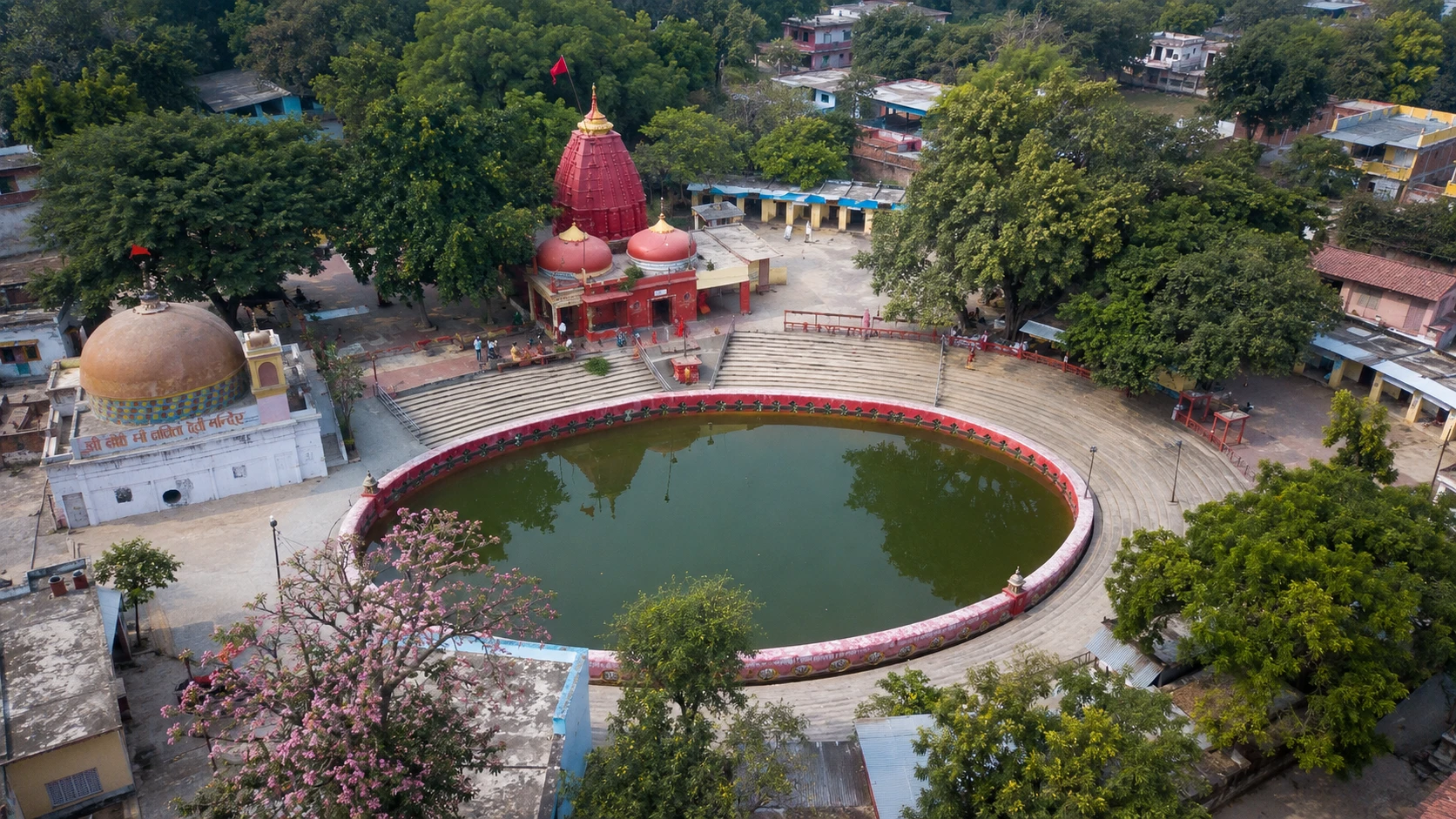
Pilgrims visiting Lalita Devi typically combine darshan at the sanctum with a visit to the Chakra Tirtha kund — the sacred tank at the heart of Naimisharanya, traditionally said to mark the spot where Brahma's chakra rim came to rest. The kund and the Lalita Devi sanctum are within easy walking distance of each other, and the combined visit forms the standard one-day pilgrimage to Naimisharanya. The pradakshina (circumambulation) of the kund is performed first, often followed by a snan (sacred bath) in its waters during the principal festival days, before darshan at the Lalita Devi sanctum. The sequence is theologically deliberate: the kund marks the geographical sanctification of the forest, and Lalita Devi is the deity who watches over that sanctified geography.
The combined pradakshina-and-darshan reinforces what the temple's mythology asserts: that Lalita Devi is not the deity of an isolated shrine but the presiding deity of the entire Naimisha tirtha. The kund and the murti together form the full devotional unit; one without the other is held to be incomplete by local pilgrimage convention.
Did You Know?क्या आप जानते हैं?
Naimisharanya is the literary cradle of Hindu storytelling itself. The frame narrative of almost every Mahapurana — Suta the bard reciting the text to the rishis under Shaunaka — is set in this forest, making Lalita Devi the presiding deity of the place where the stories of every other Hindu deity were first told.
Mahabharata, Adi Parva, Chapters 1–4; Vayu Purana, Chapter 1
The name 'Naimisha' is derived from nemi — the rim of a wheel. According to the Vayu Purana, Brahma released his manomaya chakra (mind-wheel) to find a place pure enough for a thousand-year sacrifice, and the forest where the chakra's rim came to rest was named after that rim. The geometry is theologically suggestive: Lalita's own Sri Chakra is, geometrically, a more elaborate version of the same circle-and-rim symbol.
Vayu Purana, Chapter 1
Lalita Devi Naimisharanya occupies a contested place in Shakti Peetha enumerations. The canonical 51 and 52-Peetha lists (Tantra Chudamani, Pithanirnaya) generally do not include the site, but the medieval Devi Bhagavata Purana's expanded 108-Peetha tradition does — attributing the heart of Sati here, naming the shakti as Lingadharini and the bhairava as Sarvananda. This places Naimisharanya in the second-tier of Shakti Peetha attestation, devotionally significant within its tradition but not part of the classical short-list.
Devi Bhagavata Purana, Skandha 7, Chapter 38; cf. D. C. Sircar, 'The Sakta Pithas', 1948
The temple's identification of its presiding Devi with Lalita Tripura Sundari — the supreme goddess of the Sri Vidya tradition — pairs this modest village shrine theologically with the much larger Sri Vidya centres at Kanchipuram Kamakshi, Tripurantakam Tripura Sundari, and Madurai Meenakshi. The four sites are bound by shared mantra and shared doctrine rather than by physical pilgrim flow; a Sri Vidya practitioner regards Lalita Devi Naimisharanya as no less the deity than the major southern temples.
Brahmanda Purana, Lalitopakhyana; Bhaskararaya, Saubhagya-bhaskara
Naimisharanya was included in the Ministry of Tourism's PRASHAD scheme (Pilgrimage Rejuvenation and Spiritual, Heritage Augmentation Drive) from 2014 onwards, alongside marquee Hindu tirthas including Varanasi, Mathura, Amritsar, and Ayodhya. The scheme has funded approach roads, ghat development on the Gomati, and visitor infrastructure across the broader Naimisha forest, marking the late 2010s as the most significant institutional investment in the tirtha since its medieval bhakti-period revival.
Ministry of Tourism, Government of India — PRASHAD scheme documentation (2014 onwards)
Visitor Accessप्रवेश जानकारी
Lalita Devi Naimisharanya welcomes devotees of all backgrounds for darshan without restriction. The sanctum is small and intimate; queue management during Navaratri can mean modest waiting times but no formal queue infrastructure exists in the way it does at large marquee Devi sites. Photography in outer areas is generally permitted; sanctum photography depends on the priest on duty and tends to be conservative during principal aartis. Initiated Sri Vidya practitioners performing navavarana puja or similar ritual sequences will typically coordinate directly with the local trust and brahmins rather than via any standardised seva-booking process.
Festivalsत्योहार
Lalita Jayanti
ललिता जयन्ती
Jan–Feb (Magha Shukla Panchami)
Lalita Jayanti — the celebration of Lalita Devi's manifestation — is the most theologically central festival at the temple. Observed on Magha Shukla Panchami (the fifth day of the waxing moon in the month of Magha), the festival commemorates Lalita's emergence as the supreme cosmic feminine as recorded in the Brahmanda Purana's Lalitopakhyana. The temple performs a full Lalita Sahasranama paath cycle, special abhishekam, and an extended evening aarti. Among the year's festivals it is the one with the strongest claim on Sri Vidya practitioners specifically, drawing visitors from across north India who may not attend the more general Navaratri observances.
Sharadiya Navaratri
शारदीय नवरात्रि
Sep–Oct (Ashwin Shukla Pratipada to Navami)
The autumn Navaratri is the year's largest pilgrim-flow window at the temple. Nine nights of continuous worship culminate in Mahanavami, with the Devi adorned in nine successive forms over the festival's nine days. The temple coordinates with the broader Naimisha tirtha during this period; combined Lalita Devi darshan and Chakra Tirtha kund snan is the standard sequence followed by visiting pilgrims. The Lalita Sahasranama paath is performed throughout the nine days. The autumn Navaratri is also when the temple's modest scale becomes a virtue rather than a constraint — devotees who visit famously larger Devi sites during Navaratri often speak of the contrast with Naimisharanya as a return to intimate, unhurried Devi worship.
Chaitra Navaratri
चैत्र नवरात्रि
Mar–Apr (Chaitra Shukla Pratipada to Navami)
The spring Navaratri is observed with the same nine-night cycle as Sharadiya, but with regional differences in observance — the spring observance carries a stronger Ramayana association in Awadh given that Rama Navami falls on the ninth day, and many devotees combine Naimisharanya darshan with visits to Ayodhya during this season. The Devi-temple-specific observances at Naimisharanya remain centred on the Lalita Sahasranama and the nine-form adornment cycle. Pilgrim flow during Chaitra Navaratri is lighter than during Sharadiya, which makes it a preferred season for devotees seeking quieter darshan.
Phalguna Purnima fair (Naimisha tirtha-wide)
फाल्गुन पूर्णिमा मेला (समग्र नैमिष तीर्थ)
Feb–Mar (Phalguna Purnima)
Phalguna Purnima — the full moon of Phalguna, which coincides with Holi — marks an annual fair across the broader Naimisha tirtha that includes Lalita Devi darshan as part of the standard sequence. The fair is one of the year's three principal pilgrim-flow windows alongside the two Navaratri festivals. Devotees visiting during Phalguna Purnima typically combine darshan at Lalita Devi with a snan at the Chakra Tirtha kund and visits to the surrounding shrines of the Naimisha forest. This is a Naimisha-tirtha-wide observance rather than a Lalita-Devi-specific festival, but the temple participates fully and adjusts its arrangements to accommodate the increased visitor flow.
Traditional Offeringsपारंपरिक अर्पण
प्राथमिक अर्पण
Red flowers (hibiscus and rose)
लाल पुष्प (जपा एवं गुलाब)
जपा-पुष्प
Red is the principal colour of Devi worship across the Shakta tradition — the colour of vitality, fertility, and the awakened life-force. Hibiscus (japa) is particularly associated with Devi worship from the Devi Mahatmya onwards; its five-petalled deep-red form is read as a visual analogue of the five-element body of the Devi. Rose is the regionally preferred north Indian flower for Devi offerings, with its fragrance considered a complete sensory offering in itself. Devotees typically bring small bouquets or garlands purchased from vendors near the temple approach.
Red chunari (cloth shawl)
लाल चुनरी
The red chunari — a length of red cloth, often bordered with gold thread or zari work — is offered to the Devi as a vastra-arpana, a clothing offering. Symbolically the chunari represents the devotee covering the Devi with their own care and devotion, and at the same time receiving her protection through her acceptance of the cloth. Offered chunaris are draped over the murti for a period, then returned to devotees as prasadi-vastra (blessed cloth), often kept in the home shrine. The practice is widely observed across north Indian Devi worship.
Kumkum and sindoor
कुमकुम एवं सिन्दूर
कुङ्कुम
Vermilion powder is the colour of saubhagya (auspiciousness) and shakti itself. It is applied to the Devi's forehead and feet during puja, and is given to devotees as prasad to be applied to their own foreheads. In the Sri Vidya tradition, the bindu — the red dot at the centre of the Sri Chakra and at the centre of the devotee's forehead — is the geometric symbol of Lalita herself; the application of kumkum after darshan reinforces this identification at the level of the body.
Sweets (Awadhi peda and laddu)
मिष्ठान्न (अवधी पेड़ा एवं लड्डू)
Sweet offerings — most commonly peda (a milk-based sweet) and laddu (a sphere of besan or boondi held together with sugar syrup) — are presented to the Devi as naivedya (food offering) and then distributed as prasad. The local Awadhi peda is a regional variant with a slightly drier texture than the Mathura peda. The theological reading of sweet offerings is that the devotee gives the sweetest of foods to the Devi, who in receiving and returning it transforms the offering into prasad — food that now carries her blessing.
Coconut and betel leaves
नारियल एवं पान-पत्र
नारिकेल, ताम्बूल
The coconut — its three eyes read as a symbol of the three gunas, its tough outer husk as the maya that surrounds the inner sweetness of the Self — is a standard pan-Indian offering across temple traditions, and is broken before the Devi during sankalpa (intentional vow-taking) for any wish. Betel leaves (paan/tambula) are offered as a respect-offering in the manner of welcoming a royal guest; the goddess being welcomed to the devotee's life with the same hospitality one would extend to a sovereign. Together coconut and betel form the standard north Indian Devi-offering set after the floral and cloth offerings.
इस मंदिर की विशेषता
Akhand Lalita Sahasranama recitation
अखण्ड ललिता सहस्रनाम पाठ
While not a material offering, the most distinctive 'offering' at Lalita Devi Naimisharanya is participation in or sponsorship of the Lalita Sahasranama paath. Devotees may sponsor a full Sahasranama recitation by the temple's priests in their name (or in the name of a family member, often for shubh karya — auspicious occasions, illnesses to be overcome, or major life-events), with the recitation performed in the sanctum and the sankalpa offered to the Devi in the sponsor's name. This is the temple's most theologically substantive seva — a direct articulation of the Sri Vidya understanding that Lalita's identity is constituted by her thousand names, and that to have those names recited at her own temple is the highest form of devotion available to the non-initiated devotee.
Offerings may be brought from outside or purchased from vendors near the temple approach. The temple does not run formal sale counters on the scale of large Devi shrines; the local arrangement is informal and price-by-discussion rather than fixed-price. Devotees seeking to sponsor Lalita Sahasranama paath or other specific sevas should approach the local temple brahmins directly on arrival; there is no online seva-booking infrastructure as of this entry's verification date.
How to Reachकैसे पहुँचें
Naimisharanya is well-connected to the Lucknow metropolitan transport network and is accessible by road, rail, and a long air-and-road combination.
By road: The temple is approximately 95 km from Lucknow, 45 km from Sitapur, and 40 km from Sandila. The Lucknow–Sitapur National Highway (NH-24) is the principal corridor; from Sitapur a state highway leads to Naimisharanya through Misrikh tahsil. Road conditions are generally good along the NH-24 stretch and adequate on the Sitapur–Naimisharanya state highway. Driving time from Lucknow is approximately 2.5–3 hours depending on traffic.
By rail: Naimisharanya Railway Station (NMS) is a small halt-class station within 1 km of the temple, served by limited regional trains rather than major express services. For most visitors, the more practical rail approach is via Sandila Junction (40 km) on the Delhi–Howrah main line, or via Sitapur Junction (45 km) — both major stations connected to Delhi, Lucknow, Varanasi, and Kanpur — followed by a road taxi or local bus to Naimisharanya. Lucknow Charbagh (95 km) is the primary rail hub for first-time visitors.
By air: Chaudhary Charan Singh International Airport, Lucknow (LKO) is the nearest airport at 95 km, with direct connections to Delhi, Mumbai, Bengaluru, Hyderabad, Kolkata, and select international destinations. Pre-booked taxi or hired car is the standard onward arrangement; the journey takes 2.5–3 hours.
Plan Your Visitयात्रा की योजना
🌤 सर्वोत्तम मौसम
October through March is the recommended season — cool, dry weather suited to forest-tirtha walking, lower humidity, and the principal festival windows of Sharadiya Navaratri (Sep–Oct), Lalita Jayanti (Jan–Feb), and Phalguna Purnima (Feb–Mar). The summer months (April–June) can reach 42°C and above on the Awadh plains; the monsoon (July–September) brings tropical rain that can interrupt the forest paths and approach roads, though it does not close the temple itself.
👘 पहनावे का नियम
Traditional Indian attire is preferred — saris, salwar-kameez, or kurta-pyjama. Shoulders and knees should be covered. Footwear must be removed before entering the sanctum and is kept at the entrance under priest or attendant supervision. Conservative dress is particularly observed during Navaratri days and Lalita Jayanti.
📱 फोन और फोटोग्राफी
Mobile photography in the outer temple precinct is generally permitted. Sanctum photography is at the discretion of the priest on duty and tends to be restricted during principal aartis, Navaratri days, and Lalita Jayanti. Video recording in the sanctum is generally not permitted. The temple does not maintain a published photography policy; the practical guideline is to ask the priest before taking any image inside the sanctum chamber.
🏨 आवास
Naimisharanya offers a modest range of dharamshalas and small guesthouses, primarily managed by sampradayas (Sanatan Dharma, Ramanandi, and smaller orders) and a small number of private operators serving pilgrims. Standards range from basic shared rooms to mid-tier guesthouses with private bathrooms; air-conditioned accommodation is limited but available. For higher-comfort options, many visitors stay in Lucknow or Sitapur and undertake Naimisharanya as a day-trip. Advance booking is recommended during Navaratri seasons and Lalita Jayanti; in non-festival periods, accommodation is generally available on arrival.
Sacred Soundsपवित्र ध्वनि
क्या आप जानते हैं? · Did You Know?
वही अनुवाद त्रुटि जिसने हिन्दू धर्म में '33 कोटि' को '33 करोड़' बनाया, बौद्ध धर्म में भी हुई। बौद्ध ग्रन्थों के चीनी अनुवाद ने 'सप्त कोटि बुद्ध' (7 श्रेष्ठ बुद्ध) का अनुवाद '7 करोड़ बुद्ध' कर दिया। तिब्बती अनुवाद ने सही किया: 7 प्रकार, 7 करोड़ नहीं। एक संस्कृत शब्द, दो प्रमुख विश्व धर्मों में गलत पढ़ा गया, ने दो एकसमान भ्रम स्वतन्त्र रूप से उत्पन्न किए।
Related Contentसंबंधित सामग्री
Related Scriptures
Related Temples
Meenakshi Temple
मीनाक्षी मंदिर
Madurai, Tamil Nadu
Kamakhya Temple
कामाख्या मंदिर
Guwahati, Assam
Chhinnamastika (Chintpurni)
छिन्नमस्तिका (चिंतपूर्णी)
Chintpurni, Himachal Pradesh
Annapurna Mandir (Varanasi)
अन्नपूर्णा मंदिर
Varanasi, Uttar Pradesh
Vaishno Devi
वैष्णो देवी
Katra, Jammu and Kashmir
Mahalakshmi Kolhapur
महालक्ष्मी कोल्हापुर
Kolhapur, Maharashtra
Mansa Devi (Haridwar)
मनसा देवी मंदिर
Haridwar, Uttarakhand
Chandi Devi (Haridwar)
चंडी देवी मंदिर
Haridwar, Uttarakhand
Community Reflections
🕉️
Be the first to share your reflection.