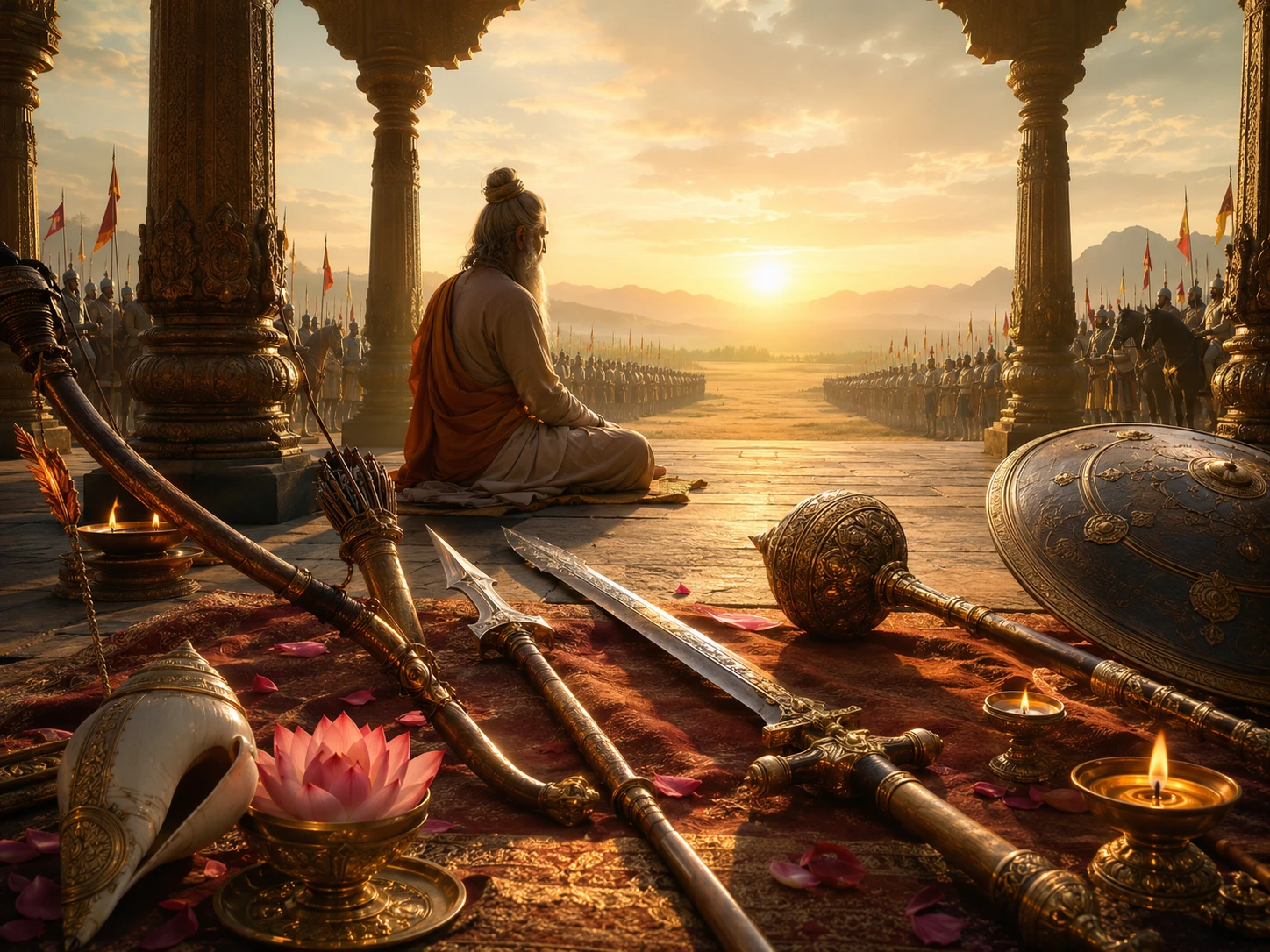
Weapon Ethics in Ramayana vs Mahabharata -- The Two Faces of Dharma Yuddha
रामायण बनाम महाभारत में शस्त्र नैतिकता -- धर्मयुद्ध के दो रूप
Two Wars, Two Verdicts
Hindu civilisation produced two epics. Both center on a war. Both agree on the rules under which war ought to be fought. Only one of them, the Ramayana, treats those rules as binding. The other, the Mahabharata, records in painful detail what happens when those rules are bent, broken, twisted, or set aside altogether.
This is not an accident of authorship. It is a deliberate civilisational pedagogy. Hindu tradition does not give us only one model of righteous warfare. It gives us two, sequentially, and asks us to study them together. The Ramayana is dharma-yuddha as it should be. The Mahabharata is dharma-yuddha as it actually unfolds when human beings, however virtuous, find themselves inside a real conflict. To read either epic alone is to receive half the curriculum.
This article does three things. It lists the canonical rules of dharma-yuddha that both epics inherit from Vedic, Upanishadic, and proto-Dharmashastric sources. It documents how the Ramayana keeps those rules and where it bends them, particularly in the Vali episode and the Brahmastra restraint. And it documents the Mahabharata's seven major violations, performed in most cases by characters who knew exactly what they were violating, with Krishna himself sometimes endorsing the violation.
The goal is not to declare one epic superior. The goal is to recover what these texts together teach about the use of force -- a teaching the Indian Army's NDA at Khadakwasla still draws upon, one that the International Committee of the Red Cross has formally compared to the Geneva Conventions, and one that any 21st-century Indian thinking about ethics in business, politics, or personal conflict would be poorer for not having read.
A brief note on what this article does not cover. It does not engage in the late medieval and modern apologetics that try to retrofit every Mahabharata violation as secretly dharmic, or every Ramayana action as flawless. The classical commentarial tradition -- Adi Shankara on Vishnu Sahasranama, Madhva on the Mahabharata Tatparya Nirnaya, the Dharmaakuutam on Valmiki Ramayana -- is more honest than that. It admits the violations. It examines them. It does not always defend them. This article follows that older intellectual standard. The two epics are read for what they say, not for what later devotional commentary wished they said.
न पाषाणैर्न शस्त्रैश्च निर्ददाति महीपतिः। पलायन्तं वने त्रस्तं विश्वस्तं पन्थि वा शयम्॥
na paashaanair-na shastraish-cha nirdadaati mahiipatih palaayantam vane trastam vishvastam panthi vaa shayam
A king does not strike with stones or weapons one who is fleeing, terrified in the forest, trusting, on the road, or asleep.
— Manusmriti 7.91-92 (paraphrased Sanskrit), preserved across multiple recensions; closely echoed in Mahabharata Shanti Parva 96 and Yajnavalkya Smriti. The classical articulation of the dharma-yuddha non-combatant principle that both epics inherit.
The Rulebook Both Epics Share
Before either epic narrates a single duel, certain rules are already in place. They are inherited from older Vedic and proto-Dharmashastric sources, codified later in the Manusmriti and Kautilya's Arthashastra, and assumed by both Valmiki and Vyasa as the moral context within which their characters act.
The central rules are these.
Fighting begins at sunrise and ends at sunset. Combat at night, in darkness, against sleeping warriors, is forbidden. Equals fight equals -- chariot warriors fight chariot warriors, infantry fights infantry, archers fight archers. Multiple warriors do not attack one. A warrior who has surrendered, lost his weapon, lost his armour, or asked for refuge becomes immediately untouchable. Women, children, the elderly, sages, healers, cooks, animal-handlers, and all other non-combatants are off the field. Pregnant women and pilgrims are sacred, even when found among the enemy. Celestial weapons -- divyastras, brahmastras, narayanastras, pashupatastras -- are not to be used against ordinary soldiers, only against equally-armed opponents who possess equivalent counter-weapons. Once an enemy is defeated, his city is not pillaged, his women are not taken, his temples are not touched. Diplomats, messengers, and dootas (envoys, including Hanuman in the Ramayana) are absolutely inviolable.
The deeper rule, common to both epics, is that war is the last resort. Saama, daana, bheda -- conciliation, gift, division -- must all be tried first. Krishna himself goes to Hastinapura as the Pandavas' final ambassador in the Udyoga Parva. Hanuman crosses the ocean as Rama's envoy. Both missions are attempts to avoid war. Both fail because the other side refuses every reasonable offer. Only when these efforts collapse does dharma-yuddha become permissible.
To read these rules in 2026 is to recognise that they are remarkably modern. The principle of distinction, the principle of proportionality, the protection of non-combatants, the prohibition on perfidy, the immunity of envoys -- all of these appear, with cleaner Sanskrit precision, in texts that predate the Geneva Conventions by anywhere between 1500 and 3000 years. The 2022 article in the International Review of the Red Cross drew this parallel explicitly, citing Manusmriti and Mahabharata passages alongside modern international humanitarian law.
The Eight Cardinal Rules and Their Fate in Each Epic
| Rule | Ramayana Outcome | Mahabharata Outcome |
|---|---|---|
| Sunrise to sunset combat only | Maintained throughout the Lanka war | Broken on day 14 -- fighting continued past sunset to slay Jayadratha |
| Equals fight equals; no multiple-on-one | Ravana and Rama fight one-on-one in the final duel | Broken on day 13 -- six maharathis surrounded and killed Abhimanyu inside the chakravyuha |
| No striking the surrendered or unarmed | Vibhishana, Ravana's brother, surrendered and was protected immediately | Bhurishravas was struck down by Satyaki when his arm had been severed by Arjuna and he had withdrawn from combat |
| No use of celestial weapons against ordinary soldiers | Lakshmana wanted to use Brahmastra against all Rakshasas; Rama explicitly forbade it | Ashwatthama released the Brahmastra during the Sauptika Parva to destroy the unborn Pandava lineage |
| No striking below the belt in mace combat (gada-yuddha) | Not directly tested -- no major mace duel in the war | Bhima struck Duryodhana's thigh on Krishna's silent signal; Balarama threatened to kill Bhima for the violation |
| No killing the sleeping or those at rest | Maintained throughout | Broken catastrophically in Sauptika Parva -- Ashwatthama, Kripa, Kritavarma killed the Pandava children at night while asleep |
| Dootas (envoys) are inviolable | Hanuman in Lanka -- Ravana ordered tail-burning rather than killing him, an indirect acknowledgement | Honoured -- Krishna was received as envoy in Hastinapura; even Duryodhana's attempt to capture him was seen as adharma |
| War is the last resort; saama daana bheda first | Hanuman as envoy, Angada as envoy, multiple peace overtures before Lanka | Krishna's Hastinapura embassy explicitly fails; Pandavas ask for only five villages and are refused |
Of the eight rules, the Ramayana keeps seven cleanly and bends one (the Vali killing). The Mahabharata breaks at least six within the eighteen days. The contrast is structural, not accidental.
Vali, Brahmastra, and the One Episode the Ramayana Cannot Easily Defend
The Ramayana keeps its rules so cleanly that the few moments where it does not stand out sharply. The Vali killing is the most discussed.
In the Kishkindha Kanda, Rama hides behind a tree and shoots Vali, the vanara king, while Vali is engaged in single combat with his brother Sugriva. This violates the surprise-attack rule and the third-party-interference rule simultaneously. Vali, dying, asks Rama directly. Why did you kill me from concealment? What is my crime against you?
Rama's answer in Valmiki Ramayana 4.18 is one of the most ethically dense passages in the entire epic. He does not deny the violation. He does not pretend it was an accident. He cites four reasons. First, Vali had taken his brother Sugriva's wife Ruma while Sugriva was alive, which under sanatana dharma equates Vali's act to incest -- a daughter-in-law treated as wife. Second, Vali had attempted repeatedly to kill Sugriva and showed no mercy. Third, a king has the right to punish wrongdoing within his territory, and as the legitimate Ikshvaku scion overseeing this region, Rama exercised that right. Fourth, Vali's classification as a vanara meant the strict warrior-code rules did not bind Rama in the same way; kings in classical Hindu law could hunt animals from concealment.
Valmiki does not let Rama off lightly. The text gives Vali the dignity of asking the question, gives Rama the burden of answering it, and lets the reader sit with the discomfort. In some commentarial traditions, especially the Dharmaakuutam commentary on Valmiki, additional pragmatic reasons are offered: had Rama confronted Vali directly, Vali would have surrendered, and a surrendered Vali could not be killed under dharma -- which would have left Sugriva permanently endangered. The Vali episode is thus not a clean win for either side. It is the Ramayana's deliberate inclusion of moral complication inside an otherwise pure record.
The Brahmastra episode is the opposite. Lakshmana, in fury after the death of Indrajit and the prolonged siege of Lanka, suggests using the Brahmastra to annihilate the entire Rakshasa population once and for all. Rama's response in the Yuddha Kanda is firm. The Brahmastra cannot be used against an entire population. Their war is with Ravana and his army, not with every Rakshasa. Any Rakshasa who asks for refuge must be granted it. This is the proportionality rule of dharma-yuddha, articulated by Rama before the Geneva Conventions formalised it in 1949. The principle holds. The weapon is not used.
तत् एतत् कारणम् पश्य यत् अर्थम् त्वम् मया हतः। भ्रातुर् वर्तसि भार्यायाम् त्यक्त्वा धर्मम् सनातनम्॥
tat etat kaaranam pashya yat artham tvam mayaa hatah bhraatur vartasi bhaaryaayaam tyaktvaa dharmam sanaatanam
See now this reason for which you have been struck down by me: you have lived with your brother's wife, abandoning the eternal dharma.
— Valmiki Ramayana 4.18.18, Kishkindha Kanda. Rama's direct address to Vali after the contested arrow strike. The verse is preserved across all major recensions of the Valmiki Ramayana including the Baroda Critical Edition.
The Mahabharata's Seven Major Violations
If the Ramayana has one disputed episode, the Mahabharata has at least seven, distributed across the eighteen days of Kurukshetra. They are documented in the Bhishma, Drona, Karna, Shalya, and Sauptika parvas. They are unflinching.
First, Bhishma's fall on day ten. Bhishma was unkillable while he held weapons. The Pandavas, on Krishna's advice, placed Shikhandi in front of Arjuna. Shikhandi had been born female and transformed; Bhishma considered him a woman and therefore unfit to be fought. Bhishma lowered his bow. Arjuna shot from behind Shikhandi. Bhishma fell on a bed of arrows. The violation: using a non-combatant-classified shield to disarm a warrior who had committed to dharmic refusal.
Second, Abhimanyu on day thirteen. Abhimanyu, sixteen years old, entered the chakravyuha alone because no one else knew how. The senior Kaurava warriors -- Drona, Karna, Kripa, Ashwatthama, Duryodhana, Dushasana's son -- surrounded him. Six maharathis attacked one teenager. Karna struck his bowstring from behind. The violation: multiple-on-one, attacking a disarmed warrior.
Third, Drona on day fifteen. Drona, the Kaurava commander, was undefeatable in arms. Krishna proposed a strategy: tell Drona that Ashwatthama (his son) is dead. Bhima killed an elephant named Ashwatthama and announced the death loudly. Yudhishthira, when asked by Drona, said in a half-whispered phrase 'Ashwatthama is dead, the elephant' -- with the second clause inaudible. Drona, broken, dropped his weapon. Dhrishtadyumna decapitated him while he sat in meditation. The violation: deliberate deception, killing a warrior at rest, killing one who had laid down arms.
Fourth, Bhurishravas on day fourteen. After Satyaki had been worn down in combat by Bhurishravas, Arjuna, watching from a distance, severed Bhurishravas's right arm with an arrow. Bhurishravas, mutilated and with weapon dropped, sat down in yogic withdrawal. Satyaki then approached and decapitated him. The violation: killing one who has surrendered. The Mahabharata records that other Kaurava warriors loudly objected and that Satyaki's defence -- 'they killed Abhimanyu, where was their dharma?' -- was the universal Mahabharata answer. Wrong met with wrong.
Fifth, Karna on day seventeen. Karna's chariot wheel sank into the earth. He stepped down to lift it. Krishna told Arjuna to fire. Arjuna's Anjalika arrow struck Karna while he was unarmed, dismounted, and outside combat. Karna himself reminded Arjuna of dharma. Krishna spoke from the chariot: this is not the time for dharma-talk; he was complicit in everything that has been done to you, fire now. Arjuna fired.
Sixth, Duryodhana on day eighteen. The mace-duel between Bhima and Duryodhana was, by classical gada-yuddha rules, to be conducted strictly above the waist. Krishna signalled to Bhima by slapping his own thigh. Bhima struck Duryodhana's thigh below the belt. Balarama, watching, was so enraged at the violation that he raised his mace at Bhima and was barely calmed by Krishna.
Seventh, the Sauptika Parva. This is the worst. After the eighteen days of formal combat had concluded, the surviving Pandava commanders and the children of the Pandavas slept at night. Ashwatthama, Kripa, and Kritavarma -- aided by Shiva, in some narratives -- entered the camp and slaughtered them in their beds. Dhrishtadyumna, Shikhandi, and the five sons of Draupadi (the Upapandavas) were killed in their sleep. The Mahabharata calls this the worst single act in the war. The violation broke every rule simultaneously: night, sleep, non-combatants in the form of children, post-war.
All seven were committed by individuals who knew the rules. The text never pretends otherwise.
The 2022 ICRC paper Charting Hinduism's Rules of Armed Conflict, published in the International Review of the Red Cross, formally documented that the dharma-yuddha tradition contains analogues of nearly every principle of modern international humanitarian law: distinction between combatants and non-combatants, proportionality of force, prohibition on perfidy, immunity of medical personnel and envoys, restraint on weapons of mass destruction, restoration after war ends, and humane treatment of prisoners. The paper went further: in some cases, the Manusmriti and Mahabharata articulate principles -- such as the duty to attempt conciliation before war, and the absolute inviolability of envoys -- that modern IHL has only recently formalised. The Indian Army's NDA at Khadakwasla and the Defence Services Staff College at Wellington both teach modules drawing on Mahabharata case studies. When Arjuna asks Krishna whether he is committing adharma in fighting his cousins, he is asking the question that every officer in every modern army must eventually face. The Mahabharata refuses to give him an easy answer. That refusal is what makes it the curriculum it is.
Why the Mahabharata Bends Where the Ramayana Holds
Why are the two epics so different? The honest answer is contextual.
The Ramayana is a war between dharma and adharma in their pure forms. Rama is the avatara of Vishnu in his explicitly righteous mode. Ravana is a kshatra-vidvesha rakshasa whose adharma is so total that the war's outcome is, in moral terms, never in doubt. Under such conditions, dharma-yuddha can be conducted cleanly because both sides are recognisable and the victorious side has no temptation to compromise principle. Rama gains nothing by breaking rules. The Ramayana therefore reads like a manual of how war should look when the moral architecture is intact.
The Mahabharata is different. Its central conflict is dharma against dharma. Bhishma, Drona, and Karna are not unequivocally adharmic. They are people of immense personal virtue trapped on the side of an unjust cause by oaths, debts, gratitude, and circumstance. Bhishma fights for the Kaurava throne because of a vow he took as a young man. Drona fights for the Kauravas because they fed his family when his Brahmin life was in poverty. Karna fights for Duryodhana because Duryodhana was the only one who saw past his birth. Each of these warriors is, in a sense, doing his own dharma when he fights for the Kauravas. The war therefore cannot be won by simple application of the rulebook, because the rulebook applies to both sides equally and the more virtuous side -- by every classical metric -- is in fact the Kaurava side.
Krishna's pragmatism enters here. The Pandavas could not defeat Bhishma fairly. They could not defeat Drona fairly. They could not defeat Karna fairly. To defeat them at all, the rules had to bend. Krishna chose, again and again, to bend rules in service of an outcome he had decided was the larger dharma -- the establishment of a Pandava raj that would honour the principles for which the war had been fought, even if those principles were broken in the fighting itself.
Is this defensible? The Mahabharata never quite says. It records what happened. It records the discomfort of those who participated -- Yudhishthira, who never recovered from the lie about Ashwatthama, whose chariot is shown after the war to no longer float a fingerwidth above the ground as it had during his uninterrupted truth-telling. It records the terrible peace -- thirty-six years of quiet rule followed by the Yadava clan's self-destruction at Krishna's own family's hands. The text refuses to pronounce a clean verdict because it does not believe one is available. The Mahabharata's gift is precisely the ambiguity the Ramayana does not offer.
यदृच्छया चोपपन्नं स्वर्गद्वारमपावृतम्। सुखिनः क्षत्रियाः पार्थ लभन्ते युद्धमीदृशम्॥
yadricchayaa chopapannam svarga-dvaaram-apaavritam sukhinah kshatriyaah paartha labhante yuddham-iidrisham
When such a war presents itself by chance, like an open gate to heaven, fortunate are the kshatriyas, O Partha, who find themselves obtaining it.
— Bhagavad Gita 2.32. Krishna's argument to Arjuna that this particular war is dharmic precisely because it has not been sought, only accepted -- the classical position that dharma-yuddha is forced upon the righteous, never chosen by them.
What These Two Epics Together Teach
The Hindu civilisational position on the use of force, drawn from the two epics together, can be summarised in three propositions.
First, force is permissible only when peace has been exhausted. Both epics structurally demonstrate this. The Ramayana sends Hanuman, Angada, and finally a full delegation before any arrow is loosed at Lanka. The Mahabharata sends Krishna himself to Hastinapura with the proposal of just five villages. War begins only when the other side closes every door. This is not pacifism. It is exhaustion-of-means as a precondition.
Second, even within war, the means matter. The Ramayana demonstrates this positively, by keeping the rules. The Mahabharata demonstrates it negatively, by showing what each violation costs. Yudhishthira's chariot stops floating. Bhima carries the curse of Balarama for striking the thigh. Arjuna spends his post-war years in increasing despondency. Krishna himself dies a strange, accidental death in a forest, shot by a hunter who mistook his foot for a deer. The text records consequence. The text understands that breaking dharma even for dharma is not free.
Third, dharma-yuddha is not only about what happens in battle. It is about what happens before and after. Diplomacy before. Restoration after. The Ramayana ends with Vibhishana installed as the dharmic king of Lanka, with no Lankan land annexed by Ayodhya. The Mahabharata ends with the Pandavas crowning the surviving Kaurava grandson Parikshit -- through Abhimanyu's son -- to ensure the Kuru line continues. Neither epic celebrates conquest. Both end with the restoration of legitimate rule and the explicit refusal of revenge as policy.
This is a sophisticated ethical architecture. It does not pretend that war is unnecessary. It does not pretend that war is always clean. It does not promise that the right side wins without cost. It does insist, however, that whether you are Rama at the gates of Lanka or Yudhishthira in the lie about the elephant, you remain accountable to a standard articulated three thousand years before the Geneva Conventions, written into the founding texts of the civilisation, and still teachable -- as it is being taught even now in Indian military academies, IIT engineering ethics seminars, and the growing field of dharma-based business school curricula at IIM Ahmedabad and ISB Hyderabad. The rulebook is old. It is also still in force. Every Hindu funeral ceremony for a fallen soldier, every Republic Day parade past Rajpath, every veteran reading the Gita on a Pune balcony at sixty-eight, every NDA cadet swearing his oath at Khadakwasla -- all of these are downstream of the dharma-yuddha tradition the two epics together codified. The civilisation that produced the Mahamrityunjaya for the dying and the Bhagavad Gita for the conflicted produced, in the same breath, a doctrine of restraint in the use of force that the modern world has only just begun to formalise. The two epics are not opposed. They are sequential. Read together, they are the most complete teaching on war that any civilisation has put on record. The Ramayana shows you the rulebook in its purest form, with one telling exception that the tradition itself preserves rather than scrubs. The Mahabharata shows you the same rulebook under genuine pressure, breaking at every joint, and asks whether the answer is to throw the rules out or to grieve the breaking and rebuild more carefully next time. Hindu civilisation answered the second way. That answer, quiet and unfashionable, is why the texts are still read.
Read the Bhagavad Gita Chapter 2 in Full
The second chapter of the Gita, Sankhya Yoga, is where Krishna directly addresses the ethics of fighting a war one did not start but cannot avoid. Set aside thirty minutes and read it through on Eternal Raga, with Sanskrit, transliteration and meaning in English and Hindi. It is the most concise statement of dharma-yuddha ethics the tradition has.
Eternal Raga · शाश्वत राग
Institutional voice — scholarly articles on Sanatan Dharma
Deepen Your Understanding
अपनी समझ और गहरी करें
scriptural exegesis
Krishna -- The Charioteer Who Steered the Cosmos
He was Vishnu's purna avatar in human form, born in a Mathura prison, raised in a Vrindavan cowherd village, king of Dwaraka, charioteer to Arjuna, the speaker of the Gita, the witness who watched the Mahabharata unfold and quietly guided every consequential decision in it. The other characters in this cluster are people. Krishna is something else. The Mahabharata is, in the end, his story.
scriptural exegesis
The Bhagavad Gita -- An Overview of the Song of God
Seven hundred verses spoken between two armies, in the minutes before a war. What the Bhagavad Gita is, where it sits in the Mahabharata, how its eighteen chapters are arranged, and why a dialogue about duty on a battlefield became the most read book of Hindu thought.
divine arsenal
The Celestial Bows -- Pinaka, Gandiva, Sharanga, Vijaya and the Sacred Art of Dhanurvidya
Five bows shaped the fate of two great epics. Forged by Vishwakarma and Brahma, wielded by Shiva, Rama, Arjuna, Vishnu, and Karna -- these were not mere weapons but extensions of cosmic will. Know their origins, their powers, and the warriors who earned them.
scriptural exegesis
The Kurukshetra War -- What Happened in Eighteen Days
Eighteen armies, eighteen days, and four Kaurava commanders who fell one after another. A day-by-day guide to the war at the heart of the Mahabharata -- who led, who fell, and how the rules agreed on the first morning were broken one by one.
scriptural exegesis
The Ramayana -- An Overview of Valmiki's Epic
A hunter's arrow, a grieving bird and a curse that came out as poetry: how the Ramayana began, what happens in its seven books, and how one epic became hundreds of Ramayanas across India and Asia.
The 2022 ICRC paper Charting Hinduism's Rules of Armed Conflict, published in the International Review of the Red Cross, formally documented that the dharma-yuddha tradition contains analogues of nearly every principle o…
More in Divine Arsenal
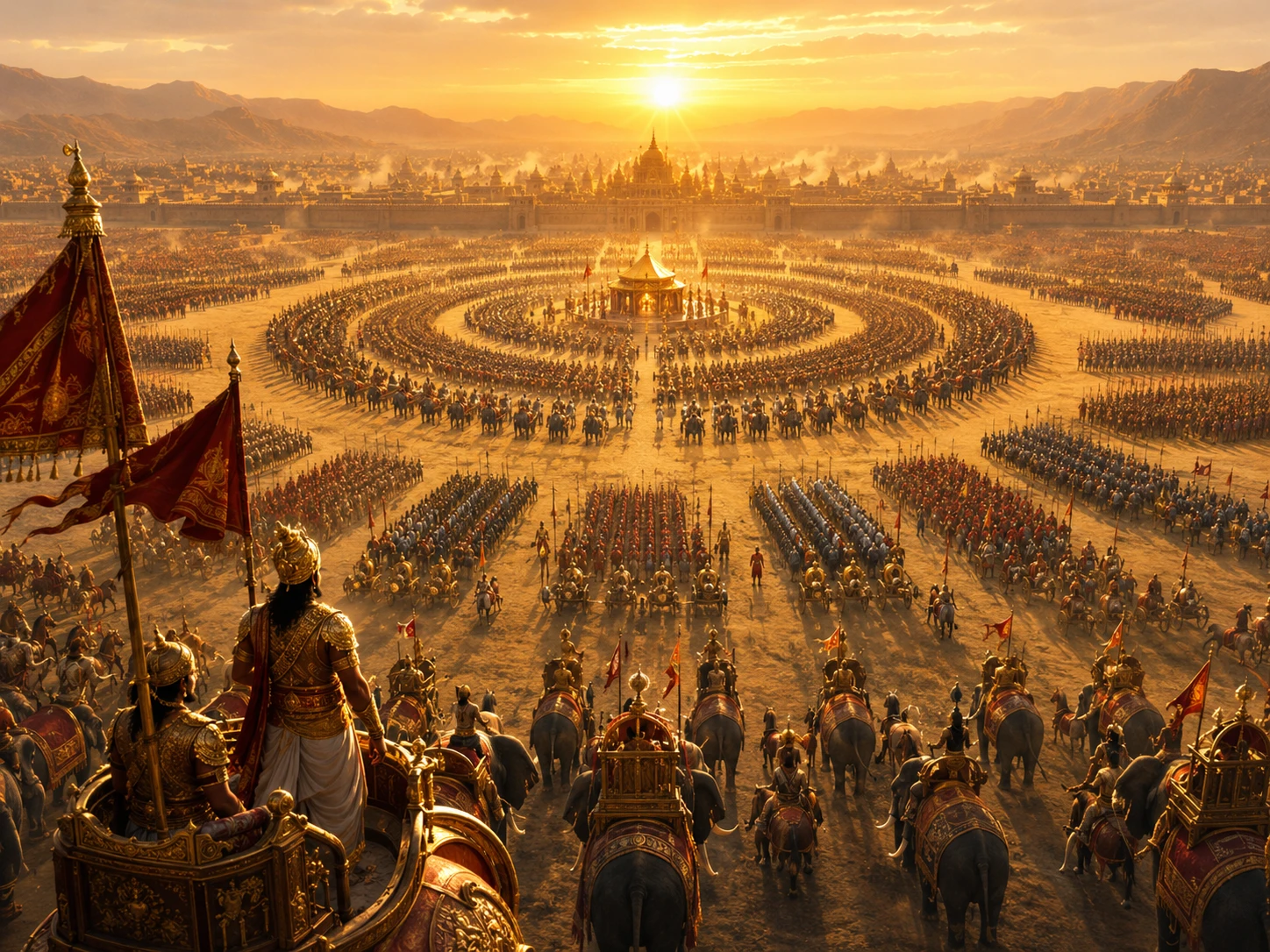
Akshauhini -- The Epic Army Structure Where Every Digit Sums to 18
14 min read
Ancient Indian Martial Arts -- Kalaripayattu to Malla-Yuddha
14 min read
Astra Invocation and Withdrawal -- The Ritual of Weapons
16 min readThe same translation error that turned '33 Koti' into '33 crore' in Hinduism also happened in Buddhism. The Chinese translation of Buddhist texts rendered 'Sapta Koti Buddha' (7 Supreme Buddhas) as '7 Crore Buddhas.' The…
Deities AvatarsCommunity Reflections
🕉️
Be the first to share your reflection.