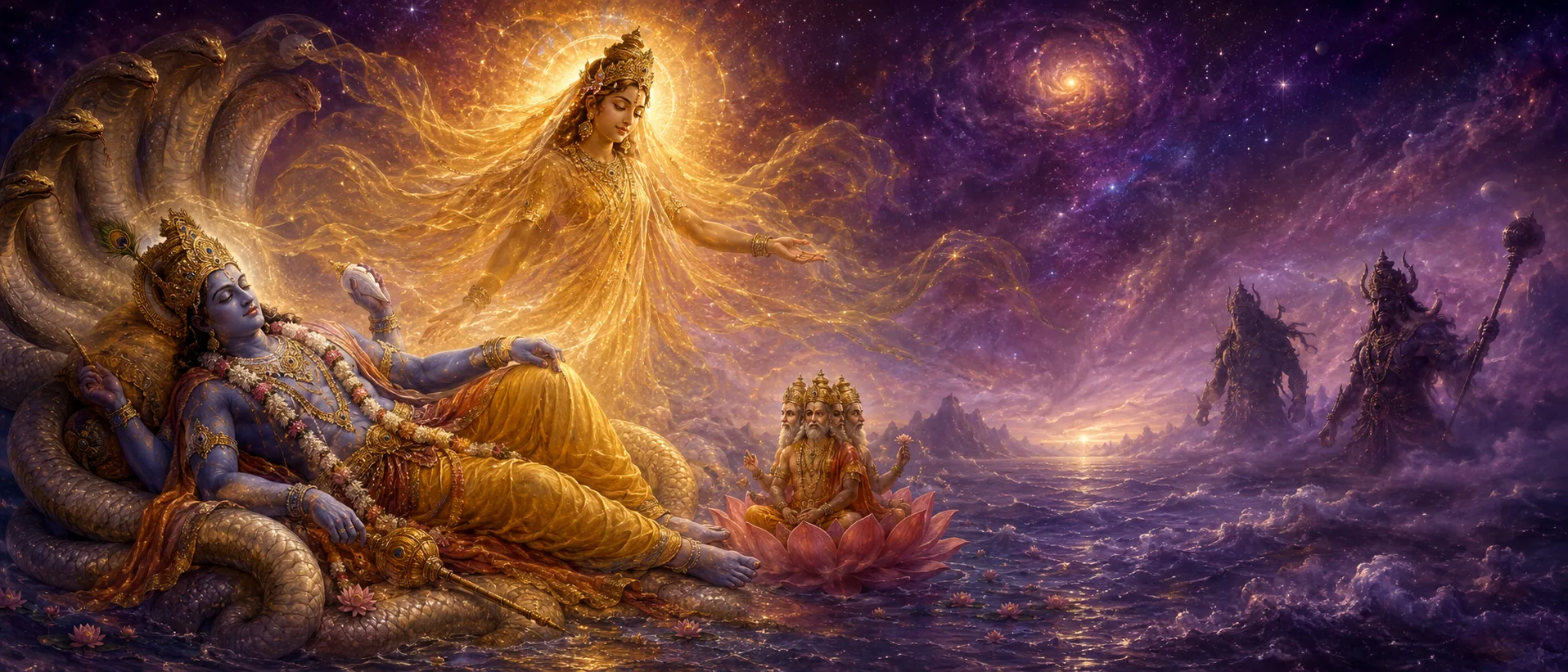
Skandha 1 opens the entire Devi Bhagavatam at the occasion of Janamejaya's snake-sacrifice, where Shaunaka's question sets the whole recitation in motion. Before the narrative proper begins, the text pauses to establish its own scope — how many chapters, how many skandhas, and the succession of Vyasas who compile the Puranas anew in each age — then makes its central claim outright: the Devi is supreme over every other deity, including Vishnu and Shiva. This is argued through two interlocking stories: the Hayagriva avatara, and, at greater length, the Madhu-Kaitabha episode, in which two demons threaten Brahma at the very dawn of creation while Vishnu lies asleep — and can only wake and fight because the Goddess herself, present in him as Yoganidra, chooses to withdraw. The skandha's second half shifts into dynastic narrative: the birth of Budha (son of the Moon and Tara), the story of Pururavas and the celestial nymph Urvashi, and, at length, the story of the sage Shuka — his birth, his early renunciation, Vyasa's own instruction to him, his visit to King Janaka's court to test his understanding, his eventual marriage, and the birth of his children — closing with the birth of Dhritarashtra, Pandu, and Vidura, the generation whose story the Mahabharata itself will tell.
Chapters
Why it matters today
The Madhu-Kaitabha episode's framing here — where Vishnu's own awakening depends entirely on the Goddess choosing to leave him as Yoganidra — is the Devi Bhagavatam's clearest theological move at the very start of the text: taking a story already well known from the Devi Mahatmya tradition and using its own internal logic to argue for the Goddess's priority over the very deity that story is nominally about.