Ballaleshwar (Pali)
बल्लालेश्वर
The only Ashtavinayak named for a devotee — the Lord that Ballal called
Pali, Maharashtra, India
BallāleśvaraAlso known as: Ballal Vinayak, Pali Ganpati, Shri Ballaleshwar, Ballaleshwar Vinayak, Pali Ballaleshwar
Era
Pre-historic per Puranic tradition (Mudgala Purana, Khanda 9 — the Ballal devotee-narrative); the original wooden temple is reported as much older than the present stone structure; the present stone temple was constructed around 1760 under Peshwa-era patronage attributed to Moreshwar Dada Phadnis (Phadnavis family lineage)
Architecture
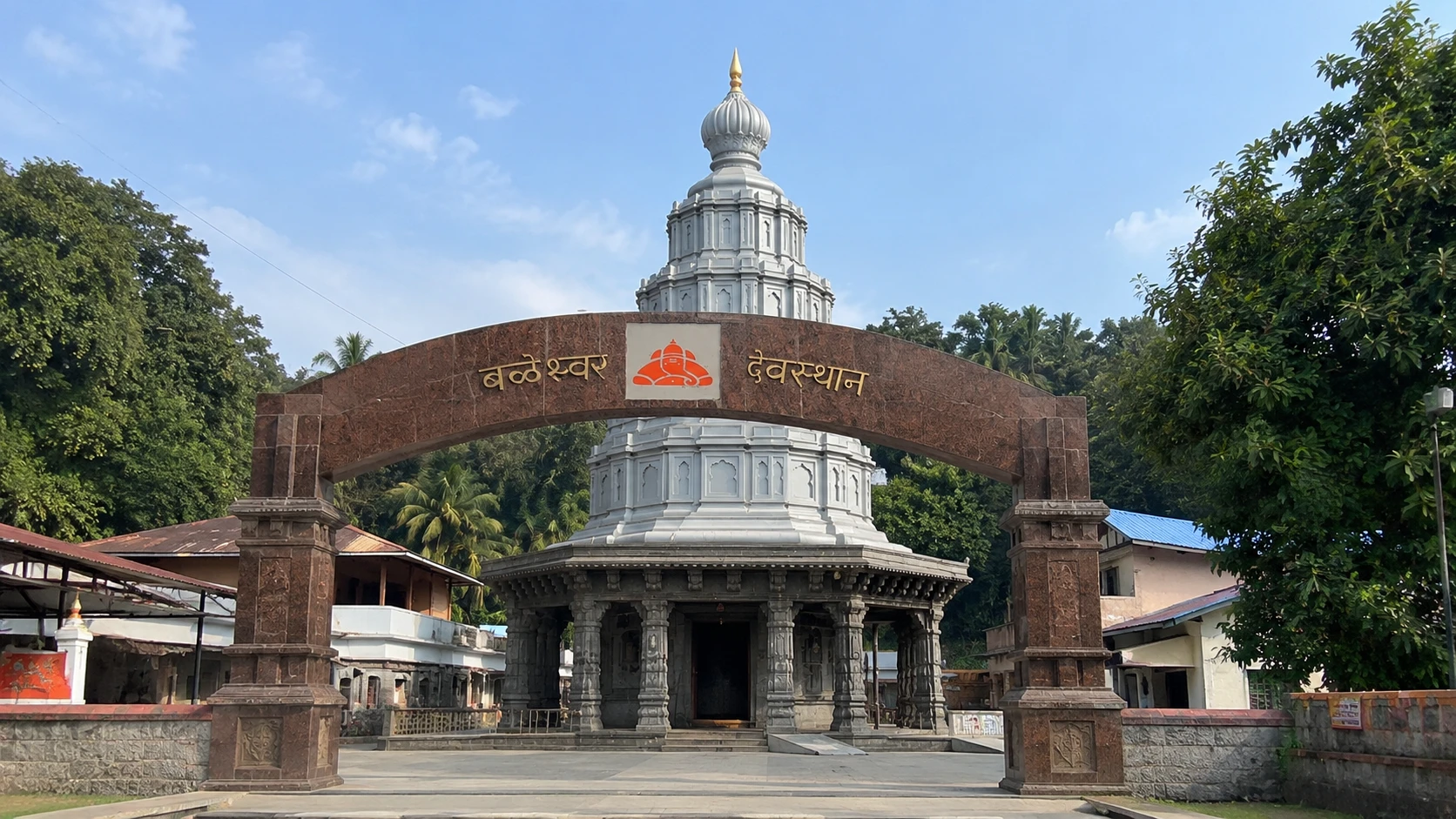
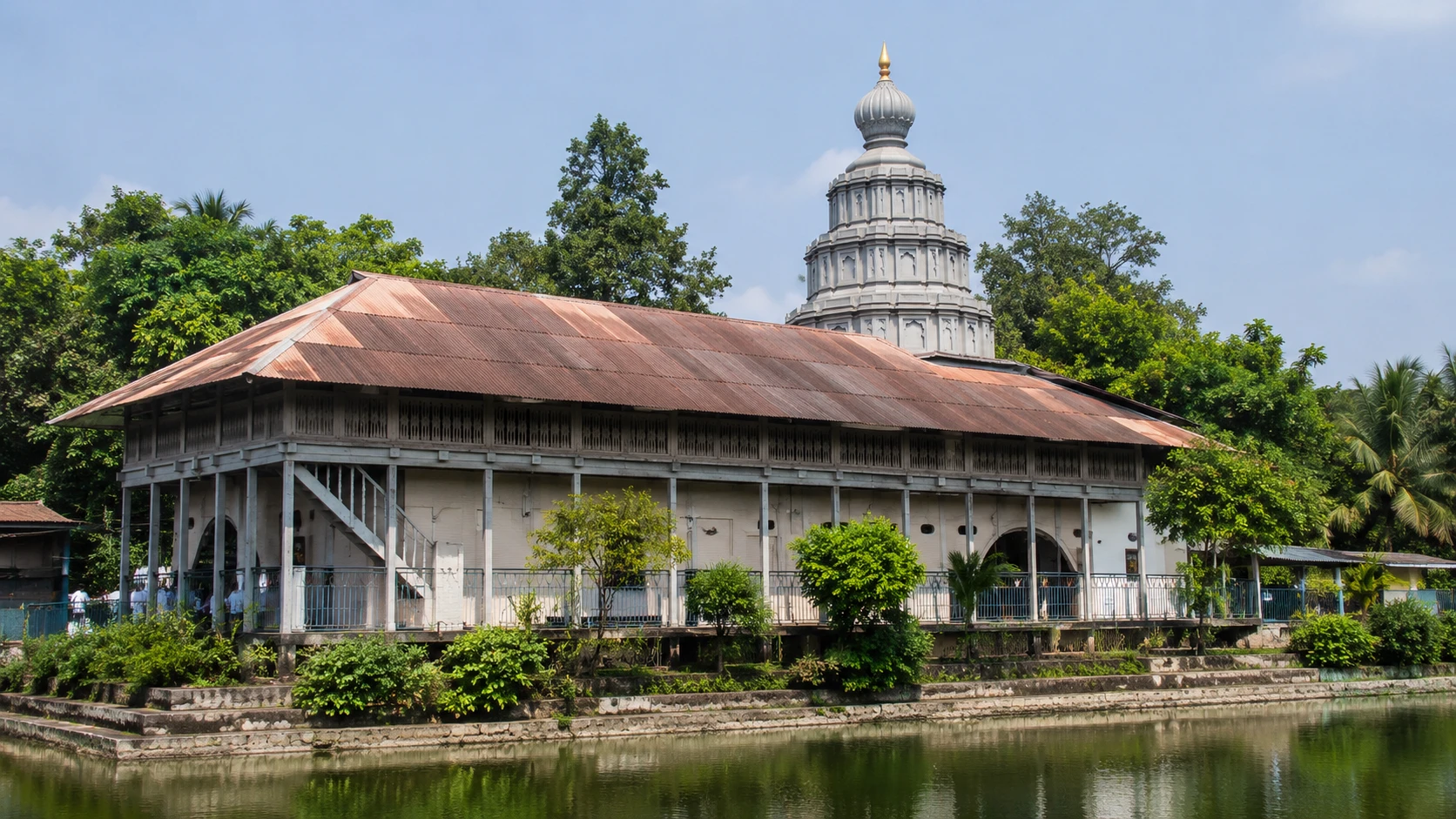
Maratha-Peshwa stone architecture (1760 reconstruction) with an octagonal Sabha-mandapa supported on eight stone pillars in Indo-Persian style — a feature relatively distinctive among the Ashtavinayak shrines. The temple is oriented east-west to enable a documented solar-alignment phenomenon on the morning of Magha Shukla Chaturthi (Ganesh Jayanti) when the rising sun's rays fall directly on the sanctum murti
Open
05:00 – 21:30
Aarti
05:30 · 12:00 · 20:00
Special
On Magha Shukla Chaturthi (Ganesh Jayanti, falling in January-February), the rising sun's first rays enter through the eastern doorway and fall directly on the Ballaleshwar murti — a solar-alignment effect built into the temple's east-west orientation and documented across pilgrim accounts for at least two centuries. Pilgrims wishing to witness the alignment should arrive before sunrise on Ganesh Jayanti specifically; on other days the orientation provides natural morning light but not the precise solstice-aligned direct ray. The two-image darshan — Ballaleshwar in the main sanctum followed by Dhundi Vinayak in the rear shrine — is the canonical darshan-sequence here
The Sacred Legend · पवित्र कथा
Ballaleshwar at Pali is the third stop on the canonical Ashtavinayak circuit, and the only one of the eight whose name belongs not to the deity but to a devotee. Ballal was a young merchant's son in this village whose love for a swayambhu Ganesha stone he had found by the roadside was so total that his father, fearing for the boy's worldly future, beat him and threw the stone away. The villagers, watching, joined in. Ballal, tied to a tree and bleeding, continued chanting Ganesha's name. The legend in the Mudgala Purana records that Ganesha himself descended at that moment — appeared as a Brahmin elder, untied the boy, healed his wounds, and asked what boon would be his. Ballal asked Ganesha to remain at this spot forever, and to be worshipped here in Ballal's own name. Ganesha agreed. The deity merged into a stone where the main murti now stands, and the original swayambhu stone Ballal had worshipped before the beating became Dhundi Vinayak, the smaller image enshrined directly behind the main sanctum. The temple's two-image structure — Ballaleshwar in front, Dhundi Vinayak behind — preserves both phases of the encounter: the form the deity took for the devotee, and the form the devotee had first found and named.
Sacred Designationपवित्र पदनाम
Sacred Origin Storyपवित्र उत्पत्ति कथा
Source: Mudgala Purana, Khanda 9 (Ballala-mahatmya) — widely-attested across the Ganapatya devotional tradition
In the village we now call Pali, in a time before recorded history, there lived a wealthy merchant named Kalyan and his wife Indumati. Their son Ballal — perhaps eight or nine years of age in the telling, though the legend does not give an exact figure — was unlike other village children. From the time he could walk, he was drawn to Ganesha. His parents indulged him at first; a child's devotion is sweet. But Ballal grew, and his devotion did not diminish. He began to gather other village children and lead them in worship — small Ganesha images made of clay and stone, simple bhajans, hours of recitation that the children would have spent at play or at family chores.
One day, walking in the forest at the village edge, Ballal came upon a stone. It was unworked, ordinary to any other eye, but to him it was unmistakable: a swayambhu form of Ganesha, the deity self-revealed in the stone's own shape. Ballal carried the stone home. He placed it in a clearing near a tree at the village edge and began to worship it with what he had — leaves, flowers, water, the most modest offerings a child can give. He stopped coming to meals. He stopped attending to his father's instructions. He brought other village children to the clearing, and they worshipped with him.
The parents of those children came to Kalyan with their complaint. Their sons were no longer doing chores. Their daughters were spending the day in prayer instead of cleaning and preparing food. The village's normal order was disrupted by this strange child-led worship cult. Kalyan listened. He understood the social cost of his son's intensity, and his patience snapped.
He took Ballal to the clearing, tied him to the tree against which the boy sat in worship, and beat him. He threw the swayambhu stone deep into the forest, far enough that the boy could not retrieve it. The village men who had complained joined the beating. Indumati, when she heard, came running, but the father refused to let her intervene — let the boy learn his lesson, let his foolish devotion be broken. They left Ballal tied to the tree, bleeding, and walked back to the village.
Ballal, unable to move, continued his recitation. He had no flowers, no water, no stone. He had only the names of Ganesha and his own breath, and he gave both. Hours passed. The sun moved. Ballal did not stop. The Mudgala Purana records that the devotion of the bound child reached the worlds beyond and the deity himself responded.
An old Brahmin appeared in the clearing. He walked toward Ballal, untied the boy's bonds with a touch, healed the wounds on his back, and lifted him to his feet. Ballal recognised the form immediately — not as the elephant-headed deity of conventional iconography, but as the being whose name he had been speaking. He fell at the elder's feet.
'What boon would you have?' the elder asked.
Ballal had thought about it through the hours of his binding, and his answer was ready. 'Lord, do not return to your heaven. Stay here, at this spot, where I have called you. Stay here forever. And when you stay, let yourself be worshipped not in your own name but in mine — so that no child who comes after me, who is beaten for loving you, has to call from far away. Let them call your name, and let them be calling mine, and let you answer.'
The elder agreed. He merged into the body of a stone that lay near where Ballal had been tied — a stone that would become the Ballaleshwar murti, the form the deity took at the boy's request. The original swayambhu stone that Ballal had carried home and lost to the forest was, the Mudgala Purana says, retrieved by the boy himself and placed behind the new form — that smaller image became Dhundi Vinayak, the deity-as-Ballal-first-found-it, enshrined to this day directly behind the main sanctum.
For this reason, every pilgrim who comes to Pali approaches both images: Dhundi Vinayak first, the form Ballal originally worshipped, and then Ballaleshwar, the form the deity took in answer to the devotee's call. The temple is the only Ashtavinayak shrine where the deity carries the devotee's name, and the only one where the canonical darshan-sequence begins with the deity's pre-manifestation form before arriving at the manifested image.
Sources cited:
- Mudgala Purana, Khanda 9 (Ballala-mahatmya)
- Ganesha Purana — referencing the Ballal episode in cross-text
- Sthala-purana of Pali (regional Marathi devotional tradition)
Scholarly Context
Modern scholarship on Ganapatya devotional literature (Paul Courtright, 'Ganesa: Lord of Obstacles, Lord of Beginnings', Oxford 1985; Anita Raina Thapan, 'Understanding Ganapati', Manohar 1997) treats the Ballal-narrative as among the most distinctive devotional templates in the broader Hindu bhakti tradition — a structure in which the deity descends specifically in response to a child's devotional intensity against social opposition, and in which the resulting shrine bears the devotee's name rather than the deity's title. The narrative type has parallels with the Prahlada-Vishnu tradition (the child Prahlada protected by Vishnu against his hostile father Hiranyakashipu) and the Dhruva-Vishnu tradition (the child Dhruva attaining cosmic stature through devotion against family rejection). The Mudgala Purana's deployment of this template specifically for a Ganapatya site is significant in the medieval reshaping of Ganapati from a sectarian gana-deity into a major bhakti-tradition figure capable of bearing the full theological weight of the child-devotee narrative. The temple's architectural orientation — calibrated for the Magha Shukla Chaturthi solar alignment — has been studied by Maharashtra Department of Archaeology surveys and is treated as deliberate Peshwa-era astronomical planning at the time of the 1760 stone reconstruction.
Historyइतिहास
The documented history of the Ballaleshwar temple in its present form begins much later than the legendary Ballal-narrative. The original shrine on this site, where pilgrim tradition identifies the very spot of Ballal's binding and the deity's descent, was a wooden structure of considerable antiquity but no precise foundation date. Pre-stone-temple references in regional Marathi devotional literature suggest continuous worship at this site through the medieval centuries, but the absence of inscriptional or substantial architectural evidence keeps the pre-1760 history of the temple in the realm of devotional rather than documented chronology.
The transformation of Pali from a small wooden Ganapatya shrine into a major stone temple complex took place in the eighteenth century under Peshwa-era patronage. The construction of the present stone temple — including the distinctive octagonal Sabha-mandapa with eight Indo-Persian-style columns, the east-facing sanctum aligned for the Magha Shukla Chaturthi solar phenomenon, and the rear shrine for Dhundi Vinayak — is attributed to Moreshwar Dada Phadnis, a senior administrative figure of the Phadnavis lineage active during the reign of Peshwa Madhavrao I. The reconstruction is conventionally dated to approximately 1760, though the work proceeded across multiple phases through the following decade.
A documented historical detail that sets Pali apart from the other Ashtavinayak sites is the temple's main bell. The bell hanging in the Sabha-mandapa was reportedly brought from the Portuguese-controlled Bassein (Vasai) fort north of Mumbai following its capture by the Maratha general Chimaji Appa in 1739. Chimaji Appa's military campaign against the Portuguese in coastal western India produced a substantial quantity of bronze cast church bells, several of which were redistributed to Maratha religious sites as offerings of victory. The Pali bell carries Portuguese-language inscriptional fragments visible to close examination, making it a tangible material trace of the eighteenth-century Maratha-Portuguese confrontation now hanging in a temple about a Ganapatya devotee from a much earlier mythological time.
The nearby Sudhagad fort, on the hill above Pali, has its own historical significance. Chhatrapati Shivaji Maharaj is recorded in regional Bakhar chronicles as having considered Sudhagad as a possible capital for the emerging Maratha state in the mid-seventeenth century, before settling on Raigad as the more strategically defensible option. While Sudhagad was not ultimately chosen, the area's place in the Maratha imagination contributed to the Peshwa-era investment in the Ballaleshwar temple below.
After the fall of Peshwa rule in 1818, Ballaleshwar continued under local Brahmin priestly administration. The early twentieth century saw periodic local-trust reconstructions but no major architectural intervention until the early twenty-first century, when the Ashtavinayak Vikas Yojana of 2003-04 funded restoration work on the octagonal mandapa, the sanctum platform, the Dhundi Vinayak rear shrine, and pilgrim infrastructure. Today the temple is administered by the local Ballaleshwar Devasthan Trust, with religious-ceremonial authority connected to the broader Ashtavinayak Devasthan framework. The proximity to Mumbai (130 km) and the Mumbai-Pune-Khopoli road corridor makes Pali one of the most-visited Ashtavinayak sites in absolute pilgrim numbers, particularly across weekend day-trip flows from urban Maharashtra.
Historical Timelineऐतिहासिक कालक्रम
Original wooden temple at Pali, of unspecified medieval antiquity, where continuous Ganapatya worship is attested through regional Marathi devotional literature. No surviving inscriptional evidence permits precise foundation dating; the site is treated by tradition as the location of the legendary Ballal-narrative itself.
The temple's mythological foundation is well-attested in Puranic literature; its physical-architectural foundation pre-1760 is not. We list this as an event-bracket rather than a specific date out of editorial honesty about pre-stone-phase undocumentation.
Maratha general Chimaji Appa captured the Portuguese-controlled Bassein (Vasai) fort north of Mumbai, ending Portuguese coastal dominance in the region. Among the war-trophies redistributed across Maratha territories was a quantity of bronze cast church bells; one such bell — bearing visible Portuguese-language inscriptional fragments — was offered to the Ballaleshwar temple and now hangs in the Sabha-mandapa.
Reconstruction of the wooden Ballaleshwar shrine into a major stone temple complex undertaken by Moreshwar Dada Phadnis of the Phadnavis administrative lineage, during the reign of Peshwa Madhavrao I. The reconstruction produced the octagonal Sabha-mandapa with eight Indo-Persian columns, the east-aligned sanctum oriented for the Magha Shukla Chaturthi solar phenomenon, and the rear shrine for the Dhundi Vinayak image. Work continued across multiple phases through the 1760s.
The 1760 dating is conventional; the work occurred across multiple phases and exact start and completion years are not preserved. The attribution to Moreshwar Dada Phadnis is consistent across Peshwa Daftar references and Chinchwad Sansthan tradition, though some local accounts attribute portions of the work to Nana Phadnavis (Balaji Janardan Bhanu) of the next administrative generation.
Fall of Peshwa rule to British East India Company at the Battle of Khadki, ending major patronage flows to Ashtavinayak sites. Ballaleshwar entered a quieter institutional phase under continued local Brahmin priestly administration, with no further major architectural interventions until the twenty-first century.
This event is recorded here not as physical destruction (which did not occur) but as the structural end of the patronage system that had funded the eighteenth-century reconstruction. The 'destruction' enum-tag captures this institutional sense rather than physical demolition.
Increasing pilgrim traffic to Pali following the development of the Mumbai-Pune road corridor and the Mumbai-Pune Expressway access via Khopoli. Ballaleshwar's relative proximity to Mumbai (compared to the other Ashtavinayak sites further inland) made it the most-visited shrine in the circuit in absolute numbers, particularly across weekend day-trip flows from Mumbai-region urban devotees.
Ashtavinayak Vikas Yojana renovation works at Pali included structural repairs to the octagonal Sabha-mandapa, restoration of the sanctum platform, conservation work on the Dhundi Vinayak rear shrine, and modernization of pilgrim infrastructure including approach roads, parking, and rest-houses.
What You'll Seeदर्शन में
The Ballaleshwar temple's iconographic structure is unique among the Ashtavinayak shrines in that two distinct Ganesha images are enshrined within a single complex, and the canonical darshan sequence requires visiting both. The main sanctum holds the Ballaleshwar murti — the form Ganesha took when he descended in response to Ballal's call. Carved in dark basalt, seated in lotus posture, the murti rises approximately three feet from the platform. The face is broad and the expression is notably gentle — pilgrim accounts repeatedly emphasize the soft, almost childlike quality of the Ballaleshwar face, in keeping with the legend's framing of a deity who appeared specifically for a child. The trunk turns to the left (vamavarti). The third eye is visible on the forehead. The murti's eyes are traditionally inlaid with small diamonds, and a similar diamond is set at the navel — these are visible at certain angles during the morning aarti, though the heavy garlanding can obscure them during peak darshan windows. Siddhi and Riddhi (the consorts) sit smaller to either side; a small Mooshaka (mouse) is at the base of the platform.
Behind the main sanctum, in a separate small shrine accessible by a short passage, stands the Dhundi Vinayak — the original swayambhu stone that Ballal had carried home and worshipped before his beating, retrieved by him after the descent and enshrined in honour. The Dhundi Vinayak is smaller, more roughly shaped, and visibly an older form than the Ballaleshwar murti — pilgrim tradition holds it to be unaltered from the form Ballal first found in the forest. The canonical darshan-sequence at Pali is to approach Dhundi Vinayak first (the deity-as-the-devotee-found-him), then Ballaleshwar (the deity-as-he-responded), preserving the chronological arc of the original legend.
The sanctum itself is east-facing and architecturally calibrated for the Magha Shukla Chaturthi solar alignment. On the morning of Ganesh Jayanti, the rising sun's first rays enter through the eastern doorway and fall directly on the Ballaleshwar murti — a documented effect built into the 1760 Peshwa-era reconstruction and verified by Maharashtra Department of Archaeology surveys as deliberate astronomical orientation. Pilgrims arriving before sunrise on Ganesh Jayanti specifically can witness this alignment; on other days the orientation produces ordinary morning light entering the sanctum, beautiful but not the precise solstice-window phenomenon.
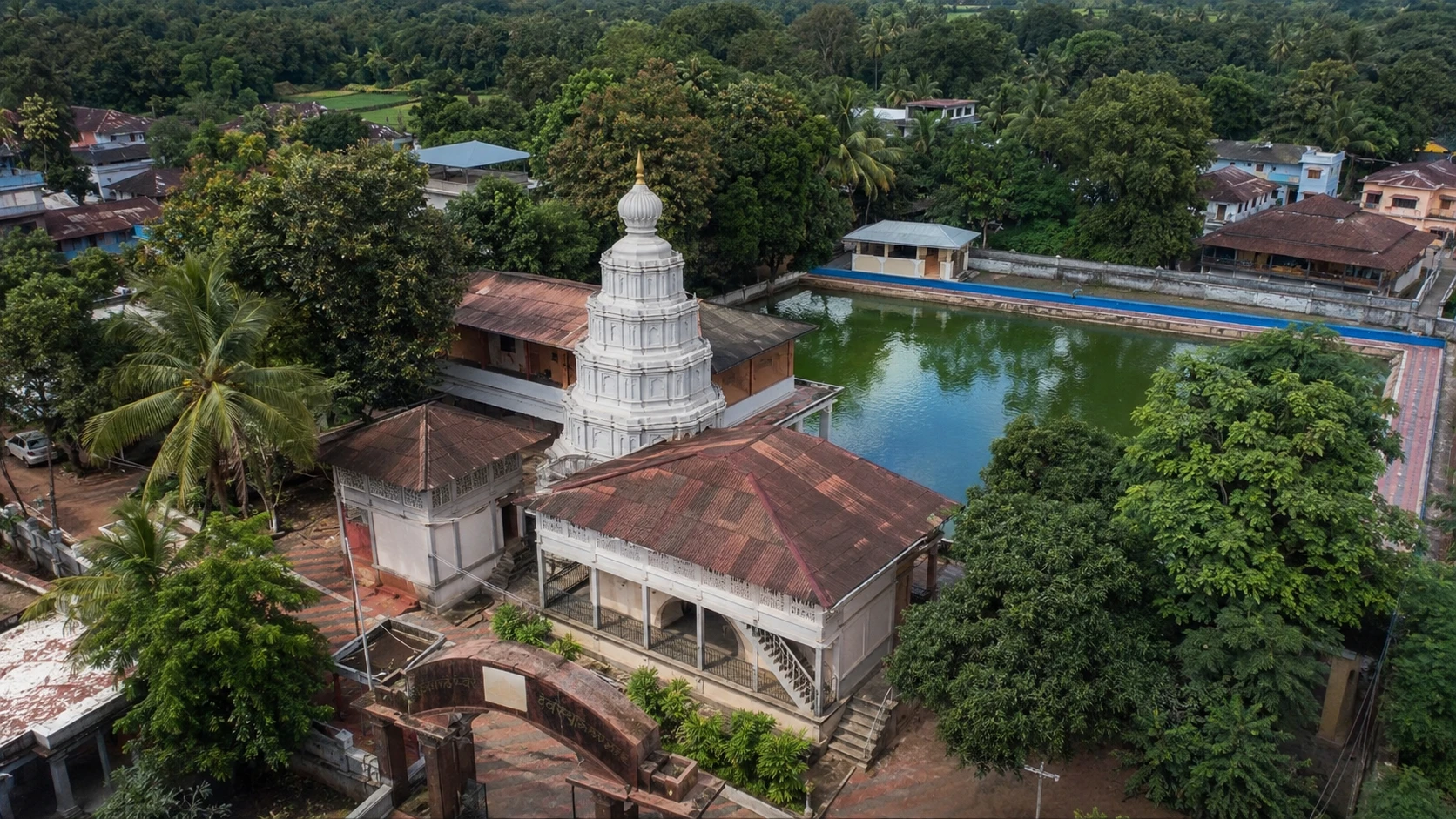
The Sabha-mandapa surrounding the sanctum is the temple's most architecturally distinctive feature among the Ashtavinayak sites: an octagonal hall supported on eight stone pillars in an Indo-Persian style that reflects the syncretic architectural vocabulary of the late Peshwa period. The pillars carry sculpted floral and geometric ornament typical of 18th-century Maratha temple work. From the eastern wall of the Sabha-mandapa hangs the temple's famous bronze bell — brought from the captured Portuguese fort of Bassein in 1739 by Chimaji Appa and bearing visible Portuguese-language inscriptional fragments to anyone who examines it closely. Beyond the Sabha-mandapa stretches a courtyard with subsidiary smaller shrines, the standard Peshwa-era priest-residences, and modern pilgrim facilities added during the 2003-04 renovation.
Distinctive Practicesविशिष्ट परंपराएँ
Dual-Image Darshan Sequence (Dhundi Vinayak first, Ballaleshwar second)
द्वि-मूर्ति दर्शन क्रम (पहले ढुंडी विनायक, फिर बल्लालेश्वर)
Every darshan visit, including ordinary daily darshan and festival darshan
Unique among the Ashtavinayak shrines, Pali requires its pilgrims to perform a two-image darshan in a specific order. After entering the temple complex, pilgrims proceed first to the small rear shrine of Dhundi Vinayak — the original swayambhu stone Ballal had worshipped before his beating — offer prayers and durva there, then return to the main sanctum to take darshan of the Ballaleshwar murti. The reverse sequence (main sanctum first, rear shrine second) is treated by the temple priests and the Chinchwad Sansthan tradition as incomplete, since it inverts the chronological arc of the legend itself. Pilgrims who do not know this sequence are guided through it by the temple priests on arrival.
The dual-image structure preserves both phases of the Ballal-encounter: the form the deity had as devotion-object before the manifestation, and the form the deity took in response to the devotion. Darshan in this order is treated as walking the legend in time — first one approaches the deity as the child Ballal had, with the modesty of devotion that does not yet know whether it will be answered; only then does one approach the manifested form, the answer that came. The practice resists the temptation to skip directly to the manifest deity, which would erase the devotee from the temple that bears the devotee's name.
Magha Shukla Chaturthi Solar Alignment Darshan
माघ शुक्ल चतुर्थी सौर संरेखन दर्शन
Magha Shukla Chaturthi (Ganesh Jayanti) — January-February — pre-sunrise to first morning rays
On the morning of Magha Shukla Chaturthi each year, the east-aligned sanctum produces a documented solar-alignment phenomenon: the rising sun's first rays enter through the eastern doorway and fall directly on the Ballaleshwar murti for several minutes. Pilgrims wishing to witness this alignment must arrive at the temple complex before sunrise — the sanctum opens for darshan early on this morning specifically to accommodate the phenomenon. The light enters the sanctum at the angle calibrated by the 1760 reconstruction, traverses across the murti's face, and gradually withdraws as the sun rises further. The alignment is documented across pilgrim accounts for at least two centuries and verified by Maharashtra Department of Archaeology surveys as deliberate astronomical orientation built into the temple's design.
The alignment ties the temple's annual peak day — Ganesh Jayanti, the birth-tithi — to the cosmic order of the solar cycle. The light that falls on the murti on this single morning is treated as the visible blessing of the deity's birth: the sun itself comes to witness, the architecture cooperates, the legend of Ballal's call is annually re-confirmed by the universe itself bringing its light to the spot the devotee asked to be illuminated. Pilgrims who arrive for this specific alignment often note it as the most affecting moment of their entire Ashtavinayak yatra.
Bell-Ringing at the Vasai Bell
वसई घंटे पर घंटा-वादन
Every visit; with particular significance during Vijayadashami and on the anniversary of the 1739 Vasai capture
The bronze bell hanging in the Sabha-mandapa — brought from the captured Portuguese fort of Bassein in 1739 — is rung by pilgrims as part of the darshan ritual. The bell's deep resonance, distinct from the smaller modern bells found at most Hindu temples, is itself considered devotionally significant: it is held to be the only major temple-bell at any Ashtavinayak shrine that carries documented military-historical provenance from outside the Maratha religious-architectural sphere. On Vijayadashami (the day of cosmic victory) and on the traditional anniversary date of the Vasai conquest, particular emphasis is placed on the bell-ringing ritual.
The bell's journey — cast as a Portuguese church-bell, captured in the eighteenth-century Maratha-Portuguese confrontation, redistributed to a Ganapatya temple, ringing now in service of a Mudgala Purana legend about a child's devotion — is itself a meditation on how sacred objects acquire layers of meaning across history. Each ringing of the bell is held to invoke not only Ganapati's attention but also the historical victory that brought this particular bronze to this particular shrine, integrating the devotee into a longer chain of devotional and historical agency.
Pilgrim-as-Child Bhava Sankalpa
बालक-भाव संकल्प
Personal sadhana commitment; particularly undertaken by pilgrims who have known parental or community opposition to their devotional life
A distinctive devotional practice at Pali — preserved in the local devotional tradition and in Chinchwad Sansthan pilgrim guidance — is the conscious adoption of the bhava (devotional disposition) of the child Ballal during darshan. Pilgrims who have themselves experienced family or community opposition to their devotional practice come to Pali specifically to take darshan in this bhava, mentally placing themselves in Ballal's position as the deity descends. Some pilgrims add a sankalpa-statement at the rear shrine of Dhundi Vinayak naming the particular opposition they have faced or are facing, asking the same intervention that Ganapati gave to Ballal. The practice is informal in structure — there is no fixed ritual — but it is a recognized devotional pattern at Pali.
The Ballal-narrative offers a specific theology of devotional descent: the deity comes precisely in response to devotion-against-opposition. Pilgrims who consciously adopt the child-bhava at Pali frame their own oppositions in this theological structure, treating their experience as continuous with the legend rather than separate from it. The Mudgala Purana's repeated emphasis on Ballal's youth and helplessness becomes a devotional resource: any devotee who can re-enter that helplessness through bhava can access the response that helplessness received.
Did You Know?क्या आप जानते हैं?
Ballaleshwar is the only Ashtavinayak shrine — and one of very few major Hindu temples anywhere in India — where the deity is named not after his own form or function but after a human devotee. The name 'Ballaleshwar' means 'the Lord of Ballal' or 'the Lord that Ballal called', preserving the devotee's identity in the deity's title across every subsequent generation of worshippers. This naming inversion is the temple's single most-cited differentiator across Ashtavinayak devotional literature.
Mudgala Purana, Khanda 9 (Ballala-mahatmya); corroborated across Ashtavinayak devotional literature
The temple holds two enshrined Ganesha images rather than one. The main sanctum contains the Ballaleshwar murti — the form Ganesha took in response to the devotee's call — while a smaller rear shrine holds Dhundi Vinayak, the original swayambhu stone that Ballal had worshipped before the descent. The canonical darshan-sequence is to visit Dhundi Vinayak first, then proceed to the main sanctum, walking the chronological arc of the legend itself. This dual-image structure is unique among the Ashtavinayak sites.
Chinchwad Sansthan pilgrim tradition; Mudgala Purana iconographic notes
On the morning of Magha Shukla Chaturthi (Ganesh Jayanti) each year, the rising sun's first rays enter the east-facing sanctum through the doorway and fall directly on the Ballaleshwar murti for several minutes. This solar alignment is documented across pilgrim accounts for at least two centuries and was verified by Maharashtra Department of Archaeology surveys as deliberate astronomical orientation built into the 1760 Peshwa-era reconstruction. The architectural calibration of a sanctum for an annual solstice-window solar phenomenon is rare in Ashtavinayak architecture and treated as a Pali signature.
Maharashtra Department of Archaeology, Ashtavinayak sites survey; pre-modern Marathi pilgrim travel-writing
The bronze bell hanging in the temple's octagonal Sabha-mandapa was brought from the Portuguese-controlled Bassein (Vasai) fort, captured by the Maratha general Chimaji Appa in 1739. The bell — bearing visible Portuguese-language inscriptional fragments to anyone who examines it closely — is one of the few temple-bells anywhere in India that carries documented military-historical provenance from outside the Indian religious-architectural sphere. Its deep resonance, distinct from the smaller modern bells of most contemporary temples, is itself treated as devotionally significant.
Peshwa Daftar records of Chimaji Appa's Vasai campaign; G.S. Sardesai, 'New History of the Marathas' (1958)
The Sabha-mandapa surrounding the sanctum is an octagonal hall supported on eight Indo-Persian-style stone pillars — a syncretic architectural feature distinctive among the Ashtavinayak shrines and characteristic of the late Peshwa period's absorption of post-Mughal architectural vocabulary into Maratha temple-building. The eight-pillar octagonal form is sometimes read as iconographically resonant with the Ashtavinayak number itself, though no contemporary source confirms a deliberate symbolic intent.
Maharashtra Department of Archaeology architectural survey; Bhalchandra Khandekar, 'Ashtavinayak Darshan' (1978)
The temple stands at the base of Sudhagad fort, which Chhatrapati Shivaji Maharaj considered as a possible capital for the emerging Maratha state in the mid-seventeenth century. While Shivaji ultimately chose Raigad as his capital, Sudhagad's place in early Maratha strategic imagination contributed to the area's status, and the Peshwa-era investment in the Ballaleshwar temple below partly reflects this longer historical layering of Maratha religious and political attention at the site.
Regional Bakhar chronicles of the Shivaji era; Stewart Gordon, 'The Marathas 1600–1818' (Cambridge 1993)
Ballaleshwar receives the largest absolute pilgrim numbers of any Ashtavinayak site, due to its proximity to Mumbai (130 km via the Mumbai-Pune Expressway and Khopoli) and its accessibility for weekend day-trips from the Mumbai-Pune-Thane urban corridor. Pilgrim flow is particularly heavy on Sundays, on every Sankashti Chaturthi evening, and across the Ganesh Chaturthi and Magha Ganesh Jayanti festival weeks. Pilgrims aiming for quieter darshan are advised to plan weekday mid-morning visits.
Maharashtra Tourism Development Corporation pilgrim flow estimates; local Devasthan visitor records
Visitor Accessप्रवेश जानकारी
Ballaleshwar welcomes devotees of all backgrounds without restriction based on gender, age, caste, or origin. Photography is permitted in the outer octagonal mandapa, the surrounding courtyard, and on the approach pathway, but is not allowed within either the main Ballaleshwar sanctum or the Dhundi Vinayak rear shrine. Footwear must be removed before entering the temple complex. Mobile phones should be silenced inside the sanctum and rear-shrine areas. The temple's hilltop position requires a short stone-step climb from the parking area; a side ramp provides partial wheelchair access to the outer mandapa though not directly into either inner sanctum.
There is no formal VIP-darshan or priority-queue at Ballaleshwar. On weekdays the queue moves swiftly. Sundays, Sankashti Chaturthi evenings, the Ganesh Chaturthi festival week (Bhadrapada) and the Magha Ganesh Jayanti week generate substantial queues — pilgrims should plan to arrive by mid-morning at the latest on these days. Pilgrims wishing to witness the Magha Shukla Chaturthi solar-alignment darshan must arrive before sunrise on Ganesh Jayanti specifically — the temple opens earlier than usual on this morning. Photo ID is not required for ordinary darshan. The canonical dual-image darshan-sequence (Dhundi Vinayak first, then Ballaleshwar) is guided by the temple priests on arrival; pilgrims unfamiliar with the sequence should follow priest direction rather than the queue flow.
Festivalsत्योहार
Magha Ganesh Jayanti (Magha Shukla Chaturthi)
माघ गणेश जयंती (माघ शुक्ल चतुर्थी)
Jan-Feb (Magha Shukla Chaturthi)
Ballaleshwar's most architecturally and spiritually distinctive festival day. The east-facing sanctum produces its documented solar-alignment phenomenon on this morning — rising sun rays falling directly on the Ballaleshwar murti for several minutes after sunrise. The temple opens earlier than usual on Ganesh Jayanti specifically to accommodate pre-sunrise pilgrim arrivals, and the morning aarti is coordinated with the solar window. The day draws sustained pilgrim crowds from Mumbai, Pune, and the wider Maharashtra Ganapatya community; many pilgrims combine the Pali alignment darshan with the rest of the Ashtavinayak circuit across the surrounding days.
Ganesh Chaturthi (Bhadrapada Shukla Chaturthi)
गणेश चतुर्थी (भाद्रपद शुक्ल चतुर्थी)
Aug-Sep (Bhadrapada Shukla Chaturthi)
The principal Ganapati festival of the lunar calendar, observed at Ballaleshwar with continuous abhishekam, twenty-one Atharvashirsha recitations, and major naivedya offerings of modak across the festival fortnight. Pilgrim flow during this period is among the heaviest in the Ashtavinayak circuit, with substantial day-trip traffic from Mumbai and Pune adding to the package-tour circuit pilgrims. Both the Ballaleshwar and Dhundi Vinayak shrines remain open for extended hours during the festival week. The Bhadrapada festival lacks the Pali-specific solar-alignment that defines the Magha festival, but compensates in scale and devotional intensity.
Sankashti Chaturthi (monthly)
संकष्टी चतुर्थी (मासिक)
Every lunar month — Krishna Paksha Chaturthi
The monthly Sankashti at Ballaleshwar draws particularly heavy evening crowds because of the temple's accessibility from Mumbai and Pune — many urban devotees use the Sunday-Sankashti coincidence (when it occurs) for a same-day Mumbai-Pali round trip. The temple operates extended evening hours to accommodate the moonrise darshan pattern. Angarki Sankashti (falling on Tuesday) draws the largest of the monthly crowd cycles. The temple's combination of devotee-narrative theology and ease of access makes it a favoured Sankashti destination among the Ashtavinayak shrines.
Vijayadashami (Dussehra)
विजयादशमी (दशहरा)
Sep-Oct (Ashwin Shukla Dashami)
At Ballaleshwar, Vijayadashami carries an additional historical resonance specific to Pali: the temple's Vasai bell — brought from the captured Portuguese fort in 1739 — is rung with particular emphasis on this day of cosmic victory. The bell-ringing ritual is incorporated into the evening aarti, and the temple priests typically recount the Chimaji Appa Vasai-conquest narrative as part of the Dussehra observance, integrating the local material-historical record into the larger cosmic victory framework of the festival.
Pratipada Chaturthi Vinayaki Chaturthi (Shukla Paksha Chaturthi monthly)
विनायकी चतुर्थी (शुक्ल पक्ष चतुर्थी मासिक)
Every lunar month — Shukla Paksha Chaturthi
The bright-fortnight Chaturthi each lunar month is observed at Ballaleshwar with morning special abhishekam and afternoon naivedya. While less elaborate than the Krishna Paksha Sankashti, the Vinayaki Chaturthi observance is the more inwardly devotional of the two monthly Chaturthi cycles — preferred by pilgrims undertaking sustained personal sadhana rather than seeking obstacle-removal intervention. Crowd levels are markedly lower than Sankashti Chaturthi evenings, making Vinayaki Chaturthi the preferred monthly window for pilgrims seeking quieter darshan.
Traditional Offeringsपारंपरिक अर्पण
Primary Offerings
Modak
मोदक
मोदक
The canonical Ganesha naivedya — steamed or fried rice-flour dumplings filled with coconut and jaggery. At Ballaleshwar the modak offering is integrated into the dual-image darshan: pilgrims may offer modak at both the Dhundi Vinayak rear shrine and the Ballaleshwar main sanctum across a single visit. The symbolism of the modak — plain dough containing inner sweetness — reads particularly resonantly at Pali, where the Ballal-narrative itself is a story of inner devotional sweetness contained within the unremarkable exterior of an ordinary village child.
Durva grass
दूर्वा घास
दूर्वा
Trifoliate durva grass sacred to Ganesha across all Ganapatya traditions. At Pali the durva offering is part of the canonical dual-darshan sequence — pilgrims offer durva first at Dhundi Vinayak (the form Ballal worshipped before the descent), then at Ballaleshwar (the manifested form). Twenty-one durva-tufts (ekvis durva) is the formal full offering, mirroring the twenty-one modak offering.
Red Hibiscus (Jaaswand)
लाल जपा कुसुम
जपापुष्प
Red hibiscus flowers sacred to Ganesha among floral offerings. At Ballaleshwar the offering is part of the daily morning abhishekam at both the main sanctum and the rear shrine. The flower's deep red colour echoes the sindoor that perpetually adorns both murtis and links the two shrines visually as part of a single devotional space.
Coconut
नारियल
नारिकेल
Coconut is the standard preliminary offering at Hindu temple thresholds, symbolizing the human ego that must be broken before the deity for spiritual progress. At Pali the coconut is broken at the entrance to the temple complex before pilgrims begin the dual-image darshan sequence — a marking of the boundary between ordinary consciousness and the legend-walking sadhana the temple's dual-image structure invites.
Sindoor (Vermilion paste)
सिंदूर
सिन्दूर
Saffron-red vermilion paste, applied to both the Ballaleshwar and Dhundi Vinayak murtis during abhishekam and offered to devotees as prasad after darshan. The Pali sindoor accumulation is moderate — heavier than at Siddhatek (where the original carvings remain quite visible) but lighter than at Morgaon (where the original features are now almost entirely obscured). Devotees often receive sindoor-prasad from both shrines after the dual-image darshan.
Pilgrims are welcome to bring offerings from outside the temple complex. A small puja-sahitya counter near the temple entrance, operated under the local Devasthan, offers basic offering bundles (modaks, durva, sindoor packets, flowers). The canonical dual-image darshan sequence requires that offerings be made at both Dhundi Vinayak (first) and Ballaleshwar (second); the temple priests will guide pilgrims through this sequence on arrival. Synthetic plastic flowers are politely discouraged in favour of fresh natural materials.
How to Reachकैसे पहुँचें
Pali is located in Sudhagad taluka of Raigad district, Maharashtra, at the base of Sudhagad fort. The village sits in the Konkan-Sahyadri transitional belt, with the green Konkan-side ghats rising visibly above the temple compound. Among all the Ashtavinayak sites, Pali is the closest to Mumbai and the most accessible for weekend day-trip pilgrimage from the Mumbai-Pune-Thane urban corridor.
By road from Mumbai, the most common route is via the Mumbai-Pune Expressway to Khopoli, then state road to Pali — approximately 130 km, with a driving time of 2.5 to 3 hours under normal traffic conditions (longer on weekends and during festival weeks when the expressway is heavily used). The older Mumbai-Pune NH-48 highway via Lonavala is a slower alternative. From Pune, the route is via the same NH-48 highway to Khopoli and then south to Pali, approximately 110 km and 2.5 hours by private vehicle. Maharashtra State Road Transport Corporation (MSRTC) buses run from Mumbai, Pune, and Thane to Khopoli and onward to Pali; private package-tour vehicles and shared taxis are the more common pilgrim transport modes.
By rail, Karjat Junction on the Mumbai-Pune central line is the most useful station, approximately 38 km from Pali. Karjat has direct local-train and express services from Mumbai (Chhatrapati Shivaji Maharaj Terminus / Lokmanya Tilak Terminus / Thane / Kalyan) and from Pune, with shared taxis from the station readily available. Khopoli Junction (30 km) is a secondary option; Lonavala (45 km) is further but has the widest range of long-distance train services.
By air, Mumbai's Chhatrapati Shivaji Maharaj International Airport (BOM, approximately 130 km) is the most practical access point for both domestic and international pilgrims, given Pali's proximity to Mumbai. Pune International Airport (PNQ, approximately 110 km) is the alternative for pilgrims approaching from the east. Pre-paid taxi and ride-hailing services from both airports to Pali are readily available; the road from Mumbai is somewhat shorter and on the better-quality Expressway corridor.
Within the Ashtavinayak circuit, the canonical sequence after Ballaleshwar proceeds to Varadavinayak at Mahad (in Raigad district, approximately 27 km north of Pali). This is one of the shorter inter-shrine legs of the circuit; the two Raigad-district shrines are routinely visited on the same day by Ashtavinayak pilgrims travelling together. Pilgrims undertaking the full circuit independently will typically do Pali and Mahad on the second day of a 3-day Mumbai-anchored yatra.
Plan Your Visitयात्रा की योजना
🌤 Best Season
October to February is the most comfortable period for Pali — daytime temperatures range from 22-30°C with moderate humidity, the post-monsoon Konkan-Sahyadri countryside is at its lushest, and the approach drives are unaffected by rain. The temple is open year-round. March to May is the hot humid season (35-40°C with high humidity given the Konkan-side location) — manageable but uncomfortable for unhurried darshan. The monsoon (June-September) brings heavy rain to the Konkan side; the surrounding hills are spectacularly green but the roads from Khopoli can flood briefly and the Mumbai-Pune Expressway sees frequent monsoon delays. The most spiritually charged window is Magha Shukla Chaturthi (January-February) for the solar-alignment darshan; Bhadrapada Ganesh Chaturthi (August-September) is the largest festival window. November to early February is the most operationally comfortable for ordinary darshan.
👘 Dress Code
Modest traditional dress is expected and appreciated. For men, full-length trousers or dhotis with appropriate shirts are suitable; shorts and sleeveless tops are discouraged. For women, sarees, salwar suits, or long skirts with covered shoulders are appropriate. The temple does not formally enforce a strict written dress code, but gestures of traditional modesty are visibly respected by other devotees and by the priests. There is no requirement for a head covering at this temple. Pilgrims arriving from Mumbai weekend-day-trip mode should note that the temple's traditional formality, while not strictly enforced, is appreciated by the priests and adds dignity to the darshan experience.
📱 Phones & Photography
Mobile phones should be silenced before entering either the main Ballaleshwar sanctum or the Dhundi Vinayak rear shrine. Photography with phones is permitted in the outer octagonal Sabha-mandapa, around the famous Vasai bell, in the surrounding courtyard, and on the approach pathway. Photography is not permitted within either inner sanctum during darshan and abhishekam. The temple does not formally collect phones at the entrance, but enforces the inner-sanctum photography prohibition through priest intervention if necessary.
🏨 Accommodation
Pali village itself has modest accommodation infrastructure — a local Devasthan-managed dharamshala adjacent to the temple complex offers basic rooms suitable for overnight pilgrims on first-come-first-served basis. Most pilgrims arrange overnight accommodation at one of three regional hubs: Khopoli (30 km, basic and mid-range hotels suited to a single-night stay on the Mumbai-Pune corridor), Lonavala (45 km, mid-range and luxury hotels and resorts — a popular regional accommodation hub serving both the Ashtavinayak circuit and broader Pune-Mumbai tourism), or Mumbai itself (130 km, the standard choice for pilgrims doing Pali as a day-trip rather than as part of an extended circuit). Most Ashtavinayak package operators arrange overnight in Lonavala or Pune for the segment that includes the two Raigad-district shrines (Pali and Mahad).
Book a Pujaपूजा बुक करें
The Shri Ballaleshwar Devasthan at Pali does not currently operate a verified online puja booking portal. The Ashtavinayak circuit attracts a high volume of package-tour pilgrims, and Pali specifically draws substantial Mumbai-based weekend day-trip traffic. Third-party websites and intermediaries claiming to offer puja bookings, priority darshan passes, or accommodation packages should be approached with caution — many are unaffiliated with the Devasthan and the Chinchwad Sansthan. For puja bookings, including the Magha Shukla Chaturthi solar-alignment darshan, contact the temple office directly upon arrival or coordinate through a reputable Ashtavinayak package-tour operator. We do not list a phone number or email here because no verified primary contact has been published by the Trust; this section will be updated when the Trust publishes one.
Managed by: Shri Ballaleshwar Devasthan, Pali (under the Ashtavinayak Devasthan framework with associated authority from the Chinchwad Sansthan)
Abhishekam (ritual bathing at both Ballaleshwar and Dhundi Vinayak)
अभिषेकम (बल्लालेश्वर और ढुंडी विनायक दोनों पर)
Ekvis Modak Naivedya (twenty-one modak offering)
एकवीस मोदक नैवेद्य
Atharvashirsha Avartan (twenty-one recitations)
अथर्वशीर्ष आवर्तन (एकवीस आवर्तने)
Magha Shukla Chaturthi solar-alignment darshan sponsored aarti
माघ शुक्ल चतुर्थी सौर-संरेखन दर्शन प्रायोजित आरती
Booking information verified: 2026-05-19
Sacred Soundsपवित्र ध्वनि
Did You Know? · क्या आप जानते हैं?
The same translation error that turned '33 Koti' into '33 crore' in Hinduism also happened in Buddhism. The Chinese translation of Buddhist texts rendered 'Sapta Koti Buddha' (7 Supreme Buddhas) as '7 Crore Buddhas.' The Tibetan translation got it right: 7 types, not 7 crore. One Sanskrit word, misread across two major world religions, generated two identical misconceptions independently.
Related Contentसंबंधित सामग्री
Related Scriptures
Related Temples
Varadavinayak (Mahad)
वरदविनायक
Mahad, Maharashtra
Moreshwar Mayureshwar (Morgaon)
मोरेश्वर मयूरेश्वर
Morgaon, Maharashtra
Siddhivinayak (Siddhatek)
सिद्धिविनायक सिद्धटेक
Siddhatek, Maharashtra
Chintamani (Theur)
चिंतामणि थेऊर
Theur, Maharashtra
Girijatmaj (Lenyadri)
गिरिजात्मज लेण्याद्री
Lenyadri, Maharashtra
Vighneshwar (Ozar)
विघ्नेश्वर ओझर
Ozar, Maharashtra
Mahaganapati (Ranjangaon)
महागणपति रांजणगाव
Ranjangaon, Maharashtra
Community Reflections
🕉️
Be the first to share your reflection.