Siddhivinayak (Siddhatek)
सिद्धिविनायक सिद्धटेक
The right-trunked Siddhivinayak — Ganapati who granted Vishnu his siddhi
Siddhatek, Maharashtra, India
SiddhivināyakaAlso known as: Siddhi Vinayak, Siddhatek Ganpati, Shri Siddhivinayak Siddhatek, Dakshinavarti Vinayak, Siddhi Ganesha
Era
Pre-historic per Puranic tradition (Ganesha Purana, Mudgala Purana — Vishnu's siddhi-attainment narrative); earliest documented stone temple core attributed to the medieval period; present complex shaped by 18th-century Peshwa-era patronage with later 19th-century elaborations
Architecture
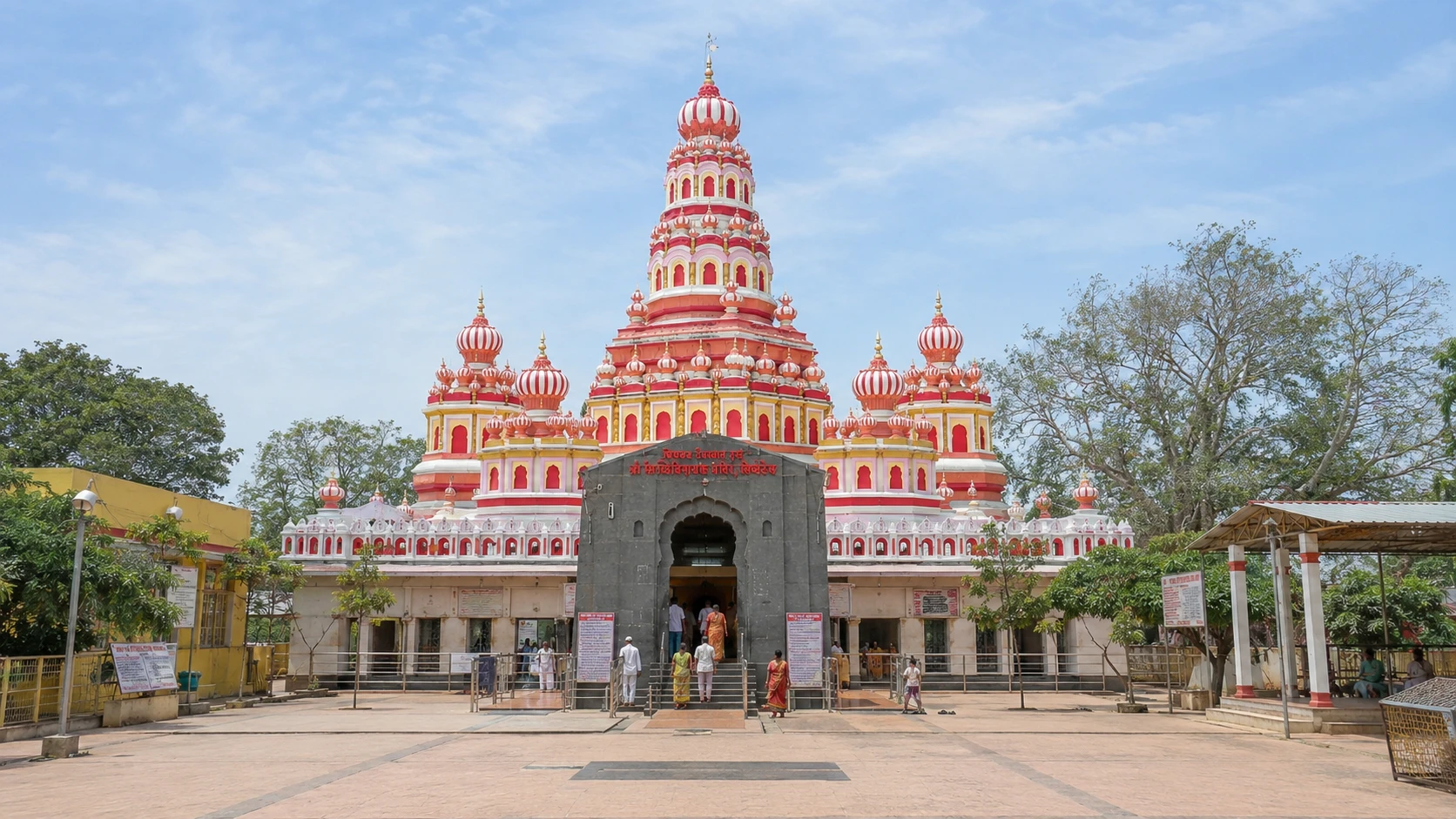
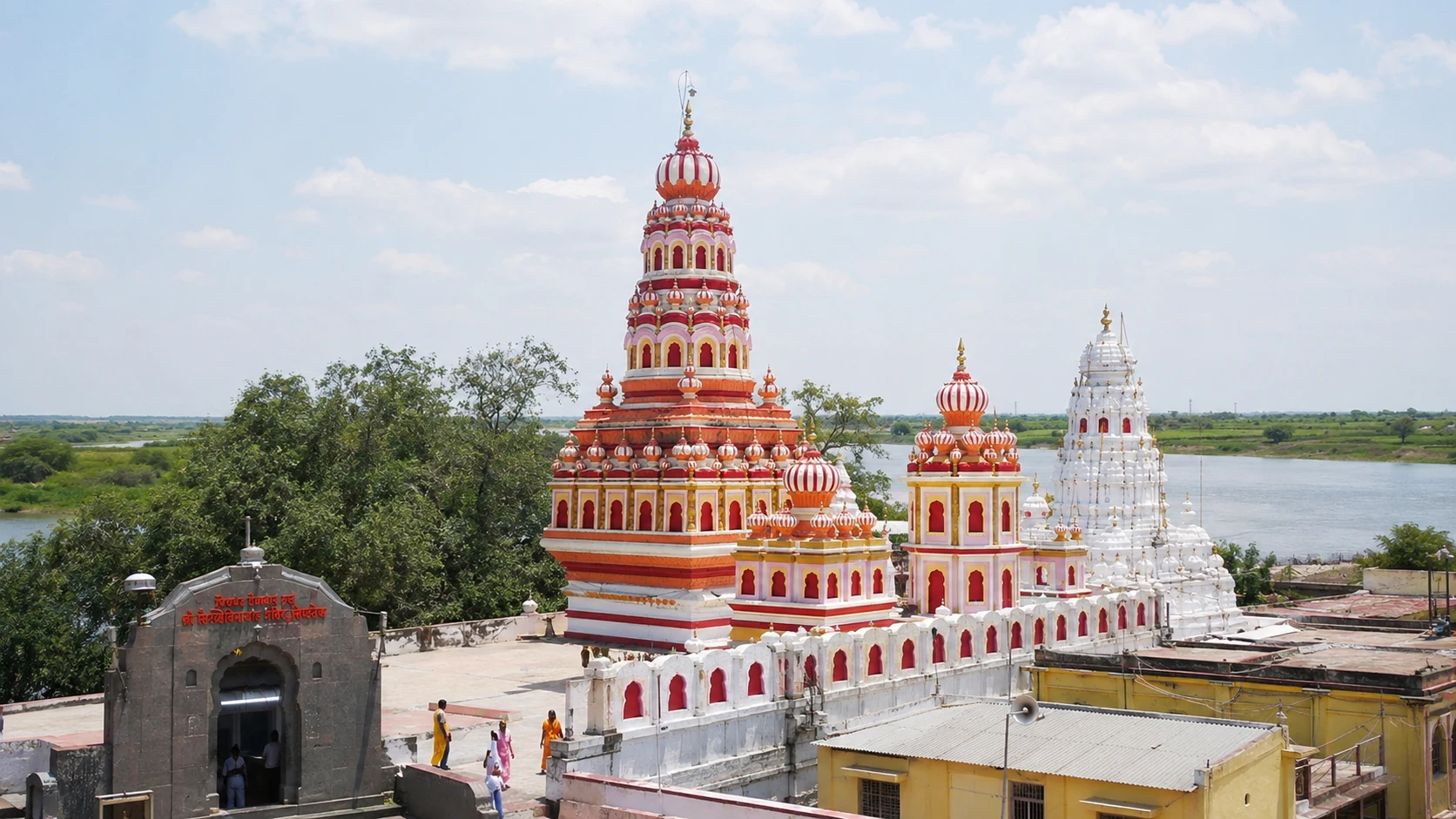
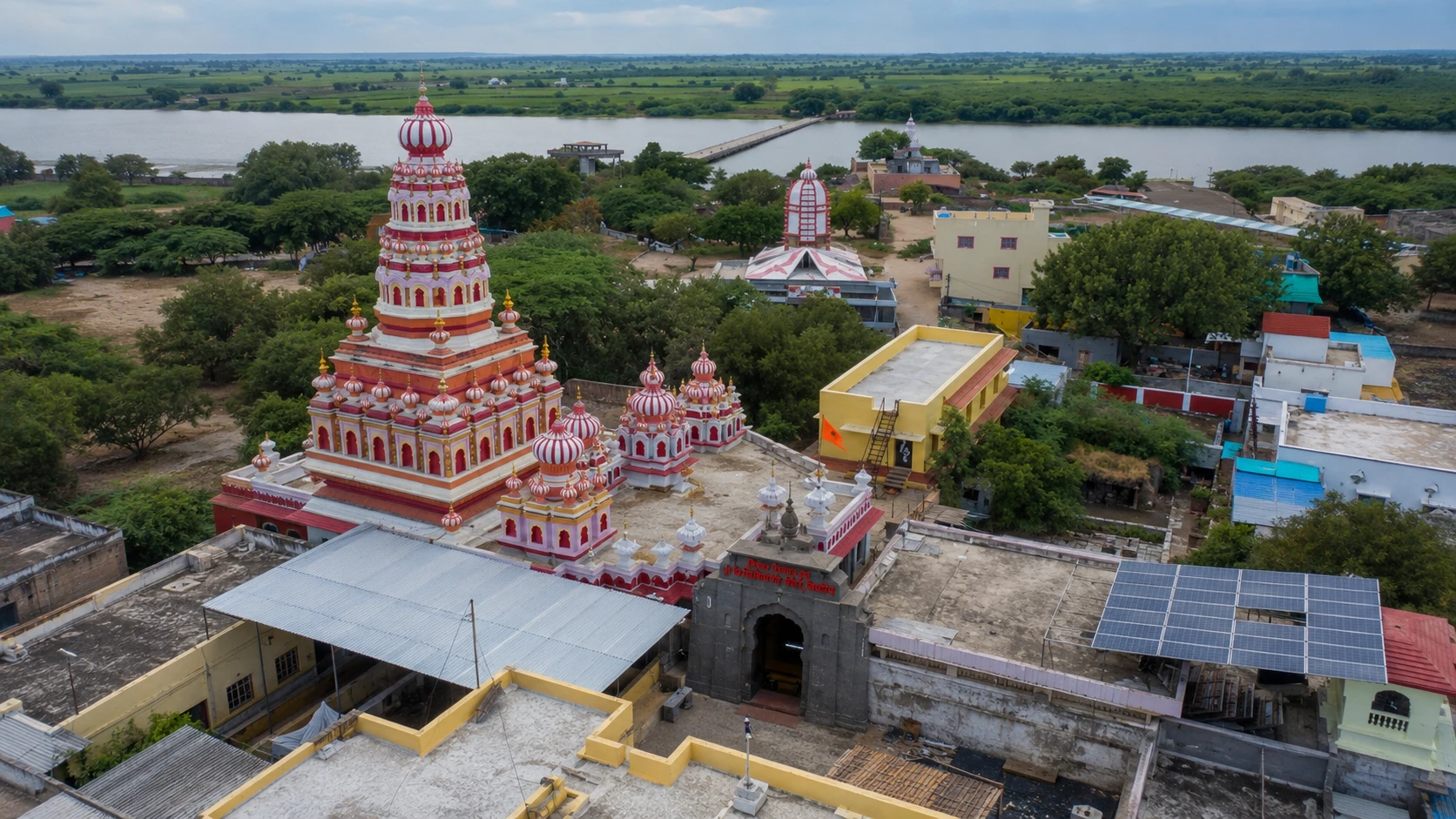
Modest Hemadpanthi sanctum core with Peshwa-era mandapa additions; the temple sits atop a small hillock (the eponymous 'Siddhatek') and is approached via a stone-cut pathway. The compact temple footprint and exposed hilltop position give the site a markedly different visual character from the prakara-walled Morgaon or the cave-shrine Lenyadri
Open
05:00 – 21:30
Aarti
05:30 · 12:00 · 20:00
Special
The full hill-pradakshina — circumambulation of the entire hillock on which the temple sits, approximately 5 km — is the distinctive practice here. The route is partially paved, partially cross-country, and takes around an hour at a steady walking pace; the more austere pilgrims walk it barefoot. The pradakshina is undertaken before or after sanctum darshan; on Sankashti Chaturthi evenings and major festival days, group pradakshinas are organized through the temple office
The Sacred Legend · पवित्र कथा
Siddhatek is the second stop on the canonical Ashtavinayak circuit, and the only one of the eight where the Ganesha murti has a trunk turned to the right. Among Ganapati iconographic traditions, a right-twisted trunk (dakshinavarti) is held to mark a particularly potent form — one whose worship demands stricter ritual observance and whose darshan is held to grant difficult siddhis (spiritual attainments) that the gentler left-trunked form does not. The legend that ties Siddhatek to this iconography is Vaishnava, not Shaiva: when Lord Vishnu, lying on the cosmic ocean, was assailed by the demons Madhu and Kaitabha emerging from his ears, he propitiated Ganapati at this hilltop on the banks of the Bhima river and received the siddhi to slay them. The temple thus stands at the precise spot where Vishnu himself sought and obtained the obstacle-removing grace of Ganapati — making Siddhatek the Ashtavinayak shrine most directly woven into the Vaishnava cosmic narrative. Pilgrims undertake a hill-pradakshina here, circumambulating the entire hillock on which the temple sits — a five-kilometre walk taking roughly an hour, undertaken barefoot by the more austere.
Sacred Designationपवित्र पदनाम
Sacred Origin Storyपवित्र उत्पत्ति कथा
Source: Mudgala Purana and Ganesha Purana (Krida Khanda) — Vaishnava-Ganapatya synthesis narrative, widely-attested
At the beginning of time, before the cosmos had taken stable form, Lord Vishnu lay upon the cosmic ocean in Yoga Nidra — the cosmic sleep from which creation arises. From his navel emerged a lotus, and from the lotus emerged Brahma, who would become the architect of the manifested world. But before Brahma could begin his work of creation, two demons emerged from the wax of Vishnu's own ears: Madhu and Kaitabha. They were born of Vishnu's tamasic shadow, and they were terrible. Their first act, on emerging into the half-formed cosmos, was to threaten Brahma — to threaten the very possibility of creation. They moved to consume the lotus-stalk on which Brahma stood. The cosmos had not yet learned how to be, and now the two demons would prevent it from learning.
Vishnu awoke. He saw the threat. He took up his weapons and engaged Madhu and Kaitabha in combat. But the battle did not go as the cosmic order required. For five thousand years they fought. The demons could not be defeated by ordinary means; they had been granted a boon by the Devi herself that they could choose the time and place of their death. Each weapon Vishnu raised was met. Each strategy was countered. The cosmic time-cycle was suspended in this combat — creation itself paused, neither beginning nor failing, while the two demons and the Preserver of the universe traded blows.
At last, Vishnu understood. He could not win this fight by force. He needed a siddhi — a specific spiritual power, an attainment he did not yet hold. He withdrew from the battle, mounted his eagle Garuda, and descended to the earth. He sought out a quiet hilltop on the banks of the Bhima river. There he installed a swayambhu Ganapati murti — a form that had revealed itself to him in meditation, a form with the trunk turning to the right — and undertook intensive tapas in its presence.
The austerities Vishnu performed at Siddhatek are described by the Mudgala Purana as the most intensive any deva had ever offered to Ganapati. Days, then years passed. Vishnu remained motionless on the hilltop. Ganapati, pleased by the depth of the worship, finally appeared and asked what siddhi the Preserver required. Vishnu replied: 'The siddhi to defeat what cannot be defeated. The siddhi to end the deadlock at the boundary of creation.' Ganapati granted the boon. He named this hilltop the place of siddhi — Siddhatek — and made the swayambhu murti that Vishnu had worshipped the visible sign of the gift. From that moment, any worshipper who comes to this hill in seriousness can ask Ganapati for the siddhi to defeat what cannot otherwise be defeated.
Vishnu returned to the cosmic ocean armed with the siddhi. He approached Madhu and Kaitabha not with weapons but with a single question — flattering them, asking what boon they would have him grant in return for the favour of their permitting him a strike. The demons, intoxicated by their own undefeated five-thousand-year combat, replied with the proud boon: 'Strike us where no creature can step — neither earth nor sky. Then we shall accept the strike.' Vishnu, holding the siddhi from Siddhatek, expanded his own thighs to cosmic proportion and placed the demons upon them — neither earth, nor sky, but the body of the Preserver himself — and struck. Madhu and Kaitabha fell. Creation could now begin. Brahma, on his lotus, took up his work. The cosmos was saved by a siddhi granted at Siddhatek.
For this reason, the right-trunked swayambhu murti at this hilltop is held to grant difficult siddhis to any worshipper who undertakes serious tapas before it. Pilgrims who walk the five-kilometre hill-pradakshina before entering the sanctum are said to be re-enacting Vishnu's own approach. The Mudgala Purana names Siddhatek as the place where the deadlock at the boundary of creation was broken — the place of Siddhi Vinayak, the bestower of attainment.
Sources cited:
- Mudgala Purana, Khanda 1 (Siddhi-Vinayaka prakarana)
- Ganesha Purana, Krida Khanda (Vishnu-tapas at Siddhatek)
- Devi Bhagavata Purana, Madhu-Kaitabha narrative (cross-reference for the demon-defeat framework)
- Sthala-purana of Siddhatek (regional Marathi devotional tradition)
Scholarly Context
Modern scholarship treats the Siddhatek Vishnu-Ganapati narrative as a significant example of inter-sectarian textual integration within the medieval Puranic tradition. Paul Courtright (in 'Ganesa: Lord of Obstacles, Lord of Beginnings', Oxford 1985) reads the Madhu-Kaitabha-Siddhatek synthesis as Ganapati-narrative drawing on the older Vaishnava cosmogony for its philosophical weight — the act of granting a siddhi to the Preserver himself elevates Ganapati above the cosmic-functional deities and frames Ganapati as the precondition of creation rather than merely a member of the pantheon. Anita Raina Thapan ('Understanding Ganapati', Manohar 1997) notes that the Vishnu-prays-to-Ganapati narrative appears in multiple regional traditions but is most fully developed in the Mudgala Purana cycle from which Siddhatek's identity is derived. The right-trunked iconography (dakshinavarti) is documented by P.K. Gode and other 20th-century textual scholars as a recognized but rare Ganapati form across the subcontinent, with Siddhatek being its most prominent pilgrimage anchor.
Historyइतिहास
The documented history of the Siddhatek temple is sparser than that of Morgaon, in part because the hilltop's remote location across the Bhima river kept it outside the major medieval pilgrim and patronage corridors until the Maratha period. The site itself appears to have functioned as a Ganapati shrine of long standing; the swayambhu murti is attested as object of regional worship at least from the early medieval centuries, though the present temple structure cannot be dated to that early phase with archaeological precision. The earliest stone-temple core is attributable to the Yadava-period Hemadpanthi style by structural analysis, but the visible mandapa and outer structures are largely Peshwa-era additions.
The figure who established Siddhatek's place within the formal Ashtavinayak circuit was Saint Morya Gosavi of Chinchwad, who is held by tradition to have undertaken intensive tapas here as part of his broader Ganapatya pilgrimage practice. The 17th-century saint Narayan Maharaj of Jejuri — known locally as Mauni Maharaj for his vow of silence — established his ashram at Siddhatek and is said to have attained samadhi here around 1772, his small samadhi shrine standing today within the temple complex. The Mauni Maharaj tradition is partly responsible for the institutional continuity of the temple across the troubled late-Peshwa and early-colonial transitions.
The major Peshwa-era patron of Siddhatek was Peshwa Madhavrao I, whose 18th-century interventions included the construction of the present sabha-mandapa, the stone-paved approach pathway to the hilltop, and significant land grants for the maintenance of daily worship. Documentation in the Peshwa Daftar specifically names Madhavrao's commanders and family in connection with Siddhatek donations. The pradakshina path around the hill — the five-kilometre route that defines the Siddhatek pilgrim experience — was substantially formalized and partially stone-marked during this period.
After the fall of the Peshwa rule in 1818, Siddhatek entered a quieter phase under continued local Brahmin priestly administration loosely affiliated with the Chinchwad Sansthan. The temple did not receive the colonial-era attention given to more accessible sites; its remoteness preserved it but also limited substantial physical interventions. Following Maharashtra's formation in 1960, the temple came under the Ashtavinayak Devasthan framework, and the 2003-04 Ashtavinayak Vikas Yojana renovation funded structural repairs to the hilltop sanctum, the pradakshina path, and the river-crossing approach. The bridge across the Bhima river that today provides road access replaced an earlier boat-crossing system; the bridge, opened in stages across the 1980s and 1990s, significantly increased pilgrim accessibility, transforming Siddhatek from a difficult-access shrine into a routine stop on the canonical circuit.
Historical Timelineऐतिहासिक कालक्रम
Earliest stone-temple core at Siddhatek, attributed to Yadava-period Hemadpanthi-style construction by structural-architectural analysis. Pre-stone phases of the shrine are likely but archaeologically unattested.
The Yadava-period attribution is structural rather than inscriptionally dated. Specific patron-rulers and consecration dates from this medieval phase are not preserved.
Saint Morya Gosavi of Chinchwad undertook tapas at Siddhatek as part of his broader Ashtavinayak pilgrimage practice, contributing to the formal integration of Siddhatek into the canonical eight-shrine circuit that the Chinchwad Sansthan came to formalize over subsequent generations.
Saint Narayan Maharaj of Jejuri (Mauni Maharaj — 'the silent saint', so named for his lifelong vow of silence) established his ashram at Siddhatek and is held by tradition to have attained samadhi here around 1772. His small samadhi shrine within the temple complex continues to receive devotional veneration.
Peshwa Madhavrao I undertook major patronage works at Siddhatek, including construction of the present sabha-mandapa, the stone-paved approach pathway to the hilltop, and land grants for daily worship. The pradakshina path around the hill was substantially formalized and partially stone-marked during this period.
Fall of Peshwa rule to British East India Company at the Battle of Khadki, ending major patronage flows to Ashtavinayak sites. Siddhatek entered a quieter institutional phase under local Brahmin administration loosely affiliated with the Chinchwad Sansthan.
This event is recorded here not as physical destruction of the temple itself (which did not occur) but as the structural end of the patronage system that had sustained its institutional life through the 18th century. The 'destruction' enum-tag in our schema captures this institutional sense rather than a physical demolition.
Construction of the road bridge across the Bhima river replacing the earlier boat-crossing approach to Siddhatek. The bridge transformed pilgrim accessibility, shifting Siddhatek from a difficult-access shrine requiring river-crossing logistics into a routine vehicle-accessible stop on the Ashtavinayak circuit.
Ashtavinayak Vikas Yojana renovation works at Siddhatek included structural repairs to the hilltop sanctum, restoration of the pradakshina pathway, and modernization of pilgrim infrastructure including water provision and rest-houses.
Ahmednagar district renamed Ahilyanagar district by the Government of Maharashtra in honour of Rajmata Ahilyabai Holkar. The renaming changes the administrative reference for Siddhatek's district even though the location itself is unchanged. Older sources will continue to reference Ahmednagar district.
What You'll Seeदर्शन में
The Siddhivinayak murti at Siddhatek is the iconographic signature of the entire Ashtavinayak circuit — the only one of the eight where the trunk turns to the right. The form is seated, approximately three feet in height, broader than tall in seated proportion, carved in dark basalt, and shares the small sanctum platform with two flanking subsidiary figures of Riddhi (prosperity) and Siddhi (achievement) — in the Ganapatya tradition of this temple, the two consorts are named Riddhi and Siddhi rather than the Siddhi and Buddhi pairing seen at Morgaon. A small Mooshaka (mouse vahana) is carved at the base of the platform.
The right-twisted trunk is the central iconographic feature and the entire reason for Siddhatek's distinct ritual status. Across Ganapati iconography, the orientation of the trunk encodes the deity's mode of engagement: a left-twisted trunk (vamavarti) faces the Ida nadi side of the body and is held to be the gentler, householder-devotional form suitable for ordinary worship; a right-twisted trunk (dakshinavarti) faces the Pingala nadi side, is held to be the more potent and demanding form, and requires the worshipper to maintain stricter ritual purity and observance. Siddhatek is the only Ashtavinayak shrine carrying this rarer orientation, and the iconographic distinction is the foundation of the temple's claim to grant difficult siddhis.
The sindoor layering at Siddhatek is lighter than at Morgaon — the underlying carved features of the swayambhu form are more readily visible, allowing pilgrims a clearer view of the murti's original stone iconography. The face is broad, the third eye visible vertically on the forehead, and the ears (kapola) sculpted with characteristic Yadava-period idiom. The two front hands hold the canonical Ganapati attributes — paasha (noose) and ankusha (goad) — while the lower hands rest in modaka-dharana (holding-modak) and varada (boon-granting) mudras.
Outside the sanctum, the surrounding mandapa is a relatively compact Peshwa-era structure with sculpted pillars in the moderate Maratha style. The sabha-mandapa attributed to Peshwa Madhavrao I is supported on stone columns and carries painted murals along its upper register, including scenes from the Vishnu-Madhu-Kaitabha narrative and from the broader Ashtavinayak cycle. A separate small samadhi-shrine within the larger compound enshrines Saint Narayan Maharaj (Mauni Maharaj), with daily offerings continuing the 18th-century devotional tradition. The hilltop position of the temple gives the sanctum natural light entering through the eastern doorway during morning hours — a quality the priests typically note as distinctive among the Ashtavinayak shrines, several of which are deep-set in their compounds.
Distinctive Practicesविशिष्ट परंपराएँ
Hill Pradakshina (parikrama)
पहाड़ी प्रदक्षिणा (परिक्रमा)
Year-round; performed before or after sanctum darshan; group pradakshinas on Sankashti Chaturthi and major festival days
The signature practice at Siddhatek is the full pradakshina of the hill on which the temple sits — a five-kilometre circumambulation route taking roughly an hour at steady walking pace. The path is partially stone-paved (the Peshwa-era stretches), partially cross-country through scrub and agricultural land. More austere pilgrims walk it barefoot. Group pradakshinas are organized on Sankashti Chaturthi evenings, on the Magha and Bhadrapada Ganesh festivals, and on Vijayadashami; pilgrims wishing to undertake the full pradakshina at other times can do so independently. The route is considered safe by day; pilgrims are advised against attempting it after dark.
The Mudgala Purana narrative of Vishnu's tapas at Siddhatek frames the entire hill as the seat of the siddhi-granting deity. Circumambulating the hill is therefore not merely the symbolic circumambulation of a shrine but the literal circumambulation of the place where Vishnu himself approached Ganapati. Pilgrims who walk the pradakshina are held to be re-enacting the Preserver's own seeking of difficult siddhi, and serious sadhakas undertake the pradakshina specifically with the request for a specific difficult attainment in mind.
Difficult-Siddhi Sankalpa
कठिन-सिद्धि संकल्प
Personal sadhana commitment; most commonly initiated on Sankashti Chaturthi or Magha Ganesh Jayanti
Pilgrims undertaking serious sadhana at Siddhatek often make a formal sankalpa (vow-statement) at the sanctum identifying a specific difficult attainment they seek — a health goal, a vocational breakthrough, an obstacle whose ordinary removal has failed, or in the case of advanced sadhakas a spiritual siddhi of meditation or discipline. The sankalpa is structured as a multi-visit commitment: the pilgrim typically returns to Siddhatek across multiple Sankashti Chaturthis until either the siddhi manifests or the pilgrim formally releases the vow. The temple priests can guide the sankalpa formulation; in particularly intensive cases, pilgrims undertake the 21-day Atharvashirsha avartan parallel to the sankalpa.
The right-trunked Ganapati at Siddhatek is canonically the bestower of those specific attainments that ordinary devotional practice does not unlock. The sankalpa is the formal devotional framing of that request — a structured naming of the difficulty, an explicit commitment of patience and sustained sadhana, and a placing of the entire matter in Ganapati's keeping. The practice rests on the underlying conviction that obstacles persist because they require a specific siddhi to remove, and that Siddhatek is the place where that siddhi is most directly available.
Mauni Maharaj Samadhi Darshan
मौनी महाराज समाधि दर्शन
Daily; alongside or immediately after sanctum darshan
Within the temple complex stands the small samadhi-shrine of Saint Narayan Maharaj — Mauni Maharaj — who attained samadhi at Siddhatek around 1772. Devotees customarily visit the samadhi-shrine in conjunction with sanctum darshan, offering a brief prayer and circumambulating the small structure. The Mauni Maharaj tradition emphasizes silence as the foundational devotional practice — a discipline that pilgrims undertaking the difficult-siddhi sankalpa often partially adopt during their multi-visit sadhana cycles.
The Mauni Maharaj samadhi anchors a living devotional lineage at Siddhatek that connects the present pilgrim to the 18th-century institutional revival of the temple. The samadhi-darshan is treated as an acknowledgement that the difficult sadhana the pilgrim is undertaking has been undertaken before by saints whose attainment is preserved in this very ground.
Did You Know?क्या आप जानते हैं?
Siddhatek is the only Ashtavinayak shrine where the Ganesha murti has a right-twisted trunk (dakshinavarti). The other seven all show the left-twisted (vamavarti) trunk associated with householder-devotional worship. Right-trunked Ganapati forms are rare across India as a whole, and Siddhatek is their most prominent pilgrimage anchor — making this iconographic distinction the single most-cited differentiator of the shrine.
Mudgala Purana iconographic classification; corroborated across Ashtavinayak devotional literature (Bhalchandra Khandekar 1978; P.K. Gode textual studies)
The Mudgala Purana frames Siddhatek as the place where Lord Vishnu himself sought and obtained the siddhi to defeat the demons Madhu and Kaitabha at the boundary of creation. Of all the Ashtavinayak shrines, only Siddhatek has its foundational legend tied directly to a Vaishnava cosmogonic event — making this the Ashtavinayak shrine most explicitly woven into the broader Vaishnava-Ganapatya textual synthesis of the medieval Puranic tradition.
Mudgala Purana, Khanda 1 (Siddhi-Vinayaka prakarana); Ganesha Purana, Krida Khanda
The signature pilgrim practice at Siddhatek is a full five-kilometre pradakshina around the entire hill on which the temple sits — not just around the shrine itself but around the eponymous hillock. This is unique among the Ashtavinayak shrines; the other seven require only the conventional shrine-pradakshina. More austere pilgrims undertake the full hill-pradakshina barefoot, treating the walk as a re-enactment of Vishnu's own approach to the deity.
Chinchwad Sansthan pilgrim guides; local Siddhatek devotional tradition
Saint Narayan Maharaj, known as Mauni Maharaj for his lifelong vow of silence, established his ashram at Siddhatek in the mid-18th century and attained samadhi here around 1772. His small samadhi-shrine still stands within the temple complex and receives daily offerings, making Siddhatek one of the few Ashtavinayak shrines that combines a major deity-pilgrimage with a continuous saint-samadhi tradition.
Local Siddhatek devotional tradition; Chinchwad Sansthan associated records
Until the construction of the road bridge across the Bhima river in the 1980s-1990s, Siddhatek was accessible only by boat across the river. This geographic isolation kept pilgrim flows comparatively modest through most of the temple's history; the bridge opening transformed Siddhatek from a difficult-access destination into a routine vehicle-accessible stop on the Ashtavinayak package-tour circuit. Older Marathi devotional literature still references the boat-crossing as part of the pilgrim experience.
Maharashtra Public Works Department bridge construction records; pre-bridge Marathi pilgrim travel-writing
At Siddhatek the two consorts flanking the murti are named Riddhi (prosperity) and Siddhi (achievement), rather than the Siddhi and Buddhi pairing found at Morgaon and most Ganapatya iconography. This consort-naming variation is a small but consistent textual signature: Riddhi-Siddhi appears in certain Mudgala Purana passages and is preserved in the regional iconographic tradition specific to this temple. The variation does not contradict the broader Ganapatya consort theology — Riddhi, Siddhi, and Buddhi are all in different traditions named as Ganapati's wives — but it does distinguish Siddhatek's textual tradition from Morgaon's.
Mudgala Purana, Khanda 1; Siddhatek Sthala-purana
The temple's hilltop position gives the eastern sanctum doorway a quality of natural morning light that is unusual among Ashtavinayak shrines — most of which sit deep within walled prakara courtyards. Pilgrims arriving for the early morning aarti at Siddhatek often note the brief few minutes when slanted sunrise light falls directly onto the murti, illuminating the dakshinavarti trunk against the dim basalt background. This light-darshan window is unscheduled but recurs naturally each clear morning.
Field observations from Marathi devotional travel-writers and Mayureshwar-Siddhivinayak circuit pilgrim guides
Visitor Accessप्रवेश जानकारी
Siddhatek welcomes devotees of all backgrounds without restriction based on gender, age, caste, or origin. Photography is permitted in the outer mandapa, the surrounding compound, and along the pradakshina pathway, but is not allowed within the inner sanctum during darshan or abhishekam. Footwear must be removed before entering the temple complex. Mobile phones should be silenced inside the sanctum. The hill-pradakshina route is on natural terrain in part and may not be fully accessible to differently-abled pilgrims; the temple itself can be reached via stone steps from the parking area and a side ramp provides limited wheelchair access to the outer mandapa though not directly into the sanctum.
There is no formal VIP-darshan or priority-queue at Siddhatek; on ordinary days the queue moves swiftly. Sankashti Chaturthi evenings, Ganesh Chaturthi week (Bhadrapada), and Magha Ganesh Jayanti can produce longer queues and significantly heavier circuit-tour traffic — pilgrims attending on these days should plan to arrive by mid-morning. The hill-pradakshina is best undertaken in the cooler morning or late-afternoon hours; midday pradakshinas in the hot months (March-May) are discouraged due to direct sun exposure on the open-terrain sections. Carry water and wear sun-protection if undertaking the pradakshina between 10 AM and 4 PM. Pilgrims undertaking the multi-visit difficult-siddhi sankalpa are advised to consult the temple priests directly for sankalpa-formulation guidance.
Festivalsत्योहार
Ganesh Chaturthi (Bhadrapada Shukla Chaturthi)
गणेश चतुर्थी (भाद्रपद शुक्ल चतुर्थी)
Aug-Sep (Bhadrapada Shukla Chaturthi)
The principal Ganapati festival is observed at Siddhatek with continuous abhishekam, twenty-one Atharvashirsha recitations by groups of priests, and organized group hill-pradakshinas across the festival fortnight. Pilgrim crowds are substantial but somewhat smaller than at Morgaon, given Siddhatek's geographic position off the main Pune-circuit road. The right-trunked iconography draws devotees making sankalpa-vows for particularly difficult attainments; the multi-day festival is considered an especially powerful window for siddhi-sankalpas to be formalized.
Magha Ganesh Jayanti (Magha Shuddha Chaturthi)
माघ गणेश जयंती (माघ शुद्ध चतुर्थी)
Jan-Feb (Magha Shuddha Chaturthi)
Held by the Ganapatya tradition to be the birth-tithi of Ganesha, observed at Siddhatek as the more inwardly devotional of the two major Ganapati festivals. Pilgrim flow is smaller and more sustained than at the Bhadrapada festival; the day is favoured by serious sadhakas undertaking the difficult-siddhi sankalpa. Extended Atharvashirsha-paath cycles continue from pre-dawn through midnight. The Vishnu-Madhu-Kaitabha narrative is publicly recited from the Mudgala Purana during the day, anchoring the sanctum darshan in its foundational cosmological context.
Sankashti Chaturthi (monthly)
संकष्टी चतुर्थी (मासिक)
Every lunar month — Krishna Paksha Chaturthi
The monthly Sankashti at Siddhatek carries particular weight for pilgrims undertaking the multi-visit difficult-siddhi sankalpa — these pilgrims typically return on consecutive or alternate Sankashti dates across multiple lunar months until the vow resolves. The Angarki Sankashti (Sankashti falling on a Tuesday) draws the largest of the monthly crowd cycles, with organized group hill-pradakshinas conducted from late afternoon onward.
Mauni Maharaj Punyatithi
मौनी महाराज पुण्यतिथि
Annual death-anniversary observance in the month corresponding to traditional dating around April-May
Annual remembrance day of Saint Narayan Maharaj — Mauni Maharaj — observed at the saint's samadhi-shrine within the temple complex. Special prayer-services are conducted at the samadhi alongside the regular sanctum aarti, and pilgrims who track the Mauni Maharaj sadhana lineage gather for the observance. The Punyatithi is moderate in scale — primarily a local and lineage-affiliated devotional event rather than a major festival — but is preserved continuously by the Chinchwad Sansthan and associated devotional networks.
Vijayadashami (Dussehra)
विजयादशमी (दशहरा)
Sep-Oct (Ashwin Shukla Dashami)
Observed at Siddhatek with particular thematic resonance — Dussehra is the cosmic day of demon-slaying victory, and Siddhatek's foundational legend is precisely Vishnu's slaying of Madhu and Kaitabha with the siddhi obtained at this site. The day's evening aarti is followed by a ceremonial reading of the Madhu-Kaitabha-vadha narrative. Many pilgrim groups choose to begin or pivot their Ashtavinayak circuits on this day.
Traditional Offeringsपारंपरिक अर्पण
Primary Offerings
Modak
मोदक
मोदक
The canonical naivedya for Ganesha across the Marathi devotional tradition — a steamed or fried dumpling of rice-flour dough filled with grated coconut and jaggery. At Siddhatek, the modak offering is integrated into the formal Ekvis Modak Naivedya (twenty-one modak offering) that pilgrims undertaking the difficult-siddhi sankalpa often sponsor. The Ganesha Purana describes modak as the food the deity himself preferred; its symbolism — plain dough outside, sweet revelation within — mirrors the principle of obstacle becoming the gate to inner attainment, which is central to the Siddhatek devotional framework.
Durva grass
दूर्वा घास
दूर्वा
Trifoliate durva grass, sacred to Ganesha across all Ganapatya traditions. At Siddhatek the durva offering carries an additional ritual sense — pilgrims undertaking the difficult-siddhi sankalpa often offer twenty-one durva-tufts together with twenty-one modaks across the multi-visit sadhana cycle, treating the parallel offerings as a doubled commitment.
Red Hibiscus (Jaaswand)
लाल जपा कुसुम
जपापुष्प
Red hibiscus flowers — jaaswand in Marathi — sacred to Ganesha among floral offerings. At Siddhatek the offering is part of the daily morning abhishekam and is also incorporated into the difficult-siddhi sankalpa offerings as part of the formal puja sponsorship.
Coconut
नारियल
नारिकेल
Coconut is the standard preliminary offering at Hindu temple-thresholds across India, symbolizing the human ego that must be broken before the deity for spiritual progress. At Siddhatek the coconut is broken at the entrance to the temple complex before pilgrims begin the hill-pradakshina or the sanctum darshan — a marking of the boundary between ordinary consciousness and the siddhi-seeking sadhana the temple is held to support.
Sindoor (Vermilion paste)
सिंदूर
सिन्दूर
Saffron-red vermilion paste, applied to the murti during abhishekam and offered to devotees as prasad after darshan. At Siddhatek the sindoor accumulation on the murti is lighter than at Morgaon, allowing the original swayambhu features to remain visible — but the sindoor's symbolic and devotional significance is identical: the substance of layered prayer across centuries, the touchable trace of every devotee's request preserved on the body of the deity.
Unique to This Temple
Difficult-Siddhi Sankalpa Naivedya
कठिन-सिद्धि संकल्प नैवेद्य
Pilgrims undertaking the formal difficult-siddhi sankalpa typically sponsor a particular naivedya offering pattern that reflects the commitment: twenty-one modaks, twenty-one durva-tufts, and a sankalpa-statement read by the priest at the sanctum. The naivedya is consecrated through the abhishekam, distributed back to the pilgrim as prasad, and the sankalpa itself is recorded in the temple's sankalpa register. This is a Siddhatek-specific devotional pattern — no other Ashtavinayak shrine maintains a comparable sankalpa-register tradition. Pilgrims completing their sankalpa (whether through the manifestation of the requested siddhi or through formal release of the vow) typically return to Siddhatek for a closing-naivedya offering as well.
Pilgrims are welcome to bring offerings from outside the temple complex. A small puja-sahitya counter near the temple entrance, operated under the local Devasthan, offers basic offering bundles (modaks, durva, sindoor packets, flowers). Pilgrims undertaking the formal difficult-siddhi sankalpa are advised to consult the priests directly to determine the appropriate offering scale for their sankalpa scope. Synthetic plastic flowers are politely discouraged in favour of fresh natural materials.
How to Reachकैसे पहुँचें
Siddhatek lies in Karjat taluka of Ahilyanagar district (formerly Ahmednagar district until the 2024 renaming), on the north bank of the Bhima river. The temple sits on a small hill in agricultural countryside; the surrounding landscape is the open semi-arid plateau of central Maharashtra rather than the green hill-belt of the Pune ghats.
By road, the temple is most commonly reached from Pune as part of a circuit traversal — the Pune–Daund–Siddhatek route runs approximately 100 km and takes 2 to 2.5 hours by private vehicle. The road approach now crosses a bridge over the Bhima river (operational since the 1980s-1990s and replacing the earlier boat-crossing). Maharashtra State Road Transport Corporation (MSRTC) buses run from Pune Swargate bus stand to Daund and onward to nearby villages, but the final stretch into Siddhatek typically requires a shared auto or a private taxi from Daund. Most Ashtavinayak package operators include Siddhatek as the second stop on the canonical circuit and arrange direct vehicle transport from Morgaon, which lies approximately 70 km south.
By rail, the most useful station is Daund Junction (18 km from Siddhatek). Daund is a major junction with direct trains from Pune, Mumbai, Solapur, Hyderabad, and Bangalore, and shared taxis to Siddhatek are readily available from the station. Pune Junction (approximately 100 km) is the larger regional rail hub with the widest spread of national-level services, but the road journey from Pune is the same regardless of which station the pilgrim arrives at.
By air, Pune International Airport (PNQ, approximately 105 km via the Daund route) is the practical access point for domestic pilgrims. Mumbai's Chhatrapati Shivaji Maharaj International Airport (BOM, approximately 250 km, 5.5 to 6.5 hours by road via the Pune Expressway and onward to Daund) is the access point for international pilgrims, though most international circuit pilgrims fly into Pune and undertake the road journey from there.
Within the Ashtavinayak circuit, the canonical sequence after Siddhatek proceeds to Pali (in Raigad district, approximately 175 km west via Pune) — this is the longest single leg of the circuit and typically involves an overnight stop in Pune between the second and third shrines. Pilgrim package operators handle this transition routinely; independent pilgrims travelling by private vehicle should plan accordingly.
Plan Your Visitयात्रा की योजना
🌤 Best Season
October to February is the most comfortable period for Siddhatek — daytime temperatures range from 18-28°C with low humidity, the post-monsoon countryside is at its best, and the hill-pradakshina can be undertaken in comfortable walking weather. The temple is open year-round. March to May is the hot dry season (35-42°C) — the hill-pradakshina becomes physically demanding under direct sun and is best limited to early morning or late afternoon during these months. The monsoon (June-September) brings rain to the central Maharashtra plateau; the Bhima river runs high and the hill-pradakshina pathway is muddy in stretches but remains traversable. The most spiritually intense windows are Magha Ganesh Jayanti (January-February) and Bhadrapada Ganesh Chaturthi (August-September). The most operationally comfortable is November to early February.
👘 Dress Code
Modest traditional dress is expected and appreciated. For men, full-length trousers or dhotis with appropriate shirts are suitable; shorts and sleeveless tops are discouraged. For women, sarees, salwar suits, or long skirts with covered shoulders are appropriate. Pilgrims undertaking the hill-pradakshina should wear comfortable closed footwear suitable for mixed terrain (or be prepared to walk barefoot if observing the austere practice); avoid heeled or open-toed sandals. There is no requirement for a head covering at this temple.
📱 Phones & Photography
Mobile phones should be silenced before entering the inner sanctum. Photography with phones is permitted in the outer mandapa, the surrounding compound, along the hill-pradakshina pathway, and at the Mauni Maharaj samadhi-shrine. Photography is not permitted within the inner sanctum itself, particularly during darshan and abhishekam. The temple does not formally collect phones at the entrance, but enforces the sanctum-photography prohibition through priest intervention if necessary.
🏨 Accommodation
Siddhatek village itself has minimal accommodation infrastructure — a small dharamshala adjacent to the temple, operated by the local trust, offers basic rooms for overnight pilgrims on first-come-first-served basis. The standard pilgrim practice is to stay at one of the regional accommodation hubs: Daund (18 km, basic and mid-range hotels suited to a single overnight), Baramati (50 km, mid-range hotels), or Pune (100 km, full hotel range — the standard choice for organized package tours). Most Ashtavinayak package operators arrange overnight in Pune between the Morgaon-Siddhatek leg and the longer Siddhatek-Pali leg, with daytime travel covering both shrines.
Book a Pujaपूजा बुक करें
The Shri Siddhivinayak Devasthan at Siddhatek does not currently operate a verified online puja booking portal. The Ashtavinayak circuit attracts a high volume of package-tour pilgrims, and third-party websites and intermediaries claiming to offer puja bookings, priority darshan passes, or accommodation packages should be approached with caution — many are unaffiliated with the Devasthan and the Chinchwad Sansthan. For puja bookings, including the temple-distinctive difficult-siddhi sankalpa puja, contact the temple office directly upon arrival or coordinate through a reputable Ashtavinayak package-tour operator. We do not list a phone number or email here because no verified primary contact has been published by the Trust; this section will be updated when the Trust publishes one. Pilgrims undertaking the hill-pradakshina should plan for daylight hours only and carry water in hotter months.
Managed by: Shri Siddhivinayak Devasthan, Siddhatek (under the Ashtavinayak Devasthan framework with associated authority from the Chinchwad Sansthan)
Abhishekam (ritual bathing)
अभिषेकम
Difficult-Siddhi Sankalpa Puja (with naivedya and sankalpa register entry)
कठिन-सिद्धि संकल्प पूजा (नैवेद्य और संकल्प रजिस्टर प्रविष्टि सहित)
Ekvis Modak Naivedya (twenty-one modak offering)
एकवीस मोदक नैवेद्य
Atharvashirsha Avartan (twenty-one recitations)
अथर्वशीर्ष आवर्तन (एकवीस आवर्तने)
Booking information verified: 2026-05-19
Sacred Soundsपवित्र ध्वनि
Did You Know? · क्या आप जानते हैं?
The same translation error that turned '33 Koti' into '33 crore' in Hinduism also happened in Buddhism. The Chinese translation of Buddhist texts rendered 'Sapta Koti Buddha' (7 Supreme Buddhas) as '7 Crore Buddhas.' The Tibetan translation got it right: 7 types, not 7 crore. One Sanskrit word, misread across two major world religions, generated two identical misconceptions independently.
Related Contentसंबंधित सामग्री
Related Scriptures
Related Temples
Moreshwar Mayureshwar (Morgaon)
मोरेश्वर मयूरेश्वर
Morgaon, Maharashtra
Ballaleshwar (Pali)
बल्लालेश्वर
Pali, Maharashtra
Varadavinayak (Mahad)
वरदविनायक
Mahad, Maharashtra
Chintamani (Theur)
चिंतामणि थेऊर
Theur, Maharashtra
Girijatmaj (Lenyadri)
गिरिजात्मज लेण्याद्री
Lenyadri, Maharashtra
Vighneshwar (Ozar)
विघ्नेश्वर ओझर
Ozar, Maharashtra
Mahaganapati (Ranjangaon)
महागणपति रांजणगाव
Ranjangaon, Maharashtra
Community Reflections
🕉️
Be the first to share your reflection.