Vighneshwar (Ozar)
विघ्नेश्वर ओझर
The obstacle-remover at the Kukadi — Vighneshwar who wears the demon's name as his own
Ozar, Maharashtra, India
VighneśvaraAlso known as: Vighnahar, Vighnaharta, Vighnahari, Ozar Ganpati, Shri Vighneshwar, Ozar Vinayak
Era
Mythological origins per Mudgala Purana (Vighnasura-vadha narrative); the present stone sanctum reflects Maratha-era construction with major eighteenth-century patronage from Chimaji Appa (who funded the gold-plating of the dome from his 1739 Bassein conquest treasury) and later restoration by Yedoji Surekar around 1785 under Peshwa-era support
Architecture
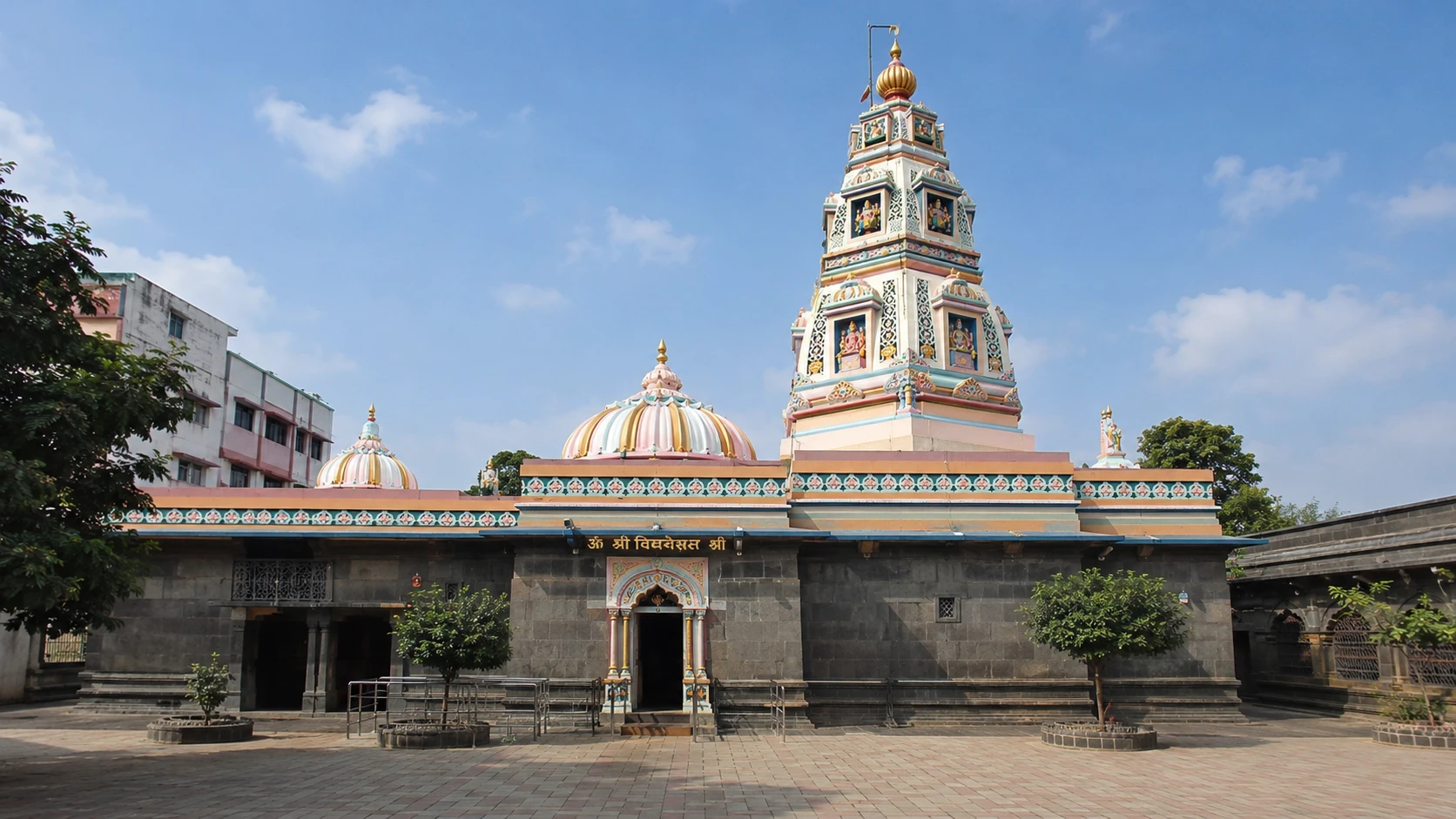
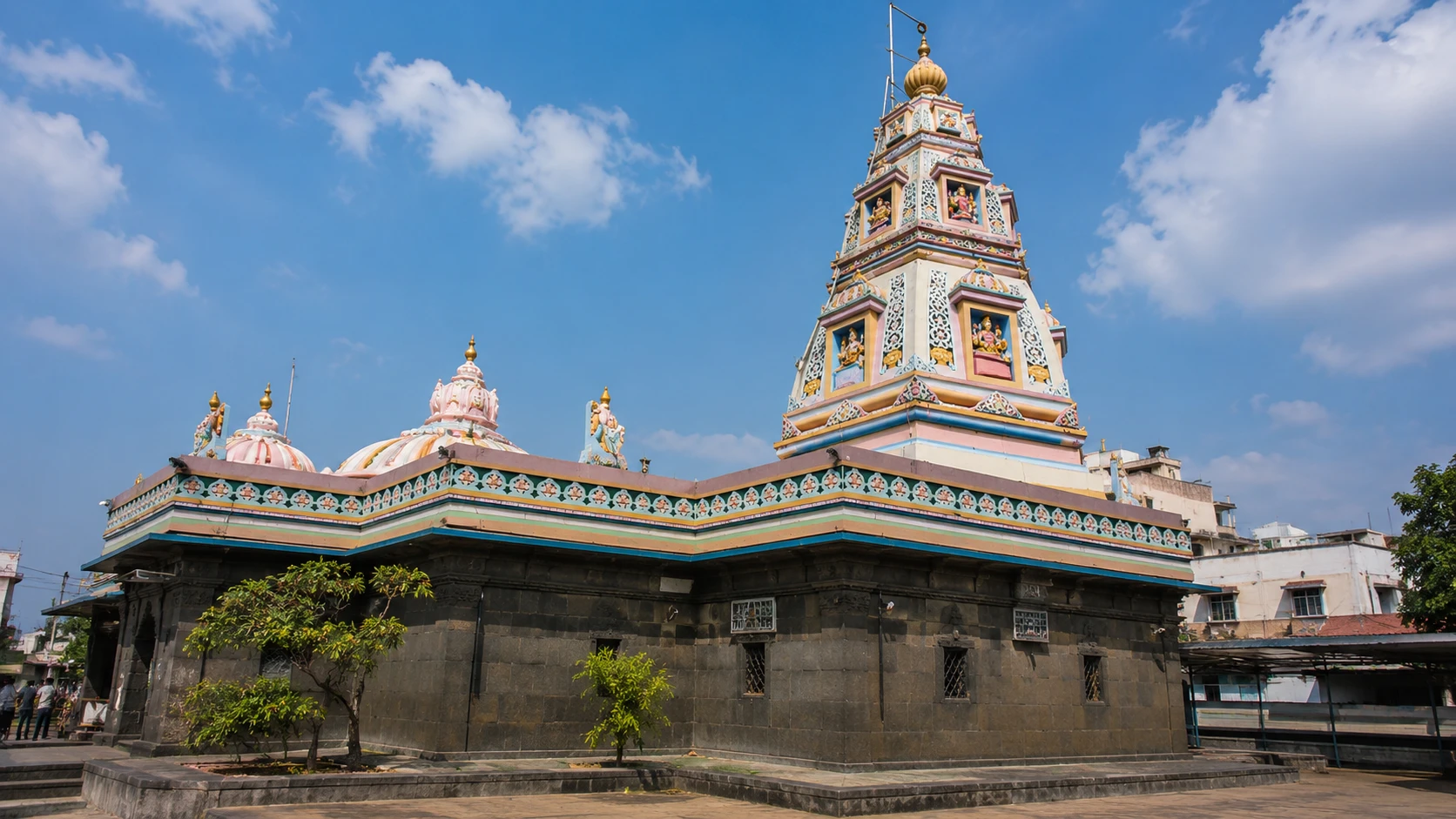
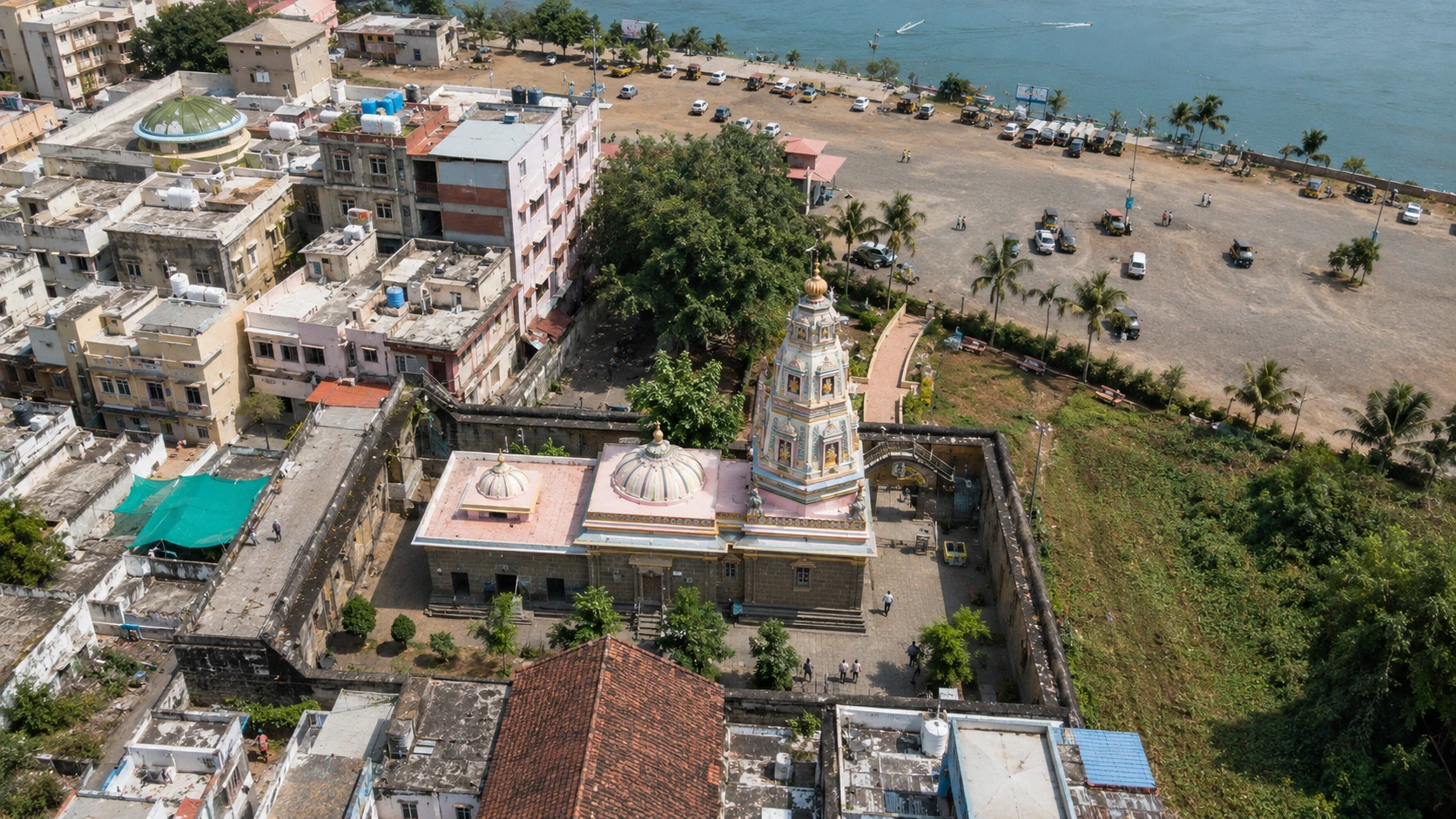
Maratha-Peshwa temple architecture combining a stone sanctum core with a wooden Sabha-mandapa added in front during the eighteenth-century renovations. The most architecturally distinctive feature is the gold-plated dome crowning the sanctum — a gilding that gleams visibly from a considerable distance and is among the most striking Ashtavinayak temple visuals. The compound includes two stone deepmala lamp-towers flanking the entrance, a feature shared with Morgaon and several other Maratha-era Ashtavinayak shrines. The temple is east-facing toward the Kukadi river, with the riverbank accessible by a short pathway below the temple
Open
05:00 – 22:00
Aarti
05:30 · 12:00 · 20:00
Special
The Ozar visit conventionally combines the main Vighneshwar sanctum darshan with a brief walk to the Kukadi riverbank below the temple, where pilgrims customarily offer water and durva. The temple's gold-plated dome is best viewed from outside in morning sunlight (when the gilding catches the light most strikingly) or under festival illumination in the evening. Pilgrims undertaking the Junnar-segment circuit typically pair Ozar with Lenyadri (14 km west) into a single-day visit, with Ozar in the afternoon after the Lenyadri morning climb
The Sacred Legend · पवित्र कथा
Vighneshwar at Ozar is the seventh stop on the canonical Ashtavinayak circuit — the obstacle-remover form of Ganesha, set on the banks of the Kukadi river in Junnar taluka of Pune district, only fourteen kilometres east of Lenyadri. The shrine's foundational legend involves the demon Vighnasura — literally 'the obstacle demon' — created by Indra to disturb a yagna and so effective at obstacle-creation that he turned the same talent against the yagnas of every sage and brahmin he encountered. When the assembled sages prayed to Ganesha, the deity descended and defeated Vighnasura. The repentant demon, in surrender, asked the unusual boon that his name be preserved as part of the deity's own title; Ganesha agreed, accepting 'Vighneshwar' — Lord of Vighnasura, Lord of obstacles — as one of his recognized names. The temple is therefore not the shrine of a deity who merely removes obstacles but the shrine of a deity who wears the obstacle-name as his own, a theologically distinctive framing within the Ashtavinayak corpus. The temple itself is one of the most architecturally striking on the circuit: a gold-plated dome (the gold-plating funded by Chimaji Appa from the treasure of his 1739 conquest of the Portuguese Bassein fort, the same campaign that produced the famous Vasai bell now hanging at Pali) crowns a Maratha-era stone sanctum east-facing toward the Kukadi river. The temple's murti carries diamonds in its eyes and an elaborately decorated form, and the compound includes deepmala lamp-towers and a wooden Sabha-mandapa added during eighteenth-century renovation.
Sacred Designationपवित्र पदनाम
Sacred Origin Storyपवित्र उत्पत्ति कथा
Source: Mudgala Purana (Vighnasura-vadha prakarana) — widely-attested Ganapatya canonical narrative
In an age before the present yuga, a king named Abhinandan ruled a prosperous kingdom in the Bhima river valley. He had vowed to perform a sacred yagna that would, if completed without obstruction, elevate his standing among the celestial hierarchies and threaten Indra's pre-eminence as king of the devas. Indra, watching from his heaven, recognized the danger to his position and resolved to prevent the yagna's completion. He could not interfere openly, since direct divine interference in a properly-conducted yagna would itself attract karmic consequences. Indra needed an agent who could disrupt the ritual without his fingerprints on the disruption.
From his own substance and intent, Indra generated such an agent. He named him Vighna — obstacle — and gave him the form of a powerful demon. Vighnasura, as the demon would come to be known across the legend, was created with one specific competence: the generation of obstacles. He could conjure obstacles where none existed; he could amplify obstacles where they did; he could position obstacles with precision at the moments when their effect would be maximal. Indra dispatched him to King Abhinandan's yagna.
Vighnasura's work at the yagna was thorough. He generated obstacles to the assembly of the materials; obstacles to the arrival of the brahmin-priests; obstacles to the ritual sequence; obstacles to the timing and accuracy of the mantras. The yagna stalled, then collapsed. Abhinandan, who could see the disruption but not its source, was forced to abandon the ceremony. Indra's position was secure.
But Vighnasura, having tasted his own competence, did not stop. He had been created for one specific yagna's disruption, but he discovered that the talent generalized. He moved across the inhabited world, finding yagnas and disrupting them. Sages performing private austerities were disturbed by sudden obstacles. Brahmin households conducting routine domestic rituals found their materials missing, their fires extinguishing, their family members falling ill at the inopportune moment. The fabric of religious life began to fray. Indra, who had wanted only the one disruption, discovered that he had created an autonomous agent who could no longer be recalled. The damage Vighnasura was doing was no longer in Indra's interest, but Indra had no mechanism to undo the creation.
The sages of the inhabited world, in their distress, performed a collective petition to Ganapati. They explained the situation: a demon was disrupting all yagnas, the religious order was breaking down, even Indra who had created the demon could not control him, and only Ganapati — the lord of beginnings, the deity whose specific province was the management of obstacles in the conduct of dharmic life — had the standing to address the situation. The petition was made at the spot we now call Ozar, on the banks of the Kukadi river, where the assembled sages had gathered.
Ganapati heard. He descended at Ozar to meet Vighnasura. The Mudgala Purana describes the encounter as one of the more direct of the deity's martial confrontations: Vighnasura, recognising the deity whose specific competence was the matter at issue, fought with everything he had — generating obstacles of unprecedented complexity, attempting to overwhelm the deity with the same talent he had used against sages and yagnas. But Ganapati was the lord of obstacles. There was no obstacle Vighnasura could generate that Ganapati could not see through, manage, dissolve, or absorb. The fight, prolonged at first, eventually concluded with Vighnasura defeated and at the deity's feet.
The demon, in surrender, asked an unexpected boon. He did not ask to be killed; he did not ask to be liberated; he did not even ask to be restored to whatever pre-existence he had had. He asked instead that his name be preserved. 'Lord,' he said, 'I was created for one disruption and discovered a talent that I could not control. I am surrendering not because I regret the obstacles — they were what I was made for — but because I have learned that obstacles in service of personal ambition produce no good. Let me submit to you. But let my name continue. Let those who come to you for the removal of obstacles know me by name as the obstacle that you transcended. Call yourself Vighneshwar — Lord of Vighnasura — and let my surrender be the foundation of your obstacle-removing competence.'
Ganapati agreed. He accepted Vighneshwar as one of his names. The Ozar site became the place where the deity carries the demon's name as part of his own. The Mudgala Purana records that Vighnasura, freed from his original assignment, was permitted to remain as a minor attendant in the deity's retinue — present whenever the obstacle-removing aspect of the deity's work is being invoked. The temple at Ozar is therefore not the site of a deity who simply removes obstacles in the abstract; it is the site of a deity who has integrated the obstacle-source into his own identity. Pilgrims who come to Ozar with specific obstacle-concerns are approaching the deity who knows the structure of obstacles from inside, the deity who has met the obstacle-source and absorbed it rather than merely opposed it.
Sources cited:
- Mudgala Purana — Vighnasura-vadha prakarana
- Ganesha Purana — referencing the Vighnasura episode in cross-text
- Sthala-purana of Ozar (regional Marathi devotional tradition)
Scholarly Context
Modern scholarship on the Vighnasura narrative (Paul Courtright, 'Ganesa: Lord of Obstacles, Lord of Beginnings', Oxford 1985; Anita Raina Thapan, 'Understanding Ganapati', Manohar 1997) treats the Mudgala Purana's Ozar legend as among the most theologically subtle of the Ashtavinayak shrine-narratives. The story functions as an etiological account for the deity's most-cited epithet — Lord of Obstacles — and explains why a deity whose competence is the removal of obstacles also carries an obstacle-name as part of his title. Courtright reads the legend as resolving an apparent theological contradiction: if Ganesha simply opposed and destroyed all obstacles, the deity's identity would be purely negative (the anti-obstacle); the Vighnasura-narrative reframes the relationship as one of integration rather than opposition. The demon's surrender and the demon's name-survival establish Vighneshwar as a deity who has absorbed the obstacle-principle rather than merely defeated it. This integration framing has practical devotional implications: pilgrims at Ozar are encouraged to acknowledge the structural reality of obstacles in life rather than to ask for obstacles to be erased, and to seek the deity's help in navigating obstacles rather than in pretending obstacles do not exist. The Ozar site's specific identification with the Kukadi riverbank and with the sage-petition event reflects a localised attribution of the broader pan-Ganapatya narrative; the legend itself is referenced in multiple Puranic sources but the Mudgala Purana's anchoring of it to Ozar is the canonically authoritative version for the Ashtavinayak circuit.
Historyइतिहास
The documented history of the Vighneshwar temple at Ozar begins with the standard pattern of mythologically-rich but archaeologically-thin pre-Maratha origins. The Mudgala Purana's Vighnasura-vadha narrative places the shrine's origins in pre-historical antiquity, and continuous Ganapatya worship at this Kukadi-riverbank site is suggested by regional Marathi devotional literature through the medieval period. No archaeological evidence permits precise dating of any pre-eighteenth-century stone structure at the site; the early temple is understood to have been a more modest wooden or stone-rubble structure that did not survive into the modern period.
The temple's institutional transformation into its present form began in the late seventeenth and early eighteenth centuries with the Chinchwad Sansthan's broader project of consolidating the Ashtavinayak circuit. Saint Morya Gosavi of Chinchwad and his successor-generation saints recognized Ozar as the seventh Ashtavinayak shrine within the canonical eight, and the Sansthan extended ceremonial authority and ritual coordination to the site. The Chinchwad tradition continues to hold this institutional authority over Ozar today.
The single most-cited historical detail in the Ozar narrative concerns the gold-plating of the temple's dome. The gilding is conventionally attributed to Chimaji Appa, the Maratha general and brother of the Peshwa, who funded the work from the treasury obtained at his 1739 conquest of the Portuguese-controlled Bassein (Vasai) fort. This is the same campaign whose redistributed war-trophies included the bronze bell now hanging at Ballaleshwar in Pali — making Chimaji Appa's Vasai conquest a doubly-attested funding event across the Ashtavinayak corpus, with two surviving material artefacts (the Pali bell and the Ozar dome-gilding) traceable to the single 1739 source. The gold-plating itself was performed by Maratha-era craftsmen on the existing stone dome, with the gilding-gold applied as thin sheets adhered to the masonry. The original gilding has been periodically renewed across the past two centuries; the dome visible today reflects both the original 1740s-era Chimaji Appa gilding (in its method and aesthetic) and successive Devasthan-managed renewals (in the physical gold currently in place).
A second major eighteenth-century patronage layer at Ozar is associated with Yedoji Surekar (sometimes written Yedoji Sankar), who undertook substantial renovation work around 1785, during the later Peshwa period. Surekar's work focused on the stone Sabha-mandapa, the wooden mandapa extension in front of the stone sanctum, the deepmala lamp-towers flanking the entrance, and the formal compound-wall and courtyard arrangement that survives largely intact today. The eighteenth-century gilding by Chimaji Appa and the slightly later structural-architectural work by Surekar together constitute the temple's principal Maratha-era heritage.
After the fall of Peshwa rule in 1818, Vighneshwar continued under Chinchwad Sansthan ceremonial authority with local priestly administration. The 19th and early 20th centuries saw periodic maintenance and renewal of the gold-plating without major architectural intervention. The Kukadi river was dammed upstream in the mid-20th century as part of broader Maharashtra irrigation projects; this had no direct effect on the temple but altered the river's flow patterns at Ozar and added contextual modern engineering to the riverine sacred geography that informed the original mythological framing.
The 2003-04 Ashtavinayak Vikas Yojana renovation works at Ozar included structural conservation of the stone sanctum and the wooden Sabha-mandapa, renewal of the gold-plating on the dome (the most recent renewal of this periodically-refreshed feature), restoration of the deepmala lamp-towers and the compound walls, and modernization of pilgrim infrastructure including approach roads, parking, and rest-houses. Today the temple is among the most-visited Ashtavinayak sites within the Junnar segment, paired with Lenyadri for the standard single-day Junnar-area pilgrim itinerary.
Historical Timelineऐतिहासिक कालक्रम
Mythological-traditional foundation of the shrine in the Mudgala Purana's Vighnasura-vadha narrative at the Kukadi riverbank site. Continuous medieval-period Ganapatya worship is suggested by regional devotional literature, but no archaeological evidence permits precise pre-eighteenth-century structural dating; the early temple was probably a modest wooden or stone-rubble construction that did not survive into the modern period.
Event-bracket dating preserves the editorial honesty principle. Mythologically rich, archaeologically undocumented.
Integration of the Ozar shrine into the formal Ashtavinayak circuit institutionalized by Saint Morya Gosavi of Chinchwad and his successor-generation saints. Vighneshwar is established as the seventh Ashtavinayak shrine within the canonical eight, with the Chinchwad Sansthan extending ceremonial authority and ritual coordination to the site.
Maratha general Chimaji Appa (brother of the Peshwa) captured the Portuguese-controlled Bassein (Vasai) fort north of Mumbai, ending Portuguese coastal dominance in the region. The campaign produced substantial war-trophies including bronze church-bells and considerable treasury, redistributed across Maratha religious sites as offerings of victory. This campaign is the funding source for two surviving Ashtavinayak material artefacts: the bronze bell now hanging at Ballaleshwar in Pali, and the gold-plating of the Vighneshwar dome at Ozar.
Gold-plating of the Vighneshwar temple dome at Ozar, funded by Chimaji Appa from the 1739 Bassein conquest treasury. The gilding was performed by Maratha-era craftsmen using thin gold sheets adhered to the masonry of the existing stone dome. This dome-gilding is the temple's most architecturally distinctive feature and one of two surviving Vasai-campaign-funded artefacts within the Ashtavinayak corpus.
Major structural renovation at Ozar undertaken by Yedoji Surekar (sometimes written Yedoji Sankar), a Peshwa-era patron of the later eighteenth-century. Surekar's work produced the stone Sabha-mandapa, the wooden mandapa extension in front of the stone sanctum, the deepmala lamp-towers flanking the entrance, and the formal compound-wall and courtyard arrangement that survives largely intact today. Surekar's renovation, together with the earlier Chimaji Appa dome-gilding, constitutes the temple's principal Maratha-era architectural heritage.
Fall of Peshwa rule to British East India Company at the Battle of Khadki, ending major patronage flows to Ashtavinayak sites. Vighneshwar continued under Chinchwad Sansthan ceremonial authority with local priestly administration. No further major architectural intervention occurred until the 21st century.
Institutional rupture rather than physical destruction; the temple itself was not damaged.
Ashtavinayak Vikas Yojana renovation works at Ozar included structural conservation of the stone sanctum and the wooden Sabha-mandapa, renewal of the gold-plating on the dome (the most recent of the periodic renewals across the past two centuries), restoration of the deepmala lamp-towers and the compound walls, and modernization of pilgrim infrastructure including approach roads, parking, and rest-houses.
What You'll Seeदर्शन में
The Vighneshwar murti at Ozar is the iconographic centre of a temple whose most architecturally striking feature is actually external — the gold-plated dome visible from outside the compound. The murti itself is a self-manifested seated form in dark basalt, approximately three feet tall, with the trunk turning to the left (vamavarti). The face is broad with the standard Ganapati expression and the third eye visible on the forehead. The most distinctive iconographic feature of the murti is the inset diamonds in the eyes — small, discreetly set, less elaborate than the Theur Chintamani neck-ornament but adding a visible glint that catches light during the morning aarti. Riddhi and Siddhi sit smaller to either side, and a small Mooshaka is carved at the base of the platform. During darshan hours the murti is elaborately decorated with garlands, ornaments, and silver and gold accents that partially obscure the original carved features beneath; pilgrims who wish to see the underlying carved face directly should visit during the pre-decoration early morning sandhya-aarti window.
The sanctum is a Hemadpanthi-style stone inner chamber dating to the Maratha-era construction, with the gold-plated dome rising above it visible from outside the temple compound. The dome is the temple's most-photographed and most-narrated visual feature: the gilding catches morning sunlight strikingly, and the dome's gold flash is often the first sight pilgrims see as they approach the temple along the Kukadi-side road. The original 1740s Chimaji Appa gilding has been periodically renewed; the gold currently in place is the 2003-04 AVY renewal applied over the inherited gilded surface. The dome's structural form is conventional Maratha shikhara style; the gold-plating is its distinguishing element rather than the underlying architecture.
In front of the stone sanctum, the wooden Sabha-mandapa added during Yedoji Surekar's c. 1785 renovation provides the main pilgrim approach space. The wooden construction is in late-Peshwa Maratha temple style — carved pillars, painted ceiling-panels with floral and geometric motifs, and a peaked wooden roof. Pilgrims gather here during darshan-queue periods and the mandapa accommodates seated devotees during longer recitation sessions. Beyond the Sabha-mandapa, the compound includes two stone deepmala lamp-towers flanking the entrance — characteristic Maratha-era pilgrim-temple features that share design vocabulary with the Morgaon deepmalas though smaller in scale. The compound wall encloses a modest courtyard with priest-residences along the inner wall and a small subsidiary Hanuman shrine at the southwest corner.
A short pathway from the compound leads down to the Kukadi riverbank. The river has been dammed upstream since the mid-twentieth century, so flow patterns at Ozar differ from the pre-modern condition described in the Mudgala Purana account, but the riverbank remains a contemplative space and pilgrims customarily walk down to offer water-libations as part of the Ozar visit. The Kukadi is a tributary of the Bhima, which itself flows past Siddhatek (the second Ashtavinayak shrine, near the Bhima-Bhama confluence) — establishing a riverine-geographical link between Vighneshwar at Ozar and the Bhima-side Ashtavinayak shrines further downstream.
Distinctive Practicesविशिष्ट परंपराएँ
Specific Obstacle-Naming Sankalpa
विशिष्ट विघ्न-नामकरण संकल्प
Personal devotional commitment at darshan; not a fixed ritual but a recognized devotional pattern at this temple
A devotional pattern specific to Vighneshwar — preserved in the temple tradition and the Chinchwad Sansthan pilgrim guidance — is the conscious naming of a specific concrete obstacle during sanctum darshan rather than asking for vague generalized blessings. The Vighnasura legend underlying this temple establishes Ganapati as a deity who has met the obstacle-principle from inside and integrated it rather than merely opposed it; the practical devotional implication is that pilgrims at Ozar are encouraged to bring specific obstacles to the deity rather than to ask for abstract good fortune. The obstacle may be of any kind — a career impasse, a relationship difficulty, a health concern, a stalled project, a long-running family conflict, a delayed decision. The pilgrim names the obstacle silently or whispered at the murti and asks not for its erasure but for help in navigating it. The Vighnasura-narrative theology specifically resists the petition-bhakti tendency to ask for obstacle-removal in the abstract; the practice asks pilgrims to be specific about the obstacle they bring, on the theological premise that the deity has integrated obstacles into his identity and therefore engages with their concrete form.
If the deity has integrated the obstacle-principle into his identity (rather than merely opposing it from outside), then the proper devotional approach is to engage the obstacle as a concrete reality the deity recognizes, not as something to be magicked away. The practice resists the tendency to spiritualize obstacles into generic abstractions and asks pilgrims to retain the obstacle's particularity while bringing it to the deity. The result is a different devotional posture from the typical petition-bhakti, oriented toward navigation rather than erasure.
Gold-Dome Dawn Darshan
स्वर्ण-शिखर प्रातः दर्शन
Optional pre-darshan practice; particularly favoured on clear-weather mornings
A widely-observed pilgrim practice specific to Ozar is the pre-darshan viewing of the gold-plated dome from outside the compound at sunrise or shortly after. The dome's gilding catches the early morning light at an angle that produces the most visually striking gold-flash effect, an impression that pilgrim accounts repeatedly describe as the temple's signature aesthetic moment. Many pilgrims time their arrival at Ozar to coincide with the dawn dome-viewing — taking a brief external circumambulation of the compound to see the dome from different angles before entering for the morning darshan. The practice is not formalized in any ritual sequence but is widely-recognized in the local pilgrim tradition as the proper way to begin a Vighneshwar visit.
The dome is the temple's most-cited material legacy, funded by the historical Vasai conquest and renewed across generations. The dawn-viewing acknowledges the dome itself as a devotional artefact — not merely architecture but a continuing visible record of devotional-historical patronage stretching from Chimaji Appa's 1739 campaign to the present-day Devasthan renewals. Pilgrims who pause to see the dome before entering are integrating the historical-material layer of the temple into their darshan rather than treating it as background.
Kukadi Riverbank Argha
कुकडी तट अर्घ्य
Part of the conventional Ozar visit; undertaken after sanctum darshan
Pilgrims customarily walk down from the temple compound to the Kukadi riverbank below, where they offer river water back to the deity through a brief argha (water-libation) ritual and place durva tufts at the water's edge. The Kukadi is the river beside which the Vighnasura legend's sage-petition is said to have taken place in the Mudgala Purana account, so the riverbank visit integrates the riverine sacred geography of the legend into the pilgrim's darshan. The river has been dammed upstream since the mid-twentieth century and flow patterns differ from pre-modern conditions, but the riverbank remains a contemplative space and the argha-ritual remains the canonical conclusion of the Ozar visit before pilgrims depart for Lenyadri (the paired Junnar-area shrine, 14 km west) or Ranjangaon (the eighth and final Ashtavinayak shrine, 95 km southeast).
The Kukadi riverbank is the legend's geographical anchor — the place where the sages gathered to petition Ganapati against Vighnasura. The water-offering ritual closes the loop between the textual sacred geography and the pilgrim's embodied participation in it. Pilgrims who pause at the riverbank often note its contemplative quality as a counterpoint to the busier sanctum area, and the argha-offering is treated as the natural conclusion of the Ozar darshan before the journey to the next shrine.
Did You Know?क्या आप जानते हैं?
The Vighneshwar temple at Ozar carries a gold-plated dome, funded by Maratha general Chimaji Appa (brother of the Peshwa) from the treasury obtained at his 1739 conquest of the Portuguese-controlled Bassein (Vasai) fort. This is the same campaign that produced the famous bronze bell now hanging at Ballaleshwar in Pali — making Chimaji Appa's Vasai conquest the funding source for two surviving Ashtavinayak material artefacts across the corpus. The Ozar dome's gilding has been periodically renewed across two centuries; the gold currently in place is the 2003-04 Ashtavinayak Vikas Yojana renewal applied over the inherited Chimaji Appa gilding.
Peshwa Daftar — Chimaji Appa post-Bassein temple-patronage records; G.S. Sardesai, 'New History of the Marathas' Volume II (1958)
The Mudgala Purana's Vighnasura-vadha narrative pivots on an unexpected boon-request: the defeated demon Vighnasura, in surrender, asked not to be killed or liberated but for his name to be preserved as part of Ganesha's own title. Ganesha agreed, accepting 'Vighneshwar' (Lord of Vighnasura, Lord of obstacles) as one of his recognized names. The Ozar temple is therefore not the shrine of a deity who simply opposes obstacles but the shrine of a deity who has absorbed the obstacle-source into his identity — a theologically subtle framing that modern scholarship (Paul Courtright, 1985) reads as the legend's resolution of an apparent contradiction in the obstacle-removing deity's title.
Mudgala Purana — Vighnasura-vadha prakarana; Paul Courtright, 'Ganesa: Lord of Obstacles, Lord of Beginnings' (Oxford 1985)
The Vighneshwar murti has small inset diamonds in the eyes — a feature shared with the Theur Chintamani murti among the Ashtavinayak shrines. At Ozar the diamonds are smaller and more discreetly set than at Theur (where they form part of a more elaborate gemstone neck-ornament), but they remain visible during the morning aarti when the murti is illuminated and catches light at darshan eye-level. The temple's iconographic-decoration combination of the diamond-eye murti and the gold-plated dome makes Vighneshwar one of the most visually elaborate of the Ashtavinayak shrines.
Bhalchandra Khandekar, 'Ashtavinayak Darshan' (1978); Mahad/Ozar Devasthan iconographic documentation
Vighneshwar at Ozar and Girijatmaj at Lenyadri together form the Junnar-area pair of the Ashtavinayak circuit — only 14 km apart and routinely combined into a single-day visit by both package-tour operators and independent pilgrims. The two shrines together represent two distinct theological framings of Ganesha within a small geographical radius: Lenyadri as the divine-childhood-home (Parvati's tapas and Ganesha's birth) and Ozar as the obstacle-encounter site (the Vighnasura legend). Pilgrims completing both visits on the same day are exposed to two contrasting devotional postures — maternal-bhakti at Lenyadri, obstacle-naming-bhakti at Ozar — within a few hours of each other.
Chinchwad Sansthan pilgrim guidance; Maharashtra Tourism Development Corporation circuit-tour itineraries
The temple stands on the banks of the Kukadi river, a tributary of the Bhima. The Bhima itself flows past Siddhatek (the second Ashtavinayak shrine, near the Bhima-Bhama confluence), establishing a riverine-geographical link between Ozar's Kukadi-side location and the Bhima-side Ashtavinayak shrines further downstream. The Kukadi has been dammed upstream since the mid-twentieth century as part of broader Maharashtra irrigation projects; flow patterns at Ozar differ from the pre-modern condition described in the Mudgala Purana narrative, but the riverbank remains accessible to pilgrims for the canonical argha-libation that concludes the Ozar visit.
Maharashtra State Department of Water Resources records; ASI Junnar regional survey
The c. 1785 renovation by Yedoji Surekar (sometimes written Yedoji Sankar), a Peshwa-era patron of the later eighteenth century, produced the wooden Sabha-mandapa, the deepmala lamp-towers flanking the entrance, and the formal compound-wall and courtyard arrangement that survives largely intact today. Together with the earlier Chimaji Appa dome-gilding from the 1740s, Surekar's renovation constitutes the temple's principal Maratha-era architectural heritage. The combined Chimaji Appa and Surekar layers represent two distinct phases of late-eighteenth-century Maratha patronage at the same site, with different funding sources (military-trophy treasury for Chimaji Appa, ordinary patronage funds for Surekar) and different architectural emphases (the visible gilding for Chimaji Appa, the structural-architectural completion for Surekar).
Peshwa Daftar — Yedoji Surekar patronage records; Bhalchandra Khandekar, 'Ashtavinayak Darshan' (1978)
The Mudgala Purana's Vighnasura-vadha narrative places the assembled sages' petition to Ganapati specifically at the Kukadi riverbank Ozar site, establishing the temple's geographical-mythological identity rather than treating Ozar as a generic location attribution. This site-specificity is among the more developed in the Ashtavinayak corpus — many other shrine-narratives are general enough that the site-attribution feels secondary, while at Ozar the Kukadi-side location is integral to the legend itself. Pilgrims walking down to the riverbank after sanctum darshan are physically retracing the legendary geography of the sage-petition that initiated the Vighnasura-vadha encounter.
Mudgala Purana — Vighnasura-vadha prakarana; Sthala-purana of Ozar
Visitor Accessप्रवेश जानकारी
Vighneshwar welcomes devotees of all backgrounds without restriction based on gender, age, caste, or origin. Photography is permitted in the wooden Sabha-mandapa, the outer compound, around the deepmala lamp-towers, on the approach pathway, and especially around the exterior of the gold-plated dome (which is the most-photographed visual feature of the temple); photography is not permitted within the inner stone sanctum during darshan or abhishekam. The compound is at near-level access from the approach road — no significant climb or staircase required (in contrast to Lenyadri's 307-step requirement). Wheelchair access ramps to the Sabha-mandapa are available; the inner sanctum requires a short step-up that may need assistance. Footwear must be removed before entering the temple compound. Mobile phones should be silenced inside the sanctum.
There is no formal VIP-darshan or priority-queue at Vighneshwar. On weekdays the queue moves swiftly. Sundays, Sankashti Chaturthi (especially Angarki Sankashti on Tuesday), the Ganesh Chaturthi and Magha Ganesh Jayanti festival weeks generate substantial crowds — particularly heavy because Lenyadri-Ozar combined-tour day-trips concentrate visitor flow at both shrines simultaneously. Pilgrims wishing for unhurried darshan should target weekday mid-morning arrivals; pilgrims wishing to see the gold-plated dome at its most striking should arrive at sunrise or shortly after for the dawn dome-viewing practice. The Lenyadri-Ozar pairing on a single day typically follows the pattern: morning at Lenyadri (cooler climb, better cave light), early afternoon transfer (14 km drive), late afternoon at Ozar. Reverse-direction pilgrims (Ozar first, Lenyadri second) sometimes find the Lenyadri climb fatiguing in the afternoon heat; the morning-Lenyadri / afternoon-Ozar order is generally recommended.
Festivalsत्योहार
Ganesh Chaturthi (Bhadrapada Shukla Chaturthi)
गणेश चतुर्थी (भाद्रपद शुक्ल चतुर्थी)
Aug-Sep (Bhadrapada Shukla Chaturthi)
The principal Ganapati festival of the lunar calendar, observed at Vighneshwar with continuous abhishekam, twenty-one Atharvashirsha recitations, and major naivedya offerings of modak across the festival fortnight. The gold-plated dome is illuminated at night during the festival week, producing the temple's most striking visual presentation of the year. Pilgrim flow during this period is heavy, intensified by the Lenyadri-Ozar combined-tour pattern (Bhadrapada festival pilgrims often visit both Junnar-area shrines on the same day, multiplying the volume at each). The Vighnasura-vadha narrative is recited or read aloud across the festival, framing the obstacle-removing aspect of the deity within the broader celebratory tradition.
Magha Ganesh Jayanti (Magha Shukla Chaturthi)
माघ गणेश जयंती (माघ शुक्ल चतुर्थी)
Jan-Feb (Magha Shukla Chaturthi)
The birth-tithi observance of Ganesha. At Vighneshwar the day is marked by sustained abhishekam from pre-dawn through midnight, extended Atharvashirsha avartans, and special recitations of the Vighnasura-vadha prakarana from the Mudgala Purana through the day. The cooler January-February climate is favourable for the Junnar-area visit and the Lenyadri-Ozar combined pilgrimage pattern operates at full intensity during the Magha festival week. The dawn dome-viewing practice is particularly favoured on Magha Chaturthi morning, with the gold-plated dome catching the winter sunrise light at a distinctive angle.
Sankashti Chaturthi (monthly)
संकष्टी चतुर्थी (मासिक)
Every lunar month — Krishna Paksha Chaturthi
The monthly Sankashti at Vighneshwar draws moderate evening crowds. Pilgrims observing Sankashti who wish to combine the obstacle-removal theology of Ozar with the moonrise darshan typically arrive in late afternoon, complete the sanctum darshan and the Kukadi riverbank argha, and observe the moonrise from the temple compound or its immediate surroundings. The temple operates extended hours to accommodate the moonrise darshan pattern. Angarki Sankashti (Tuesday Sankashti) draws the largest of the monthly crowd cycles, with the specific-obstacle-naming sankalpa practice particularly favoured by pilgrims undertaking sustained multi-month commitment to resolving named obstacles.
Vijayadashami (Dussehra)
विजयादशमी (दशहरा)
Sep-Oct (Ashwin Shukla Dashami)
Observed at Vighneshwar with the cosmic-victory framework that fits the temple's Vighnasura-vadha foundational legend particularly well: the day's framing as cosmic victory over disorder resonates with the legend's narrative of Ganapati's victory over the obstacle-demon. Morning special abhishekam, evening procession of the utsav-murti around the temple compound, and a public reading of the Vighnasura-vadha prakarana define the day's observance. The gold-plated dome is illuminated for evening darshan as part of the festival celebration.
Tripuri Pournima (Kartik Purnima)
त्रिपुरी पौर्णिमा (कार्तिक पूर्णिमा)
Oct-Nov (Kartik Shukla Purnima)
A festival of light particularly distinctive at Vighneshwar because of the temple's deepmala lamp-towers and the gold-plated dome. On Tripuri Pournima the deepmala lamp-towers are lit with traditional oil-lamps, with hundreds of small flames illuminating the temple's flanking towers. The combination of the lit deepmalas and the gold-plated dome under the full-moon night sky produces what pilgrim accounts repeatedly describe as the temple's most aesthetically distinctive evening of the year. The festival is less crowded than the major Ganapati festivals but is preferred by pilgrims seeking the temple's visual-architectural distinctiveness rather than peak-festival devotional density.
Traditional Offeringsपारंपरिक अर्पण
Primary Offerings
Modak
मोदक
मोदक
The canonical Ganesha naivedya — steamed or fried rice-flour dumplings filled with coconut and jaggery. At Vighneshwar the modak offering is integrated into the sanctum darshan and the specific-obstacle-naming sankalpa practice: pilgrims often pair the modak offering with the silent naming of a concrete obstacle, treating the offering as a material accompaniment to the verbal-mental sankalpa. Twenty-one modaks (ekvis modak) is the formal full naivedya offering.
Durva grass
दूर्वा घास
दूर्वा
Trifoliate durva grass sacred to Ganesha. At Vighneshwar durva is offered during the sanctum darshan and additionally placed at the Kukadi riverbank during the canonical argha-libation that concludes the Ozar visit. Twenty-one durva-tufts (ekvis durva) is the formal full offering.
Red Hibiscus (Jaaswand)
लाल जपा कुसुम
जपापुष्प
Red hibiscus flowers sacred to Ganesha. At Vighneshwar the offering is part of the daily morning abhishekam at the sanctum. Garlands and individual flowers are placed on the murti during the ritual sequence, partially obscuring the underlying carved features but contributing to the elaborate visual presentation that the temple is known for during festival periods.
Coconut
नारियल
नारिकेल
The standard preliminary offering at Hindu temple thresholds. At Vighneshwar the coconut is broken at the entrance to the temple compound before pilgrims approach the sanctum darshan — a marking of the boundary between ordinary consciousness and the obstacle-encountering darshan the temple invites.
Sindoor (Vermilion paste)
सिंदूर
सिन्दूर
Saffron-red vermilion paste applied to the murti during abhishekam and offered to devotees as prasad after darshan. At Vighneshwar the sindoor accumulation on the murti is moderate; the inset diamond eyes remain visible across the sindoor cover during darshan hours. Pilgrims receive sindoor-prasad after the sanctum darshan as tilak.
Unique to This Temple
Kukadi Riverbank Argha (water-libation at the legendary sage-petition site)
कुकडी तट अर्घ्य (पौराणिक ऋषि-याचना स्थल पर जल-अर्पण)
An Ozar-specific offering pattern: pilgrims walk down to the Kukadi riverbank below the temple compound, where they offer river water back to the deity through a brief argha (water-libation) ritual at the spot identified in the Mudgala Purana as the site of the assembled sages' petition to Ganapati against Vighnasura. Durva tufts are placed at the water's edge alongside the argha. The riverbank visit is the canonical conclusion of the Ozar darshan and integrates the geographical-mythological identity of the temple into the pilgrim's embodied experience.
Pilgrims are welcome to bring offerings from outside the temple complex. A puja-sahitya counter near the temple entrance, operated under the local Devasthan, offers basic offering bundles (modaks, durva, sindoor packets, flowers). Pilgrims undertaking the canonical Ozar visit should plan offerings for both the sanctum darshan and the Kukadi riverbank argha — small additional durva-and-water offerings for the riverbank stop. Synthetic plastic flowers are politely discouraged in favour of fresh natural materials.
How to Reachकैसे पहुँचें
Vighneshwar lies in Ozar village of Junnar taluka, Pune district, on the banks of the Kukadi river, approximately 9 km south of Junnar town and 14 km east of Lenyadri (the paired Junnar-area Ashtavinayak shrine). The total road distance from central Pune is approximately 85 km, with a driving time of 2 to 2.5 hours under normal conditions.
By road from Pune, the standard route is via the Pune-Nashik Highway (NH-60) to Narayangaon (approximately 65 km from Pune), then a short eastward turn through Junnar to Ozar. From Mumbai, the route is more circuitous given Ozar's northern Pune district location — pilgrims travel via the Mumbai-Pune Expressway to Pune and then via the standard Pune-Junnar route, totalling approximately 190 km and 4.5 to 5 hours by private vehicle. Maharashtra State Road Transport Corporation (MSRTC) buses run from Pune Station to Junnar with multiple daily departures; shared transport from Junnar to Ozar (9 km) is readily available. Private taxis and ride-hailing from Pune to Ozar can be arranged.
By rail, Pune Junction (85 km) is the principal regional rail access with direct services from across India; shared taxis from Pune to Ozar are available. There is no significantly closer railway station — Ozar is in a non-rail area of northern Pune district. By air, Pune International Airport (PNQ, approximately 90 km via Narayangaon and Junnar) is the principal access point for both domestic and international pilgrims. Mumbai's Chhatrapati Shivaji Maharaj International Airport (BOM, approximately 170 km) is the long-haul international option.
Within the Ashtavinayak circuit, the canonical sequence after Vighneshwar proceeds to Mahaganapati at Ranjangaon (in Pune district, approximately 95 km southeast via Pune). This is the final Ashtavinayak shrine in the canonical sequence — Ranjangaon's Mahaganapati is the circuit-closing position, completing the eight before the traditional return darshan at Morgaon that concludes the full Ashtavinayak yatra. Pilgrims completing the Pune-district segment will typically visit Ranjangaon on the day after the Lenyadri-Ozar combined day, allowing for a full rest evening at the Pune base before the Ranjangaon visit.
The Lenyadri-Ozar pairing on a single day is the standard pattern: morning at Lenyadri (cooler climb, better cave light), early afternoon transfer (14 km drive), late afternoon at Ozar (afternoon sunlight on the gold-plated dome). Some pilgrims also incorporate a Shivneri Fort visit between the two shrines (the fort is approximately 7 km from Lenyadri and 12 km from Ozar) for the combined cave-Hindu-Maratha heritage experience that this micro-region offers.
Plan Your Visitयात्रा की योजना
🌤 Best Season
October to February is the most comfortable period for Vighneshwar — daytime temperatures range from 18-30°C with low humidity, the Junnar-Ozar region's countryside is at its best, and the combined Lenyadri-Ozar day-trip is operationally easy. The temple is open year-round. March to May is the hot dry season (35-42°C) — manageable for an Ozar-only visit, but the combined Lenyadri-Ozar day is physically demanding under direct sun. The monsoon (June-September) brings rain to the Sahyadri foothills; the Kukadi runs high and the riverbank-walk may be partially restricted in the heaviest weeks. The most spiritually significant windows are Magha Ganesh Jayanti (January-February) and Bhadrapada Ganesh Chaturthi (August-September); Tripuri Pournima (October-November) is the temple's most aesthetically distinctive evening. The most operationally comfortable for ordinary darshan and the dawn dome-viewing practice is November to early February.
👘 Dress Code
Modest traditional dress is expected and appreciated. For men, full-length trousers or dhotis with appropriate shirts are suitable; shorts and sleeveless tops are discouraged. For women, sarees, salwar suits, or long skirts with covered shoulders are appropriate. There is no requirement for a head covering at this temple. Pilgrims undertaking the combined Lenyadri-Ozar day should plan for the Lenyadri climb's footwear and physical requirements as the primary determinant; Ozar's near-level access does not add separate dress constraints.
📱 Phones & Photography
Mobile phones should be silenced before entering the inner sanctum. Photography with phones is permitted in the wooden Sabha-mandapa, the outer compound, around the deepmala lamp-towers, on the approach pathway, and especially around the exterior of the gold-plated dome (where the gilding is the temple's most-photographed visual feature). Photography is not permitted within the inner stone sanctum during darshan or abhishekam. The temple does not formally collect phones at the entrance, but enforces the inner-sanctum photography prohibition through priest intervention if necessary. The Kukadi riverbank below the temple is open to photography.
🏨 Accommodation
Ozar village has minimal accommodation infrastructure beyond a basic Devasthan-managed pilgrim shelter near the temple. Most pilgrims stay in Junnar (9 km, basic hotels suited to a single overnight covering the Lenyadri-Ozar pair) or in Pune (85 km, full hotel range). Junnar is the convenient overnight option for pilgrims wanting to undertake both Lenyadri (morning) and Ozar (afternoon) without long-distance return travel. Narayangaon (25 km) has a few mid-range hotels suited to package-tour pilgrims. Most Ashtavinayak package-tour operators arrange Pune-based accommodation for the Pune-district segment and undertake Lenyadri-Ozar as a single-day excursion from Pune; this is the typical arrangement for international pilgrims.
Book a Pujaपूजा बुक करें
The Shri Vighneshwar Devasthan at Ozar does not currently operate a verified online puja booking portal. The Ashtavinayak circuit attracts a high volume of package-tour pilgrims, and Ozar specifically draws heavy volumes through the Lenyadri-Ozar combined-tour pattern (both Junnar-area shrines are routinely covered in a single-day visit, concentrating visitor flow at both sites simultaneously). Third-party websites and intermediaries claiming to offer puja bookings, priority darshan passes, or accommodation packages should be approached with caution — many are unaffiliated with the Devasthan and the Chinchwad Sansthan. For puja bookings, including the specific-obstacle-naming sankalpa puja and the combined sanctum-Kukadi-argha sponsored darshan, contact the temple office directly upon arrival or coordinate through a reputable Ashtavinayak package-tour operator. We do not list a phone number or email here because no verified primary contact has been published by the Trust; this section will be updated when the Trust publishes one. Pilgrims walking down to the Kukadi riverbank should remain on the paved pathway and exercise caution during monsoon high-water periods.
Managed by: Shri Vighneshwar Devasthan, Ozar (under the Chinchwad Sansthan administrative framework with ceremonial authority extending from the Morya Gosavi tradition)
Abhishekam (ritual bathing)
अभिषेकम
Specific Obstacle-Naming Sankalpa Puja
विशिष्ट विघ्न-नामकरण संकल्प पूजा
Ekvis Modak Naivedya (twenty-one modak offering)
एकवीस मोदक नैवेद्य
Atharvashirsha Avartan (twenty-one recitations)
अथर्वशीर्ष आवर्तन (एकवीस आवर्तने)
Combined Sanctum-Kukadi-Argha Sponsored Darshan
संयुक्त गर्भगृह-कुकडी-अर्घ्य प्रायोजित दर्शन
Booking information verified: 2026-05-19
Sacred Soundsपवित्र ध्वनि
Did You Know? · क्या आप जानते हैं?
The same translation error that turned '33 Koti' into '33 crore' in Hinduism also happened in Buddhism. The Chinese translation of Buddhist texts rendered 'Sapta Koti Buddha' (7 Supreme Buddhas) as '7 Crore Buddhas.' The Tibetan translation got it right: 7 types, not 7 crore. One Sanskrit word, misread across two major world religions, generated two identical misconceptions independently.
Related Contentसंबंधित सामग्री
Related Scriptures
Related Temples
Mahaganapati (Ranjangaon)
महागणपति रांजणगाव
Ranjangaon, Maharashtra
Girijatmaj (Lenyadri)
गिरिजात्मज लेण्याद्री
Lenyadri, Maharashtra
Chintamani (Theur)
चिंतामणि थेऊर
Theur, Maharashtra
Moreshwar Mayureshwar (Morgaon)
मोरेश्वर मयूरेश्वर
Morgaon, Maharashtra
Siddhivinayak (Siddhatek)
सिद्धिविनायक सिद्धटेक
Siddhatek, Maharashtra
Ballaleshwar (Pali)
बल्लालेश्वर
Pali, Maharashtra
Varadavinayak (Mahad)
वरदविनायक
Mahad, Maharashtra
Community Reflections
🕉️
Be the first to share your reflection.