Ulagalantha Perumal (Kanchipuram)
उलगलंदा पेरुमाल
One of the 108 Divya Desams, in Vishnu-Kanchi, where Vishnu stands as the colossal Trivikrama, Ulagalantha Perumal, measuring the three worlds
Kanchipuram, Tamil Nadu, India
Śrī Ulagaḷanda Perumāḷ (Kāñcīpuram)Also known as: Ulagalantha Perumal Temple, Trivikrama Kanchi, Thiruooragam
Era
An ancient Divya Desam sung by the Alvars in the first millennium, in a temple city built and enlarged under the Pallavas, Cholas, Pandyas and Vijayanagara; the standing Trivikrama shrine is among the old Vaishnava foundations of Kanchipuram
Architecture
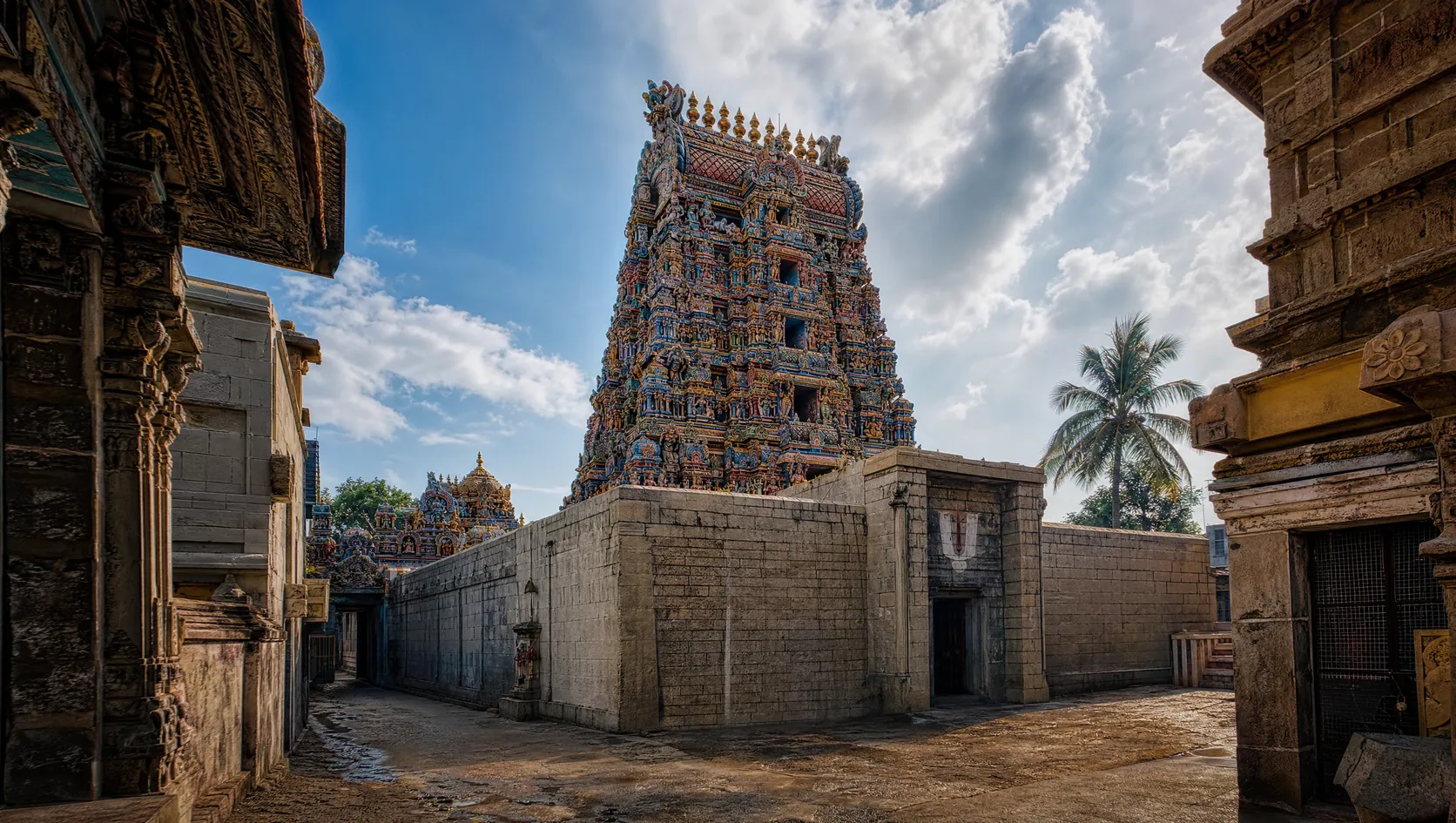
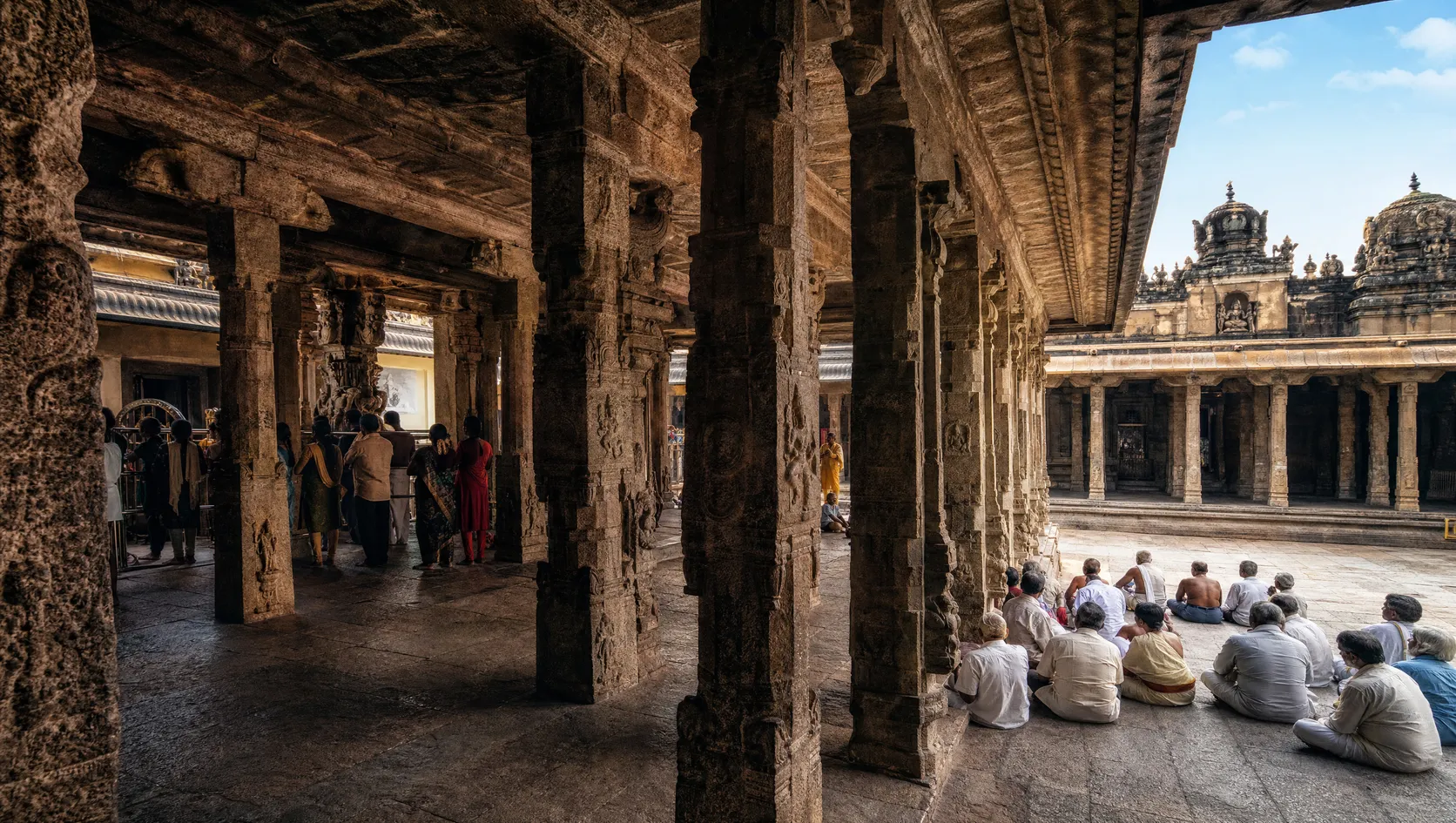
Dravidian, with a towering standing image of Trivikrama filling the sanctum, a gopuram over the entrance, pillared halls, and the shrines of five Divya Desams gathered within one complex
Open
06:00 – 20:00
Special
The temple keeps the Srivaishnava round of daily worship to Ulagalantha Perumal and the shrines of the other Divya Desams within it, with recitation of the Nalayira Divya Prabandham on set occasions. Timings run in a morning and an evening session with a midday break and vary with the festival calendar; they should be confirmed locally.
The Sacred Legend · पवित्र कथा
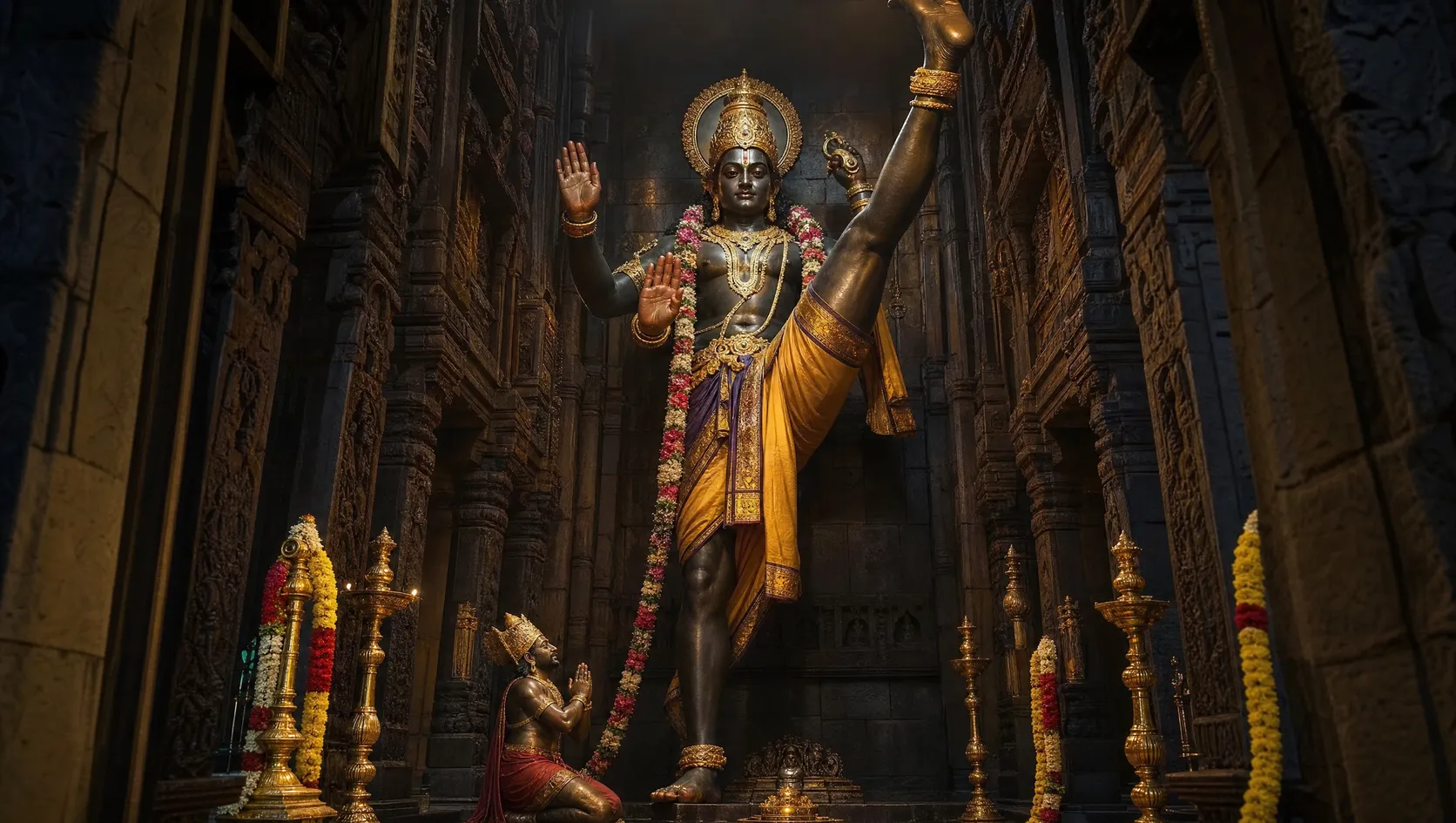
Among the hundred and eight Divya Desams, the abodes of Vishnu sung by the Alvar poet-saints, one at Kanchipuram holds the god not reclining and not seated but towering upright, one leg planted on the earth and the other flung skyward, caught in the very act of measuring the universe. This is Ulagalantha Perumal, the Lord who measured the worlds, the colossal standing image of Trivikrama that fills the sanctum from floor to roof, and to stand before it is to stand beneath a god frozen at the instant of his cosmic stride. The image tells the oldest of Vishnu's rescue stories. The asura king Mahabali, righteous and generous, had won lordship over the three worlds, and Vishnu came to him as Vamana, a small brahmin boy, and begged only three paces of ground. Bali granted it, and the dwarf swelled into Trivikrama, the being of three strides, and with one foot covered the earth and with the second the heavens, and for the third, finding no room left, set his foot upon Bali's own bowed head and pressed him down to rule the netherworld. The Kanchipuram image holds exactly that moment: the raised leg measuring the sky, the whole enormous body straining upward, the god in motion made stone. And the temple is stranger still, for it is not one Divya Desam but five folded into a single complex. Around the towering Trivikrama are gathered the shrines of Thirukaaragam, Thirukaarvanam, Thiruneeragam and Thiru Kaalvanoor, each counted in its own right among the hundred and eight, so that a pilgrim who enters this one temple in Vishnu-Kanchi has stood in five of the abodes of Vishnu at once.
Sacred Designationपवित्र पदनाम
Sacred Origin Storyपवित्र उत्पत्ति कथा
Source: The Srivaishnava tradition, the Vamana-Trivikrama story of the Puranas, and the Sthala tradition of Vishnu-Kanchi
The story the standing image tells is the story of Vamana, the fifth of the ten avatars of Vishnu. In the age when the asura king Mahabali ruled, the throne of the three worlds had passed from the gods to the asuras. Bali was no ordinary demon king; he was the grandson of Prahlada, the great devotee, righteous, truthful and boundlessly generous, and under his rule the worlds prospered. But the gods, dispossessed of heaven, appealed to Vishnu, and Vishnu was born as the son of Kashyapa and Aditi in the form of Vamana, a brahmin dwarf.
Bali was performing a great sacrifice, at which he vowed to deny no request. Into that sacrifice came the small brahmin boy, radiant and humble, and asked for a gift so modest it seemed a jest: three paces of ground, measured by his own small feet. Bali's teacher Shukracharya saw at once who the dwarf was and warned the king not to grant it, but Bali, holding his word above his kingdom, poured the water of the gift and said the land was given.
In that instant the dwarf began to grow. He swelled beyond the sacrificial ground, beyond the palace, beyond the earth and the sky, into Trivikrama, the Lord of three strides, a form filling the universe. With his first pace he measured the whole earth; with his second he measured the heavens and all the worlds above; and for the third pace there was no space remaining, for he had already covered everything that was. Then Bali, understanding, bowed his head and offered it as the ground for the third step. Vishnu set his foot upon the king's head and pressed him gently down to the netherworld, Sutala, to rule there; and honouring Bali's truth and surrender, he granted that the king would be a lord of that realm and that the Lord himself would stand as guardian at his door. The Kanchipuram image is that Trivikrama, the raised leg forever measuring the sky.
Sources cited:
- Vamana and Trivikrama account of the Bhagavata and other Puranas
- Srivaishnava tradition and the Nalayira Divya Prabandham
- Sthala tradition of Vishnu-Kanchi and the Ooragam shrine
Other Traditions · अन्य परंपराएँ
The Divya Desam tradition of Vishnu-Kanchi and the gathering of five shrines
Scholarly Context
The Ulagalantha Perumal temple is studied as one of the oldest Vaishnava foundations of Kanchipuram, a city that was among the great capitals and centres of learning of the Tamil country under the Pallavas, and later a temple city enlarged by the Cholas, the Pandyas and the Vijayanagara empire. Kanchipuram is counted among the seven sacred cities that grant liberation, and is unusual in being sacred to both Shiva and Vishnu, divided in tradition into Shiva-Kanchi and Vishnu-Kanchi; the Ulagalantha Perumal shrine lies in the Vaishnava half. The temple's importance rests on its being sung in the Nalayira Divya Prabandham of the Alvars, whose activity spans the middle centuries of the first millennium, and on its remarkable status as a single complex holding five Divya Desams. Scholars note that this gathering of five abodes, Thiruooragam, Thirukaaragam, Thirukaarvanam, Thiruneeragam and Thiru Kaalvanoor, reflects the density of Vaishnava sanctity in Vishnu-Kanchi, where many shrines once separate came to be counted and worshipped together. The standing image of Trivikrama, colossal and filling the sanctum with one leg raised, is a striking example of the iconography of the Vamana-Trivikrama story rendered on a monumental scale, and the temple is treated as an important witness to how the Puranic story of Bali and the three strides was given permanent visible form in the Tamil Vaishnava tradition.
Historyइतिहास
The Ulagalantha Perumal temple, also called Thiruooragam, is one of the 108 Divya Desams, the abodes of Vishnu sung by the Alvar poet-saints, and lies in Vishnu-Kanchi, the Vaishnava quarter of the ancient city of Kanchipuram in northern Tamil Nadu. Its presiding deity is Vishnu as Ulagalantha Perumal, the Lord who measured the worlds, whose colossal standing image of Trivikrama fills the sanctum from floor to roof, one leg raised in the act of measuring the heavens.
Kanchipuram is one of the seven sacred cities of India held to grant liberation, and is unusual in being holy to both Shiva and Vishnu, divided by tradition into Shiva-Kanchi and Vishnu-Kanchi. The city was a great capital and centre of learning under the Pallavas in the first millennium and remained a major temple city under the Cholas, the Pandyas and the Vijayanagara empire, its shrines built, endowed and enlarged over many centuries.
The temple's sanctity is attested from deep antiquity by the hymns of the Alvars, who sang it in the Nalayira Divya Prabandham; Thiruooragam and the deity Ulagalantha Perumal are glorified by Thirumangai Alvar and Bhutattalvar among others, giving the shrine a place in the earliest layer of Tamil Vaishnava devotion.
What most distinguishes the temple is that it is not a single Divya Desam but five gathered into one complex. Around the towering Trivikrama stand the shrines of Thirukaaragam, Thirukaarvanam, Thiruneeragam and Thiru Kaalvanoor, each counted in its own right among the hundred and eight abodes of Vishnu, so that one temple in Vishnu-Kanchi holds five of the Divya Desams together. The tradition treats this as a concentration of the sacred, where a single pilgrimage gathers the merit of five.
The great standing image of Ulagalantha Perumal renders the Vamana-Trivikrama story on a monumental scale: Vishnu, having come to the asura king Mahabali as the dwarf Vamana and begged three paces of ground, grows into the cosmic Trivikrama and measures the earth and the heavens, pressing Bali to the netherworld with his third step. The image holds that moment forever, the raised leg reaching upward. The temple remains a living Srivaishnava shrine, worshipped in the tradition of the Alvars and the acharyas, its worship keeping the Prabandham beside the Veda, and it is a principal station on the pilgrimage of the Divya Desams of Kanchipuram.
Historical Timelineऐतिहासिक कालक्रम
The Alvars, the Tamil poet-saints of Vishnu, sing Thiruooragam and the deity Ulagalantha Perumal in the hymns gathered as the Nalayira Divya Prabandham, giving the shrine an attested sanctity of great antiquity as one of the 108 Divya Desams.
The Alvars' activity is generally placed across the middle centuries of the first millennium; their hymns are the earliest firm evidence of the shrine's importance.
Under the Pallavas, Kanchipuram flourishes as a capital and a great centre of learning and temple building, and the Vaishnava shrines of Vishnu-Kanchi, among them the abodes gathered in the Ulagalantha Perumal complex, take their early form.
Kanchipuram under the Pallavas was among the foremost cities of the south, its temples the seedbed of later Dravidian temple architecture.
Under the Cholas the temples of Kanchipuram are richly endowed and enlarged, with halls, gopurams and inscriptions added, and the Vaishnava shrines of the city, including the Divya Desams of Vishnu-Kanchi, share in the era's building and patronage.
Kanchipuram is among the most richly inscribed temple cities of the south, its walls recording centuries of endowment.
In the age of Ramanuja and the great Srivaishnava acharyas, Kanchipuram is a centre of the tradition, closely tied to Ramanuja's own life and to the nearby Varadaraja Perumal temple, and the Divya Desams of Vishnu-Kanchi are held within the living fabric of Srivaishnava worship.
Kanchipuram's association with Ramanuja and the acharyas places its Vaishnava shrines within the wider Srivaishnava world centred on Srirangam.
The Pandyas, ruling after the Cholas, continue the patronage of the temples of Kanchipuram, adding to the shrines and endowments of the city and keeping its Vaishnava temples in active worship.
The temple city of Kanchipuram, like the other great shrines of the far south, faces the turmoil of the Delhi Sultanate's invasions of the Tamil country, a period of disruption for the temples of the region before the recovery under Vijayanagara.
The invasions of the early fourteenth century disrupted worship across the temple cities of the far south before the Vijayanagara restoration.
Under the protection and patronage of the Vijayanagara empire the temples of Kanchipuram are restored and enriched, halls and gopurams added and endowments renewed, and the Vaishnava shrines of Vishnu-Kanchi share in the era's revival.
The Vijayanagara period is one of major restoration and building across the temples of the Tamil country.
The Divya Desam tradition, formalising the count of the 108 abodes of Vishnu sung by the Alvars, holds the Ulagalantha Perumal complex as a place where five of the abodes, Thiruooragam, Thirukaaragam, Thirukaarvanam, Thiruneeragam and Thiru Kaalvanoor, are gathered and worshipped together.
The gathering of five Divya Desams in one complex is a distinctive feature of Vishnu-Kanchi, reflecting the density of Vaishnava shrines there.
In the centuries after Vijayanagara the temples of Kanchipuram continue in worship under the Nayakas and later local powers, maintaining the festivals and the daily services of the Vaishnava shrines of the city.
The temples of Kanchipuram, among them the Ulagalantha Perumal shrine, are documented in colonial-era surveys and gazetteers of the south, which record the city's standing as one of the seven sacred cities and its wealth of Shaiva and Vaishnava temples.
The Ulagalantha Perumal temple remains a living Srivaishnava shrine and a principal station on the pilgrimage of the Divya Desams of Kanchipuram, drawing pilgrims to the towering Trivikrama and the five abodes of Vishnu gathered within its walls.
What You'll Seeदर्शन में
The presiding image of the temple is Ulagalantha Perumal, Vishnu as Trivikrama, and it is unlike almost any other Divya Desam image in its scale and posture. The god stands upright and colossal, filling the sanctum from floor to roof, his left leg raised high and flung upward in the act of measuring the heavens, his right foot planted on the earth. This is the god in motion, caught at the instant of his cosmic stride, and the sheer size of the standing form, dominating the sanctum so that the worshipper must look steeply up to see the raised leg, is the temple's defining sight.
The image renders the moment of the Vamana-Trivikrama story when the dwarf has grown into the being of three strides. At the foot of the towering figure the tradition places the asura king Mahabali, bowed and pressed down by the third step, so that the whole sculpture holds not only the god but the story: the measuring of the worlds and the humbling of the generous king who gave the ground. The raised leg reaching toward the roof is the second stride measuring the sky, the very gesture from which the deity takes his name, Ulagalantha, the one who measured the worlds.
Around this central image the temple gathers the shrines of the other Divya Desams of the complex, Thirukaaragam, Thirukaarvanam, Thiruneeragam and Thiru Kaalvanoor, each with its own deity and its own place in the count of the hundred and eight, and the consort Amudhavalli Thayar has her shrine within the temple. The iconographic pattern is that of a single overwhelming form at the centre, the god who covered all the worlds in three steps, surrounded by the gathered abodes of Vishnu, so that the temple is at once the image of one cosmic act and a concentration of many sacred places into one.
Distinctive Practicesविशिष्ट परंपराएँ
Darshan of the Colossal Standing Trivikrama
विराट खड़े त्रिविक्रम का दर्शन
Year-round, in the daily worship
The central practice of the temple is the darshan of Ulagalantha Perumal, the towering standing image of Trivikrama that fills the sanctum, the worshipper looking up the length of the god to the leg raised in the act of measuring the sky. The scale of the image and its posture of cosmic motion make its darshan unlike that of any reclining or seated form.
To look up at the raised leg of Trivikrama is to be placed bodily beneath the cosmic act itself, to stand where Mahabali stood as the god measured the worlds above his head. The tradition holds that the sight teaches the lesson of the story: that Vishnu, come as the smallest of beggars, contains and covers all the worlds, and that the surrender of the generous king who gave the ground is the surrender the devotee is called to make. The overwhelming scale is not display but instruction, the smallness of the worshipper before the god who strides across the universe.
The Pilgrimage of Five Divya Desams in One Temple
एक मंदिर में पाँच दिव्य देशम् की तीर्थयात्रा
Year-round, on the Divya Desam pilgrimage
A practice particular to this temple is that a pilgrim who worships here has visited five Divya Desams at once: Thiruooragam of Ulagalantha Perumal, and the shrines of Thirukaaragam, Thirukaarvanam, Thiruneeragam and Thiru Kaalvanoor gathered within the same complex, each counted among the 108 abodes of Vishnu. Pilgrims making the round of the Divya Desams offer worship at each of the five within the one temple.
The gathering of five abodes in one temple lets the devotee complete a large portion of the arduous Divya Desam pilgrimage in a single place, and the tradition treats this concentration as a grace: the merit of five pilgrimages given at one shrine. To worship at the five is to honour the density of the sacred in Vishnu-Kanchi, where the abodes of Vishnu are gathered close, and to receive at once the blessings of five of the hymned homes of the Lord.
Recitation of the Nalayira Divya Prabandham
नालायिर दिव्य प्रबंधम् का पाठ
In the daily worship and centrally in the Adhyayana Utsavam
As at every Divya Desam, the Tamil hymns of the Alvars, the Nalayira Divya Prabandham, are recited in the temple's worship beside the Sanskrit Veda, and the verses in which Thirumangai Alvar, Bhutattalvar and the other Alvars sang Ulagalantha Perumal and the abodes of the complex are chanted before the god, above all in the Adhyayana Utsavam of Margazhi.
That the Tamil hymns are given equal standing with the Sanskrit Veda is the defining claim of Srivaishnavism: the Prabandham is the Dravida Veda, the Veda in Tamil, and the Alvars are seers on a level with the ancient rishis. To sing the Alvars' verses on the measuring of the worlds before the standing Trivikrama is to worship the god in the language of the land, in the very words by which the poet-saints first hymned this abode as one of the homes of Vishnu.
Onam and the Return of Mahabali
ओणम् और महाबलि की वापसी
Onam / Vamana Jayanti, in Avani (Aug-Sep)
The temple keeps a special connection to the story of Mahabali, whose humbling by Trivikrama the image depicts. Around the time of Onam and Vamana Jayanti, the appearance of Vishnu as Vamana, the temple honours the memory of the generous king pressed to the netherworld, and the story of Bali's boon and his yearly return is recalled at the shrine of the god who measured the worlds.
The story the image holds is not one of a demon defeated but of a righteous king honoured. Bali gave the ground though he knew who the dwarf was, and Vishnu, pressing him down, granted him lordship of the netherworld and stood guard at his door, and gave him leave to return once a year to see the people who loved him, the return that Onam celebrates. To recall Bali before Ulagalantha Perumal is to hold together the two faces of the story: the god who covers all the worlds, and the devotee whose surrender is honoured even as he is humbled, so that the measuring of the worlds is remembered as an act of grace as much as of power.
Did You Know?क्या आप जानते हैं?
Ulagalantha Perumal is Vishnu as Trivikrama, and his colossal standing image fills the sanctum from floor to roof, one leg raised in the act of measuring the heavens, unlike almost any other Divya Desam image.
Sthala tradition of Vishnu-Kanchi
The temple is unusual in that it houses five Divya Desams within one complex: Thiruooragam, Thirukaaragam, Thirukaarvanam, Thiruneeragam and Thiru Kaalvanoor, each counted among the 108 abodes of Vishnu.
Divya Desam tradition
The image depicts the exact moment of the Vamana story when the dwarf has grown into Trivikrama and measures the worlds, with the asura king Mahabali shown bowed and pressed to the netherworld beneath the god's foot.
Vamana-Trivikrama account of the Puranas
The deity's name, Ulagalantha, means the one who measured the worlds, taken directly from the cosmic act of Trivikrama that the standing image holds forever.
Srivaishnava tradition
The temple lies in Vishnu-Kanchi, the Vaishnava half of Kanchipuram, one of the seven sacred cities of India held to grant liberation, and unusual in being holy to both Shiva and Vishnu.
Sthala tradition of Kanchipuram
Ulagalantha Perumal and the abode of Thiruooragam are glorified in the Nalayira Divya Prabandham by Thirumangai Alvar and Bhutattalvar among the Tamil poet-saints.
Nalayira Divya Prabandham
The consort of Ulagalantha Perumal is Amudhavalli Thayar, who has her own shrine within the temple in the Srivaishnava manner of Lord and Goddess each in their precinct.
Temple tradition
The story the image holds honours Mahabali as a righteous king; Vishnu, pressing him to the netherworld, granted him lordship there and leave to return once a year, the return that the festival of Onam celebrates.
Vamana-Trivikrama tradition
Because five abodes are gathered here, a pilgrim making the arduous round of the 108 Divya Desams completes five of them in a single visit to this one temple in Vishnu-Kanchi.
Divya Desam pilgrimage tradition
Visitor Accessप्रवेश जानकारी
The temple is open to Hindus, and the inner sanctum of the standing Ulagalantha Perumal is reached through the halls of the complex. As at many major Vaishnava temples of the south, entry to the innermost precinct is restricted to Hindus, and this may be signposted or advised at the temple. Within the one complex are the shrines of five Divya Desams and the shrine of the goddess Amudhavalli Thayar, and a full visit takes in each. A dress code of traditional and modest attire applies, and footwear is left outside the temple. Timings run in a morning and an evening session with a midday closure, and vary with the festival calendar. The temple is one of a group of Divya Desams in Vishnu-Kanchi and is generally visited as part of a Kanchipuram temple round. Confirm current timings and any restrictions locally before visiting.
Spiritual Basis
The restriction of the innermost precinct to Hindus follows the practice of the major Vaishnava temples of the south, which preserve the ritual purity of the sanctum according to their tradition. The approach through the halls of the complex to the standing god is itself part of the worship: the devotee moves from the outer courts through the gathered shrines of the five abodes to the towering Trivikrama at the heart, so that the visit gathers the five Divya Desams and comes at last to the god who measured the worlds. The god's accessibility is held to be real for all his devotees within these forms. The colossal image is not remote but present, placed so that the worshipper stands beneath it as Mahabali stood, called to the same surrender that the king made when he gave the ground.
Contemporary Context
The Ulagalantha Perumal temple is one of the well-known Divya Desams of Kanchipuram and is visited both by pilgrims making the round of the 108 abodes of Vishnu and by the many visitors who come to Kanchipuram for its wealth of temples. The city is a compact temple town, and the Vaishnava shrines of Vishnu-Kanchi are close together, so the temple is easily combined with others in a single day. The temple is administered as a functioning shrine with daily worship, and the darshan of the standing Trivikrama and the five gathered abodes is its principal draw. On ordinary days a visit is unhurried; on festival days, above all around the Brahmotsavam and Vaikuntha Ekadasi, crowds are larger and the temple more active.
Practical Guidance
Allow time to see the whole complex: the sanctum of the standing Ulagalantha Perumal, the shrine of Amudhavalli Thayar, and the shrines of Thirukaaragam, Thirukaarvanam, Thiruneeragam and Thiru Kaalvanoor gathered within, each a Divya Desam in its own right. Looking up the length of the colossal Trivikrama to the raised leg is the temple's defining sight. Dress traditionally and modestly, and leave footwear outside. Note the restriction at the innermost precinct. The temple is best visited as part of a round of the Divya Desams and other temples of Vishnu-Kanchi and Kanchipuram, which are close together in the compact temple city; a guide or the temple's own priests can help identify the five abodes within the one complex.
Festivalsत्योहार
Vaikuntha Ekadasi
वैकुण्ठ एकादशी
Dec-Jan (Margazhi)
The great Vaishnava festival of Vaikuntha Ekadasi is observed at the temple as at all the Divya Desams, when the gate of the highest heaven is opened in the Srivaishnava tradition and the day is held the most sacred of the Vaishnava year, the passage to the Lord's own abode enacted before Ulagalantha Perumal.
Brahmotsavam
ब्रह्मोत्सवम्
Annual festival calendar of the temple
The annual Brahmotsavam is the temple's great festival of many days, over which the processional deity is taken in procession on the vahanas around the shrine and the streets of Vishnu-Kanchi, the fullest public celebration of Ulagalantha Perumal's presence in the temple city.
Onam and Vamana Jayanti
ओणम् और वामन जयंती
Aug-Sep (Avani)
Around Onam and Vamana Jayanti, the appearance of Vishnu as Vamana, the temple honours the story its image holds, the coming of Vishnu as the dwarf, his growth into Trivikrama, and the memory of the generous king Mahabali whose yearly return Onam celebrates. This festival is of particular relevance to a temple whose deity is Trivikrama himself.
Adhyayana Utsavam
अध्ययन उत्सवम्
Dec-Jan (Margazhi), around Vaikuntha Ekadasi
The festival of the recitation of the Nalayira Divya Prabandham, when the Tamil hymns of the Alvars are chanted in full over its days, including the verses in which the Alvars sang Ulagalantha Perumal and the abodes of the complex, a central observance of the Srivaishnava year.
Traditional Offeringsपारंपरिक अर्पण
Primary Offerings
Tulasi (holy basil)
तुलसी
तुलसी
Tulasi, the holy basil beloved of Vishnu, is the offering most proper to Ulagalantha Perumal as to any form of Vishnu, laid at his feet and woven into his garlands. No worship of Vishnu is complete without it, and it is offered to the standing Trivikrama as to the Lord in every abode.
Sacred food (prasadam)
प्रसाद
प्रसादम्
Food is cooked and offered to Ulagalantha Perumal and shared with devotees as prasadam, the grace of the Lord made tangible. To receive the prasadam of the god who measured the worlds is to carry away a portion of his blessing from the shrine.
Garlands of flowers
पुष्प-मालाएँ
पुष्पमाला
Garlands of flowers, with tulasi, are offered to Ulagalantha Perumal and to the goddess Amudhavalli Thayar, and garlands that have adorned the deity are returned to devotees as a blessing carrying the touch of the Lord.
Lamps and camphor (deepa aradhana)
दीप और कर्पूर (दीप आराधना)
दीपाराधना
The waving of lamps and the burning of camphor before the deity is central to the worship, and before the colossal standing Trivikrama the lamp is raised the length of the image, lighting the god from his planted foot to the leg raised toward the heavens.
Recitation of the Prabandham and the Sahasranama
प्रबंधम् और सहस्रनाम का पाठ
स्तोत्रपाठ
Beyond material offerings, the recitation of the Alvars' Tamil hymns and of the Vishnu Sahasranama, the thousand names of Vishnu, is held a high offering to Ulagalantha Perumal, the god worshipped as much in sung word as in flower and food. The hymns in which the Alvars sang this abode are offered before the standing Trivikrama.
Unique to This Temple
The Offering at the Foot of Trivikrama
त्रिविक्रम के चरण पर भेंट
What is particular to this temple is that the offering is made at the foot of the god who measured the worlds, in the posture of Mahabali who gave the ground and bowed his head for the third step. The tradition holds that the devotee who stands beneath the raised leg of Trivikrama and offers himself imitates the surrender of the generous king, whose truth and self-gift Vishnu honoured even as he pressed him down. A pilgrim brings tulasi, flowers and food as at any abode of Vishnu, but the offering the story holds highest is the offering Bali made: the giving of what one has, and then the giving of oneself, in the confidence that the Lord who covers all the worlds receives the surrender and returns it with grace. To worship the measuring of the worlds is to be reminded that nothing is beyond the god's stride, and that the way to him is the way of the king who gave everything and was honoured for it.
Offerings at the Ulagalantha Perumal temple follow the Srivaishnava tradition, with tulasi, flowers, garlands, prasadam and the waving of lamps central, and the recitation of the Prabandham and the Vishnu Sahasranama held as offerings of word. Eternal Raga presents these practices as a devotional tradition; specific seva and offering arrangements should be confirmed with the temple.
How to Reachकैसे पहुँचें
The Ulagalantha Perumal temple lies in Vishnu-Kanchi, within the temple city of Kanchipuram in northern Tamil Nadu, and is easily reached from Chennai and the surrounding region.
By air: Chennai International Airport is about 75 km away, the nearest major airport, connected to cities across India and abroad, with road connections onward to Kanchipuram.
By rail: Kanchipuram has its own railway station, and Chengalpattu Junction, a larger railhead a short distance away, is well connected; the city is reached by train from Chennai and the wider network.
By road: Kanchipuram is well served by road, with frequent buses and taxis from Chennai, about 70 to 75 km away, and from Chengalpattu and the surrounding towns. Within the compact temple city the temple is reached by local transport, and the Vaishnava shrines of Vishnu-Kanchi lie close together.
Many pilgrims visit the Ulagalantha Perumal temple as part of a round of the Divya Desams and the great temples of Kanchipuram, among them the Varadaraja Perumal temple in Vishnu-Kanchi and the Kamakshi Amman and Ekambareswarar temples in the Shaiva half of the city, all within the one temple town.
Plan Your Visitयात्रा की योजना
🌤 Best Season
October to March is the most comfortable time to visit Kanchipuram, with milder temperatures across the northern Tamil plain. The Margazhi month (December-January) brings the temple's Vaikuntha Ekadasi and the Adhyayana Utsavam, a spiritually rich season, while the annual Brahmotsavam and the Onam and Vamana Jayanti observances draw devotees to the story of Trivikrama. April to June is hot in the region, and the monsoon months bring rain, though the temple remains accessible throughout. Early morning and evening, when the temple is active with worship and the day is cool, are the most atmospheric times for the darshan of the standing Trivikrama. Because Kanchipuram is a compact temple city with many shrines close together, a visit is easily planned to take in the Ulagalantha Perumal temple with the other Divya Desams and great temples of the town in a day or two.
👘 Dress Code
Traditional and modest dress is required. Men commonly wear a dhoti or trousers with a shirt; women a saree or salwar kameez. Footwear is left outside the temple. As a Vaishnava Divya Desam, the temple expects respectful traditional attire.
📱 Phones & Photography
Photography is generally restricted within the sanctum and the inner areas, and cameras and phones may need to be kept away in the innermost precinct. Follow the posted rules and the directions of temple staff, and keep phones silenced within the shrines.
🏨 Accommodation
Kanchipuram offers a range of accommodation, from pilgrim lodges and guest houses near the temples to hotels of various standards across the town, and the larger city of Chennai, about 70 to 75 km away, has ample options for those who prefer to visit on a day trip. Demand rises around the temple's festivals, above all the Brahmotsavam and Vaikuntha Ekadasi, when booking ahead is advisable. Outside the festivals the temple town absorbs its visitors easily, and its compact size makes it simple to stay near the cluster of temples.
Sacred Soundsपवित्र ध्वनि
Did You Know? · क्या आप जानते हैं?
The same translation error that turned '33 Koti' into '33 crore' in Hinduism also happened in Buddhism. The Chinese translation of Buddhist texts rendered 'Sapta Koti Buddha' (7 Supreme Buddhas) as '7 Crore Buddhas.' The Tibetan translation got it right: 7 types, not 7 crore. One Sanskrit word, misread across two major world religions, generated two identical misconceptions independently.
Related Contentसंबंधित सामग्री
Related Scriptures
Community Reflections
🕉️
Be the first to share your reflection.