Palani
पलनी
Where the god of war became the ascetic — Murugan as renunciant on Sivagiri hill
Palani, Tamil Nadu, India
PaḷaṉiAlso known as: Pazhani, Thiruavinankudi, Dandayuthapani Temple, Palani Murugan Temple, Palani Andavar
Era
Antiquity uncertain; Siddha tradition places the navapashanam idol's installation in a pre-medieval period; current structural complex largely medieval with later additions
Architecture
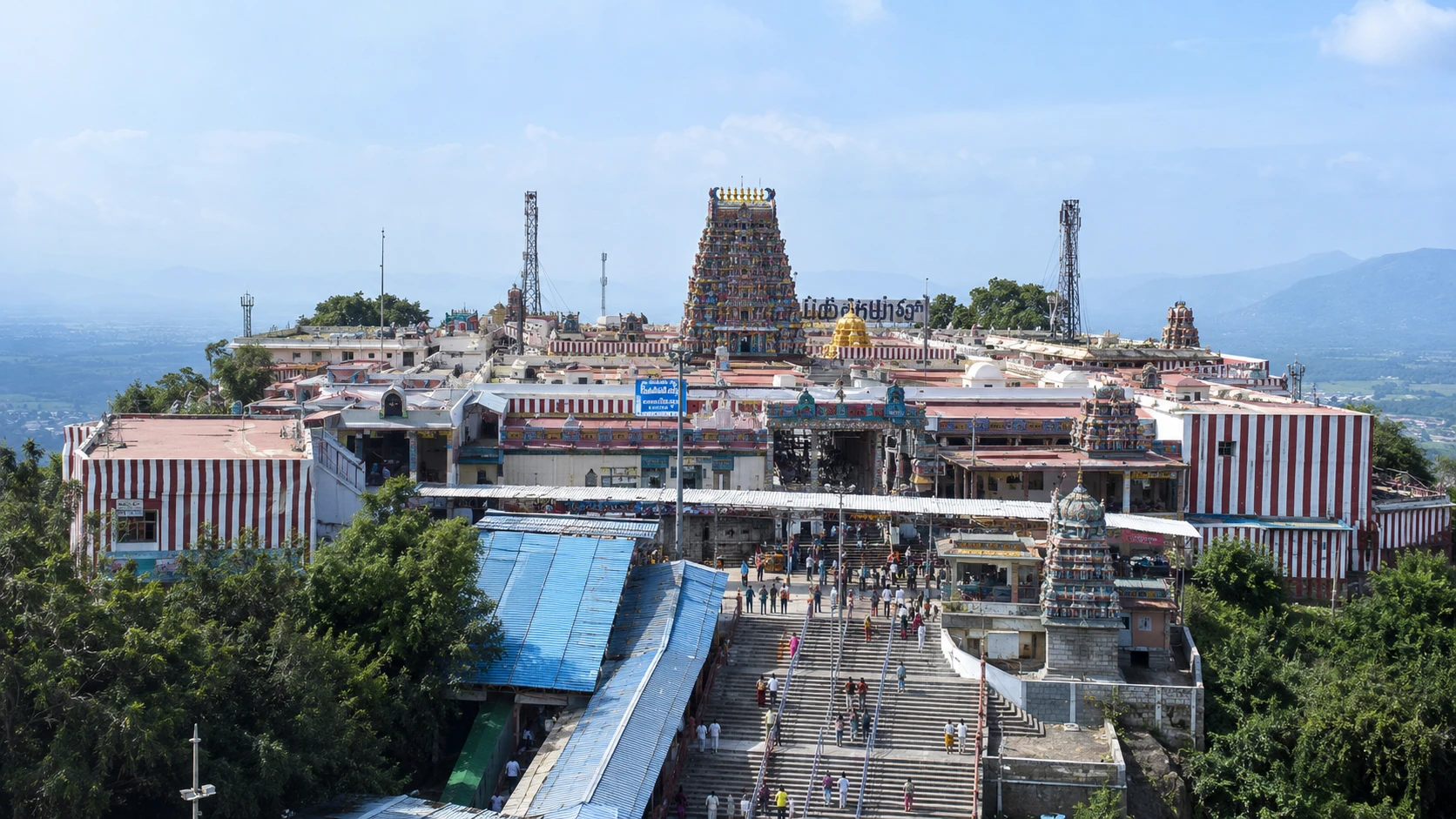
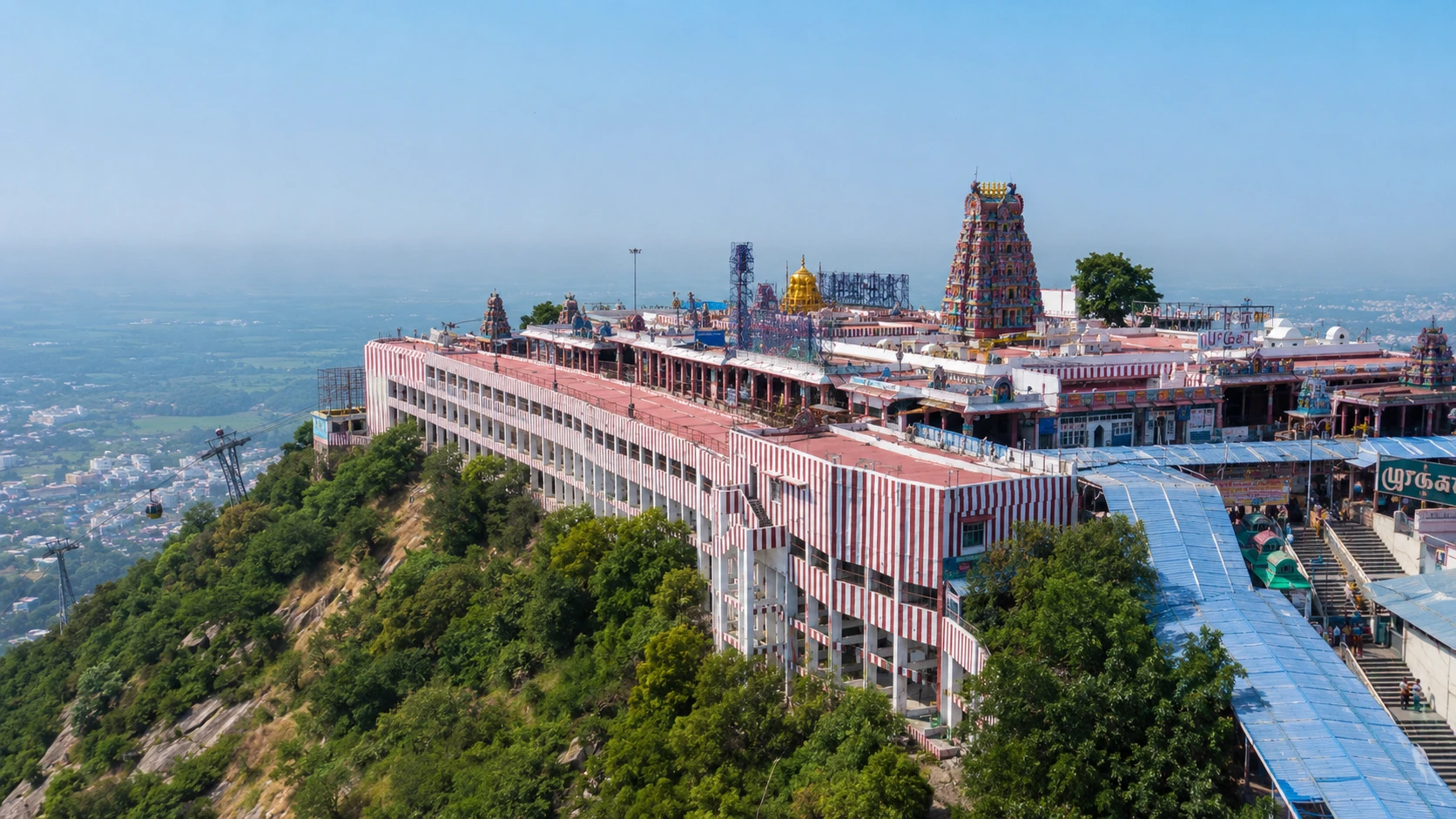
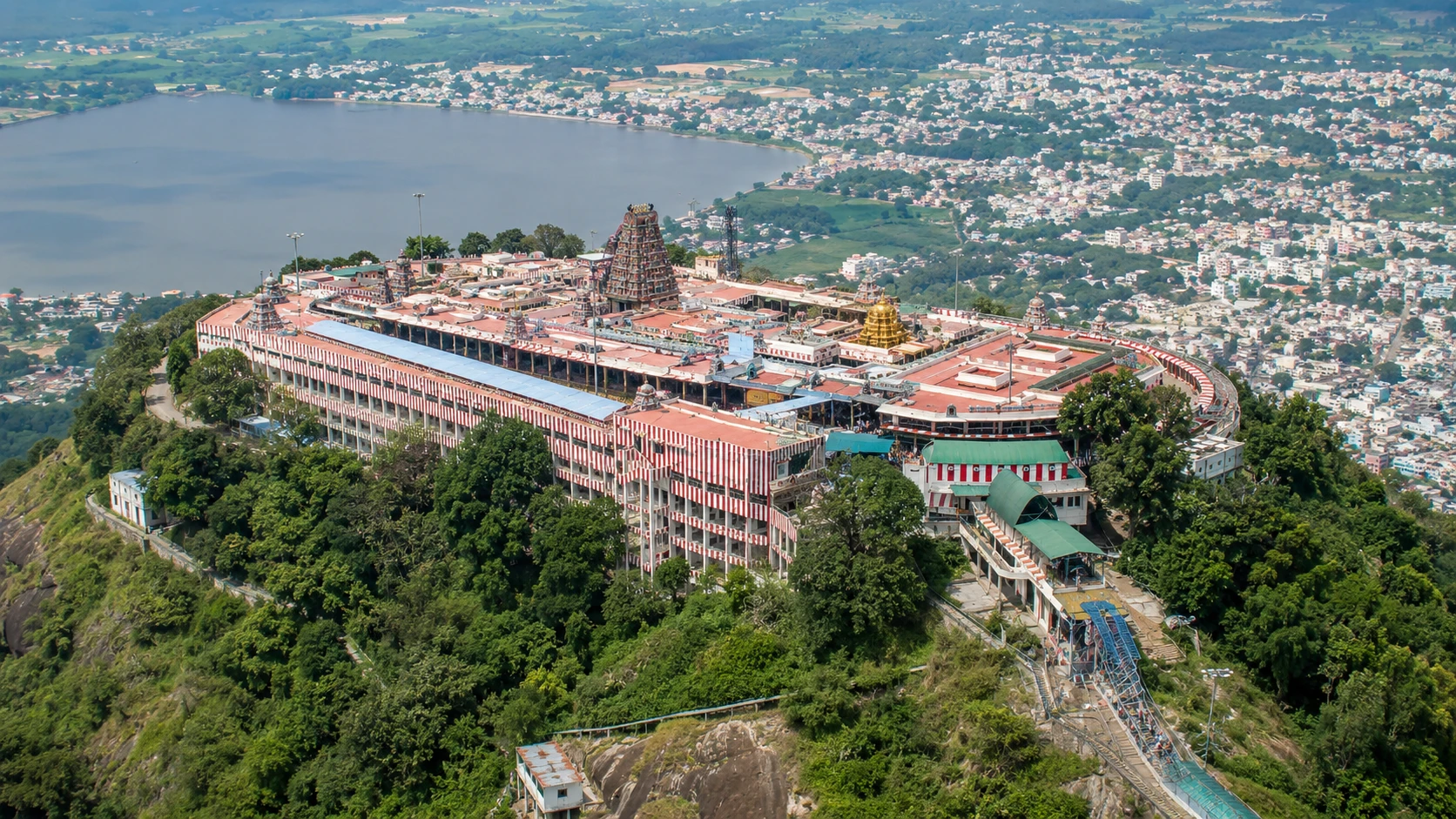
Dravidian hill temple; gopuram at the hilltop; 693 steps to the summit; ropeway system for pilgrims
Open
06:00 – 21:00
Aarti
06:00 · 08:00 · 12:00 · 18:00 · 20:30
Special
Abhishekam with Panchamritam — the sacred mixture offered to the navapashanam idol; prasad distributed to pilgrims
The Sacred Legend · पवित्र कथा
At Palani, Murugan is not the warrior who split Surapadman at the seashore, nor the bridegroom garlanded at Thirupparankundram — he is the ascetic. He stands on Sivagiri hill holding only a danda (staff), stripped of his ornaments, his vel, and his consorts, having renounced everything in a moment of divine disillusionment. The story that brought him here begins with a golden mango — the fruit of wisdom — that Narada placed before Shiva. When Murugan lost the contest to Ganesha through a trick of devotion rather than speed, he refused consolation and withdrew to this hill. He declared that he himself was pazhani — the fruit, the wisdom — and the hill has carried that declaration ever since. The idol in the sanctum is said to have been cast by Bogar, one of the eighteen Tamil Siddhas, from navapashanam — a mysterious compound of nine medicinal minerals. The liquid that flows from the abhishekam of this idol, the Palani Panchamritam, is received by millions of pilgrims as both prasad and medicine. Palani is the only Arupadaiveedu where Murugan appears in the form of the sannyasi — the god who turned away from the world and found, in that turning, the deepest wisdom.
Sacred Designationपवित्र पदनाम
Sacred Origin Storyपवित्र उत्पत्ति कथा
Source: Skanda Purana / Tamil Sthala Purana of Palani / Kanda Puranam tradition
Narada the divine messenger arrived one day at Kailasa carrying a single golden mango — the fruit of wisdom, jnana palam — and presented it to Shiva and Parvati. There was only one fruit, and two sons. Parvati suggested a contest: whoever could circle the entire universe and return first would receive it. Murugan, confident in his peacock's speed, accepted immediately and flew off into the cosmos. Ganesha sat still. He looked at his parents. Then he rose, walked around Shiva and Parvati three times, and bowed. 'My parents are the universe,' he said. 'I have circled all of creation.' Shiva agreed. The golden mango was given to Ganesha. Murugan returned from his great flight to find his brother holding the prize. He felt the injustice of it — not as a child's tantrum but as a god's genuine grievance. He was the one who had taken the contest seriously; he was the one who had done the actual work. He removed his ornaments, took off his armour, set down his vel and his spear and his jewelled crown, and he walked to Palani hill. He sat there as a sannyasi, holding nothing but a bamboo staff. Parvati sent Shiva himself to console their son. But Murugan would not be moved. He said: 'I am pazhani' — I am the fruit. I am the wisdom. The wisdom was never in the mango. It was always here, in this stillness, on this hill. Shiva understood. The hill became the third Padai Veedu. The ascetic form of Murugan — Dandayuthapani, the one whose weapon is the staff — became one of the most beloved divine forms in all of Tamil Nadu.
Sources cited:
- Skanda Purana — Murugan's renunciation narrative
- Tamil Sthala Purana of Palani (local temple tradition)
- Kacciyappa Sivachariyar, Kanda Puranam (Tamil, 14th century CE)
- Arunagirinathar, Thirupugazh — verses on Palani Dandayuthapani (c. 15th century CE)
Scholarly Context
The etymology of 'Palani' (Tamil: பழனி) from 'pazham ni' ('you are the fruit') is the received devotional explanation and is embedded in the Sthala Purana tradition. Scholarly opinion (K.A. Nilakanta Sastri, 'A History of South India') notes that the town name predates the Sanskrit–Tamil theological elaboration and likely derives from a topographic or tribal term; the etymological narrative is a devotional construction of the Puranic period. The navapashanam idol tradition — attributed to the Siddha sage Bogar — belongs to the Tamil Siddha literature tradition, which is distinct from, though contemporaneous with, the Bhakti saints' tradition. The Siddhas are not documented in the same epigraphic record as the Nayanmars.
Historyइतिहास
Palani's sacred status is attested in Sangam-era literature, with the Tirumurugaṟṟuppaṭai naming it among Murugan's six abodes. The Tevaram saints of the Bhakti period composed hymns here, and the temple was part of the pan-Tamil pilgrimage circuit by the early medieval period. The most distinctive thread in Palani's historical tradition is the attribution of the principal idol to Bogar (Boganathar), one of the eighteen Tamil Siddhas — an alchemist-saint tradition that runs parallel to the Bhakti movement in Tamil Nadu. According to this tradition, Bogar cast the idol from navapashanam — a compound of nine minerals including cinnabar, arsenic, mica, sulfur, and others — and installed it on the hill. Whether the current idol is identical to Bogar's original installation is not confirmed in peer-reviewed scholarship; the temple's own tradition asserts continuity. Bogar's samadhi (meditation space and burial site) is located within the temple complex. Arunagirinathar (c. 15th century CE) composed Thirupugazh verses specific to Palani, consolidating the Dandayuthapani iconographic tradition. The temple's position atop a steep hill prompted the eventual construction of a ropeway system for pilgrims unable to climb the 693 steps. Palani Panchamritam — the abhishekam liquid from the navapashanam idol — was granted a Geographical Indication (GI) tag by the Government of India, recognising its unique origin and traditional preparation. The temple is administered by the Hindu Religious and Charitable Endowments (HR&CE) Department, Government of Tamil Nadu.
Historical Timelineऐतिहासिक कालक्रम
Nakkirar's Tirumurugaṟṟuppaṭai names Palani (as Thiruavinankudi) among Murugan's six Padai Veedu, providing the earliest datable literary attestation of the site's sacred status.
Nayanmar saints of the Bhakti tradition composed Tevaram hymns on Palani, establishing the temple within the Tamil Shaiva devotional canon.
Arunagirinathar composed Thirupugazh verses specific to Palani's Dandayuthapani, crystallising the iconographic and devotional understanding of Murugan as renunciant-ascetic at this site.
The Siddha sage Bogar (Boganathar) is traditionally credited with casting the principal Murugan idol from navapashanam — a compound of nine minerals — and installing it on Palani hill. Bogar's samadhi within the temple complex is a site of active veneration. This tradition belongs to the Tamil Siddha literature lineage; it is not corroborated by dateable epigraphic evidence.
The Siddha attribution to Bogar is a living devotional tradition embedded in the Palani Sthala Purana and in oral transmission within the Tamil Siddha lineage. The composition of the navapashanam idol — variously described as including cinnabar (mercury sulfide), arsenic compounds, mica, pyrite, quartz, and other minerals — has been a subject of scientific interest. No peer-reviewed published analysis of the idol's composition has been made available publicly as of the time of writing. The claim that the abhishekam liquid carries medicinal properties is a traditional folk-belief widely held by devotees; it is not substantiated in clinical or pharmacological literature and should be understood as devotional tradition rather than medical claim.
Palani Panchamritam — the sacred abhishekam mixture prepared from the navapashanam idol's offering at Palani — received a Geographical Indication (GI) tag from the Government of India, formally recognising its unique traditional preparation and its origin at this specific temple.
The GI tag year cited here is based on published reports; the precise grant date should be verified against the official GI Registry records at ipindia.gov.in. Flagged for verification.
What You'll Seeदर्शन में
Murugan at Palani is enshrined as Dandayuthapani — 'he whose weapon (ayudha) is the staff (danda)'. The form is unique among all of Murugan's iconographic expressions: he stands alone, without his vel, without his peacock, without his consorts Devasena and Valli. He holds a simple bamboo staff (danda) in one hand. His other hand rests on his hip or extends downward in a gesture of composed equanimity. He wears minimal ornaments — the voluntary poverty of the renunciant. The face carries an expression of serene, self-sufficient stillness that devotees describe as the look of one who has found, and does not need to seek. The idol itself is the navapashanam murti — traditionally said to have been cast by the Siddha Bogar from nine mineral compounds. The material is dark, dense, and lustrous; it does not visually resemble stone or conventional metal. Abhishekam is performed with the Panchamritam mixture, and the liquid that flows from the idol is distributed as prasad. Because the idol is considered sensitive to the chemical interactions of repeated bathing with common liquids, the abhishekam protocols are specific and traditional. Photography is not permitted inside the inner sanctum.
Distinctive Practicesविशिष्ट परंपराएँ
Palani Panchamritam Abhishekam
पलनी पंचामृतम अभिषेकम
Daily; intensified on Fridays, Skanda Sashti, and Thai Poosam
The abhishekam at Palani is performed with Panchamritam — a ritual mixture of five sacred substances including banana, jaggery, cardamom, honey, and coconut — applied to the navapashanam idol. What flows from the idol after the abhishekam is the Palani Panchamritam, distributed to pilgrims as prasad. The Panchamritam is believed by devotees to carry the medicinal and spiritual properties absorbed from the navapashanam idol through repeated contact over centuries of ritual bathing. It has a Geographical Indication tag from the Government of India, recognising its unique preparation at this specific temple.
The Panchamritam's spiritual significance rests on its contact with the navapashanam idol — it is understood as carrying the idol's essence outward to the devotee. To receive the Panchamritam is to receive what the idol embodies: the concentrated wisdom, self-sufficiency, and grace of Dandayuthapani. The folk belief in its medicinal properties is inseparable from this spiritual logic — the body and the spirit are both addressed by the same substance.
Kavadi Attam — Votive Burden-Bearing
कावड़ी अट्टम — मन्नत का बोझ वहन
Thai Poosam (January–February); Skanda Sashti; Panguni Uthiram
Palani is one of the primary centres of kavadi practice in Tamil Nadu. Devotees who have made vows to Murugan carry kavadi — decorated bamboo frames or arched structures, sometimes weighted with pots of milk — up the 693 steps to the hilltop temple. The most intense form involves vel skewers pierced through the cheeks and tongue; devotees in this state are understood to be in a trance of divine possession, protected by Murugan's grace from pain. The kavadi bearer typically observes a 48-day fast and celibacy vow before undertaking the pilgrimage.
Kavadi represents the voluntary assumption of a sacred burden in exchange for divine grace — the devotee literally carries weight for Murugan, enacting a relationship of surrender and reciprocal blessing. At Palani, the kavadi ascent mirrors Murugan's own renunciation: the devotee strips away comfort and takes on a burden just as the god stripped away ornaments and took up a staff. The ascent itself — 693 steps, often barefoot, often in the heat — is the spiritual practice.
Did You Know?क्या आप जानते हैं?
Palani is the only one of the six Arupadaiveedu where Murugan is enshrined in ascetic form — without his vel, without his peacock, without his consorts. The Dandayuthapani iconography (staff-bearer) exists nowhere in Indian religious art as powerfully as it does here. This is the god at his most vulnerable and most invincible simultaneously.
Palani Sthala Purana; Kanda Puranam; Tamil Murugan iconography scholarship
The principal idol at Palani is said to be the navapashanam murti — cast by the Siddha sage Bogar from a compound of nine minerals. The abhishekam mixture that flows from this idol — Palani Panchamritam — has received a Geographical Indication (GI) tag from the Government of India, making it one of the very few temple ritual prasads in India to hold such legal recognition of its unique origin.
Geographical Indications Registry, Government of India; Palani temple administration
The word 'Palani' is traditionally derived from 'pazhani' — a Tamil phrase meaning 'you are the fruit' or 'I am the fruit (of wisdom)'. According to the Sthala Purana, when Parvati's messenger asked Murugan why he had retreated to this hill, he replied: 'I am pazhani' — meaning the wisdom (the jnana palam, the fruit of knowledge) is not the mango that was given away; it is this, here, within me. The hill was named for that declaration.
Palani Sthala Purana; Tamil devotional tradition
Bogar's samadhi — the meditation seat and burial place of the Siddha sage credited with casting the idol — is located within the Palani temple complex and is actively venerated. Bogar belongs to the tradition of the Pathinenmar Siddhargal (Eighteen Tamil Siddhas) — alchemist-saint-physicians whose works in Tamil blend devotion, alchemy, medicine, and yoga in a tradition largely distinct from the Bhakti Nayanmars.
Tamil Siddha tradition; Bogar Sapta Kandam (attributed text); Palani temple records
Visitor Accessप्रवेश जानकारी
Palani is open to devotees of all backgrounds. Modest dress is required. Photography is not permitted inside the inner sanctum. The temple is atop a hill — devotees may climb 693 steps or use the ropeway (winch/gondola service). A motorable road also provides vehicle access. Elderly and differently-abled pilgrims are advised to use the ropeway.
Steps (693) are a significant physical undertaking, especially in summer. Wear sturdy footwear for the approach (removed at the temple threshold). Carry water. The ropeway operates during temple hours — check current schedule and queue times at the temple office. Palani Panchamritam is distributed at the designated prasad counter; queues can be long on festival days.
Festivalsत्योहार
Thai Poosam
थाई पूसम
January–February
The most important festival at Palani — draws millions of pilgrims annually, making it one of the largest religious gatherings in South India. Kavadi-bearing devotees from across Tamil Nadu and the global Tamil diaspora converge on Palani. Many walk long distances carrying decorated kavadis as votive offerings. The festival celebrates Parvati's gift of the vel to Murugan — the weapon he received and then laid down.
Skanda Sashti
स्कंद षष्ठी
October–November
Six-day festival celebrating Murugan's victory over Surapadman. At Palani, the festival also carries the resonance of Murugan's renunciation — having won the war, he gave everything away. The Soorasamharam re-enactment is observed, followed by Thirukalyanam.
Panguni Uthiram
पंगुनी उत्तिरम
March–April
Celebrated at all six Arupadaiveedu; at Palani, the festival draws large crowds for the Brahmotsavam (grand festival) and special abhishekam rituals for Dandayuthapani.
Vaikasi Visakam
वैकासी विशाखम
May–June
Celebrates Murugan's birth star (Visakha nakshatra) in the Tamil month of Vaikasi. One of the most auspicious Murugan observances; at Palani, special abhishekam and processions are held.
How to Reachकैसे पहुँचें
Palani is located in Dindigul district, Tamil Nadu, approximately 100 km east of Coimbatore and 120 km north of Madurai. Palani Railway Station (2 km from the temple) is on the Pollachi–Palani broad-gauge line; connections to Coimbatore, Madurai, and Chennai require a change at Pollachi or Dindigul Junction. Coimbatore International Airport (100 km) is the nearest major airport. State buses (TNSTC) run direct services from Coimbatore, Madurai, Dindigul, Chennai, and all major Tamil Nadu cities to Palani bus stand. The temple hill is reached by climbing 693 steps, by ropeway, or by vehicle on a motorable road to the hilltop area.
Plan Your Visitयात्रा की योजना
🌤 Best Season
October through February. Summers (April–June) are hot; the hill climb is physically demanding in heat. Thai Poosam (January–February) brings enormous crowds — plan accommodation many months in advance. Vaikasi Visakam (May–June) is also very crowded.
👘 Dress Code
Modest traditional dress. Men typically remove shirts before entering the inner sanctum. No shorts, miniskirts, or sleeveless garments. Footwear removed at the temple entrance. For the hill climb, sturdy footwear on the approach path is practical — removed at the base threshold.
📱 Phones & Photography
Mobile phones permitted in outer precincts. Photography strictly prohibited inside the inner sanctum.
🏨 Accommodation
Palani town has numerous pilgrim lodges, dharamshalas, and hotels near the base of the temple hill. The temple trust also manages accommodation for pilgrims. For wider options, Dindigul (65 km) and Coimbatore (100 km) offer more variety. During Thai Poosam, all accommodation fills months in advance.
Book a Pujaपूजा बुक करें
Booking links and phone numbers are verified periodically but may change without notice. Always confirm the destination URL belongs to the official temple trust before payment. The Palani Panchamritam's claimed medicinal properties are a traditional folk belief; Eternal Raga makes no representation regarding health claims associated with prasad. Please verify all puja arrangements with the official HR&CE portal only.
Managed by: Hindu Religious and Charitable Endowments (HR&CE) Department, Government of Tamil Nadu — Arulmigu Dhandayuthapani Swamy Temple, Palani
Abhishekam (Panchamritam)
अभिषेकम (पंचामृतम)
Karpaga Archanai
कर्पग अर्चनै
Ropeway ticket (separate from puja — temple trust operated)
रोपवे टिकट (पूजा से अलग — मंदिर ट्रस्ट संचालित)
Booking information verified: 2026-05-23
Sacred Soundsपवित्र ध्वनि
Did You Know? · क्या आप जानते हैं?
The same translation error that turned '33 Koti' into '33 crore' in Hinduism also happened in Buddhism. The Chinese translation of Buddhist texts rendered 'Sapta Koti Buddha' (7 Supreme Buddhas) as '7 Crore Buddhas.' The Tibetan translation got it right: 7 types, not 7 crore. One Sanskrit word, misread across two major world religions, generated two identical misconceptions independently.
Related Contentसंबंधित सामग्री
Related Scriptures
Community Reflections
🕉️
Be the first to share your reflection.