Thiruthani
तिरुथणि
Where Murugan rested after war — and loved a tribal girl who guarded a millet field
Thiruvallur, Tamil Nadu, India
TiruttaṇiAlso known as: Thiruttani, Thaani Malai, Tiruttani Murugan Temple, Arulmigu Subramanya Swami Temple Thiruthani
Era
Attested from c. 2nd century CE (Sangam period); present Dravidian structure spans medieval and later periods
Architecture
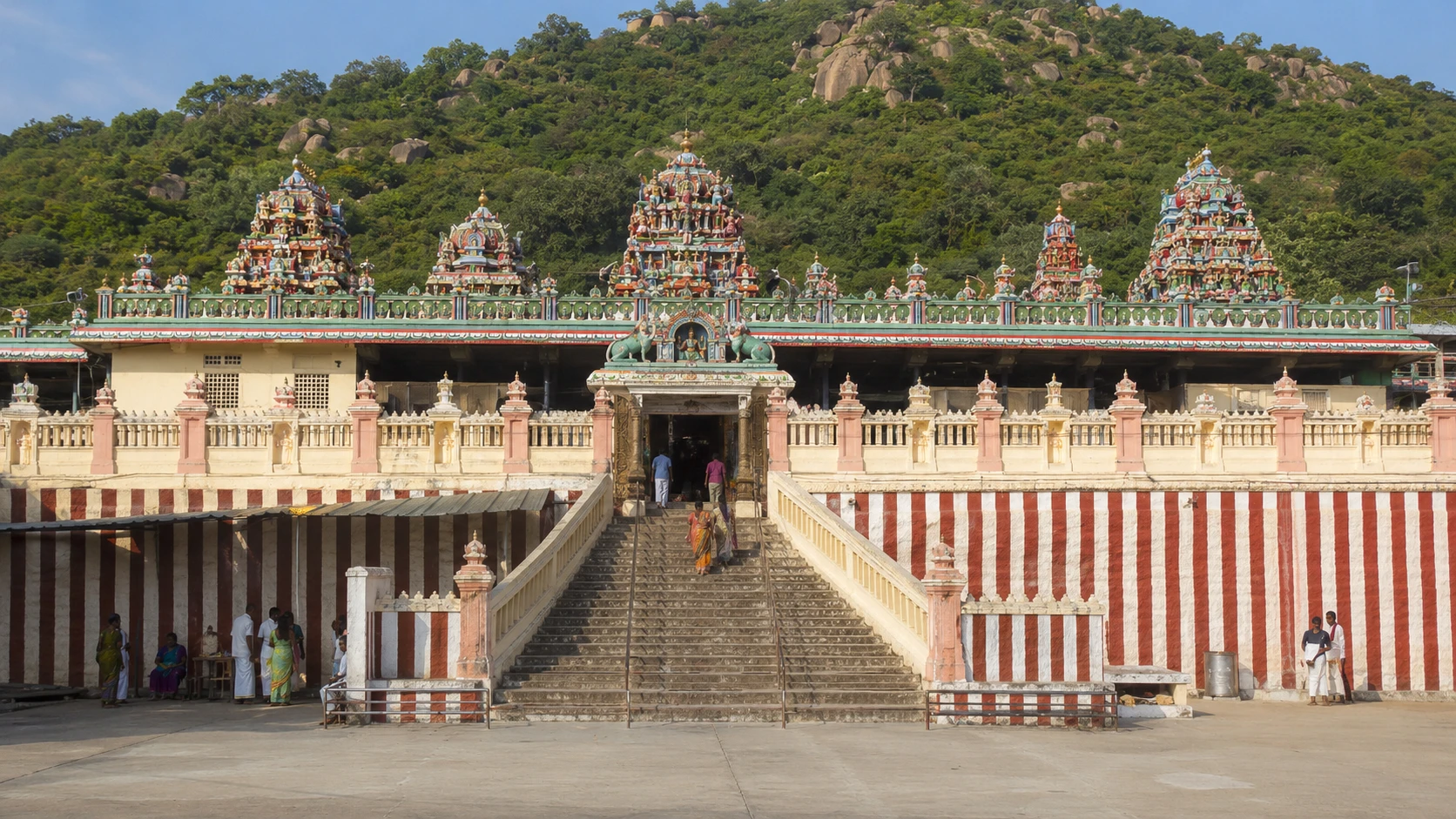
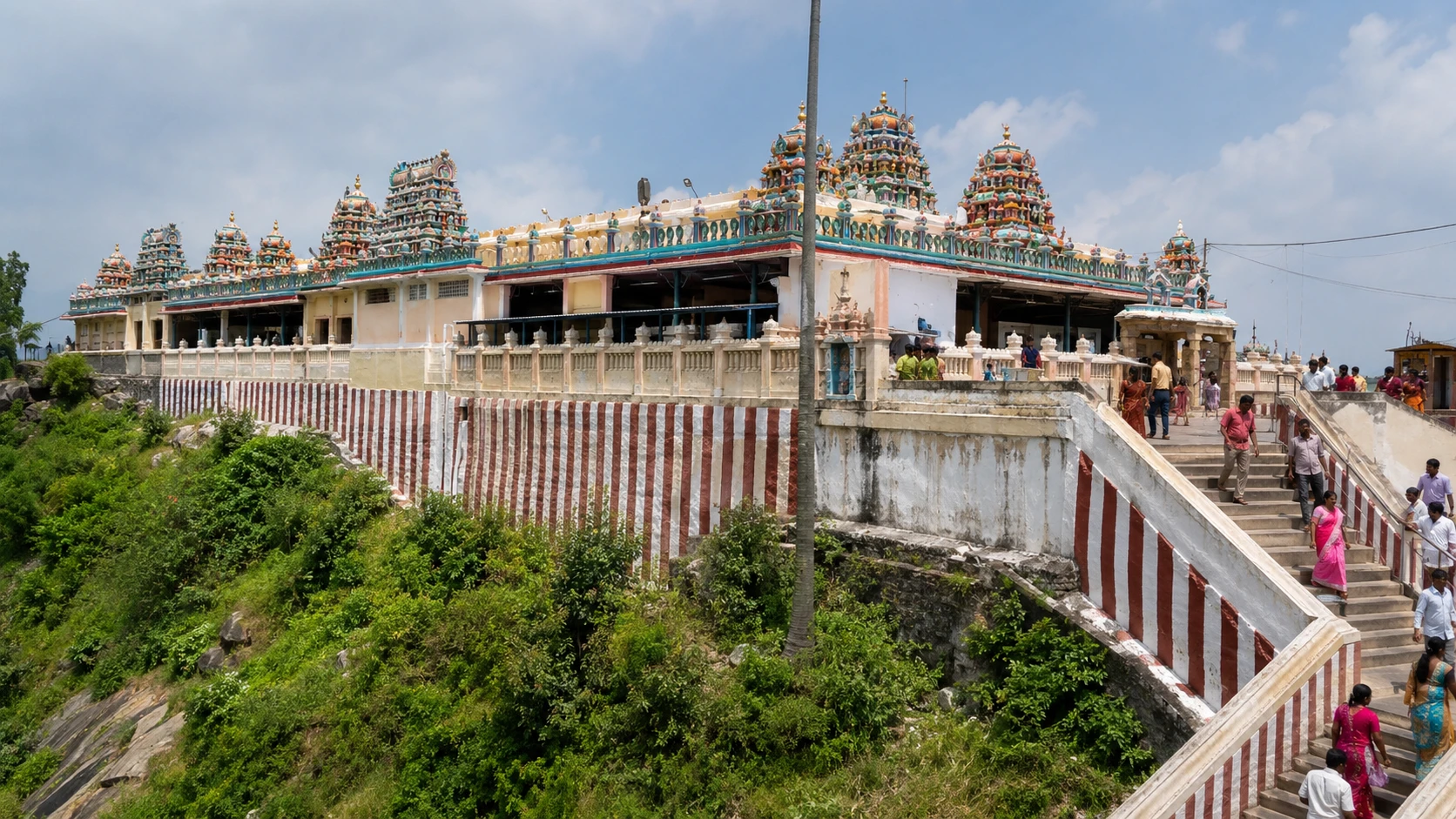
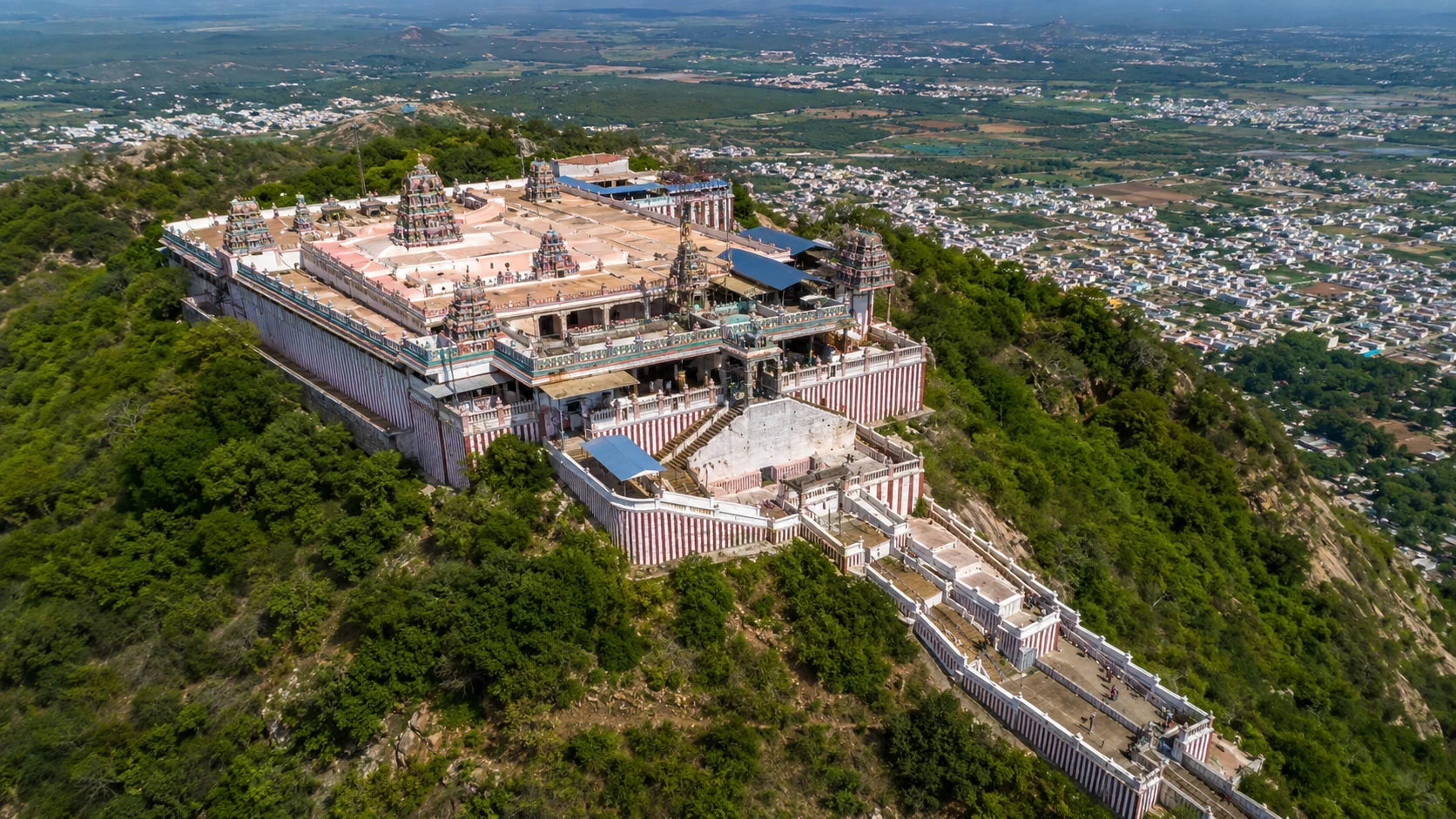
Dravidian hill temple; gopuram at the hilltop; 365 steps to the summit
Open
06:00 – 21:00
Aarti
06:00 · 08:00 · 12:00 · 18:00 · 20:30
Special
Panguni Uthiram (March–April): wedding of Murugan and Valli re-enacted — the defining festival at Thiruthani
The Sacred Legend · पवित्र कथा
Thiruthani is where Murugan rested. After the cosmic war at Thiruchendur, after the wisdom teaching at Swamimalai, the god of war came to this hill — and fell in love with Valli, a tribal girl who was guarding a millet field against birds. The courtship is the most human story in all the Murugan mythology: the god disguised as an old man, the girl refusing him, the trick with Ganesha appearing as a frightening elephant, the girl fleeing to the old man's arms, the revelation of the divine form. Valli was not of celestial birth. She was not given as a prize for victory. She was loved — wholly, persistently, with tricks and disguises and finally with the full disclosure of the divine — because her own longing for the divine was real. At Thiruthani, Murugan stands flanked by both his wives: the celestial Devasena on his left, the earthborn Valli on his right. Together the three figures complete the theological portrait of Murugan: lord of the heavens, lord of the earth, and lord of love that crosses every boundary. The 365 steps to the hilltop — one for each day of the year — are among the most climbed in Tamil pilgrimage, making Thiruthani the closest Arupadaiveedu to Chennai and among the most frequented by urban devotees.
Sacred Designationपवित्र पदनाम
Sacred Origin Storyपवित्र उत्पत्ति कथा
Source: Skanda Purana / Kanda Puranam (Kacciyappa Sivachariyar, 14th century CE) / Tamil Sthala Purana of Thiruthani
After the war against Surapadman, after his marriages and his teachings, Murugan came to the Thiruthani hill for repose. In the valley below the hill, a Veda hunter-tribe kept its settlement, and the hunters' fields of millet needed protection from birds. The tribal chief's daughter Valli was sent every day to guard the field. She sat in the centre of the millet, clapping and singing to drive the birds away, and in her solitude she would think of Murugan — the divine lord whom she had loved, formlessly, since childhood. Murugan, watching from his hill, felt that love like a tug. He came down disguised as an old man and approached her. He told her he was cold and hungry and asked her to take him in. Valli refused — she was a young girl alone, and this old man was a stranger. Murugan persisted with the wordplay and the charm of the besotted disguised divine. She remained unmoved. Then Murugan summoned his brother. Ganesha appeared from the trees in the form of a maddened wild elephant, crashing through the undergrowth, charging at Valli. She screamed and ran — directly into the arms of the old man, pressing close, begging for protection. Murugan held her and shed his disguise. The god stood before her in his full radiance: his youthful face, his peacock, his vel, his crown. Valli, who had loved him in her heart her whole life, recognised what she had always known. They were married on the Thiruthani hill. The tribal chief gave his blessing. The girl who had guarded a millet field from the birds became the bride of the lord who had defeated the armies of the cosmos.
Sources cited:
- Kacciyappa Sivachariyar, Kanda Puranam (Tamil, 14th century CE) — Valli Thirumanam episode
- Skanda Purana — Valli Kalyana narrative
- Nakkirar, Tirumurugaṟṟuppaṭai — Thiruthani as sixth Padai Veedu (Sangam era, c. 2nd century CE)
- Arunagirinathar, Thirupugazh — verses on Thiruthani Murugan (c. 15th century CE)
Scholarly Context
The Valli narrative is a specifically Tamil mythological construction that scholars including Kamil Zvelebil ('The Smile of Murugan', 1973) and Fred Clothey ('The Many Faces of Murukan', 1978) identify as central to Tamil Murugan theology's distinction from North Indian Skanda traditions. The two-wife structure — celestial Devasena (received through divine decree) and earthly Valli (won through persistent devotion) — encodes a Saiva Siddhanta theological point: that divine grace is accessible both through the fulfilment of dharmic duty (Devasena represents this) and through pure bhakti love (Valli represents this), and that neither alone is complete. The Valli story's setting in a tribal/hunter community (Veda Vyadha tradition) has been noted by scholars as an assertion of the accessibility of divine love across social hierarchies, a recurring motif in Tamil devotional literature.
Historyइतिहास
Thiruthani's sacred status is attested in the Tirumurugaṟṟuppaṭai (c. 2nd century CE), which names it among Murugan's six abodes. Tevaram saints of the Bhakti period composed hymns here, and Arunagirinathar (c. 15th century CE) composed Thirupugazh verses specific to this temple. The site is historically significant as both a major Murugan shrine and a waypoint on the ancient pilgrimage corridor between Chennai (Madras) and Tirupati — positioned on the route that devotees have traveled for centuries between the two great temples of South India. The temple atop the granite hill has been the subject of periodic renovation and expansion under various dynasties and later under the Madras Presidency administration. Its proximity to what is now Chennai has made it one of the most heavily attended Arupadaiveedu temples among urban pilgrims from the metropolitan region. The 365 steps to the hilltop are a well-known feature and a regular physical practice for Chennai devotees. The temple is currently administered by the Hindu Religious and Charitable Endowments (HR&CE) Department, Government of Tamil Nadu. Note: The manifest records this temple's city as 'Thiruvallur'; the temple is located in the town of Thiruthani (Tiruttani), within Thiruvallur district — a distinction flagged for manifest correction.
Historical Timelineऐतिहासिक कालक्रम
Nakkirar's Tirumurugaṟṟuppaṭai names Thiruthani among Murugan's six Padai Veedu, providing the earliest datable literary attestation of the site's sacred status.
Nayanmar Bhakti saints composed Tevaram hymns on Thiruthani, embedding the temple within the Tamil Shaiva devotional pilgrimage canon.
Arunagirinathar composed Thirupugazh verses specific to Thiruthani, consolidating the Valli–Murugan marriage narrative's devotional centrality in Tamil literature and cementing the site's place in the Arupadaiveedu pilgrimage tradition.
The temple underwent structural renovations during the Madras Presidency period. Its position on the Chennai–Tirupati pilgrimage corridor increased the flow of devotees and supported periodic expansion of the mandapam complex and gopuram.
Specific renovation dates and patrons for the Thiruthani temple in the medieval and early modern period are not fully documented in peer-reviewed published scholarship available to this editor. The general renovation history is based on district gazetteer sources.
As Chennai grew into a major metropolis, Thiruthani became the most accessible Arupadaiveedu for the city's population, approximately 70 km distant. Weekend pilgrimage from Chennai became a defining characteristic of the temple's contemporary religious life, with millions visiting annually.
What You'll Seeदर्शन में
Murugan at Thiruthani is enshrined in one of his most complete iconic forms: standing upright, flanked by both his consorts. To his left stands Devasena (Deivayanai) — the celestial wife, the daughter of Indra, representing divine grace obtained through merit and cosmic order. To his right stands Valli — the earthborn tribal beloved, representing divine grace obtained through devotion and the persistence of love. Murugan between them holds his vel. The three-figure composition (Murugan-Devasena-Valli) is called the 'Thiruvaavadu Thirumeni' in Tamil devotional poetry — the sacred triple form. Each figure is elaborately dressed and garlanded. The peacock may appear at the base or in processional sculptures. The sanctum faces east. The iconography of Thiruthani encodes the central theological proposition of the Valli narrative: that the earthly beloved and the celestial bride stand at equal height, on either side of the same god. Photography is not permitted inside the inner sanctum.
Distinctive Practicesविशिष्ट परंपराएँ
Panguni Uthiram — Valli Thirumanam (Valli's Divine Wedding)
पंगुनी उत्तिरम — वल्ली तिरुमणम (वल्ली का दिव्य विवाह)
Annual, March–April (Tamil month Panguni, Uthiram nakshatra day)
On Panguni Uthiram at Thiruthani, the divine wedding of Murugan and Valli is re-enacted in full ritual. This is distinct from the Panguni Uthiram at Thirupparankundram (which re-enacts the Devasena wedding) — at Thiruthani, the ceremony celebrates the second marriage, the earthly union. The utsava murti of Murugan is adorned as a groom; the Valli idol is brought in the dress of a tribal bride. The wedding rites are performed to the congregation assembled on the hill. Thirupugazh hymns specific to the Valli story are sung. Devotees who attend pray specifically for love, marriage, and the grace of devotion finding its divine fulfilment.
The Valli Thirumanam at Thiruthani re-enacts the theological proposition that devotion alone — without celestial birth, without merit accumulated through cosmic cycles, without any qualification except love — is sufficient to win divine grace. For devotees who feel distant from the traditional pathways of religious achievement, the Valli story is the most direct reassurance in the Murugan canon: even a tribal girl who knew no Sanskrit, performed no elaborate rites, and had no ritual qualification was loved by the god, completely and without conditions.
The 365-Step Ascent
365 सीढ़ियों की चढ़ाई
Year-round; a daily practice for many Chennai-area devotees
The 365 steps to the Thiruthani hilltop — traditionally said to represent one step for each day of the year — are climbed barefoot by pilgrims as a form of physical devotion. For many devotees from Chennai and the surrounding region, climbing the hill on a weekly or monthly basis is a regular spiritual practice rather than an occasional pilgrimage. Some devotees climb on their knees; others carry camphor, coconut, or flowers as offerings for the entire ascent. The climb takes approximately 30–45 minutes at a devotional pace.
The 365-step ascent encodes the year as a devotional unit — each step a day of life offered to Murugan, the climb itself a circumambulation of time. For the urban pilgrim who cannot undertake the full Arupadaiveedu circuit, the weekly climb at Thiruthani becomes the equivalent of a recurring covenant: I return, I climb, I bring nothing but my body and my willingness to ascend.
Did You Know?क्या आप जानते हैं?
The Valli story is the only narrative in the entire Arupadaiveedu mythology where the god actively pursues a mortal woman through disguise, trickery, and the help of a divine co-conspirator (Ganesha as the elephant). This is understood in Tamil Saiva theology not as deception but as leela — divine play — through which the god reveals the lengths he will go to be close to a devotee whose love is real.
Kacciyappa Sivachariyar, Kanda Puranam (14th century CE); Fred Clothey, 'The Many Faces of Murukan' (1978)
Thiruthani is the only Arupadaiveedu where Murugan is regularly depicted with both wives simultaneously — Devasena on his left, Valli on his right. The two-consort iconography encodes a specific theological claim: that celestial grace (Devasena) and devotional grace (Valli) are equally present in the divine, and that neither is complete without the other.
Tamil Murugan iconography scholarship; Thiruthani Sthala Purana
Thiruthani is the closest of the six Arupadaiveedu to Chennai — approximately 70 km — and lies directly on the Chennai–Tirupati highway corridor. This has made it the default Murugan pilgrimage destination for Tamil Nadu's largest urban population, with millions of pilgrims visiting annually, predominantly on weekends.
Tamil Nadu Tourism; HR&CE Department records
The 365 steps to the Thiruthani hilltop are traditionally said to represent the days of the year — making each step a day of life offered in devotion. This numerical symbolism is shared with the 60 steps at Swamimalai (60-year Tamil calendar cycle) and the 693 steps at Palani (numerologically significant but the symbolic reading is less standardised).
Temple tradition; Tamil Murugan pilgrimage scholarship
Visitor Accessप्रवेश जानकारी
Thiruthani is open to devotees of all backgrounds. Modest dress is required. Photography is not permitted inside the inner sanctum. The 365-step climb is the traditional access route; a vehicle road also provides access to the hill area for those unable to climb. Weekends and festival days see very heavy crowds.
Arrive early on weekends — queues for darshan begin forming by 7 AM and can extend to 2–3 hours by mid-morning. The step climb is barefoot; bring water. Avoid peak festival days (Thai Poosam, Skanda Sashti, Panguni Uthiram) unless prepared for very large crowds.
Festivalsत्योहार
Panguni Uthiram — Valli Thirumanam
पंगुनी उत्तिरम — वल्ली तिरुमणम
March–April
The defining festival of Thiruthani — the divine wedding of Murugan and Valli is re-enacted in full ceremony. While Panguni Uthiram at Thirupparankundram celebrates the Devasena marriage, Thiruthani's celebration focuses on the Valli union: the earthborn devotee's love finding its divine reciprocal. Lakhs of pilgrims attend. Prayers for love, marriage, and devotion bearing fruit are considered most powerful on this day.
Skanda Sashti
स्कंद षष्ठी
October–November
Six-day festival celebrating Murugan's victory over Surapadman, observed at all six Arupadaiveedu. At Thiruthani, the Soorasamharam and Thirukalyanam are enacted; the proximity to Chennai brings enormous crowds for the Sashti observances.
Thai Poosam
थाई पूसम
January–February
Major Murugan festival on Poosam nakshatra in Thai. Kavadi-bearing devotees from Chennai and surrounding areas converge on Thiruthani. The festival marks Parvati's gift of the vel to Murugan.
Vaikasi Visakam
वैकासी विशाखम
May–June
Murugan's birth-star festival in the Tamil month of Vaikasi. A significant observance at all Arupadaiveedu; at Thiruthani, special abhishekam and processional rituals are held.
How to Reachकैसे पहुँचें
Thiruthani is located approximately 70 km north of Chennai, directly on the Chennai–Tirupati National Highway (NH 716). Tiruttani Railway Station (2 km from the temple) is on the Chennai–Tirupati broad-gauge line, with frequent trains from Chennai Central and Chennai Beach stations. Chennai International Airport (70 km) is the nearest major airport. TNSTC and private buses run frequent services from Chennai's Koyambedu CMBT and from Tirupati. Taxis and cabs (including app-based cabs from Chennai) are a popular option for day-trip pilgrimage from the city. The temple is atop a hill; the standard approach is the 365-step climb or the vehicle road.
Plan Your Visitयात्रा की योजना
🌤 Best Season
October through March is most comfortable. Year-round pilgrimage is heavy given Chennai proximity. Weekday mornings are significantly less crowded than weekends. Avoid Skanda Sashti, Thai Poosam, and Panguni Uthiram unless specifically attending the festival — these days see very large crowds and extended queue times.
👘 Dress Code
Modest traditional dress. Men typically remove shirts before entering the inner sanctum. No shorts or sleeveless garments. Footwear removed at the temple entrance. Bring water for the step climb.
📱 Phones & Photography
Mobile phones permitted in outer precincts. Photography strictly prohibited inside the inner sanctum.
🏨 Accommodation
Thiruthani town has pilgrim lodges and small hotels near the temple base. Given the 70 km distance from Chennai, many devotees visit as a day trip by car, bus, or train. For overnight stays, Thiruthani town is the practical option; Chennai is an alternative for those arriving from the city.
Book a Pujaपूजा बुक करें
Booking links and phone numbers are verified periodically but may change without notice. Always confirm the destination URL belongs to the official temple trust before payment. Weekend darshan at Thiruthani involves significant crowds and queuing; consult the HR&CE portal for current special darshan procedures before visiting.
Managed by: Hindu Religious and Charitable Endowments (HR&CE) Department, Government of Tamil Nadu — Arulmigu Subramanya Swami Temple, Thiruthani
Karpaga Archanai
कर्पग अर्चनै
Abishekam
अभिषेकम
Special darshan ticket (weekends — recommended)
विशेष दर्शन टिकट (सप्ताहांत — अनुशंसित)
Booking information verified: 2026-05-23
Sacred Soundsपवित्र ध्वनि
Did You Know? · क्या आप जानते हैं?
The same translation error that turned '33 Koti' into '33 crore' in Hinduism also happened in Buddhism. The Chinese translation of Buddhist texts rendered 'Sapta Koti Buddha' (7 Supreme Buddhas) as '7 Crore Buddhas.' The Tibetan translation got it right: 7 types, not 7 crore. One Sanskrit word, misread across two major world religions, generated two identical misconceptions independently.
Related Contentसंबंधित सामग्री
Related Scriptures
Community Reflections
🕉️
Be the first to share your reflection.