Pazhamudircholai
पझमुदिर्चोलै
The grove of ripe fruits — Murugan's forest abode, where the pilgrimage ends in stillness
Madurai, Tamil Nadu, India
PaḻamutiṟcōlaiAlso known as: Pazhamudir Cholai, Pazhamudircholai Murugan Temple, Alagar Hills Murugan Temple, Thirupazhamudircholai
Era
Attested from c. 2nd century CE (Sangam period); present structure spans medieval and later periods
Architecture
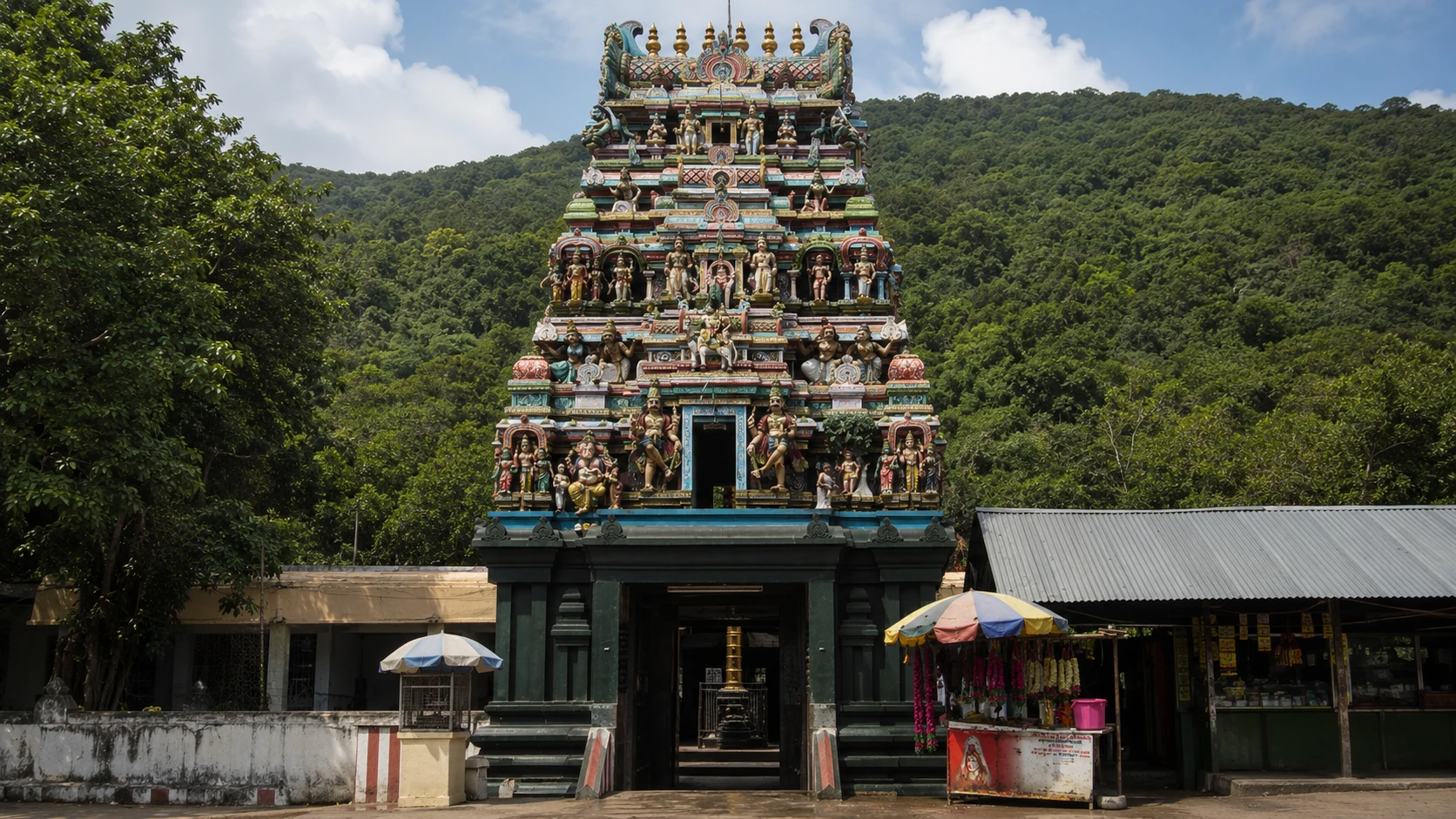
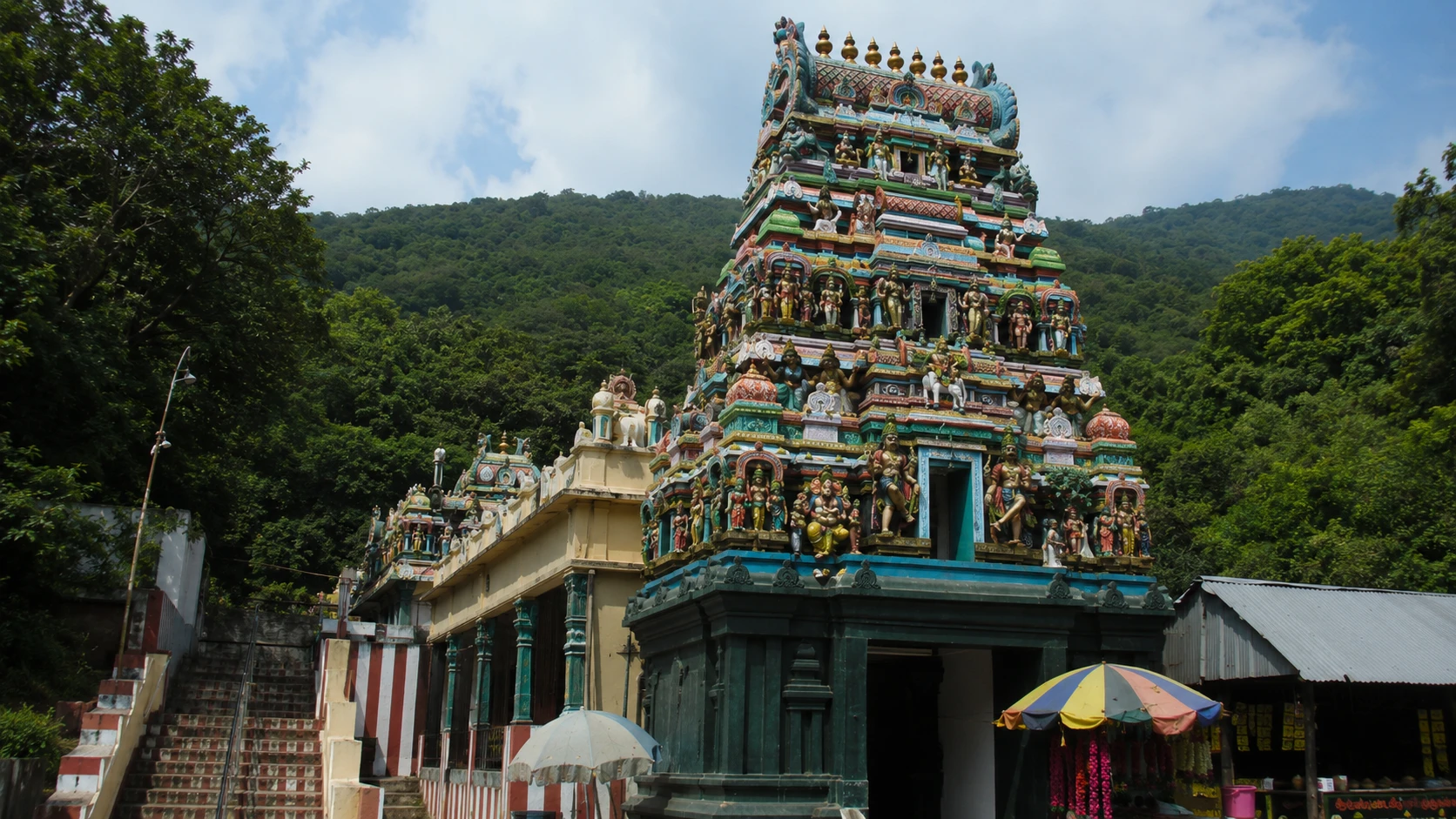
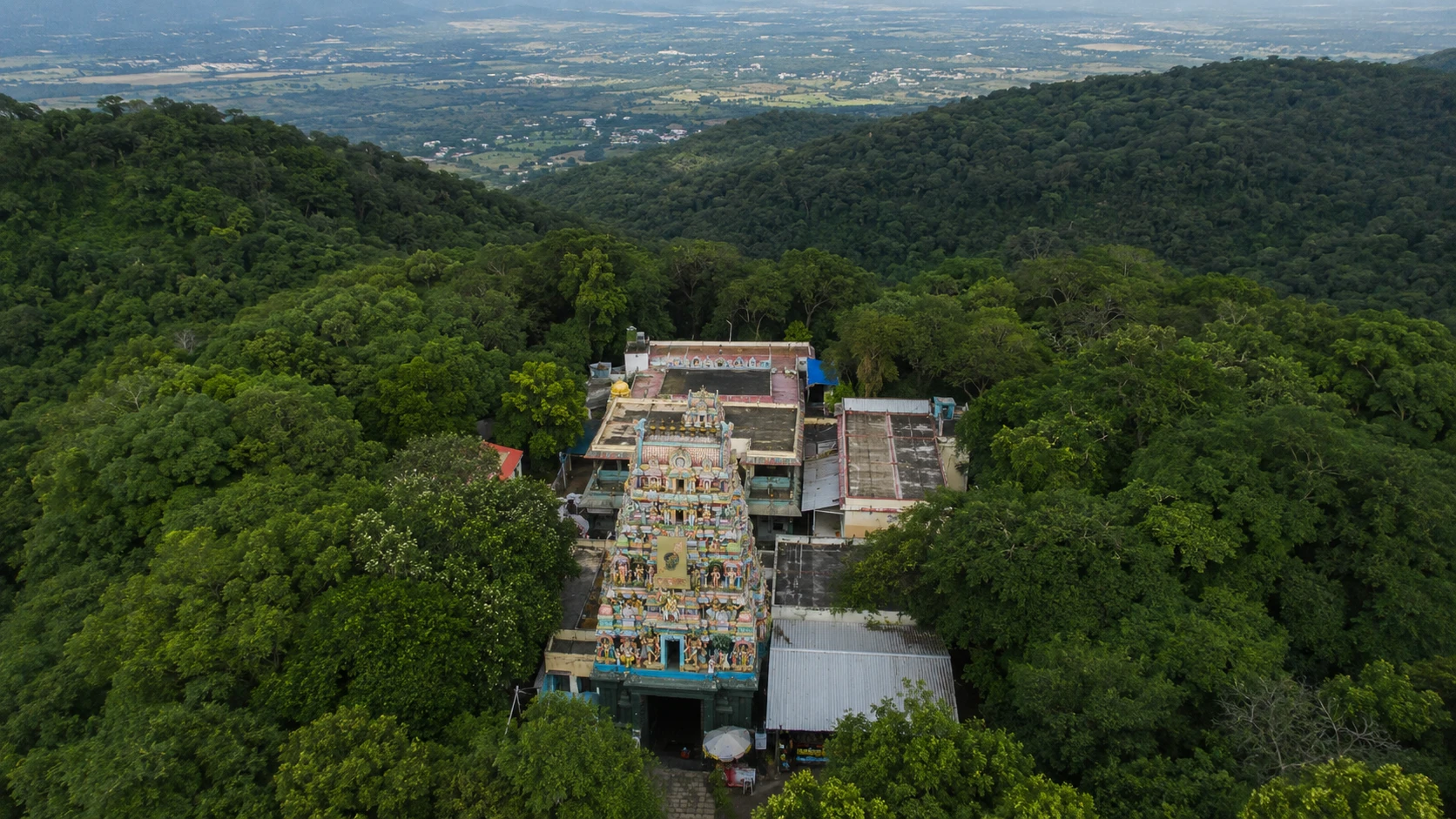
Dravidian forest temple; set within the natural landscape of the Alagar Hills; no significant hilltop climb required
Open
06:00 – 21:00
Aarti
06:00 · 08:00 · 12:00 · 18:00 · 20:30
Special
The forest and hillside setting — kadamba trees, flowing water, birdsong — is itself the sacred environment; the natural surroundings are integral to the darshan experience here in a way unique among the six Arupadaiveedu
The Sacred Legend · पवित्र कथा
Pazhamudircholai is the sixth and final Arupadaiveedu — and the most unlike the other five. There is no seashore battle, no steep hilltop climb, no wedding ceremony, no teaching from a summit. There is a grove. A forest in the Alagar Hills near Madurai, fragrant with ripe fruits and flowering trees, alive with birdsong, waterfalls, and the sound of bees in the flowering kadamba. The Tirumurugaṟṟuppaṭai — the Sangam poem of the second century CE that is the oldest surviving Tamil pilgrimage guide — saves its most lyrical descriptions for this final station: the grove where Murugan simply dwells, in nature, at peace. The war is done. The marriages are made. The teaching has been given. The renunciation is complete. Here he rests. The name itself carries devotional meaning: Pazham (fruit) + mudir (ripe) + cholai (grove) — the grove of ripe fruits, a name that describes both the landscape and a quality of divine presence: mature, sweet, arrived, complete. It is the only Arupadaiveedu set in a forest rather than on a hilltop or a shore, and it is situated in the Alagar Hills near Madurai — in the same sacred hills that also shelter the great Vishnu temple of Azhagar Kovil (Thirumaliruncholai), a Divya Desam, though the two are distinct temples with separate presiding deities and traditions.
Sacred Designationपवित्र पदनाम
Sacred Origin Storyपवित्र उत्पत्ति कथा
Source: Tirumurugaṟṟuppaṭai tradition (Sangam, c. 2nd century CE) / Skanda Purana / Tamil Sthala Purana of Pazhamudircholai
The Tirumurugaṟṟuppaṭai, the oldest Tamil text describing Murugan's sacred abodes, reaches its most sustained lyrical passage when it arrives at Pazhamudircholai. The poem describes a grove of surpassing beauty: mango trees so heavy with ripe fruit that the branches bow to the ground; fragrant kadamba flowers falling in the streams; bees drunk on the honey of konrai blossoms; peacocks calling in the canopy; waterfalls threading down the hillside through groves of plantain and jackfruit. In this forest, the text tells us, Murugan dwells at ease — not as the warrior with the vel, not as the bridegroom at his wedding, not as the ascetic on a bare hilltop, but as the natural lord of a living, fruiting, singing world. The forest itself is his ornament; the birdsong is his music; the ripe fruit is his prasad. The grove became the sixth Padai Veedu: not a battlefield or a marriage site or a teaching hall, but a place of divine presence expressed through abundance, fragrance, and the patient maturation of living things. Pazham — fruit. Mudir — ripe. Cholai — grove. The name of the sixth abode is a complete theological statement: at the end of all the wars and weddings and teachings and renunciations, what remains is ripe, fragrant, abundant, and without limit.
Sources cited:
- Nakkirar, Tirumurugaṟṟuppaṭai, verses describing Pazhamudircholai (Pattupattu corpus, Sangam literature, c. 2nd century CE)
- Skanda Purana — Pazhamudircholai as the sixth Padai Veedu
- Arunagirinathar, Thirupugazh — verses on Pazhamudircholai Murugan (c. 15th century CE)
Scholarly Context
The Tirumurugaṟṟuppaṭai's description of Pazhamudircholai is among the most celebrated passages in classical Tamil poetry, noted for its sustained sensory evocation of a sacred landscape. Scholars of Tamil literature including Kamil Zvelebil ('The Smile of Murugan', 1973) and A.K. Ramanujan ('Poems of Love and War', 1985) have commented on the poem's technique of making the natural world itself into a form of divine presence — the grove's ripeness, fragrance, and abundance are theological statements, not merely descriptive. Pazhamudircholai must be carefully distinguished from the adjacent Azhagar Kovil (Thirumaliruncholai), a major Vishnu temple and Divya Desam (#3 in the Nalayira Divya Prabandham), located in the same Alagar Hills complex. Pazhamudircholai is a Murugan temple whose sacred tradition derives from the Sangam-era Murugan corpus and the Skanda Purana. The two temples are geographically proximate but theologically, institutionally, and liturgically separate.
Historyइतिहास
Pazhamudircholai holds the distinction of being the most lyrically described of all the six Arupadaiveedu in the Tirumurugaṟṟuppaṭai — Nakkirar's poem of the second century CE dwells on it with particular richness. The forest-grove setting in the Alagar Hills north of Madurai has been a Murugan sacred site since at least the Sangam period. Nayanmar saints of the Bhakti period composed Tevaram hymns here, and Arunagirinathar (c. 15th century CE) composed Thirupugazh verses specific to this grove temple. The Alagar Hills are also home to Azhagar Kovil — the celebrated Vishnu temple and Divya Desam — and the entire hill complex has been a sacred geography of the Madurai region for over two millennia. The Chithirai festival of Madurai, one of Tamil Nadu's greatest annual events, includes the ceremonial journey of the Azhagar deity from Azhagar Kovil to Madurai; this procession passes through the hills but is associated with the Vishnu temple, not with Pazhamudircholai Murugan. The Murugan temple at Pazhamudircholai has its own institutional and liturgical identity, administered by the Hindu Religious and Charitable Endowments (HR&CE) Department, Government of Tamil Nadu. The natural forest environment — one of the few among the six Arupadaiveedu where the grove itself is considered sacred alongside the built temple — has required active conservation attention in recent decades.
Historical Timelineऐतिहासिक कालक्रम
Nakkirar's Tirumurugaṟṟuppaṭai names Pazhamudircholai as the sixth of Murugan's Padai Veedu and devotes its most extended lyrical description to this grove — the earliest datable literary testimony to the site's sacred status and the source of its enduring poetic identity in Tamil literature.
Nayanmar Bhakti saints composed Tevaram hymns on Pazhamudircholai, establishing the grove-temple within the Tamil Shaiva devotional canon alongside the other Arupadaiveedu.
Arunagirinathar composed Thirupugazh verses specific to Pazhamudircholai, completing the Thirupugazh canon of the six Arupadaiveedu and cementing the grove's identity as the serene, nature-suffused final station of the Murugan pilgrimage circuit.
The Pandya kings of Madurai, and later the Nayaka rulers, patronised the Alagar Hills complex as a whole — including both the Azhagar Kovil (Vishnu) and the Pazhamudircholai Murugan temple. Inscriptions in the Alagar Hills area record medieval donations; specific epigraphic evidence for Pazhamudircholai distinct from the Vishnu temple has not been separately indexed in publicly available ASI volumes reviewed by this editor.
The epigraphic record for the Alagar Hills complex has been published primarily with reference to Azhagar Kovil (the Vishnu temple). Inscriptions specifically attesting to the Pazhamudircholai Murugan temple as a distinct institutional entity within the same hills have not been separately catalogued in published ASI volumes available to this editor. This is a known gap in the historical documentation and is flagged for further specialist research.
The natural forest environment of the Alagar Hills, including the grove associated with Pazhamudircholai, became a subject of conservation attention as development pressure in the Madurai region increased. The Tamil Nadu Forest Department and the HR&CE administration have engaged with managing the balance between pilgrimage access and forest conservation in the hill area.
What You'll Seeदर्शन में
Murugan at Pazhamudircholai is enshrined in a form of quiet, forest-dwelling grace — the deity at rest in his own natural abode, not the warrior, not the teacher, not the renunciant, but the lord of a living world. The primary murti is typically depicted standing or seated, holding the vel, with the peacock at his feet. At Pazhamudircholai, the sacred environment of the shrine — the surrounding trees, the flowering plants, the sound of water — is understood by devotees as extending the iconographic field outward beyond the temple walls. The grove itself is the icon. The kadamba tree in particular, associated with Murugan in Sangam poetry as a marker of his divine presence, is considered especially auspicious in this forest setting. Photography is not permitted inside the inner sanctum.
Distinctive Practicesविशिष्ट परंपराएँ
Forest Pradakshina — Circumambulation of the Sacred Grove
वन प्रदक्षिणा — पवित्र उपवन की परिक्रमा
Year-round; particularly on festival days
At Pazhamudircholai, the pradakshina (circumambulation) extends beyond the built temple into the surrounding grove — devotees walk through the living forest as part of their ritual circuit. The trees, flowering plants, and streams are treated as sacred presences rather than mere landscape. Devotees traditionally touch the kadamba tree, offer flowers to the stream, and pause beneath the canopy before completing the circuit at the main sanctum. This is a practice distinctive to Pazhamudircholai — no other Arupadaiveedu extends its sacred boundary into a living forest in this way.
The Tirumurugaṟṟuppaṭai teaches that at Pazhamudircholai, the grove itself is Murugan's body — the fruit-heaviness of the trees, the sweetness of the streams, the call of the birds are all expressions of his presence. To walk through the grove mindfully is to be received by the deity in his most natural, unmediated form. The practice enacts the deepest claim of the Arupadaiveedu theology: that after all the battles and teachings and renunciations, the divine is simply here, in the fruit-bearing world, waiting to be recognised.
Did You Know?क्या आप जानते हैं?
Pazhamudircholai is the only one of the six Arupadaiveedu that requires no hilltop climb — it is a grove temple set within the natural landscape of the Alagar Hills, accessible without ascending steep steps. This makes it unique in the circuit: where the other five temples are defined by ascent (steps, cliffs, hills), the sixth is defined by arrival in a forest.
Nakkirar, Tirumurugaṟṟuppaṭai (Sangam, c. 2nd century CE); temple geography; Arupadaiveedu pilgrimage tradition
The Tirumurugaṟṟuppaṭai devotes its most sustained and lyrical description to Pazhamudircholai — more than to any other Padai Veedu. The poem describes the grove in precise sensory detail: specific trees, specific flowers, specific birds, the smell of ripe fruit, the sound of bees. Scholars of classical Tamil poetry have noted this passage as one of the finest examples of akam (interior landscape) poetry applied to a sacred site.
Nakkirar, Tirumurugaṟṟuppaṭai; A.K. Ramanujan, 'Poems of Love and War' (1985); Kamil Zvelebil, 'The Smile of Murugan' (1973)
Pazhamudircholai must be carefully distinguished from Azhagar Kovil (Thirumaliruncholai) — a major Vishnu temple and Divya Desam (one of the 108 Divya Desams of the Nalayira Divya Prabandham) located in the same Alagar Hills complex. Pazhamudircholai is a Murugan temple; Azhagar Kovil enshrines Kallazhagar (a form of Vishnu). The two are geographically proximate but are separate temples with distinct deities, traditions, and institutional administrations.
Nalayira Divya Prabandham; Arupadaiveedu canonical tradition; HR&CE temple records; South Indian sacred geography scholarship
The name Pazhamudircholai is itself a devotional statement: 'Pazham' (fruit) + 'mudir' (ripe) + 'cholai' (grove). As the sixth and final station of the Arupadaiveedu circuit, the name encodes a theological summary — after the battle, the marriage, the renunciation, the teaching, and the love story, what the devotee arrives at is ripeness: a quality of presence that is complete, sweet, and without further striving.
Tamil Sthala Purana of Pazhamudircholai; Tamil devotional etymology scholarship
Visitor Accessप्रवेश जानकारी
Pazhamudircholai is open to devotees of all backgrounds. Modest dress is required. Photography is not permitted inside the inner sanctum. The grove setting means the natural environment — trees, paths, streams — is part of the sacred precinct; visitors are asked to maintain the cleanliness and sanctity of the forest area. The Alagar Hills also contain the Azhagar Kovil (a separate Vishnu temple) — visitors to the hills can visit both temples but should note they are distinct institutions.
No significant hilltop climb required — the most accessible of all six Arupadaiveedu for pilgrims with limited mobility. Forest paths may be uneven; sturdy footwear for the approach (removed at the sanctum threshold). Do not disturb the natural environment of the grove. The Alagar Hills area can be combined with a visit to Azhagar Kovil (Vishnu) and the scenic hill landscape.
Festivalsत्योहार
Skanda Sashti
स्कंद षष्ठी
October–November
Six-day festival celebrating Murugan's victory over Surapadman, observed at all six Arupadaiveedu. At Pazhamudircholai, the forest setting gives the celebration a particular quality — the grove witnesses the re-enactment of the cosmic battle that preceded the divine repose expressed at this site.
Thai Poosam
थाई पूसम
January–February
Major Murugan festival on Poosam nakshatra in the Tamil month of Thai. Kavadi-bearing devotees carry votive offerings through the forest setting at Pazhamudircholai, making the grove itself part of the devotional landscape of the festival.
Panguni Uthiram
पंगुनी उत्तिरम
March–April
Observed at all six Arupadaiveedu. Note: In the broader Alagar Hills region, the Panguni Uthiram period also includes the great Chithirai procession of Azhagar Kovil (the Vishnu temple) toward Madurai — that event is associated with the Vishnu tradition, not with Pazhamudircholai Murugan.
Vaikasi Visakam
वैकासी विशाखम
May–June
Murugan's birth-star festival in the Tamil month of Vaikasi. At Pazhamudircholai, the flowering trees of the grove are in their summer abundance during this period — the natural environment and the festival's celebratory tone resonate with each other.
How to Reachकैसे पहुँचें
Pazhamudircholai is located in the Alagar Hills, approximately 21 km north of Madurai city. Madurai Junction is the nearest major railway station, well-connected to Chennai, Bengaluru, Mumbai, Delhi, and all major Tamil Nadu cities. Madurai Airport (approximately 30 km from the temple) has regular flights from Chennai, Bengaluru, Mumbai, Hyderabad, and Delhi. From Madurai city, buses and taxis operate to the Alagar Hills area; the journey passes through Thiruparankundram road and the northern outskirts. The Alagar Hills are also accessible as part of a combined visit with Thirupparankundram (the first Arupadaiveedu, also near Madurai), making the two temples a natural Madurai-based Murugan circuit.
Plan Your Visitयात्रा की योजना
🌤 Best Season
October through March. The grove is most beautiful in the cooler months and after the northeast monsoon (November–December), when flowering is abundant. Summer months (April–June) are hot. The forest setting makes early morning visits particularly rewarding — birdsong, cool air, and low crowds.
👘 Dress Code
Modest traditional dress. Men typically remove shirts before entering the inner sanctum. No shorts or sleeveless garments. Footwear removed at the sanctum threshold. For the forest paths, sturdy footwear on the approach is practical.
📱 Phones & Photography
Mobile phones permitted in outer precincts and the grove area. Photography strictly prohibited inside the inner sanctum.
🏨 Accommodation
Madurai city, 21 km away, offers the full range of accommodation from pilgrim lodges to luxury hotels — all price points, extensive facilities. Pazhamudircholai and Thirupparankundram (both Madurai-area Arupadaiveedu) can be combined in a single Madurai-based itinerary.
Book a Pujaपूजा बुक करें
Booking links and phone numbers are verified periodically but may change without notice. Always confirm the destination URL belongs to the official temple trust before payment. Note: the adjacent Azhagar Kovil (Vishnu / Divya Desam) and Pazhamudircholai Murugan temple are separate institutions — booking and operational details for one do not apply to the other.
Managed by: Hindu Religious and Charitable Endowments (HR&CE) Department, Government of Tamil Nadu — Arulmigu Subramanya Swami Temple, Pazhamudircholai
Booking information verified: 2026-05-23
Sacred Soundsपवित्र ध्वनि
108 Japa Practice
Shadakshari Mantra — Om Saravanabhavaya Namah
Chant 108 times in the spirit of this temple
Did You Know? · क्या आप जानते हैं?
The same translation error that turned '33 Koti' into '33 crore' in Hinduism also happened in Buddhism. The Chinese translation of Buddhist texts rendered 'Sapta Koti Buddha' (7 Supreme Buddhas) as '7 Crore Buddhas.' The Tibetan translation got it right: 7 types, not 7 crore. One Sanskrit word, misread across two major world religions, generated two identical misconceptions independently.
Related Contentसंबंधित सामग्री
Related Scriptures
Community Reflections
🕉️
Be the first to share your reflection.