Thirupparankundram
तिरुप्परंकुन्द्रम
First among the six divine abodes — where Murugan wed his celestial bride
Madurai, Tamil Nadu, India
TirupparaṅkuṉṟamAlso known as: Thirupparangundram, Subramanya Swami Temple Madurai, Paramalai Murugan, Tirupparan Kundram
Era
Attested from c. 2nd century CE (Sangam period); present cave-cut structure spans Pandya and Nayaka periods
Architecture
Dravidian rock-cut cave temple; Pandya and Nayaka structural mandapam additions
Open
05:30 – 21:00
Aarti
05:30 · 08:00 · 12:00 · 18:00 · 20:30
Special
Panguni Uthiram (March–April): divine wedding of Murugan and Devasena re-enacted with full ritual — the temple's most sacred annual festival
The Sacred Legend · पवित्र कथा
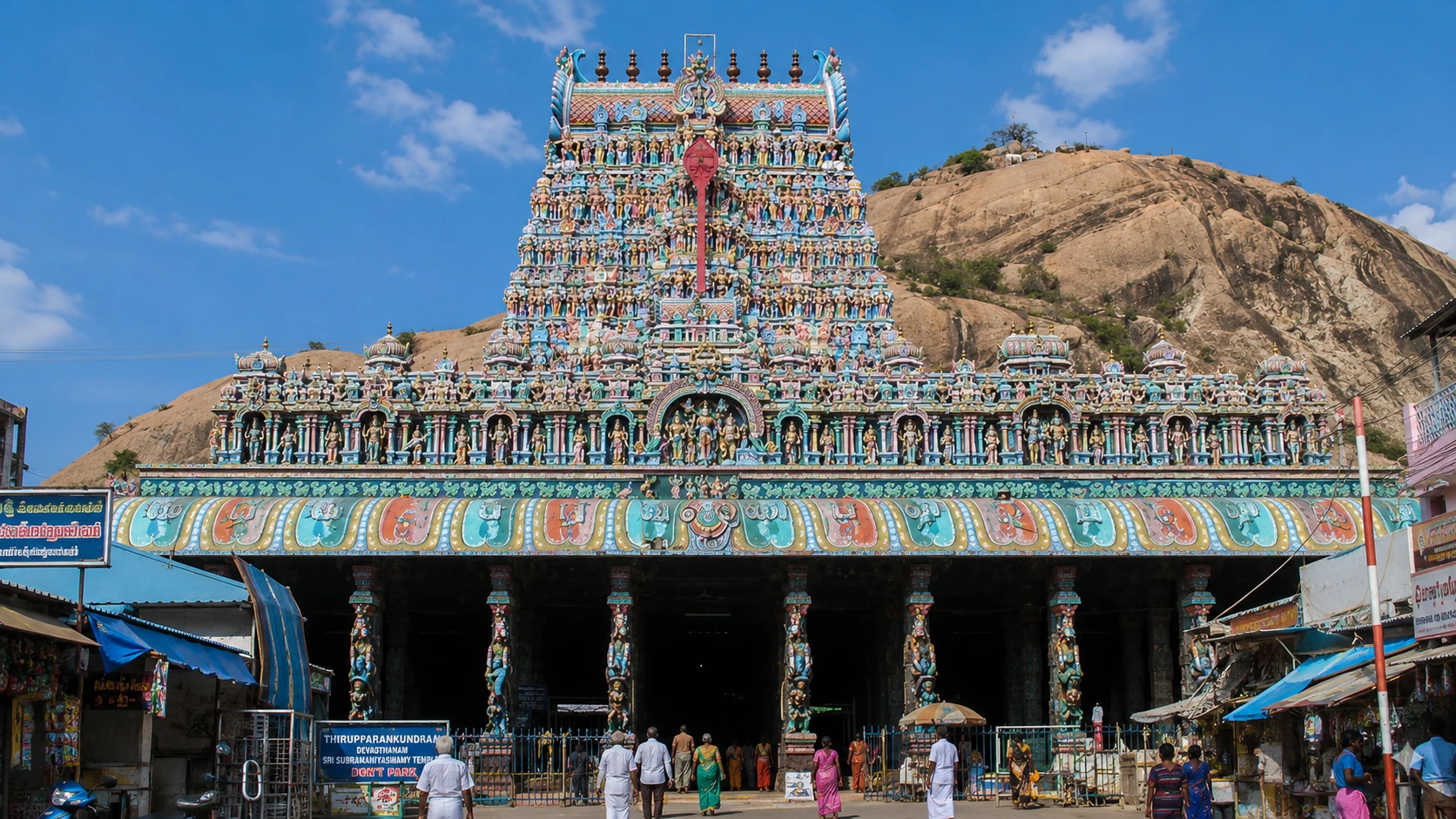
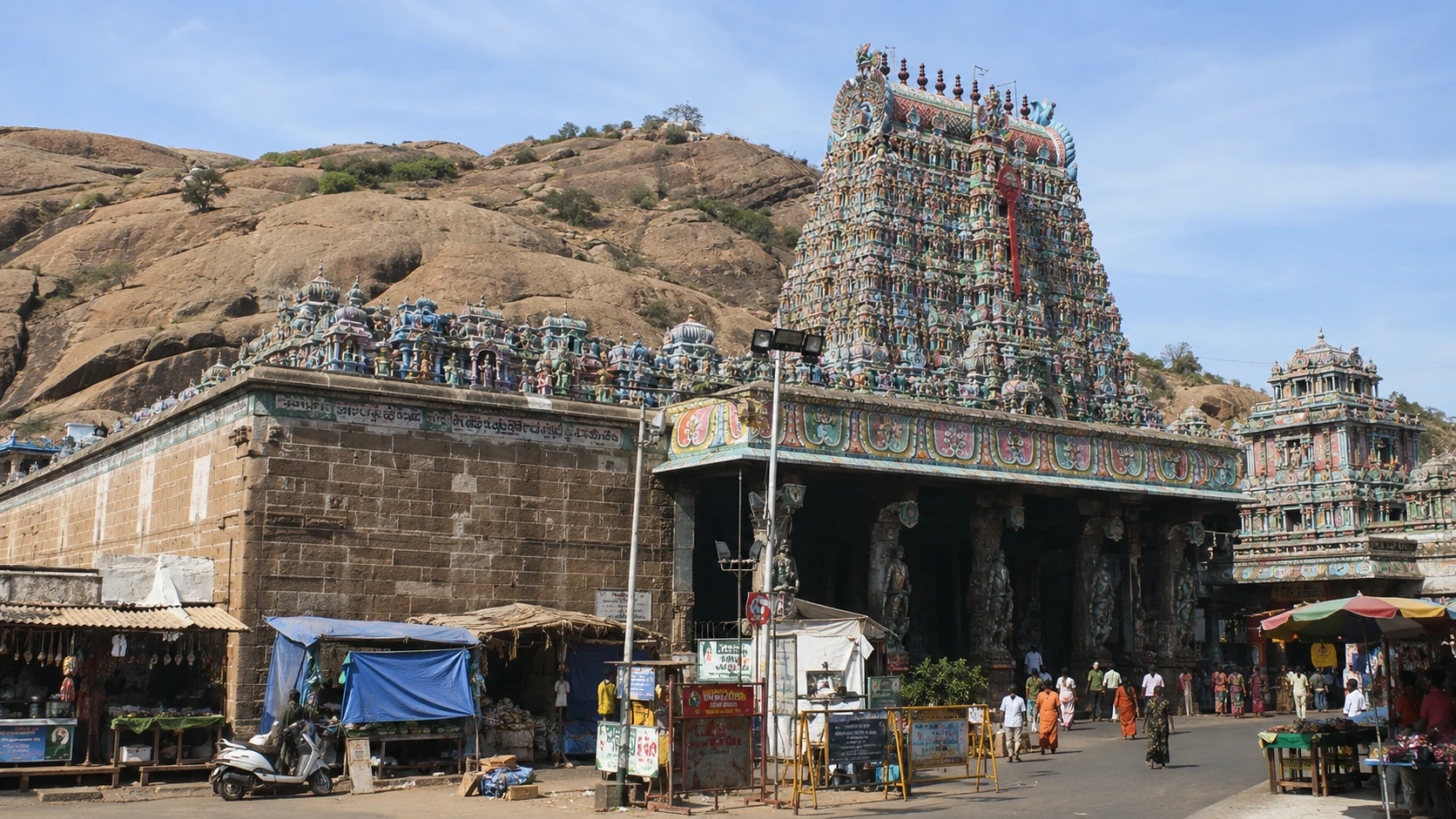
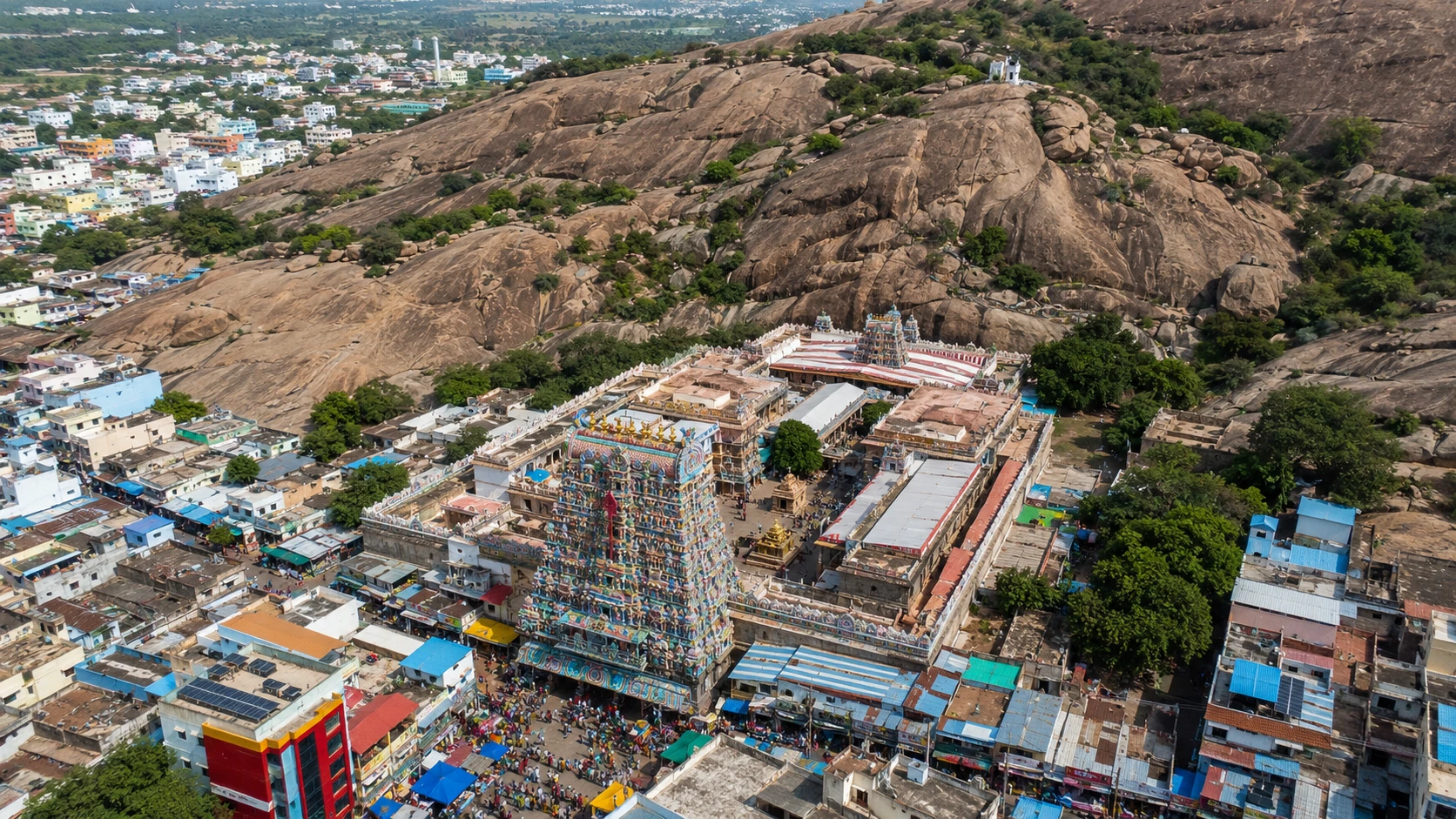
Carved into the granite heart of a hill eight kilometres from Madurai, Thirupparankundram is where the Skanda Purana places Murugan's first marriage — the celestial wedding to Devasena, daughter of Indra, witnessed by Shiva and Parvati themselves. It is the first of the six sacred Padai Veedu named in Nakkirar's Tirumurugaṟṟuppaṭai, a Sangam-era poem from the second century CE and the oldest surviving Tamil-language pilgrimage guide. The hill holds more than one faith: within the same rock face, a Shiva cave, a Vishnu shrine, a Ganesha sanctum, a Durga shrine, and a Sufi Muslim dargah have shared sacred space for centuries — a devotional palimpsest written in stone that makes Thirupparankundram one of the most layered sacred landscapes in all of South India.
Sacred Designationपवित्र पदनाम
Sacred Origin Storyपवित्र उत्पत्ति कथा
Source: Skanda Purana (Kumara Khanda) / Tirumurugaṟṟuppaṭai tradition (Sangam, c. 2nd century CE)
After the great war in which Murugan led the celestial armies to victory over the asura Tarakasura and his forces, Indra — king of the devas — wished to honour the divine general. He offered his daughter Devasena (also called Deivayanai, meaning 'the celestial woman') in marriage, and the divine wedding was arranged at Thirupparankundram. Shiva descended from Kailasa, Parvati came with him, and the assembled gods gathered on the summit to witness the union. The Tirumurugaṟṟuppaṭai describes the hill as alive with peacocks calling in the mango groves, waterfalls threading between flowering kadamba trees, and the air thick with fragrance — a paradise of sound and scent where the god of youth, beauty, and war chose to take a heavenly wife. This is Murugan's first marriage: to Devasena, the daughter of the divine king, representing his sovereignty over the celestial order. The contrast with his second marriage — to the earthborn Valli, the tribal woman at Thiruthani — frames the full theological range of Murugan's nature. He is god of both the heavens and the earth, the celestial and the earthly, the warrior and the beloved.
Sources cited:
- Skanda Purana, Kumara Khanda — Devasena Kalyana episode
- Nakkirar, Tirumurugaṟṟuppaṭai, verses 1–52 (Pattupattu corpus, Sangam literature, c. 2nd century CE)
- Thirugnanasambandar, Tevaram hymns on Thirupparankundram (Panniru Tirumurai, 7th century CE)
Scholarly Context
The Tirumurugaṟṟuppaṭai by Nakkirar is conventionally dated to the late Sangam period, c. 2nd century CE, based on linguistic and stylistic criteria within the Sangam corpus. Scholars including K.A. Nilakanta Sastri ('A History of South India', 4th ed., 1966) have noted that Murugan as a deity in Tamil Nadu predates his identification with the Sanskrit Skanda/Kartikeya — the Sangam-era Murugan was a distinctly Tamil hill deity subsequently integrated with the pan-Indian Puranic tradition. The multi-faith character of the Thirupparankundram hill — Hindu cave sanctums alongside a functioning Sufi dargah — is documented in British-era district gazetteers and studied by scholars of South Indian religious geography as an example of organic shared sacred space rather than institutional syncretism or planned coexistence.
Historyइतिहास
Thirupparankundram stands among the oldest documented sacred sites in Tamil religious literature, attested in the Sangam corpus by at least the second century CE. The Tirumurugaṟṟuppaṭai of Nakkirar names it first among Murugan's six abodes, and the hill's association with Murugan worship appears to predate even that text. In the Bhakti period, Nayanmar saints of the Shaiva tradition — particularly Thirugnanasambandar (c. 7th century CE) — composed Tevaram hymns celebrating this temple, embedding it within the pan-Tamil devotional pilgrimage circuit. The Pandya kings, whose capital at Madurai lies only eight kilometres away, were the temple's principal royal patrons across several centuries; stone inscriptions from the Pandya period record land grants and ritual endowments that shaped the temple's institutional structure. The rock-cut cave shrines visible today represent layered phases of excavation and architectural addition spanning the Pandya and Nayaka periods. The Sikandar Dargah — a Sufi Muslim shrine — was established within the same hill during the medieval period and continues in active use alongside the Hindu shrines, a feature documented in district gazetteers and noted by scholars as an example of South India's layered sacred geography. The temple is currently administered by the Hindu Religious and Charitable Endowments (HR&CE) Department, Government of Tamil Nadu.
Historical Timelineऐतिहासिक कालक्रम
Nakkirar's Tirumurugaṟṟuppaṭai names Thirupparankundram as the first of Murugan's six Padai Veedu — the earliest datable textual attestation of the site's sacred status in Tamil literature.
The conventional dating of the Tirumurugaṟṟuppaṭai to c. 2nd century CE is based on linguistic and stylistic analysis within the Sangam corpus. Some scholars propose a wider window of 1st–4th century CE. The text is universally accepted as Sangam-period literature predating the Pallava era.
Thirugnanasambandar, Shaiva Nayanmar saint, composed Tevaram hymns on Thirupparankundram, firmly establishing the temple within the Bhakti pilgrimage circuit of Tamil Shaivism.
Pandya-period stone inscriptions at the site record royal donations, land grants, and ritual endowments — providing the primary epigraphic evidence for the temple's medieval institutional history and confirming sustained Pandya royal patronage across multiple dynastic generations.
The Sikandar Dargah, a Sufi Muslim shrine, was established within the Thirupparankundram hill complex. Hindu temple worship and the dargah have coexisted within the same rock-cut hill from this period to the present day.
The precise founding date of the Sikandar Dargah within the hill is not firmly established in published academic literature. Its presence is documented in British-era district gazetteers. Scholars of South Indian religious geography note this coexistence as an organic example of shared sacred space — not institutional syncretism or administrative merger.
What You'll Seeदर्शन में
The main sanctum at Thirupparankundram enshrines Murugan as Subramanya Swami — a four-armed standing deity in his dual aspect as victorious general and divine bridegroom. He holds the vel (the divine spear, symbol of wisdom and grace) in one right hand; the other hands display the abhaya mudra (gesture of protection) and the varada mudra (gesture of bestowing). His consort Devasena (Deivayanai) is enshrined beside him in a posture of composed regal grace. The sacred peacock — Murugan's vahana — is depicted at the base of the icon. The sanctum occupies a cave cut directly into the granite hillside; the rock walls, the natural dimness, and the proximity of the living stone give the darshan an intimacy impossible in the soaring gopuram temples of the plains. Within the same hill, five further sanctums open from the rock face: a Shiva lingam cave, a reclining Vishnu in the Ranganatha manner, a Ganesha shrine, and a Durga cave. Across a different face of the hill, the Sikandar Dargah occupies its own carved space. Photography is not permitted inside any of the sanctums.
Distinctive Practicesविशिष्ट परंपराएँ
Panguni Uthiram — Thirukalyanam (Divine Wedding Ceremony)
पंगुनी उत्तिरम — तिरुकल्याणम (दिव्य विवाह संस्कार)
Annual, March–April (Tamil month Panguni, Uthiram nakshatra day)
On Panguni Uthiram — the day tradition holds as the actual date of Murugan's marriage to Devasena — the utsava murti (processional deity) of Murugan is adorned as a bridegroom: draped in silk, garlanded with fresh flowers, and crowned. Devasena's idol is brought in bridal regalia. The full Vedic and Agamic wedding rites are performed before the assembled congregation to the accompaniment of Tevaram hymns and Thirupugazh songs. Thousands of devotees attend as divine witnesses. The procession of the deities through the temple streets on decorated vahanas follows the ceremony.
Thirupparankundram is the only Arupadaiveedu where Murugan is worshipped primarily in his aspect as bridegroom rather than warrior. Attending the Panguni Uthiram thirukalyanam is believed to carry the blessing of the divine wedding itself — prayers for marriage, children, and family harmony offered on this day are held to be especially potent. The festival enacts the theological truth that divine love and celestial sovereignty are not separate: Murugan as general wins the war; Murugan as husband consecrates the peace.
Did You Know?क्या आप जानते हैं?
The Tirumurugaṟṟuppaṭai by Nakkirar (c. 2nd century CE) is the oldest surviving Tamil-language pilgrimage guide — and Thirupparankundram is the very first site it names. The text predates all major Dravidian stone temple construction and stands as a document of devotion from a period when Murugan was still primarily a Tamil hill deity, before his integration with the pan-Indian Skanda tradition.
Nakkirar, Tirumurugaṟṟuppaṭai (Pattupattu corpus, Sangam literature, c. 2nd century CE)
Within the same granite hill, five Hindu sanctums — for Murugan, Shiva, Vishnu, Ganesha, and Durga — coexist with a functioning Sufi Muslim dargah (Sikandar Dargah). Each tradition is active and undisturbed, making Thirupparankundram one of the very few sacred sites in India where rock-cut Hindu temples and a Muslim shrine occupy the same geological formation.
Madurai District Gazetteer (Government of Tamil Nadu); South Indian sacred geography scholarship
The cave-cut sanctums at Thirupparankundram are carved entirely into living granite — no freestanding structural masonry was used for the original shrines. The hill itself is both building material and temple: the rock is simultaneously the mountain where the wedding happened and the walls of the house of worship.
Archaeological Survey of India documentation; Dravidian rock-cut architecture scholarship
Arunagirinathar (c. 15th century CE), the great Tamil Murugan saint-poet and author of the Thirupugazh, composed multiple dedicated hymns for Thirupparankundram. The Thirupugazh tradition, which encompasses over 16,000 verses addressed to Murugan across his sacred sites, treats Thirupparankundram as one of its principal venues — the hymns specific to this temple describe the hill's wedding atmosphere with particular detail.
Arunagirinathar, Thirupugazh (c. 15th century CE); Thirupugazh Anbargal sabha records
Visitor Accessप्रवेश जानकारी
Thirupparankundram is open to devotees of all backgrounds. Modest dress is required — no shorts, sleeveless garments, or footwear within the temple precincts. Photography is prohibited inside all sanctums. The Sikandar Dargah within the hill complex is a functioning Muslim shrine; visitors are requested to observe appropriate decorum in that area.
Enter barefoot. Men are typically required to remove shirts before entering the inner sanctum, as is customary at HR&CE-administered Tamil Nadu temples. The cave interior is dimly lit; eyes adjust quickly. The Dargah occupies a separate section of the hill approached via different steps.
Festivalsत्योहार
Panguni Uthiram
पंगुनी उत्तिरम
March–April
The most sacred festival at Thirupparankundram — celebrates the divine wedding of Murugan and Devasena, which the Skanda Purana locates on this very hill. The thirukalyanam (wedding ceremony) is re-enacted in full ritual. Lakhs of devotees attend as witnesses; prayers for marriage and family are considered especially efficacious on this day.
Skanda Sashti
स्कंद षष्ठी
October–November
Six-day festival celebrating Murugan's victory over Surapadman. The Soorasamharam (slaying of the asura) is enacted on the sixth day. Observed at all six Arupadaiveedu temples; Thirupparankundram's celebration draws large crowds from Madurai and the surrounding districts.
Thai Poosam
थाई पूसम
January–February
Major Murugan festival observed on the Poosam nakshatra in the Tamil month of Thai. At Thirupparankundram, kavadi-bearing devotees carry decorated frames as vows. The festival commemorates Parvati's gift of the vel (divine spear) to Murugan.
Vijayadasami — Vidhyarambham
विजयदशमी — विद्यारंभम
October
On Vijayadasami, children are brought to Thirupparankundram to begin formal learning — the tradition called Vidhyarambham ('commencement of knowledge'). Parents guide their children's hands to write the first letters in a tray of raw rice before the deity. Murugan, as the god of intelligence and spiritual wisdom, is the presiding deity for this learning initiation across Tamil Nadu.
How to Reachकैसे पहुँचें
Thirupparankundram is located 8 km west of Madurai city. Madurai Junction is the nearest major railway station, well-connected to Chennai, Bengaluru, Mumbai, Delhi, and all major Tamil Nadu cities. Madurai Airport (approximately 17 km from the temple) has regular flights from Chennai, Bengaluru, Mumbai, Hyderabad, and Delhi. From Madurai city, city buses (MTC) operate regular services to Thirupparankundram from the Central Bus Stand; auto-rickshaws and taxis are widely available. The approach to the hill involves a moderate climb on steps; manageable for most devotees.
Plan Your Visitयात्रा की योजना
🌤 Best Season
October through April. The summer months (May–July) are intensely hot; early morning visits are recommended year-round. Skanda Sashti (October–November) and Panguni Uthiram (March–April) bring very large crowds — plan accommodation well in advance.
👘 Dress Code
Modest traditional dress. Men are typically required to remove shirts when entering the inner sanctum (standard practice at HR&CE Tamil Nadu temples). No shorts, miniskirts, or sleeveless garments. Footwear removed at the temple entrance.
📱 Phones & Photography
Mobile phones permitted in outer precincts. Photography strictly prohibited inside all cave sanctums.
🏨 Accommodation
Madurai city, 8 km away, offers accommodation at all price ranges — from budget pilgrim lodges to five-star hotels. Madurai is a major pilgrimage and tourism hub with extensive facilities. Dharamshala-style pilgrim accommodation near the temple is also available.
Book a Pujaपूजा बुक करें
Booking links and phone numbers are verified periodically but may change without notice. Always confirm the destination URL belongs to the official temple trust before payment. Phone numbers and email addresses listed here are provided by the official temple authority where available; verify on the trust's official website before contacting.
Managed by: Hindu Religious and Charitable Endowments (HR&CE) Department, Government of Tamil Nadu
Booking information verified: 2026-05-23
Sacred Soundsपवित्र ध्वनि
Did You Know? · क्या आप जानते हैं?
The same translation error that turned '33 Koti' into '33 crore' in Hinduism also happened in Buddhism. The Chinese translation of Buddhist texts rendered 'Sapta Koti Buddha' (7 Supreme Buddhas) as '7 Crore Buddhas.' The Tibetan translation got it right: 7 types, not 7 crore. One Sanskrit word, misread across two major world religions, generated two identical misconceptions independently.
Related Contentसंबंधित सामग्री
Related Scriptures
Community Reflections
🕉️
Be the first to share your reflection.