Hanuman Dhara (Chitrakoot)
हनुमान धारा चित्रकूट
Where a mountain spring cools Hanuman's fire-scorched body forever
Chitrakoot, Uttar Pradesh, India
Hanumāna Dhārā CitrakūṭaAlso known as: Hanuman Dhara Mandir, Hanumana Dhara, Chitrakoot Hanuman Dhara, Ram Vana Hanuman
Era
Antiquity uncertain; associated with the Ramayana exile period in tradition; current structure of the medieval era
Architecture
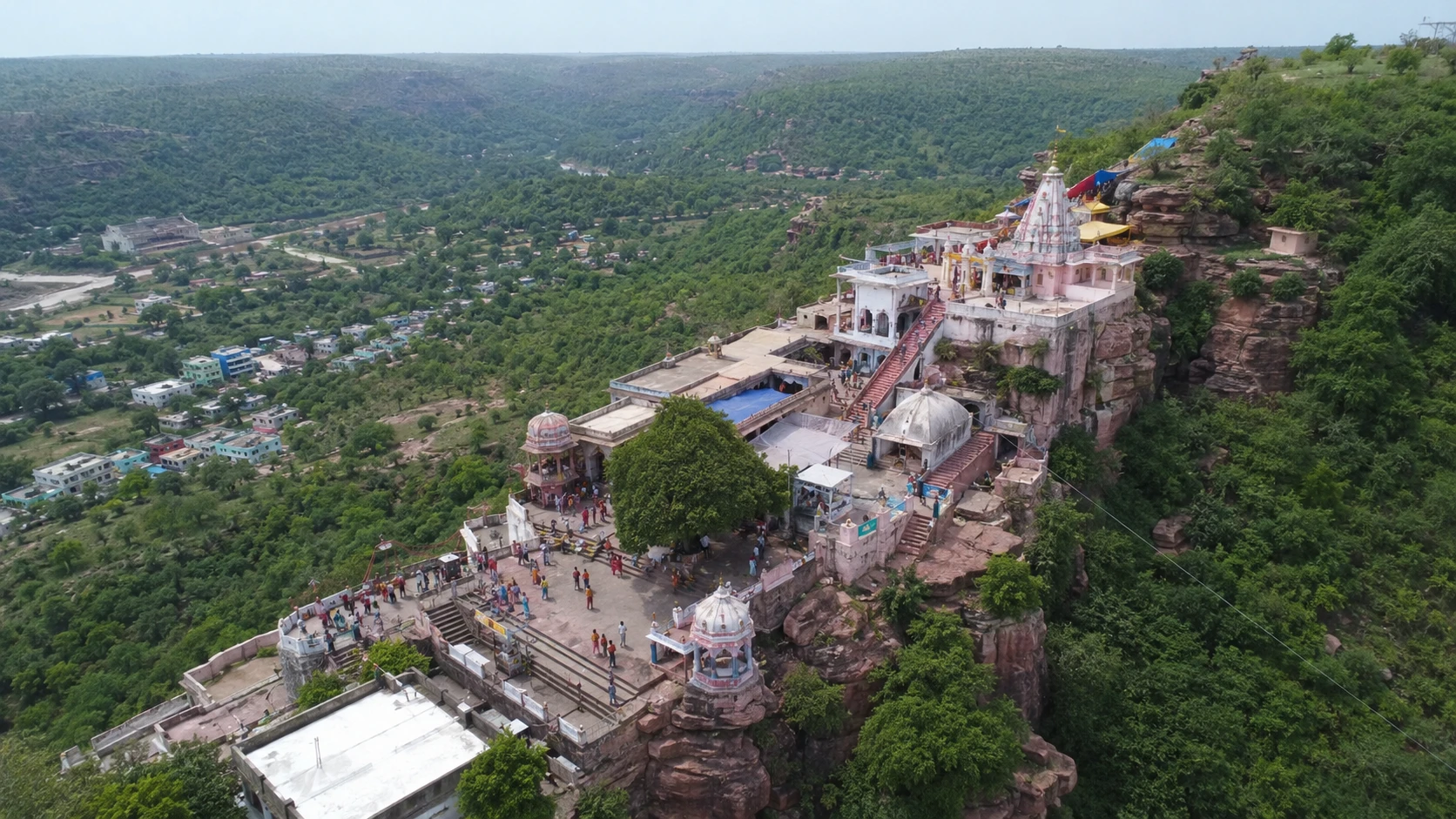
Hill-cut shrine integrated with natural rock face; natural spring forms the perpetual abhishekam feature
Open
06:00 – 20:00
Aarti
06:30 · 12:00 · 19:00
Special
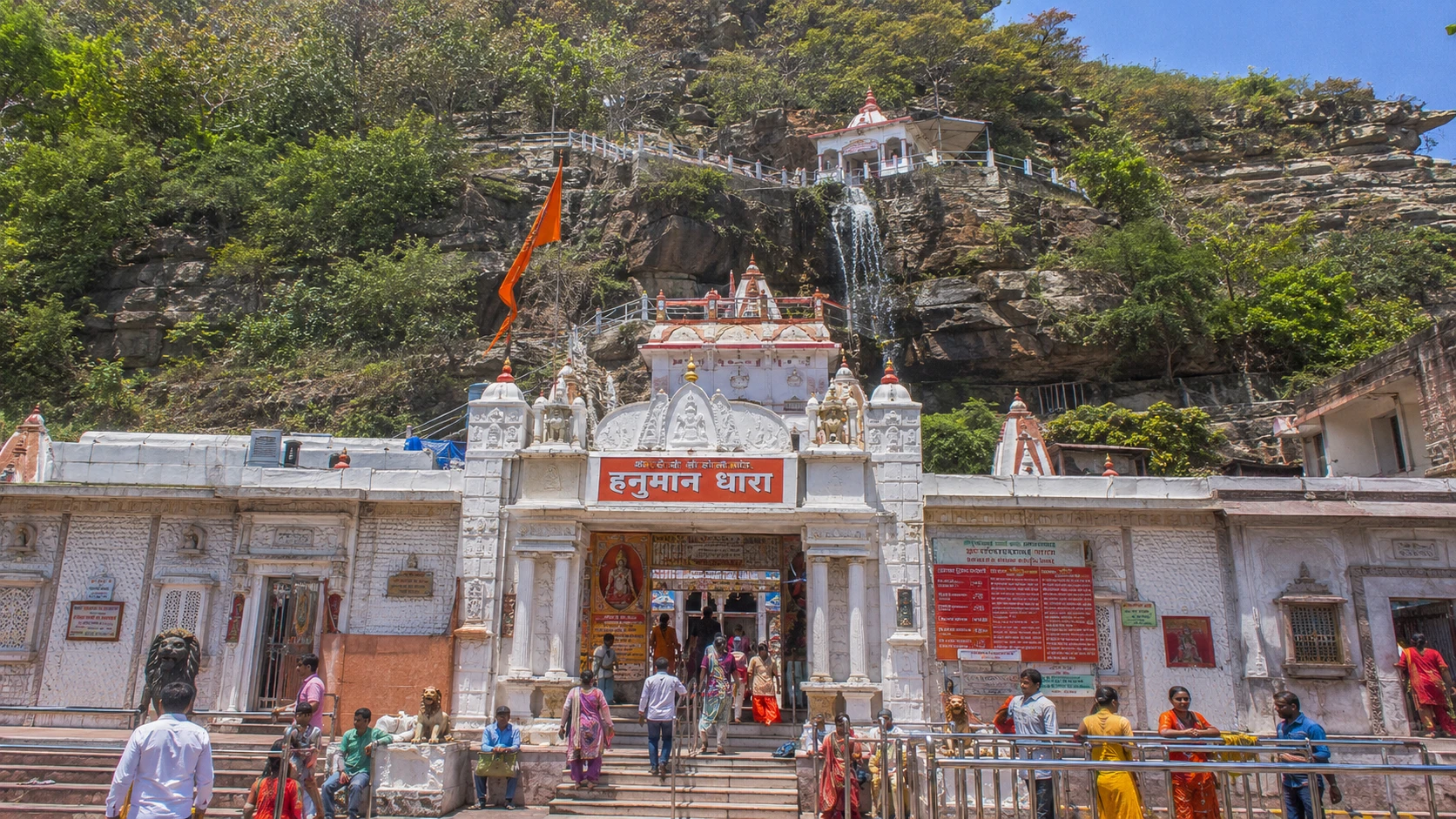
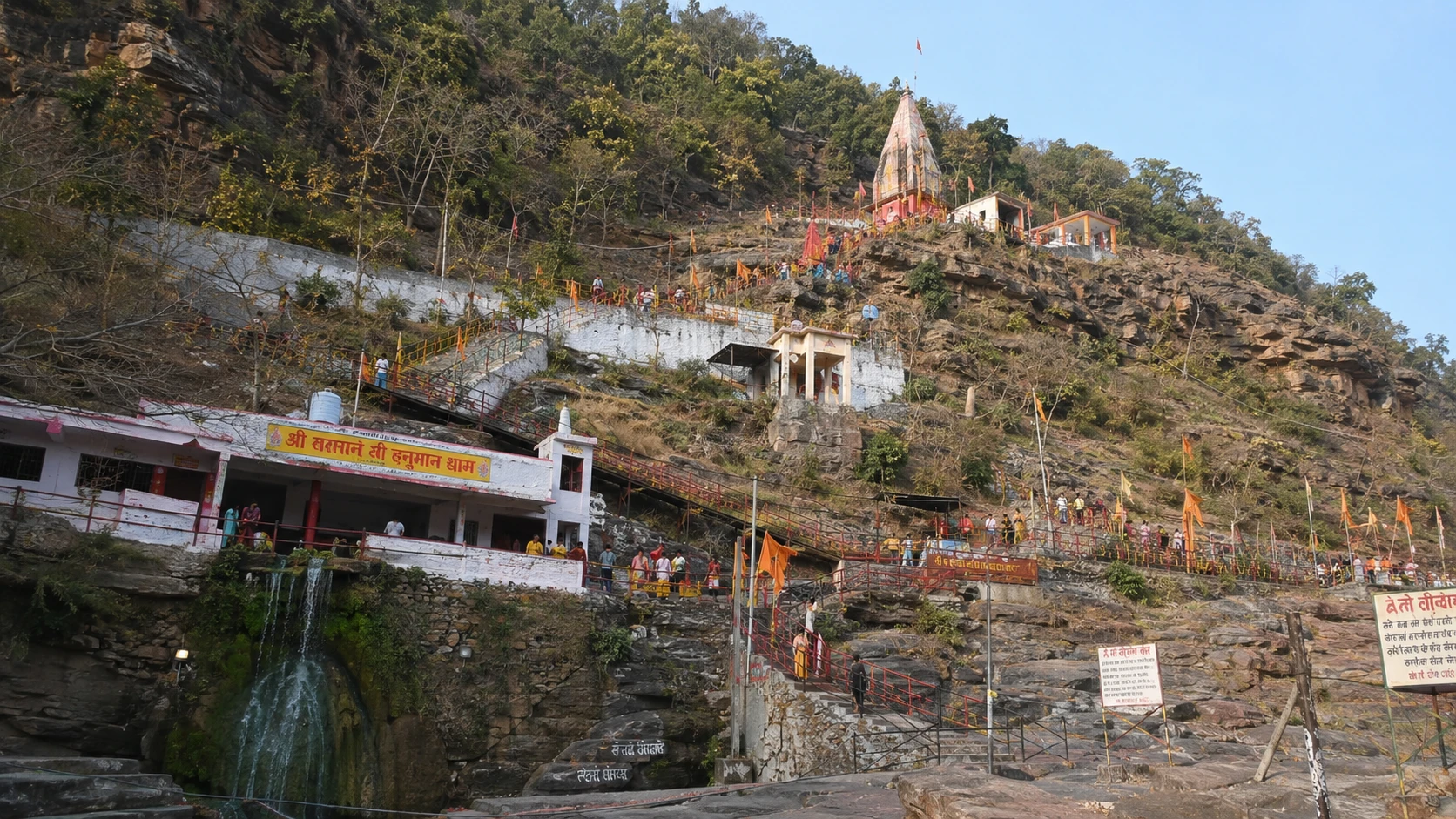
The natural spring pours water onto the murti continuously — perpetual abhishekam visible to all visitors; approximately 360 steps to reach the temple
The Sacred Legend · पवित्र कथा
When Hanuman set Lanka ablaze — every palace, every street, every fortress wall consumed — the fire that burned the demon king's city also scorched Hanuman's own body. His fur, his skin, his very form carried the heat of Lanka's destruction. The tradition holds that Hanuman came to this forested hill above Chitrakoot, where Rama himself was living in exile, and that Rama — out of love for his servant — caused a stream to flow from the hillside and fall perpetually upon the murti. At Hanuman Dhara, the spring has never stopped. This is a temple where the abhishekam is not performed by a priest: the mountain itself pours water onto Hanuman without ceasing, cooling in perpetuity the body that burned for Rama's cause.
Sacred Origin Storyपवित्र उत्पत्ति कथा
Source: Valmiki Ramayana and Tulsidas Ramcharitmanas — Lanka Kanda / local Chitrakoot tradition
The mythology of Hanuman Dhara is rooted in the aftermath of one of the Ramayana's most dramatic episodes — the burning of Lanka.
Hanuman had been captured by Ravana's forces and brought before the demon king. In the Lanka Sabha, Ravana humiliated Hanuman by ordering his tail set on fire. But Hanuman, by divine grace, reduced the bonds on his body and leapt free. He then proceeded to bound across Lanka's rooftops and streets, setting the city alight with his burning tail — palace after palace, gate after gate, until Lanka blazed from end to end.
The fire that consumed Lanka also consumed Hanuman's own form. By the time he crossed the sea back toward India, his body carried the heat of Lanka — scorched, feverish, the celestial fire not yet subsided. The Valmiki Ramayana describes Hanuman plunging into the ocean to cool himself, but the tradition of Chitrakoot adds a further chapter.
Chitrakoot was the forest where Rama, Sita, and Lakshmana spent a significant portion of their fourteen-year exile. The Mandakini river flows below these hills. The Ramayana attests that Brahmarishi Valmiki had his ashram here, that Atri and Anasuya lived on these slopes, and that the forest was thick with the divine presence of rishis and devas.
The local tradition holds that after Lanka burned, Hanuman came directly to Chitrakoot — to Rama, who was still in exile in these hills. He came not triumphant but scorched, his body still carrying the heat of his deed. Seeing his servant's condition, Rama was moved with love and compassion. He directed a mountain stream to flow from the hillside and fall upon Hanuman, cooling and healing the body that had burned for Rama's cause.
The stream has flowed without interruption ever since. The Hanuman murti at this site receives the mountain spring's water continuously — an abhishekam that has no beginning in recorded history and, by the tradition's claim, will have no end. To come to Hanuman Dhara is to witness the moment that never ended: Rama's loving gesture of cooling his servant's burn, perpetuated in stone and water on the hillside above the Mandakini.
Sources cited:
- Valmiki Ramayana, Sundara Kanda and Yuddha Kanda — Lanka burning episode
- Tulsidas, Ramcharitmanas, Lanka Kanda
- Local Chitrakoot Sthala Purana (oral tradition)
- Diana Eck, 'India: A Sacred Geography' (2012) — on Chitrakoot's Ramayana sacred geography
Scholarly Context
Chitrakoot's position in the Ramayana geography is exceptionally well-attested. Diana Eck ('India: A Sacred Geography', 2012) devotes substantial analysis to Chitrakoot as one of the most saturated Ramayana pilgrimage landscapes in India — a site where nearly every hill, river bend, and stone is identified with a specific Ramayana episode. The Hanuman Dhara site fits within this pattern of hyper-specific Ramayana geography: unlike temples associated with general Hanuman worship, this site claims a very precise narrative moment — the cooling of Hanuman's burned body after Lanka — and the natural spring is understood as the physical evidence of that claim.
Historyइतिहास
Chitrakoot's sacred history is among the most extensively documented of any Hindu pilgrimage site, owing to the Ramayana's detailed description of the exile period spent in these hills. The Valmiki Ramayana places Rama, Sita, and Lakshmana at Chitrakoot for approximately eleven and a half years of their fourteen-year exile. The Chitrakoot hills, the Mandakini river, and the specific ashrams and gathering places described in the text have been identified with physical locations on and around the Chitrakoot plateau since at least the early medieval period.
The Hanuman Dhara site specifically — the hillside spring and the Hanuman murti — does not appear in the earliest surviving textual accounts of Chitrakoot pilgrimage, suggesting it developed as a distinct pilgrimage point in the medieval period, when the elaboration of Chitrakoot's sacred geography was most active. The site is mentioned in the Chitrakoot Mahatmya sections of regional religious literature.
Chitrakoot lies on the Uttar Pradesh–Madhya Pradesh border in the Vindhya foothills. The town of Karwi (Chitrakoot Dham) on the UP side and Satna district on the MP side both contribute pilgrims and infrastructure. The area came under various medieval dynasties — the Chandelas, the Pratiharas, and later the Bundelkhand kingdoms — who invested in temple construction and pilgrimage infrastructure across the Chitrakoot region.
Tulsidas, who composed the Ramcharitmanas in the 16th century and spent time in Chitrakoot, is credited with revitalizing the Chitrakoot pilgrimage tradition. His compositions drew pilgrims from across North India and gave Chitrakoot's sacred geography a literary anchor that has sustained its pilgrimage significance into the modern era.
The modern period has seen Chitrakoot develop significantly as a pilgrimage destination. The establishment of Chitrakoot as a separate district in Uttar Pradesh, infrastructure investment in ghats along the Mandakini, improved road connectivity, and the site's association with Ram Van Gaman Path (the national project to develop Rama's forest exile route) have all contributed to growth in visitor numbers.
Historical Timelineऐतिहासिक कालक्रम
Rama, Sita, and Lakshmana's residence at Chitrakoot during the fourteen-year exile, as described in the Valmiki Ramayana. The Chitrakoot hills become the site of the most extensively documented portion of Rama's forest exile, with specific locations identified for Valmiki's ashram, Atri-Anasuya's hermitage, and the primary forest dwelling sites.
Tulsidas, author of the Ramcharitmanas, visits and spends time at Chitrakoot. His literary identification of Chitrakoot's sacred geography — specific hills, rivers, and sites with Ramayana episodes — revitalizes the pilgrimage tradition and draws pan-North Indian pilgrim traffic to Chitrakoot.
Development of Chitrakoot as a modern pilgrimage infrastructure, including the establishment of Chitrakoot as a separate district in Uttar Pradesh, construction of Mandakini ghats, improved road connectivity, and the Ram Van Gaman Path national heritage development project.
What You'll Seeदर्शन में
The Hanuman murti at Hanuman Dhara is set into a niche in the hillside, positioned to receive the flow of the natural mountain spring that pours continuously from the rock face above. The murti depicts Hanuman in a standing form, typically adorned with sindoor, fresh garlands, and ornamental clothing — but the dominant visual impression is not of the decoration but of the water: the spring falls in a continuous stream over the murti, making the deity perpetually wet, perpetually being bathed. The murti's surfaces carry the mineral deposits of centuries of spring water, giving it a textured, geological character unlike the smooth stone of carved temple images. The spring water, by local tradition, is considered sacred — pilgrims cup their hands to receive it and drink it as tirtham. The hillside above the niche is green and moss-covered from the perpetual moisture. A small Sita Rasoi (Sita's Kitchen) shrine is located nearby on the same hillside, part of the broader Chitrakoot sacred geography.
Distinctive Practicesविशिष्ट परंपराएँ
Perpetual Abhishekam (Self-Performing Mountain Spring)
शाश्वत अभिषेकम (स्वयं-प्रदर्शन करता पर्वत स्रोत)
Always — the spring flows continuously, year-round
The natural mountain spring that flows over the Hanuman murti at Hanuman Dhara constitutes a perpetual, self-performing abhishekam — an uninterrupted ritual bathing that no human priest initiates or controls. The spring water, cool and clear, falls in a continuous curtain over the deity. Pilgrims stand below the overhang of the niche and cup their hands to receive the water as it runs off the murti, treating it as prasad tirtham — sacred water blessed by its contact with Hanuman. The sound of the flowing water creates a constant aural backdrop to worship at this site.
The spring's theology mirrors Bade Hanuman Ji at Prayagraj in its fundamental structure — a natural element performing what human hands cannot replicate. Here, the cooling principle is the narrative: Rama's compassion for his burned servant, perpetuated in natural hydrology. Pilgrims receive the spring water as a direct physical transmission of that compassion — cool water from Rama's mountain, falling on Hanuman's murti and flowing to the devotee's cupped hands.
Did You Know?क्या आप जानते हैं?
The natural mountain spring at Hanuman Dhara performs a continuous, uninterrupted abhishekam on the Hanuman murti — a phenomenon with no recorded beginning. The spring water is collected by pilgrims as sacred tirtham, believed to carry the blessing of its contact with Hanuman's form. The mineral deposits of centuries of spring water give the murti a unique geological texture.
On-site observation; temple tradition
Chitrakoot is described in the Valmiki Ramayana as the site where Rama, Sita, and Lakshmana spent approximately eleven and a half of their fourteen years in forest exile — making it the most extensively described location in the entire Ramayana's exile narrative. Nearly every hill, river bend, and path in Chitrakoot is identified with a specific episode from the text.
Valmiki Ramayana, Ayodhya and Aranya Kandas; Diana Eck (2012)
Hanuman Dhara requires climbing approximately 360 steps from the base to the temple. The climb through the forested hillside, with the sound of the Mandakini river below and the spring water audible above, is considered part of the devotional experience — the effort of ascent mirrors the effort of Hanuman's own devotion.
Temple trust; on-site visitor information
Nearby on the same hillside is Sita Rasoi — 'Sita's Kitchen' — a site where Sita is said to have prepared food during the Chitrakoot exile. The Chitrakoot pilgrimage circuit typically includes both Hanuman Dhara and Sita Rasoi in a single hill climb, making the physical ascent a condensed journey through the Ramayana exile narrative.
Chitrakoot pilgrimage tradition; local guidebooks
Visitor Accessप्रवेश जानकारी
Hanuman Dhara is open to all devotees without restriction. The temple requires climbing approximately 360 steps — plan for this, especially in summer heat or if visiting with elderly companions. The spring water may splash; dress accordingly. Photography is permitted at the hillside and of the spring; confirm inner shrine photography policy on site. Footwear must be removed before the temple area.
Start the climb early morning for cooler temperatures and smaller crowds. Carry water — the climb is moderately strenuous. The spring water at the top is potable per tradition, but drink in small quantities. Combine with the Kamadgiri parikrama (circumambulation of the sacred Chitrakoot hill) on the same day — the parikrama is 5 km and flat, easily done after the hill descent. Chitrakoot's complete circuit takes a full day.
Festivalsत्योहार
Ram Navami
राम नवमी
Mar-Apr (Chaitra Shukla Navami)
The most important festival at Chitrakoot as a whole, celebrating Lord Rama's birthday. Hanuman Dhara sees its peak annual traffic. The entire Chitrakoot pilgrimage circuit — Kamadgiri parikrama, Ramghat, Hanuman Dhara, Sita Rasoi, Janaki Kund — is performed in sequence by tens of thousands of pilgrims over the Ram Navami period.
Hanuman Jayanti
हनुमान जयंती
Mar-Apr (Chaitra Purnima)
Hanuman's birthday brings additional large-scale pilgrimage specifically to Hanuman Dhara. The natural spring's perpetual flow takes on particular significance on this day — the spring's abhishekam becomes a community celebration rather than a private devotional phenomenon. Extended darshan and special offerings mark the festival.
Kartik Purnima and Deepavali
कार्तिक पूर्णिमा और दीपावली
Oct-Nov
The autumn festival season draws large crowds to Chitrakoot. Kartik Purnima is particularly significant — the Mandakini river receives lamp offerings, and the ghats and hillside temples are illuminated. Hanuman Dhara, with its perpetual spring sound and the darkness of the hillside forest, is among the most atmospheric settings in Chitrakoot for evening lamp worship.
Traditional Offeringsपारंपरिक अर्पण
Primary Offerings
Sindoor (Vermilion)
सिंदूर
सिन्दूर
Sindoor offered to Hanuman at Hanuman Dhara carries layered meaning: the offering recalls Hanuman's legendary act of covering himself in vermilion for Rama, but here the red of sindoor is also the color of fire — the fire that scorched Hanuman's body at Lanka, whose healing this site commemorates. Offering sindoor here is thus an act of honoring both Hanuman's devotion and his sacrifice.
Spring water (Hanuman Dhara Tirtham)
झरने का जल (हनुमान धारा तीर्थम)
The natural spring water falling from the hillside is the defining offering at Hanuman Dhara — not brought by the devotee but received from the mountain itself. Pilgrims cup their hands to catch the water as it runs off the murti and drink it as prasad tirtham. This reverses the normal logic of offering: rather than devotees bringing water to pour on the deity, the deity's water flows to the devotee. The spring water carries the mineral memory of the mountain and the theological memory of Rama's cooling gesture.
Laddoo (Sweet offering)
लड्डू
Boondi laddoos are offered to Hanuman as a standard sweet offering. At Chitrakoot — a site deeply embedded in the Ramayana forest narrative — the offering of laddoos recalls the folk tradition of Hanuman's fondness for sweet foods mentioned in the Ramayana periphery. The offering is placed before the murti before the spring water washes it, or presented through the priests who manage the inner shrine.
Coconut
नारियल
नारिकेल
Coconut offering and breaking before Hanuman symbolizes the shattering of obstacles. At Hanuman Dhara, the coconut offering is often made at the base of the steps before the climb — a petition to Hanuman for strength and protection for the ascent, transforming the physical climb into a devotional act from its very beginning.
The spring water at Hanuman Dhara is the site's unique and defining offering — pilgrims receive it rather than bring it. For other offerings (sindoor, laddoo, coconut, garlands), vendors are available near the base of the 360 steps. Purchase offerings before climbing as options are limited at the top. Carry a small vessel if you wish to take spring water home — it is considered sacred tirtham.
How to Reachकैसे पहुँचें
Chitrakoot lies on the Uttar Pradesh–Madhya Pradesh border in the Vindhya foothills. The Hanuman Dhara hillside is within the main Chitrakoot pilgrimage area, approximately 3 km from Ramghat (the main ghat on the Mandakini river).
By road, Chitrakoot is connected to Allahabad/Prayagraj (170 km, ~4 hours via NH-35 and SH roads), Jhansi (150 km), Satna (70 km, MP side), and Mahoba (60 km). UP State Road Transport Corporation buses and private operators run from Prayagraj, Lucknow, and Satna.
By rail, the nearest station is Chitrakoot Dham Karwi (9 km from Ramghat), on the Manikpur–Prayagraj rail line. From Karwi, shared autos and taxis reach the Chitrakoot pilgrimage area. Satna Junction (80 km, MP) and Manikpur Junction (50 km) are larger junctions with more train connections.
By air, Prayagraj Airport (200 km) and Khajuraho Airport (170 km) are the nearest options. Khajuraho has connections from Delhi and select domestic airports. Prayagraj has broader connectivity.
The Chitrakoot pilgrimage circuit typically includes: Kamadgiri parikrama (the main sacred hill), Ramghat, Hanuman Dhara and Sita Rasoi (single hill climb), Janaki Kund, Gupt Godavari, and the various forest ashrams associated with the Ramayana.
Plan Your Visitयात्रा की योजना
🌤 Best Season
October to March is ideal — pleasant temperatures (12–28°C) for the 360-step climb. Monsoon (July–September) makes the steps slippery and the hillside muddy, but the spring is at its fullest and the forest is extraordinarily green. Avoid April–June (40–46°C) for the climb. Ram Navami (March–April) is the most spiritually charged period but also the most crowded.
👘 Dress Code
Modest traditional dress expected. Wear clothes you don't mind getting wet from spring water splash. Comfortable footwear for the 360-step climb, removed at the temple. Carry a change of clothes if you plan to be at Ramghat for a sacred dip in the Mandakini after the hill visit.
📱 Phones & Photography
Photography permitted on the hillside and of the spring and outer shrine. Confirm photography policy for inner sanctum on-site.
🏨 Accommodation
Chitrakoot has a well-developed pilgrimage accommodation infrastructure. Ram Ghat area has numerous dharamshalas and budget hotels. The Uttar Pradesh government operates UPTDC tourist facilities. For mid-range options, the main Chitrakoot Dham town has better hotels. The MP side of Chitrakoot (Satna district) also has accommodation. Book in advance for Ram Navami and Hanuman Jayanti periods.
Sacred Soundsपवित्र ध्वनि
Did You Know? · क्या आप जानते हैं?
The same translation error that turned '33 Koti' into '33 crore' in Hinduism also happened in Buddhism. The Chinese translation of Buddhist texts rendered 'Sapta Koti Buddha' (7 Supreme Buddhas) as '7 Crore Buddhas.' The Tibetan translation got it right: 7 types, not 7 crore. One Sanskrit word, misread across two major world religions, generated two identical misconceptions independently.
Related Contentसंबंधित सामग्री
Related Scriptures
Community Reflections
🕉️
Be the first to share your reflection.