Gadayuddha as Martial Science -- Twenty Techniques, One Tradition Still Standing
गदायुद्ध का शास्त्र -- बीस तकनीकें, एक परम्परा आज भी जीवन्त
Eighteenth Day. Two Men. One Teacher in the Audience.
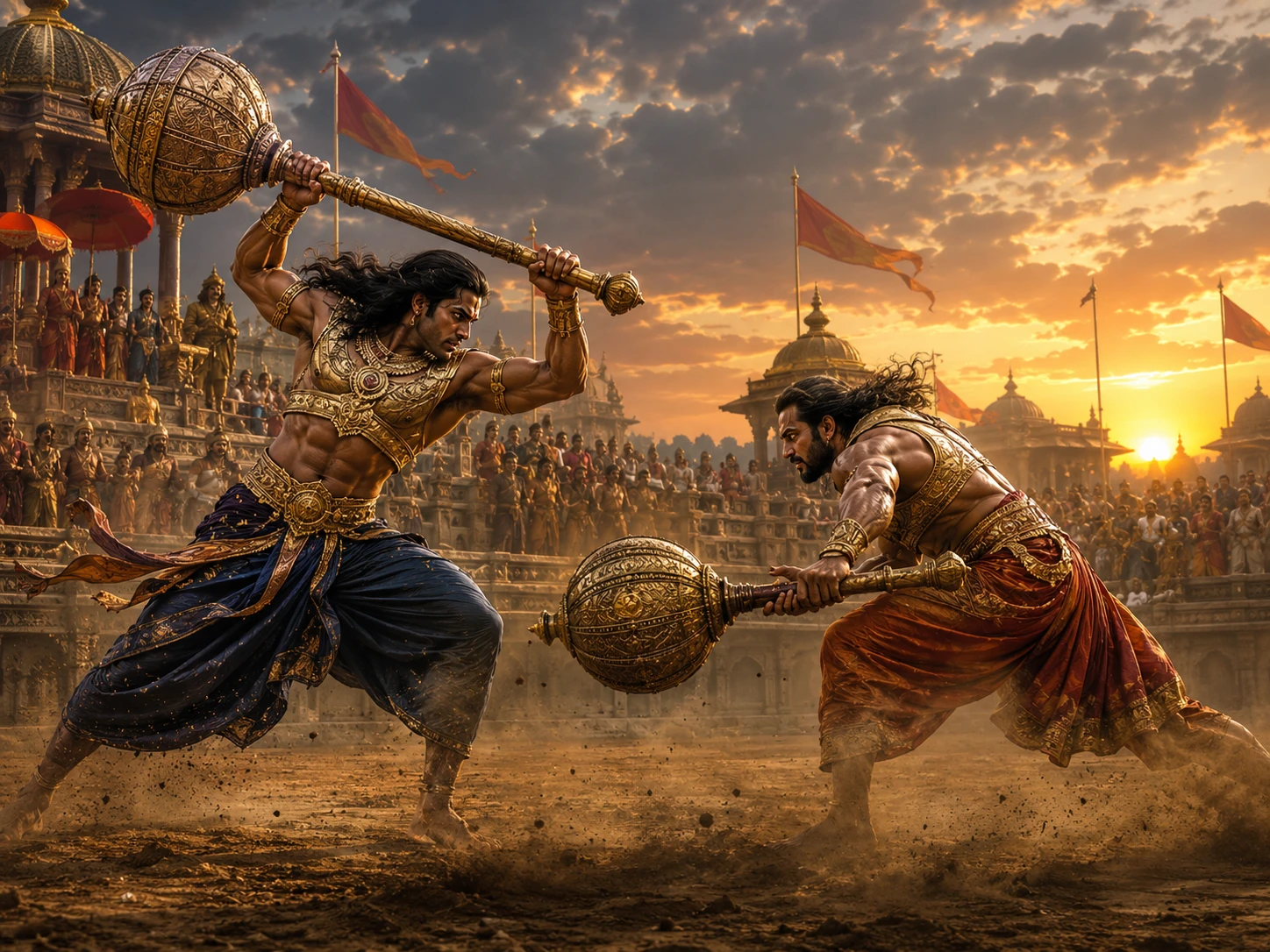
On the eighteenth day of the Kurukshetra war, after the armies have been broken and most of the great warriors are dead, two men face each other beside the lake at Samanta Panchaka. Bhima and Duryodhana. Each holds a single mace. Each is the finest gadadhari of his generation. And in the audience, seated on a folded cloth, is the man who taught both of them.
Balarama has just returned from a forty-two-day pilgrimage along the Saraswati. He has not fought in the war. He stayed neutral by choice -- Bhima was his student, but so was Duryodhana, and he could not bring himself to favour either. Now the two students he trained will fight each other to the end. Krishna sits a little apart. Yudhishthira has just made a strategic blunder by allowing Duryodhana to choose any one Pandava brother as his opponent. Krishna knows what almost everyone else has missed: Duryodhana practised the gada for thirteen years during the Pandavas' exile. Daily. Without interruption. He is, on technique alone, the better mace-fighter at this moment.
What happens next is not just a duel. It is the most carefully described martial encounter in any classical Indian text. The Shalya Parva of the Mahabharata, in Section 57, breaks down the fight movement by movement -- the circling, the feints, the parries, the dodges by bending and leaping. It is, in plain English, a martial arts manual embedded inside an epic. And it sits within a much larger tradition. The Agni Purana names twenty distinct techniques of gadayuddha. The Sukra Niti specifies the dimensions of the weapon. The Viramitrodaya documents construction details. The Arthashastra slots the gadadhari into the king's military hierarchy. By the time the Mahabharata describes Bhima and Duryodhana circling each other, gadayuddha is not a folk skill. It is a science with named techniques, measured equipment, formal pedagogy, and a living lineage. That lineage did not die when the Mahabharata ended. It walked into the akharas of north India and is still being practised every morning in Varanasi, Kolhapur, Mysore, and Delhi.
The case for treating gadayuddha as a science rather than a folk practice rests on four documented features. First, the techniques are named, not described loosely. Second, the equipment has tolerances, not just a general shape. Third, the pedagogy follows a guru-shishya structure with formal entry, formal grading, and a formal ethical code. Fourth, the discipline has a continuous transmission history. No other classical Indian weapon-art preserves all four features into the present. Sword and spear-fighting kept some named techniques but lost the equipment standardisation. Archery kept the pedagogy but lost the battlefield context. Only gadayuddha kept all four, and that is why a sports scientist at NIS Patiala in 2026 can study a senior pehelwan in Kolhapur and find him doing the same hamsamarga circles that Sanjaya described to Dhritarashtra.
अष्टादश दिनान्यद्य युद्धस्यास्य जनार्दन। वर्तमानस्य महतः समासाद्य परस्परम्॥
ashtadasha dinaanyadya yuddhasyasya janaardana vartamaanasya mahatah samaasaadya parasparam
Today is the eighteenth day, O Janardana, of this great war that has continued so long, of two sides confronting each other again and again.
— Mahabharata, Shalya Parva, Gadayuddha Upa-Parva (the opening verse of Section 54 in Ganguli, marking the formal beginning of the mace-duel narrative). Spoken by Arjuna to Krishna immediately before Bhima and Duryodhana take their positions.
What the Agni Purana and the Mahabharata Together Catalogue
Most readers know the gada as the heavy thing Bhima swings. The technical literature knows it as one of the most precisely codified weapons in the classical Indian arsenal. The Agni Purana, in its Dhanurveda section, and the Mahabharata in scattered passages, together name roughly twenty distinct techniques of gadayuddha. They are not generic. Each one describes a specific footwork-and-strike combination, named after the shape of the body movement or the trajectory of the mace. The technical vocabulary survives in modern akhara teaching, even if the Sanskrit names are no longer used in everyday speech.
The Sukra Niti, attributed to the sage Shukra, specifies the geometry of the weapon itself. The shaft is to be octagonal, broad at the head, with the iron head shaped to hold weight without splintering. The Viramitrodaya, a much later compendium, gives construction tolerances down to the angula -- the danda or shaft is fifty angulas long, with knots spaced one angula apart for grip, and the striking edge no wider than a thumb's breadth. These are not poetic flourishes. They are the kind of specifications you would expect to find on a CAD drawing for a competition kettlebell at IIT Kanpur today.
The twenty named techniques include aahat (the direct strike), gomutra (a zig-zag pattern named after the meandering pattern of cattle urine on dry ground), prabrita (the throwing motion), kamalasana (the lotus-seat stance, low and rooted), urdhvagatra (the upward swing), namita (the bent posture for dodging), vamadakshina (the left-right pivot), aavrita (the encircling motion), paraavrita (the reverse encircle), padoddhrita (the foot-lifted block), avaplata (the leaping evasion), hamsamarga (the swan's path -- the gliding circular footwork), and vibhaga (the splitting strike). The list closes at twenty in the canonical reckoning, although the Agni Purana sometimes implies more by combining named pairs into composite drills. The Mahabharata is not abstract about these. When Section 57 of the Shalya Parva describes Bhima careering in left mandala while Duryodhana takes the right mandala, that is hamsamarga in action -- the swan-footwork. When it says Bhima avoided blows by bending or jumping aloft, those are namita and avaplata. The text reads like a coach's notebook from Kothi Akhara in Varanasi, except it was written down two thousand years earlier.
Eight Named Techniques in the Mace Curriculum
| Sanskrit Name | संस्कृत नाम | Literal Meaning | Function in Combat | Akhara Echo Today |
|---|---|---|---|---|
| Aahat (आहत) | आहत | Direct strike | Frontal vertical or horizontal blow with full body weight behind the mace. | The basic overhead swing every pehelwan learns first in any akhara. |
| Hamsamarga (हंसमार्ग) | हंसमार्ग | Swan's path | Smooth circular footwork while keeping the mace in continuous motion. Conserves energy, sets up traps. | The signature flowing gada-circle drill in Kothi Akhara, Varanasi. |
| Kamalasana (कमलासन) | कमलासन | Lotus-seat | Low rooted stance with knees deeply bent, mace held diagonally. Resists being knocked down. | The squat-base position taught for steel-mace strength training in modern akhara. |
| Urdhvagatra (ऊर्ध्वगात्र) | ऊर्ध्वगात्र | Upward swing | Mace lifted from low to high in a single arc, used to break a defensive guard from below. | The full-extension swing seen in functional fitness mace-360 routines today. |
| Namita (नमित) | नमित | Bent posture | Dropping the head and torso under an incoming horizontal swing while keeping the feet planted. | The duck-and-counter taught in every kushti session before contact sparring. |
| Avaplata (अवप्लत) | अवप्लत | Leaping evasion | Vertical jump to clear a low or thigh-aimed strike, mace held overhead for the descending counter. | The plyometric jump-counter every modern combat-sport coach calls intuitive. |
| Aavrita (आवृत्त) | आवृत्त | Encircling | Moving rightward around the opponent, mace held to threaten the unguarded flank. The right mandala. | Duryodhana's preferred footwork in Shalya Parva 57 -- still in akhara training drills. |
| Vibhaga (विभाग) | विभाग | Splitting strike | A descending blow aimed at the line dividing the opponent's body, intended to terminate the fight. | The finishing strike in mace-on-bag drills. Reserved for last, never first. |
These eight are drawn from the canonical list of twenty in the Agni Purana and from descriptive passages in Shalya Parva 57. The remaining twelve techniques function as compounds, transitions, and feints between these foundational positions.
The Pedagogy: Balarama's Training Ground
Bhima and Duryodhana studied the mace under the same teacher: Balarama, the elder brother of Krishna. The Mahabharata never describes the curriculum directly, but it leaves enough clues for any reader who has spent a morning in an akhara. Both students received the same drills. Both were graded on the same techniques. Both knew the same twenty-move vocabulary. The difference between them by the end was not knowledge. It was time on task. Duryodhana practised daily for thirteen years during the exile. Bhima had a wider warrior's training that included the full spectrum of weapons -- bow, sword, javelin, wrestling -- but did not specialise in the mace to the same depth.
Balarama's neutrality is one of the most striking ethical positions in the Mahabharata. He could see clearly that Duryodhana's claim to the throne was unjust. He could also see that Krishna's plan to use the Pandavas as the instrument of dharma was strategically sound. He chose neither side. He went on pilgrimage along the Saraswati for the entire war and returned only for the final mace duel between his two students. This is what a guru looks like in Hindu pedagogy: someone whose loyalty is to the student rather than the cause. He came back not to influence the result but to witness whether the techniques he had taught had been mastered. When Bhima struck Duryodhana below the navel -- a clear violation of the mace-duel rules he himself had drilled into both boys -- Balarama raised his plough weapon to attack Bhima then and there. Krishna had to physically restrain him and argue the case for why Duryodhana's earlier breaches of dharma justified Bhima's foul. Balarama left the field unconvinced and travelled away from Kurukshetra. The teacher does not approve of cheating, even in service of the right cause. That is the older standard, and the Mahabharata records both views without erasing either.
Balarama was not the only mace-teacher in the tradition. Drona, the master archer, also taught the gada in the early years at Hastinapura. His student rolls included Bhima, Duryodhana, Karna, and Ashwatthama. Jarasandha, the Magadha emperor whom Bhima later killed in wrestling, was himself counted among the great gadadharis. Shalya, the Madra king who became Karna's charioteer and later commander-in-chief, was on Duryodhana's own list of the four strongest mace-fighters of the age -- the others being Bhima, Balarama, and the herder-king Keechaka of Virata. The pedagogy was distributed across kingdoms. The vocabulary, however, was shared. A gadadhari trained in Saurashtra could fight a gadadhari trained in Madra and they would both recognise hamsamarga.
दक्षिणं मण्डलं तावत्तव पुत्रोऽन्वपद्यत। सव्यं मण्डलमेवाथ भीमसेनोऽन्वपद्यत॥
dakshinam mandalam taavat tava putro 'nvapadyata savyam mandalam evaatha bhimaseno 'nvapadyata
Your son adopted the right mandala, while Bhimasena adopted the left mandala. Both began to wheel in circles around each other, each watching for the moment the other's footwork would expose a target.
— Mahabharata, Shalya Parva 57.10-11 (Sanjaya describing the duel to Dhritarashtra). The technical term 'mandala' here refers specifically to the circular footwork of gadayuddha and is the direct ancestor of the modern akhara term for the floor-circle around which wrestlers train.
The Ethics Constraint: Above the Navel, Always
Every documented martial art has a rule structure. Gadayuddha had a clean one: the strike must land above the navel. Below was the kati-pradesha, the hip region, off-limits. The reason was technical and ethical at once. A mace strike to the thigh or knee will not always kill, but it will permanently disable -- and gadayuddha was, in its dharmic frame, supposed to settle a quarrel between equals, not produce a maimed survivor for life. Above the navel, a clean strike could end the fight cleanly. Below it, you produced a different kind of result, and that result fell outside the scope of dharma yuddha.
Krishna's signal to Bhima -- the slap on his own left thigh -- was the most consequential gesture in the war. Bhima had taken a vow during the dice-game scene that he would one day break Duryodhana's thigh, the thigh on which Duryodhana had invited Draupadi to sit. The vow was made in pure rage. Whether it was redeemable through honourable combat had been debated for thirteen years. On the eighteenth day, when Duryodhana's defensive technique had Bhima's normal repertoire stalled, Krishna decided. He slapped his own thigh, in clear view of Bhima, while standing behind the watching Pandavas. Bhima saw. Bhima struck. The mace came down at thigh height. Duryodhana fell.
Balarama's anger was the anger of a teacher whose student has technically violated the rule. Krishna's defence was the argument of a strategist whose moral accountancy looked beyond this single fight. Both positions are preserved in the text. Neither is endorsed without reservation. The Mahabharata refuses to tell you which view is correct, but it does tell you that Bhima paid a price. In Yudhishthira's own narration of his post-war journey to heaven, he had to walk briefly through hell because of one particular act -- the deception that placed Drona's death within reach -- but the entire family had to face the consequences of breaking dharma in war, including the rule of kati-pradesha. Victory does not erase the breach. The text is honest enough to tell you that. And every akhara guru today, when teaching the kati-pradesha rule to a young pehelwan in Varanasi, repeats the Mahabharata's lesson: you may win this way once, but you cannot build a life on it.
Every Indian wrestler who has won an Olympic medal -- Khashaba Jadhav (1952 bronze, the first individual Indian medal), Sushil Kumar (2008, 2012), Yogeshwar Dutt (2012), Sakshi Malik (2016), Bajrang Punia (2020), Ravi Kumar Dahiya (2020), and Vinesh Phogat in her path to Paris 2024 -- trained at akharas where the gada is still a daily strength tool. The mace dimensions documented in the Sukra Niti and Viramitrodaya match almost exactly the steel-mace specifications now sold by Indian fitness equipment manufacturers in Meerut and Jalandhar to gyms in California and Berlin. The functional fitness movement that made the steel mace a global sensation after 2010 was, in plain fact, the western rediscovery of an Indian akhara training tool that had not paused for two thousand years. AIIMS Delhi sports medicine studies in the 2020s have confirmed that gada-style rotational training produces the deepest activation of the obliques, lower back, and grip flexors of any single weighted implement -- exactly the muscle groups Bhima would have needed to wheel in the left mandala for an entire afternoon.
The Akhara Tradition: Hanuman, Hanuman Chalisa, and the Daily 6 AM Drill
Walk into Tulsi Ghat Akhara in Varanasi at six in the morning, or into Guru Hanuman's Akhara in Birla Mandir Delhi, or into Motibagh Akhara in Kolhapur, or any of the hundreds of akharas across Maharashtra, Punjab, Haryana, and Uttar Pradesh, and the same scene plays out. A small Hanuman murti at the entrance. A clay floor that has been re-tilled and watered the previous night. Wrestlers, ages fifteen to fifty, doing surya namaskars, dands, baithaks, and -- after warmup -- swinging the gada. The maces vary in weight from five kilos to over forty. Some are wooden with bound iron rings, some are solid steel, the heaviest are kept for the senior pehelwan only.
Before touching the gada, the wrestler bows to Hanuman. The reason is in the Hanuman Chalisa itself: 'haath bajra aur dhwaja biraajai' -- in his hand, the vajra (gada) and the flag are radiant. Hanuman is the patron deity of strength. He is also the warrior who carries the gada in art and worship. Wrestlers have always seen themselves as Hanuman's disciples first and athletes second. The Great Gama Pehelwan, who never lost a wrestling bout in over fifty years of professional combat in the early twentieth century, kept a small Hanuman idol in his training shed and offered prayer before every dand session. Indian Olympic wrestlers in the modern era do the same. Sushil Kumar, in interviews after his 2008 Beijing bronze, repeatedly credited his routine of Hanuman Chalisa recitation before training as central to his focus.
The daily akhara routine is identical in structure to what Bhima and Duryodhana would have followed under Balarama. The pehelwan begins with several hundred squats and pushups, moves to wrestling drills, and only then takes up the gada. Mace work is treated as the load-development phase, not the technical phase. Footwork drills are done separately, in a clay circle, without the weapon. When the gada comes out, it is for swing repetition: hamsamarga circles overhead, urdhvagatra swings front to back, kamalasana holds at the bottom of the squat, and -- for the most senior wrestlers -- aahat strikes against a heavy bag stuffed with sand. The senior pehelwan in any major akhara can still recognise and demonstrate at least eight of the twenty named techniques on request. The vocabulary is alive. The drilling is alive. The lineage of teaching that started with Balarama, passed through countless gurus across north and central India, runs unbroken into the morning of any week in Varanasi.
What varies between akharas is the texture, not the structure. Tulsi Ghat in Varanasi keeps to the older diet of seasonal milk, almonds, and ghee, with the gada drill done at first light before the river-front activity begins. Guru Hanuman's Akhara in Delhi runs a more standardised regimen because it has fed the national wrestling team for two generations. The Maharashtra akharas around Kolhapur and Pune lean into the Maratha martial heritage, where the gada sat alongside the dandpatta and the bhala on the courtly weapon list. Punjab's Jalandhar and Amritsar akharas blend kushti with the Sikh shastra-vidya tradition, where Hanuman is honoured but the warrior's atmosphere is heavier with martial sangat than with bhakti chant. The Mysore akhara school, smaller in scale, keeps the discipline distinctly southern, with the Vajra Mushti and the Krida-yuddha texts of Karnataka quoting the same Agni Purana technique-list in Kannada commentary. None of these styles diverged from the others on technique. The kati-pradesha rule holds in Pune as in Patna. The hamsamarga circle is identical in Mysore and Meerut. The discipline is regional in flavour and pan-Indian in structure.
हाथ बज्र अरु ध्वजा बिराजै। काँधे मूँज जनेऊ साजै॥
haath bajra aru dhvajaa biraajai kaandhe moonja janeu saajai
In your hand, the vajra (mace) and the flag shine radiant. On your shoulder, the sacred thread of munja grass is decorated.
— Hanuman Chalisa, verse 7, by Tulsidas (composed in Awadhi, late 16th century). Recited daily by every wrestler in every traditional akhara before training begins.
Why the Lineage Survived When Other Combat Forms Did Not
Sword fighting in India largely died out as a mass discipline after the eighteenth century. Archery survived as a sport but not as a battlefield art. Spear-fighting, javelin-throwing, and chariot-driving disappeared with their context. Gadayuddha, alone among the major weapons of dhanurveda, made the transition into modern times intact. The reason is structural. The gada is, before it is anything else, a physical training tool. A young man who picks up a five-kilo iron mace and learns to swing it through hamsamarga circles is building strength, grip, and rotational stability that have value with or without an opponent. The akhara made the gada do double duty -- as a martial weapon when needed, as a strength implement always -- and that double identity is what carried it through colonial decline, through the disuse of war, through the rise and fall of every fitness fashion of the twentieth century, into the year 2026 where Bajrang Punia and Vinesh Phogat use almost the same equipment as Bhima.
There is a second reason. Hanuman. While other martial traditions lost their patron deities to either neglect or to the sectarian narrowing of bhakti, Hanuman's worship grew across the same period. Tulsidas's Hanuman Chalisa in the 1500s gave the wrestler-devotee a recitable text that fit between sets of dands. The proliferation of Hanuman temples across the cow belt in the seventeenth and eighteenth centuries gave every akhara a religious anchor. By the early twentieth century, when the Arya Samaj and the Hindu Mahasabha began advocating for a renewal of physical strength as part of national renewal, the gada was already in place as the trainer of choice. The Indian Olympic Association's wrestling delegation has trained, almost without exception, in akharas where Hanuman is the presiding deity and the gada is the morning warmup. None of this is incidental. A martial science survives when the people who practise it have a continuing reason to practise. The gada had wrestlers, the wrestlers had Hanuman, and Hanuman had no end of devotees. That triangle held when nothing else could.
The third reason is the most quietly important. Gadayuddha was always taught with its ethics. The kati-pradesha rule was not a footnote to the technique. It was part of the curriculum. Bhima's foul on Duryodhana's thigh was preserved in the Mahabharata not as a cool victory move but as a moral cost that the entire Pandava family eventually paid. Every wrestler taught the gada from a Hanuman-bhakti akhara has heard the kati-pradesha story by the time he is twelve. He has been told that the rule survives even when his teacher might tell him to break it. He has been told that Krishna's argument was correct in the cosmic frame but Balarama's anger was correct in the dharmic frame, and a serious student needs to hold both at once. This embedded ethics is what kept the discipline from degenerating into pure brute force. A martial science that drops its ethics becomes a brawl. A martial science that keeps its ethics survives as a school.
Recite the Hanuman Chalisa
Read or chant the full forty verses of the Hanuman Chalisa, including the line 'haath bajra aur dhwaja biraajai' on Hanuman's mace. The Chalisa is the daily prayer of every wrestler trained in the gadayuddha tradition.
Tags
Eternal Raga · शाश्वत राग
Institutional voice — scholarly articles on Sanatan Dharma
Deepen Your Understanding
अपनी समझ और गहरी करें
divine arsenal
The Thundering Mace -- Kaumodaki, Bhima's Gada, and the Art of Gada-Yuddha
The mace is the weapon of raw, unapologetic power. Vishnu carries one, Hanuman wields one, Bhima ended the war with one, and Duryodhana -- the finest mace-fighter alive -- died by one. This is the story of the weapon that decided the Mahabharata's final duel.
scriptural exegesis
The Kurukshetra War -- What Happened in Eighteen Days
Eighteen armies, eighteen days, and four Kaurava commanders who fell one after another. A day-by-day guide to the war at the heart of the Mahabharata -- who led, who fell, and how the rules agreed on the first morning were broken one by one.
divine arsenal
Weapon Ethics in Ramayana vs Mahabharata -- The Two Faces of Dharma Yuddha
Both epics agree on the rules of war. Only one of them keeps them. The Ramayana presents dharma-yuddha as it should be; the Mahabharata records what happens when it bends. Read together, the two epics form Hindu civilisation's complete ethical curriculum on the use of force.
deities avatars
Hanuman -- The Perfect Devotee
He could lift mountains, leap oceans, and burn Lanka to the ground -- yet his greatest power was this: he never forgot whose work he was doing. Hanuman is not just a mythological hero. He is the operating system of selfless devotion that India still runs on.
divine arsenal
The Celestial Bows -- Pinaka, Gandiva, Sharanga, Vijaya and the Sacred Art of Dhanurvidya
Five bows shaped the fate of two great epics. Forged by Vishwakarma and Brahma, wielded by Shiva, Rama, Arjuna, Vishnu, and Karna -- these were not mere weapons but extensions of cosmic will. Know their origins, their powers, and the warriors who earned them.
Every Indian wrestler who has won an Olympic medal -- Khashaba Jadhav (1952 bronze, the first individual Indian medal), Sushil Kumar (2008, 2012), Yogeshwar Dutt (2012), Sakshi Malik (2016), Bajrang Punia (2020), Ravi Ku…
More in Divine Arsenal
Akshauhini -- The Epic Army Structure Where Every Digit Sums to 18
14 min read
Ancient Indian Martial Arts -- Kalaripayattu to Malla-Yuddha
14 min read
Astra Invocation and Withdrawal -- The Ritual of Weapons
16 min readThe same translation error that turned '33 Koti' into '33 crore' in Hinduism also happened in Buddhism. The Chinese translation of Buddhist texts rendered 'Sapta Koti Buddha' (7 Supreme Buddhas) as '7 Crore Buddhas.' The…
Deities AvatarsCommunity Reflections
🕉️
Be the first to share your reflection.