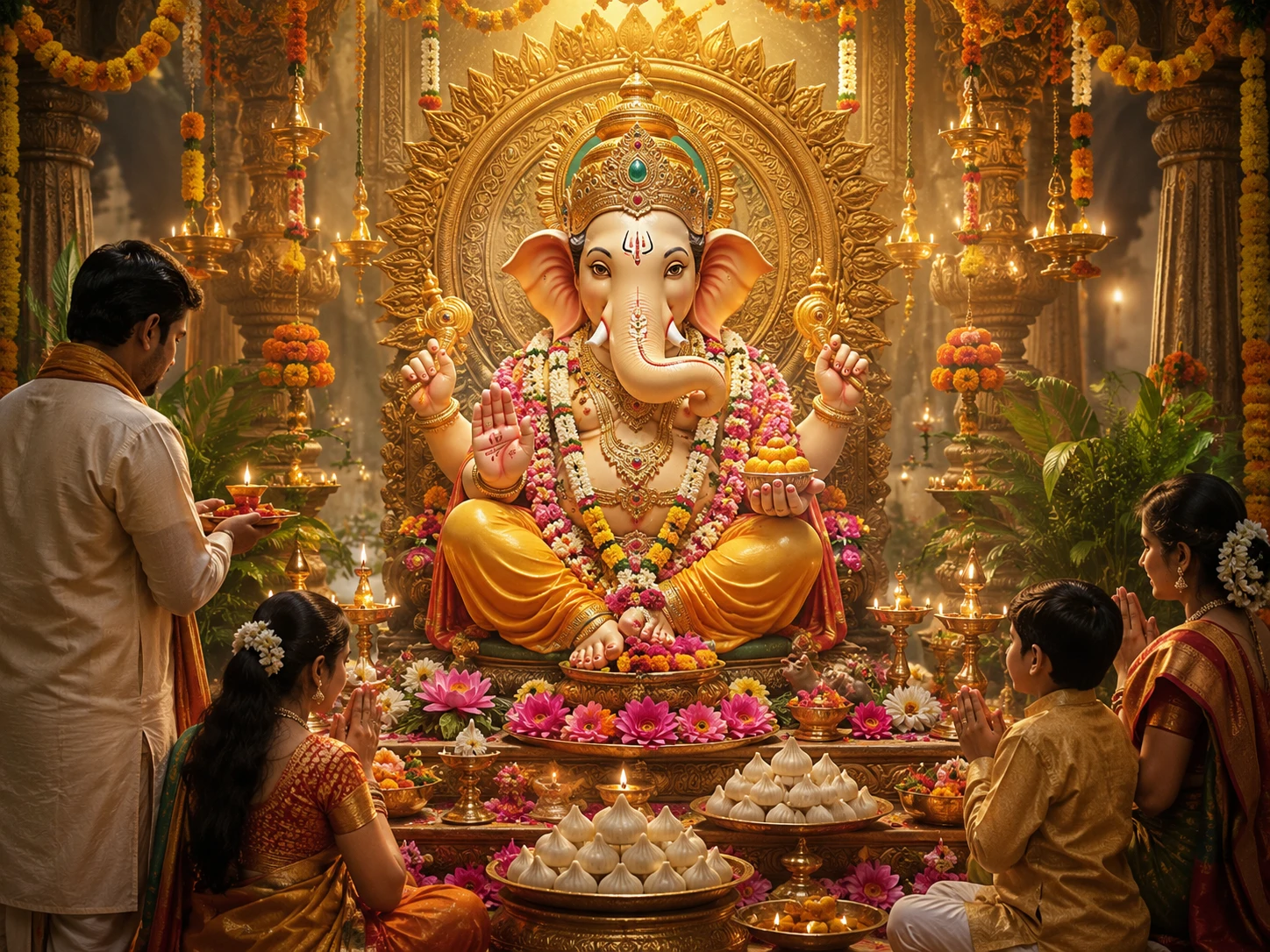
Ganesh Chaturthi -- The Festival That Became a Freedom Movement
गणेश चतुर्थी -- वह उत्सव जो स्वतन्त्रता आन्दोलन बना
If you have ever been in Mumbai during the first week of September, you know. The city transforms. Every neighbourhood -- from Lalbaug to Lokhandwala, from Dadar to Dharavi -- erupts with pandals, loudspeakers, processions, and the unmistakable roar of 'Ganpati Bappa Morya, Pudhchya Varshi Lavkar Ya!' (Hail Lord Ganpati, come back soon next year!). Traffic stops. Offices empty. The sea at Girgaon Chowpatty turns orange with vermillion and flowers as thousands of idols are immersed on the final day.
But rewind 130 years and the scene was entirely different. In 1892, Ganesh Chaturthi was a quiet, private, one-day affair -- a domestic puja observed primarily by Brahmin families in their homes. There were no pandals, no processions, no ten-day celebrations. The transformation from a private family ritual into India's largest public festival is one of the most remarkable acts of cultural engineering in modern history, and it was designed by one man: Lokmanya Bal Gangadhar Tilak.
The story of Ganesh Chaturthi is therefore two stories braided together. The first is ancient -- the mythology of Ganesha, the elephant-headed son of Shiva and Parvati, the Remover of Obstacles, the Lord of Beginnings. The second is modern -- a colonial-era freedom fighter who saw in a clay idol the power to unite a fragmented nation. Together, they explain why Ganesh Chaturthi is not just a religious festival but a civilisational event -- a ten-day annual demonstration that India can organise itself, celebrate itself, and dissolve its divisions in shared joy.
For anyone who has watched the Lalbaugcha Raja darshan queue stretch two kilometres through Mumbai's streets, or witnessed the Dagdusheth Ganpati celebrations fill the lanes of Pune, or seen the Khairatabad Ganesh in Hyderabad tower forty feet above the traffic -- this is how it all began.
वक्रतुण्ड महाकाय सूर्यकोटिसमप्रभ। निर्विघ्नं कुरु मे देव सर्वकार्येषु सर्वदा॥
vakratuṇḍa mahākāya sūryakoṭi-samaprabha nirvighnaṃ kuru me deva sarvakāryeṣu sarvadā
O Lord of the curved trunk and massive body, whose radiance equals ten million suns -- remove all obstacles from all my endeavours, always.
— Traditional Ganesha Dhyana Shloka (recited at the beginning of all auspicious activities)
Tilak's Revolution -- How a Puja Became a Movement
The year is 1893. India is under the British Raj. The colonial administration, scarred by the memory of the 1857 uprising, has passed a series of ordinances banning public assemblies of more than twenty people. Any gathering that could foster 'seditious' sentiment is suppressed. Political meetings are monitored. Public speeches are censored.
But the British make one exemption: religious gatherings. Festivals and pujas, however large, are permitted because the administration considers them harmless expressions of 'native superstition.'
Lokmanya Bal Gangadhar Tilak sees the loophole. He is based in Pune, editing the fiery Marathi newspaper Kesari. He has watched the 1893 communal riots in Bombay with anguish. He believes that Hindus lack organisational unity -- that caste divisions and British divide-and-rule policies have fragmented Indian society. He needs a platform that can unite all castes, all classes, all regions -- under a single roof, on a single occasion, with no British permission required.
Ganesha is the answer. Tilak recognises that Ganesha worship cuts across every social division in Maharashtra and much of India. The deity is worshipped by Brahmins and Dalits, merchants and farmers, urbanites and villagers. Robert Brown, a historian of Indian religions, notes that Tilak specifically chose Ganesha because the deity 'bridged the gap between Brahmins and non-Brahmins.'
In 1892, Krishnajipant Khasgiwale -- a Pune resident -- had visited Gwalior, where he witnessed a public Ganesh celebration. Inspired, he shared the idea with Shrimant Bhausaheb Rangari, a respected physician and freedom fighter, who installed the first Sarvajanik (public) Ganesha idol in his wada in Pune's Shalukar Bol area. In 1893, Tilak praised this initiative in Kesari and dedicated his efforts to expanding it into a mass movement.
Tilak's genius was in the design. He transformed Ganesh Chaturthi from a one-day private puja into a ten-day public festival with: large pandals open to all castes, intellectual lectures and nationalist speeches delivered alongside religious rituals, patriotic songs and plays performed alongside bhajans, athletic competitions alongside devotional activities, and a grand public visarjan procession on the tenth day that became the largest mass gathering the British had ever permitted.
By 1897, Ganesh Chaturthi had become a fixture across Maharashtra. By the early 1900s, it had spread to Karnataka, Gujarat, and beyond. The festival that the British dismissed as a 'native superstition' became the single most effective platform for anti-colonial mobilisation before Gandhi's arrival on the national scene. Tilak's famous declaration -- 'Swarajya is my birthright, and I shall have it' -- was first thundered at a Ganeshotsav gathering.
The Ritual Framework -- Shodashopachara Puja
The traditional Ganesh Chaturthi puja follows the Shodashopachara format -- the sixteen-step worship protocol that governs the reception of any deity as a guest in the home. The metaphor is precise: God arrives as a visitor, is treated with the full hospitality due to an honoured guest, stays for a prescribed period (1, 3, 5, 7, or 10 days), and then departs.
Step 1: Avahana -- Invocation. The deity is invited into the clay idol through the Prana Pratishtha ceremony. The priest chants mantras from the Ganapati Atharvashirsha and the Rig Veda to establish divine presence in the murti. Until this moment, the idol is art. After this moment, it is God.
Step 2: Asana -- Offering a seat. The idol is placed on a decorated throne (simhasana) or platform.
Step 3: Padya -- Washing the feet. Water is offered at the base of the idol.
Step 4: Arghya -- Offering water for washing hands.
Step 5: Achamana -- Offering water to sip.
Step 6: Snana -- Ritual bathing with panchamrita (milk, curd, honey, ghee, sugar).
Step 7: Vastra -- Offering new cloth or flowers as garment.
Step 8: Upavita -- Offering the sacred thread.
Step 9: Gandha -- Applying sandalwood paste.
Step 10: Pushpa -- Offering flowers -- specifically red hibiscus (jaswand) and durva grass, both sacred to Ganesha.
Step 11: Dhupa -- Offering incense.
Step 12: Deepa -- Offering lamp light.
Step 13: Naivedya -- Offering food. The signature offering is the modak -- a sweet dumpling made of jaggery and coconut in a rice flour shell. The Puranas declare modak as Ganesha's favourite food. Twenty-one modaks is the traditional count.
Step 14: Tambula -- Offering betel leaf and nut.
Step 15: Pradakshina -- Circumambulation (walking around the idol).
Step 16: Namaskara -- Prostration and final prayers.
After the puja, daily aarti is performed morning and evening for the duration of the festival. The household treats the idol as a living family member -- food is offered before the family eats, lights are kept on near the idol at night, and conversations in the room maintain a respectful tone. For ten days, God is not in a distant temple -- God is in the living room, eating what you eat, hearing what you say, sharing your home.
This is the profound emotional architecture of Ganesh Chaturthi: it makes the divine domestic. For a child growing up in a Pune middle-class flat or a Chennai apartment, the memory of Ganesh in the house -- the smell of incense, the taste of modak, the evening aarti with the whole family -- becomes the foundational sensory experience of what 'God at home' means.
Ganesh Chaturthi Across India -- Regional Variations
| Region | Local Name | Duration | Distinctive Feature | Iconic Celebration |
|---|---|---|---|---|
| Maharashtra | Ganeshotsav | 10 days (Anant Chaturdashi visarjan) | Sarvajanik (public) pandals, grand visarjan processions | Lalbaugcha Raja and Dagdusheth Ganpati (Pune) |
| Karnataka | Ganesha Habba | 10 days | Chamundi Hills celebration, Mysuru palace illumination | Basavanagudi Bull Temple festival, Bengaluru |
| Tamil Nadu | Vinayagar Chaturthi / Pillayar Chaturthi | 1-3 days | Kozhukattai (steamed modak) as primary offering, Avani month | Pillayarpatti temple, Sivaganga |
| Andhra Pradesh / Telangana | Vinayaka Chavithi | 9-11 days | Massive Khairatabad Ganesh (40+ feet), Tank Bund immersion | Khairatabad Ganesh, Hyderabad |
| Goa | Chovoth | 1-5 days | Pre-Portuguese tradition revived, Konkani rituals | Marcela and Bicholim celebrations |
| Gujarat | Ganesh Chaturthi | 10 days | Close ties to Navratri preparations, Dandia alongside aarti | Surat and Vadodara public pandals |
| North India (UP, Bihar, MP) | Ganesh Chaturthi | 1-3 days (smaller scale) | Primarily domestic celebration, growing public scale | Varanasi ghats immersion, Indore pandals |
The ten-day format (Bhadrapada Shukla Chaturthi to Anant Chaturdashi) is standard in Maharashtra, Karnataka, and Andhra-Telangana. Tamil Nadu and Goa traditionally observe shorter durations. North India is seeing rapid growth in public celebrations, particularly in cities with significant Maharashtrian diaspora.
The Lalbaugcha Raja Ganesh in Mumbai's Lalbaug receives over 1.5 million visitors during the ten-day festival -- making the darshan queue one of the longest in the world. In 2019, donations to just this single pandal exceeded Rs 14 crore. The Lalbaugcha Raja trust uses these funds for community hospitals, blood banks, and educational scholarships. A ten-day religious festival funds year-round social infrastructure -- Tilak's original vision of the festival as a vehicle for collective action, fulfilled in the 21st century.
Visarjan -- The Art of Letting Go
The most emotionally powerful moment of Ganesh Chaturthi is not the installation -- it is the departure. On the final day (Anant Chaturdashi, the fourteenth day of the bright fortnight), the idol that the family has worshipped, decorated, fed, and loved for ten days is carried out of the house in procession and immersed in water -- a river, a lake, the ocean, or, in modern urban practice, an artificial tank.
This is Visarjan -- the dissolution. The clay idol, which was inert earth before Prana Pratishtha, and which became the living presence of Ganesha during the festival, now returns to the element from which it came. The water dissolves the clay. The colours wash away. The form disappears. And Ganesha, the tradition teaches, returns to Kailash -- His celestial abode -- until He is invited back next year.
The philosophical teaching embedded in Visarjan is among the most profound in Hinduism: all forms are temporary. Even the form of God, lovingly created and worshipped, must be released. Attachment -- even to the divine -- must ultimately be surrendered. The child who cries when Bappa leaves is experiencing, in the most visceral way, the lesson of Vairagya (detachment) that the Gita teaches in abstract terms. The adult who carries the idol to the water is practising what every philosopher talks about but few enact: letting go of what you love because holding on too tightly distorts the relationship.
For anyone who has stood at Girgaon Chowpatty or Juhu Beach on Visarjan night -- surrounded by lakhs of people, drums pounding, voices chanting, tears and smiles mingling -- there is a felt understanding that transcends intellectual analysis. Visarjan is not a ritual. It is an annual rehearsal for the most difficult act a human being ever faces: releasing what is precious, trusting it will return, and finding peace in the interval of absence.
The Eco-Friendly Revolution -- Ganesh Goes Green
The 21st century has brought a necessary reckoning. The visarjan of hundreds of thousands of Plaster-of-Paris (PoP) idols painted with chemical colours into rivers, lakes, and the sea has caused measurable environmental damage. Studies by the Central Pollution Control Board (CPCB) and the Maharashtra Pollution Control Board (MPCB) have documented spikes in heavy metal contamination (lead, mercury, cadmium from synthetic paints), pH imbalances, and dissolved oxygen depletion in water bodies after mass visarjan events.
The traditional Ganesh idol was always made of natural river clay (shadu mati in Marathi) and painted with natural colours -- turmeric for yellow, vermillion for red, indigo for blue. Such idols dissolved completely within hours, returning to the earth without residue. The shift to PoP -- which does not dissolve, blocks water flow, and releases toxic chemicals -- happened in the mid-20th century as the festival's scale grew and demand for larger, more ornate idols outstripped the supply of natural clay.
The eco-friendly Ganesh movement began in the early 2000s and has grown exponentially. Key developments: Mumbai's BMC now provides artificial immersion tanks across the city to prevent direct ocean pollution. The Maharashtra government has promoted shadu mati (natural clay) idol workshops. Startups like EcoGanesh and GreenGanesha offer seed-embedded idols that sprout into Tulsi or other plants after dissolution. Schools across India run competitions for the best eco-friendly Ganesh made from paper-mache, natural clay, or chocolate. ISKCON and several temple trusts have introduced the practice of symbolic visarjan -- immersing the idol in a bucket at home and using the clay for the garden.
The Bombay High Court and the National Green Tribunal (NGT) have issued guidelines restricting PoP idols and chemical paints near natural water bodies. In Hyderabad, the Greater Hyderabad Municipal Corporation provides crane-assisted immersion at designated lake points to minimise bank erosion.
The eco-friendly movement is not anti-tradition. It IS tradition. The original Ganesh Chaturthi used natural clay idols that dissolved harmlessly. The eco-friendly revolution is a return to the festival's own roots -- using modern awareness to restore ancient practice. This resonates powerfully with young Indians who want to celebrate without ecological guilt. A clay Ganesh that becomes a Tulsi plant after visarjan is not a compromise -- it is an evolution.
The Ashtavinayak Yatra -- a pilgrimage circuit of eight ancient Ganesh temples in Maharashtra's Pune district -- predates Tilak's public festival by centuries. The eight temples (Morgaon, Siddhatek, Pali, Mahad, Theur, Lenyadri, Ozar, and Ranjangaon) are believed to be self-manifested (svayambhu) shrines. Completing the circuit in the prescribed order is considered equivalent to a tirtha yatra of all major pilgrimage sites. The temples are connected by road and can be completed in a two-day drive from Pune -- making it one of the most accessible pilgrimage circuits in India.
गणानां त्वा गणपतिं हवामहे कविं कवीनामुपमश्रवस्तमम्। ज्येष्ठराजं ब्रह्मणां ब्रह्मणस्पत आ नः शृण्वन्नूतिभिः सीद सादनम्॥
gaṇānāṃ tvā gaṇapatiṃ havāmahe kaviṃ kavīnām upamaśravastamam jyeṣṭharājaṃ brahmaṇāṃ brahmaṇas pata ā naḥ śṛṇvann ūtibhiḥ sīda sādanam
We invoke you, O Ganapati of the ganas (celestial attendants), the wisest among the wise, supreme in glory. O eldest lord, lord of sacred speech -- hearing our prayers, come with your protections and take your seat among us.
— Rig Veda, Mandala 2, Sukta 23, Mantra 1 (the oldest known invocation of Ganapati)
Ganesh Chaturthi Today -- Between Spectacle and Sacredness
The modern Ganesh Chaturthi exists on a spectrum. At one end: the intimate domestic puja, where a small clay idol sits in a simple puja room, adorned with durva grass and modaks, the family gathering for aarti twice a day. At the other end: the mega-pandals of Mumbai and Hyderabad, with forty-foot idols, Bollywood-themed decorations, celebrity darshan queues, deafening sound systems, and corporate sponsorship banners.
Both are legitimate expressions. The tradition accommodates both. But the tension is real. Many devout practitioners feel that the festival's sacred core is being drowned by noise, spectacle, and commercialisation. The DJ systems playing Bollywood remixes during visarjan processions trouble those who remember that the procession is a farewell to God, not a dance party. The competitive escalation of pandal spending -- where mandals spend crores on decorations that last ten days -- raises questions about resource allocation in a country where children still lack schools.
Tilak's vision was neither of these extremes. He wanted the festival to be public, inclusive, intellectually stimulating, and devotionally grounded -- a community gathering where culture, politics, education, and worship converged. The challenge for contemporary India is to hold onto that integrative vision while adapting to the realities of a 21st-century megacity.
For young Indians navigating this tension, the answer may be simple: bring Ganesh home. A small shadu mati idol, a proper Shodashopachara puja, modak made in your own kitchen, ten days of family aarti, and a quiet visarjan in a bucket of water at home. This is not lesser Ganesh Chaturthi. This is the original. The mega-pandals are the addition. The small clay idol in your living room, made by your own hands or a local artisan, is where the tradition began and where its deepest power still resides.
Ganpati Bappa Morya. Pudhchya Varshi Lavkar Ya.
Chant Ganapati Atharvashirsha -- The Complete Ganesh Upanishad
The Ganapati Atharvashirsha, the Upanishad of Ganesha, is the ideal daily recitation through the ten days of Ganeshotsav. It is on Eternal Raga with its Sanskrit text, transliteration and meaning.
Tags
Eternal Raga · शाश्वत राग
Institutional voice — scholarly articles on Sanatan Dharma
Deepen Your Understanding
अपनी समझ और गहरी करें
deities avatars
Ganesha -- The Elephant God Decoded
An elephant head on a child's body. A broken tusk in one hand and a sweet in the other. A mouse as a vehicle for the largest deity in the room. Nothing about Ganesha makes sense on the surface -- and everything makes sense once you decode the symbols. This is the deity India invokes before every exam, every business launch, and every WhatsApp group creation.
rituals traditions
Ashtavinayak -- The Eight Ganesha Shrines of Maharashtra
Eight temples of Ganesha around Pune, each with a self-manifested image and its own legend, visited in a fixed order that begins and ends at Morgaon. Where the Ashtavinayak shrines are, what makes them special, and how the pilgrimage is made.
sacred symbols
108 -- The Sacred Number That Links Your Mala to the Solar System
Why does a japa mala have exactly 108 beads? Why do temples list 108 names for every deity? The answer involves astronomy, anatomy, music, and mathematics -- and a coincidence so precise it still stuns astrophysicists: the distance from Earth to the Sun is approximately 108 times the Sun's diameter.
tantra mantra yantra
Tantra, Mantra and Yantra -- The Three Pillars of Spiritual Practice
Tantra is the loom, Mantra is the thread, Yantra is the pattern. Together they form the complete technology of spiritual transformation that India gifted to the world -- and they are far more profound than popular culture imagines.
scriptural exegesis
Samudra Manthan -- When Gods and Demons Ran a Joint Venture and the Universe Almost Died
A cosmic ocean. A mountain for a churning rod. A serpent king for a rope. Gods on one end, demons on the other. And out came 14 treasures -- including wealth, beauty, medicine, immortality, and one poison so lethal it could end creation itself. The Samudra Manthan is not mythology. It is the original playbook for collaboration, crisis management, and how to handle it when your joint venture partner tries to cheat you.
The Lalbaugcha Raja Ganesh in Mumbai's Lalbaug receives over 1.5 million visitors during the ten-day festival -- making the darshan queue one of the longest in the world. In 2019, donations to just this single pandal exc…
More in Rituals & Traditions
Aarti -- Why Hindus Circle Light Before God
13 min read
Abhisheka -- Why Hindus Bathe Their Gods
10 min read
Akshaya Tritiya -- The Day Nothing Given Away Runs Out
12 min readThe same translation error that turned '33 Koti' into '33 crore' in Hinduism also happened in Buddhism. The Chinese translation of Buddhist texts rendered 'Sapta Koti Buddha' (7 Supreme Buddhas) as '7 Crore Buddhas.' The…
Deities AvatarsCommunity Reflections
🕉️
Be the first to share your reflection.