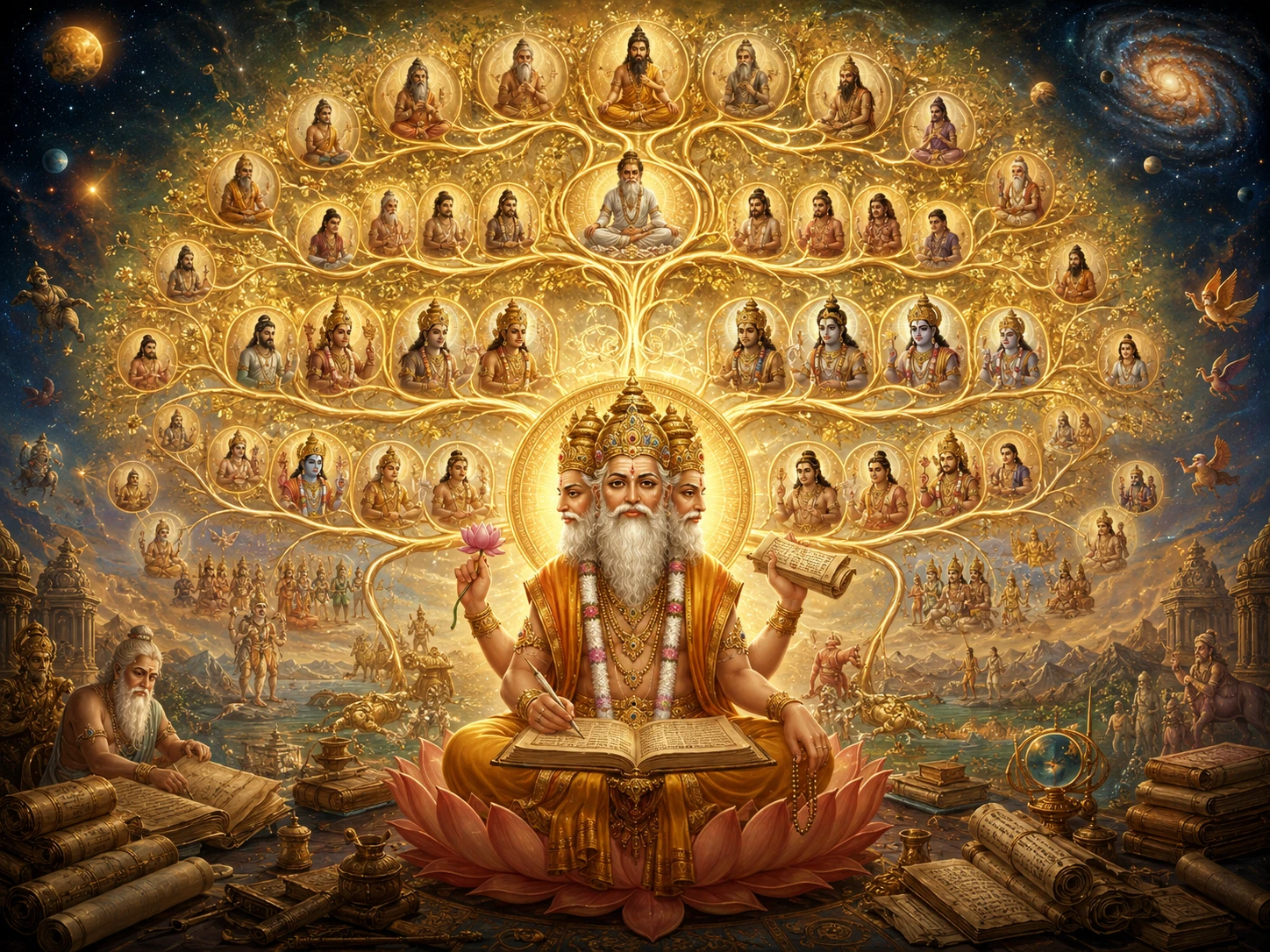
Brahma Vanshavali -- The Complete Hindu Family Tree
ब्रह्मा वंशावली -- सम्पूर्ण हिन्दू वंश वृक्ष
When you read the Mahabharata or the Ramayana for the first time, the cast feels infinite. Hundreds of named warriors. Dozens of rishis. Devas and asuras whose names blur after the first chapter. Most readers give up trying to keep track and just follow the lead characters. The result is a perpetual feeling of catching only fragments of a story too large to hold.
The Vanshavali tree fixes that. It is the master genealogy of Hindu civilisation, drawn directly from the Vishnu Purana, the Bhagavata Purana, and the Mahabharata's Adi Parva. Two hundred and nine named beings. Ten generations. One single ancestor at the root -- Brahma, sitting on the lotus that grew from Vishnu's navel.
Every character you have heard of is in this tree. Krishna is here, with his grandfather Yadu and his great-great-grandson Vajra. Rama is here, with his ancestor Ikshvaku and his sons Lava and Kusha. Ravana is here, in the Pulastya branch with his half-brother Kubera. The Pandavas are here, with Vyasa as their biological great-grandfather. Hiranyakashipu, Prahlada, and Bali are here, sharing a father with Indra by way of two sister-wives. The Sanatkumaras are here, eternally five years old. Even your gotra is here, traced back to one of the seven or eight founding rishis whose names you say in every Sankalp.
The tree below is the visualisation that ships inside the Eternal Raga app. Tap any node to expand its descendants. Pinch or scroll to zoom. Drag to pan. Switch between English and Hindi labels using the language toggle. When you find yourself in an unfamiliar branch, follow the parent connections back to the root. You will reach Brahma in fewer than ten taps every single time.
Tree Categories -- Colour Legend and Sample Members
| Category | श्रेणी | Colour | Sample Members | Count in Tree |
|---|---|---|---|---|
| Creator | स्रष्टा | Gold | Brahma, Saraswati | 2 |
| Prajapati | प्रजापति | Burnt Orange | Marichi, Atri, Daksha, Vasishtha, Bhrigu, Narada | 16 |
| Celibate Rishi | ब्रह्मचारी ऋषि | Pale Gold | Sanaka, Sananda, Sanatana, Sanatkumara | 4 |
| Rishi | ऋषि | Brown | Vyasa, Parashara, Jamadagni, Brihaspati, Drona | 15 |
| Rishi Consort | ऋषि पत्नी | Dusty Rose | Anasuya, Renuka, Lopamudra, Arundhati | 19 |
| Deva | देव | Sky Blue | Indra, Surya, Vayu, Yama, Ashvins | 33 |
| Avatar | अवतार | Saffron | Rama, Krishna, Parashurama, Dattatreya, Kalki | 9 |
| Asura | असुर | Deep Red | Hiranyakashipu, Hiranyaksha, Bali, Virochana | 7 |
| Rakshasa | राक्षस | Darker Red | Ravana, Kumbhakarna, Vibhishana, Surpanakha | 9 |
| Naga | नाग | Teal | Vasuki, Takshaka, Adi Shesha, Kaliya | 6 |
| Apsara | अप्सरा | Pink | Anjana (Hanuman's mother) | 1 |
| Asura Bhakta | असुर भक्त | Violet | Prahlada (Vishnu devotee in asura clan) | 2 |
| Human Dynasty | मानव वंश | Green | Pandavas, Kauravas, Rama, Ikshvaku, Kuru, Yadu | 80 |
| Lineage Bridge | वंश सेतु | Grey | Compressed multi-generation chains in Solar/Paurava/Yadava lines | 3 |
Categories total 209 nodes. Lineage-bridge nodes are placeholder compressions used to skip 25-60 generation chains in the Solar Dynasty (Ikshvaku to Dasharatha), Paurava Dynasty (Puru to Shantanu), and Yadava Dynasty (Yadu to Vasudeva) without bloating the visualisation.
Of the 209 nodes in this tree, 99 are flagged as notable -- meaning a typical educated Indian will recognise the name without explanation. The remaining 110 are the connective tissue: the wives, the half-sisters, the lesser-known sons whose only narrative role is to bridge between two famous figures. Without these 110 connectors, almost every famous-name lineage path would break. Vyasa would not connect to the Pandavas without Satyavati. Krishna would not connect to Atri-line cosmology without Yadu. The forgotten members of the family hold the famous ones together.
Read the Companion Article -- Brahma's Creation Lineage
The prose narrative companion piece walks through the three creation attempts and the most consequential branches in detail. This visualisation is the map. The companion article is the journey.
Tags
Eternal Raga · शाश्वत राग
Institutional voice — scholarly articles on Sanatan Dharma
Deepen Your Understanding
अपनी समझ और गहरी करें
scriptural exegesis
Brahma's Children -- The First Generation of Creation
Brahma tried three times to populate the universe. First he created four sons who refused to reproduce and became monks. Then he got so angry that Rudra burst from his forehead. Finally he created ten Prajapatis from his mind -- and through them, every god, demon, human, animal, and plant in existence traces its origin. This is the original org chart of the cosmos.
vedic sciences
Kaal Ganana -- The Hindu Measure of Time
From a single blink of the eye (Nimesha) to one Day of Brahma (4.32 billion years) -- explore the complete cosmic time hierarchy of Hindu cosmology, anchored in Vishnu Purana 1.3, with its remarkable parallels to modern science.
Of the 209 nodes in this tree, 99 are flagged as notable -- meaning a typical educated Indian will recognise the name without explanation. The remaining 110 are the connective tissue: the wives, the half-sisters, the les…
More in Scriptural Exegesis
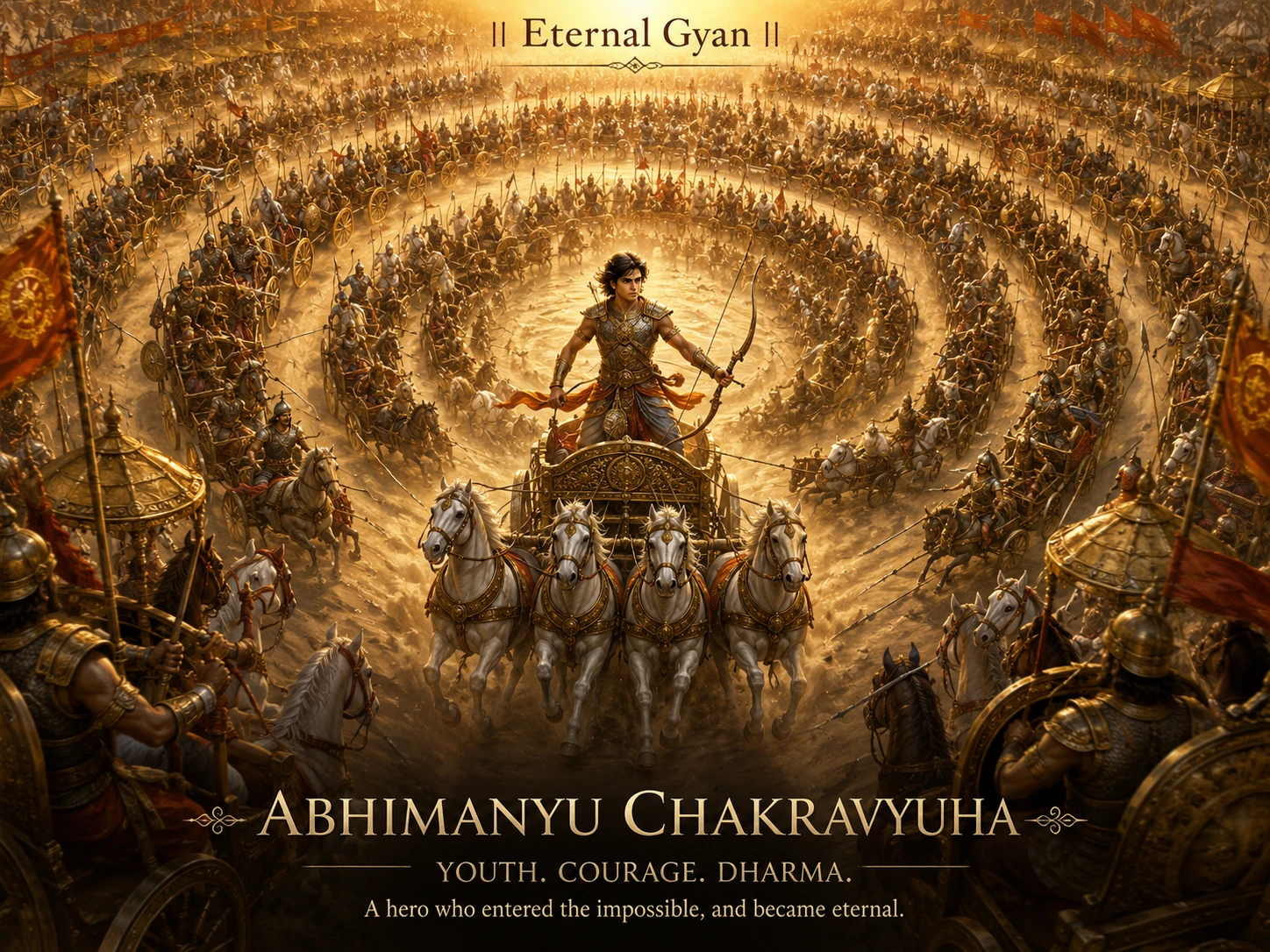
Abhimanyu and the Chakravyuha -- The Boy Who Knew How to Enter but Not How to Leave
14 min read
Adbhuta Ramayana -- The Ramayana Where Sita Becomes Kali
9 min read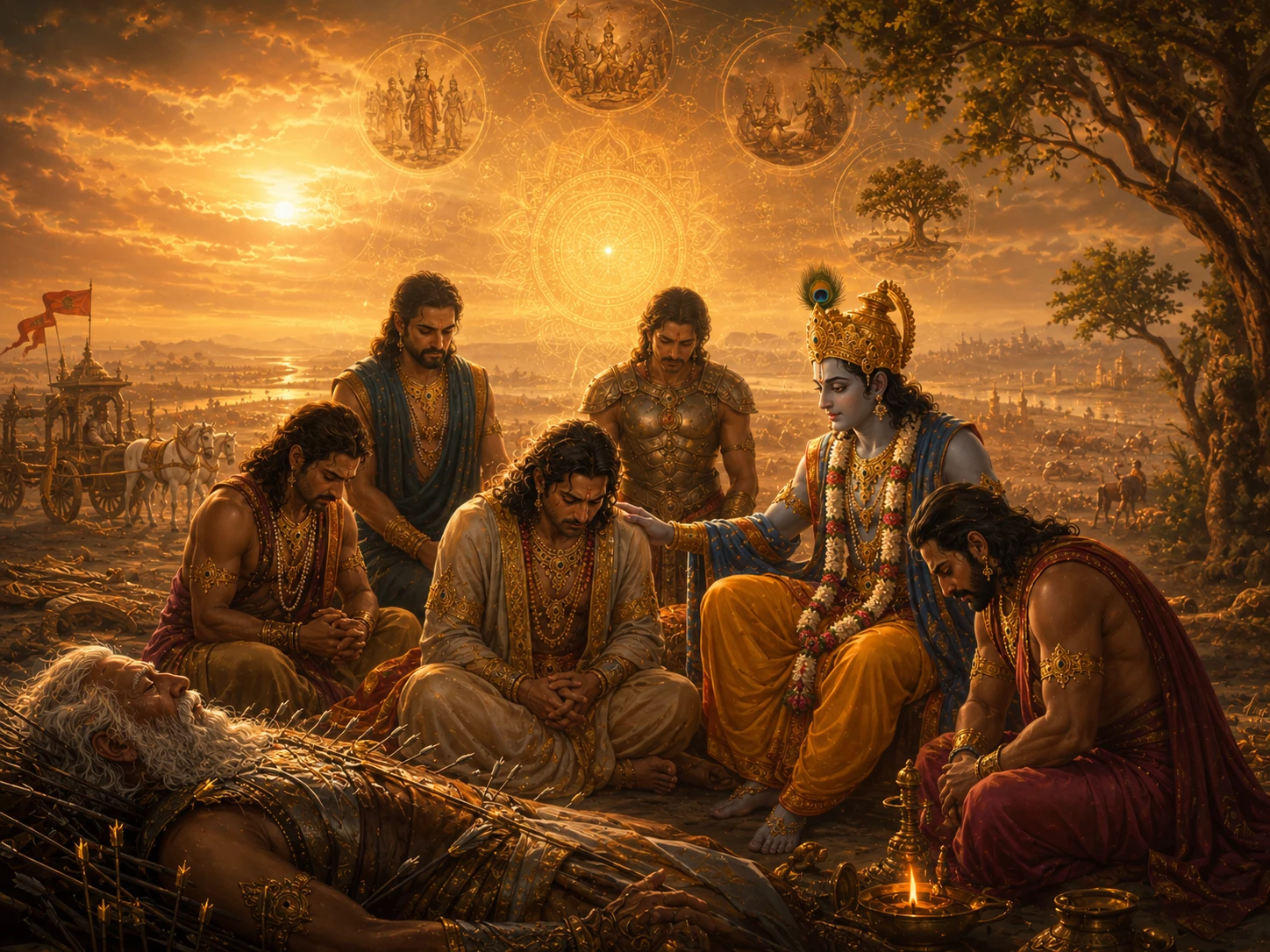
After Kurukshetra -- What Happened Next
14 min readThe same translation error that turned '33 Koti' into '33 crore' in Hinduism also happened in Buddhism. The Chinese translation of Buddhist texts rendered 'Sapta Koti Buddha' (7 Supreme Buddhas) as '7 Crore Buddhas.' The…
Deities AvatarsCommunity Reflections
🕉️
Be the first to share your reflection.