
Kanda Puranam -- The Tamil Epic That Is Not the Skanda Purana, Though It Comes From It
कन्द पुराणम् -- वह तमिल महाकाव्य जो स्कन्द पुराण नहीं है, यद्यपि वह उससे आता है
The single most common point of confusion around this text is worth clearing up before anything else: Kanda Puranam is not the Sanskrit Skanda Purana, the sprawling Maha Purana covered elsewhere on this site. It is a Tamil work, composed independently by the poet Kachiyappar (also written Kachiappa Sivachariyar), that draws on Skanda Purana material -- particularly its Murugan-centred episodes -- and retells it as its own sustained literary composition in Tamil verse, following Tamil poetic conventions rather than translating the Sanskrit text line by line. The two works share subject matter and a shared name, kanda and skanda both referring to the deity also called Murugan or Kartikeya, and that shared name is exactly why the confusion recurs so often. But a reader who wants the Sanskrit Skanda Purana's own khanda-by-khanda structure, its Kashi Khanda or its Sri Saila Khanda, is looking for a different text than the one this article covers.
Kanda Puranam is, in its own right, one of the major works of Tamil Shaiva and Murugan-devotional literature -- a six-part composition running to roughly thirteen thousand verses, traditionally understood as a retelling of Murugan's mythology drawn from a Sanskrit source Kachiyappar's own tradition names as the Skanda Purana's Sanat Kumara Samhita or a closely related text, though the precise Sanskrit source he actually worked from is not preserved in a form scholars can check verse against verse. What survives and matters is the Tamil work itself: independently composed, still recited today, and treated by Tamil Shaiva communities not as a translation to be checked against an original but as a scripture in its own standing.
Kachiyappar's own biography and dating are, honestly, some of the most tangled details in Tamil literary history, and it is worth naming the tangle rather than smoothing it into false confidence. Traditional devotional accounts, drawing on a colophon in Kachiyappar's own preface, state that he completed the work in the Saka year 700, corresponding to 778 CE, which would place him in the eighth century. Other devotional sources describe him more vaguely as having lived '1,100 years ago' from the point of writing, a phrase that points toward a similar early date without pinning it down. Set against these traditional claims, most modern historians of Tamil literature place Kachiyappar considerably later, in the fourteenth century, closer to the Vijayanagara period -- a dating this site follows in its companion article on Skanda Shashthi -- based primarily on the grammar, vocabulary, and poetic conventions of the Tamil the Kanda Puranam is actually written in, which read as medieval rather than as the Tamil of the eighth century.
This is a genuinely open question rather than a settled one, and readers should treat any single confident date with appropriate caution. What is agreed across both traditional and scholarly accounts is the place: Kachiyappar was a Shaivite priest attached to the Kumara Kottam Murugan shrine within the Ekambareswarar temple complex at Kanchipuram, and tradition holds that he composed the Kanda Puranam there under a striking devotional frame. Murugan himself is said to have appeared to Kachiyappar in a dream, commissioning the Tamil work and dictating its opening line; each day, the story goes, Kachiyappar wrote a further portion and left it overnight at the shrine, and each morning found it corrected in the deity's own hand. Whatever the historical basis for that specific legend, it signals plainly how the Tamil Shaiva tradition itself frames the text's authority -- not as a scholar's translation project but as a directly commissioned, divinely supervised composition.
The Kanda Puranam is organised into six kandams, or sections, that trace a continuous arc: Urpatti Kandam covers the divine background and origins leading up to Murugan's birth; Asura Kandam and Mahendra Kandam narrate the tyranny of the asura Surapadman and his brothers over the three worlds and the devas' desperate appeal for a deliverer; Devakanda Kandam narrates Murugan's birth and childhood; Yudha Kandam (sometimes folded together with the surrounding sections under varying names in different editions) carries the war against Surapadman to its climax in Soorasamharam, Murugan's defeat and transformation of the demon; and a closing Dakshakanda-style section handles subsequent episodes, including material connected to Daksha. The exact segmentation and naming of the six kandams varies slightly across printed editions and manuscript traditions, which is itself unsurprising for a text this size transmitted across seven centuries or more, but the overall arc -- tyranny, birth, war, and resolution -- is consistent.
The text's centrepiece, and the portion most familiar to ordinary devotees regardless of whether they have read the rest of the work, is its account of the war against Surapadman and its resolution: rather than simply killing the demon outright, Murugan's Vel splits him in two, and the halves are transformed into a peacock, who becomes Murugan's own mount, and a rooster, who is placed on his battle standard. Eternal Raga's article on Skanda Shashthi already covers this Soorasamharam narrative and its annual six-day ritual re-enactment at Tiruchendur in detail, drawing on the Kanda Puranam as its primary textual source; this article's job is to place that famous episode inside the larger six-kandam structure it belongs to, rather than retell the episode itself a second time.
Kanda Puranam vs the Sanskrit Skanda Purana -- Not the Same Text
| Kanda Puranam | Sanskrit Skanda Purana | |
|---|---|---|
| Language | Tamil | Sanskrit |
| Traditional author | Kachiyappar (Kachiappa Sivachariyar), a named historical poet | Attributed to Vyasa, per general Puranic convention |
| Dating | Contested: traditional colophon claims 778 CE; most Tamil literary historians place the poet closer to the 14th century | Oldest attested core c. late 6th - early 7th century CE; the vast regionally-expanded compilation grew over the following 6-8 centuries |
| Structure | Six kandams (sections), roughly 13,305 verses, focused almost entirely on Murugan's mythology | Multiple khandas (Maheshvara, Vaishnava, Kashi, Sri Saila, and others), covering many deities and sacred sites across the subcontinent, exceeding 81,000 verses |
| Relationship between the two | An independent Tamil literary composition drawing on Skanda Purana material, not a direct line-by-line translation | The Sanskrit source tradition Kachiyappar's own text names as its inspiration |
Sharing the name Skanda/Kanda (both referring to the deity Murugan-Kartikeya) is the main reason the two texts are commonly confused; they are read, transmitted, and recited as entirely separate scriptures within their respective traditions.
Kachiyappar's Kanda Puranam is not the only significant retelling of Murugan's mythology in Tamil; an earlier and shorter version, sometimes called the Kandapuranam of Paranjothi Munivar, circulated before Kachiyappar's fuller work and is occasionally distinguished from it in specialist literature, though Kachiyappar's version became by far the more widely transmitted and recited of the two. The composition hall traditionally identified as the site where Kachiyappar wrote the text, within the Ekambareswarar-Kumara Kottam temple complex at Kanchipuram, is still shown to visitors today as a marker of the text's local, place-specific origin story -- much as the Kashi Khanda's chapters remain tied to specific ghats and wells in Varanasi.
What keeps the Kanda Puranam alive today is not manuscript scholarship but recitation. During Skanda Shashthi, the six-day fast and festival culminating in Tiruchendur's Soorasamharam re-enactment, temples and households across Tamil Nadu, Sri Lanka, and the Tamil diaspora hold group parayanam, sustained public readings of the Kanda Puranam's chapters, working through the birth, the war, and the resolution in the same sequence the text lays them out, so that the six days of ritual observance track the six kandams of the poem itself. Kartikeya-Murugan's own article on this site notes that the 1008 names of Subrahmanya collected within the Sanskrit Skanda Purana exist in Sanskrit, while Kachiyappar's Kanda Puranam preserves the parallel Tamil devotional tradition alongside it -- two related but genuinely separate textual lineages, each still actively read, neither one simply a copy of the other.
That living recitation practice is the clearest evidence that the confusion between the two texts, while understandable given the shared name, does real disservice to both. The Sanskrit Skanda Purana is a vast, composite, pan-Indian mahatmya collection whose individual khandas, including Kashi Khanda and Sri Saila Khanda, glorify dozens of sacred sites having little to do with each other. Kachiyappar's Kanda Puranam is a focused, independently composed Tamil epic with one subject, Murugan, and one continuous emotional arc, from a world under a demon's tyranny to a war concluded not in annihilation but in transformation. Both deserve to be read on their own terms, and neither should stand in for the other.
Tags
Eternal Raga · शाश्वत राग
Institutional voice — scholarly articles on Sanatan Dharma
Deepen Your Understanding
अपनी समझ और गहरी करें
deities avatars
Kartikeya (Murugan) -- The Commander of the Devas
Six faces, twelve arms, a spear of light, and a peacock that was once a demon. Kartikeya is the warrior god Tamil Nadu calls Murugan, the one teenagers in Chennai pray to before JEE, and the one a million devotees climb Batu Caves for during Thaipusam. His story is the story of how anger becomes discipline.
rituals traditions
Skanda Shashthi -- Six Days, One Battle, and the Spear That Ends It
For six days every year, mainly across Tamil Nadu, temples re-enact a war. Kartikeya, the six-faced commander son of Shiva whom Eternal Raga's Kartikeya-Murugan article covers in full, is not this article's subject. Skanda Shashthi is: the fast, the six escalating days, and the climactic sixth-day ritual called Soorasamharam, in which Murugan's defeat of the demon Soorapadman is performed on a seashore stage at Tiruchendur before crowds that can exceed half a million people.
scriptural exegesis
Skanda Purana's Sri Saila Khanda -- One Mountain, Its Own Section of the Longest Purana
Very few temples in India can point to an entire section of scripture written for them alone. Srisailam can. The Skanda Purana -- at over 81,000 verses, the largest of the eighteen Maha Puranas -- devotes a full khanda to this one Andhra mountain. This article is about that text: what a khanda is, what mahatmya literature does, and how the Skanda Purana became the size it is.
scriptural exegesis
Kashi Khanda -- The Text That Made Varanasi a Scripture, Not Just a City
No city in the Hindu world has more scripture written about it than Varanasi. The Kashi Khanda, a section of the Skanda Purana running to roughly a hundred chapters, is the largest single work of city-mahatmya literature in the Puranic canon. This article is about that text -- its structure, its composite history, and what modern manuscript scholarship has found underneath it -- not about the temple or the pilgrimage, which this site covers elsewhere.
scriptural exegesis
What Are the Puranas? -- The Five Marks, the Eighteen Texts, and Why None of Them Had One Author
Everyone who reads about the Markandeya Purana, the Shiva Purana, or the Bhagavata Purana on this site eventually asks the more basic question: what is a Purana, actually? This article answers it -- the traditional five marks a text needs to count as one, the canonical list of eighteen Maha Puranas plus the looser Upapurana category beside it, and the honest scholarly picture of how these composite, centuries-in-the-making texts actually came together.
Kachiyappar's Kanda Puranam is not the only significant retelling of Murugan's mythology in Tamil; an earlier and shorter version, sometimes called the Kandapuranam of Paranjothi Munivar, circulated before Kachiyappar's …
More in Scriptural Exegesis
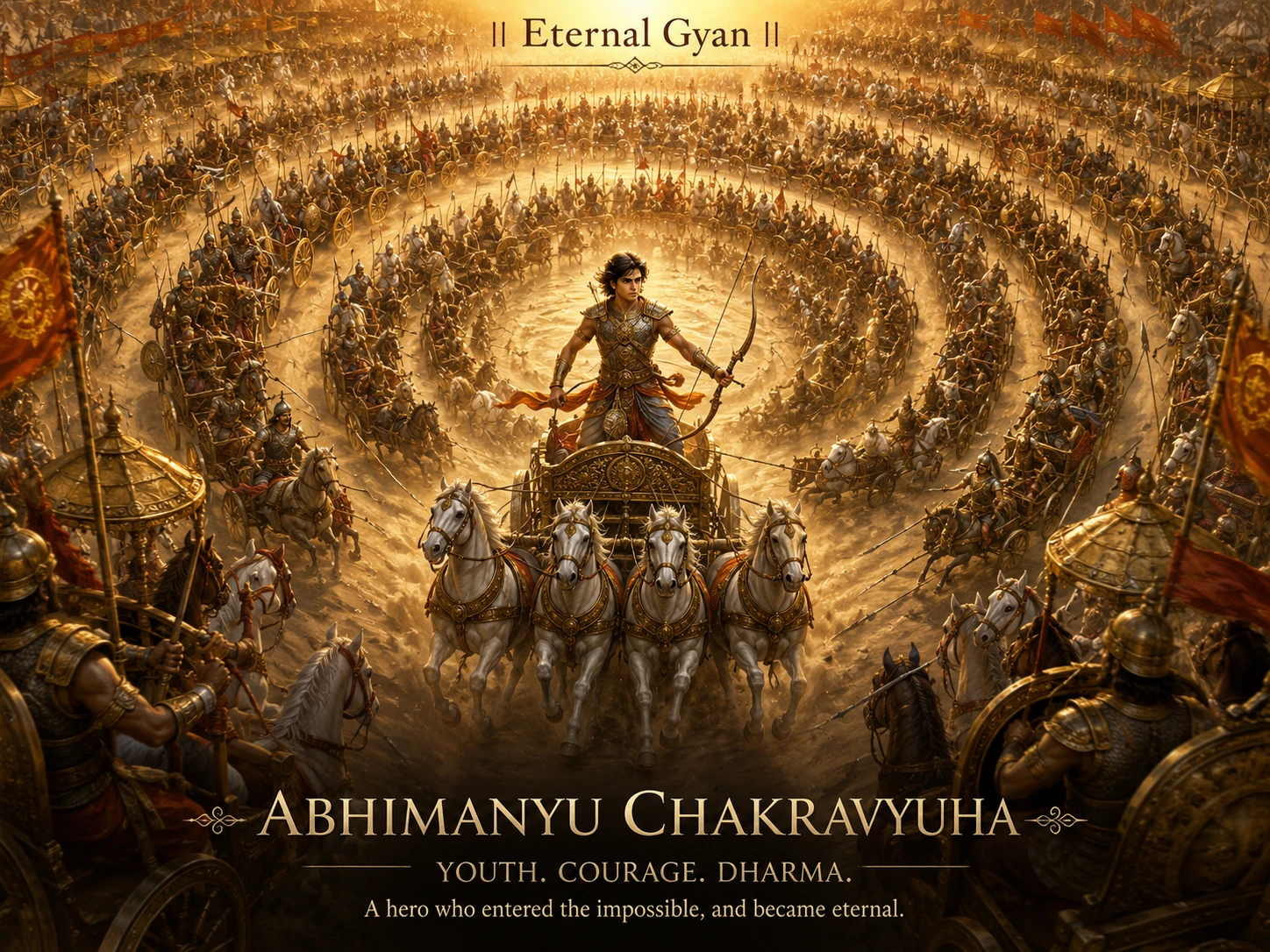
Abhimanyu and the Chakravyuha -- The Boy Who Knew How to Enter but Not How to Leave
14 min read
Adbhuta Ramayana -- The Ramayana Where Sita Becomes Kali
9 min read
After Kurukshetra -- What Happened Next
14 min readThe same translation error that turned '33 Koti' into '33 crore' in Hinduism also happened in Buddhism. The Chinese translation of Buddhist texts rendered 'Sapta Koti Buddha' (7 Supreme Buddhas) as '7 Crore Buddhas.' The…
Deities AvatarsCommunity Reflections
🕉️
Be the first to share your reflection.