
What Are the Puranas? -- The Five Marks, the Eighteen Texts, and Why None of Them Had One Author
पुराण क्या हैं? -- पाँच लक्षण, अठारह ग्रन्थ, और इनमें से किसी का भी एक रचयिता क्यों नहीं था
Purana means, roughly, 'ancient lore' or 'that which is old,' and it names one of the largest and least uniform categories in the entire Hindu scriptural corpus. Readers who arrive at this site's individual Purana articles -- on the Markandeya Purana's talking-birds frame story, the Shiva Purana's disputed place on its own canonical list, the Linga Purana's account of why Shiva is worshipped as a formless pillar, the Bhagavata Purana's theology of devotion, or the Kalika Purana's place among the secondary Upapuranas -- eventually run into the same more basic question each of those articles has to set aside to do its own job: what actually makes a text a Purana in the first place, and how many of them are there? This article is that orienting piece. Read it before or after any specific Purana article on this site; either order works, because the point here is the shape of the genre, not the content of any one text inside it.
The short answer, which the rest of this article unpacks, is that a Purana is traditionally defined not by a single story or deity but by a set of five recurring topics it is expected to cover, that eighteen texts are conventionally recognised as the great or 'Maha' Puranas, that a looser and less agreed-upon set of Upapuranas sits alongside them, and that modern textual scholarship treats every one of these works -- without exception -- as a composite product of many hands across many centuries rather than the output of a single author at a single sitting. None of this makes the Puranas less important to the traditions that hold them sacred. It describes, honestly, what living scripture assembled across a very long span of time actually looks like once anyone goes looking closely at its edges.
The traditional definition of a Purana runs through five characteristics, pancha-lakshana, most often traced to a verse preserved in several Puranas themselves and repeated in the classical lexicon Amarakosha. A text earns the name Purana, in this framework, by covering: sarga, the creation of the universe; pratisarga, its periodic dissolution and re-creation; vamsha, the genealogies of gods, sages, and royal lines; manvantara, the great cosmic ages, each presided over by a Manu, the progenitor of humanity for that era; and vamshanucharita, the continuing histories and deeds of the dynasties descended from those genealogies. Read this list against any specific Purana on this site and the pattern becomes visible immediately -- the Markandeya Purana devotes roughly forty chapters to exactly this kind of manvantara and genealogical material before and after its famous Devi Mahatmya section, precisely because a Maha Purana was never meant to be only a story collection.
It is worth stating plainly, in the same honest spirit this site brings to dating questions, that the five-fold definition describes an ideal template more than a strict checklist every Purana satisfies in full. Some Puranas lean heavily into one or two of the five categories and touch the others only briefly; others, particularly the later and more devotionally focused texts such as the Bhagavata Purana, wrap philosophy, hymn, and detailed narrative theology around the traditional five-part frame rather than organising themselves strictly by it. The pancha-lakshana is best understood as the genre's founding blueprint, present in some form in every text that claims the name, rather than a rigid formula that predicts a given Purana's actual table of contents chapter for chapter.
Eighteen texts are conventionally named the Maha Puranas, the great Puranas, and this list is one of the more stable pieces of the whole tradition, repeated with only minor variation across most later Puranic sources: Brahma, Padma, Vishnu, Vayu (sometimes replaced by or paired with Shiva in some regional lists), Bhagavata, Naradiya, Garuda, Markandeya, Agni, Bhavishya, Brahmavaivarta, Linga, Varaha, Skanda, Vamana, Kurma, Matsya, and Brahmanda. Some medieval lists substitute the Shiva Purana for the Vayu Purana or include both under slightly different names, and the Shiva Purana's own article on this site covers that specific disputed case in detail -- one of several places where the tidy number eighteen turns out to hide real manuscript-level disagreement about which text belongs on it.
Orthodox tradition attributes all eighteen to a single author, the sage Vyasa, in the same way it attributes the Mahabharata to him -- a claim that functions, across Hindu tradition, more as a statement of the Puranas' unified religious authority than as a historical record a manuscript scholar could verify chapter by chapter. Below the eighteen Maha Puranas sits a second, looser tier: the Upapuranas, or secondary Puranas, traditionally also numbered at eighteen but far less stable a set, since different sources naming the Upapuranas frequently disagree with each other about which texts belong on the list. The Kalika Purana, covered in its own article on this site, is a well-known example, generally placed twelfth on the Upapurana list preserved in the Kurma Purana, and valued in its own right as the textual source for much of the ritual detail surrounding Kamakhya worship, regardless of its secondary formal status.
The Eighteen Maha Puranas
| Purana | Primary Deity / Focus | Covered on Eternal Raga |
|---|---|---|
| Brahma Purana | Brahma; Odisha regional material | Not yet covered as a standalone article |
| Padma Purana | Vishnu; creation and cosmology | Not yet covered as a standalone article |
| Vishnu Purana | Vishnu; genealogy and dynastic history | Not yet covered as a standalone article |
| Vayu Purana | Shiva-centred; disputed against Shiva Purana on some lists | Not yet covered as a standalone article |
| Bhagavata Purana | Krishna; bhakti as a complete path | Bhagavata Purana Overview |
| Naradiya Purana | Vishnu; dharma and pilgrimage instruction | Not yet covered as a standalone article |
| Garuda Purana | Vishnu; death rites and the afterlife | Not yet covered as a standalone article |
| Markandeya Purana | Frame narrative; houses the Devi Mahatmya | Markandeya Purana |
| Agni Purana | Encyclopedic; ritual, polity, poetics | Not yet covered as a standalone article |
| Bhavishya Purana | Prophecy and future ages | Not yet covered as a standalone article |
| Brahmavaivarta Purana | Krishna and Radha | Not yet covered as a standalone article |
| Linga Purana | Shiva as the formless linga | Linga Purana |
| Varaha Purana | Vishnu's boar avatar | Not yet covered as a standalone article |
| Skanda Purana | Kartikeya; the largest Purana, built from regional khandas | Sri Saila Khanda; Kashi Khanda |
| Vamana Purana | Vishnu's dwarf avatar | Not yet covered as a standalone article |
| Kurma Purana | Vishnu's tortoise avatar | Not yet covered as a standalone article |
| Matsya Purana | Vishnu's fish avatar | Not yet covered as a standalone article |
| Brahmanda Purana | Cosmic egg cosmology | Not yet covered as a standalone article |
Some medieval lists substitute the Shiva Purana for the Vayu Purana; this table follows the most commonly cited modern sequence. Eternal Raga's coverage of individual Puranas is ongoing, and this table will be updated as more are added.
The distinction between Maha Purana and Upapurana is itself less ancient and less firm than the two-tier system suggests. The scholar Ludo Rocher, in his standard reference survey of the genre, notes that the term Maha Purana appears only rarely within Puranic literature itself and is probably a comparatively late addition to the tradition's own vocabulary, and that there is little firm evidence the eighteen Upapuranas were ever treated as meaningfully less authoritative or less widely known than their eighteen Maha Purana counterparts during the centuries both categories were actively read and recited. The two-tier hierarchy familiar today may say more about how later cataloguers organised the corpus than about how earlier audiences actually ranked these texts against each other.
The most important thing to carry away from all of this is the one point every individual Purana article on this site returns to in its own way: none of these eighteen-plus-eighteen texts is a single-authored, single-moment composition, whatever the Vyasa attribution claims. Modern manuscript scholarship, working text by text, has found the same underlying pattern almost everywhere it has looked closely. The Markandeya Purana carries an early narrative core dated by Wendy Doniger to roughly 250 CE, with its famous Devi Mahatmya section layered in some three centuries later. The Skanda Purana's oldest attested core, reconstructed by the Skandapurana Project from early Nepalese manuscripts, is a shorter and substantially different text from the vast regional compilation, including the Kashi Khanda and Sri Saila Khanda, that grew up around its name over the following six to eight centuries. The Shiva Purana's own claim to a place among the eighteen is itself contested in some medieval lists. This is not a pattern of a few damaged or unusually late texts among otherwise pristine ancient originals. It is the ordinary condition of the genre: living scripture, orally rooted and continuously copied by hand across a subcontinent and a couple of thousand years, accumulating material the way every long-lived oral-and-written tradition does.
None of this diminishes the Puranas within the traditions that hold them sacred, any more than the composite, centuries-long history of the Mahabharata diminishes its epic, or the layered compositional history of the Rigveda's tenth mandala diminishes the philosophical force of its creation hymns. It describes, accurately, what a scripture built by many hands actually looks like once anyone goes looking for its edges -- and it is the honest starting point for reading any single Purana on its own terms, rather than as a monolith it never claimed to be.
Tags
Eternal Raga · शाश्वत राग
Institutional voice — scholarly articles on Sanatan Dharma
Deepen Your Understanding
अपनी समझ और गहरी करें
scriptural exegesis
Markandeya Purana -- The Text Behind the Devi Mahatmya, and Everything Else It Contains
Most people who chant the Devi Mahatmya every Navratri have never opened the book it comes from. The Markandeya Purana houses that famous section, yes -- but it also opens with four unanswered questions put to talking birds, spends thirty-seven chapters on cosmic time-cycles, and closes with the story of a king who sold his wife to keep a promise. This is the rest of the book.
scriptural exegesis
Linga Purana -- The Text That Explains Why Shiva Has No Face
Most Hindu deities are worshipped as a face, a figure, a story frozen in stone. Shiva, in his most common temple form, is worshipped as a plain cylindrical pillar. The Linga Purana is the text that argues this absence of form is the point -- that a shape without a face is the only honest way to represent something too vast to be measured, let alone depicted.
scriptural exegesis
Shiva Purana -- The Shaiva Mahapurana Whose Own Place on the List Is Disputed
Ask which eighteen texts make up the Maha Puranas and most lists will name the Shiva Purana without hesitation. Ask a Sanskritist who has actually compared manuscripts, and some will tell you the Vayu Purana belongs in that slot instead, and that the two texts were confused with each other for over a century. What is not in dispute is what the Shiva Purana actually argues: that Shiva is the formless absolute behind everything, and the linga is the one honest way to worship him.
scriptural exegesis
Kalika Purana -- The Upapurana That Wrote Down How Kamakhya Is Worshipped
The Kalika Purana is not one of the eighteen Maha Puranas, and getting that right matters. It is an Upapurana, a secondary text, twelfth on the list preserved in the Kurma Purana, from a category so loosely canonized that one scholar counted twenty-three competing lists of what the eighteen Upapuranas even are. What it lacks in Maha Purana status it makes up in influence: it is the founding scripture behind Kamakhya's worship, and the source of the Rudhiradhyaya, the chapter that first wrote down how Shakta blood offering is performed.
scriptural exegesis
Bhagavata Purana -- The Text That Made Devotion a Complete Path
Eighteen thousand verses, twelve cantos, and one argument running through all of them: that loving devotion to a personal God is not a lesser path than philosophical knowledge, but a complete one on its own terms. The Bhagavata Purana gives Krishna's life its fullest telling, especially in its famous tenth canto, and builds around it a case for bhakti that reshaped Hindu devotion for a thousand years. Tradition credits Vyasa. The manuscript evidence tells a more complicated, more interesting story.
scriptural exegesis
Skanda Purana's Sri Saila Khanda -- One Mountain, Its Own Section of the Longest Purana
Very few temples in India can point to an entire section of scripture written for them alone. Srisailam can. The Skanda Purana -- at over 81,000 verses, the largest of the eighteen Maha Puranas -- devotes a full khanda to this one Andhra mountain. This article is about that text: what a khanda is, what mahatmya literature does, and how the Skanda Purana became the size it is.
scriptural exegesis
Kashi Khanda -- The Text That Made Varanasi a Scripture, Not Just a City
No city in the Hindu world has more scripture written about it than Varanasi. The Kashi Khanda, a section of the Skanda Purana running to roughly a hundred chapters, is the largest single work of city-mahatmya literature in the Puranic canon. This article is about that text -- its structure, its composite history, and what modern manuscript scholarship has found underneath it -- not about the temple or the pilgrimage, which this site covers elsewhere.
scriptural exegesis
Shastra Vriksha -- The Complete Map of Hindu Scriptures
Vedas, Upanishads, Puranas, Gita -- everyone has heard these names, but almost nobody knows how they connect to each other. Shastra Vriksha is the GPS of Hindu scripture -- a single interactive tree that maps every major text, from the root of the four Vedas to the 126 catalogued Gitas, and finally makes the whole system click.
scriptural exegesis
The Mahabharata -- The Text Behind the World's Longest Epic
Most people who say they have read the Mahabharata mean they have read a retelling of the dice game, the exile, and Kurukshetra. Few have asked how the book itself is built: eighteen numbered parvas, a traditional count of one hundred thousand verses, and a story that reaches every reader through three narrators nested inside one another, the outermost speaking at a sacrifice convened because a king's father died of snakebite. This is that architecture, not the episodes.
The distinction between Maha Purana and Upapurana is itself less ancient and less firm than the two-tier system suggests. The scholar Ludo Rocher, in his standard reference survey of the genre, notes that the term Maha P…
More in Scriptural Exegesis
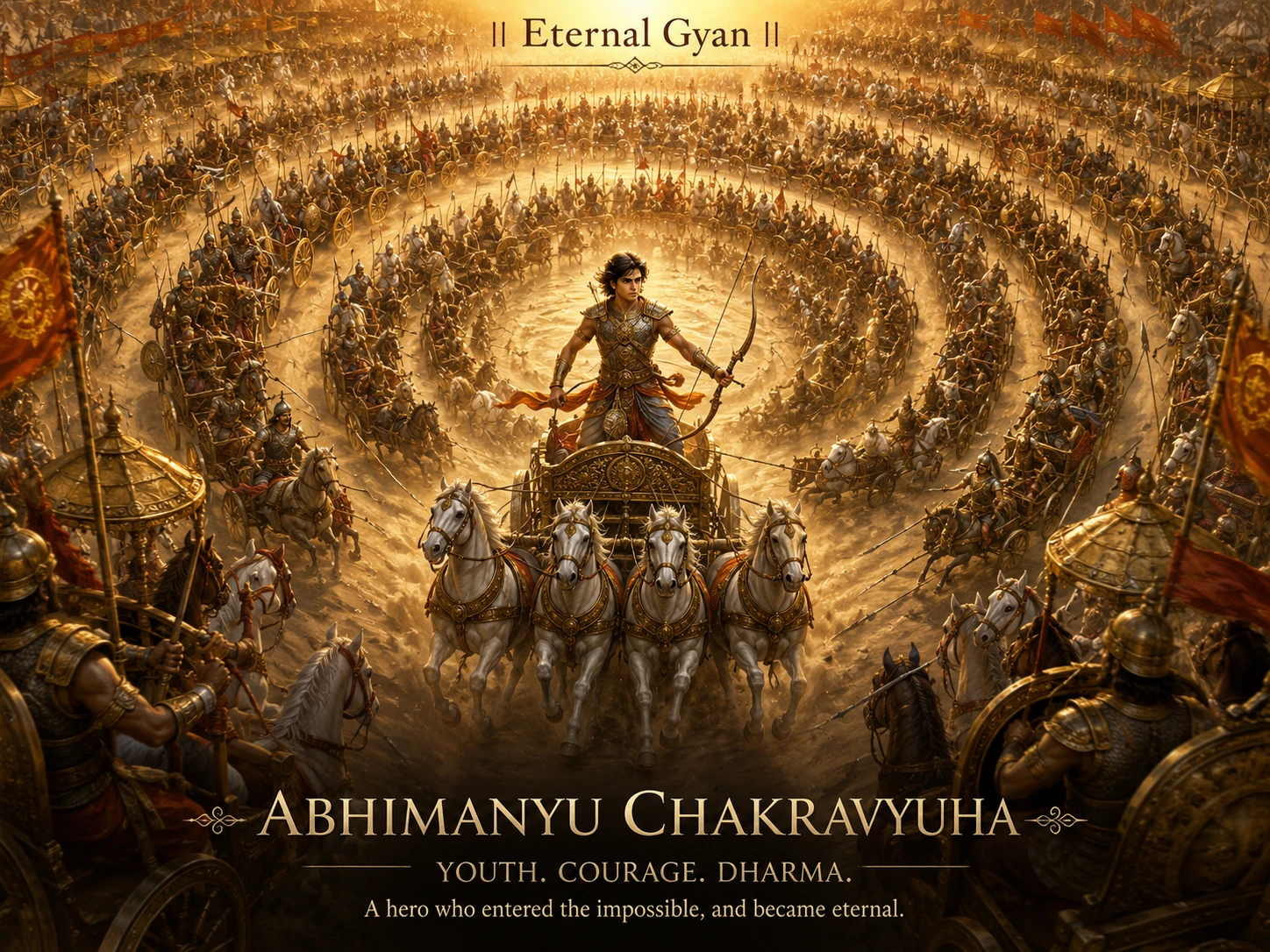
Abhimanyu and the Chakravyuha -- The Boy Who Knew How to Enter but Not How to Leave
14 min read
Adbhuta Ramayana -- The Ramayana Where Sita Becomes Kali
9 min read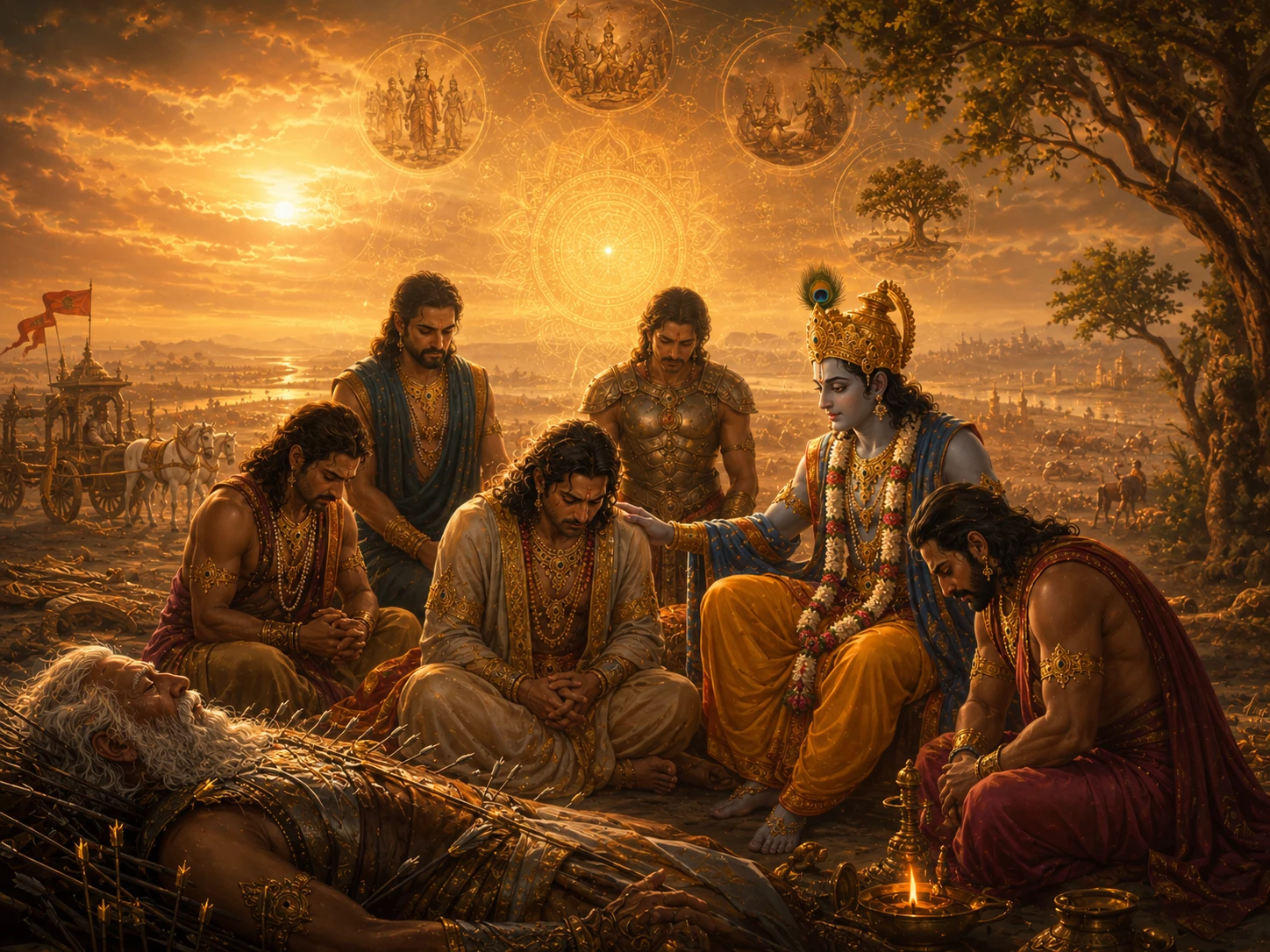
After Kurukshetra -- What Happened Next
14 min readThe same translation error that turned '33 Koti' into '33 crore' in Hinduism also happened in Buddhism. The Chinese translation of Buddhist texts rendered 'Sapta Koti Buddha' (7 Supreme Buddhas) as '7 Crore Buddhas.' The…
Deities AvatarsCommunity Reflections
🕉️
Be the first to share your reflection.