
Linga Purana -- The Text That Explains Why Shiva Has No Face
लिंग पुराण -- वह ग्रन्थ जो बताता है शिव का कोई मुख क्यों नहीं
The Linga Purana is one of the eighteen Maha Puranas, and the Shaiva text most directly organised around a single question: why is Shiva worshipped in the form of a linga, an aniconic pillar, rather than as a face and a figure the way most other Hindu deities are approached in temple worship?
The text as it survives runs to roughly 163 chapters, divided into two parts: a Purva-bhaga (earlier section) of 108 chapters and an Uttara-bhaga (later section) that most printed editions give as 55 chapters -- though at least one internal verse (2.55.37) states the Uttara-bhaga contains only 46, a small but telling sign that the text grew and was renumbered at some point in its transmission rather than arriving whole from a single hand.
Within that structure, the Linga Purana covers an unusually wide range for a text ostensibly focused on one symbol: cosmology, the cycle of yugas (world-ages), the fourteen Manvantaras, competing accounts of creation, mythological narrative, sections on astronomy and on yoga, geographical description, guides to tirthas (pilgrimage sites), and material on ethics. This breadth is not a digression from its purpose. It follows the classical five-topic template scholars use to define a purana in the first place -- sarga (creation), pratisarga (secondary creation and dissolution), vamsha (genealogy), manvantara (cosmic ages), and vamshanucharita (dynastic histories) -- and applies that whole encyclopedic frame specifically to Shaiva material, with the theology of the linga as its organising centre.
It is worth stating what the Linga Purana itself says the word linga means, because popular explanation and the text's own framing do not always match. The Purana offers a definitional statement close to this: the distinctive sign by which one can recognise the nature of something is called linga -- linga, in this reading, is closer in meaning to 'sign' or 'mark' than to any single anatomical reference. A trail of smoke is the linga of fire, since it signals fire's presence without being fire itself; in the same way, the pillar-form is presented as the sign that points to Shiva's presence -- the formless made just barely recognisable -- rather than a literal likeness of any part of him.
Honest scholarship holds more than one thread here without needing to pick a single winner. The historical roots of linga worship almost certainly include an older fertility and generative symbolism, well documented in the archaeology and comparative religious history of ancient Shaiva and pre-Shaiva traditions across the subcontinent. The Puranic layer represented by texts like this one builds a further, explicitly metaphysical reading on top of that older symbolism: the linga as an aniconic sign of the unmeasurable absolute, chosen precisely because it refuses the specificity a face or a figure would impose. Both readings are part of the tradition's own layered history; treating either one as the whole story flattens what devotees, priests, and scholars have actually said about the symbol across very different centuries.
The Purana's central mythological argument for the linga's shape is the Lingodbhava episode, a story that also appears, in more elaborated form, in the Shiva Purana. Brahma and Vishnu fall into a dispute over which of them is the greater god. The argument is interrupted by the appearance of a colossal pillar of fire and light with no visible beginning and no visible end. The two gods agree to a test: whoever finds an end to the pillar first will be acknowledged as supreme. Vishnu takes the form of a boar and burrows downward through the cosmos; Brahma takes the form of a swan and flies upward. Both search for what the texts describe as many years. Neither finds an end.
Vishnu returns and admits defeat honestly. Brahma, in the version of the story told across the wider Puranic corpus, does not -- he claims to have reached the top, offering a ketaki flower as false witness to support the claim. The pillar then opens, and Shiva emerges from within it, exposing Brahma's lie and cursing him: that he would never again be worshipped in temples the way other deities are, an outcome still visible today in how few dedicated Brahma temples exist across India compared to the vast numbers dedicated to Vishnu and Shiva.
The theological point of the story is inseparable from its shape. The pillar has no beginning and no end because it stands for something anantatva, without limit, that a bounded human or animal figure could never fully represent without falsely claiming to have measured it. Worshipping Shiva as a linga, in this reading, is not an avoidance of representation. It is a representation that stays honest about its own incompleteness -- the one shape, the tradition argues, that does not pretend to have found the top.
Linga Purana -- Two Bhagas, One Argument
| Section | Chapters | Primary content |
|---|---|---|
| Purva-bhaga (earlier section) | 108 | Creation, cosmology, the Lingodbhava episode, modes of Linga worship, Shiva's mythology, the yugas and Manvantaras, early Shiva-avatara accounts including Nakulisha |
| Uttara-bhaga (later section) | 55 in most editions (one internal verse states 46) | Further cosmological and ritual material, geography and tirtha description, ethical instruction, astronomy and yoga sections |
The chapter-count discrepancy within the text's own verses is itself evidence that the Uttara-bhaga was expanded after the Purva-bhaga had already taken a more settled shape.
The Linga Purana (in its 24th chapter, alongside similar accounts in the Vayu and Kurma Puranas) names Nakulisha, also spelled Lakulisha, as the twenty-eighth and final incarnation of Shiva in the current cycle, appearing as a wandering ascetic who takes four disciples -- Kushika, Garga, Mitra, and Kaurushya -- to revive the worship of Pashupati. This is one of the rare points where Puranic mythology and documented religious history meet directly: Pashupata Shaivism was a real, organised ascetic movement, attested in inscriptions and archaeological remains from roughly the early centuries CE onward, and Lakulisha is treated by modern historians as its most plausible historical founder or reformer, later absorbed into Puranic literature as a divine incarnation.
As with almost every text in the Puranic corpus, the honest answer to 'who wrote the Linga Purana and when' is that no one knows, and the question itself may be slightly wrong-shaped. Scholarly estimates place the text's composition broadly between the 5th and 10th centuries CE, a five-century window that reflects genuine uncertainty rather than a lack of research. Multiple, sometimes conflicting, manuscript versions of the text survive, and internal evidence -- like the chapter-count discrepancy in the Uttara-bhaga noted above -- points to a text that grew, was reorganised, and absorbed new material across generations of transmission rather than one composed at a single sitting by a single author.
This site's article on the Shiva Linga covers the symbol itself: its forms, its place in daily and temple worship, and its practical meaning for a devotee standing in front of one. This article's job has been narrower and more textual -- to describe what the Linga Purana actually contains as a book, chapter by chapter, and to state plainly what can and cannot be known about when it was written. The two pieces of information belong together, but they are not the same question.
Tags
Eternal Raga · शाश्वत राग
Institutional voice — scholarly articles on Sanatan Dharma
Deepen Your Understanding
अपनी समझ और गहरी करें
sacred symbols
Shiva Linga -- Symbol, Form, and Misunderstanding
The most searched, most misunderstood, and most deliberately distorted symbol in Hinduism. The word 'Linga' means 'sign' or 'mark' in Sanskrit -- the same word Panini uses in grammar for 'gender marker' and the Nyaya school uses for 'evidence in logical inference.' The Shvetashvatara Upanishad says Shiva has no linga -- meaning He is beyond all characteristics, including gender. The Linga Purana says the Linga is the formless Brahman made graspable. Colonial-era mistranslation turned this into something else entirely. Here is what the texts actually say.
deities avatars
Who is Shiva?
He is the ash-smeared ascetic who is also the ideal husband. The destroyer of the universe who is called 'The Auspicious One.' The god of death who drank poison to save all life. He sits in meditation on a Himalayan peak, and simultaneously dances the cosmos into existence and annihilation. No deity in Hinduism contains more contradictions -- and no deity resolves them more completely. This is not a mythology explainer. This is an attempt to stand at the foot of the mountain and look up.
deities avatars
Trimurti -- Brahma, Vishnu, Shiva and the Three-Act Play of the Cosmos
The universe has three jobs: it must be created, maintained, and destroyed. Hinduism assigns each job to a god -- Brahma the creator, Vishnu the preserver, Shiva the destroyer -- and then does something no other religion has dared: it worships the destroyer as enthusiastically as the creator. That is the Trimurti, and it is Hinduism's most revolutionary idea about how reality works.
scriptural exegesis
Shastra Vriksha -- The Complete Map of Hindu Scriptures
Vedas, Upanishads, Puranas, Gita -- everyone has heard these names, but almost nobody knows how they connect to each other. Shastra Vriksha is the GPS of Hindu scripture -- a single interactive tree that maps every major text, from the root of the four Vedas to the 126 catalogued Gitas, and finally makes the whole system click.
The Linga Purana (in its 24th chapter, alongside similar accounts in the Vayu and Kurma Puranas) names Nakulisha, also spelled Lakulisha, as the twenty-eighth and final incarnation of Shiva in the current cycle, appearin…
More in Scriptural Exegesis
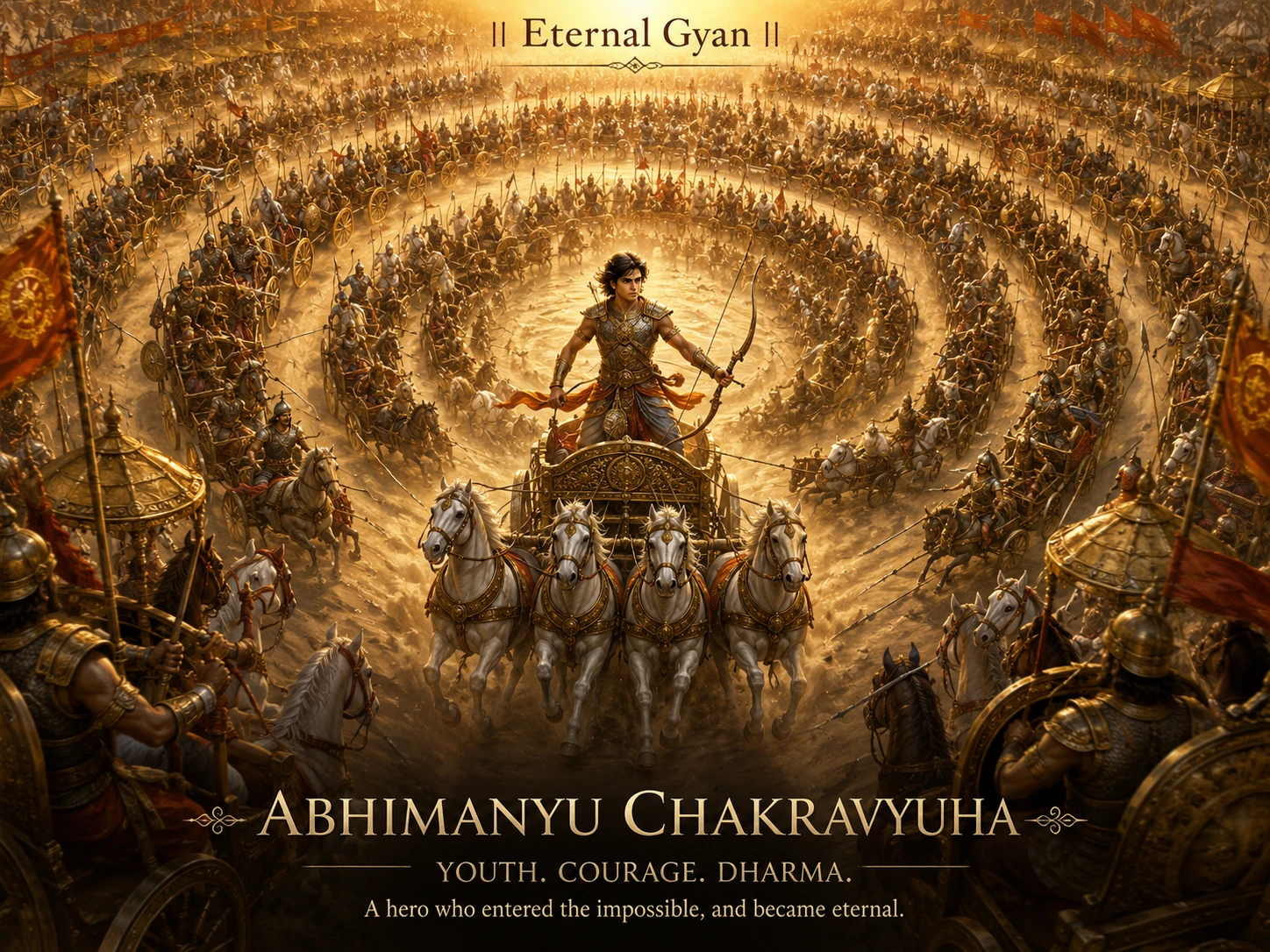
Abhimanyu and the Chakravyuha -- The Boy Who Knew How to Enter but Not How to Leave
14 min read
Adbhuta Ramayana -- The Ramayana Where Sita Becomes Kali
9 min read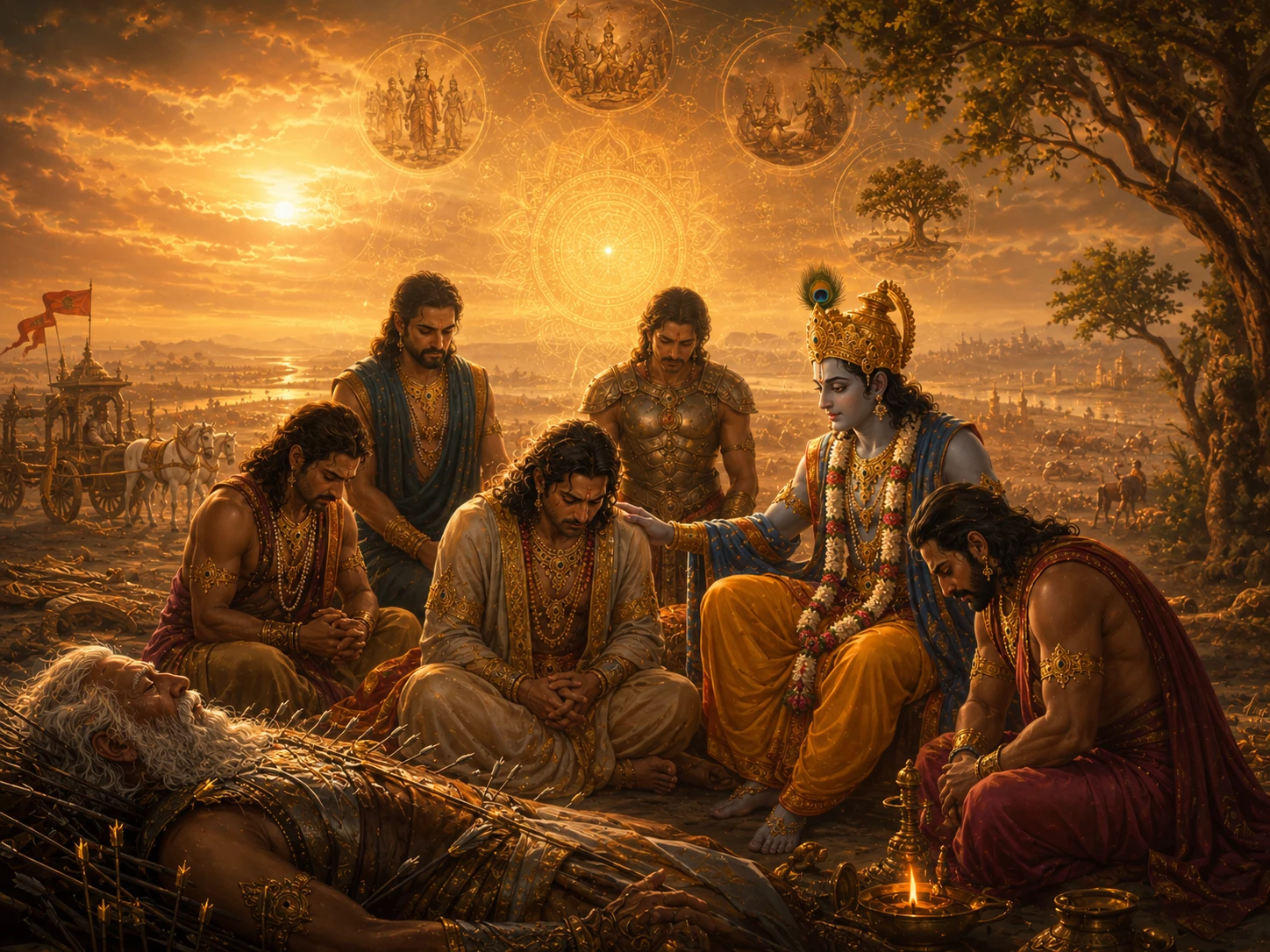
After Kurukshetra -- What Happened Next
14 min readThe same translation error that turned '33 Koti' into '33 crore' in Hinduism also happened in Buddhism. The Chinese translation of Buddhist texts rendered 'Sapta Koti Buddha' (7 Supreme Buddhas) as '7 Crore Buddhas.' The…
Deities AvatarsCommunity Reflections
🕉️
Be the first to share your reflection.