
Markandeya Purana -- The Text Behind the Devi Mahatmya, and Everything Else It Contains
मार्कण्डेय पुराण -- देवी माहात्म्य के पीछे का ग्रन्थ, और वह सब जो इसमें और भी है
The Markandeya Purana is one of the eighteen Maha Puranas (great Puranas) of Hindu tradition, and it opens with an admission of trouble, not a hymn of praise. The sage Jaimini, a disciple of Vyasa who helped compile the Mahabharata, cannot stop turning over four questions that the great epic left hanging: why did Vishnu, formless and beyond material qualities, take a human body and suffer human troubles as Krishna? Why did Draupadi become the shared wife of all five Pandavas? Why did Balarama, an expansion of the divine, go on pilgrimage to atone for killing a brahmin, as if a god could commit a sin? And why were Draupadi's five sons -- warriors in their own right -- slaughtered in their sleep after Kurukshetra's war had already ended, as though no protection remained for them?
Jaimini takes these questions to the sage Markandeya, expecting an answer. Markandeya cannot give one directly -- the text is not always explicit about why, treating it as a given constraint of his situation -- and instead redirects Jaimini to four wise birds who live on Mount Vindhya. These are no ordinary birds: they are the sons of the sage-couple Drona and the apsara Vapu, cursed by the notoriously short-tempered sage Durvasas to take bird form. It is these cursed, articulate birds who spend chapters 10 through 44 answering Jaimini's four questions in turn, treating each one as a real theological problem rather than a rhetorical opening for more myth.
This is an unusual way for a Purana to begin. Most of the eighteen Maha Puranas frame their content through Suta, a bard reciting to sages gathered at Naimisharanya forest. The Markandeya Purana breaks that convention almost entirely, routing its opening books through Jaimini, then Markandeya, then the birds -- a layered chain of narrators that signals, from the first page, a text more interested in working through hard questions than in settling into a single comfortable voice.
After the birds close the frame story around chapter 44, the Markandeya Purana shifts register entirely. Chapters 45 through 81 turn to cosmology on a vast scale: the fourteen Manvantaras, the great cosmic eras each presided over by a Manu (progenitor of humanity), interwoven with genealogical material tracing royal and divine lineages, geographical description, and an extended glorification of Surya, the sun god, whose worship and solar dynasty (Suryavansha) this site covers elsewhere in more depth. This section reads less like narrative and more like a structured reference work -- the Purana doing the encyclopedic job that its name (purana, 'ancient lore') implies: organising cosmic time, genealogy, and geography into a single frame before the text's most famous section arrives.
That famous section sits at chapters 81 through 93 (the exact chapter boundary varies slightly by manuscript and print edition): the Devi Mahatmya, also called the Durga Saptashati or Chandi Path, the 700-verse text that gave Shakta theology its founding scripture and Navaratri its liturgical core. Eternal Raga covers the Devi Mahatmya's three charitas, its psychological framing, and its Navaratri and Durga Puja significance in full elsewhere on this site, and there is no reason to retell that ground here. What matters for understanding the Markandeya Purana as a whole is the fact of placement: a Purana that opens with hard questions about divine paradox and continues through cosmology and genealogy houses, almost as an interior text within a text, the single most influential piece of Goddess-centred scripture in the Hindu canon.
The Purana does not end with the Devi Mahatmya. Chapters 93 through 136 return to the dialogue frame, now between Markandeya and a sage named Kraushtuki, and the material shifts register once more, toward dharma and ethical instruction delivered through story. The best-known episode here is the trial of King Harishchandra: the sage Vishvamitra tests Harishchandra's commitment to truth and dharma by stripping him, step by step, of his kingdom, his wealth, his wife, and finally his son, until the king is reduced to working as a servant at a cremation ground under a chandala (a keeper of the burning ground) -- and still will not break his word. It is one of the starkest meditations on satya (truthfulness) as an absolute value anywhere in Puranic literature, closer in tone to a moral parable than a mythological adventure.
Elsewhere in this closing section, a mother named Madalasa instructs her son Alarka in rajadharma, the duties and ethical constraints of kingship, and in the wider structure of varna and ashrama dharma, the social and life-stage duties that organise classical Hindu ethical thought. Taken together, this final third of the Purana reads less like myth and more like dharma-shastra delivered in narrative form -- confirmation that a Maha Purana was never meant to be only a story collection. It was meant to be a working reference for cosmology, genealogy, ritual, and ethics all at once, and the Markandeya Purana, questions-first frame and all, executes that brief unusually deliberately.
Markandeya Purana -- Layers of a Composite Text
| Section | Chapters (approx.) | Content | Dating note |
|---|---|---|---|
| Frame story | 1-9 | Jaimini's four questions; Markandeya redirects him to the four wise birds | Belongs to the earlier compositional core |
| The birds' answers | 10-44 | The birds resolve Jaimini's questions about Krishna, Draupadi, Balarama, and Draupadi's sons | Same early core |
| Manvantaras and Surya | 45-81 | Cosmic time-cycles, genealogy, geography, and glorification of the sun god | Composite; likely assembled across a wide span |
| Devi Mahatmya | 81/82-92/93 | The three-charita battle narrative that became Shaktism's founding scripture | Widely dated later than the surrounding text, c. 550 CE per Wendy Doniger, versus c. 250 CE for the earlier core |
| Markandeya-Kraushtuki dialogue | 93-136 | Dharma-shastra material in narrative form, including the Harishchandra episode and Madalasa's teaching to Alarka | Uncertain relative dating; likely a later addition layered onto the frame |
Chapter numbering varies slightly across manuscripts and print editions; the boundaries above follow the most commonly cited scheme.
Markandeya, the sage who narrates this entire Purana, is himself one of the Chiranjeevis -- the small group of beings in Hindu tradition believed to remain alive across all four yugas, never dying a natural death. His own story, told across several Puranas, has him surviving an attempt by Yama, the god of death, to claim him as a child, by clinging to a Shiva Linga in unbroken devotion until Shiva himself intervened. A text narrated by an immortal sage, opening with unresolved questions about death, mortality, and apparent injustice in the Mahabharata, carries a certain structural irony: the narrator is the one figure in the frame who has already stepped outside the ordinary cycle the questions are asking about.
The honest picture of this text's history is a composite one, and it should stay that way rather than resolving into a single confident date. Wendy Doniger's widely cited estimate places the core of the Markandeya Purana around 250 CE, with the Devi Mahatmya section understood as a later insertion, closer to 550 CE -- roughly three centuries later, and by a different hand or hands than whoever assembled the surrounding frame. This is not a controversial claim within Puranic scholarship; it is close to the working consensus, because the internal evidence (style, vocabulary, and theological register) shifts noticeably between the Devi Mahatmya and the material around it.
Manuscript evidence supports treating the Devi Mahatmya portion as reasonably old in its own right, even if the surrounding Purana is composite: the Dadhimati Mata inscription, dated to 608 CE, quotes directly from what is now chapter 10 of the Markandeya Purana (part of the Devi Mahatmya), confirming that at least this section existed in recognisable form by the early 7th century. The oldest known complete manuscript of the full Purana, a palm-leaf text discovered in Nepal, is dated to 998 CE -- a gap of several centuries between the text's likely composition and its earliest surviving complete copy, which is normal for Puranic literature but worth stating plainly. Medieval textual tradition claims the Markandeya Purana runs to 9,000 verses; the manuscripts that actually survive total closer to 6,900. None of these facts diminish the text. They describe, accurately, what a living, orally-transmitted, centuries-in-the-making scripture actually looks like once scholars go looking for its edges.
Tags
Eternal Raga · शाश्वत राग
Institutional voice — scholarly articles on Sanatan Dharma
Deepen Your Understanding
अपनी समझ और गहरी करें
scriptural exegesis
Devi Mahatmya -- The Three Charitas That Changed How India Worships the Feminine
700 verses. 13 chapters. Three battles. One thesis: when every god in the universe has failed, a woman finishes the job. The Devi Mahatmya from the Markandeya Purana is not just a scripture -- it is the founding document of Shakta theology and the reason 300 million people celebrate Navaratri.
scriptural exegesis
Madhu and Kaitabha -- The Demons Born from Vishnu's Ear Wax
Before the universe existed, Vishnu slept on the cosmic ocean. From the wax of his ears, two demons were born. They stole the Vedas, tried to kill Brahma, and fought Vishnu for five thousand years -- until the Goddess herself intervened. The Madhu-Kaitabha myth is the first episode of the Devi Mahatmya and the reason Vishnu is called Madhusudana.
scriptural exegesis
Shastra Vriksha -- The Complete Map of Hindu Scriptures
Vedas, Upanishads, Puranas, Gita -- everyone has heard these names, but almost nobody knows how they connect to each other. Shastra Vriksha is the GPS of Hindu scripture -- a single interactive tree that maps every major text, from the root of the four Vedas to the 126 catalogued Gitas, and finally makes the whole system click.
scriptural exegesis
7 Chiranjeevis -- The Immortals of Hindu Tradition
Seven beings who will not die until the end of this cosmic age. One is cursed to wander in agony. One rules the underworld. One compiled every scripture you have ever read. One is the most worshipped deity in India. The Chiranjeevis are not a mythology trivia list -- they are a map of how immortality works in Hindu thought, and why it is not always a blessing.
Markandeya, the sage who narrates this entire Purana, is himself one of the Chiranjeevis -- the small group of beings in Hindu tradition believed to remain alive across all four yugas, never dying a natural death. His ow…
More in Scriptural Exegesis
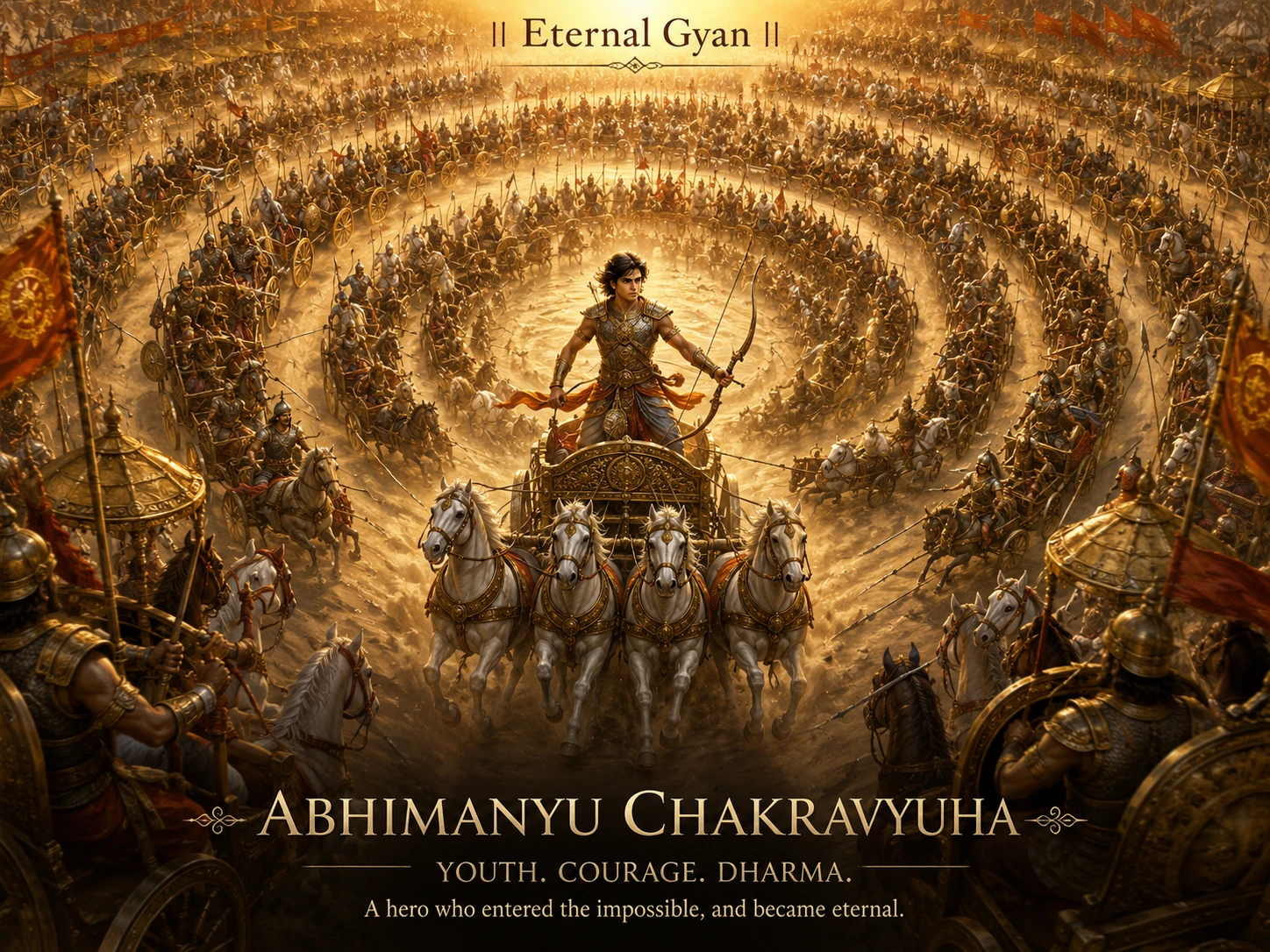
Abhimanyu and the Chakravyuha -- The Boy Who Knew How to Enter but Not How to Leave
14 min read
Adbhuta Ramayana -- The Ramayana Where Sita Becomes Kali
9 min read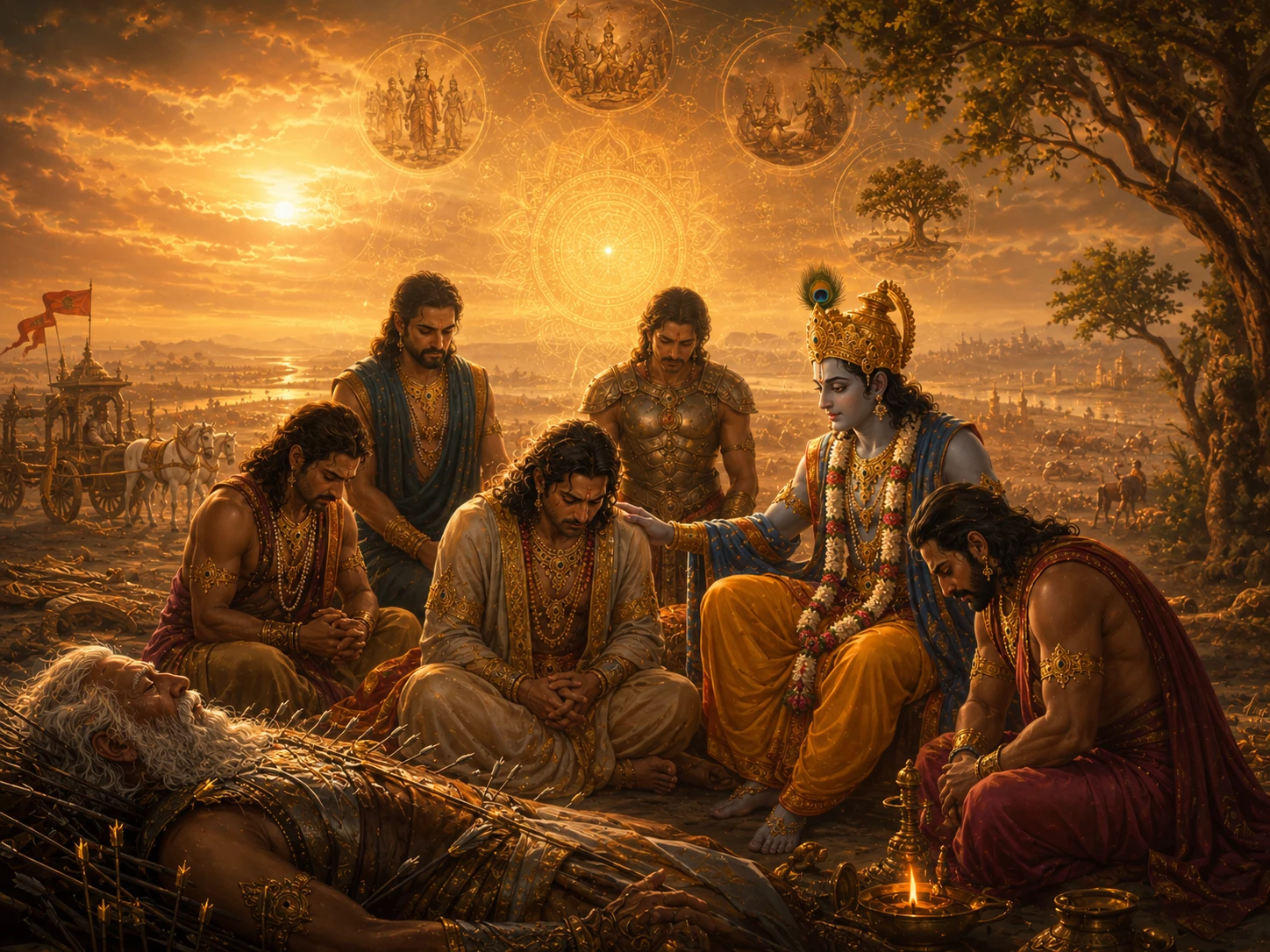
After Kurukshetra -- What Happened Next
14 min readThe same translation error that turned '33 Koti' into '33 crore' in Hinduism also happened in Buddhism. The Chinese translation of Buddhist texts rendered 'Sapta Koti Buddha' (7 Supreme Buddhas) as '7 Crore Buddhas.' The…
Deities AvatarsCommunity Reflections
🕉️
Be the first to share your reflection.