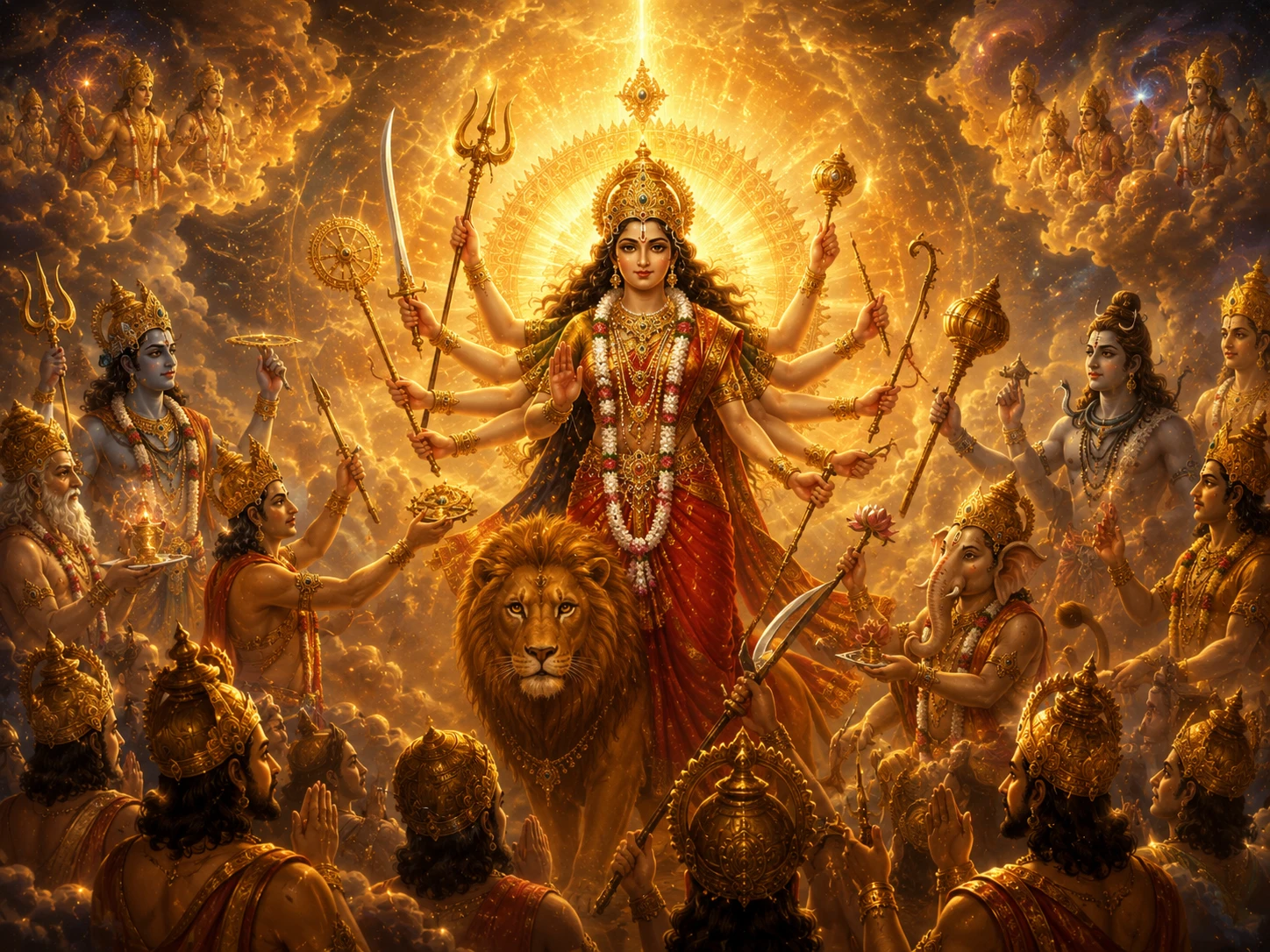
Madhu and Kaitabha -- The Demons Born from Vishnu's Ear Wax
मधु और कैटभ -- विष्णु के कर्णमल से जन्मे दैत्य
The Devi Mahatmya -- the 700-verse hymn to the Goddess embedded in the Markandeya Purana (chapters 81-93) -- opens not with a battle between good and evil but with a question about attachment. A dispossessed king named Suratha and a cheated merchant named Samadhi approach the sage Medhas in the forest. Both have been betrayed by people they trusted. Both have lost everything. And yet, both still feel attachment to those who wronged them. Why?
The sage's answer is Mahamaya -- the Great Illusion, the supreme Goddess who controls the attachments and delusions of even the wisest beings. To explain her power, he tells three stories. The first is the myth of Madhu and Kaitabha -- and it begins in the strangest possible place: the ear canal of a sleeping god.
At the end of a cosmic cycle, the universe has dissolved into a vast, dark ocean. There is no land, no sky, no stars. Vishnu lies asleep on the coils of the serpent Shesha (Ananta), immersed in Yoganidra -- a profound meditative sleep controlled by the Goddess herself. From his navel grows a lotus, and on that lotus sits Brahma, preparing to create the next universe.
But creation cannot begin. Two demons -- Madhu and Kaitabha -- have manifested from the wax inside Vishnu's ears. Madhu, born from a sweet droplet, embodies Tamas (inertia, darkness). Kaitabha, born from a hard droplet, embodies Rajas (passion, aggression). Together, they represent the two psychological forces that obstruct all creative work: lethargy and uncontrolled ambition. And their first act is to steal the Vedas from Brahma -- the knowledge necessary for creation -- and hide them in the depths of the cosmic ocean.
Brahma is helpless. Vishnu is asleep. The demons are advancing. There is no army, no weapon, no ally. What does Brahma do? He prays. Not to Vishnu -- because Vishnu cannot wake up. Vishnu is held in sleep by the Goddess. So Brahma prays to the Goddess directly. He chants the Ratri Suktam, praising her as Vishweshwari, Nidra, Svaha, Svadha, Mahavidya, Mahamaya, Kalaratri, and Ishvari -- and begs her to release Vishnu from her own spell.
This is the theological bombshell of the Devi Mahatmya's opening: the Goddess is not Vishnu's assistant. She is the power that controls Vishnu's consciousness. Without her consent, the Preserver of the universe cannot even open his eyes. She is the operating system on which even the gods run.
विष्णुः शरीरग्रहणमहमाया जगत्प्रभोः। यया निद्रां समाश्रित्य जगत्येकार्णवीकृते॥
viṣṇuḥ śarīragrahaṇam ahamāyā jagatprabhoḥ | yayā nidrāṃ samāśritya jagaty ekārṇavīkṛte ||
The Goddess Yoganidra, by whose power the Lord of the World (Vishnu) was held in sleep while the universe had become a single ocean.
— Devi Mahatmya (Durga Saptashati), Chapter 1, Markandeya Purana 81
The Five-Thousand-Year Battle and the Trick
Pleased by Brahma's prayer, the Goddess withdrew from Vishnu's body -- emerging from his eyes, nose, arms, heart, and chest. Vishnu awoke. He saw the two demons menacing Brahma and engaged them in combat.
What followed was not a quick victory. Vishnu fought Madhu and Kaitabha for five thousand divine years. The battle raged across the cosmic ocean. This is significant -- these were no ordinary asuras. They had performed tapasya on the Vagbija mantra and received a boon from the Goddess herself: they could die only with their own consent. They were, by the Goddess's own grant, nearly invincible.
How do you kill someone who can only die if they agree to die? Vishnu used Maya -- the Goddess's own tool. After five thousand years of inconclusive combat, Vishnu praised the demons' valour so lavishly that their egos swelled. Intoxicated by flattery, Madhu and Kaitabha made a fatal error: they offered Vishnu a boon. 'Ask anything of us, O Vishnu.'
Vishnu asked: 'Grant me the boon of slaying you.'
Trapped by their own words, the demons tried to impose an impossible condition: 'Kill us where there is no water.' Since the entire universe was flooded, they believed this made their death impossible. But Vishnu expanded his thighs above the water surface -- creating dry land on his own body -- and placed Madhu and Kaitabha upon them. Then he severed their heads with his Sudarshana Chakra.
The fat and marrow from the demons' bodies spread across the cosmic waters and solidified into the earth. Some Puranic traditions hold that the word 'Medini' (earth) derives from the fat ('meda') of Madhu and Kaitabha -- making the ground we walk on literally the transformed remains of primordial ignorance and passion.
Vishnu received the epithet 'Madhusudana' -- the slayer of Madhu -- which remains one of his most frequently invoked names. And the Devi Mahatmya's first lesson was established: even Vishnu, the Preserver, cannot act without Shakti. The Goddess is not a supporting character in this story. She is the author.
Madhu vs Kaitabha -- The Twin Demons Decoded
| Aspect | Madhu | Kaitabha |
|---|---|---|
| Meaning of Name | Honey; sweetness | Insect; the one who stings |
| Born From | Sweet droplet of Vishnu's ear wax | Hard droplet of Vishnu's ear wax |
| Guna Embodied | Tamas (inertia, darkness, lethargy) | Rajas (passion, aggression, restlessness) |
| Psychological Parallel | Procrastination; comfort-zone addiction; Netflix-binge paralysis | Hustle culture; burnout; manic ambition without direction |
| Combined Effect | Steals knowledge (Vedas) and paralyses creative action | Attacks the creator (Brahma) before creation can begin |
| How Defeated | Tricked by ego-flattery into consenting to their own death | Vishnu created 'dry land' on his own thighs -- the impossible condition made possible |
| Legacy | Vishnu called 'Madhusudana' (Madhu's slayer) | Earth (Medini) formed from their body-fat |
Madhu and Kaitabha are not external enemies. They are internal states -- lethargy and manic ambition -- that every creative person battles before any meaningful work can begin.
The Devi Mahatmya (Durga Saptashati / Chandi Path) is recited in its entirety during Navratri in millions of Hindu households. It has three episodes, each featuring a different form of the Goddess defeating a different class of demon: Mahakali defeats Madhu-Kaitabha (tamas), Mahalakshmi defeats Mahishasura (rajas), and Mahasaraswati defeats Shumbha-Nishumbha (ahamkara/ego). The three episodes map to the three gunas and the three stages of spiritual progress: first overcome laziness, then overcome uncontrolled desire, then overcome ego. The structure is not accidental -- it is a graduated syllabus for inner transformation.
Read the Madhu-Kaitabha Chapter of the Devi Mahatmya
The Madhu-Kaitabha story is the opening chapter of the Durga Saptashati. It is on Eternal Raga as chapter 81 of the Markandeya Purana, with Sanskrit and translation; read it aloud, and continue through the chapters that follow.
Tags
Eternal Raga · शाश्वत राग
Institutional voice — scholarly articles on Sanatan Dharma
Deepen Your Understanding
अपनी समझ और गहरी करें
scriptural exegesis
Samudra Manthan -- When Gods and Demons Ran a Joint Venture and the Universe Almost Died
A cosmic ocean. A mountain for a churning rod. A serpent king for a rope. Gods on one end, demons on the other. And out came 14 treasures -- including wealth, beauty, medicine, immortality, and one poison so lethal it could end creation itself. The Samudra Manthan is not mythology. It is the original playbook for collaboration, crisis management, and how to handle it when your joint venture partner tries to cheat you.
deities avatars
Devi Swaroopa -- Forms of the Goddess
She is Durga on the battlefield and Annapurna in the kitchen. She is Kali at the cremation ground and Lakshmi in the boardroom. She is Saraswati at the university and Parvati in the family. The Hindu Goddess is not one deity with accessories -- she is the entire spectrum of feminine power, from terrifying to tender, from cosmic to domestic. Understanding her forms is understanding the universe itself.
scriptural exegesis
Devi Mahatmya -- The Three Charitas That Changed How India Worships the Feminine
700 verses. 13 chapters. Three battles. One thesis: when every god in the universe has failed, a woman finishes the job. The Devi Mahatmya from the Markandeya Purana is not just a scripture -- it is the founding document of Shakta theology and the reason 300 million people celebrate Navaratri.
deities avatars
Dashavatara -- Why Vishnu Comes Back Ten Times
Fish, tortoise, boar, half-lion, dwarf, axe-warrior, prince, cowherd, enlightened teacher, future horseman. The ten avatars of Vishnu are not random folklore. Read them in sequence and you get something startling -- a narrative that mirrors evolutionary biology, tracks the rise and fall of political systems, and argues that God does not sit above history but enters it, gets dirty, and does the work. The Dashavatara is Hinduism's answer to the question every civilisation asks: why does the world keep breaking, and who fixes it?
deities avatars
Rahu and Ketu -- How a Demon Lost His Body and Became the Enemy of Sun and Moon
During the distribution of the nectar of immortality, one demon disguised himself as a god and drank. Vishnu's Sudarshana Chakra severed his head -- but the amrit had already passed his throat. The head became Rahu. The body became Ketu. And their eternal grudge against the Sun and Moon who exposed them is why eclipses happen. At least, that is what the Puranas say.
deities avatars
Chandra Dev and His 27 Wives -- Why the Moon Waxes and Wanes
Chandra married all 27 daughters of Daksha -- one for each nakshatra in the zodiac. He was supposed to love them equally. He did not. His obsessive favouritism toward Rohini left the other 26 wives neglected. Their father cursed him to waste away and die. And that is why the moon shrinks for fifteen days every month -- and why the full moon and new moon exist at all.
The Devi Mahatmya (Durga Saptashati / Chandi Path) is recited in its entirety during Navratri in millions of Hindu households. It has three episodes, each featuring a different form of the Goddess defeating a different c…
More in Scriptural Exegesis
Abhimanyu and the Chakravyuha -- The Boy Who Knew How to Enter but Not How to Leave
14 min read
Adbhuta Ramayana -- The Ramayana Where Sita Becomes Kali
9 min read
After Kurukshetra -- What Happened Next
14 min readThe same translation error that turned '33 Koti' into '33 crore' in Hinduism also happened in Buddhism. The Chinese translation of Buddhist texts rendered 'Sapta Koti Buddha' (7 Supreme Buddhas) as '7 Crore Buddhas.' The…
Deities AvatarsCommunity Reflections
🕉️
Be the first to share your reflection.