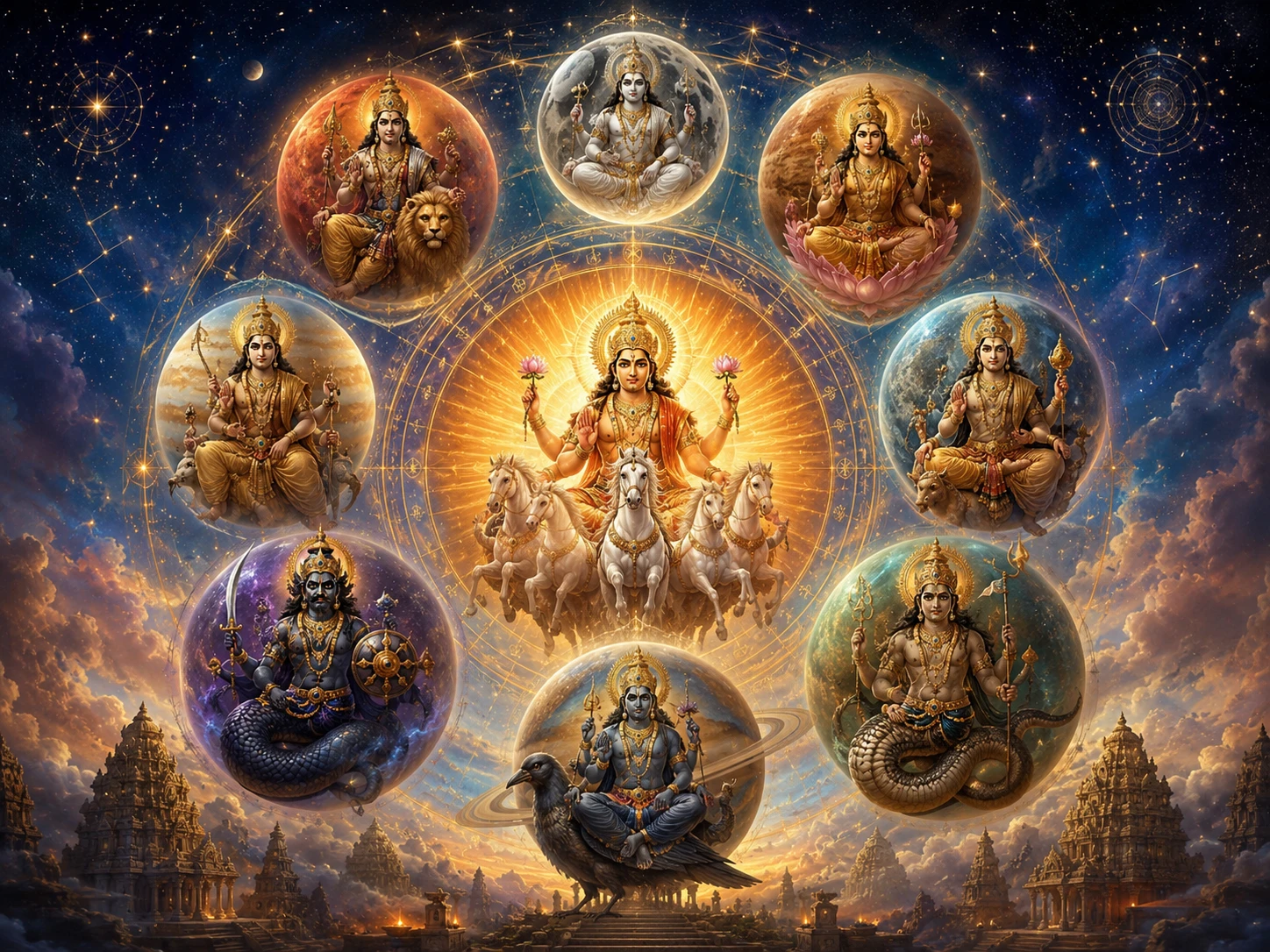
Rahu and Ketu -- How a Demon Lost His Body and Became the Enemy of Sun and Moon
राहु और केतु -- कैसे एक दैत्य ने शरीर खोया और सूर्य-चन्द्र का शत्रु बना
Every few months, somewhere on earth, the sun goes dark in the middle of the day or the moon turns blood-red at night. Modern astronomy explains eclipses with orbital mechanics -- the moon's shadow crossing the earth (solar eclipse) or the earth's shadow crossing the moon (lunar eclipse). Hindu mythology explains them with a grudge.
The story begins at the Samudra Manthan -- the Churning of the Ocean of Milk -- one of the most important episodes in Hindu cosmology. Devas and Asuras cooperated to churn the cosmic ocean using Mount Mandara as the churning rod and the serpent Vasuki as the rope. The goal: to extract Amrit, the nectar of immortality.
When the Amrit finally emerged, carried in a golden pot by Dhanvantari, the Asuras grabbed it. Chaos erupted. To restore order, Vishnu assumed his Mohini avatar -- the enchanting female form -- and offered to distribute the Amrit fairly. The Devas sat in one line, the Asuras in another. Mohini began serving the Devas first.
One Asura -- Svarbhanu -- was not fooled. He saw through the strategy. While Mohini served the Devas, Svarbhanu quietly slipped out of the Asura line, disguised himself as a Deva, and sat between Surya (the Sun) and Chandra (the Moon) in the Deva line. When Mohini reached him, she poured the Amrit into his mouth.
But Surya and Chandra recognised the imposter. They alerted Vishnu. In that instant, before the Amrit could pass below Svarbhanu's throat, Vishnu hurled his Sudarshana Chakra and severed the demon's head.
The Amrit had already touched Svarbhanu's mouth and throat. His head and body both became immortal -- but separated forever. The severed head, still alive and raging, became Rahu. The headless torso, writhing in darkness, became Ketu. And their eternal vendetta was set: Rahu would forever chase and swallow the Sun, Ketu would forever chase and swallow the Moon -- the two beings who had betrayed them. Each time they catch their target, an eclipse occurs. But because Rahu has no body and Ketu has no head, the swallowed celestial body passes right through -- and the eclipse ends.
This is the Puranic explanation for eclipses. It appears in the Vishnu Purana, Bhagavata Purana (Skandha 8), Matsya Purana, and Mahabharata (Adi Parva).
राहुर्ग्रसत्यर्कमथेन्दुमेव सोमो विशुद्धस्तपसा महीयते।
rāhur grasaty arkam athendum eva somo viśuddhas tapasā mahīyate |
Rahu swallows the Sun and then the Moon; the Moon, purified, shines again through its own radiance.
— Reference from Puranic eclipse descriptions (Vishnu Purana / Bhagavata Purana tradition)
Rahu vs Ketu -- The Shadow Planets Decoded
| Aspect | Rahu (Head) | Ketu (Body) |
|---|---|---|
| Part of Svarbhanu | Severed head -- immortal, no body | Headless torso -- immortal, no head |
| Eclipse Caused | Solar eclipse (swallows Sun) | Lunar eclipse (swallows Moon) |
| Nature | Insatiable desire; ambition without roots; illusion | Detachment; spiritual liberation; past-life karma |
| Direction | North Lunar Node (ascending) | South Lunar Node (descending) |
| Jyotisha Significance | Obsession, materialism, foreign travel, sudden gains | Moksha, renunciation, spiritual insight, sudden losses |
| Associated Deity | Durga / Kali (fierce feminine) | Ganesha / Chitragupta (karmic record) |
| Gem | Hessonite (Gomed) | Cat's Eye (Lehsunia / Vaidurya) |
| Modern Parallel | FOMO; hustle without purpose; chasing status | Existential crisis; letting go; finding meaning after loss |
In Vedic astrology, Rahu and Ketu are not physical planets -- they are the mathematical points where the Moon's orbit intersects the ecliptic plane. Modern astronomy calls them the Ascending and Descending Lunar Nodes, and they do determine when eclipses occur.
The mathematical concept behind Rahu and Ketu -- the lunar nodes where the Moon's orbital plane crosses the ecliptic -- was known to Indian astronomers by the time of the Surya Siddhanta (roughly 4th-5th century CE). Aryabhata (476 CE) explicitly described eclipses as caused by the shadow of the Earth and Moon, not by a demon swallowing celestial bodies. Yet the Rahu-Ketu mythology persisted alongside the scientific explanation -- not because Indians were unscientific, but because the myth served a different function: it explained why eclipses feel ominous, not just how they work. Science answers 'what'; myth answers 'what does it mean'.
Recite the Navagraha Stotram
During eclipses or difficult Rahu and Ketu periods, recite the Navagraha Stotram, which gives one verse to each of the nine planets, including the two shadow planets. It is on Eternal Raga with its meaning.
Tags
Eternal Raga · शाश्वत राग
Institutional voice — scholarly articles on Sanatan Dharma
Deepen Your Understanding
अपनी समझ और गहरी करें
scriptural exegesis
Samudra Manthan -- When Gods and Demons Ran a Joint Venture and the Universe Almost Died
A cosmic ocean. A mountain for a churning rod. A serpent king for a rope. Gods on one end, demons on the other. And out came 14 treasures -- including wealth, beauty, medicine, immortality, and one poison so lethal it could end creation itself. The Samudra Manthan is not mythology. It is the original playbook for collaboration, crisis management, and how to handle it when your joint venture partner tries to cheat you.
deities avatars
Chandra Dev and His 27 Wives -- Why the Moon Waxes and Wanes
Chandra married all 27 daughters of Daksha -- one for each nakshatra in the zodiac. He was supposed to love them equally. He did not. His obsessive favouritism toward Rohini left the other 26 wives neglected. Their father cursed him to waste away and die. And that is why the moon shrinks for fifteen days every month -- and why the full moon and new moon exist at all.
deities avatars
Surya's Family -- How One God Fathered Yama, Shani, the Ashwini Kumaras, and All of Humanity
Surya had two wives: Sanjana, who could not bear his radiance, and Chhaya, the shadow she left behind. From Sanjana came Yama (death), Yamuna (the river), Manu (humanity's ancestor), and the Ashwini Kumaras (divine physicians). From Chhaya came Shani (Saturn, karma's enforcer), Tapati (the river), and Savarni Manu (the next cosmic era's ruler). Same father. Two mothers. Ten children. And the entire human race.
deities avatars
Dashavatara -- Why Vishnu Comes Back Ten Times
Fish, tortoise, boar, half-lion, dwarf, axe-warrior, prince, cowherd, enlightened teacher, future horseman. The ten avatars of Vishnu are not random folklore. Read them in sequence and you get something startling -- a narrative that mirrors evolutionary biology, tracks the rise and fall of political systems, and argues that God does not sit above history but enters it, gets dirty, and does the work. The Dashavatara is Hinduism's answer to the question every civilisation asks: why does the world keep breaking, and who fixes it?
scriptural exegesis
Mohini and Shiva -- Why the Bhagavatam Tells This Story
Social media loves verse 8.12.32 -- Shiva loses control chasing Mohini. It never shows verse 8.12.36 -- where Shiva recovers instantly and is not at all surprised. It never shows 8.12.37 -- where Vishnu is very pleased to see Shiva unagitated and unashamed. And it never shows 8.12.38 -- where Vishnu Himself declares that Shiva is 'established in his position' despite everything. This is not a story about Shiva's weakness. It is the Bhagavatam's most powerful teaching on Maya, surrender, and why even the greatest ascetic needs divine grace.
vedic sciences
Kaal Ganana -- The Hindu Measure of Time
From a single blink of the eye (Nimesha) to one Day of Brahma (4.32 billion years) -- explore the complete cosmic time hierarchy of Hindu cosmology, anchored in Vishnu Purana 1.3, with its remarkable parallels to modern science.
The mathematical concept behind Rahu and Ketu -- the lunar nodes where the Moon's orbital plane crosses the ecliptic -- was known to Indian astronomers by the time of the Surya Siddhanta (roughly 4th-5th century CE). Ary…
More in Deities & Avatars
33 Koti Devata -- Why Hinduism Has 33 Types of Gods, Not 33 Crore
13 min read
Agni -- The Fire God
19 min read
Annapurna -- Goddess of Food
19 min readThe same translation error that turned '33 Koti' into '33 crore' in Hinduism also happened in Buddhism. The Chinese translation of Buddhist texts rendered 'Sapta Koti Buddha' (7 Supreme Buddhas) as '7 Crore Buddhas.' The…
Deities AvatarsCommunity Reflections
🕉️
Be the first to share your reflection.