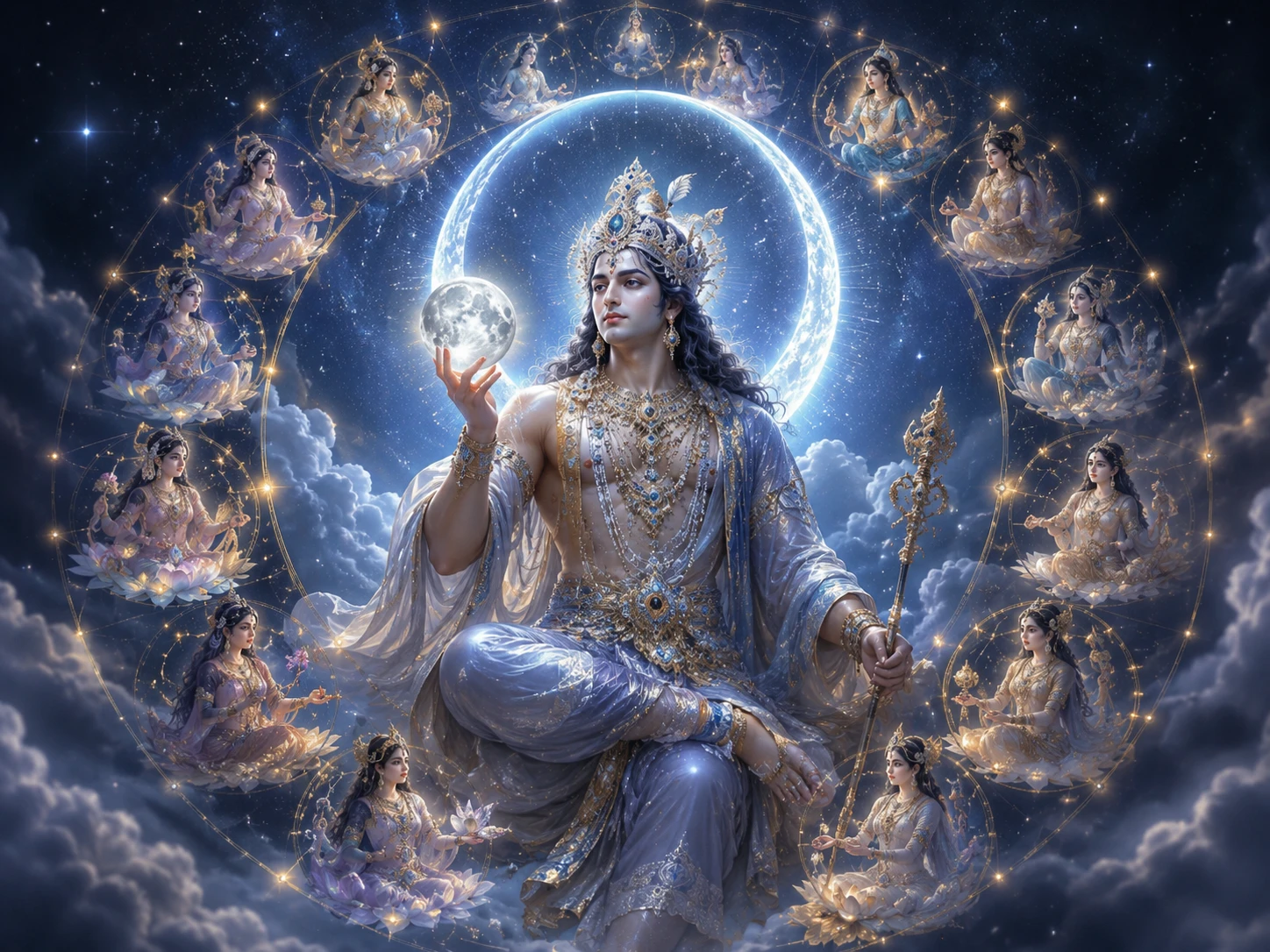
Chandra Dev and His 27 Wives -- Why the Moon Waxes and Wanes
चन्द्र देव और उनकी 27 पत्नियाँ -- चाँद क्यों घटता-बढ़ता है
Look at the night sky tonight. If the moon is a thin crescent, growing fatter each night, you are watching Shukla Paksha -- the bright fortnight. If it is shrinking, you are watching Krishna Paksha -- the dark fortnight. By Amavasya (new moon), the moon disappears entirely. By Purnima (full moon), it is whole again. This cycle repeats every 29.5 days, has done so for billions of years, and is the foundation of the Hindu lunar calendar, the timing of every fast, festival, and muhurta.
Modern astronomy explains the lunar phases as the changing angle between the Sun, Earth, and Moon. Hindu mythology explains them with a marriage gone wrong, a father's curse, and a partial reprieve from Shiva.
Chandra -- also called Soma -- is the Moon god. He is described in the Puranas as devastatingly handsome, fair-skinned, adorned with lotuses, riding a chariot drawn by ten white horses (or an antelope in some traditions). He is the son of the sage Atri and his wife Anasuya, born from Atri's eyes during intense tapasya. In some traditions, Chandra emerged from the Samudra Manthan and was claimed by Shiva, who placed him on his head -- which is why Shiva is called Chandrashekhar (the one who wears the Moon).
Daksha, the Prajapati, had 27 daughters who personified the 27 Nakshatras -- the lunar mansions through which the Moon travels during its monthly orbit. Their names are the nakshatra names themselves: Ashvini, Bharani, Krittika, Rohini, Mrigashira, Ardra, Punarvasu, Pushya, Ashlesha, Magha, Purva Phalguni, Uttara Phalguni, Hasta, Chitra, Svati, Vishakha, Anuradha, Jyeshtha, Mula, Purva Ashadha, Uttara Ashadha, Shravana, Dhanishtha, Shatabhisha, Purva Bhadrapada, Uttara Bhadrapada, and Revati.
Daksha married all 27 to Chandra. The deal was simple and explicit: Chandra must spend equal time with each wife -- one night per nakshatra, completing the cycle every 27 days. This was not a romantic arrangement. It was an astronomical contract. The Moon's passage through each nakshatra was to be honoured by equal attention to each wife.
Chandra agreed. And then promptly broke every promise.
क्षयं प्रयास्यसि त्वं हि क्षीणः क्षीणतरो भव। न ते कश्चिद्भविष्यन्ति पुत्रा वंशकराः क्वचित्॥
kṣayaṃ prayāsyasi tvaṃ hi kṣīṇaḥ kṣīṇataro bhava | na te kaścid bhaviṣyanti putrā vaṃśakarāḥ kvacit ||
You shall waste away with a consuming disease, becoming weaker and weaker. No son shall be born to continue your lineage.
— Daksha's curse to Chandra, Vishnu Purana / Matsya Purana tradition
The Favouritism, the Curse, and the Reprieve
Chandra fell completely and hopelessly in love with Rohini -- the fourth nakshatra, associated with beauty, fertility, and the colour red. She is the brightest star in the constellation Taurus (Aldebaran, Alpha Tauri). In mythological terms, she was the most beautiful of the 27 sisters.
Chandra began spending all his time with Rohini and neglecting the other 26 wives. They waited for their nights. He did not come. He did not send word. He simply stayed with Rohini -- mesmerised, intoxicated, oblivious to his contractual obligations.
The 26 neglected wives went to their father Daksha and complained. Daksha summoned Chandra and warned him: honour the agreement, spend time with all wives equally, or face consequences. Chandra promised to reform. He went back to Rohini.
Daksha warned him again. Chandra promised again. He went back to Rohini again. Some versions say this cycle of warning and relapse happened three times. Others say seven. The number does not matter. The pattern does: Chandra could not -- or would not -- control his obsession.
Finally, Daksha cursed him. The curse was devastating: Chandra would be afflicted with Kshaya Roga -- a wasting disease (consumption/tuberculosis in the Puranic metaphor). He would lose his lustre, shrink day by day, and eventually disappear. No son would be born to continue his lineage.
The curse took immediate effect. Chandra began to fade. His light dimmed. His body shrank. The cosmos was thrown into darkness -- because without moonlight, the herbs that fed on lunar energy began to die, the tides failed, and the rhythms of the natural world collapsed.
The Devas, alarmed, intervened. They appealed to Daksha to modify the curse. Daksha, a Prajapati who understood cosmic balance, agreed to a compromise: the curse could not be removed, but it could be made cyclical. Chandra would wane for fifteen days (Krishna Paksha, the dark fortnight) -- reaching his lowest point at Amavasya (new moon). Then he would wax for fifteen days (Shukla Paksha, the bright fortnight) -- returning to full strength at Purnima (full moon). The cycle would repeat forever.
To heal from the worst of the curse, Chandra was told to worship Shiva. He established a Shiva Linga at Somnath in present-day Gujarat -- 'Soma' (Moon) + 'Nath' (Lord) = the Lord of the Moon. The first of the twelve Jyotirlingas, Somnath is, by this tradition, the place where the Moon went to pray for his life. Shiva placed Chandra on his own head -- absorbing the curse into himself, sharing the Moon's burden. This is why Shiva wears the crescent moon in his matted hair.
The Tara Scandal
Chandra's troubles did not end with Daksha's curse. He later abducted Tara -- the wife of Brihaspati (Jupiter), the guru of the Devas. The affair produced a son: Budha (the planet Mercury). This scandal divided the cosmos: the Devas sided with Brihaspati, the Asuras with Chandra (because chaos benefited them), and Brahma eventually intervened to return Tara to her husband. Budha, despite his scandalous parentage, went on to marry Ila (the gender-fluid child of Manu) and founded the Chandravanshi (Lunar) dynasty -- the lineage that would produce the Pandavas and Kauravas of the Mahabharata.
So the next time you look at a crescent moon and feel a pang of melancholy, you are looking at a god who loved too much, too unevenly, and paid for it with his own body. The moon's waning is not an astronomical event in the Hindu imagination. It is a love story that went wrong, a father's anger, and a cosmic compromise that turned a curse into the calendar.
Lunar Phases -- The Astronomical and Mythological Map
| Phase | Sanskrit | Astronomical Cause | Mythological Cause | Significance |
|---|---|---|---|---|
| New Moon | अमावस्या (Amavasya) | Moon between Sun and Earth; dark side faces us | Chandra at his weakest -- Daksha's curse at full effect | Pitru Tarpan; Shani worship; considered inauspicious for new beginnings |
| Waxing Crescent to Half | शुक्ल पक्ष 1-8 (Pratipada to Ashtami) | Increasing sunlit area visible | Chandra recovering from the curse; gaining strength | Auspicious for starting projects; Ekadashi fasting |
| Full Moon | पूर्णिमा (Purnima) | Earth between Sun and Moon; full face illuminated | Chandra at full health -- curse temporarily neutralised by Shiva's grace | Satyanarayan Puja; Guru Purnima; Sharad Purnima; harvest festivals |
| Waning Gibbous to Half | कृष्ण पक्ष 1-8 | Decreasing sunlit area visible | Chandra's disease returning; light fading | Pradosh Vrat; Shiva worship intensifies |
| Waning Crescent | कृष्ण पक्ष 9-14 | Thin crescent before disappearance | Chandra near death; only Shiva's protection keeps him alive | Maha Shivaratri (Chaturdashi); deepest spiritual practice night |
The Hindu calendar's dependence on lunar phases means every festival is astronomically timed. Maha Shivaratri falls on the darkest night because that is when Chandra most needs Shiva -- and when humans most need meditation.
The Somnath Temple in Gujarat -- one of the twelve Jyotirlingas and one of the most historically significant temples in India -- was built, according to tradition, by Chandra Dev himself to worship Shiva and recover from Daksha's curse. The temple has been destroyed and rebuilt at least six times over a thousand years -- by Mahmud of Ghazni (1026 CE), Alauddin Khalji's generals (1296 CE), and others. Each time, it was reconstructed by devotees. The current temple, inaugurated by Sardar Vallabhbhai Patel in 1951 (one of independent India's first major reconstruction projects), stands as a symbol of resilience. Chandra's curse was cyclical -- and so, it seems, is Somnath's.
Chant Som Mantra on Purnima
The full moon is Chandra at his brightest. On the next Purnima night, chant Om Somaya Namah 108 times on a mala, or recite the Chandra Stotram, which is on Eternal Raga with its meaning.
Tags
Eternal Raga · शाश्वत राग
Institutional voice — scholarly articles on Sanatan Dharma
Deepen Your Understanding
अपनी समझ और गहरी करें
deities avatars
Rahu and Ketu -- How a Demon Lost His Body and Became the Enemy of Sun and Moon
During the distribution of the nectar of immortality, one demon disguised himself as a god and drank. Vishnu's Sudarshana Chakra severed his head -- but the amrit had already passed his throat. The head became Rahu. The body became Ketu. And their eternal grudge against the Sun and Moon who exposed them is why eclipses happen. At least, that is what the Puranas say.
deities avatars
Surya's Family -- How One God Fathered Yama, Shani, the Ashwini Kumaras, and All of Humanity
Surya had two wives: Sanjana, who could not bear his radiance, and Chhaya, the shadow she left behind. From Sanjana came Yama (death), Yamuna (the river), Manu (humanity's ancestor), and the Ashwini Kumaras (divine physicians). From Chhaya came Shani (Saturn, karma's enforcer), Tapati (the river), and Savarni Manu (the next cosmic era's ruler). Same father. Two mothers. Ten children. And the entire human race.
deities avatars
Daksha's Yagna and Sati -- Why Daksha Hated Shiva
A father so offended by his son-in-law that he held a cosmic sacrifice and invited every god in the universe -- except Shiva. A wife so devastated by the insult that she walked into the sacred fire and burned herself alive. And a husband so enraged by her death that he created a warrior from his dreadlock who destroyed the entire ceremony and beheaded the father-in-law. The Daksha Yagna is not a domestic dispute. It is the origin story of the Shakti Peethas, the theology of Shiva's rage, and the reason Parvati exists.
scriptural exegesis
Samudra Manthan -- When Gods and Demons Ran a Joint Venture and the Universe Almost Died
A cosmic ocean. A mountain for a churning rod. A serpent king for a rope. Gods on one end, demons on the other. And out came 14 treasures -- including wealth, beauty, medicine, immortality, and one poison so lethal it could end creation itself. The Samudra Manthan is not mythology. It is the original playbook for collaboration, crisis management, and how to handle it when your joint venture partner tries to cheat you.
scriptural exegesis
Chandravanshi -- The Lunar Dynasty from Moon to Mahabharata
The Solar Dynasty gave India Rama. The Lunar Dynasty gave India everything else: Krishna, the Pandavas, the Kauravas, Bharata (after whom India is named), Shakuntala (Kalidasa's masterpiece), and the Mahabharata itself. It begins with a scandal -- the Moon god Soma abducting Tara, wife of Brihaspati -- and it ends with the greatest war in mythology. One lineage. Two branches. Every epic.
vedic sciences
Kaal Ganana -- The Hindu Measure of Time
From a single blink of the eye (Nimesha) to one Day of Brahma (4.32 billion years) -- explore the complete cosmic time hierarchy of Hindu cosmology, anchored in Vishnu Purana 1.3, with its remarkable parallels to modern science.
The Somnath Temple in Gujarat -- one of the twelve Jyotirlingas and one of the most historically significant temples in India -- was built, according to tradition, by Chandra Dev himself to worship Shiva and recover from…
More in Deities & Avatars
33 Koti Devata -- Why Hinduism Has 33 Types of Gods, Not 33 Crore
13 min read
Agni -- The Fire God
19 min read
Annapurna -- Goddess of Food
19 min readThe same translation error that turned '33 Koti' into '33 crore' in Hinduism also happened in Buddhism. The Chinese translation of Buddhist texts rendered 'Sapta Koti Buddha' (7 Supreme Buddhas) as '7 Crore Buddhas.' The…
Deities AvatarsCommunity Reflections
🕉️
Be the first to share your reflection.