
The Mahabharata -- The Text Behind the World's Longest Epic
महाभारत -- विश्व के सबसे लम्बे महाकाव्य के पीछे का ग्रन्थ
Most people who say they have read the Mahabharata mean they have read a retelling: the Pandavas and Kauravas, the dice game, the war at Kurukshetra, the Bhagavad Gita. Very few have opened the text as a text and asked the more basic questions a book invites. How is this book actually organised? Who is supposed to have composed it? And through how many mouths does its story pass before it reaches a reader at all? This article stays with those three questions. It does not retell the dice game, which Eternal Raga covers scene by scene elsewhere on this site, and it does not reopen the historicity debate, which has its own dedicated article here. What follows instead is the architecture: the eighteen parvas that divide the text, the scale that makes it the longest epic poem to survive from the ancient world, the authorship tradition set against what textual scholarship actually finds, and the layered frame narrative through which the story reaches every reader, then and now.
The tradition has a name for the epic's size: Shatasahasri Samhita, the hundred-thousand-verse collection, built from shlokas, the standard couplet of classical Sanskrit narrative verse. A hundred thousand shlokas is the figure the text itself claims and the figure repeated across the Puranas that describe it. Rendered in a unit modern readers can picture, that comes to close to 1.8 million words, a length commonly compared to roughly ten times the combined length of Homer's Iliad and Odyssey, though the precise multiple shifts depending on which edition of the Greek epics is doing the counting. However the comparison is run, the result does not change: the Mahabharata is the longest single epic poem to survive from the ancient world, by a margin wide enough that the claim rarely needs softening.
What does need softening is the exact verse count in what can actually be checked against surviving manuscripts. The Pune Critical Edition, compiled at the Bhandarkar Oriental Research Institute (BORI) between 1919 and 1966 by comparing more than 1,250 manuscripts gathered from across the subcontinent, arrived at a constituted text of a little under 75,000 verses, commonly cited as 73,784; adding the appended Harivamsha brings the total closer to 80,000. The gap between that figure and the traditional 100,000 is not a scandal, and it is not evidence that the tradition exaggerated. It is what a text copied by hand across two millennia and dozens of regional lineages should look like: a stable narrative core, surrounded by a wide penumbra of passages that some manuscript families kept and others dropped, which the Critical Edition's editors recorded in a textual apparatus rather than silently including or silently erasing.
Hindu tradition names a single author: Krishna Dvaipayana Vyasa, also called Veda Vyasa, born to the sage Parashara and the fisherwoman Satyavati on a river island, dvaipa, which gives him his name. Tradition holds that Vyasa composed the epic in its entirety and then needed a scribe fast enough to keep pace with his recitation. Ganesha volunteered, on one condition: Vyasa could not pause. Vyasa agreed, on a counter-condition of his own: Ganesha had to understand every verse before writing it down. Whenever Vyasa needed time to compose the next difficult passage, he inserted a verse dense enough to make Ganesha stop and think, buying himself room to work. In the most famous embellishment of the story, Ganesha's pen breaks partway through, and he snaps off his own tusk to keep writing rather than interrupt the recitation.
That specific embellishment is later than most readers assume. The Ganesha-as-scribe episode does not appear in the oldest manuscript layers behind the Mahabharata; it entered the tradition around the 9th or 10th century CE, present in only some manuscript families (37 of the 59 consulted for the Pune Critical Edition carry it at all), and the Critical Edition's editors placed it in a footnote within an appendix rather than in the constituted text. Even that added episode, in its earliest form, says nothing about a broken tusk; the tusk detail is a further layer added on top of an already late addition. None of this makes the story less loved. It makes it a useful small case study in how a beloved detail of who wrote the Mahabharata can itself be a later chapter in the text's own transmission history.
Set against the devotional tradition, textual scholarship treats single authorship, by Vyasa or anyone else, as the wrong kind of question to ask of a text like this. John Brockington's influential account of the Sanskrit epics argues for gradual accretion: an oral epic core, focused on conflict between the Kuru and Panchala dynasties, that grew through recognisable stages, absorbing genealogical, didactic, and devotional material as it moved from oral performance toward a fixed written form. Alf Hiltebeitel takes a more architected view, arguing that a formative version of the epic came together in a comparatively compressed window, roughly the mid-2nd century BCE to the turn of the era, shaped with enough deliberate design that he resists calling it pure accretion, even while accepting that further material was layered on afterward. The two scholars disagree sharply on how planned the process was; neither of them argues for a single sitting or a single hand across the whole text. The working range most often cited across the field for the epic reaching something close to its current form is roughly the 4th century BCE to the 4th century CE, a span of some eight hundred years, built on oral material about a Kuru-Panchala conflict that may itself reach back further still.
The Pune Critical Edition project did not attempt to settle a date of composition at all. Its editors, working under general editor V.S. Sukthankar and his successors across nearly five decades, set out to reconstruct the earliest recoverable common ancestor of the many surviving manuscript recensions, not to identify an original text by an original author. That is a meaningfully different task, and the distinction matters. Asking who wrote the Mahabharata and when turns out to be the wrong shape of question for a text transmitted this way, in the same honest sense this site uses for the Puranas elsewhere: a scripture built by many hands across many centuries is not diminished by that fact. It is simply describing what a living, orally rooted, continuously copied tradition actually looks like once scholars go looking for its edges.
The story reaches every reader through a frame nested at least three levels deep, and the Mahabharata is unusually deliberate about making that frame visible rather than hiding it. At the outermost level, a bard named Ugrashrava Sauti, son of Lomaharshana, arrives at Naimisharanya, a forest hermitage, during a pause in a twelve-year sacrifice being conducted by the sage Shaunaka. The assembled sages ask Sauti for a story, and Sauti obliges by narrating the Mahabharata, in full, exactly as he says he once heard it recited. This outer conversation, Sauti speaking to Shaunaka's sages, is the frame a reader actually enters when opening the text: everything that follows is presented as Sauti's retelling, not as an unmediated narration.
What Sauti heard, in turn, was Vaishampayana, a direct disciple of Vyasa, narrating the epic to King Janamejaya at Janamejaya's own royal sacrifice. That gives the text a second interior frame, one level further in: Vaishampayana speaking to Janamejaya, which Sauti is now repeating to Shaunaka's sages, who are in turn the reason the text exists on the page at all for anyone reading it later. Vyasa himself appears inside this structure too, not only as the epic's traditional author but as a character present at Janamejaya's sacrifice, who is said to have directed Vaishampayana to narrate the story his disciple had learned from him. The author, in other words, steps into his own frame narrative as a witness to its telling.
Janamejaya's sacrifice was not a routine ritual occasion. It was a sarpa satra, a snake sacrifice, and Janamejaya convened it out of grief and rage. His father, Parikshit, grandson of Arjuna and the king who inherited the Kuru throne after the Kurukshetra war, died of snakebite. The immediate cause, as the tradition tells it, was an insult: Parikshit, out hunting and unable to get an answer from a sage named Shamika who was absorbed in silent meditation, draped a dead snake around the sage's neck in irritation and walked away. Shamika's son, the young ascetic Shringin, learned of the insult and, in fury, cursed Parikshit to die of snakebite within seven days. The serpent king Takshaka carried out the curse.
Janamejaya, on succeeding his father, resolved to destroy the entire race of serpents in retaliation, and the sarpa satra was the mechanism: a Vedic fire ritual designed to draw every snake in existence into the sacrificial flames by the power of mantra. Thousands of snakes were destroyed before a young sage named Astika, born of a Naga mother and a Brahmin father and therefore standing between both sides of the conflict, intervened and persuaded Janamejaya to halt the sacrifice before Takshaka himself, the one who had actually killed Parikshit, could be consumed. It is in the intervals of this same sacrifice, called for revenge and interrupted by mercy, that Vaishampayana narrates the Mahabharata to Janamejaya.
The connection between the frame and the framed story is closer than it first appears, because the Adi Parva, the very first book of the Mahabharata, opens by narrating the sarpa satra and the Astika episode as part of its own content, before moving on to Vyasa's birth and the genealogy of the Kuru line. The occasion of the telling and the beginning of what is told are not two separate things happening at a tidy distance from each other. They overlap: the first book a reader encounters is partly an account of the very sacrifice at which the whole epic was first recited aloud to Janamejaya. A story about a king's grief and a race nearly exterminated becomes, within a few chapters, the doorway into an eighteen-book epic about a different war and a different set of grieving survivors.
This nested structure, story inside story inside story, each with its own narrator and its own occasion, is one of the Mahabharata's most distinctive formal features, and it is easy to miss entirely when the text is encountered only through retellings that begin directly with Bhishma or Shantanu. Read as it presents itself, the epic never lets a reader forget that a story is always being told by someone, to someone, for some reason, and that the reason is itself worth listening to.
The Eighteen Parvas of the Mahabharata
| Parva (Book) | Chapters (adhyayas, traditional) | What It Contains |
|---|---|---|
| Adi Parva (आदि पर्व) -- Book of the Beginning | ~236 | The frame narrative (Sauti at Naimisharanya, Vaishampayana narrating to Janamejaya, the sarpa satra and Astika episode); Vyasa's birth; the genealogy and birth of the Kuru princes; Draupadi's swayamvar. |
| Sabha Parva (सभा पर्व) -- Book of the Assembly Hall | ~81 | The building of Indraprastha's assembly hall; Yudhishthira's Rajasuya sacrifice; the dice game and its aftermath (covered in full elsewhere on this site); the sentence of exile. |
| Vana Parva / Aranyaka Parva (वन पर्व) -- Book of the Forest | ~324 | The twelve years of forest exile: pilgrimages, the story of Nala and Damayanti, Draupadi's abduction by Jayadratha, Arjuna's penance and his acquisition of celestial weapons. |
| Virata Parva (विराट पर्व) -- Book of Virata | ~72 | The thirteenth year, spent incognito at King Virata's court; the death of Kichaka; the Kaurava cattle raid repelled. |
| Udyoga Parva (उद्योग पर्व) -- Book of the Effort | ~199 | Failed peace negotiations before the war; Krishna's embassy to Hastinapura; both sides mustering their armies; Karna learning his true parentage. |
| Bhishma Parva (भीष्म पर्व) -- Book of Bhishma | ~124 | The war's first ten days under Bhishma's command; the Bhagavad Gita, Krishna's counsel to Arjuna before the fighting begins; Bhishma's fall. |
| Drona Parva (द्रोण पर्व) -- Book of Drona | ~204 | Days eleven through fifteen under Drona's command; Abhimanyu's death inside the Chakravyuha formation; Drona's death. |
| Karna Parva (कर्ण पर्व) -- Book of Karna | ~96 | Days sixteen and seventeen under Karna's command; his duel with and death at the hands of Arjuna. |
| Shalya Parva (शल्य पर्व) -- Book of Shalya | ~65 | The eighteenth and final day of the war; Shalya's brief command and death; Duryodhana's mace duel with Bhima. |
| Sauptika Parva (सौप्तिक पर्व) -- Book of the Sleeping Warriors | ~18 | Ashwatthama's night raid on the sleeping Pandava camp; the killing of Draupadi's five sons. |
| Stri Parva (स्त्री पर्व) -- Book of the Women | ~27 | The women of both sides mourning the dead on the battlefield; Gandhari's grief and her words to Krishna. |
| Shanti Parva (शान्ति पर्व) -- Book of Peace | ~365 | The longest single parva; Bhishma, from his bed of arrows, instructs Yudhishthira at length on rajadharma, statecraft, and ethics. |
| Anushasana Parva (अनुशासन पर्व) -- Book of Instructions | ~168 | Bhishma's continued teaching on dharma, charity, and duty; recitation of the Vishnu Sahasranama; Bhishma's death, timed to his own choosing. |
| Ashvamedhika Parva (अश्वमेध पर्व) -- Book of the Horse Sacrifice | ~96 | Yudhishthira's horse sacrifice to affirm his sovereignty; the Anugita, Krishna's supplementary teaching to Arjuna. |
| Ashramavasika Parva (आश्रमवासिक पर्व) -- Book of the Hermitage | ~39 | Dhritarashtra, Gandhari, and Kunti retire to a forest hermitage; their deaths in a forest fire. |
| Mausala Parva (मौसल पर्व) -- Book of the Clubs | ~9 | The Yadava civil war at Prabhasa and the destruction of Krishna's clan; the submergence of Dwaraka. |
| Mahaprasthanika Parva (महाप्रस्थानिक पर्व) -- Book of the Great Journey | ~3 | The Pandavas' and Draupadi's final journey toward the Himalayas, and their deaths along the way. |
| Svargarohana Parva (स्वर्गारोहण पर्व) -- Book of the Ascent to Heaven | ~6 | Yudhishthira's ascent to heaven and his reunion there with kin who fought on both sides. |
Chapter (adhyaya) counts follow the commonly cited traditional reckoning and vary somewhat by manuscript recension and printed edition; the Pune Critical Edition's own adhyaya numbering differs in places from the popular Ganguli and Gita Press editions.
The Ganesha-as-scribe story, so often treated as the defining fact of the Mahabharata's authorship, is a comparatively late addition to the tradition. Textual scholars trace it to roughly the 9th or 10th century CE, present in only some manuscript families (37 of the 59 examined for the Pune Critical Edition carry any version of it), and the Critical Edition's editors relegated it to a footnote inside an appendix rather than the constituted text. The detail everyone remembers best, Ganesha snapping off his own tusk to keep writing without pausing the recitation, is not even part of that base story; it is a further embellishment layered on top of an episode that was already an addition. The epic's most famous image of its own composition turns out to be a small, well-documented example of the very process, texts accumulating detail across centuries, that this article describes for the Mahabharata as a whole.
None of this structural picture explains why the epic is still read, argued about, and adapted three thousand years after its oldest layers were first composed. Much of that answer sits inside episodes this article has deliberately left alone. The dice game in the Sabha Parva, where Yudhishthira stakes and loses his brothers, himself, and finally Draupadi while the assembled elders of Hastinapura watch and say nothing, is arguably the single hinge on which the entire plot turns. Eternal Raga covers that scene in full, verse by verse, elsewhere on this site, and there is no reason to retell it here. The same holds for the historicity question, whether the war, the dynasties, and the geography the epic names correspond to anything archaeology, astronomy, or geology can actually confirm. That question also has its own dedicated article on this site, weighing the evidence honestly in both directions rather than settling it either way.
What belongs in this article instead is the structural fact that makes the Mahabharata unlike almost anything else surviving from the ancient world: a text that narrates its own transmission as part of its own content. Every reader who opens the epic is, formally speaking, sitting where the sages at Shaunaka's sacrifice sat, listening to Sauti repeat what Vaishampayana once told Janamejaya, at a sacrifice convened because a king's father was killed by a snake and halted because a boy born of two warring worlds asked for mercy. The book does not just contain a story. It contains an account of how that story survived long enough to be told at all, layer folded inside layer, until it reaches whoever happens to be reading it next.
Tags
Eternal Raga · शाश्वत राग
Institutional voice — scholarly articles on Sanatan Dharma
Deepen Your Understanding
अपनी समझ और गहरी करें
scriptural exegesis
The Dice Game -- The Darkest Hour of the Mahabharata
A king who cannot say no to a challenge. An uncle whose dice are loaded with the bones of the dead. A court full of elders who watch injustice and say nothing. And a woman who asks one question that nobody in the room can answer: 'Did my husband lose himself first, or me?' The dice game in the Sabha Parva is not a plot device. It is the moral black hole at the centre of the Mahabharata. Everything before it is prologue. Everything after it is consequence. And the central horror is not what happens -- it is who lets it happen.
scriptural exegesis
Mahabharata -- History or Myth? What the Evidence Actually Says
Submerged cities off Gujarat. 35+ archaeological sites matching the epic's geography. 200+ astronomical events verified by planetarium software. A river that vanished exactly as the text describes. Five categories of evidence that do not 'prove' the Mahabharata -- but make dismissing it as pure fiction increasingly difficult.
scriptural exegesis
Parikshit to Janamejaya -- The Pandava Dynasty After the War and Why the Mahabharata Was Told
The child who survived a divine weapon in the womb became the king who united a shattered kingdom. His son, consumed by vengeance for his father's death by snakebite, launched a sacrifice to burn every serpent in the world -- and it was at that sacrifice that a sage named Vaishampayana narrated the entire Mahabharata for the first time. Without Parikshit's miraculous survival, there is no Pandava dynasty. Without Janamejaya's rage, there is no Mahabharata as we know it. These two generations are the reason the story exists.
scriptural exegesis
100 Kauravas -- The Forgotten Brothers of the Mahabharata
Everyone knows Duryodhana and Dushasana. But what about Vikarna, who stood up for Draupadi when no one else did? Or Yuyutsu, who defected to the Pandavas because his conscience demanded it? The Mahabharata names all 100 sons of Dhritarashtra -- warriors, strategists, and dissenters -- most of whom are killed across 18 days. Their story is not just a casualty list. It is the most devastating portrait of fratricidal war ever composed.
scriptural exegesis
Karna's Tragedy -- The Sun's Forgotten Son
Born with divine armor, abandoned at birth, raised by a charioteer, humiliated for his caste, cursed by his teacher, and killed while defenseless -- Karna's story is not the Mahabharata's subplot. It is the Mahabharata's conscience. Every system that failed him is a system that still fails people today.
scriptural exegesis
Vidura Niti -- The Wisest Counsel That the King Heard and Still Ignored
The night before the Pandavas' exile ended, when war was one decision away, a sleepless king called his wisest adviser. For eight chapters of the Udyoga Parva, Vidura -- the bastard son who could never be king, the only man in Hastinapura who always told the truth -- delivered 593 verses of raw, unfiltered counsel on leadership, ethics, self-mastery, and statecraft. Dhritarashtra listened to every word. Agreed with every point. And then did the opposite. Vidura Niti is not just political philosophy. It is the anatomy of a man who knew the right thing, had the right adviser, and chose wrong anyway.
scriptural exegesis
Shanti Parva -- What the Dying Man on the Bed of Arrows Taught a King Who Did Not Want to Rule
The war is over. A million men are dead. Yudhishthira, the victorious king, wants to renounce everything and walk into the forest. He says: 'I am a sinner. I caused this slaughter. I have no right to rule.' And then the dying Bhishma -- pierced by hundreds of arrows, lying on a bed of shafts, waiting for the winter solstice to die -- delivers the longest, most comprehensive discourse on governance, ethics, crisis management, and spiritual liberation in all of world literature. 365 chapters. 13,716 verses. Three massive sections: how to rule, how to survive crisis, and how to be free. The Shanti Parva is the Mahabharata's final exam -- and the answer key.
divine arsenal
10 Weapons That Changed the War
Across the Ramayana and Mahabharata, certain weapons did not merely kill -- they altered the course of history. From Rama shattering Shiva's bow to win Sita, to the Shakti that saved the Pandavas by killing the one person it should not have, these ten weapon-moments are the pivot points on which two epics turn.
The Ganesha-as-scribe story, so often treated as the defining fact of the Mahabharata's authorship, is a comparatively late addition to the tradition. Textual scholars trace it to roughly the 9th or 10th century CE, pres…
More in Scriptural Exegesis
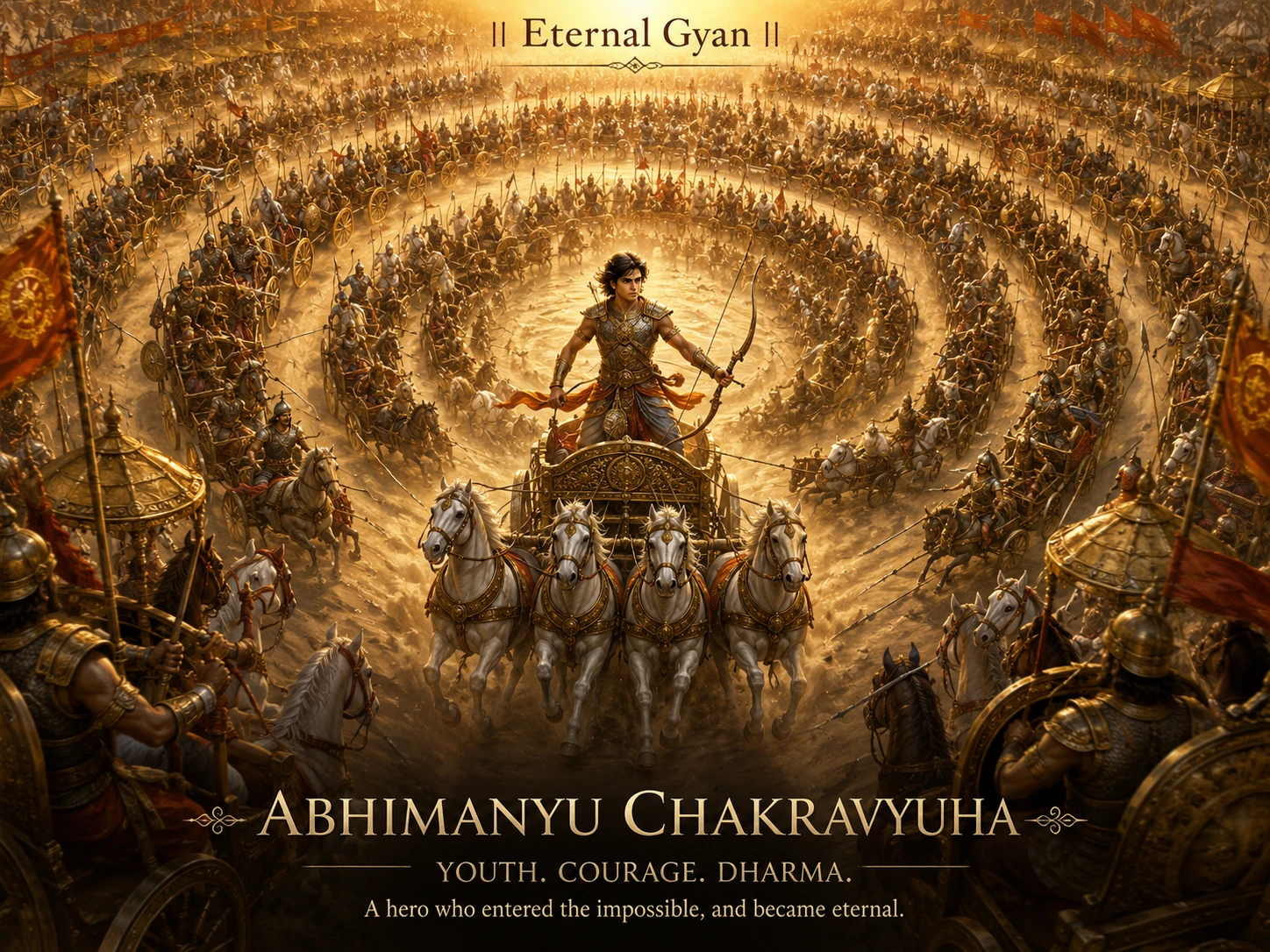
Abhimanyu and the Chakravyuha -- The Boy Who Knew How to Enter but Not How to Leave
14 min read
Adbhuta Ramayana -- The Ramayana Where Sita Becomes Kali
9 min read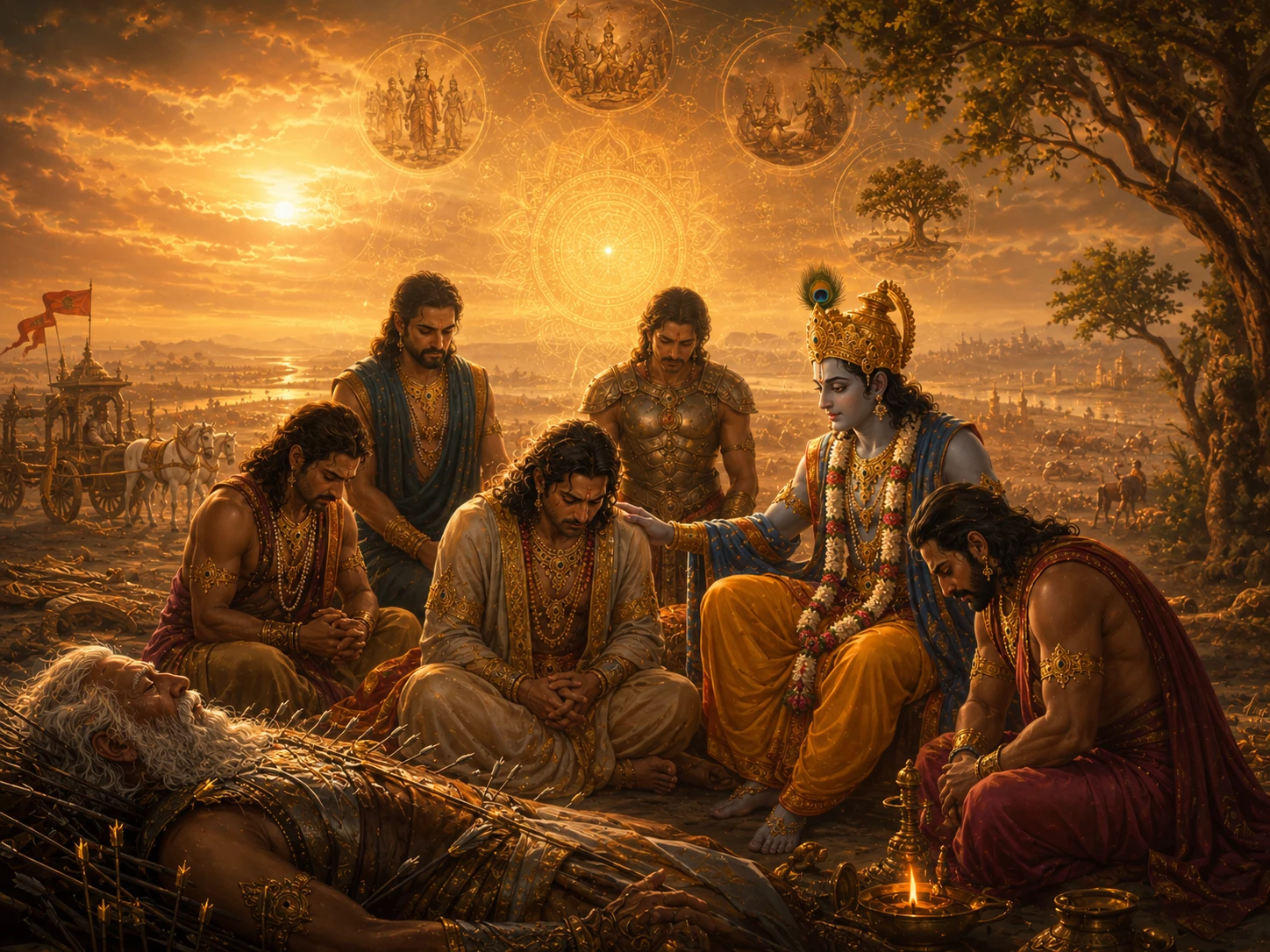
After Kurukshetra -- What Happened Next
14 min readThe same translation error that turned '33 Koti' into '33 crore' in Hinduism also happened in Buddhism. The Chinese translation of Buddhist texts rendered 'Sapta Koti Buddha' (7 Supreme Buddhas) as '7 Crore Buddhas.' The…
Deities AvatarsCommunity Reflections
🕉️
Be the first to share your reflection.